wheel LEXUS IS250 2016 Workshop Manual
[x] Cancel search | Manufacturer: LEXUS, Model Year: 2016, Model line: IS250, Model: LEXUS IS250 2016Pages: 542, PDF Size: 9.65 MB
Page 290 of 542
292
4-1. Maintenance and care
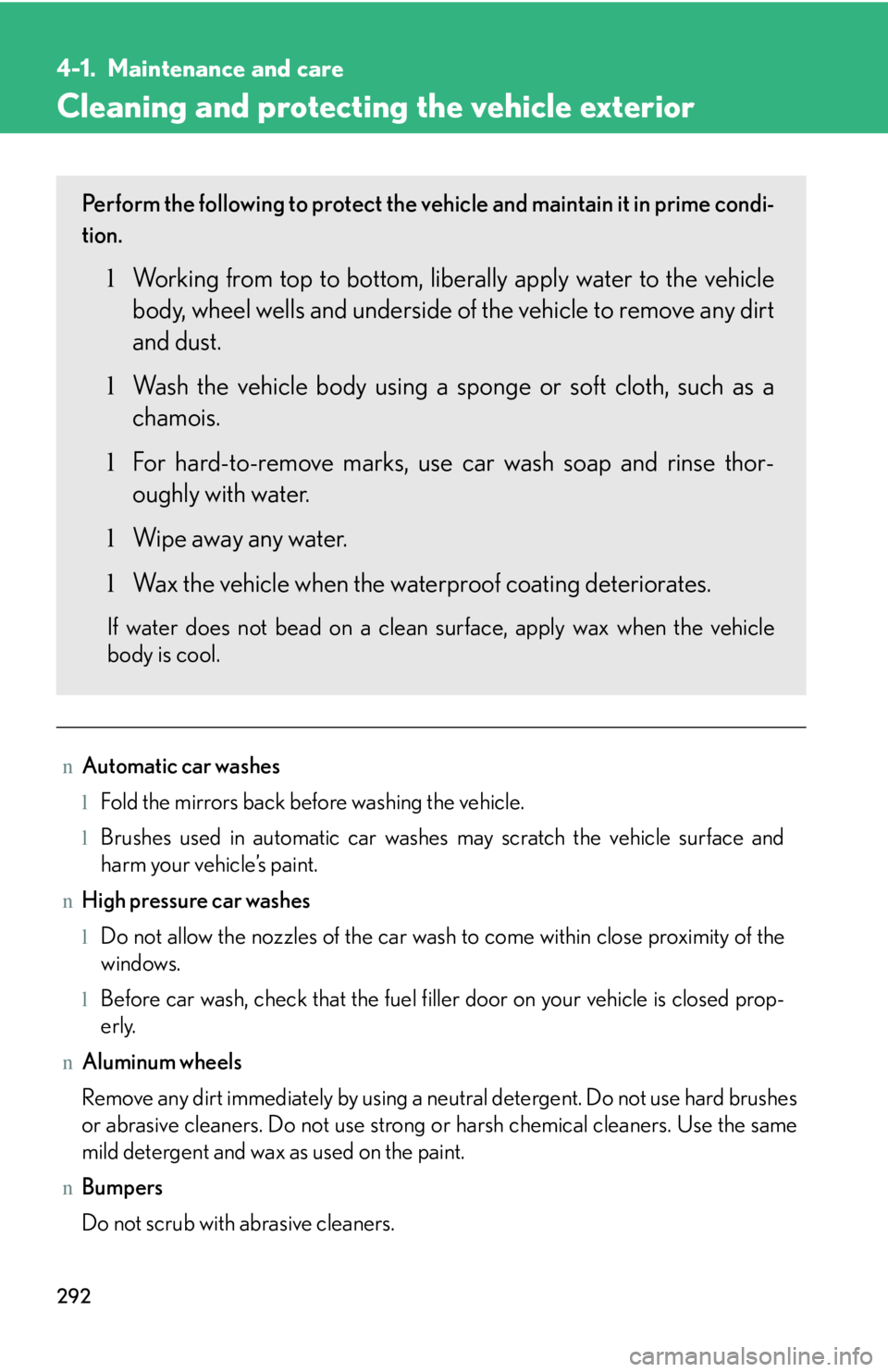
Cleaning and protecting the vehicle exterior
nAutomatic car washes
lFold the mirrors back before washing the vehicle.
lBrushes used in automatic car washes may scratch the vehicle surface and
harm your vehicle’s paint.
nHigh pressure car washes
lDo not allow the nozzles of the car wash to come within close proximity of the
windows.
lBefore car wash, check that the fuel filler door on your vehicle is closed prop-
erly.
nAluminum wheels
Remove any dirt immediately by using a neutral detergent. Do not use hard brushes
or abrasive cleaners. Do not use strong or harsh chemical cleaners. Use the same
mild detergent and wax as used on the paint.
nBumpers
Do not scrub with abrasive cleaners.
Perform the following to protect the vehicle and maintain it in prime condi-
tion.
lWorking from top to bottom, liberally apply water to the vehicle
body, wheel wells and underside of the vehicle to remove any dirt
and dust.
lWash the vehicle body using a sponge or soft cloth, such as a
chamois.
lFor hard-to-remove marks, use car wash soap and rinse thor-
oughly with water.
lWipe away any water.
lWax the vehicle when the waterproof coating deteriorates.
If water does not bead on a clean surface, apply wax when the vehicle
body is cool.
Page 300 of 542
302
4-2. Maintenance
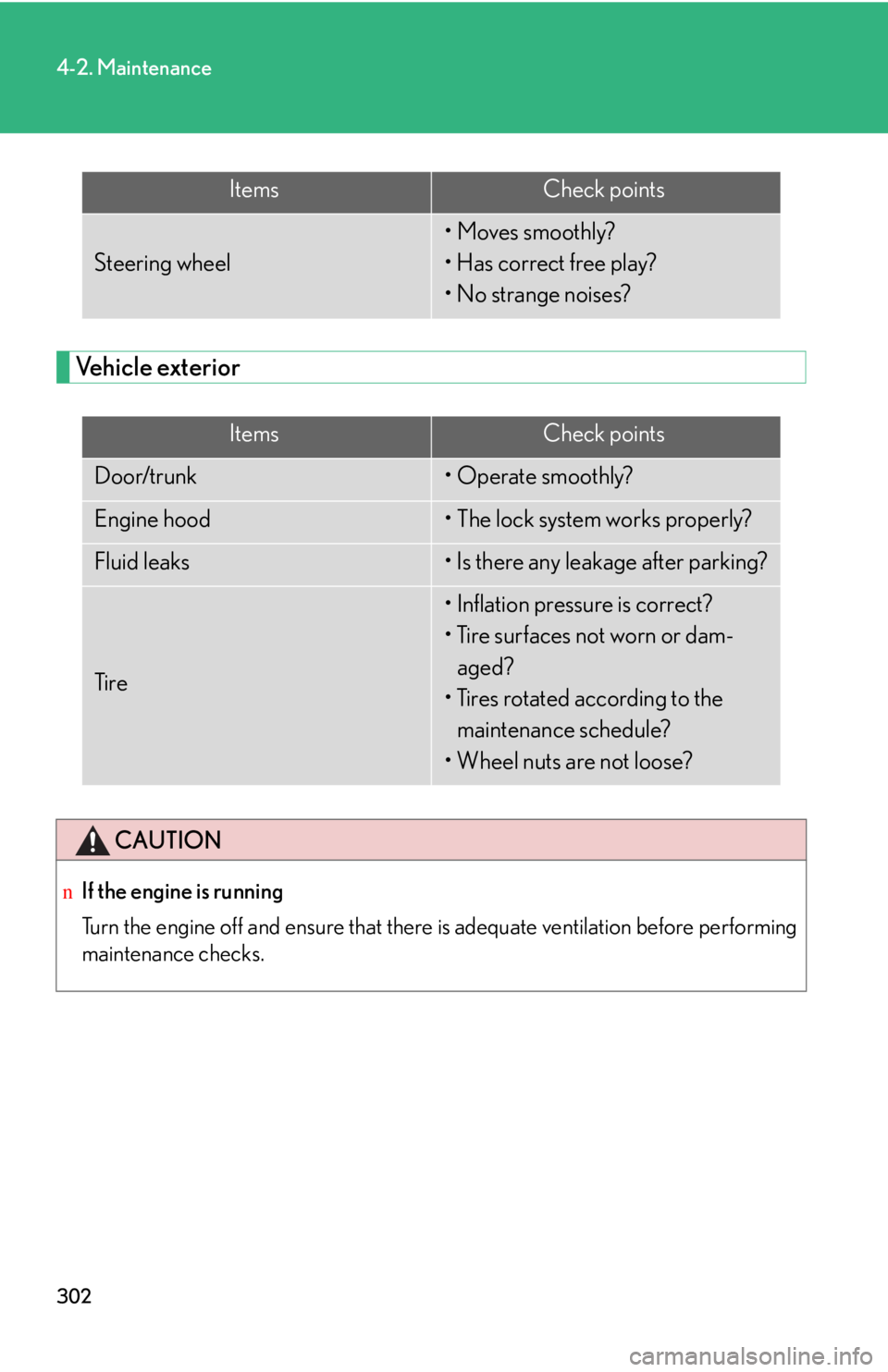
Vehicle exterior
ItemsCheck points
Steering wheel
Page 325 of 542

327
4-3. Do-it-yourself maintenance
4
Maintenance and care
Installing tire pressure warning valves and transmitters
When replacing tires or wheels, tire pressure warning valves and trans-
mitters must also be installed.
When new tire pressure warning valves and transmitters are installed,
new tire pressure warning valve and transmitter ID codes must be regis-
tered in the tire pressure warning computer and tire pressure warning
system must be initialized. Have tire pressure warning valve and transmit-
ter ID codes registered by your Lexus dealer. (→P. 329)
Initializing the tire pressure warning system
nThe tire pressure warning system must be initialized in the following
circumstances:
lWhen rotating the tires on vehicles differing with front and rear tire
inflation pressures.
lWhen changing the tire inflation pressure by changing traveling
speed.
lWhen changing the tire size.
When the tire pressure warning system is initialized, the current tire
inflation pressure is set as the pressure benchmark.
Page 329 of 542

331
4-3. Do-it-yourself maintenance
4
Maintenance and care
nWhen to replace your vehicle’s tires
Tires should be replaced if:
lYou have tire damage such as cuts, splits, cracks deep enough to expose the
fabric or bulges indicating internal damage
lA tire goes flat repeatedly or cannot be properly repaired due to the size or
location of a cut or other damage
If you are not sure, consult with your Lexus dealer.
nReplacing tires and wheels
If the ID code of the tire pressure warning valve and transmitter is not registered,
the tire pressure warning system will not work properly. After driving for about 20
minutes, the tire pressure warning light comes on after blinking for 1 minute to indi-
cate a system malfunction.
nTire life
Any tire over 6 years old must be checked by a qualified technician even if they
have seldom or never been used or damage is not obvious.
nIf the tread wears down below 0.16 in. (4 mm) on snow tires
The effectiveness of snow tires is lost.
nLow profile tires (models not equipped with 16-inch tires)
Generally, low profile tires will wear more rapidly and tire grip performance will be
reduced on snowy and/or icy roads when compared to standard tires. Be sure to
use snow tires or tire chains* on snowy and/or icy roads and drive carefully at a
speed appropriate for road and weather conditions.
*: Tire chains cannot be mounted on 18-inch tires.
nMaximum load of tire
Check that the maximum load of the replaced tire is greater than 1 /2 of the Gross
Axle Weight Ratings (GAWR) of either the front axle or the rear axle, whichever is
greater.
As for the maximum load of the tire, see the load limit at maximum cold tire inflation
pressure mentioned on the sidewall of the tire, and as for the Gross Axle Weight
Ratings (GAWR), see the Certification Label. (→P. 3 3 6 , 4 4 9 ) .
Page 330 of 542

332
4-3. Do-it-yourself maintenance
nTire types
1 Summer tires
Summer tires are high-speed performance tires best suited to highway driving
under dry conditions. Since summer tires do not have the same traction perfor-
mance as snow tires, summer tires are inadequate for driving on snow-covered
or icy roads. For driving on snow-covered roads or icy roads, the use of snow tires
is recommended. When installing snow tires, be sure to replace all four tires.
2 All season tires
All season tires are designed to provide better traction in snow and to be ade-
quate for driving in most winter conditions, as well as for use year round. All sea-
son tires, however, do not have adequate traction performance compared with
snow tires in heavy or loose snow. Also, all season tires fall short in acceleration
and handling performance compared with summer tires in highway driving.
3Snow tires
For driving on snow-covered roads or icy roads, we recommend using snow tires.
If you need snow tires, select tires of the same size, construction and load capac-
ity as the originally installed tires. Since your vehicle has radial tires as original
equipment, make sure your snow tires also have radial construction. Do not install
studded tires without first checking local regulations for possible restriction.
Snow tires should be installed on all wheels. (→P. 2 0 0 )
nInitializing the tire pressure warning system
Initialize the tires with the tire inflation pressure adjusted to the specified level.
nWhen the initialization of the tire pressure warning system has failed
Initialization can be completed in a few minutes. However, in the following cases,
the settings have not been recorded and the system will not operate properly. If
repeated attempts to record tire inflation pressure settings are unsuccessful, have
the vehicle inspected by your Lexus dealer.
lWhen operating the tire pressure warning reset switch, the tire pressure warn-
ing light does not flash 3 times and the setting message does not appear on the
multi-information display.
lAfter carrying out the initialization procedure, the tire pressure warning light
blinks for 1 minute then stays on after driving for about 20 minutes.
Page 332 of 542
334
4-3. Do-it-yourself maintenance
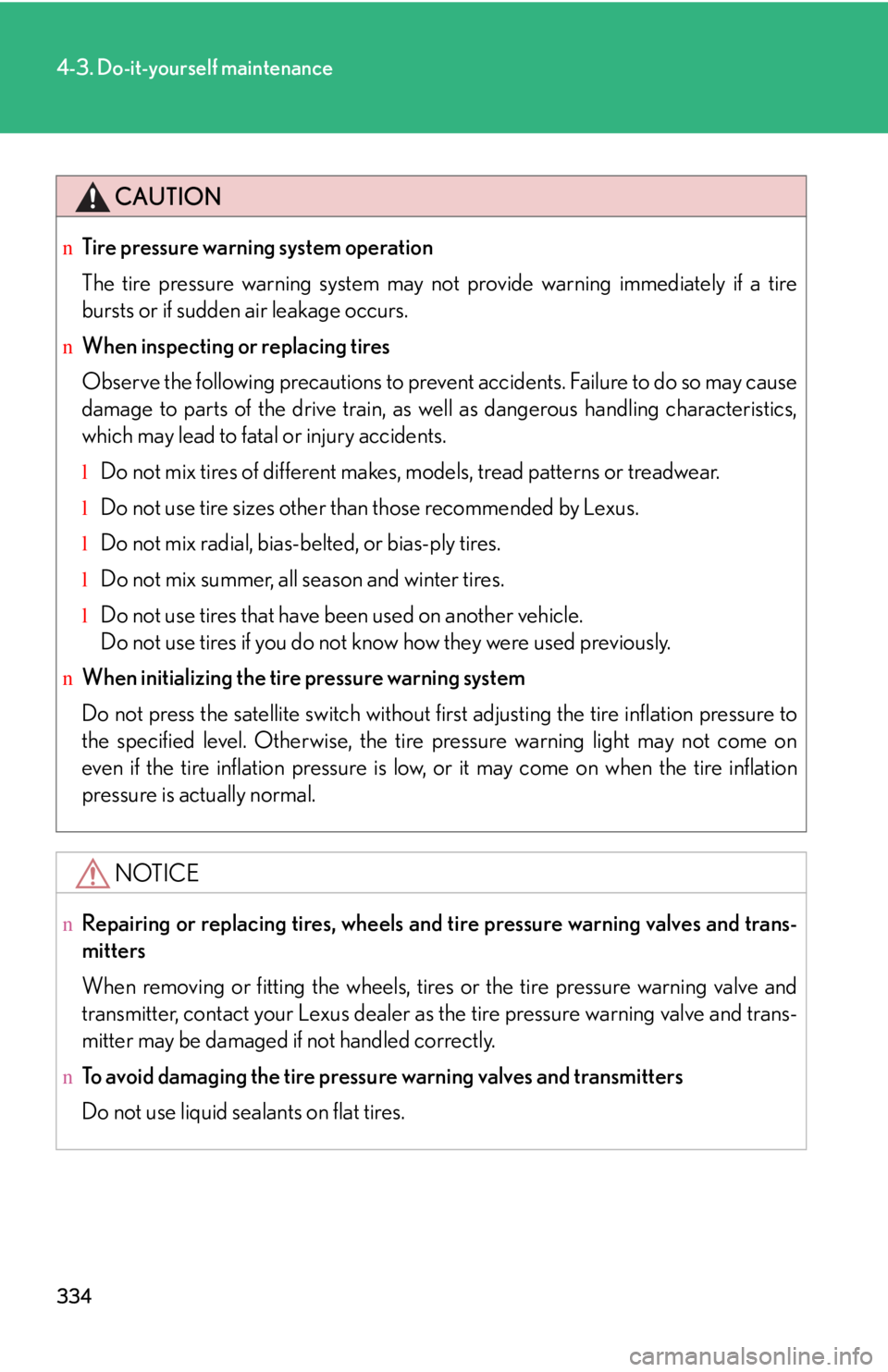
CAUTION
nTire pressure warning system operation
The tire pressure warning system may not provide warning immediately if a tire
bursts or if sudden air leakage occurs.
nWhen inspecting or replacing tires
Observe the following precautions to prevent accidents. Failure to do so may cause
damage to parts of the drive train, as well as dangerous handling characteristics,
which may lead to fatal or injury accidents.
lDo not mix tires of different makes, models, tread patterns or treadwear.
lDo not use tire sizes other than those recommended by Lexus.
lDo not mix radial, bias-belted, or bias-ply tires.
lDo not mix summer, all season and winter tires.
lDo not use tires that have been used on another vehicle.
Do not use tires if you do not know how they were used previously.
nWhen initializing the tire pressure warning system
Do not press the satellite switch without first adjusting the tire inflation pressure to
the specified level. Otherwise, the tire pressure warning light may not come on
even if the tire inflation pressure is low, or it may come on when the tire inflation
pressure is actually normal.
NOTICE
nRepairing or replacing tires, wheels and tire pressure warning valves and trans-
mitters
When removing or fitting the wheels, tires or the tire pressure warning valve and
transmitter, contact your Lexus dealer as the tire pressure warning valve and trans-
mitter may be damaged if not handled correctly.
nTo avoid damaging the tire pressure warning valves and transmitters
Do not use liquid sealants on flat tires.
Page 333 of 542

335
4-3. Do-it-yourself maintenance
4
Maintenance and care
NOTICE
nDriving on rough roads
Take particular care when driving on roads with loose surfaces or pot holes.
These conditions may cause losses in tire inflation pressure, reducing the cushion-
ing ability of the tires. In addition driving on rough roads may cause damage to the
tires themselves, as well as the vehicle’s wheels and body.
nLow profile tires and wheels
Wheels with profile tires like 17- and 18-inch tires may cause greater damage than
usual to the tire wheel when receiving impact from the road surface. Therefore pay
attention to the following:
lBe sure to use proper tire inflation pressure. If tires are under-inflated, they may
be damaged more severely.
lAvoid pot holes, uneven pavement, curbs and other road hazards.
Failure to do so can lead to severe tire and wheel damage.
nIf tire inflation pressures become low while driving
Do not continue driving, or your tires and/or wheels may be ruined.
Page 337 of 542
339
4-3. Do-it-yourself maintenance
4
Maintenance and care
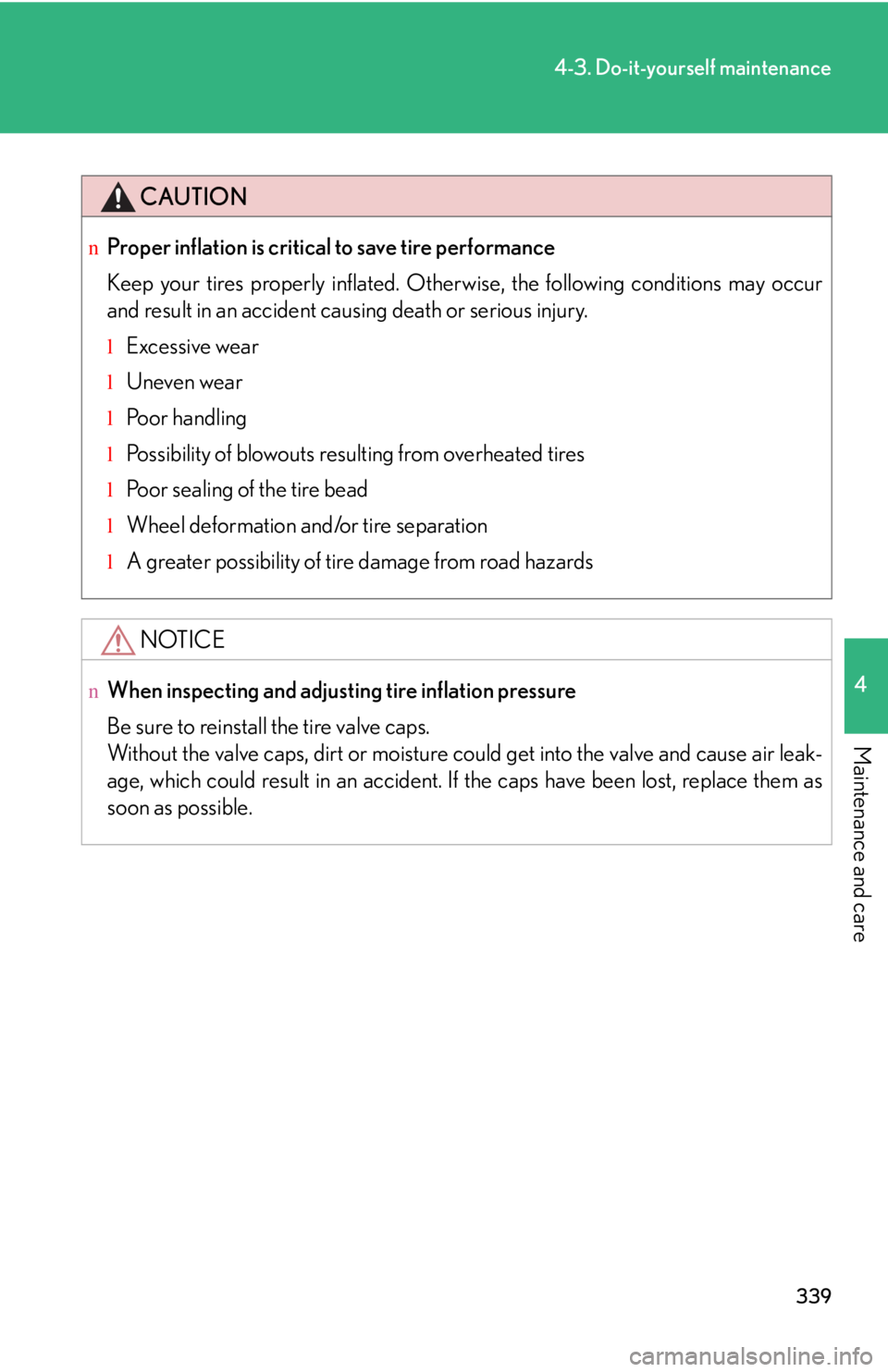
CAUTION
nProper inflation is critical to save tire performance
Keep your tires properly inflated. Otherwise, the following conditions may occur
and result in an accident causing death or serious injury.
lExcessive wear
lUneven wear
lPoor handling
lPossibility of blowouts resulting from overheated tires
lPoor sealing of the tire bead
lWheel deformation and/or tire separation
lA greater possibility of tire damage from road hazards
NOTICE
nWhen inspecting and adjusting tire inflation pressure
Be sure to reinstall the tire valve caps.
Without the valve caps, dirt or moisture could get into the valve and cause air leak-
age, which could result in an accident. If the caps have been lost, replace them as
soon as possible.
Page 338 of 542
340
4-3. Do-it-yourself maintenance
Wheels
nWhen replacing wheels
The wheels of your Lexus are equipped with tire pressure warning valves and trans-
mitters that allow the tire pressure warning system to provide advanced warning in
the event of a loss in tire inflation pressure. Whenever wheels are replaced, the tire
pressure warning valves and transmitters must be installed. (→P. 3 2 7 )
If a wheel is bent, cracked or heavily corroded, it should be replaced. Oth-
erwise, the tire may separate from the wheel or cause loss of handling con-
trol.
nWheel selection
When replacing wheels, care should be taken to ensure that they
are equivalent to those removed in load capacity, diameter, rim
width, and offset.
Replacement wheels are available at your Lexus dealer.
Lexus does not recommend using:
lWheels of different sizes or types
lUsed wheels
lBent wheels that have been straightened
nAluminum wheel precautions
lUse only Lexus wheel nuts and wrenches designed for use with
your aluminum wheels.
lWhen rotating, repairing or changing your tires, check that the
wheel nuts are still tight after driving 1000 miles (1600 km).
lBe careful not to damage the aluminum wheels when using tire
chains.
lUse only Lexus genuine balance weights or equivalent and a
plastic or rubber hammer when balancing your wheels.
Page 339 of 542

341
4-3. Do-it-yourself maintenance
4
Maintenance and care
CAUTION
nWhen replacing wheels
lDo not use wheels that are a different size from those recommended in the
Owner’s Manual, as this may result in loss of handling control.
lNever use an inner tube in a leaking wheel which is designed for a tubeless tire.
Doing so may result in an accident, causing death or serious injury.
NOTICE
nReplacing tire inflation pressure warning valves and transmitters
lBecause tire repair or replacement may affect the tire pressure warning valves
and transmitters, make sure to have tires serviced by your Lexus dealer or other
qualified service shop. In addition, make sure to purchase your tire pressure
warning valves and transmitters at your Lexus dealer.
lEnsure that only Genuine Lexus wheels are used on your vehicle.
Tire pressure warning valves and transmitters may not work properly with non-
genuine wheels.