warning LEXUS IS250 2016 Workshop Manual
[x] Cancel search | Manufacturer: LEXUS, Model Year: 2016, Model line: IS250, Model: LEXUS IS250 2016Pages: 542, PDF Size: 9.65 MB
Page 387 of 542

390
5-2. Steps to take in an emergency
CAUTION
nMaintenance of the tires
Each tire, including the spare (if provided), should be checked monthly when cold
and inflated to the inflation pressure recommended by the vehicle manufacturer on
the vehicle placard or tire inflation pressure label (tire and loading information
label). (If your vehicle has tires of a different size than the size indicated on the vehi-
cle placard or tire inflation pressure label [tire and loading information label], you
should determine the proper tire inflation pressure for those tires.)
As an added safety feature, your vehicle has been equipped with a tire pressure
monitoring system (TPMS-tire pressure warning system) that illuminates a low tire
pressure telltale (tire pressure warning light) when one or more of your tires is sig-
nificantly under-inflated. Accordingly, when the low tire pressure telltale (tire pres-
sure warning light) illuminates, you should stop and check your tires as soon as
possible, and inflate them to the proper pressure. Driving on a significantly under-
inflated tire causes the tire to overheat and can lead to tire failure. Under-inflation
also reduces fuel efficiency and tire tread life, and may affect the vehicle's handling
and stopping ability.
Please note that the TPMS (tire pressure warning system) is not a substitute for
proper tire maintenance, and it is the driver's responsibility to maintain correct tire
pressure, even if under-inflation has not reached the level to trigger illumination of
the TPMS low tire pressure telltale (tire pressure warning light).
Your vehicle has also been equipped with a TPMS (tire pressure warning system)
malfunction indicator to indicate when the system is not operating properly. The
TPMS (tire pressure warning system) malfunction indicator is combined with the
low tire pressure telltale (tire pressure warning light). When the system detects a
malfunction, the telltale will flash for approximately one minute and then remain
continuously illuminated. This sequence will continue upon subsequent vehicle
start-ups as long as the malfunction exists. When the malfunction indicator is illumi-
nated, the system may not be able to detect or signal low tire pressure as intended.
TPMS (tire pressure warning system) malfunctions may occur for a variety of rea-
sons, including the installation of replacement or alternate tires or wheels on the
vehicle that prevent the TPMS (tire pressure warning system) from functioning
properly. Always check the TPMS (tire pressure warning system) malfunction tell-
tale after replacing one or more tires or wheels on your vehicle to ensure that the
replacement or alternate tires and wheels allow the TPMS (tire pressure warning
system) to continue to function properly.
Page 389 of 542
392
5-2. Steps to take in an emergency
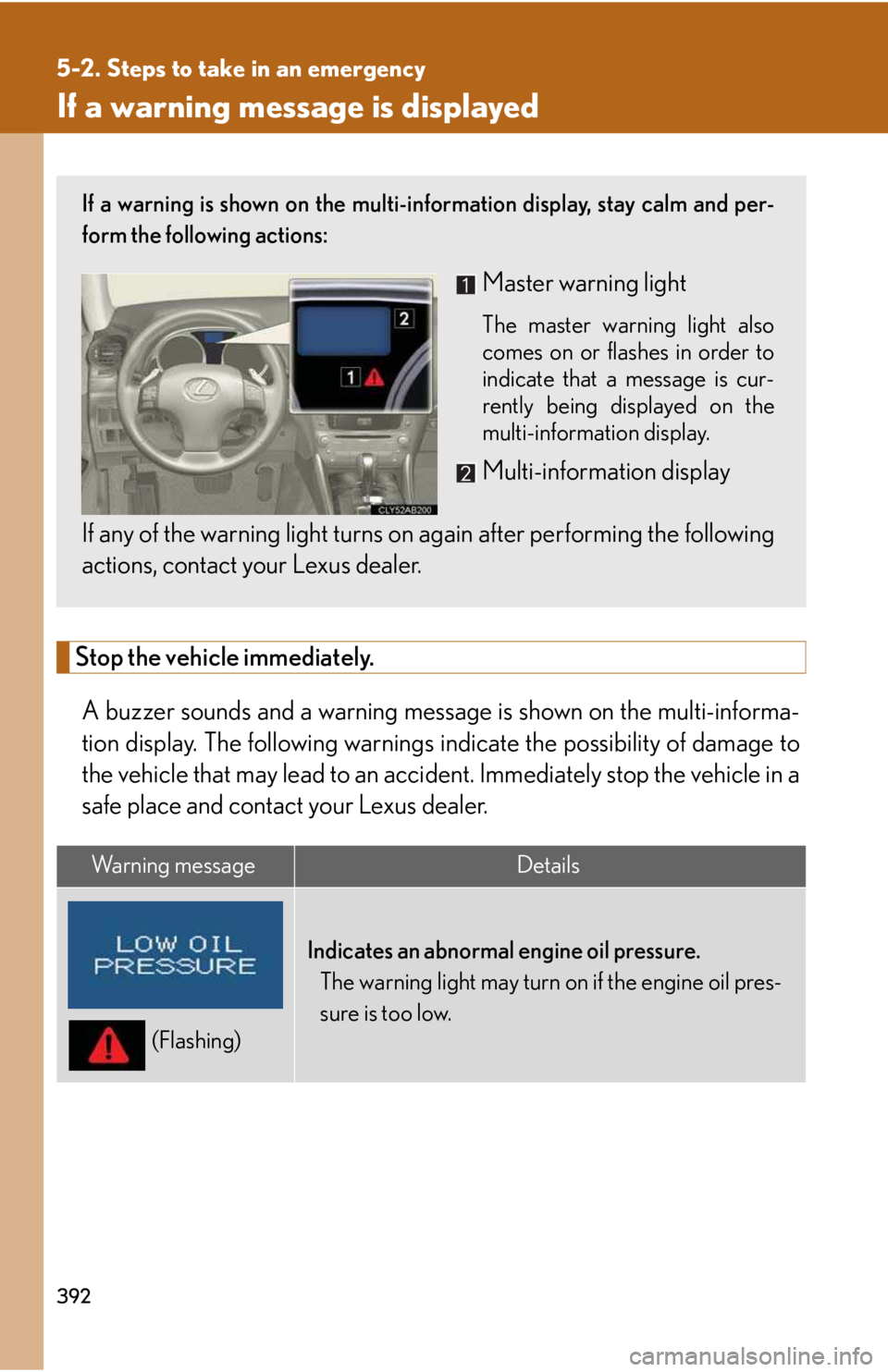
If a warning message is displayed
Stop the vehicle immediately.
A buzzer sounds and a warning message is shown on the multi-informa-
tion display. The following warnings indicate the possibility of damage to
the vehicle that may lead to an accident. Immediately stop the vehicle in a
safe place and contact your Lexus dealer.
Wa r n i n g m e s s a g eDetails
(Flashing)
Indicates an abnormal engine oil pressure.
The warning light may turn on if the engine oil pres-
sure is too low.
If a warning is shown on the multi-information display, stay calm and per-
form the following actions:
Master warning light
The master warning light also
comes on or flashes in order to
indicate that a message is cur-
rently being displayed on the
multi-information display.
Multi-information display
If any of the warning light turns on again after performing the following
actions, contact your Lexus dealer.
Page 390 of 542
5
When trouble arises
393
5-2. Steps to take in an emergency
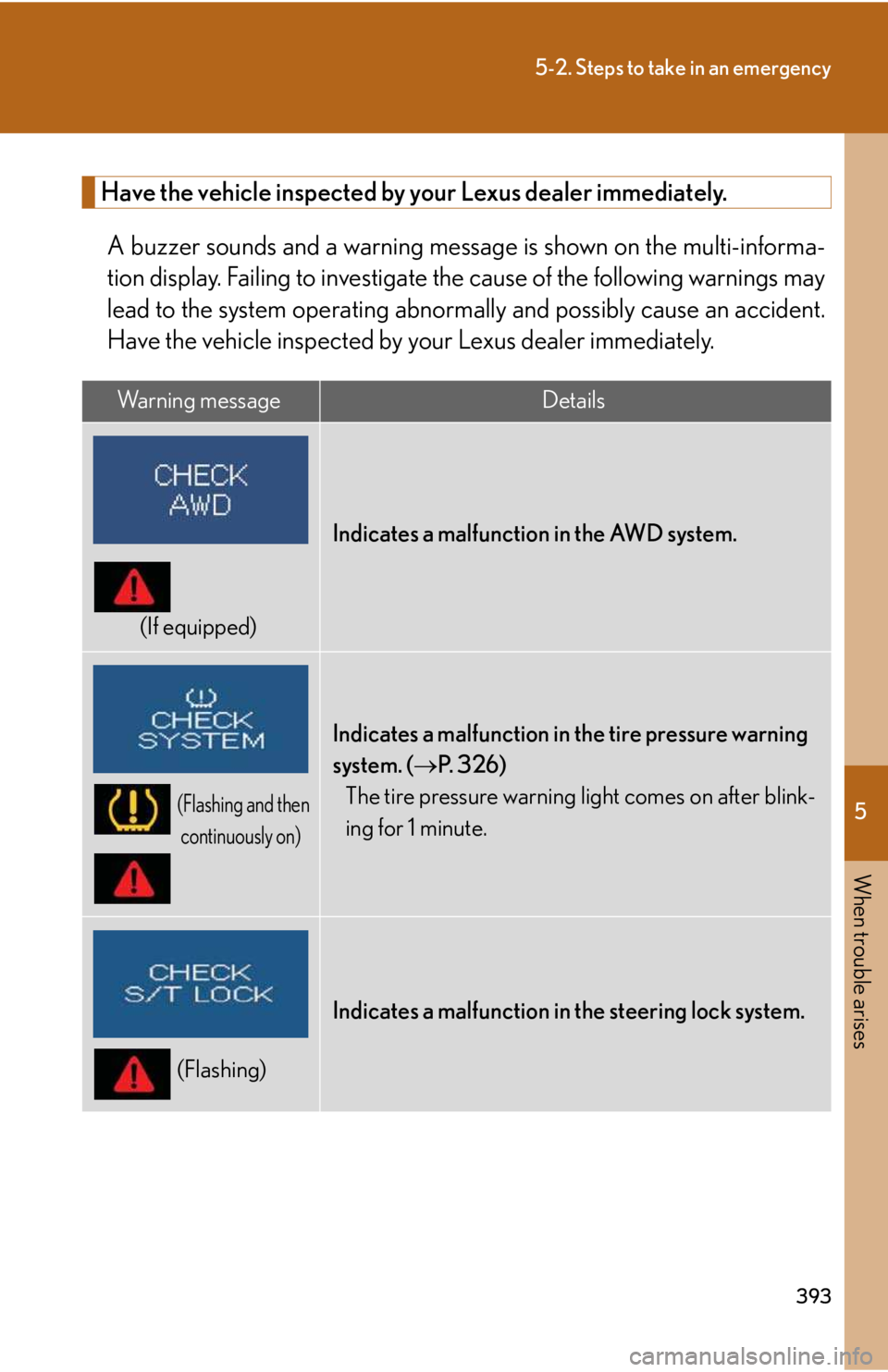
Have the vehicle inspected by your Lexus dealer immediately.
A buzzer sounds and a warning message is shown on the multi-informa-
tion display. Failing to investigate the cause of the following warnings may
lead to the system operating abnormally and possibly cause an accident.
Have the vehicle inspected by your Lexus dealer immediately.
Wa r n i n g m e s s a g eDetails
(If equipped)
Indicates a malfunction in the AWD system.
(Flashing and then
continuously on)
Indicates a malfunction in the tire pressure warning
system. (→P. 3 2 6 )
The tire pressure warning light comes on after blink-
ing for 1 minute.
(Flashing)
Indicates a malfunction in the steering lock system.
Page 392 of 542
5
When trouble arises
395
5-2. Steps to take in an emergency
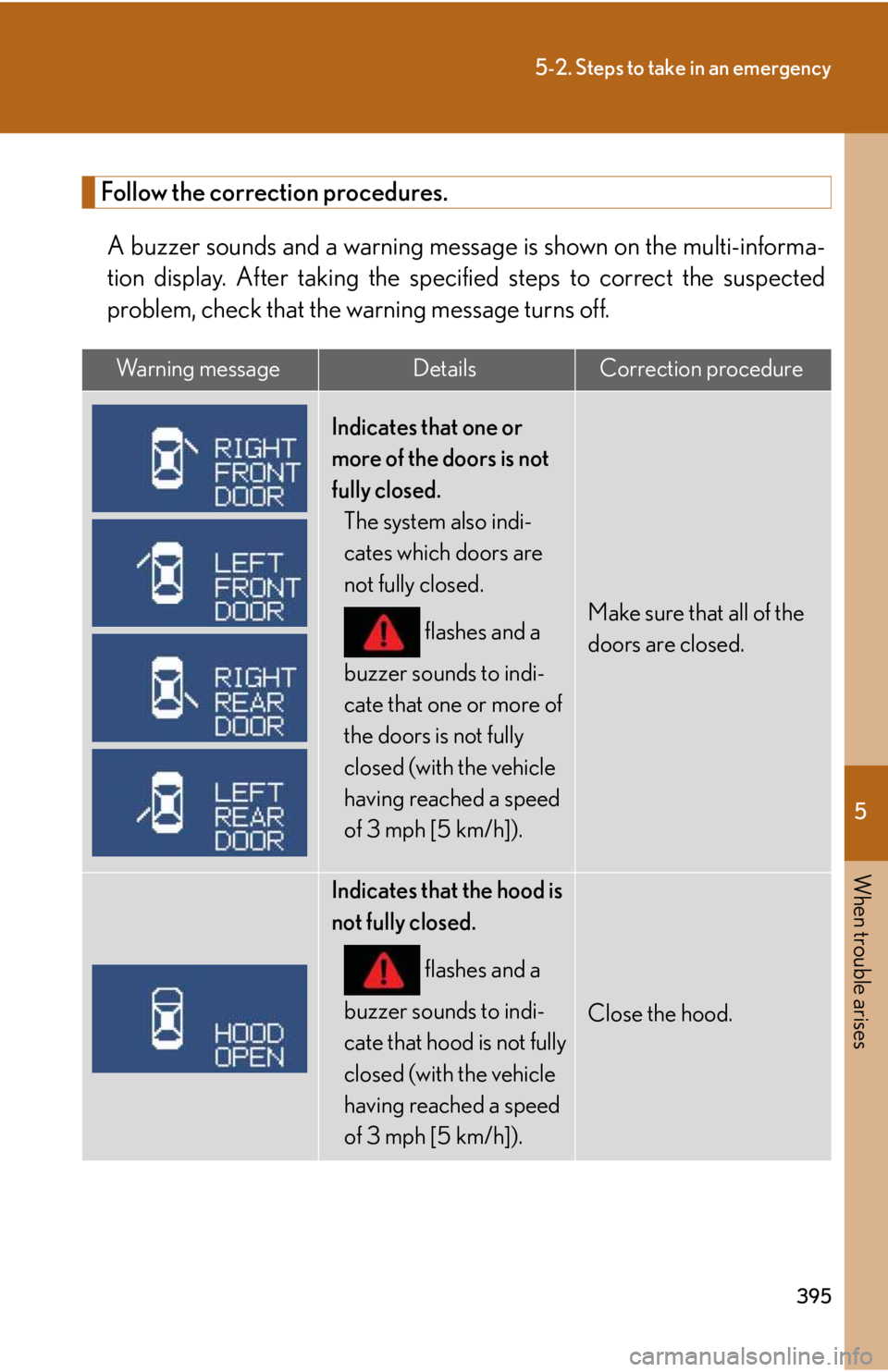
Follow the correction procedures.
A buzzer sounds and a warning message is shown on the multi-informa-
tion display. After taking the specified steps to correct the suspected
problem, check that the warning message turns off.
Wa r n i n g m e s s a g eDetailsCorrection procedure
Indicates that one or
more of the doors is not
fully closed.
The system also indi-
cates which doors are
not fully closed.
flashes and a
buzzer sounds to indi-
cate that one or more of
the doors is not fully
closed (with the vehicle
having reached a speed
of 3 mph [5 km/h]).
Make sure that all of the
doors are closed.
Indicates that the hood is
not fully closed.
flashes and a
buzzer sounds to indi-
cate that hood is not fully
closed (with the vehicle
having reached a speed
of 3 mph [5 km/h]).
Close the hood.
Page 397 of 542
400
5-2. Steps to take in an emergency
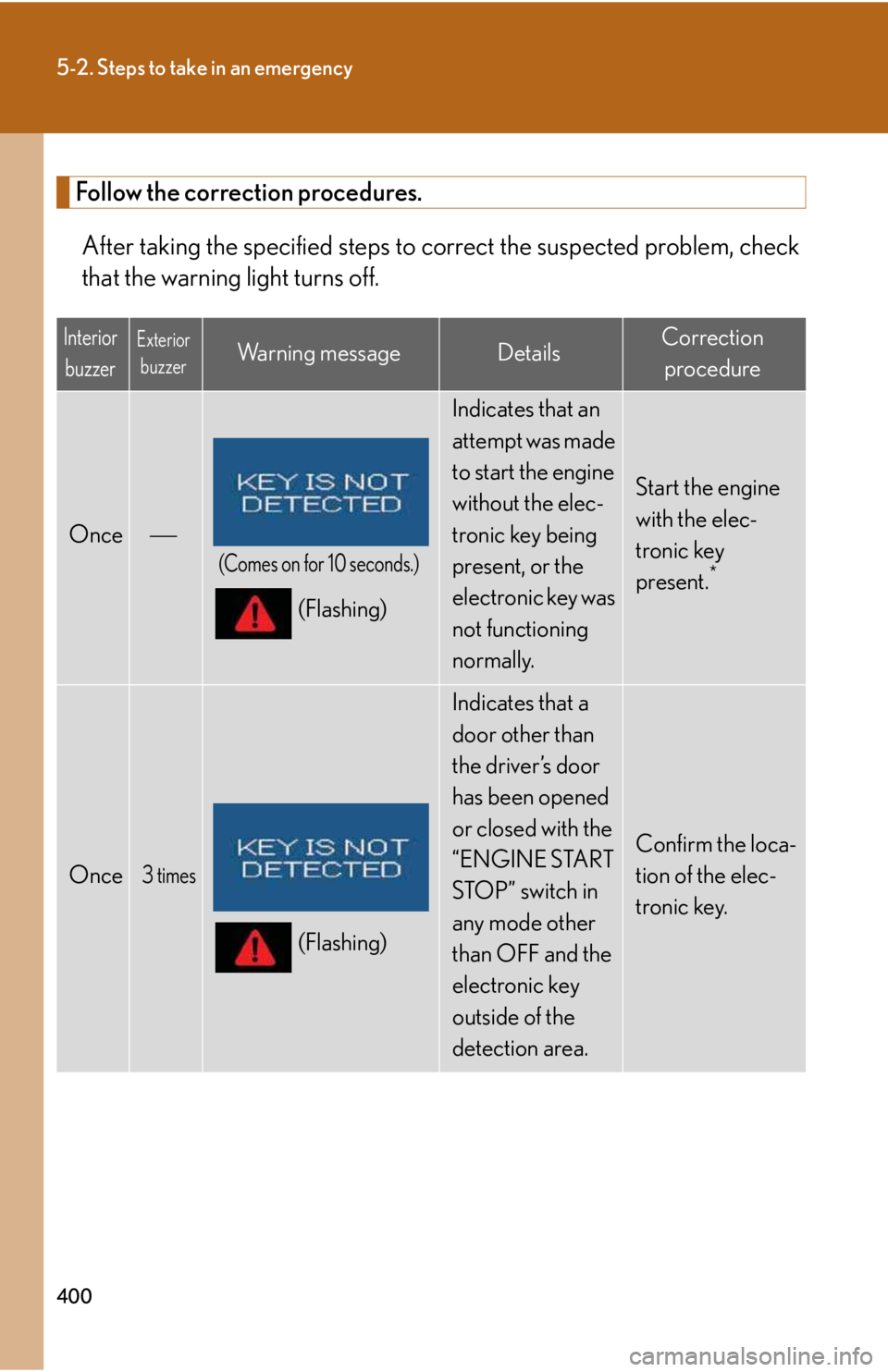
Follow the correction procedures.
After taking the specified steps to correct the suspected problem, check
that the warning light turns off.
Interior
buzzer Exterior
buzzer
Wa r n i n g m e s s a g eDetailsCorrection
procedure
Once⎯
(Comes on for 10 seconds.)
(Flashing)
Indicates that an
attempt was made
to start the engine
without the elec-
tronic key being
present, or the
electronic key was
not functioning
normally.
Start the engine
with the elec-
tronic key
present.*
Once
3 times
(Flashing)
Indicates that a
door other than
the driver’s door
has been opened
or closed with the
“ENGINE START
STOP” switch in
any mode other
than OFF and the
electronic key
outside of the
detection area.
Confirm the loca-
tion of the elec-
tronic key.
Page 406 of 542

5
When trouble arises
409
5-2. Steps to take in an emergency
nThe compact spare tire
lThe compact spare tire is identified by the label “TEMPORARY USE ONLY”
on the tire sidewall.
Use the compact spare tire temporarily only in an emergency.
lMake sure to check the tire pressure of the compact spare tire. (→P. 43 9 )
nWhen using the compact spare tire
As the compact spare tire is not equipped with the tire pressure warning valve and
transmitter, low inflation pressure of the spare tire will not be warned. Also, if you
replace the compact spare tire after the tire pressure warning light comes on, the
light remains on.
nIf you have a flat rear tire on a road covered with snow or ice
Install the compact spare tire on the front of the vehicle. Perform the following steps
and fit tire chains to the rear tires.
Replace a front tire with the compact spare tire.
Replace the flat rear tire with the tire removed from the front of the vehi-
cle.
Fit tire chains to the rear tires.
nAfter completing the tire change
The tire pressure warning system must be reset. (→P. 3 2 7 )
STEP1
STEP2
STEP3
Page 409 of 542

412
5-2. Steps to take in an emergency
NOTICE
nDo not drive the vehicle with a flat tire.
Do not continue driving with a flat tire.
Driving even a short distance with a flat tire can damage the tire and the wheel
beyond repair.
nBe careful when driving over bumps with the compact spare tire installed on the
vehicle.
The vehicle becomes lower when driving with the compact spare tire compared to
when driving with standard tires. Be careful when driving over uneven road sur-
faces.
nDriving with tire chains and the compact spare tire
Do not fit tire chains to the compact spare tire.
Tire chains may damage the vehicle body and adversely affect driving performance.
nWhen replacing the tires
When removing or fitting the wheels, tires or the tire pressure warning valve and
transmitter, contact your Lexus dealer as the tire pressure warning valve and trans-
mitter may be damaged if not handled correctly.
nTo avoid damaging the tire pressure warning valves and transmitters
Do not use liquid sealants on flat tires.
Page 449 of 542

453
6-1. Specifications
6
Vehicle specifications
nDOT quality grades
All passenger vehicle tires must conform to Federal Safety Require-
ments in addition to these grades. Quality grades can be found where
applicable on the tire sidewall between tread shoulder and maximum
section width.
For example: Treadwear 200 Traction AA Temperature A
nTreadwear
The treadwear grade is a comparative rating based on the wear rate of
the tire when tested under controlled conditions on a specified gov-
ernment test course.
For example, a tire graded 150 would wear one and a half (1 - 1 /2) times as
well on the government course as a tire graded 100.
The relative performance of tires depends upon the actual conditions of
their use, however, and may depart significantly from the norm due to varia-
tions in driving habits, service practices and differences in road characteris-
tics and climate.
nTraction AA, A, B, C
The traction grades, from highest to lowest, are AA, A, B and C, and
they represent the tire's ability to stop on wet pavement as measured
under controlled conditions on specified government test surfaces of
asphalt and concrete.
A tire marked C may have poor traction performance.
Warning: The traction grade assigned to this tire is based on braking
(straight ahead) traction tests and does not include cornering (turning) trac-
tion.
Page 450 of 542
454
6-1. Specifications
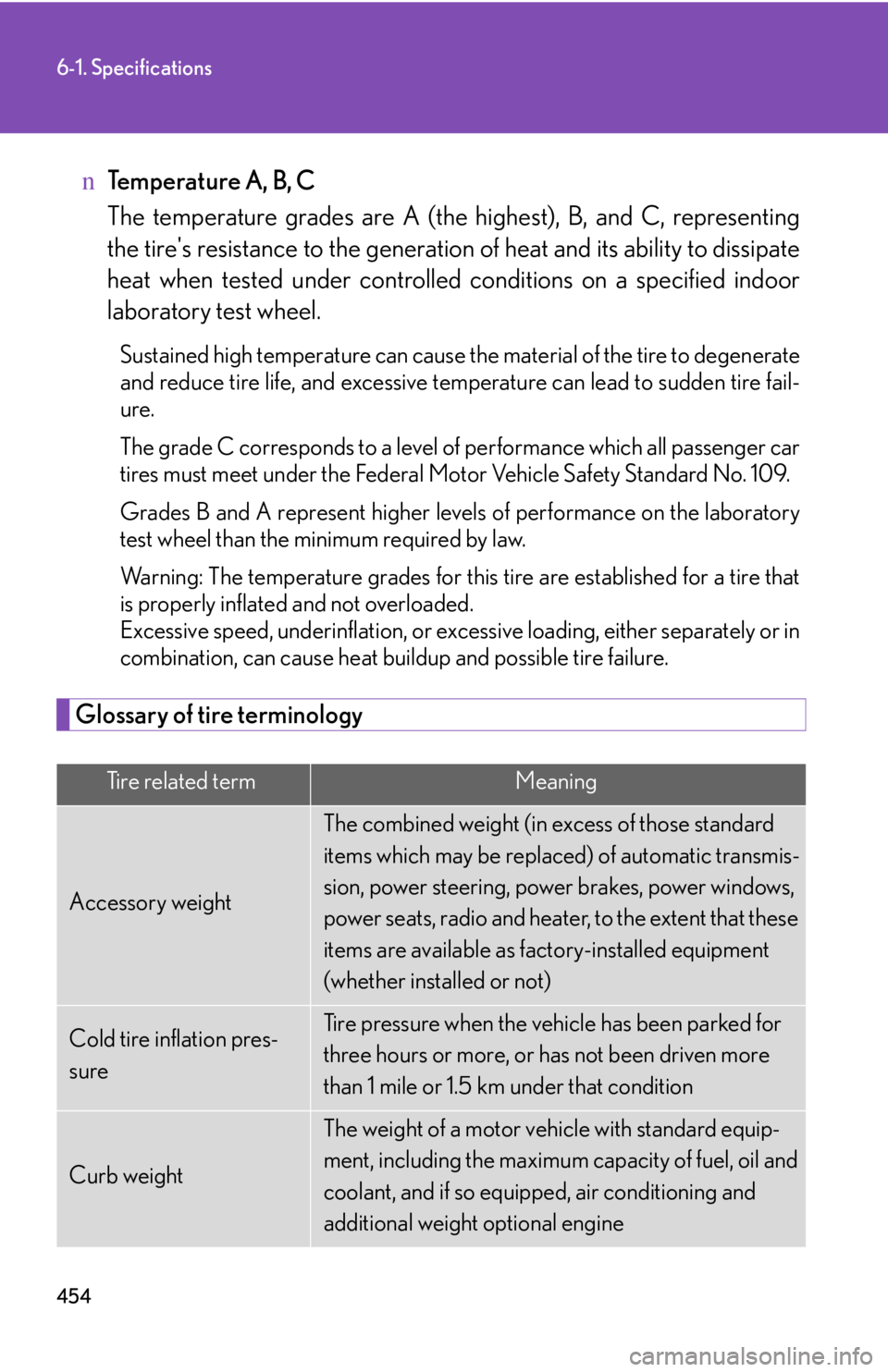
nTemperature A, B, C
The temperature grades are A (the highest), B, and C, representing
the tire's resistance to the generation of heat and its ability to dissipate
heat when tested under controlled conditions on a specified indoor
laboratory test wheel.
Sustained high temperature can cause the material of the tire to degenerate
and reduce tire life, and excessive temperature can lead to sudden tire fail-
ure.
The grade C corresponds to a level of performance which all passenger car
tires must meet under the Federal Motor Vehicle Safety Standard No. 109.
Grades B and A represent higher levels of performance on the laboratory
test wheel than the minimum required by law.
Warning: The temperature grades for this tire are established for a tire that
is properly inflated and not overloaded.
Excessive speed, underinflation, or excessive loading, either separately or in
combination, can cause heat buildup and possible tire failure.
Glossary of tire terminology
Tire related termMeaning
Accessory weight
The combined weight (in excess of those standard
items which may be replaced) of automatic transmis-
sion, power steering, power brakes, power windows,
power seats, radio and heater, to the extent that these
items are available as factory-installed equipment
(whether installed or not)
Cold tire inflation pres-
sure
Tire pressure when the vehicle has been parked for
three hours or more, or has not been driven more
than 1 mile or 1.5 km under that condition
Curb weight
The weight of a motor vehicle with standard equip-
ment, including the maximum capacity of fuel, oil and
coolant, and if so equipped, air conditioning and
additional weight optional engine
Page 463 of 542
467
6
Vehicle specifications
6-3. Initialization
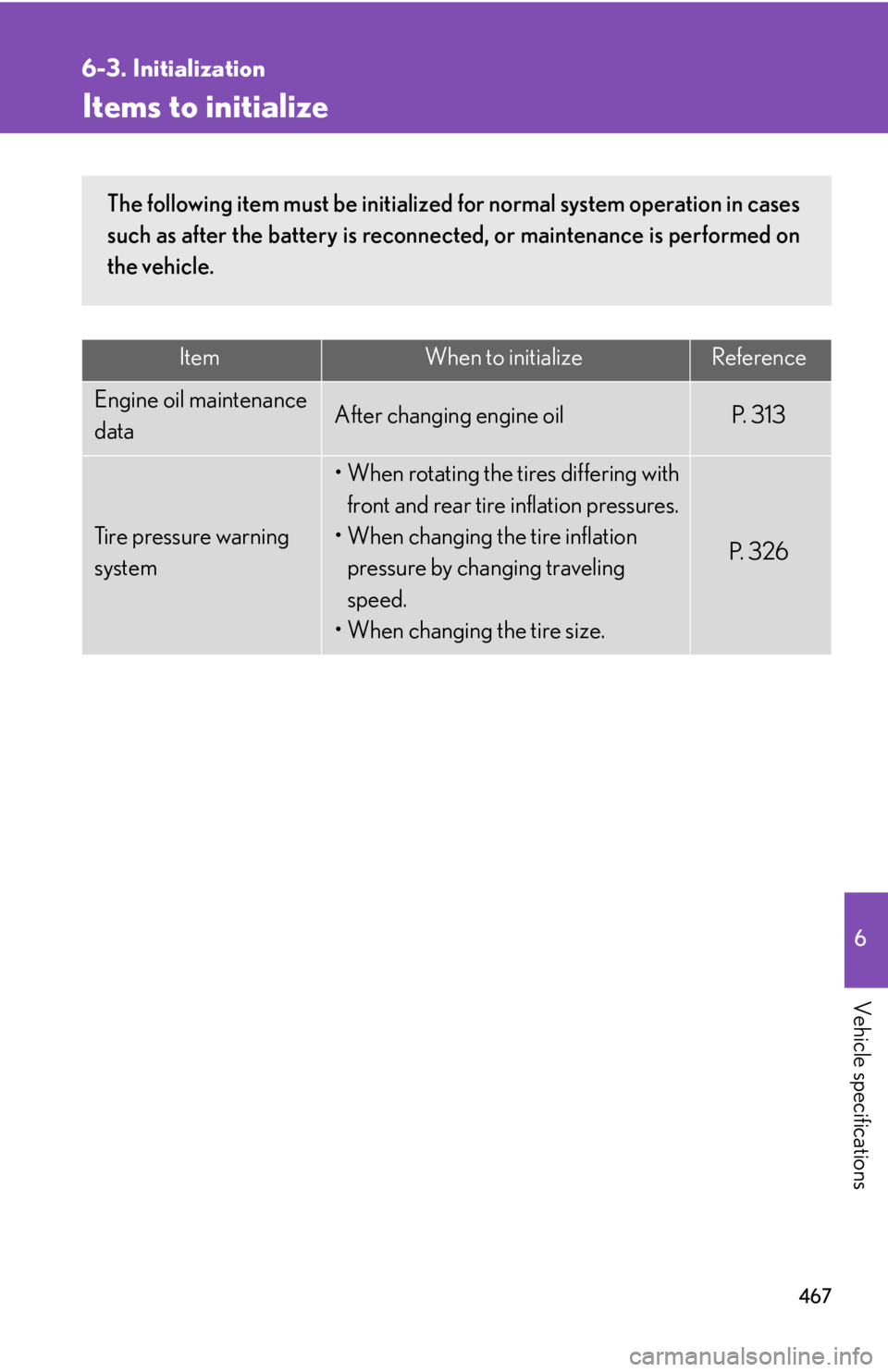
Items to initialize
ItemWhen to initializeReference
Engine oil maintenance
dataAfter changing engine oilP. 3 1 3
Tire pressure warning
system