tires Lexus IS250C 2014 Service Manual
[x] Cancel search | Manufacturer: LEXUS, Model Year: 2014, Model line: IS250C, Model: Lexus IS250C 2014Pages: 626, PDF Size: 8.02 MB
Page 540 of 626
5
When trouble arises
539
5-2. Steps to take in an emergency
IS250C/350C_U
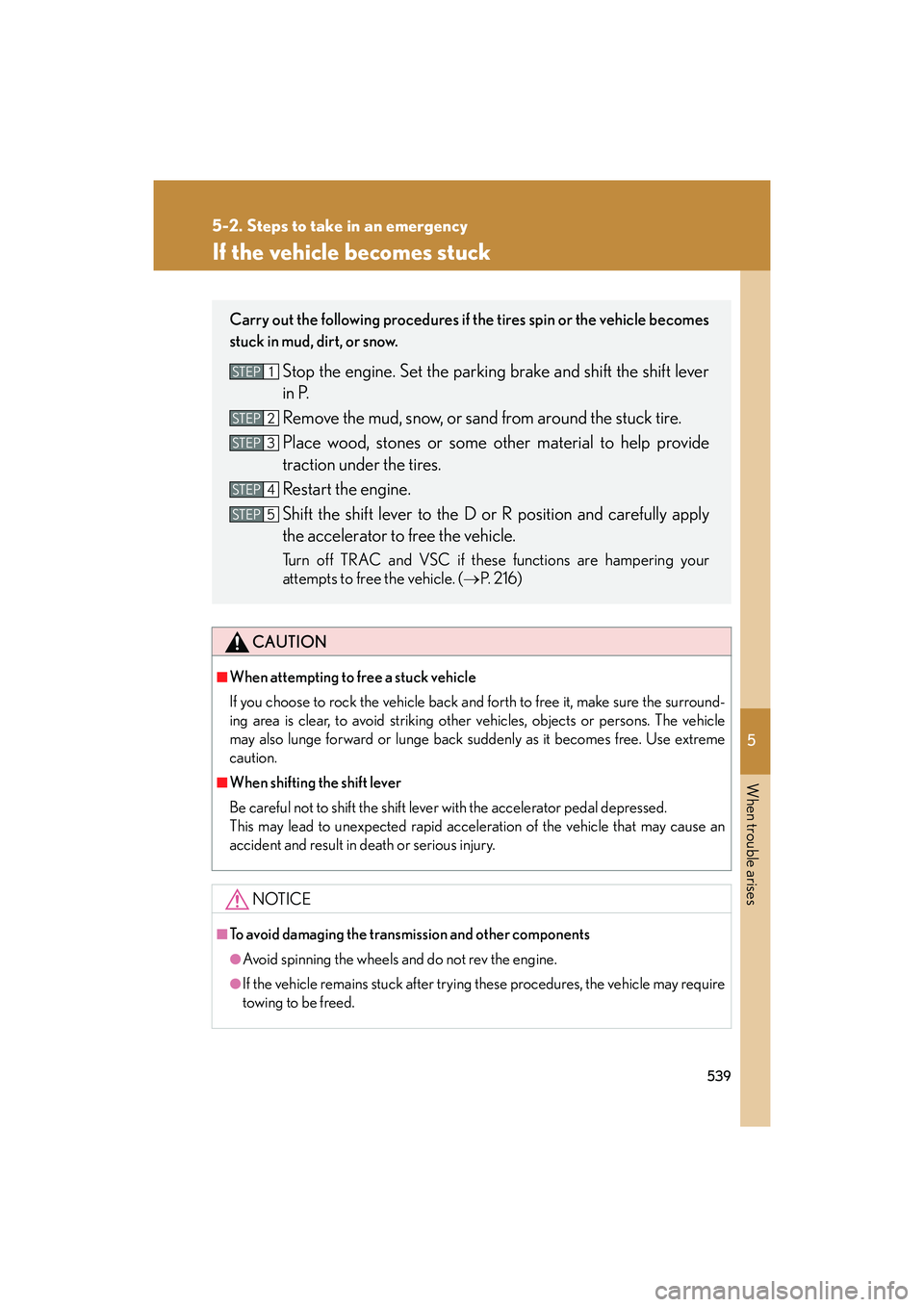
If the vehicle becomes stuck
CAUTION
■When attempting to free a stuck vehicle
If you choose to rock the vehicle back and forth to free it, make sure the surround-
ing area is clear, to avoid striking other vehicles, objects or persons. The vehicle
may also lunge forward or lunge back suddenly as it becomes free. Use extreme
caution.
■When shifting the shift lever
Be careful not to shift the shift lever with the accelerator pedal depressed.
This may lead to unexpected rapid acceleration of the vehicle that may cause an
accident and result in death or serious injury.
NOTICE
■To avoid damaging the transmission and other components
●Avoid spinning the wheels and do not rev the engine.
●If the vehicle remains stuck after trying these procedures, the vehicle may require
towing to be freed.
Carry out the following procedures if the tires spin or the vehicle becomes
stuck in mud, dirt, or snow.
Stop the engine. Set the parking brake and shift the shift lever
in P.
Remove the mud, snow, or sand from around the stuck tire.
Place wood, stones or some other material to help provide
traction under the tires.
Restart the engine.
Shift the shift lever to the D or R position and carefully apply
the accelerator to free the vehicle.
Turn off TRAC and VSC if these functions are hampering your
attempts to free the vehicle. (→P. 2 1 6 )
STEP1
STEP2
STEP3
STEP4
STEP5
Page 564 of 626

563
6-1. Specifications
6
Vehicle specifications
IS250C/350C_U
Steering
Tires and wheelsType A
Free playLess than 1.2 in. (30 mm)
Ti r e s i z e
Front tires: 225/45R17 90W
Rear tires: 245/45R17 95W
Spare tire: T125/70D17 98M
Front and rear tire inflation pres-
sure
(Recommended cold tire inflation
pressure)
Driving under normal conditions Front:
35 psi (240 kPa, 2.4 kgf/cm
2 or bar)*
Rear:
38 psi (260 kPa, 2.6 kgf/cm
2 or bar)*
Spare:
60 psi (420 kPa, 4.2 kgf/cm
2 or bar)
*: When driving at high speeds above 100 mph (160 km/h), in countries where such speeds
are permitted by law, add 4.5 psi (30 kPa, 0.3
kgf/cm
2 or bar) to the front tires and rear
tires. Never exceed the maximum cold tire
inflation pressure indicated on the tire side-
wall.
Wheel size17 × 8J, 17 × 4T (spare)
Wheel nut torque76 ft•lbf (103 N•m, 10.5 kgf•m)
Page 565 of 626

564
6-1. Specifications
IS250C/350C_UTy p e B
Ti r e s i z e
Front tires: 225/45R17 91V
Rear tires: 245/45R17 95V
Spare tire: T125/70D17 98M
Front and rear tire inflation pres-
sure
(Recommended cold tire inflation
pressure)
Driving under normal conditions
Front:
35 psi (240 kPa, 2.4 kgf/cm
2 or bar)*
Rear:
38 psi (260 kPa, 2.6 kgf/cm
2 or bar)*
Spare:
60 psi (420 kPa, 4.2 kgf/cm
2 or bar)
*: When driving at high speeds above 100 mph (160 km/h), in countries where such speeds
are permitted by law, add 7.2 psi (50 kPa, 0.5
kgf/cm
2 or bar) to the front tires and rear
tires. Never exceed the maximum cold tire
inflation pressure indicated on the tire side-
wall.
Wheel size17 × 8J, 17 × 4T (spare)
Wheel nut torque76 ft•lbf (103 N•m, 10.5 kgf•m)
Page 566 of 626

565
6-1. Specifications
6
Vehicle specifications
IS250C/350C_UType C
Ti r e s i z e
Front tires: 225/40R18 88Y
Rear tires: 255/40R18 95Y
Spare tire: T145/70D17 106M
Front and rear tire inflation pres-
sure
(Recommended cold tire inflation
pressure)
Driving under normal conditions
Front:
35 psi (240 kPa, 2.4 kgf/cm
2 or bar)*
Rear:
38 psi (260 kPa, 2.6 kgf/cm
2 or bar)*
Spare:
60 psi (420 kPa, 4.2 kgf/cm
2 or bar)
*: When driving at high speeds above 100 mph (160 km/h), in countries where such speeds
are permitted by law, add 7.2 psi (50 kPa, 0.5
kgf/cm
2 or bar) to the front tires and rear
tires. Never exceed the maximum cold tire
inflation pressure indicated on the tire side-
wall.
Wheel size
Front wheels: 18 × 8J
Rear wheels: 18 × 8 1 /2J
Spare wheel: 17 × 4T
Wheel nut torque76 ft•lbf (103 N•m, 10.5 kgf•m)
Page 567 of 626

566
6-1. Specifications
IS250C/350C_UTy p e D
Ti r e s i z e
Front tires: 225/40R18 88W
Rear tires: 255/40R18 95W
Spare tire: T145/70D17 106M
Front and rear tire inflation pres-
sure
(Recommended cold tire inflation
pressure)
Driving under normal conditions
Front:
35 psi (240 kPa, 2.4 kgf/cm
2 or bar)*
Rear:
38 psi (260 kPa, 2.6 kgf/cm
2 or bar)*
Spare:
60 psi (420 kPa, 4.2 kgf/cm
2 or bar)
*: When driving at high speeds above 100 mph (160 km/h), in countries where such speeds
are permitted by law, add 7.2 psi (50 kPa, 0.5
kgf/cm
2 or bar) to the front tires and rear
tires. Never exceed the maximum cold tire
inflation pressure indicated on the tire side-
wall.
Wheel size
Front wheels: 18 × 8J
Rear wheels: 18 × 8 1 /2J
Spare wheel: 17 × 4T
Wheel nut torque76 ft•lbf (103 N•m, 10.5 kgf•m)
Page 568 of 626

567
6-1. Specifications
6
Vehicle specifications
IS250C/350C_UType E
Ti r e s i z eFront tires: 225/40RF18 88V
Rear tires: 255/40RF18 95V
Front and rear tire inflation pres-
sure
(Recommended cold tire inflation
pressure)
Driving under normal conditions
Front:
35 psi (240 kPa, 2.4 kgf/cm
2 or bar)*
Rear:
38 psi (260 kPa, 2.6 kgf/cm
2 or bar)*
*: When driving at high speeds above 100 mph (160 km/h), in countries where such speeds
are permitted by law, add 11.7 psi (80 kPa,
0.8 kgf/cm
2 or bar) to the front tires and rear
tires. Never exceed the maximum cold tire
inflation pressure indicated on the tire side-
wall.
Wheel sizeFront wheels: 18 × 8J
Rear wheels: 18 × 8 1 /2J
Wheel nut torque76 ft•lbf (103 N•m, 10.5 kgf•m)
Page 575 of 626

574
6-1. Specifications
IS250C/350C_U
Radial tires or bias-ply tires
A radial tire has “RADIAL” on the sidewall. A tire not marked “RADIAL” is
a bias-ply tire.
TUBELESS or TUBE TYPE
A tubeless tire does not have a tube and air is directly filled in the tire. A
tube type tire has a tube inside the ti re and the tube maintains the air pres-
sure.
Load limit at maximum cold tire inflation pressure ( →P. 4 3 7 )
Maximum cold tire inflation pressure ( →P. 563)
This means the pressure to which a tire may be inflated.
Uniform tire quality grading
For details, see “Uniform Tire Quality Grading” that follows.
Summer tire or all season tire (→ P. 4 3 7 )
An all season tire has “M+S” on the sidewall. A tire not marked “M+S” is a
summer tire.
“TEMPORARY USE ONLY” (→ P. 5 1 8 )
A compact spare tire is identified by the phrase “TEMPORARY USE
ONLY” molded into its sidewall. This tire is designed for temporary
emergency use only.
Run-flat tire (RFT) or standard tire (→ P. 5 76 )
This vehicle can be equipped with either run-flat tires (RFT) or standard
tires. A “RFT” or “DSST” mark is molded on the sidewall of the run-flat
tire.
Page 579 of 626

578
6-1. Specifications
IS250C/350C_U■
DOT quality grades
All passenger vehicle tires must conform to Federal Safety Require-
ments in addition to these grades. Quality grades can be found where
applicable on the tire sidewall between tread shoulder and maximum
section width.
For example: Treadwear 200 Traction AA Temperature A
■Treadwear
The treadwear grade is a comparative rating based on the wear rate of
the tire when tested under controlled conditions on a specified gov-
ernment test course.
For example, a tire graded 150 would wear one and a half (1 - 1 /2) times as
well on the government course as a tire graded 100.
The relative performance of tires depends upon the actual conditions of
their use, however, and may depart significantly from the norm due to varia-
tions in driving habits, service practices and differences in road characteris-
tics and climate.
■Traction AA, A, B, C
The traction grades, from highest to lowest, are AA, A, B and C, and
they represent the tire's ability to stop on wet pavement as measured
under controlled conditions on specified government test surfaces of
asphalt and concrete.
A tire marked C may have poor traction performance.
Warning: The traction grade assigned to this tire is based on braking
(straight ahead) traction tests and does not include cornering (turning) trac-
tion.
Page 580 of 626

579
6-1. Specifications
6
Vehicle specifications
IS250C/350C_U■
Temperature A, B, C
The temperature grades are A (the highest), B, and C, representing
the tire's resistance to the generation of heat and its ability to dissipate
heat when tested under controlled conditions on a specified indoor
laboratory test wheel.
Sustained high temperature can cause the material of the tire to degenerate
and reduce tire life, and excessive temperature can lead to sudden tire fail-
ure.
The grade C corresponds to a level of performance which all passenger car
tires must meet under the Federal Motor Vehicle Safety Standard No. 139.
Grades B and A represent higher levels of performance on the laboratory
test wheel than the minimum required by law.
Warning: The temperature grades for this tire are established for a tire that
is properly inflated and not overloaded.
Excessive speed, underinflation, or excessive loading, either separately or in
combination, can cause heat buildup and possible tire failure.
Glossary of tire terminology
Tire related termMeaning
Accessory weight
The combined weight (in excess of those standard
items which may be replaced) of automatic transmis-
sion, power steering, power brakes, power windows,
power seats, radio and heater, to the extent that these
items are available as factory-installed equipment
(whether installed or not)
Cold tire inflation pres-
sureTire pressure when the vehicle has been parked for
three hours or more, or has not been driven more
than 1 mile or 1.5 km under that condition
Curb weight
The weight of a motor vehicle with standard equip-
ment, including the maximum capacity of fuel, oil and
coolant, and if so equipped, air conditioning and
additional weight optional engine
Page 618 of 626
617
Alphabetical index
IS250C/350C_U
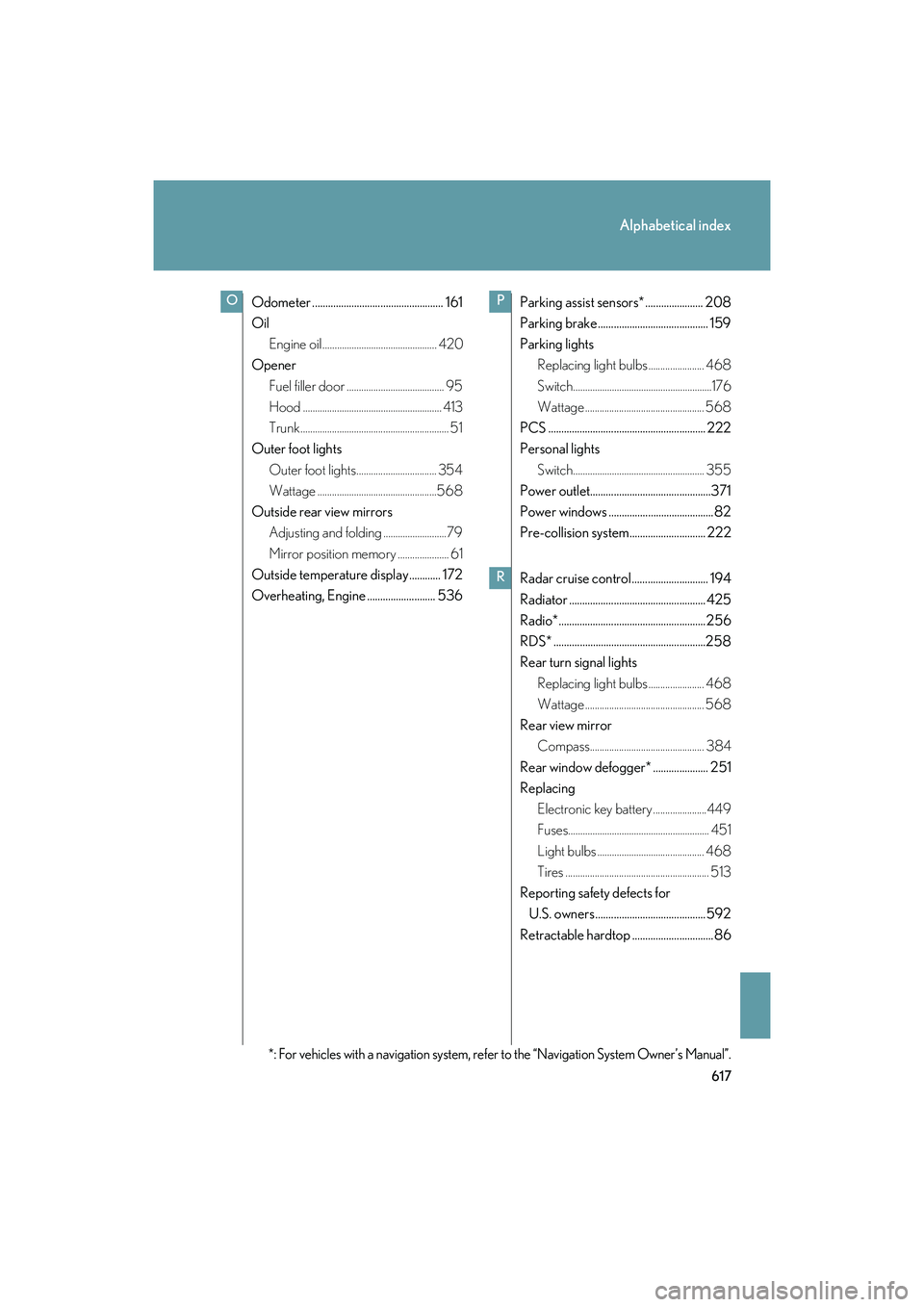
Odometer .................................................. 161
OilEngine oil ............................................... 420
Opener
Fuel filler door ........................................ 95
Hood ......................................................... 413
Trunk ............................................................. 51
Outer foot lights
Outer foot lights................................. 354
Wattage .................................................568
Outside rear view mirrors Adjusting and folding ..........................79
Mirror position memory ..................... 61
Outside temperature display............ 172
Overheating, Engine .......................... 536 Parking assist sensors*...................... 208
Parking brake .......................................... 159
Parking lights
Replacing light bulbs ....................... 468
Switch.........................................................176
Wattage ................................................. 568
PCS ............................................................ 222
Personal lights Switch...................................................... 355
Power outlet..............................................371
Power windows ........................................82
Pre-collision system............................. 222
Radar cruise control............................. 194
Radiator .................................................... 425
Radio*........................................................ 256
RDS* ..........................................................258
Rear turn signal lights
Replacing light bulbs ....................... 468
Wattage ................................................. 568
Rear view mirror Compass............................................... 384
Rear window defogger* ..................... 251
Replacing Electronic key battery ......................449
Fuses.......................................................... 451
Light bulbs ............................................ 468
Tires ........................................................... 513
Reporting safety defects for U.S. owners ..........................................592
Retractable hardtop ...............................86OP
*: For vehicles with a navigation system, refer to the “Navigation System Owner’s Manual”.
R