engine Lexus IS300h 2013 Owner's Guide
[x] Cancel search | Manufacturer: LEXUS, Model Year: 2013, Model line: IS300h, Model: Lexus IS300h 2013Pages: 628, PDF Size: 20.23 MB
Page 209 of 628

2074-1. Before driving
4
Driving
IS300h_EE(OM53B95E)
Important points regarding stability
Vehicle movement resulting from uneven road surfaces and strong
crosswinds will affect handling. The vehicle may also be rocked by
passing buses or large trucks. Frequently check behind when moving
alongside such vehicles. As soon as such vehicle movement occurs,
immediately start to decelerate smoothly by slowly applying the
brakes. Always steer the vehicle straight ahead while braking.
Passing other vehicles
Consider the total combined length of your vehicle and trailer and
ensure that the vehicle-to-vehicle distance is sufficient before execut-
ing lane changes.
Transmission information
To maintain engine braking efficiency, when using engine braking
when driving on a long steep downward grade, do not use the transmis-
sion in D. The vehicle must be driven in gear shift position “4” in S
mode. (P. 219)
If the engine overheats
Towing a loaded trailer up a long, steep incline in temperatures exceed-
ing 30C (85F) may result in the engine overheating. If the engine
coolant temperature gauge indicates that the engine is overheating, turn
the air conditioning off immediately, leave the road and stop the vehi-
cle in a safe place.
(P. 555)
When parking the vehicle
Always place wheel chocks under the wheels of both the vehicle and
trailer. Firmly set the parking brake and shift the shift lever to P.
Page 216 of 628
2144-2. Driving procedures
IS300h_EE(OM53B95E)
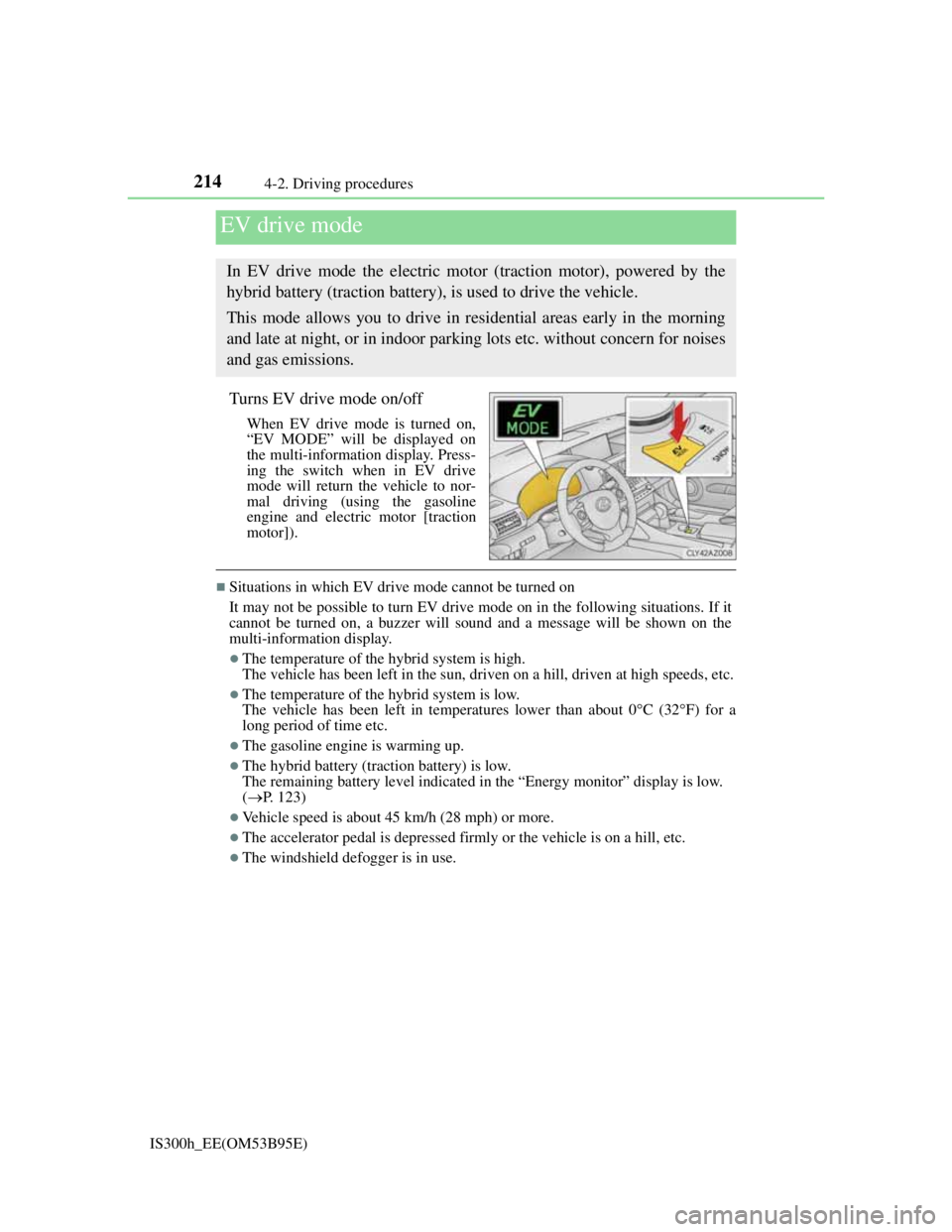
Turns EV drive mode on/off
When EV drive mode is turned on,
“EV MODE” will be displayed on
the multi-information display. Press-
ing the switch when in EV drive
mode will return the vehicle to nor-
mal driving (using the gasoline
engine and electric motor [traction
motor]).
Situations in which EV drive mode cannot be turned on
It may not be possible to turn EV drive mode on in the following situations. If it
cannot be turned on, a buzzer will sound and a message will be shown on the
multi-information display.
The temperature of the hybrid system is high.
The vehicle has been left in the sun, driven on a hill, driven at high speeds, etc.
The temperature of the hybrid system is low.
The vehicle has been left in temperatures lower than about 0C (32F) for a
long period of time etc.
The gasoline engine is warming up.
The hybrid battery (traction battery) is low.
The remaining battery level indicated in the “Energy monitor” display is low.
(P. 123)
Vehicle speed is about 45 km/h (28 mph) or more.
The accelerator pedal is depressed firmly or the vehicle is on a hill, etc.
The windshield defogger is in use.
EV drive mode
In EV drive mode the electric motor (traction motor), powered by the
hybrid battery (traction battery), is used to drive the vehicle.
This mode allows you to drive in residential areas early in the morning
and late at night, or in indoor parking lots etc. without concern for noises
and gas emissions.
Page 217 of 628

2154-2. Driving procedures
4
Driving
IS300h_EE(OM53B95E)
Switching to EV drive mode when the gasoline engine is cold
If the hybrid system is started while the gasoline engine is cold, the gasoline
engine will start automatically after a short period of time in order to warm up. In
this case, you will become unable to switch to EV drive mode.
After the hybrid system has started and the “READY” indicator has illuminated,
press the EV drive mode switch before the gasoline engine starts to switch to EV
drive mode.
Automatic cancelation of EV drive mode
When driving in EV drive mode, the gasoline engine may automatically restart in
the following situations. When EV drive mode is canceled, a buzzer will sound
and the EV drive mode indicator will flash and go off.
The hybrid battery (traction battery) becomes low.
The remaining battery level indicated in the “Energy monitor” display is low.
(P. 123)
Vehicle speed becomes more than about 45 km/h (28 mph).
The accelerator pedal is depressed firmly or the vehicle is on a hill, etc.
When it is possible to inform the driver of automatic cancelation in advance, a
prior notice screen will appear on the multi-information display.
Possible driving distance when driving in EV drive mode
EV drive mode’s possible driving distance ranges from a few hundred meters to
approximately 2 km (1.2 mile). Driving is possible at speeds of less than approx-
imately 45 km/h (28 mph). However, depending on vehicle conditions, there are
situations when EV drive mode cannot be used.
(The distance that is possible depends on the hybrid battery [traction battery]
level and driving conditions.)
Fuel economy
Your Lexus is designed to achieve the best possible fuel economy during normal
driving (using the gasoline engine and electric motor [traction motor]). Driving
in EV drive mode more than necessary may lower fuel economy.
CAUTION
Caution while driving
When driving in EV drive mode, pay special attention to the area around the
vehicle. Because there is no engine noise, pedestrians, people riding bicycles or
other people and vehicles in the area may not be aware of the vehicle starting
off or approaching them, so take extra care while driving.
Page 219 of 628
2174-2. Driving procedures
4
Driving
IS300h_EE(OM53B95E)
*1: To improve fuel efficiency and reduce noise, shift the shift lever to D for nor-
mal driving.
*2: By selecting shift ranges using S mode, you can control accelerating force and
engine braking force.
Sport mode/Eco drive mode
P. 2 8 3
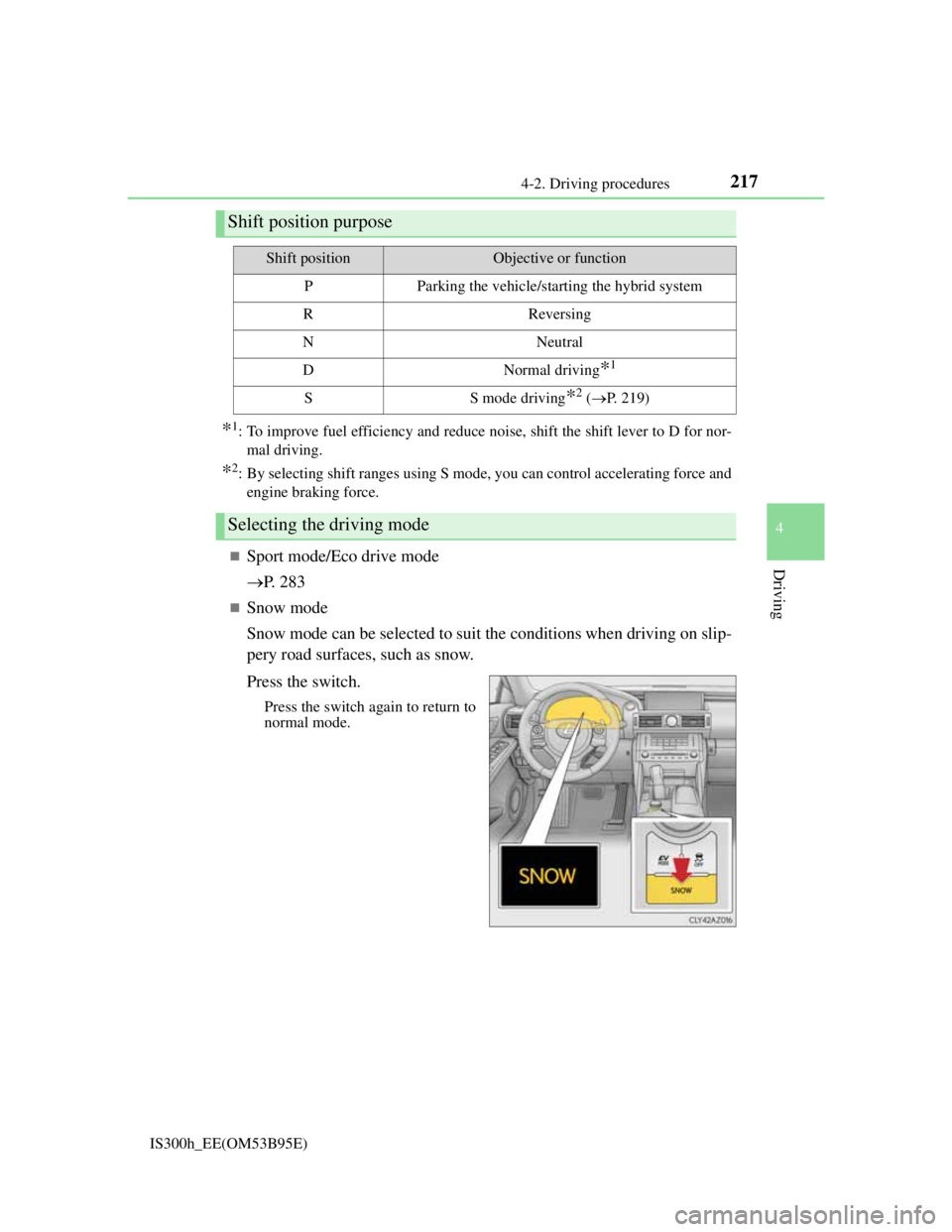
Snow mode
Snow mode can be selected to suit the conditions when driving on slip-
pery road surfaces, such as snow.
Press the switch.
Press the switch again to return to
normal mode.
Shift position purpose
Shift positionObjective or function
PParking the vehicle/starting the hybrid system
RReversing
NNeutral
DNormal driving*1
SS mode driving*2 (P. 219)
Selecting the driving mode
Page 220 of 628
2184-2. Driving procedures
IS300h_EE(OM53B95E)
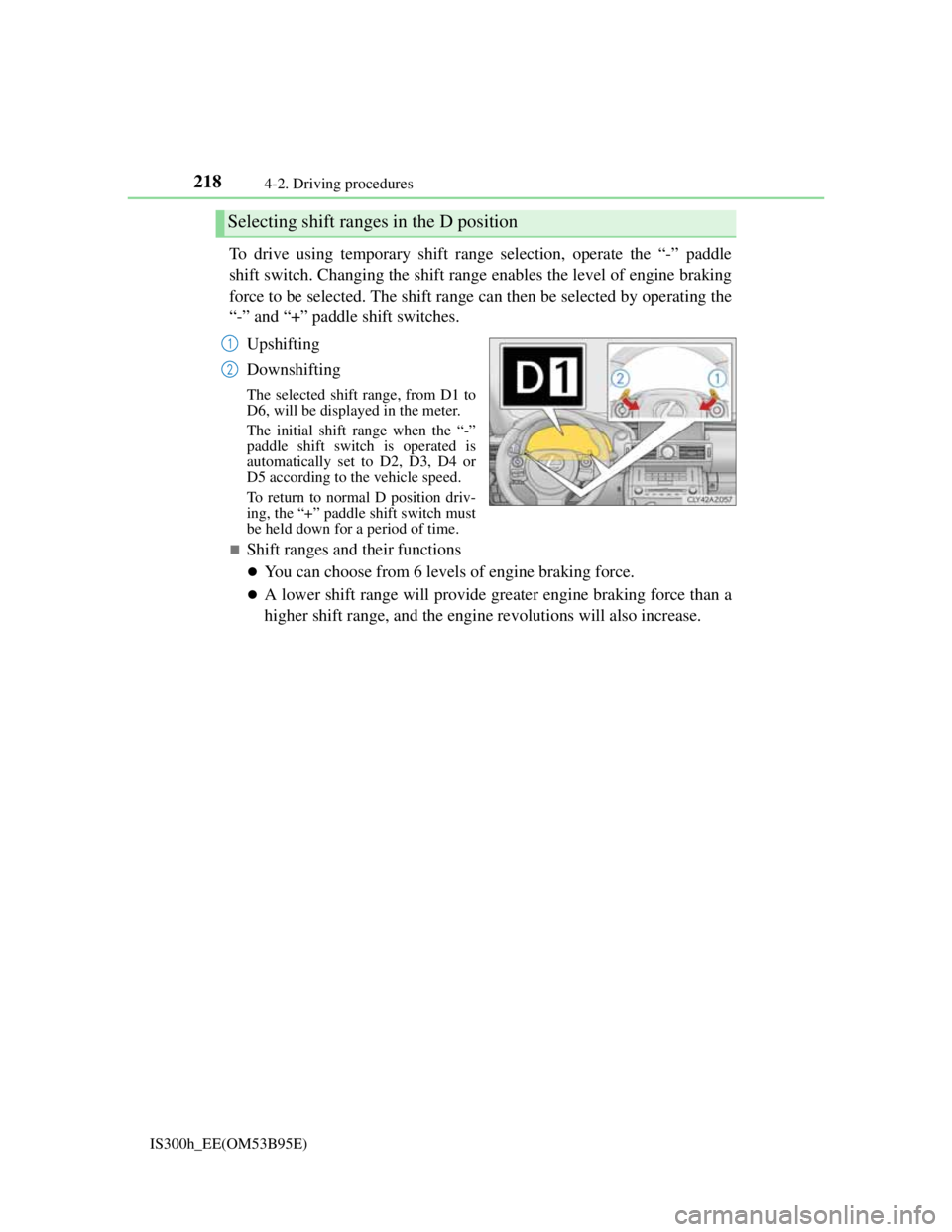
To drive using temporary shift range selection, operate the “-” paddle
shift switch. Changing the shift range enables the level of engine braking
force to be selected. The shift range can then be selected by operating the
“-” and “+” paddle shift switches.
Upshifting
Downshifting
The selected shift range, from D1 to
D6, will be displayed in the meter.
The initial shift range when the “-”
paddle shift switch is operated is
automatically set to D2, D3, D4 or
D5 according to the vehicle speed.
To return to normal D position driv-
ing, the “+” paddle shift switch must
be held down for a period of time.
Shift ranges and their functions
You can choose from 6 levels of engine braking force.
A lower shift range will provide greater engine braking force than a
higher shift range, and the engine revolutions will also increase.
Selecting shift ranges in the D position
1
2
Page 221 of 628
2194-2. Driving procedures
4
Driving
IS300h_EE(OM53B95E)
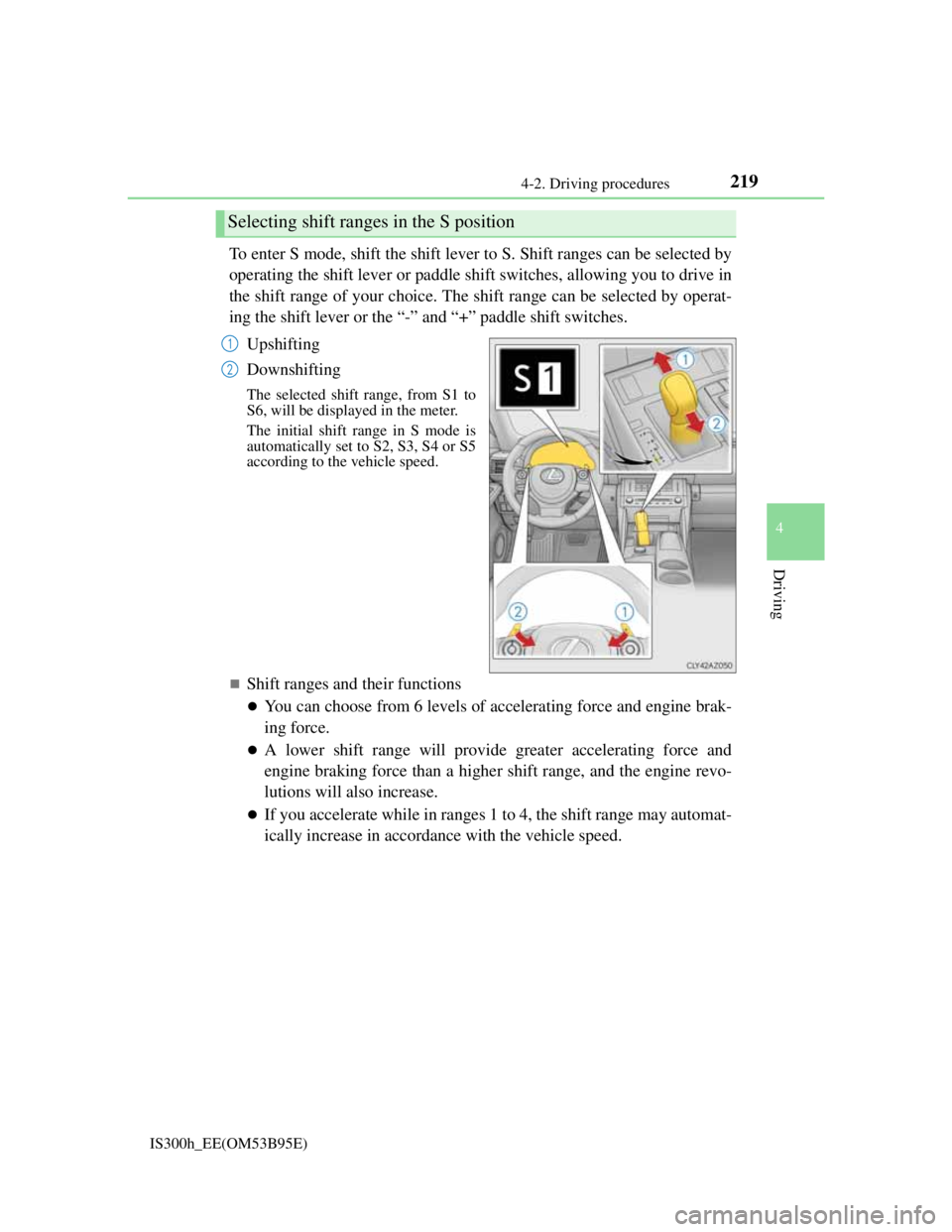
To enter S mode, shift the shift lever to S. Shift ranges can be selected by
operating the shift lever or paddle shift switches, allowing you to drive in
the shift range of your choice. The shift range can be selected by operat-
ing the shift lever or the “-” and “+” paddle shift switches.
Upshifting
Downshifting
The selected shift range, from S1 to
S6, will be displayed in the meter.
The initial shift range in S mode is
automatically set to S2, S3, S4 or S5
according to the vehicle speed.
Shift ranges and their functions
You can choose from 6 levels of accelerating force and engine brak-
ing force.
A lower shift range will provide greater accelerating force and
engine braking force than a higher shift range, and the engine revo-
lutions will also increase.
If you accelerate while in ranges 1 to 4, the shift range may automat-
ically increase in accordance with the vehicle speed.
Selecting shift ranges in the S position
1
2
Page 222 of 628

2204-2. Driving procedures
IS300h_EE(OM53B95E)
When the “-” paddle shift switch is operated with the shift lever in the D position
The shift range is downshifted to a range that enables engine braking force that is
suitable to driving conditions.
Automatic deactivation of shift range selection in the D position
Shift range selection in the D position will be deactivated in the following situa-
tions:
When the vehicle comes to a stop
If the accelerator pedal is depressed for more than a certain period of time
When the shift lever is shifted to a position other than D
Downshifting restriction warning buzzer
To help ensure safety and driving performance, downshifting operation may
sometimes be restricted. In some circumstances, downshifting may not be possi-
ble even when the shift lever or paddle shift switch is operated. (A buzzer will
sound twice.)
Snow mode automatic deactivation
Snow mode is automatically deactivated if the power switch is turned off after
driving in snow mode.
When driving with cruise control or dynamic radar cruise control activated
Even when performing the following actions with the intent of enabling engine
braking, engine braking will not activate because cruise control or dynamic radar
cruise control will not be canceled.
While driving in D or S mode, downshifting to 5 or 4. (P. 245, 249)
When switching the driving mode to sport mode while driving in D position.
(P. 283)
If the shift lever cannot be shifted from P
P. 547
Page 223 of 628

2214-2. Driving procedures
4
Driving
IS300h_EE(OM53B95E)
CAUTION
When driving on slippery road surfaces
Be careful of downshifting and sudden acceleration, as this could result in the
vehicle skidding to the side or spinning.
NOTICE
Hybrid battery (traction battery) charge
If the shift lever is in N, the hybrid battery (traction battery) will not be charged
even when the engine is running. Therefore, if the vehicle is left with the shift
lever in N for a long period of time, the hybrid battery (traction battery) will
discharge, and this may result in the vehicle not being able to start.
Page 243 of 628

241
4
Driving
IS300h_EE(OM53B95E)4-4. Refueling
Close all the doors and windows, and turn the power switch off.
Confirm the type of fuel.
Fuel types
EU area:
Unleaded gasoline conforming to European standard EN228, Research Octane
Number of 95 or higher
Except EU area:
Unleaded gasoline, Research Octane Number of 95 or higher
Use of ethanol blended gasoline in a gasoline engine
Lexus allows the use of ethanol blended gasoline where the ethanol content is up
to 10%. Make sure that the ethanol blended gasoline to be used has a Research
Octane Number that follows the above.
Opening the fuel tank cap
Perform the following steps to open the fuel tank cap:
Before refueling the vehicle
Page 278 of 628

2764-5. Using the driving support systems
IS300h_EE(OM53B95E)
Sensor detection information
The sensor’s detection areas are limited to the areas around the vehicle’s front
corner and rear bumpers.
Certain vehicle conditions and the surrounding environment may affect the
ability of the sensor to correctly detect obstacles. Particular instances where this
may occur are listed below.
• There is dirt, snow or ice on the sensor. (Wiping the sensors will resolve this
problem.)
• The sensor is frozen. (Thawing the area will resolve this problem.)
In especially cold weather, if a sensor is frozen the screen may show an
abnormal display, or obstacles may not be detected.
• The sensor is covered in any way.
• The vehicle is leaning considerably to one side.
• On an extremely bumpy road, on an incline, on gravel, or on grass.
• The vicinity of the vehicle is noisy due to vehicle horns, motorcycle engines,
air brakes of large vehicles, or other loud noises producing ultrasonic waves.
• There is another vehicle equipped with parking assist sensors in the vicinity.
• The sensor is coated with a sheet of spray or heavy rain.
• The vehicle is equipped with a fender pole or wireless antenna.
• Towing eyelets are installed.
• The bumper or sensor receives a strong impact.
• The vehicle is approaching a tall or curved curb.
• In harsh sunlight or intense cold weather.
• The area directly under the bumpers is not detected.
• If obstacles draw too close to the sensor.
• A non-genuine Lexus suspension (lowered suspension etc.) is installed.
• People may not be detected if they are wearing certain types of clothing.
In addition to the examples above, there are instances in which, because of their
shape, signs and other objects may be judged by the sensor to be closer than they
are.
The shape of the obstacle may prevent the sensor from detecting it. Pay particu-
lar attention to the following obstacles:
• Wires, fences, ropes, etc.
• Cotton, snow and other materials that absorb sound waves
• Sharply-angled objects
• Low obstacles
• Tall obstacles with upper sections projecting outwards in the direction of
your vehicle
The following situations may occur during use.
• Depending on the shape of the obstacle and other factors, the detection dis-
tance may shorten, or detection may be impossible.
• Obstacles may not be detected if they are too close to the sensor.
• There will be a short delay between obstacle detection and display. Even at
slow speeds, there is a possibility that the obstacle will come within the sen-
sor’s detection areas before the display is shown and the warning beep
sounds.
• Thin posts or objects lower than the sensor may not be detected when
approached, even if they have been detected once.
• It might be difficult to hear beeps due to the volume of the audio system or
air flow noise of the air conditioning system.