brake Lexus IS300h 2013 Service Manual
[x] Cancel search | Manufacturer: LEXUS, Model Year: 2013, Model line: IS300h, Model: Lexus IS300h 2013Pages: 628, PDF Size: 20.23 MB
Page 298 of 628

2964-5. Using the driving support systems
IS300h_EE(OM53B95E)
When the 12-volt battery is disconnected
The steering wheel may move from its straight forward position, but this will be
corrected automatically when driving.
Sounds and vibrations caused by the ABS, brake assist, TRC, VSC, hill-start
assist control systems
A sound may be heard from the engine compartment when the brake pedal is
depressed repeatedly, when the hybrid system is started or just after the vehicle
begins to move. This sound does not indicate that a malfunction has occurred in
any of these systems.
Any of the following conditions may occur when the above systems are operat-
ing. None of these indicates that a malfunction has occurred.
• Vibrations may be felt through the vehicle body and steering.
• A motor sound may be heard after the vehicle comes to a stop.
EPS operation sound
When the steering wheel is operated, a motor sound may be heard. This does not
indicate a malfunction.
Reactivation of the TRC/VSC systems
Even after the TRC/VSC systems have been turned off, turning the hybrid sys-
tem off and then on again will automatically reactivate the TRC/VSC systems.
Reactivation of the TRC system linked to vehicle speed
When only the TRC system is turned off, the TRC system will turn on when
vehicle speed increases. However, when both TRC and VSC systems are turned
off, the systems will not turn on even when vehicle speed increases.
Reduced effectiveness of the EPS system
The effectiveness of the EPS system is reduced to prevent the system from over-
heating when there is frequent steering input over an extended period of time.
The steering wheel may feel heavy as a result. Should this occur, refrain from
excessive steering input or stop the vehicle and turn the hybrid system off. The
EPS system should return to normal within 10 minutes.
Page 299 of 628

2974-5. Using the driving support systems
4
Driving
IS300h_EE(OM53B95E)
Operating conditions of hill-start assist control
When the following four conditions are met, the hill-start assist control will oper-
ate:
The shift lever is in a position other than P or N (when starting off forward/
backward on an upward incline).
The vehicle is stopped.
The accelerator pedal is not depressed.
The parking brake is not engaged.
Automatic system cancelation of hill-start assist control
The hill-start assist control will turn off in any of the following situations:
The shift lever is moved to P or N.
The accelerator pedal is depressed.
The parking brake is engaged.
Approximately 2 seconds elapse after the brake pedal is released.
Operating conditions of emergency brake signal
When the following three conditions are met, the emergency brake signal will
operate:
The emergency flashers are off.
Actual vehicle speed is over 55 km/h (35 mph).
The brake pedal is depressed in a manner that cause the system to judge from
the vehicle deceleration that this is a sudden braking operation.
Automatic system cancelation of emergency brake signal
The emergency brake signal will turn off in any of the following situations:
The emergency flashers are turned on.
The brake pedal is released.
The system judges from the vehicle deceleration that is not a sudden braking
operation.
Page 300 of 628

2984-5. Using the driving support systems
IS300h_EE(OM53B95E)
CAUTION
The ABS does not operate effectively when
The limits of tire gripping performance have been exceeded (such as exces-
sively worn tires on a snow covered road).
The vehicle hydroplanes while driving at high speed on wet or slick roads.
Stopping distance when the ABS is operating may exceed that of normal condi-
tions
The ABS is not designed to shorten the vehicle’s stopping distance. Always
maintain a safe distance from the vehicle in front of you, especially in the fol-
lowing situations:
When driving on dirt, gravel or snow-covered roads
When driving with tire chains
When driving over bumps in the road
When driving over roads with potholes or uneven surfaces
TRC may not operate effectively when
Directional control and power may not be achievable while driving on slippery
road surfaces, even if the TRC system is operating.
Drive the vehicle carefully in conditions where stability and power may be lost.
Hill- start assist control does not operate effectively when
Do not overly rely on hill-start assist control. Hill-start assist control may not
operate effectively on steep inclines and roads covered with ice.
Unlike the parking brake, hill-start assist control is not intended to hold the
vehicle stationary for an extended period of time. Do not attempt to use hill-
start assist control to hold the vehicle on an incline, as doing so may lead to an
accident.
When the VSC is activated
The slip indicator light flashes. Always drive carefully. Reckless driving may
cause an accident. Exercise particular care when the indicator light flashes.
When the TRC/VSC systems are turned off
Be especially careful and drive at a speed appropriate to the road conditions. As
these are the systems to ensure vehicle stability and driving force, do not turn
the TRC/VSC systems off unless necessary.
Replacing tires
Make sure that all tires are of the specified size, brand, tread pattern and total
load capacity. In addition, make sure that the tires are inflated to the recom-
mended tire inflation pressure level.
The ABS, TRC and VSC systems will not function correctly if different tires
are installed on the vehicle.
Contact any authorized Lexus dealer or repairer, or another duly qualified and
equipped professional for further information when replacing tires or wheels.
Handling of tires and the suspension
Using tires with any kind of problem or modifying the suspension will affect
the driving assist systems, and may cause a system to malfunction.
Page 301 of 628
2994-5. Using the driving support systems
4
Driving
IS300h_EE(OM53B95E)
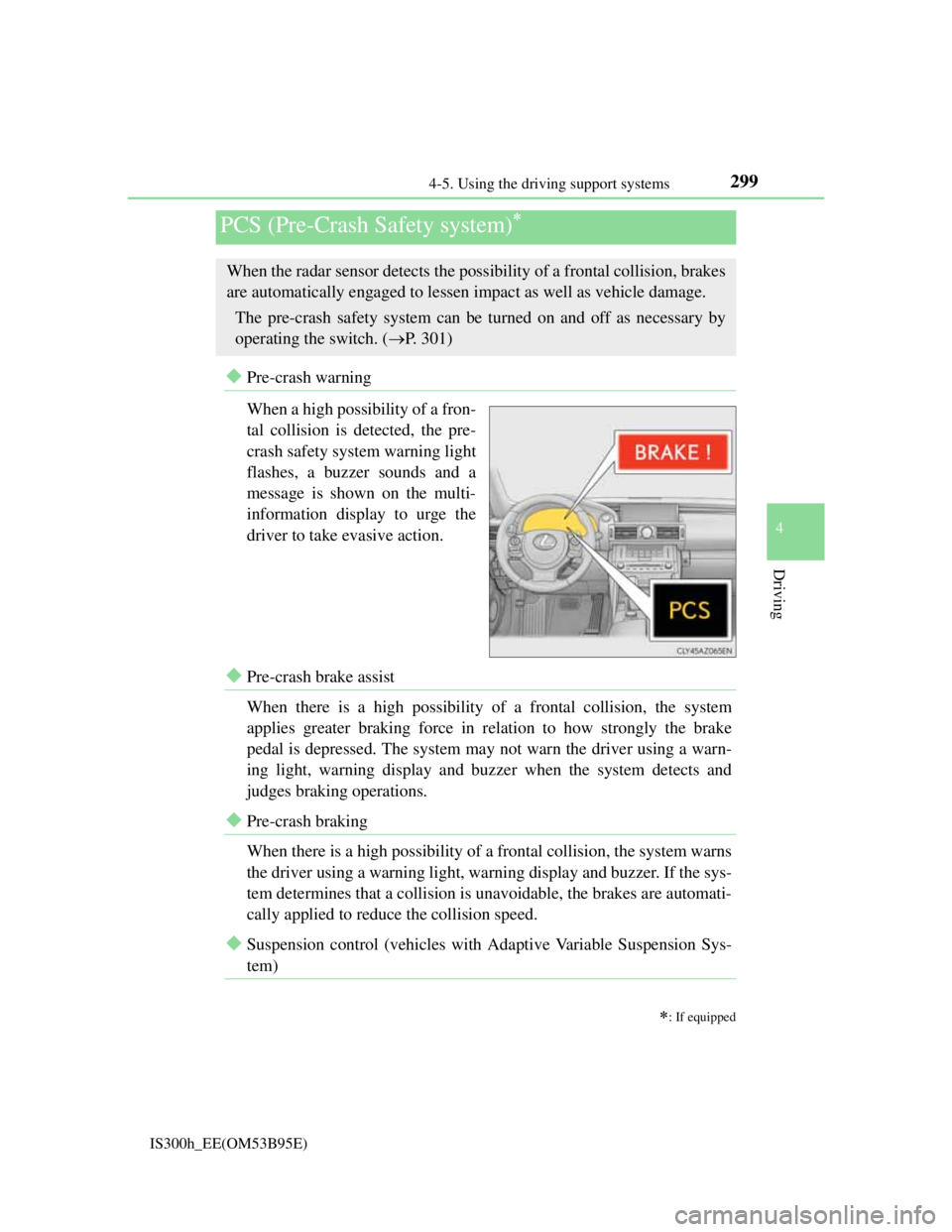
Pre-crash warning
When a high possibility of a fron-
tal collision is detected, the pre-
crash safety system warning light
flashes, a buzzer sounds and a
message is shown on the multi-
information display to urge the
driver to take evasive action.
Pre-crash brake assist
When there is a high possibility of a frontal collision, the system
applies greater braking force in relation to how strongly the brake
pedal is depressed. The system may not warn the driver using a warn-
ing light, warning display and buzzer when the system detects and
judges braking operations.
Pre-crash braking
When there is a high possibility of a frontal collision, the system warns
the driver using a warning light, warning display and buzzer. If the sys-
tem determines that a collision is unavoidable, the brakes are automati-
cally applied to reduce the collision speed.
Suspension control (vehicles with Adaptive Variable Suspension Sys-
tem)
PCS (Pre-Crash Safety system)
: If equipped
When the radar sensor detects the possibility of a frontal collision, brakes
are automatically engaged to lessen impact as well as vehicle damage.
The pre-crash safety system can be turned on and off as necessary by
operating the switch. (P. 301)
Page 304 of 628

3024-5. Using the driving support systems
IS300h_EE(OM53B95E)
The pre-crash safety system is operational when
The PCS OFF switch is not pressed and the following conditions are met:
Pre-crash warning:
• Vehicle speed is greater than about 15 km/h (10 mph).
• The speed at which your vehicle is approaching the obstacle or the vehicle
running ahead of you is greater than about 15 km/h (10 mph).
Pre-crash brake assist:
• The VSC OFF switch is not pressed.
• Vehicle speed is greater than about 30 km/h (19 mph).
• The speed at which your vehicle is approaching the obstacle or the vehicle
running ahead of you is greater than about 30 km/h (19 mph).
• The brake pedal is depressed.
Pre-crash braking:
• The VSC OFF switch is not pressed.
• Vehicle speed is greater than about 15 km/h (10 mph).
• The speed at which your vehicle is approaching the obstacle or the vehicle
running ahead of you is greater than about 15 km/h (10 mph).
Suspension control (vehicles with Adaptive Variable Suspension System):
• Vehicle speed is greater than about 5 km/h (4 mph).
• The speed at which your vehicle is approaching the obstacle or the vehicle
running ahead of you is greater than about 30 km/h (19 mph).
Conditions that may trigger the system even if there is no danger of a collision
When there is an object by the roadside at the entrance to a curve
When passing an oncoming vehicle on a curve
When driving over a narrow iron bridge
When there is a metal object on the road surface
When driving on an uneven road surface
When passing an oncoming vehicle on a left-turn (left-hand drive vehicles) or
right-turn (right-hand drive vehicles)
When your vehicle rapidly closes on the vehicle in front
When a grade separation/interchange, sign, billboard, or other structure appears
to be directly in the vehicle’s line of travel
When there is a metal plate in the road in front of the vehicle on a downhill
slope
When climbing a steep hill causes an overhead billboard or other metallic struc-
ture to appear directly in the vehicle’s line of travel
When driving under an overpass
When an extreme change in vehicle height occurs
When passing through certain toll gates
When passing through a tunnel
When the radar sensor moves off position due to its surrounding area being sub-
jected to a strong impact
When the system is activated in the situations described above, there is also a
possibility that the brakes will be applied with a force greater than normal.
Page 310 of 628

3084-5. Using the driving support systems
IS300h_EE(OM53B95E)
Limitations of the pre-crash safety system
Do not overly rely on the pre-crash safety system. Always drive safely, taking
care to observe your surroundings and checking for any obstacles or other road
hazards.
Failure to do so may cause an accident resulting in death or serious injury.
Handling the radar sensor
Observe the following to ensure the pre-crash safety system can function effec-
tively. Otherwise, the system may not function correctly and could result in an
accident.
Keep the sensor and grille cover clean at all times.
Clean the sensor and grille cover with a soft cloth so you do not mark or dam-
age them.
Do not subject the sensor or surrounding area to a strong impact.
If the sensor moves even slightly off position, the system may malfunction. If
the sensor or surrounding area is subject to a strong impact, always have the
area inspected and adjusted by any authorized Lexus dealer or repairer, or
another duly qualified and equipped professional.
Do not disassemble the sensor.
Do not attach accessories or stickers to the sensor, grille cover or surrounding
area.
Do not modify or paint the sensor and grille cover.
Do not replace them with non-genuine parts.
Cautions regarding the assist contents of the system
By means of alarms and brake control, the pre-crash safety system is intended
to assist the driver in avoiding collisions through the process of LOOK-
JUDGE-ACT. There are limits to the degree of assistance the system can pro-
vide, so please keep in mind the following important points.
Assisting the driver in watching the road
The pre-crash safety system is only able to detect obstacles directly in front of
the vehicle, and only within a limited range. It is not a mechanism that allows
careless or inattentive driving, and it is not a system that can assist the driver
in low-visibility conditions. It is still necessary for the driver to pay close
attention to the vehicle’s surroundings.
Assisting the driver in making correct judgment
When attempting to estimate the possibility of a collision, the only data avail-
able to the pre-crash safety system is that from obstacles it has detected
directly in front of the vehicle. Therefore, it is absolutely necessary for the
driver to remain vigilant and to determine whether or not there is a possibility
of collision in any given situation.
Assisting the driver in taking action
The pre-crash safety system’s braking assist feature is designed to help reduce
the severity of a collision, and so only acts when the system has judged that a
collision is unavoidable. This system by itself is not capable of automatically
avoiding a collision or bringing the vehicle to a stop safely. For this reason,
when encountering a dangerous situation the driver must take direct and
immediate action in order to ensure the safety of all involved.
Page 322 of 628

309
4
Driving
IS300h_EE(OM53B95E)4-6. Driving tips
Using Eco drive mode
When using Eco drive mode, the torque corresponding to the accelera-
tor pedal depression amount can be generated more smoothly than it is
in normal conditions. In addition, the operation of the air conditioning
system (heating/cooling) will be minimized, improving the fuel econ-
omy. (P. 290)
Use of Hybrid System Indicator
Eco-friendly driving is possible by keeping the indicator needle
(except F SPORT models) or bar display (F SPORT models) of Hybrid
System Indicator within the Eco area. (P. 1 1 4 )
When braking
Make sure to operate the brakes gently and in good time. A greater
amount of electrical energy can be regenerated when slowing down.
Delays
Repeated acceleration and deceleration, as well as long waits at traffic
lights, will lead to bad fuel economy. Check traffic reports before leav-
ing and avoid delays as much as possible. When driving in a traffic
jam, gently release the brake pedal to allow the vehicle to move for-
ward slightly while avoiding overuse of the accelerator pedal. Doing so
can help control excessive gasoline consumption.
Highway driving
Control your speed and keep at a constant speed. Before stopping at a
toll booth or similar, allow plenty of time to release the accelerator and
gently apply the brakes. A greater amount of electrical energy can be
regenerated when slowing down.
Hybrid vehicle driving tips
For economical and ecological driving, pay attention to the following
points:
Page 324 of 628

3114-6. Driving tips
4
Driving
IS300h_EE(OM53B95E)
Use fluids that are appropriate to the prevailing outside temperatures.
•Engine oil
• Engine/power control unit coolant
•Washer fluid
Have a service technician inspect the condition of the 12-volt battery.
Have the vehicle fitted with four snow tires or purchase a set of tire
chains for the rear tires.
*
Ensure that all tires are the specified size and brand, and that chains match
the size of the tires.
*: Tire chains cannot be mounted on the 18-inch tires.
Perform the following according to the driving conditions:
Do not try to forcibly open a window or move a wiper that is frozen.
Pour warm water over the frozen area to melt the ice. Wipe away the
water immediately to prevent it from freezing.
To ensure proper operation of the climate control system fan, remove
any snow that has accumulated on the air inlet vents in front of the
windshield.
Check for and remove any excess ice or snow that may have accumu-
lated on the exterior lights, vehicle’s roof, chassis, around the tires or
on the brakes.
Remove any snow or mud from the bottom of your shoes before get-
ting in the vehicle.
Accelerate the vehicle slowly, keep a safe distance between you and the
vehicle ahead, and drive at a reduced speed suitable to road conditions.
Winter driving tips
Carry out the necessary preparations and inspections before driving the
vehicle in winter. Always drive the vehicle in a manner appropriate to the
prevailing weather conditions.
Preparation for winter
Before driving the vehicle
When driving the vehicle
Page 325 of 628
3124-6. Driving tips
IS300h_EE(OM53B95E)
Park the vehicle and move the shift lever to P without setting the parking
brake. The parking brake may freeze up, preventing it from being
released. If necessary, block the wheels to prevent inadvertent sliding or
creeping.
Except vehicles with 18-inch tires
Use the correct tire chain size when mounting the tire chains.
Chain size is regulated for each tire size.
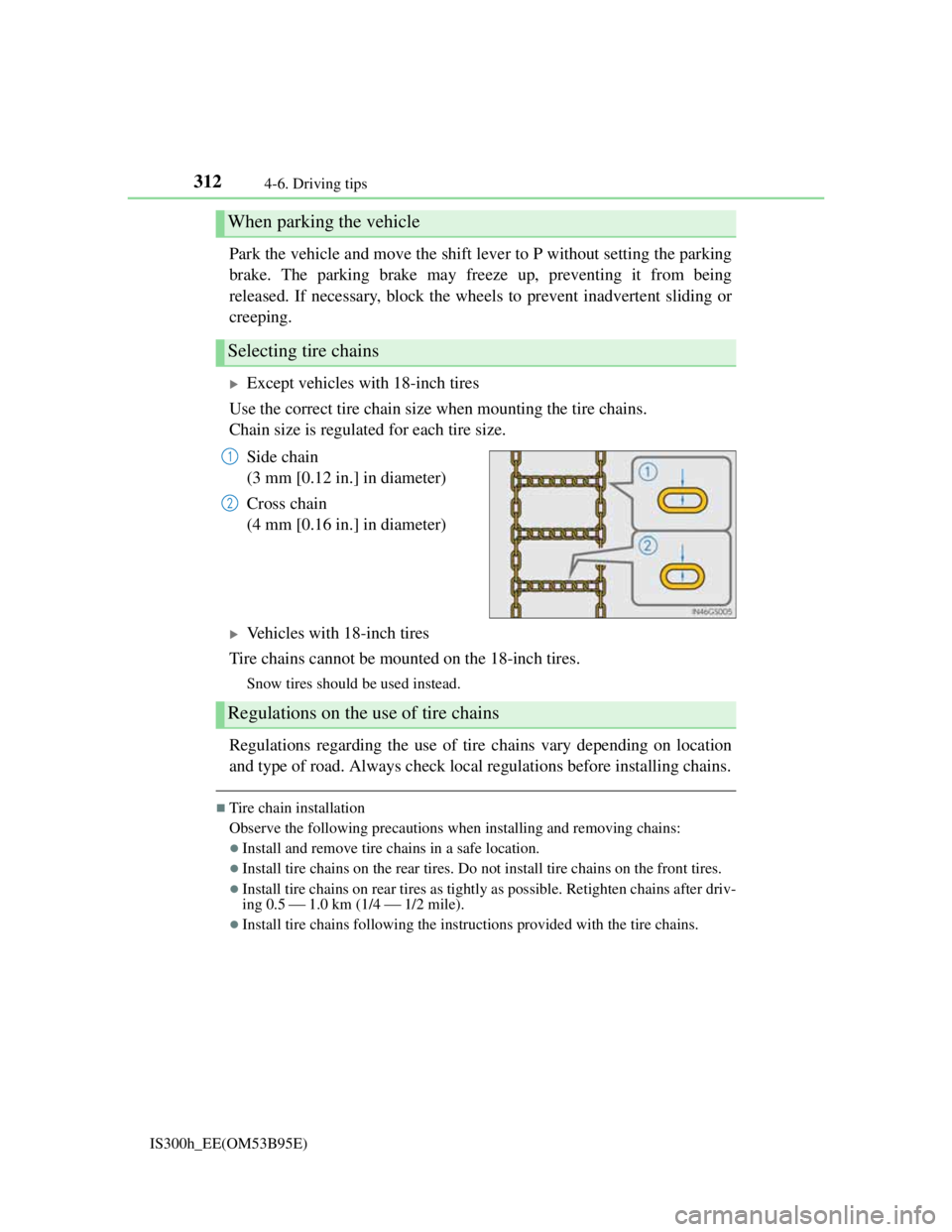
Side chain
(3 mm [0.12 in.] in diameter)
Cross chain
(4 mm [0.16 in.] in diameter)
Vehicles with 18-inch tires
Tire chains cannot be mounted on the 18-inch tires.
Snow tires should be used instead.
Regulations regarding the use of tire chains vary depending on location
and type of road. Always check local regulations before installing chains.
Tire chain installation
Observe the following precautions when installing and removing chains:
Install and remove tire chains in a safe location.
Install tire chains on the rear tires. Do not install tire chains on the front tires.
Install tire chains on rear tires as tightly as possible. Retighten chains after driv-
ing 0.5 1.0 km (1/4 1/2 mile).
Install tire chains following the instructions provided with the tire chains.
When parking the vehicle
Selecting tire chains
1
2
Regulations on the use of tire chains
Page 448 of 628

4347-2. Maintenance
IS300h_EE(OM53B95E)
Where to go for maintenance service?
In order to maintain your vehicle in the best possible condition, Lexus recom-
mends that maintenance service operations as well as other inspections and
repairs be carried out by authorized Lexus dealers or repairers or other duly qual-
ified and equipped professionals. For repairs and services covered by your war-
ranty, please visit an authorized Lexus dealer or repairer, who will use genuine
Lexus parts in repairing any difficulties you may encounter. There can also be
advantages in utilizing authorized Lexus dealers or repairers for non-warranty
repairs and services, as members of the Lexus network will be able to expertly
assist you with any difficulties you may encounter.
Your Lexus dealer or repairer, or another duly qualified and equipped profes-
sional will perform all of the scheduled maintenance on your vehicle reliably and
economically due to their experience with Lexus vehicles.
Does your vehicle need repairs?
Be on the alert for changes in performance and sounds, and visual tip-offs that
indicate service is needed. Some important clues are:
Engine missing, stumbling or pinging
Appreciable loss of power
Strange engine noises
A fluid leak under the vehicle (However, water dripping from the air condition-
ing system after use is normal.)
Change in exhaust sound (This may indicate a dangerous carbon monoxide
leak. Drive with the windows open and have the exhaust system checked imme-
diately.)
Flat-looking tires, excessive tire squeal when cornering, uneven tire wear
Vehicle pulls to one side when driven straight on a level road
Strange noises related to suspension movement
Loss of brake effectiveness, spongy feeling brake pedal, pedal almost touches
the floor, vehicle pulls to one side when braking
Engine coolant temperature continually higher than normal (P. 110)
If you notice any of these clues, take your vehicle to any authorized Lexus dealer
or repairer, or another duly qualified and equipped professional as soon as possi-
ble. Your vehicle may need adjustment or repair.
CAUTION
If your vehicle is not properly maintained
Improper maintenance could result in serious damage to the vehicle and possi-
ble death or serious injury.
Handling of the 12-volt battery
12-volt battery posts, terminals and related accessories contain lead and lead
compounds which are known to cause brain damage. Wash your hands after
handling.
(P. 447)