seal Lexus IS300h 2015 Owner's Manual
[x] Cancel search | Manufacturer: LEXUS, Model Year: 2015, Model line: IS300h, Model: Lexus IS300h 2015Pages: 628, PDF Size: 137.89 MB
Page 88 of 628
881-2. Hybrid system
IS300h_EE(OM53D56E)
CAUTION
■Hybrid battery (traction battery)
●Your vehicle contains a sealed nickel-metal hydride battery. Never resell, hand over
or modify the hybrid battery. To prevent accidents, hybrid batteries that have been
removed from a disposed vehicle are collected through any authorized Lexus dealer
or repairer, or another duly qualified and equipped professional. Do not dispose of
the battery yourself.
Unless the battery is properly collected, the following may occur, resulting in death
or serious injury:
• The hybrid battery may be illegally di sposed of or dumped, and someone may
touch a high voltage part, resu lting in an electric shock.
• The hybrid battery is intended to be used exclusively with your hybrid vehicle. If the hybrid battery is used outside of your vehicle or modified in any way, accidents
such as electric shock, heat generation, smoke generation, an explosion and elec-
trolyte leakage may occur.
When reselling or handing over your vehi cle, the possibility of an accident is
extremely high because the person receiving the vehicle may not be aware of these
dangers.
●If your vehicle is disposed of without the hybrid battery having been removed, there is
a danger of serious electric shock if high voltage parts, cables and their connectors
are touched. In the event that your vehicle must be disposed of, the hybrid battery
must be disposed of by any authorized Lexus dealer or repairer, or another duly qual-
ified and equipped professional. If the hybrid battery is not disposed of properly, it
may cause electric shock that can re sult in death or serious injury.
Page 475 of 628
4757-3. Do-it-yourself maintenance
7
Maintenance and care
IS300h_EE(OM53D56E)
NOTICE
■Repairing or replacing tires, wheels, tire pressure warning valves, transmitters and
tire valve caps
●When removing or fitting the wheels, tires or the tire pressure warning valves and
transmitters, contact any authorized Lexus dealer or repairer, or another duly quali-
fied and equipped professional as the tire pressure warning valves and transmitters
may be damaged if not handled correctly.
●Make sure to install the tire valve caps. If the tire valve caps are not installed, water
could enter the tire pressure warning valves and the tire pressure warning valves
could be bound.
●When replacing tire valve caps, do not use tire valve caps other than those specified.
The cap may become stuck.
■To avoid damage to the tire pressure warning valves and transmitters
When a tire is repaired with liquid sealants , the tire pressure warning valve and trans-
mitter may not operate properly. If a liquid sealant is used, contact any authorized
Lexus dealer or repairer, or another duly qu alified and equipped professional or other
qualified service shop as soon as possible. After use of liquid sealant, make sure to
replace the tire pressure warning valve and transmitter when repairing or replacing the
tire. ( →P. 4 6 8 )
■Driving on rough roads
Take particular care when driving on roads with loose surfaces or potholes.
These conditions may cause losses in tire inflation pressure, reducing the cushioning
ability of the tires. In addition, driving on rough roads may cause damage to the tires
themselves, as well as the vehicle’s wheels and body.
■Low profile tires (except 16-inch tires)
Low profile tires may cause greater damage than usual to the tire wheel when sustain-
ing impact from the road surface. Therefore, pay attention to the following:
●Be sure to use proper tire inflation pressure. If tires are under-inflated, they may be
damaged more severely.
●Avoid potholes, uneven pavement, curbs and other road hazards. Failure to do so
may lead to severe tire and wheel damage.
■If tire inflation pressure of each tire becomes low while driving
Do not continue driving, or your tires and/or wheels may be ruined.
Page 547 of 628
5478-2. Steps to take in an emergency
8
When trouble arises
IS300h_EE(OM53D56E)
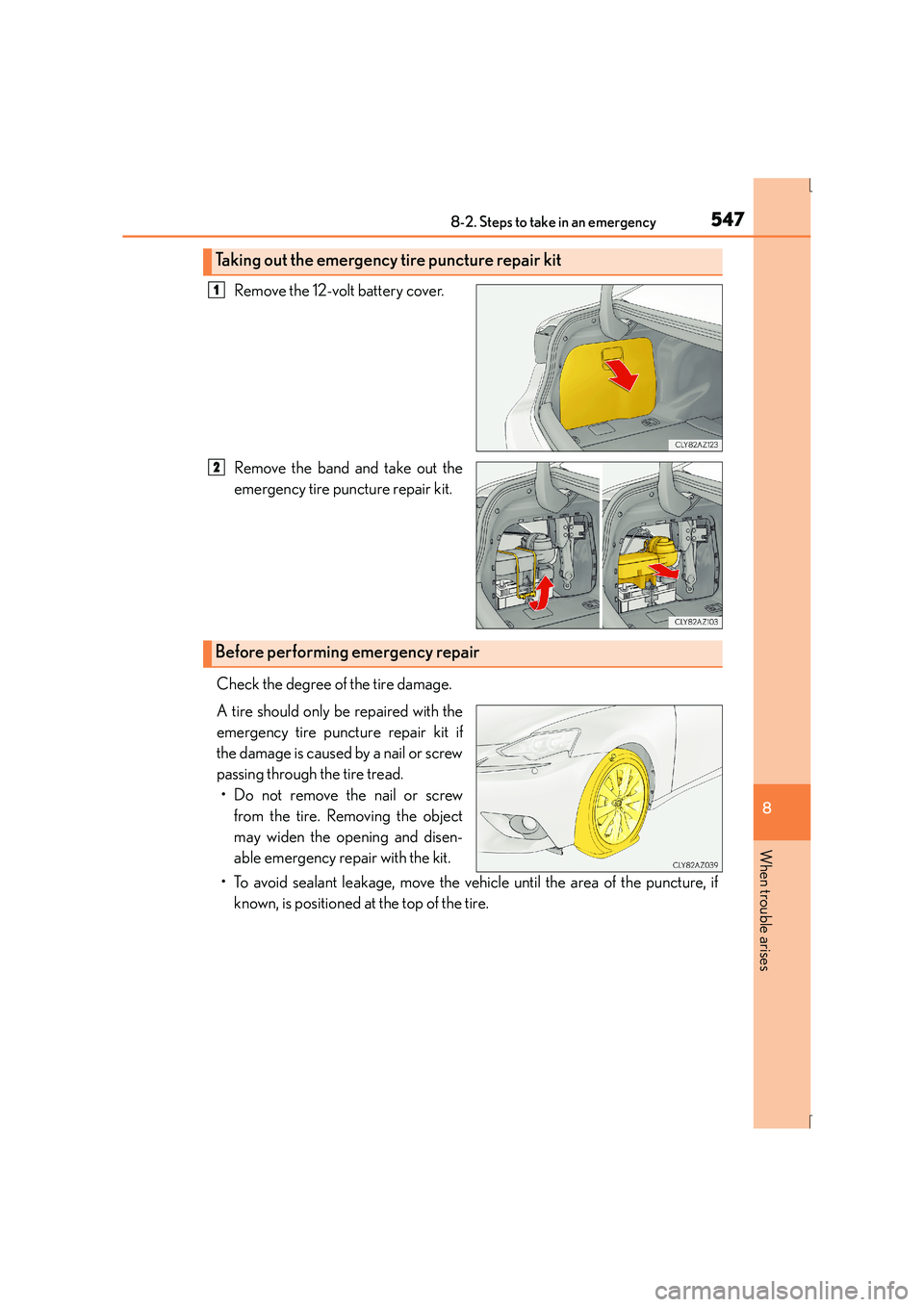
Remove the 12-volt battery cover.
Remove the band and take out the
emergency tire puncture repair kit.
Check the degree of the tire damage.
A tire should only be repaired with the
emergency tire puncture repair kit if
the damage is caused by a nail or screw
passing through the tire tread. • Do not remove the nail or screw from the tire. Removing the object
may widen the opening and disen-
able emergency repair with the kit.
• To avoid sealant leakage, move the vehicle until the area of the puncture, if known, is positioned at the top of the tire.
Taking out the emergency tire puncture repair kit
1
2
Before performing emergency repair
Page 550 of 628
5508-2. Steps to take in an emergency
IS300h_EE(OM53D56E)
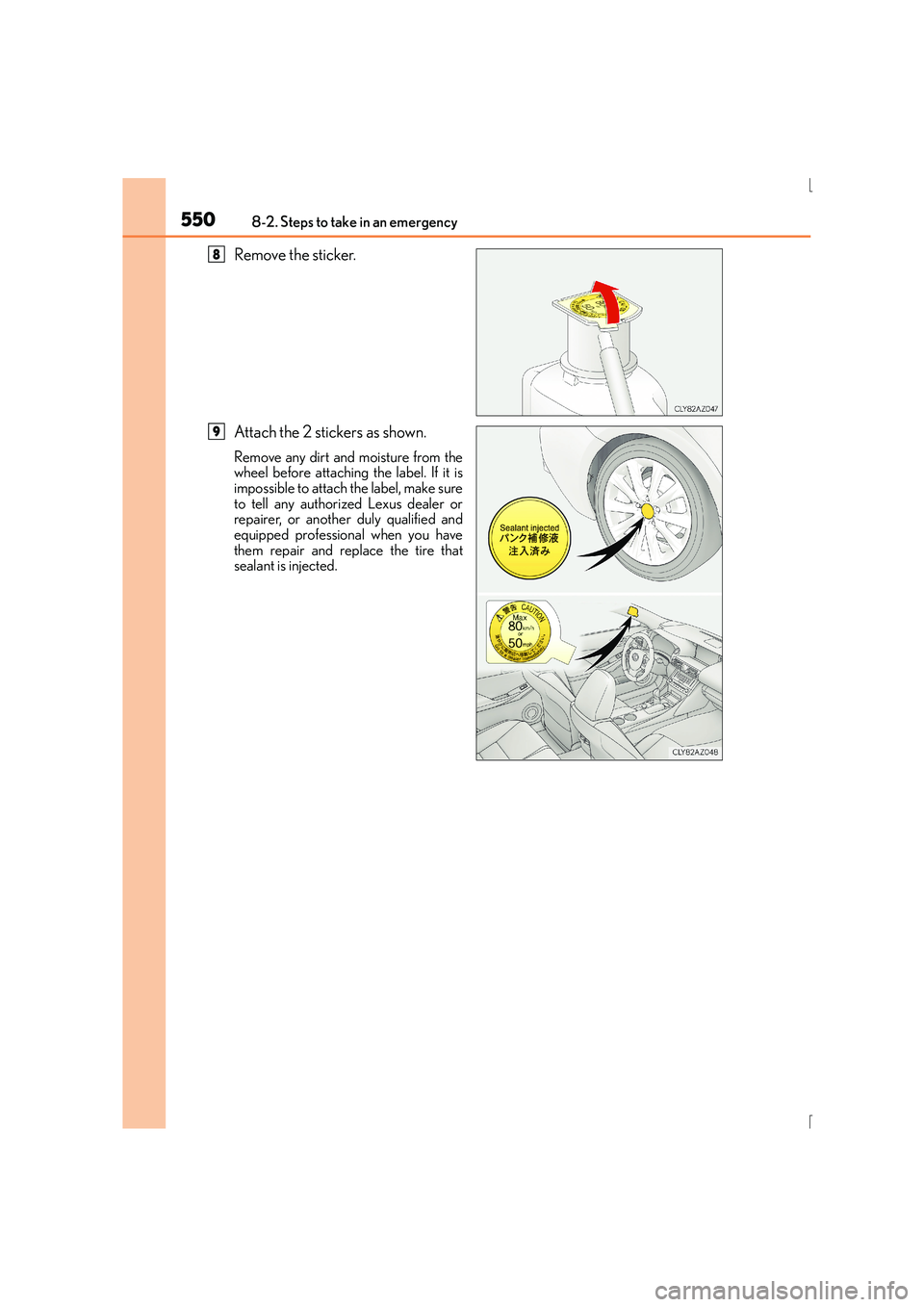
Remove the sticker.
Attach the 2 stickers as shown.
Remove any dirt and moisture from the
wheel before attaching the label. If it is
impossible to attach the label, make sure
to tell any authorized Lexus dealer or
repairer, or another duly qualified and
equipped professional when you have
them repair and replace the tire that
sealant is injected.
8
9
Page 552 of 628
5528-2. Steps to take in an emergency
IS300h_EE(OM53D56E)
Start the hybrid system.
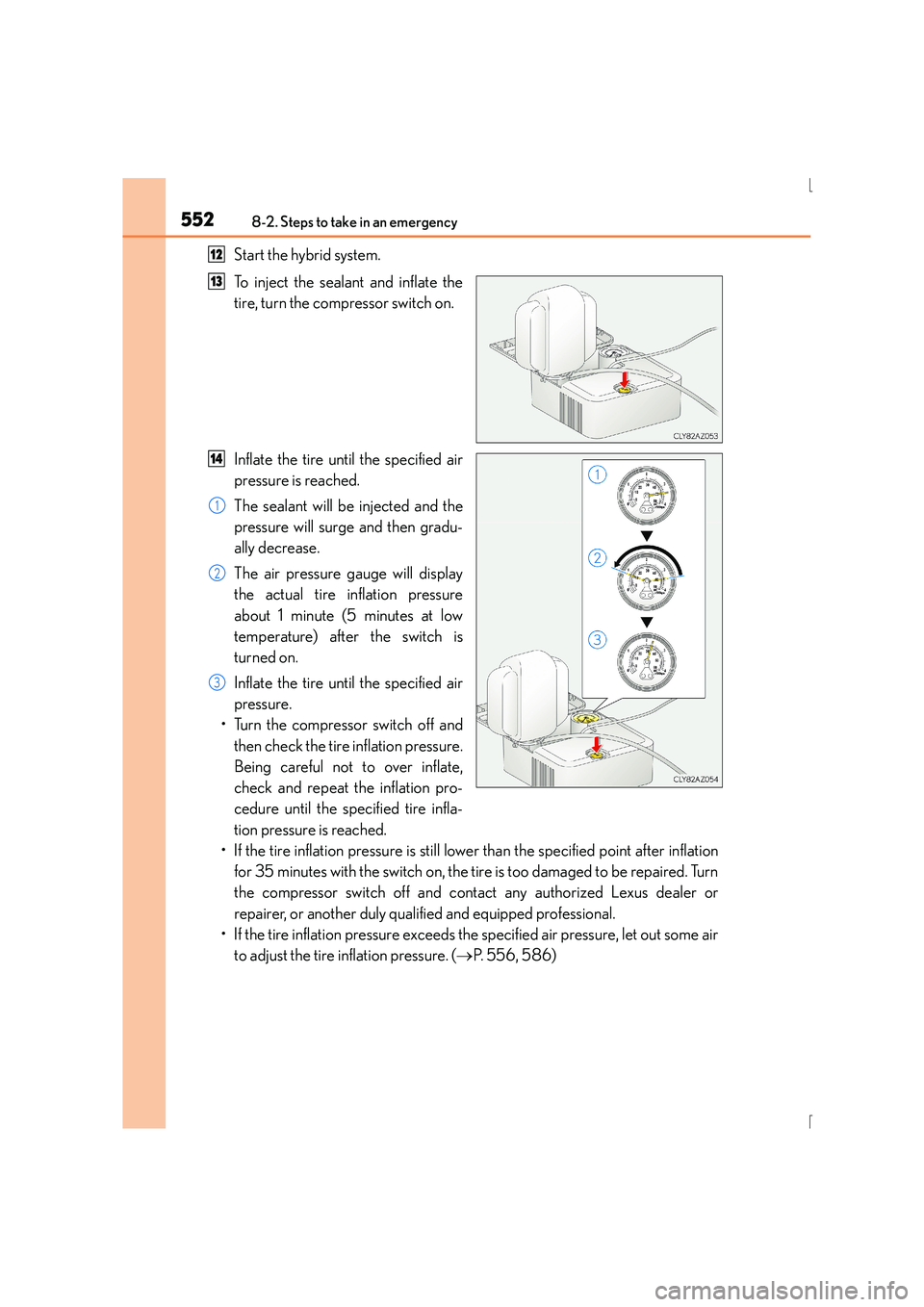
To inject the sealant and inflate the
tire, turn the compressor switch on.
Inflate the tire until the specified air
pressure is reached.
The sealant will be injected and the
pressure will surge and then gradu-
ally decrease.
The air pressure gauge will display
the actual tire inflation pressure
about 1 minute (5 minutes at low
temperature) after the switch is
turned on.
Inflate the tire until the specified air
pressure.
• Turn the compressor switch off and
then check the tire inflation pressure.
Being careful not to over inflate,
check and repeat the inflation pro-
cedure until the specified tire infla-
tion pressure is reached.
• If the tire inflation pressure is still lower than the specified point after inflation
for 35 minutes with the switch on, the tire is too damaged to be repaired. Turn
the compressor switch off and contact any authorized Lexus dealer or
repairer, or another duly qualified and equipped professional.
• If the tire inflation pressure exceeds the specified air pressure, let out some air
to adjust the tire inflation pressure. ( →P. 5 5 6 , 5 8 6 )12
13
14
1
2
3
Page 553 of 628
5538-2. Steps to take in an emergency
8
When trouble arises
IS300h_EE(OM53D56E)
With the compressor switch off, disconnect the hose from the valve on the tire
and then pull out the power plug from the power outlet socket.
Some sealant may leak when the hose is removed.
Install the valve cap onto the valve of the emergency repaired tire.
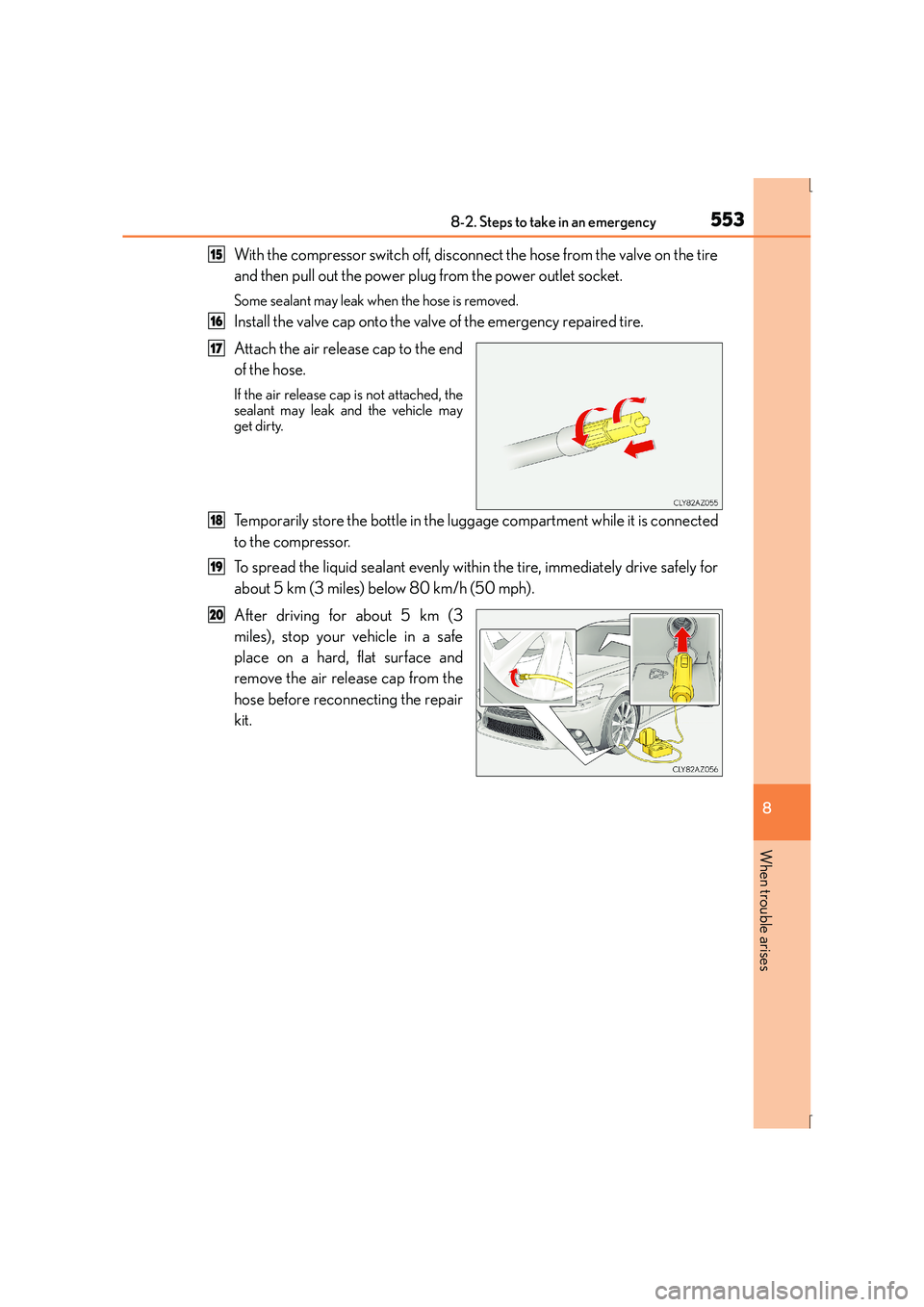
Attach the air release cap to the end
of the hose.
If the air release cap is not attached, the
sealant may leak and the vehicle may
get dirty.
Temporarily store the bottle in the luggage compartment while it is connected
to the compressor.
To spread the liquid sealant evenly within the tire, immediately drive safely for
about 5 km (3 miles) below 80 km/h (50 mph).
After driving for about 5 km (3
miles), stop your vehicle in a safe
place on a hard, flat surface and
remove the air release cap from the
hose before reconnecting the repair
kit.
15
16
17
18
19
20
Page 554 of 628
5548-2. Steps to take in an emergency
IS300h_EE(OM53D56E)
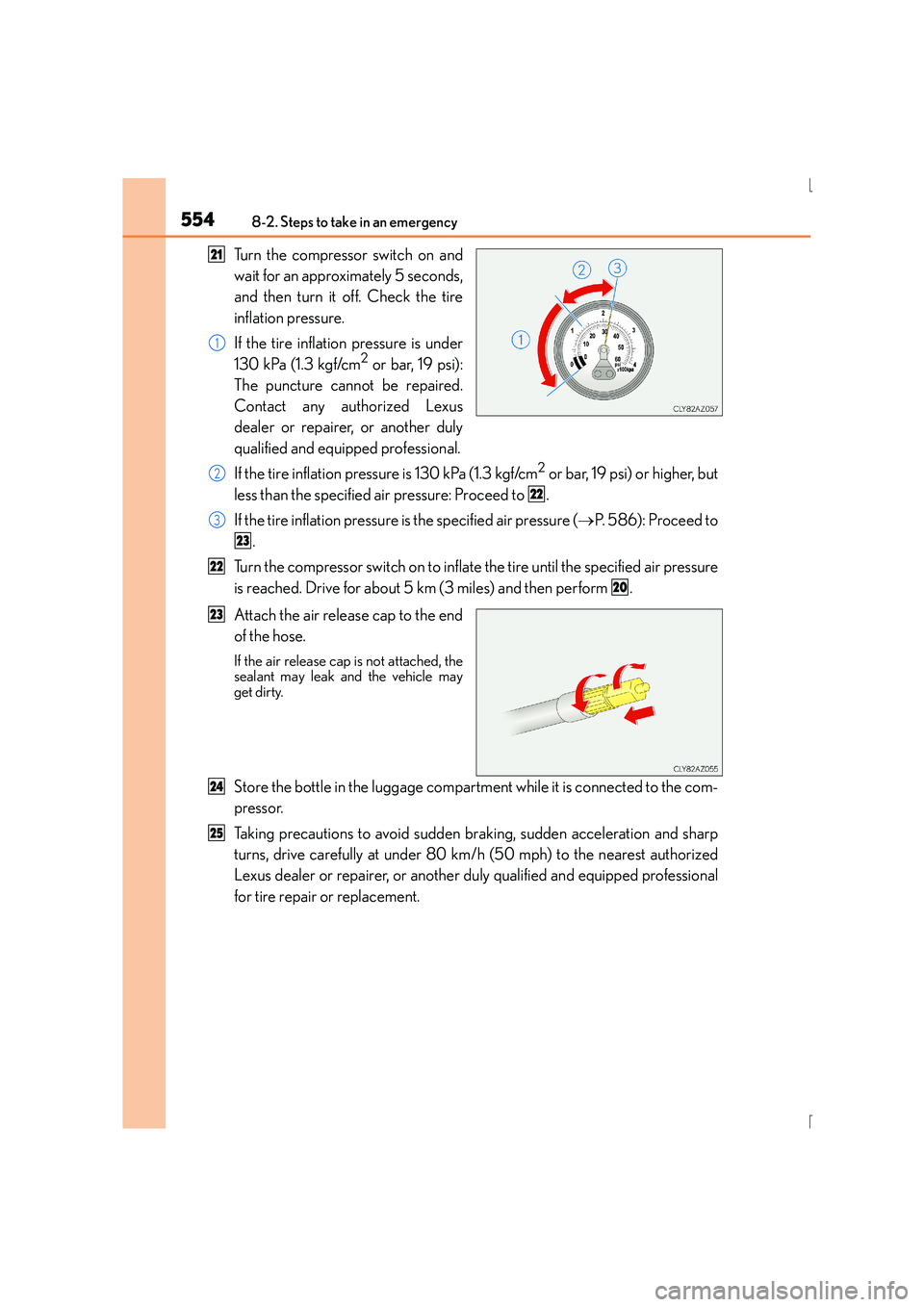
Turn the compressor switch on and
wait for an approximately 5 seconds,
and then turn it off. Check the tire
inflation pressure.
If the tire inflation pressure is under
130 kPa (1.3 kgf/cm
2 or bar, 19 psi):
The puncture cannot be repaired.
Contact any authorized Lexus
dealer or repairer, or another duly
qualified and equipped professional.
If the tire inflation pressure is 130 kPa (1.3 kgf/cm
2 or bar, 19 psi) or higher, but
less than the specified air pressure: Proceed to .
If the tire inflation pressure is the specified air pressure ( →P. 586): Proceed to
.
Turn the compressor switch on to inflate the tire until the specified air pressure
is reached. Drive for about 5 km (3 miles) and then perform .
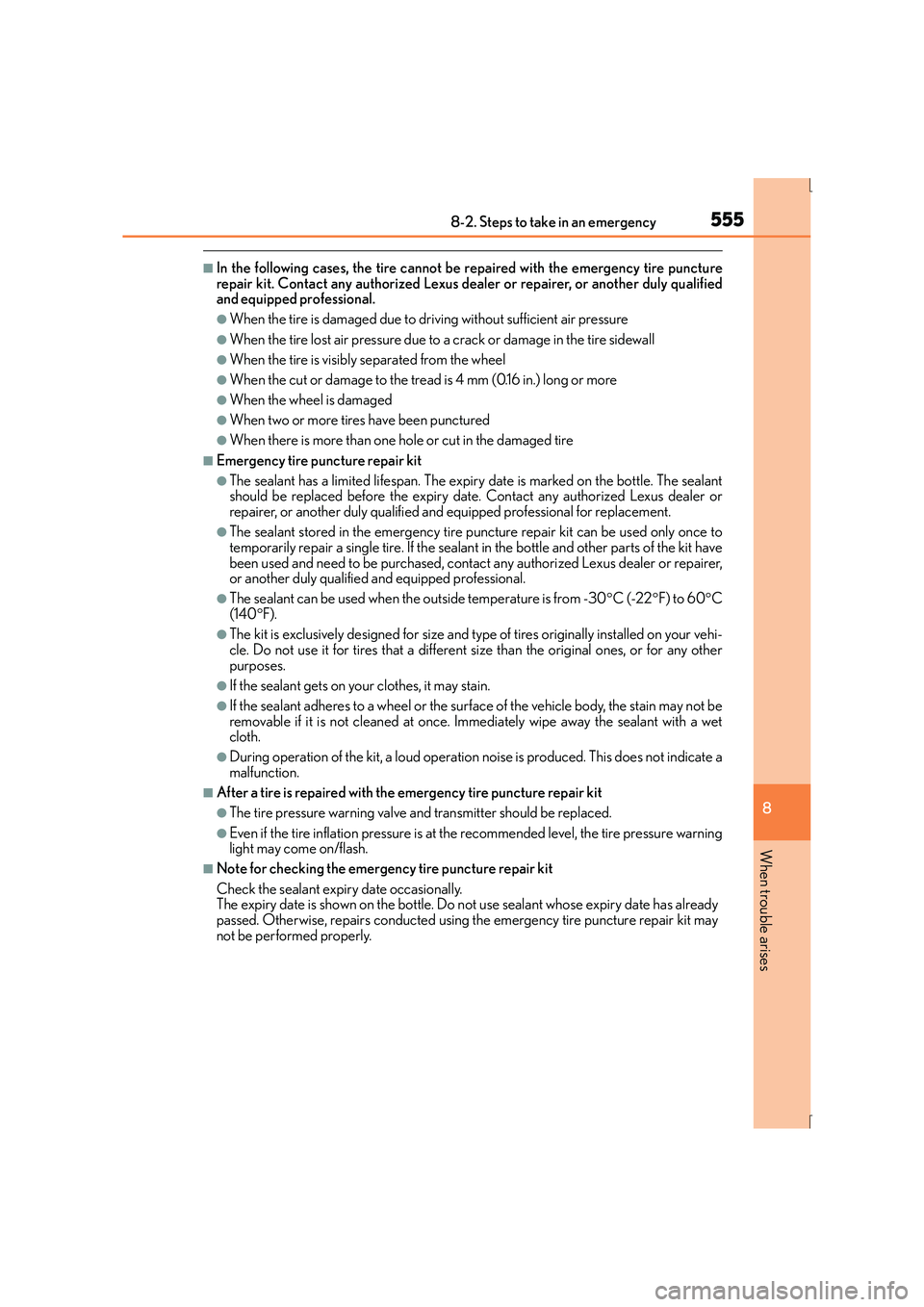
Attach the air release cap to the end
of the hose.
If the air release cap is not attached, the
sealant may leak and the vehicle may
get dirty.
Store the bottle in the luggage compartment while it is connected to the com-
pressor.
Taking precautions to avoid sudden braking, sudden acceleration and sharp
turns, drive carefully at under 80 km/h (50 mph) to the nearest authorized
Lexus dealer or repairer, or another duly qualified and equipped professional
for tire repair or replacement.
21
1
2
22
3
23
22
20
23
24
25
Page 555 of 628
5558-2. Steps to take in an emergency
8
When trouble arises
IS300h_EE(OM53D56E)
■In the following cases, the tire cannot be repaired with the emergency tire puncture
repair kit. Contact any authorized Lexus dealer or repairer, or another duly qualified
and equipped professional.
●When the tire is damaged due to driving without sufficient air pressure
●When the tire lost air pressure due to a crack or damage in the tire sidewall
●When the tire is visibly separated from the wheel
●When the cut or damage to the tread is 4 mm (0.16 in.) long or more
●When the wheel is damaged
●When two or more tires have been punctured
●When there is more than one hole or cut in the damaged tire
■Emergency tire puncture repair kit
●The sealant has a limited lifespan. The expiry date is marked on the bottle. The sealant
should be replaced before the expiry date. Contact any authorized Lexus dealer or
repairer, or another duly qualified and equipped professional for replacement.
●The sealant stored in the emergency tire puncture repair kit can be used only once to
temporarily repair a single tire. If the sealant in the bottle and other parts of the kit have
been used and need to be purchased, contact any authorized Lexus dealer or repairer,
or another duly qualified and equipped professional.
●The sealant can be used when the outside temperature is from -30 °C (-22 °F) to 60 °C
(140 °F).
●The kit is exclusively designed for size and type of tires originally installed on your vehi-
cle. Do not use it for tires that a different size than the original ones, or for any other
purposes.
●If the sealant gets on your clothes, it may stain.
●If the sealant adheres to a wheel or the surface of the vehicle body, the stain may not be
removable if it is not cleaned at once. Immediately wipe away the sealant with a wet
cloth.
●During operation of the kit, a loud operatio n noise is produced. This does not indicate a
malfunction.
■After a tire is repaired with the emergency tire puncture repair kit
●The tire pressure warning valve and transmitter should be replaced.
●Even if the tire inflation pressure is at the recommended level, the tire pressure warning
light may come on/flash.
■Note for checking the emergency tire puncture repair kit
Check the sealant expiry date occasionally.
The expiry date is shown on the bottle. Do not use sealant whose expiry date has already
passed. Otherwise, repairs conducted using the emergency tire puncture repair kit may
not be performed properly.
Page 556 of 628
5568-2. Steps to take in an emergency
IS300h_EE(OM53D56E)
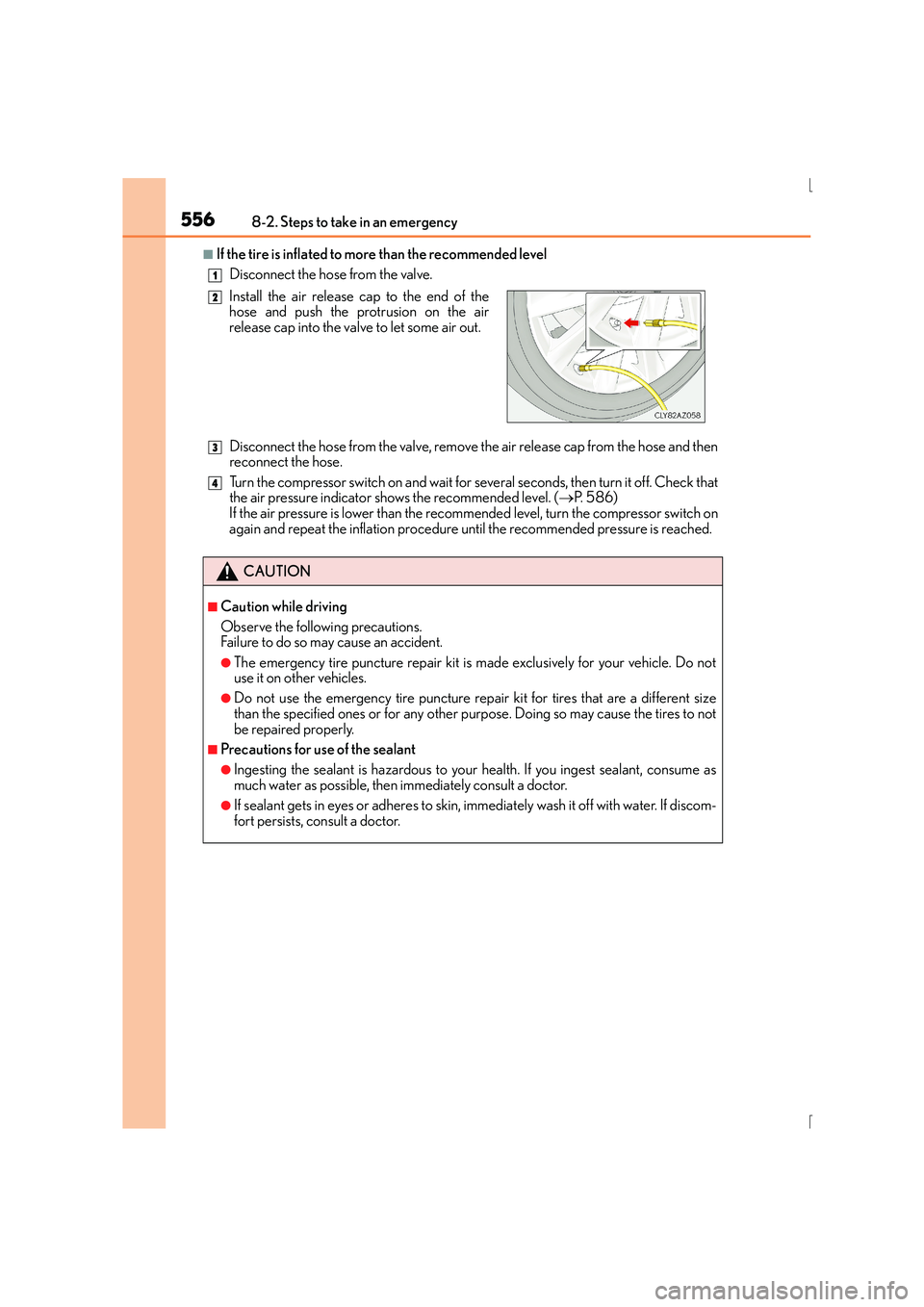
■If the tire is inflated to more than the recommended levelDisconnect the hose from the valve.
Disconnect the hose from the valve, remove the air release cap from the hose and then
reconnect the hose.
Turn the compressor switch on and wait for se veral seconds, then turn it off. Check that
the air pressure indicator shows the recommended level. ( →P. 5 8 6 )
If the air pressure is lower than the recommended level, turn the compressor switch on
again and repeat the inflation procedure until the recommended pressure is reached. Install the air release cap to the end of the
hose and push the protrusion on the air
release cap into the valve to let some air out.
CAUTION
■Caution while driving
Observe the following precautions.
Failure to do so may cause an accident.
●The emergency tire puncture repair kit is made exclusively for your vehicle. Do not
use it on other vehicles.
●Do not use the emergency tire puncture repair kit for tires that are a different size
than the specified ones or for any other purpose. Doing so may cause the tires to not
be repaired properly.
■Precautions for use of the sealant
●Ingesting the sealant is hazardous to your health. If you ingest sealant, consume as
much water as possible, then immediately consult a doctor.
●If sealant gets in eyes or adheres to skin, i mmediately wash it off with water. If discom-
fort persists, consult a doctor.
1
2
3
4
Page 557 of 628
5578-2. Steps to take in an emergency
8
When trouble arises
IS300h_EE(OM53D56E)
CAUTION
■When fixing the flat tire
●Stop your vehicle in a safe and flat area.
●Do not touch the wheels or the area around the brakes immediately after the vehicle
has been driven.
After the vehicle has been driven, the wheels and the area around the brakes may be
extremely hot. Touching these areas with hands, feet or other body parts may result in
burns.
●Connect the valve and hose securely with the tire installed on the vehicle.
●If the hose is not properly connected to the valve, air leakage may occur or sealant
may be sprayed out.
●If the hose comes off the valve while inflating the tire, there is a risk that the hose will
move abruptly due to air pressure.
●After inflation of the tire has completed, the sealant may splatter when the hose is dis-
connected or some air is let out of the tire.
●Follow the operation procedure to repair the tire. If the procedure is not followed, the
sealant may spray out.
●Keep back from the tire while it is being re paired, as there is a chance of it bursting
while the repair operation is being performe d. If you notice any cracks or deforma-
tion of the tire, turn off the compressor sw itch and stop the repair operation immedi-
ately.
●The kit may overheat if operated for a long period of time. Do not operate the com-
pressor continuously for more than 10 minutes.
●Parts of the kit become hot during operation. Be careful handling the kit during and
after operation.
●Do not attach the vehicle speed warning sticker to an area other than the one indi-
cated. If the sticker is attached to an area where an SRS airbag is located, such as the
pad of the steering wheel, it may prevent the SRS air bag from operating properly.
■Driving to spread the liquid sealant evenly
●Drive the vehicle carefully at a low speed. Be especially careful when turning and cor-
nering.
●If the vehicle does not drive straight or you feel a pull through the steering wheel, stop
the vehicle and check the following:
• Tire condition. The tire may have separated from the wheel.
• Tire inflation pressure. If tire infl ation pressure is 130 kPa (1.3 kgf/cm
2 or bar, 19 psi)
or below, this may indicate severe tire damage.