fuel type LEXUS IS350 2022 Owners Manual
[x] Cancel search | Manufacturer: LEXUS, Model Year: 2022, Model line: IS350, Model: LEXUS IS350 2022Pages: 440, PDF Size: 22.72 MB
Page 14 of 440

12Pictorial index
Precautions for winter season ..................................................................................... P.234
To prevent freezing (windshield wiper de-icer)
*................................................. P.249
Precautions for car wash ............................................................................................... P.272
Fuel filler door .......................................................................................................... P.157
Refueling method ............................................................................................................... P.157
Fuel type/fuel tank capacity ......................................................................................... P.367
Tires.......................................................................................................................... .. P.296
Tire size/inflation pressure ............................ .................................................... P.296, 372
Winter tires/tire chains .................................................................................................. P.234
Checking/rotation/tire pressure warning system.............................................. P.296
Coping with flat tires......................................................................................................... P.341
Hood ......................................................................................................................... P. 285
Opening ........................................................................................................................ .......P.285
Engine oil ..................................................................................................................... ......... P.367
Coping with overheating ............................................................................................... P.357
Warning messages ..........................................................................................................P.338
Headlights ................................................................................................................. P.14 5
Turn signal lights ......................................................................................................P.138
Parking lights/daytime running lights................ ............................................... P.145
Side marker lights ................................................................................................... P.145
Tail lights .................................................................................................................... P.145
Stop lights
Tail lights .................................................................................................................... P.145
Back-up lights
Shifting the shift lever to R .............................................................................................. P.13 5
License plate lights ................................................................................................. P.145
*:If equipped
Light bulbs of the exterior lights for driving
(Replacing method: P. 313, Watts: P.375)
E
F
G
H
I
J
K
L
M
N
O
Page 32 of 440

301-1. For safe use
Your vehicle is equipped with ADVANCED AIRBAGS designed based on the US
motor vehicle safety standards (FMVSS20 8). The airbag sensor assembly (ECU)
controls airbag deployment based on information obtain ed from the sensors etc.
shown in the system components diagram above. This information includes crash
severity and occupant information. As th e airbags deploy, a chemical reaction in
the inflators quickly fills the airbags with no n-toxic gas to help restrain the motion of
the occupants.
■If the SRS airbags deploy (inflate)
●Slight abrasions, burns, bruising etc., may
be sustained from SRS airbags, due to the
extremely high speed deployment (infla-
tion) by hot gases.
●A loud noise and white powder will be
emitted.
●Parts of the airbag module (steering
wheel hub, airbag cover and inflator) as
well as the seats, parts of the front and
rear pillars, an d roof side rails may be hot
for several minutes. The airbag itself may
also be hot.
●The windshield may crack.
●All of the doors will be unlocked. ( P.91)
●The brakes and stop lights will be con-
trolled automatically. (P.230)
●The interior lights will turn on automati-
cally. (P.254)
●The emergency flashers will turn on auto-
matically. ( P.320)
●Fuel supply to the engine will be stopped.
(P.328)
●For Lexus Enform Safety Connect sub-
scribers, if any of the following situations
occur, the system is designed to send an
emergency call to the response center,
notifying them of the vehicle’s location
(without needing to push the “SOS” but-
ton) and an agent will attempt to speak
with the occupants to ascertain the level
of emergency and assi stance required. If
the occupants are unable to communi-
cate, the agent automatically treats the
call as an emergency and helps to dis-
patch the necessary emergency services.
( P.54)
• An SRS airbag is deployed.
• A seat belt pretensioner is activated. • The vehicle is involved in a severe
rear-end collision.
■SRS airbag deployment conditions (SRS
front airbags)
●The SRS front airbags will deploy in the
event of an impact that exceeds the set
threshold level (the level of force corre-
sponding to an approximately 12 - 18
mph [20 - 30 km/h] frontal collision with
a fixed wall that does not move or
deform).
However, this threshol d velocity will be
considerably higher in the following situa-
tions:
• If the vehicle strikes an object, such as a parked vehicle or sign pole, which can
move or deform on impact
• If the vehicle is involved in an underride
collision, such as a collision in which the
front of the vehicle “u nderrides”, or goes
under, the bed of a truck
●Depending on the type of collision, it is
possible that only the seat belt
pretensioners will activate.
●The SRS front airbags for the front pas-
senger will not activate if there is no pas-
senger sitting in the front passenger seat.
However, the SRS front airbags for the
front passenger may deploy if luggage is
put in the seat, even if the seat is unoccu-
pied.
■SRS airbag deployment conditions (SRS
side and curtain shield airbags)
●The SRS side and curtain shield airbags
will deploy in the event of an impact that
exceeds the set threshold level (the level
of force corresponding to the impact
force produced by an approximately
3300 lb. [1500 kg] vehicle colliding with
the vehicle cabin from a direction per-
Page 80 of 440

782-1. Instrument cluster
Eco Driving Indicator
Boost gauge/engine oil tempera-
ture gauge/engine oil pressure
gauge (if equipped)
G-force
Gear Position
Tire pressure ( P.299)
Display off
■Drive information 1/Drive infor-
mation 2/Drive information 3
Displays drive information such as the
following:
Use the displayed values as a reference
only.
Drive information 1
• Current fuel consumption
• Average fuel economy (after reset)
Drive information 2
• Distance (driving range)
• Average vehicle speed (after reset)
Drive information 3*
• Average fuel economy (after refuel)
• Elapsed time (after start)
*:Except F SPORT models
Displayed items (listed below) can be
changed on . ( P.81)
Current fuel consumption
Bar type: Displays instantaneous current
fuel consumption
Average fuel economy
After reset: Displays average fuel con-
sumption since the display was reset
*1
After start: Displays average fuel con-
sumption since engine start After refuel: Displays average fuel con-
sumption since refuel
Average vehicle speed
After reset: Displays average vehicle
speed since the display was reset
*1
After start: Displays average vehicle speed
since engine start
Elapsed time
After reset: Displays elapsed time since the
display was reset
*1
After start: Displays elapsed time since
engine start
Distance
Driving range: Displays driving range with
remaining fuel
*2, 3
After start: Displays the distance driven
since engine start
Other
Blank: No item
*1: To reset, display the desired item and
press and hold of the meter con-
trol switch.
*2: This distance is computed based on your average fuel consumption. As a
result, the actual distance that can be
driven may differ from that displayed.
*3: When only a small amount of fuel is added to the tank, the display may not
be updated.
When refueling, turn the engine switch
off. If the vehicle is refueled without
turning the engine switch off, the display
may not be updated.
Page 85 of 440

832-1. Instrument cluster
2
Vehicle status information and indicators
menu screen.
If a screen other than “History” is dis-
played, select “History”.
This system can also be operated by
the touch screen.Best recorded fuel consumption
Latest fuel consumption
Previous fuel consumption record
Resetting the history data
Updating the latest fuel consump-
tion data
The average fuel consumption history
is divided by color into past averages
and the average fuel consumption
since the last updated. Use the dis-
played average fuel consumption as a
reference.
The image is an example only, and may
vary slightly from actual conditions.
■Updating the history data
Update the latest fuel consumption by
selecting “Updat e” to measure the current
fuel consumption again.
■Resetting the data
The fuel consumption data can be deleted
by selecting “Clear”.
■Cruising range
Displays the estimated maximum distance
that can be driven with the quantity of fuel remaining.
This distance is computed based on your
average fuel consumption.
As a result, the actual distance that can be
driven may differ from that displayed.
Vehicle information can be displayed
on the side display (
P.240), then
select or to select the desired
screen.
The image is an example only, and may
vary slightly from actual conditions.
■Trip information (type A)
Displays the average fuel consumption
for the past 10 minutes in 1 minute
intervals, as well as the cruising range.
■Trip information (type B)
Displays the cruising range, average
fuel consumption and the amount of
time elapsed since the engine was
started.
A
B
C
D
E
Using the side display (vehicles
with a navigation system
[10.3-inch display])
Page 159 of 440
1574-4. Refueling
4
Driving
4-4.Refueling
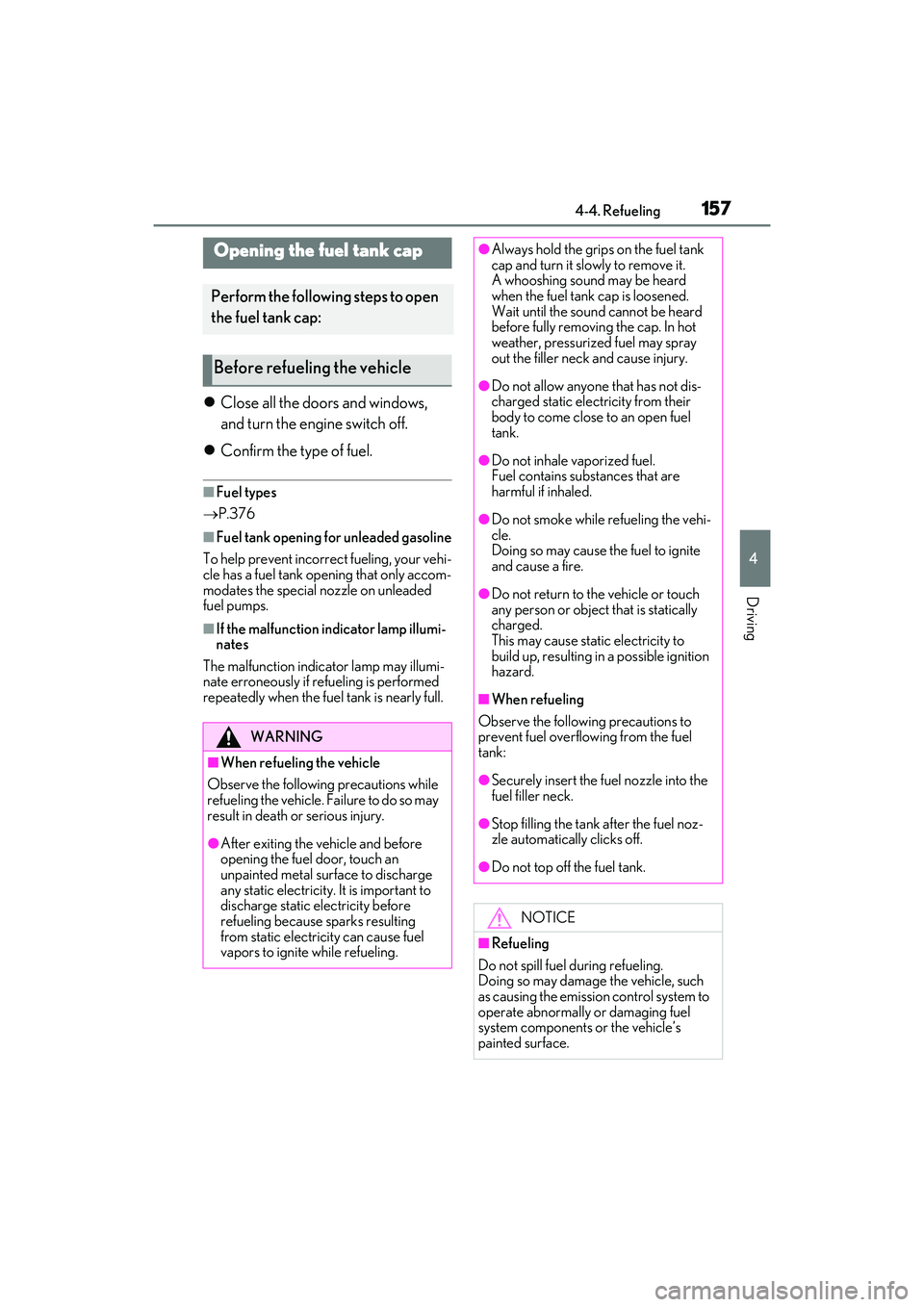
Close all the doors and windows,
and turn the engine switch off.
Confirm the type of fuel.
■Fuel types
P.376
■Fuel tank opening for unleaded gasoline
To help prevent incorrect fueling, your vehi-
cle has a fuel tank opening that only accom-
modates the special nozzle on unleaded
fuel pumps.
■If the malfunction indicator lamp illumi-
nates
The malfunction indicator lamp may illumi-
nate erroneously if refueling is performed
repeatedly when the fuel tank is nearly full.
Opening the fuel tank cap
Perform the following steps to open
the fuel tank cap:
Before refueling the vehicle
WARNING
■When refueling the vehicle
Observe the following precautions while
refueling the vehicle. Failure to do so may
result in death or serious injury.
●After exiting the ve hicle and before
opening the fuel door, touch an
unpainted metal surface to discharge
any static electricity. It is important to
discharge static electricity before
refueling because sparks resulting
from static electricity can cause fuel
vapors to ignite while refueling.
●Always hold the grips on the fuel tank
cap and turn it slowly to remove it.
A whooshing sound may be heard
when the fuel tank cap is loosened.
Wait until the sound cannot be heard
before fully removing the cap. In hot
weather, pressurized fuel may spray
out the filler neck and cause injury.
●Do not allow anyone that has not dis-
charged static electricity from their
body to come close to an open fuel
tank.
●Do not inhale vaporized fuel.
Fuel contains substances that are
harmful if inhaled.
●Do not smoke while refueling the vehi-
cle.
Doing so may cause the fuel to ignite
and cause a fire.
●Do not return to the vehicle or touch
any person or object that is statically
charged.
This may cause static electricity to
build up, resulting in a possible ignition
hazard.
■When refueling
Observe the following precautions to
prevent fuel overflowing from the fuel
tank:
●Securely insert the fuel nozzle into the
fuel filler neck.
●Stop filling the tank after the fuel noz-
zle automatically clicks off.
●Do not top off the fuel tank.
NOTICE
■Refueling
Do not spill fuel during refueling.
Doing so may damage the vehicle, such
as causing the emission control system to
operate abnormally or damaging fuel
system components or the vehicle’s
painted surface.
Page 248 of 440
2465-2. Using the air conditioning system and defogger
senger door.
●The doors that can recall the air condi-
tioning setting when unlocked using the
smart access system with push-button
start can be changed.
* For details, con-
tact your Lexus dealer.
*: The doors that can recall the driving
position memory are changed at the
same time.
■Operation of the air conditioning sys-
tem in Eco drive mode
In Eco drive mode, the air conditioning sys-
tem is controlled as follows to prioritize fuel
efficiency:
●Engine speed and compressor operation
controlled to restri ct heating/cooling
capacity
●Fan speed restricted when automatic
mode is selected
To improve air condit ioning performance,
perform the following operations:
●Adjust the fan speed
●Turn off Eco drive mode ( P.227)
■When the outside temperature falls to
nearly 32°F (0°C)
The dehumidification function may not
operate even when A/C is pressed or
“A/C” is selected.
■Ventilation and air conditioning odors
●To let fresh air in, set the air conditioning
system to the outside air mode.
●During use, various odors from inside and
outside the vehicle may enter into and
accumulate in the air conditioning sys-
tem. This may then cause odor to be
emitted from the vents.
●To reduce potential odors from occur-
ring:
• It is recommended that the air condition- ing system be set to outside air mode
prior to turning the vehicle off.
• The start timing of the blower may be delayed for a short period of time imme-
diately after the air conditioning system is
started in automatic mode or with the
micro dust and pollen filter on.
■Using the voice command system
Air conditioning system can be operated
using voice commands. For details, refer to
“NAVIGATION AND MULTIMEDIA
SYSTEM OWNER’S MANUAL”.
■Air conditioning filter
P.307
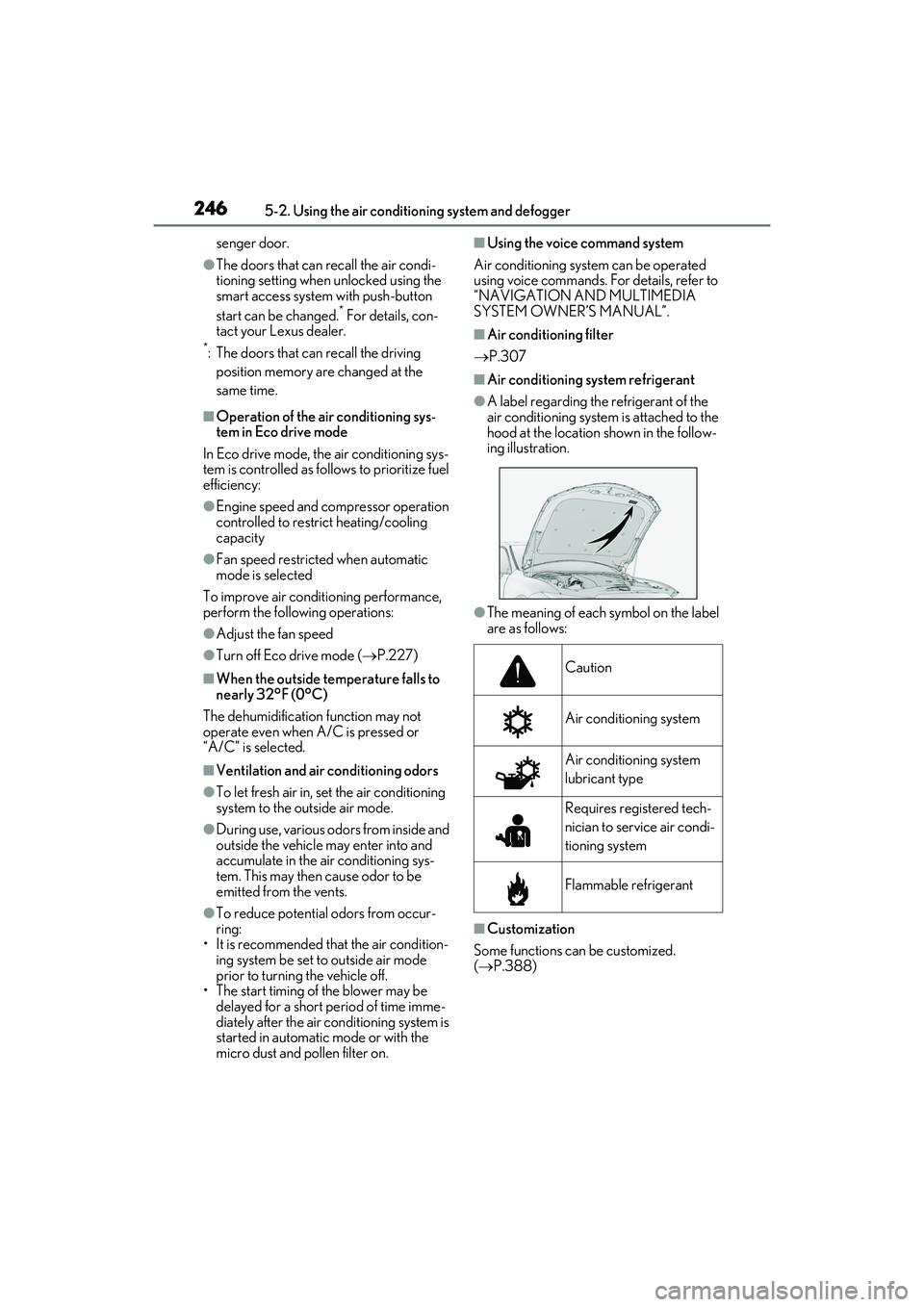
■Air conditioning system refrigerant
●A label regarding the refrigerant of the
air conditioning system is attached to the
hood at the location shown in the follow-
ing illustration.
●The meaning of each symbol on the label
are as follows:
■Customization
Some functions can be customized.
( P.388)
Caution
Air conditioning system
Air conditioning system
lubricant type
Requires registered tech-
nician to service air condi-
tioning system
Flammable refrigerant
Page 369 of 440
![LEXUS IS350 2022 Owners Manual 3678-1. Specifications
8
Vehicle specifications
■Oil capacity (Drain and refill [Ref-
erence
*])
*: The engine oil capacity is a reference quantity to be used when changing the
engine oil. Warm up](/img/36/58925/w960_58925-368.png "LEXUS IS350 2022 Owners Manual 3678-1. Specifications
8
Vehicle specifications
■Oil capacity (Drain and refill [Ref-
erence
*])
*: The engine oil capacity is a reference quantity to be used when changing the
engine oil. Warm up")
3678-1. Specifications
8
Vehicle specifications
■Oil capacity (Drain and refill [Ref-
erence
*])
*: The engine oil capacity is a reference quantity to be used when changing the
engine oil. Warm up and turn off the
engine, wait more than 5 minutes, and
check the oil level on the dipstick.
■Engine oil selection (IS350
AWD/IS350/IS300
AWD/IS300)
“Toyota Genuine Motor Oil” is used in
your Lexus vehicle. Use Lexus
approved “Toyota Genuine Motor Oil”
or equivalent to satisfy the following
grade and viscosity.
Oil grade: ILSAC GF-6A multigrade
engine oil
Recommended viscosity: SAE 0W-20
SAE 0W-20 is the best choice for
good fuel economy and good starting
in cold weather.
If SAE 0W-20 is not available, SAE
5W-20 oil may be used. However, it
must be replaced with SAE 0W-20 at
the next oil change.
Displacement303.2 cu. in. (4969 cm3)
Drive belt tensionAutomatic adjustment
Fuel
Fuel typeUnleaded gasoline only
Octane Rating91 (Research Octane Number 96) or higher
Fuel tank capacity
(Reference)17.5 gal. (66.5 L, 14.6 Imp. gal.)
Lubrication system
With filter
IS350 (2WD)
6.0 qt. (5.7 L, 5.0 Imp. qt.)
IS350 AWD/IS300
AWD (AWD)
6.8 qt. (6.4 L, 5.6 Imp. qt.)
IS300
4.9 qt. (4.6 L, 4.0 Imp. qt.)
IS500
9.1 qt. (8.6 L, 7.6 Imp. qt.)
Without fil- ter
IS350 (2WD)
5.8 qt. (5.5 L, 4.8 Imp. qt.)
IS350 AWD/IS300
AWD (AWD)
6.3 qt. (6.0 L, 5.3 Imp. qt.)
IS300
4.5 qt. (4.3 L, 3.8 Imp. qt.)
IS500
8.3 qt. (7.9 L, 7.0 Imp. qt.)
Page 379 of 440
3778-1. Specifications
8
Vehicle specifications
driving uphill. This is normal and there is
no need for concern.
NOTICE
■Notice on fuel quality
●Do not use improper fuels. If improper
fuels are used, the engine will be dam-
aged.
●Do not use leaded gasoline.
Leaded gasoline can cause damage to
your vehicle’s three-way catalytic con-
verters causing the emission control
system to malfunction.
●Do not use gasohol other than the type
previously stated.
Other gasohol may cause fuel system
damage or vehicle performance prob-
lems.
●Using unleaded gasoline with an
octane number or rating lower than
the level previously stated may cause
persistent he avy knocking.
At worst, this may lead to engine dam-
age and will void the vehicle warranty.
■When refueling with gasohol
Take care not to spill gasohol. It can dam-
age your vehicle’s paint.
■Fuel-related poor driveability
If poor driveability (poor hot starting,
vaporization, engine knocking, etc.) is
encountered after using a different type
of fuel, discontinue the use of that type of
fuel.
Page 418 of 440

416Alphabetical Index
BuzzerHands off steering wheel warning (LTA).......................................................................... 183
C
Card key ............................................................ 86
Care Exterior ........................................................... 270
Interior ............................................................. 274
Seat belts........................................................ 274
Wheels and wheel ornaments.. 270, 271
Cargo capacity...............................................128
Cargo net ....................................................... 258
Center Display ............................................. 240
Chains .............................................................. 235
Child restraint system Fixed with a LATCH system .................. 49
Fixed with a seat belt................................... 45
Front passenger occupa nt classification
system ............................................................. 36
Points to remember ...................................... 41
Riding with children ....................................... 41
Types of child restraint system installation method ............................................................42
Using an anchor bracket ............................ 51
Child safety Airbag precautions...................................... 33
Battery precautions ..................................356
Child restraint system..................................42
Heated steering wheel and seat heater precautions..................................................251
How your child should wear the seat belt ............................................................................ 25
Moon roof precautions ............................. 118
Power window lock switch...................... 115
Power window precautions .................... 115
Rear door child-protectors ..................... 93
Removed electronic key battery precau- tions ...............................................................309
Seat belt extender precautions ............. 25
Seat belt precautions .................................... 41
Trunk precautions ........................................ 94 Child-protectors............................................. 93
Cleaning
Exterior............................................................ 270
Interior ............................................................. 274
Radar sensor ................................................. 160
Seat belts ........................................................ 274
Wheels and wheel ornaments .. 270, 271
Clock ............................................... 69, 70, 260
Coat hooks..................................................... 260
Condenser ..................................................... 293
Console box .................................................. 257
Consumption screen .................................... 82
Cooling system............................................. 292 Engine overheating...................................357
Cruise control Dynamic radar cruise control with full-speed range ....................................... 187
Cup holders ................................................... 257
Current fuel consumption .......................... 78
Curtain shield airbags .................................. 28
Customizable features ..............................388
D
Daytime running light system ...................145
Defogger Outside rear view mirrors.....................245
Rear window ................................................245
Windshield ....................................................245
Differential Front differential oil......................................371
Rear differential oil.......................................371
Dimensions .................................................... 364
Dinghy towing.................................................129
Display Center Display ............................................240
Dynamic radar cruise control with full-speed range ....................................... 187
Intuitive parking assist ..............................203
LTA (Lane Tracing Assist) ..................... 180
Multi-information display .......................... 75
RCTA................................................................ 210
Warning message .................................... 338
Page 420 of 440
418Alphabetical Index
Hood................................................................285
How to start the engine ........................... 130
Identification number ...............................365
If the engine will not start ....................... 349
If your vehicle has to be stopped in an
emergency ................................................ 320
Ignition switch (engine switch) ............ 130
Overheating................................................. 357
Tachometer ............................................ 69, 70
Engine coolant Capacity .........................................................369
Checking ....................................................... 292
Preparing and checking before winter......................................................................... 234
Engine coolant temperature gauge 69, 70
Engine immobilizer system ........................ 60
Engine oil Capacity ......................................................... 367
Checking .......................................................289
Preparing and checking before winter......................................................................... 234
Warning light ...............................................330
Engine oil maintenance data ....................291
Engine oil pressure gauge ...........................79
Engine oil temperature gauge ...................79
Engine switch ................................................. 130 Auto power off function ........................... 132
Changing the engine switch modes.. 132
If your vehicle has to be stopped in an
emergency ................................................ 320
Enhanced Vehicle Stability Control (Enhanced VSC) ...................................... 229
Enhanced VSC (Enhanced Vehicle Stabil- ity Control) .................................................. 229
EPS (Electric Power Steering) .............. 229 Warning light ............................................... 332
Event data recorder (EDR) ............................7
F
First-aid kit storage belt ............................ 258
Flat tire Tire pressure warning system ............. 299 Vehicles with a spare tire.........................341
Floor mats ...........................................................22
Fluid Automatic transmission ..........................370
Brake ..................................................................371
Washer ...........................................................296
Footwell lights ............................................... 253 Wattage ..........................................................375
Front passenger occupant classification system .............................................................. 36
Front seats Adjustment ..................................................... 102
Cleaning ......................................................... 274
Correct driving posture ............................ 23
Driving position memory ........................ 104
Head restraints............................................. 107
Memory recall function............................ 105
Power easy access system .................... 104
Seat heaters ................................................... 251
Seat position memory .............................. 104
Seat ventilators ............................................. 251
Front side marker light Light switch .................................................... 145
Replacing light bulbs ..................................314
Front turn signal lights Replacing light bulbs....................... 314, 315
Turn signal lever .......................................... 138
Wattage ..........................................................375
Fuel Capacity ......................................................... 367
Fuel gauge............................................... 69, 70
Fuel pump shut off system.....................328
Information .................................................... 376
Refueling...........................................................157
Type .................................................................. 367
Warning light ............................................... 332
Fuel consumption Average fuel economy .............................. 78
Current fuel consumption ........................ 78
Fuel filler door If the fuel filler do or cannot be opened
........................................................................... 351