tire pressure lexus LC500h 2020 / LEXUS 2020 LC500,LC500H (OM11537U) Owner's Guide
[x] Cancel search | Manufacturer: LEXUS, Model Year: 2020, Model line: LC500h, Model: Lexus LC500h 2020Pages: 436, PDF Size: 13.86 MB
Page 347 of 436

3477-2. Steps to take in an emergency
7
When trouble arises
WARNING
■Maintenance of the tires
Each tire, including the spare (if provided), should be checked monthly when cold and
inflated to the inflation pressure recommended by the vehicle manufacturer on the vehi-
cle placard or tire inflation pr essure label (tire and load info rmation label). (If your vehicle
has tires of a different size th an the size indicated on the vehicle placard or tire inflation
pressure label [tire and load information label], you should determine the proper tire
inflation pressure for those tires.)
As an added safety feature, your vehicle has been equipped with a tire pressure monitor-
ing system (TPMS-tire pressure warning system) that illuminates a low tire pressure tell-
tale (tire pressure warning light) when one or more of your tires is significantly under-
inflated. Accordingly, when the low tire pressu re telltale (tire pressure warning light) illu-
minates, you should stop and check your tires as soon as possible, and inflate them to the
proper pressure. Driving on a si gnificantly under-inflated tire causes the tire to overheat
and can lead to tire failure. Under-inflation al so reduces fuel efficiency and tire tread life,
and may affect the vehicle’s handling and stopping ability.
Please note that the TPMS (tire pressure warning system) is not a substitute for proper
tire maintenance, and it is the driver’s respon sibility to maintain correct tire pressure, even
if under-inflation has not reac hed the level to trigger illumina tion of the TPMS low tire
pressure telltale (tire pressure warning light).
Your vehicle has also been equipped with a TPMS (tire pressure warning system) mal-
function indicator to indicate when the system is not operating properly. The TPMS (tire
pressure warning system) malfunction indicator is combined with the low tire pressure
telltale (tire pressure warning light). When the system detect s a malfunction, the telltale
will flash for approximately one minute and th en remain continuously illuminated. This
sequence will continue upon subsequent vehi cle start-ups as long as the malfunction
exists. When the malfunction in dicator is illuminated, the system may not be able to
detect or signal low tire pressure as intended.
TPMS (tire pressure warning system) malfunctions may occur for a variety of reasons,
including the installation of re placement or alternate tires or wheels on the vehicle that
prevent the TPMS (tire pressure warning sy stem) from functioning properly. Always
check the TPMS (tire pressure warning system ) malfunction telltale after replacing one or
more tires or wheels on your vehicle to ensu re that the replacement or alternate tires and
wheels allow the TPMS (tire pr essure warning system) to cont inue to function properly.
NOTICE
■To ensure the tire pressure warning system operates properly
Do not install tires with differ ent specifications or makers, as the tire pressure warning
system may not operate properly.
Page 350 of 436

3507-2. Steps to take in an emergency
●Malfunction in the EPS (Electric Power Steering) system
The electric power steering sy stem warning light comes on. ( P.340)
●Malfunction in the tire pressure warning system
The tire pressure warn ing light comes on. ( P.344)
●Remaining fuel level is low
The low fuel level warning light comes on. ( P.343)
■If “Hybrid System Overheated Reduce d Output Power” is shown (LC500h)
This message may be displayed when driving under severe operating conditions. (For exam-
ple, when driving up a long steep hill.) Stop and check. ( P.370)
■If “Traction Battery Needs to be Protected Re frain from the Use of N Position” is shown
(LC500h)
This message may be displayed wh en the shift position is in N.
As the hybrid battery (traction battery) cannot be charged when the shift position is in N,
shift the shift position to P when the vehicle is stopped.
■If “Traction Battery needs to be Protected Shift into P to Restart” is shown (LC500h)
This message is displayed when the hybrid ba ttery (traction battery) charge has become
extremely low because the vehicle has been left with the N shift position selected for a cer-
tain amount of time.
When operating the vehicle, shift to P and restart the hybrid system.
■If “Shift to P Before Exiting Vehicle” is shown
The driver’s door is opened without turning the engine switch
shift lever in any position other than P. Shift the shift position to P.
■If “Shift Is in N Release Accelerator Before Shifting” is shown
The accelerator pedal has been depressed when th e shift position is in N. Release the accel-
erator pedal and shift the shift position to D or R.
■If “Depress Brake when Vehicle Is Stoppe d Hybrid System May Overheat” is shown
(LC500h)
The message may be displayed when the accelerator pedal is depressed to hold the vehicle
while the vehicle is stopped on an uphill etc. The hybrid system may overheat. Release the
accelerator pedal and de press the brake pedal.
■If “Shift system malfunction Driving unavailable” is shown
There is a malfunction in the shift control system. Have the vehicle inspected by your Lexus
dealer immediately.
■If “Auto Power Off to Conserve Battery” is shown
LC500:
Power was turned off due to the automatic power off function. Next time when starting the
engine, increase the engine speed slightly an d maintain that level for approximately 5 min-
utes to recharge the battery.
LC500h:
Power was turned off due to the automatic power off function. Next time when starting the
hybrid system, operate the hybrid system for approximately 5 minutes to recharge the 12-
volt battery.
Page 354 of 436
3547-2. Steps to take in an emergency
Take your vehicle to the nearest Lexus
dealer or authorized tire dealer as
soon as possible if any tire goes flat.
The vehicle can be driven for a maximum
of 100 miles (160 km) at a speed below 50
mph (80 km/h) after the tire pressure
warning light comes on. ( P.344)
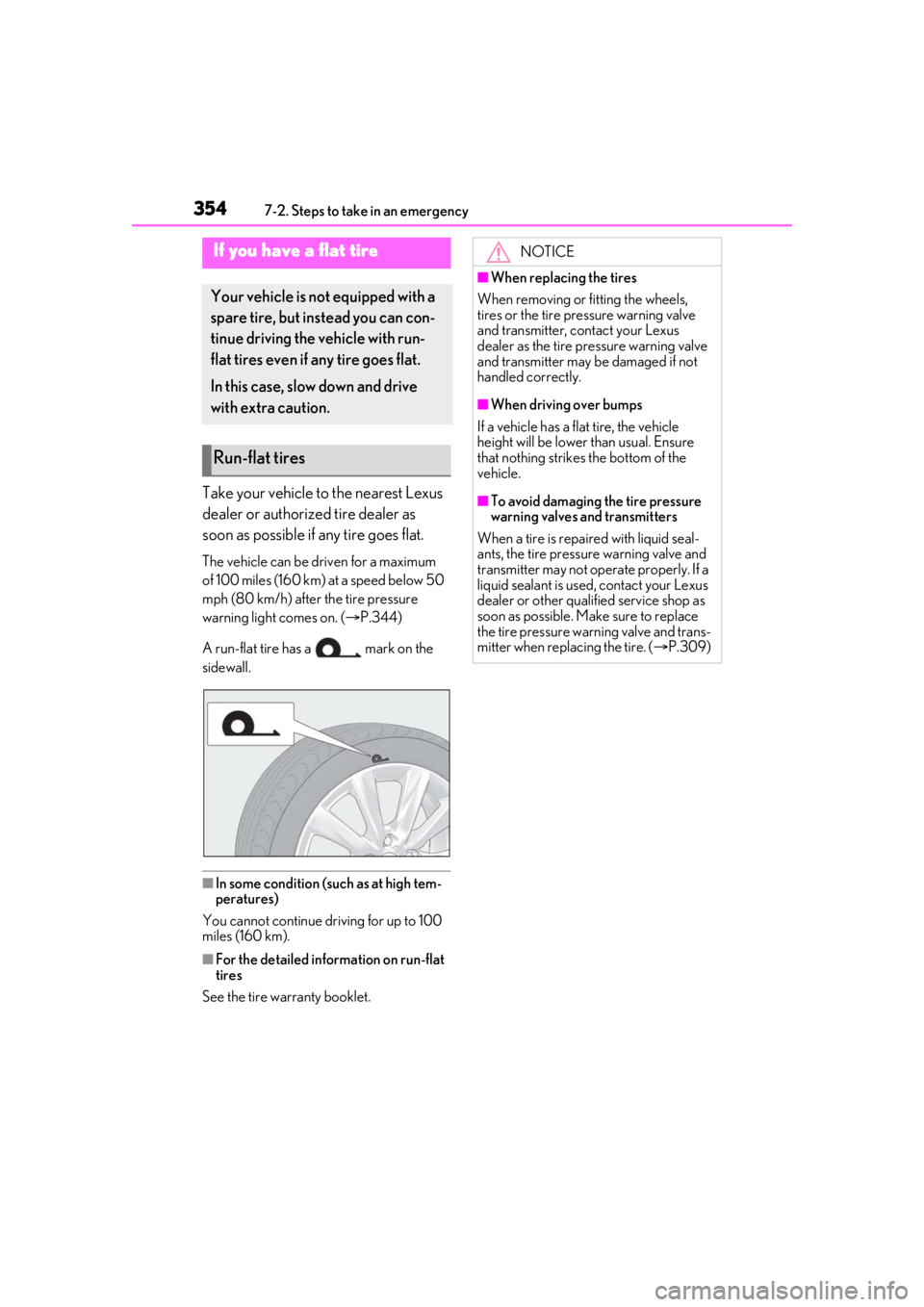
A run-flat tire has a mark on the
sidewall.
■In some condition (such as at high tem-
peratures)
You cannot continue driving for up to 100
miles (160 km).
■For the detailed information on run-flat
tires
See the tire warranty booklet.
If you have a flat tire
Your vehicle is not equipped with a
spare tire, but instead you can con-
tinue driving the vehicle with run-
flat tires even if any tire goes flat.
In this case, slow down and drive
with extra caution.
Run-flat tires
NOTICE
■When replacing the tires
When removing or fitting the wheels,
tires or the tire pr essure warning valve
and transmitter, contact your Lexus
dealer as the tire pressure warning valve
and transmitter may be damaged if not
handled correctly.
■When driving over bumps
If a vehicle has a flat tire, the vehicle
height will be lower than usual. Ensure
that nothing strikes the bottom of the
vehicle.
■To avoid damaging the tire pressure
warning valves and transmitters
When a tire is repaired with liquid seal-
ants, the tire pressure warning valve and
transmitter may not operate properly. If a
liquid sealant is used , contact your Lexus
dealer or other qualified service shop as
soon as possible. Make sure to replace
the tire pressure warning valve and trans-
mitter when replacing the tire. ( P.309)
Page 383 of 436
3838-1. Specifications
8
Vehicle specifications
*2: Make sure to confirm that the brake system warning light (yellow) does not illuminate. (If
the brake system warning light illuminates, refer to P.343.)
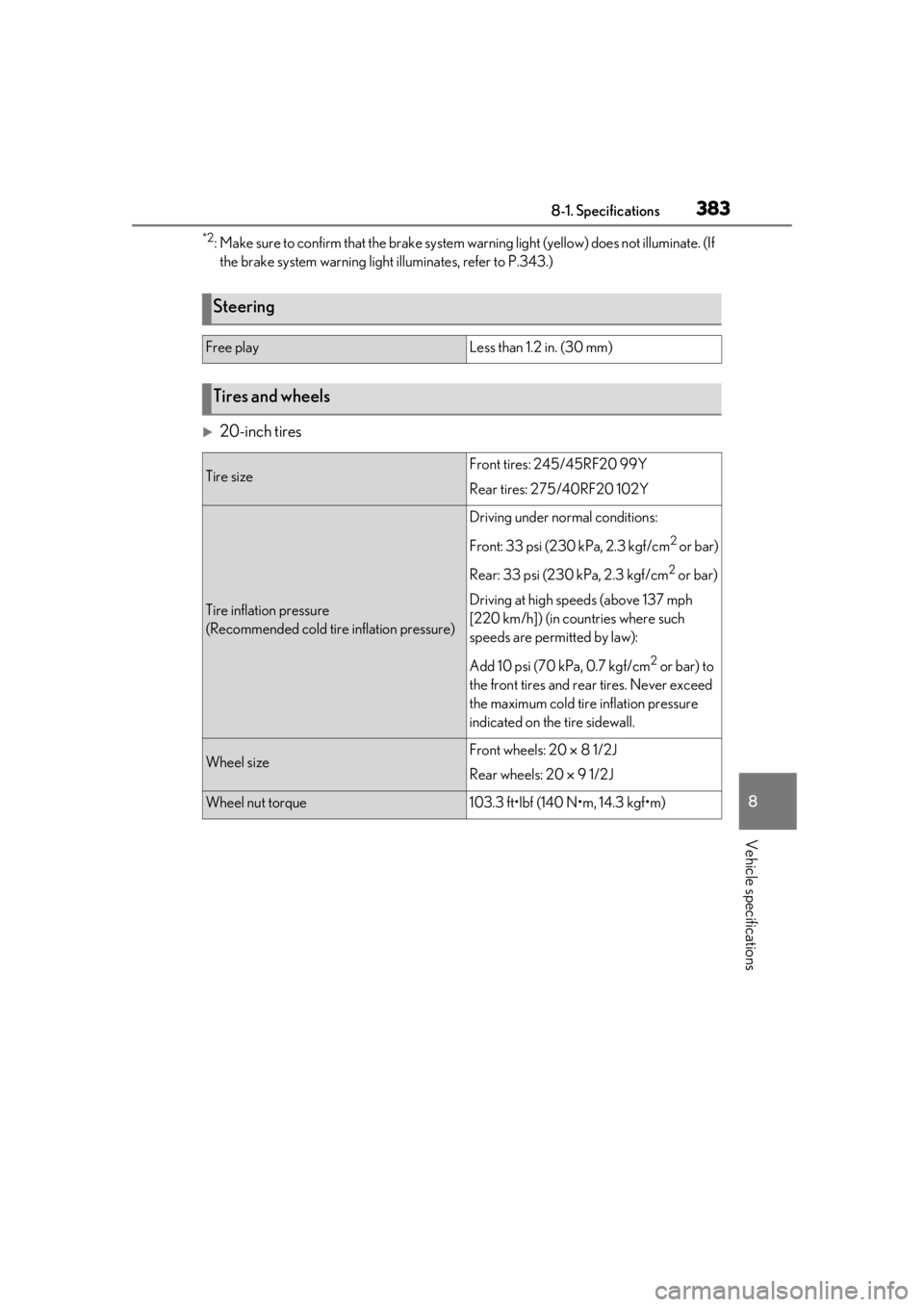
20-inch tires
Steering
Free playLess than 1.2 in. (30 mm)
Tires and wheels
Tire sizeFront tires: 245/45RF20 99Y
Rear tires: 275/40RF20 102Y
Tire inflation pressure
(Recommended cold tire inflation pressure)
Driving under normal conditions:
Front: 33 psi (230 kPa, 2.3 kgf/cm
2 or bar)
Rear: 33 psi (230 kPa, 2.3 kgf/cm
2 or bar)
Driving at high speeds (above 137 mph
[220 km/h]) (in countries where such
speeds are permitted by law):
Add 10 psi (70 kPa, 0.7 kgf/cm
2 or bar) to
the front tires and rear tires. Never exceed
the maximum cold tire inflation pressure
indicated on the tire sidewall.
Wheel sizeFront wheels: 20 8 1/2J
Rear wheels: 20 9 1/2J
Wheel nut torque103.3 ft•lbf (140 N•m, 14.3 kgf•m)
Page 384 of 436
3848-1. Specifications
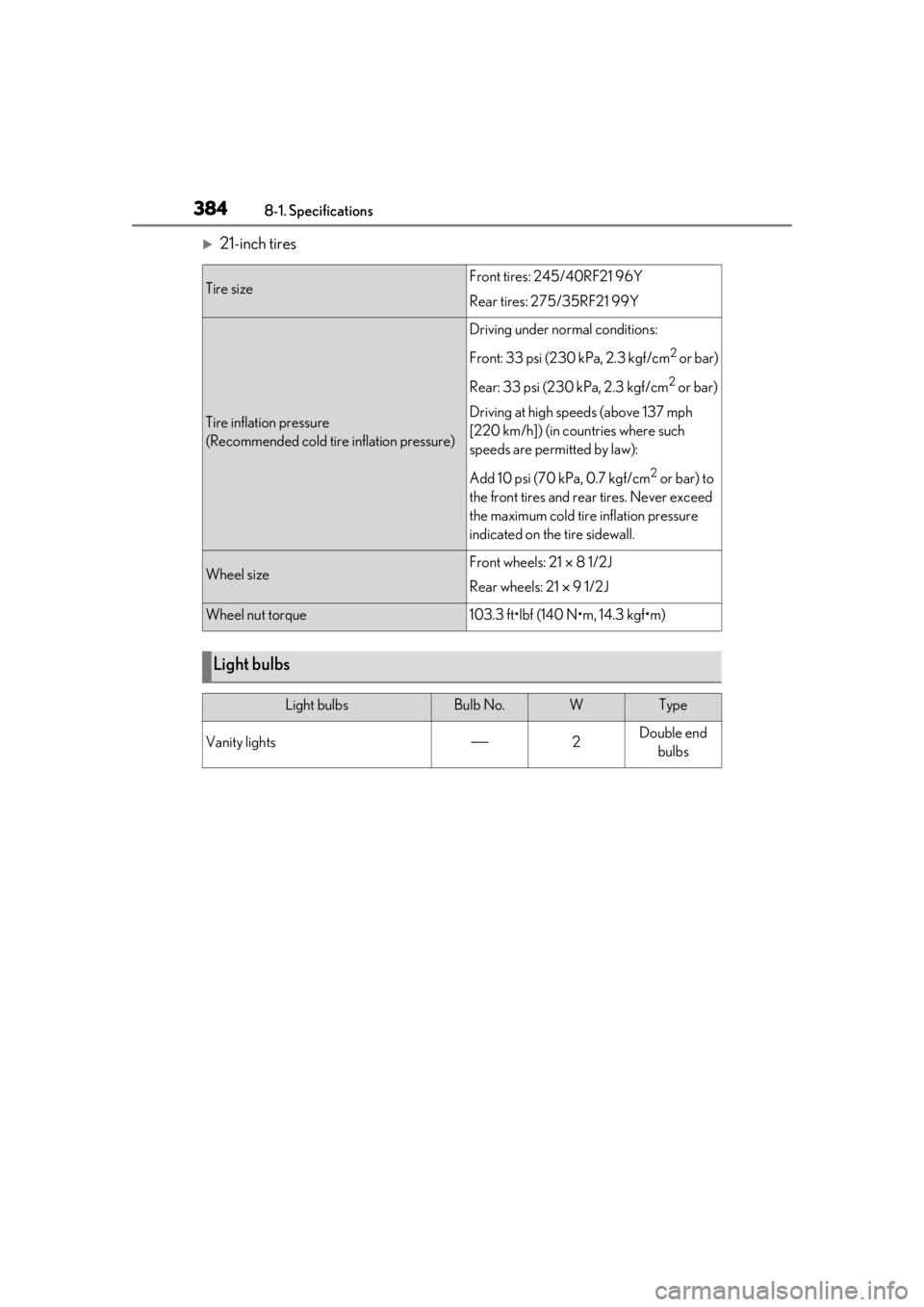
21-inch tires
Tire sizeFront tires: 245/40RF21 96Y
Rear tires: 275/35RF21 99Y
Tire inflation pressure
(Recommended cold tire inflation pressure)
Driving under normal conditions:
Front: 33 psi (230 kPa, 2.3 kgf/cm
2 or bar)
Rear: 33 psi (230 kPa, 2.3 kgf/cm
2 or bar)
Driving at high speeds (above 137 mph
[220 km/h]) (in countries where such
speeds are permitted by law):
Add 10 psi (70 kPa, 0.7 kgf/cm
2 or bar) to
the front tires and rear tires. Never exceed
the maximum cold tire inflation pressure
indicated on the tire sidewall.
Wheel sizeFront wheels: 21 8 1/2J
Rear wheels: 21 9 1/2J
Wheel nut torque103.3 ft•lbf (140 N•m, 14.3 kgf•m)
Light bulbs
Light bulbsBulb No.WType
Vanity lights2Double end
bulbs
Page 387 of 436
3878-1. Specifications
8
Vehicle specifications
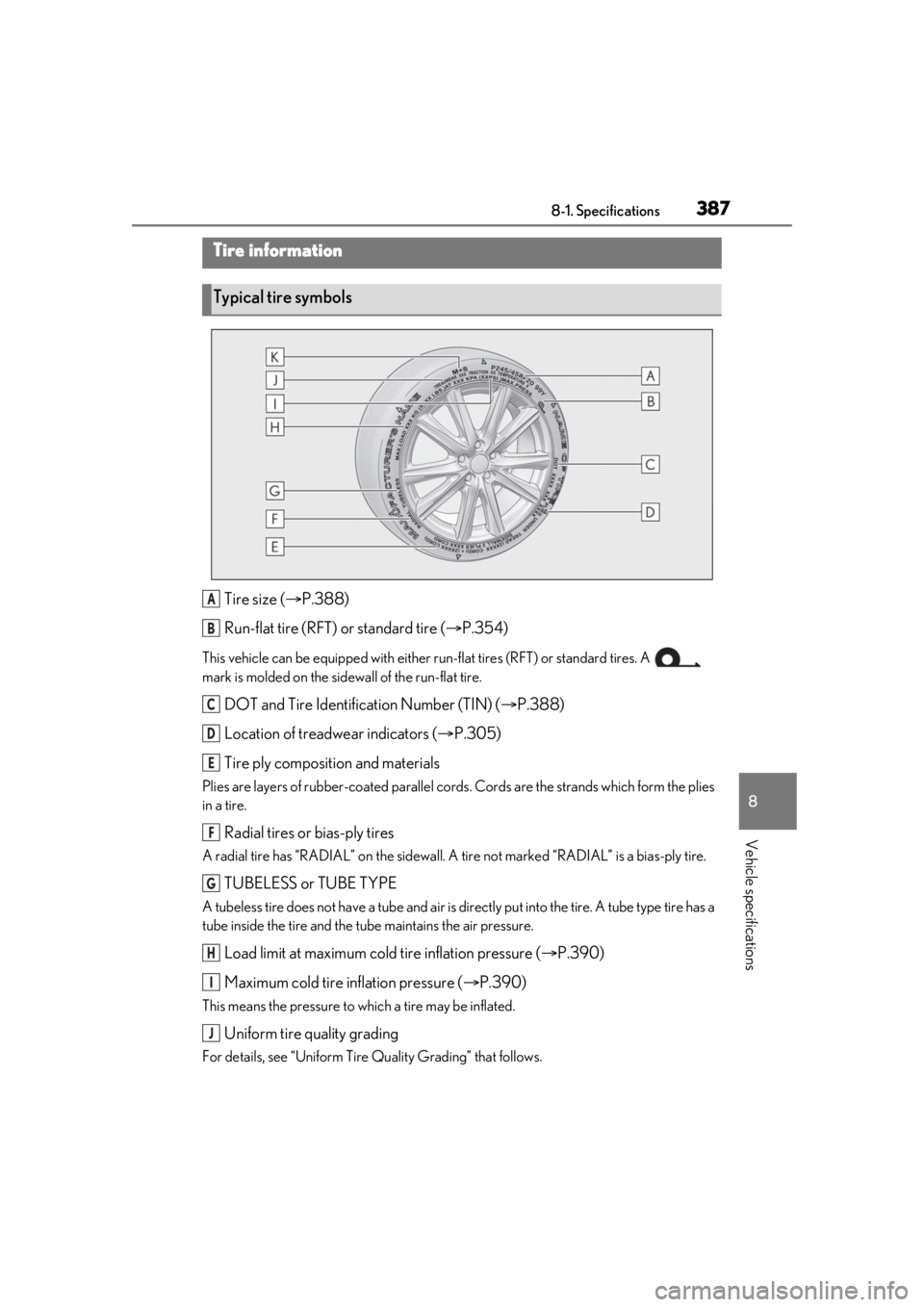
Tire size (P.388)
Run-flat tire (RFT) or standard tire ( P.354)
This vehicle can be equipped with either run-flat tires (RFT) or standard tires. A
mark is molded on the sidewall of the run-flat tire.
DOT and Tire Identification Number (TIN) ( P.388)
Location of treadwear indicators ( P.305)
Tire ply composition and materials
Plies are layers of rubber-coated parallel cords. Cords are the strands which form the plies
in a tire.
Radial tires or bias-ply tires
A radial tire has “RADIAL” on the sidewall. A tire not marked “RADIAL” is a bias-ply tire.
TUBELESS or TUBE TYPE
A tubeless tire does not have a tube and air is directly put into the tire. A tube type tire has a
tube inside the tire and the tube maintains the air pressure.
Load limit at maximum cold tire inflation pressure ( P.390)
Maximum cold tire inflation pressure ( P.390)
This means the pressure to which a tire may be inflated.
Uniform tire quality grading
For details, see “Uniform Tire Quality Grading” that follows.
Tire information
Typical tire symbols
A
B
C
D
E
F
G
H
I
J
Page 390 of 436
3908-1. Specifications
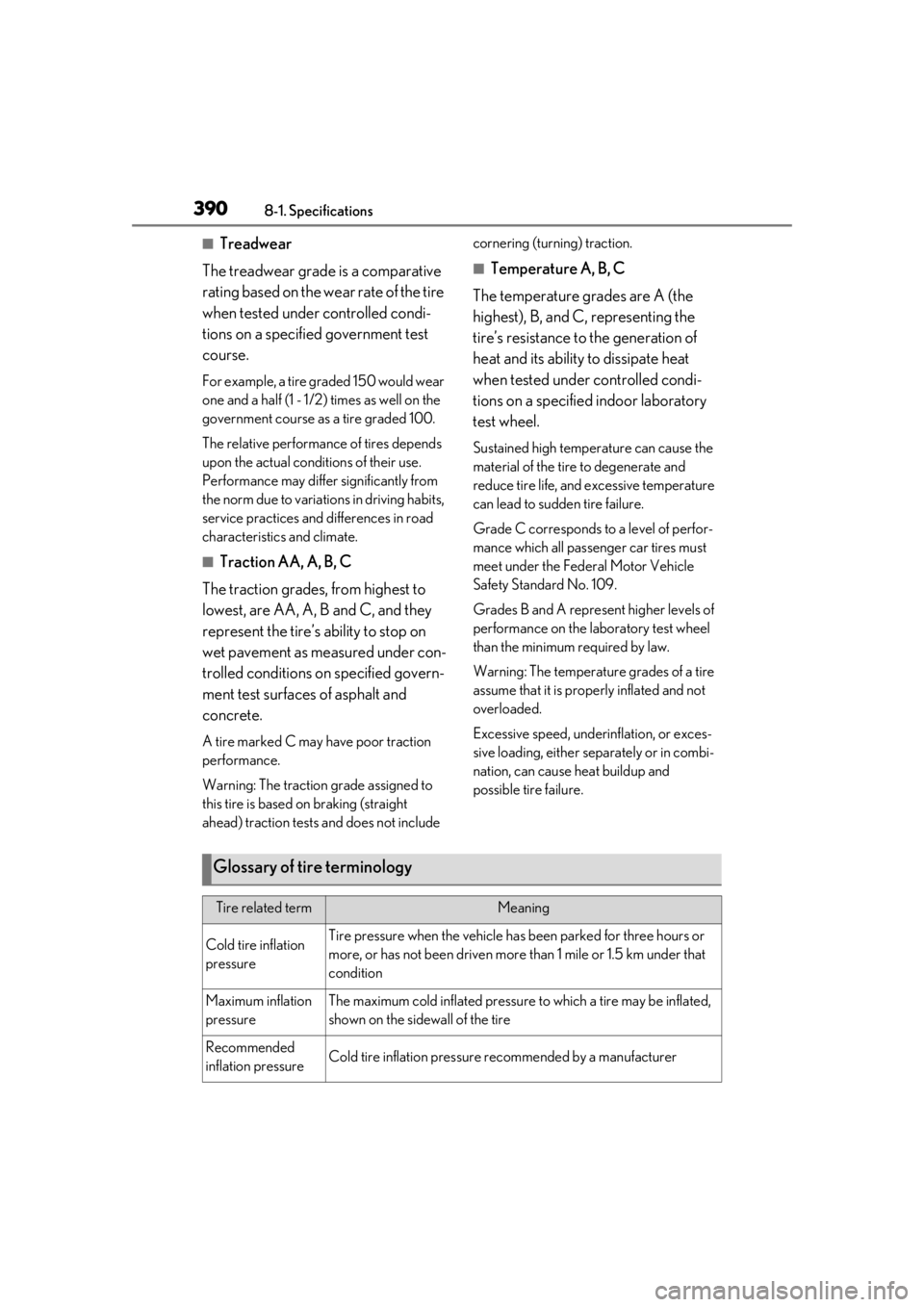
■Treadwear
The treadwear grade is a comparative
rating based on the wear rate of the tire
when tested under controlled condi-
tions on a specified government test
course.
For example, a tire graded 150 would wear
one and a half (1 - 1/2) times as well on the
government course as a tire graded 100.
The relative performa nce of tires depends
upon the actual conditions of their use.
Performance may differ significantly from
the norm due to variatio ns in driving habits,
service practices and differences in road
characteristics and climate.
■Traction AA, A, B, C
The traction grades, from highest to
lowest, are AA, A, B and C, and they
represent the tire’s ability to stop on
wet pavement as measured under con-
trolled conditions on specified govern-
ment test surfaces of asphalt and
concrete.
A tire marked C may have poor traction
performance.
Warning: The traction grade assigned to
this tire is based on braking (straight
ahead) traction tests and does not include cornering (turning) traction.
■Temperature A, B, C
The temperature grades are A (the
highest), B, and C, representing the
tire’s resistance to the generation of
heat and its ability to dissipate heat
when tested under controlled condi-
tions on a specified indoor laboratory
test wheel.
Sustained high temperature can cause the
material of the tire to degenerate and
reduce tire life, and excessive temperature
can lead to sudd en tire failure.
Grade C corresponds to a level of perfor-
mance which all passenger car tires must
meet under the Fede ral Motor Vehicle
Safety Standard No. 109.
Grades B and A represent higher levels of
performance on the laboratory test wheel
than the minimum required by law.
Warning: The temperature grades of a tire
assume that it is properly inflated and not
overloaded.
Excessive speed, unde rinflation, or exces-
sive loading, either separately or in combi-
nation, can cause heat buildup and
possible tire failure.
Glossary of tire terminology
Tire related termMeaning
Cold tire inflation
pressureTire pressure when the vehicle has been parked for three hours or
more, or has not been driven more than 1 mile or 1.5 km under that
condition
Maximum inflation
pressureThe maximum cold inflated pressure to which a tire may be inflated,
shown on the sidewall of the tire
Recommended
inflation pressureCold tire inflation pressure recommended by a manufacturer
Page 392 of 436
3928-1. Specifications
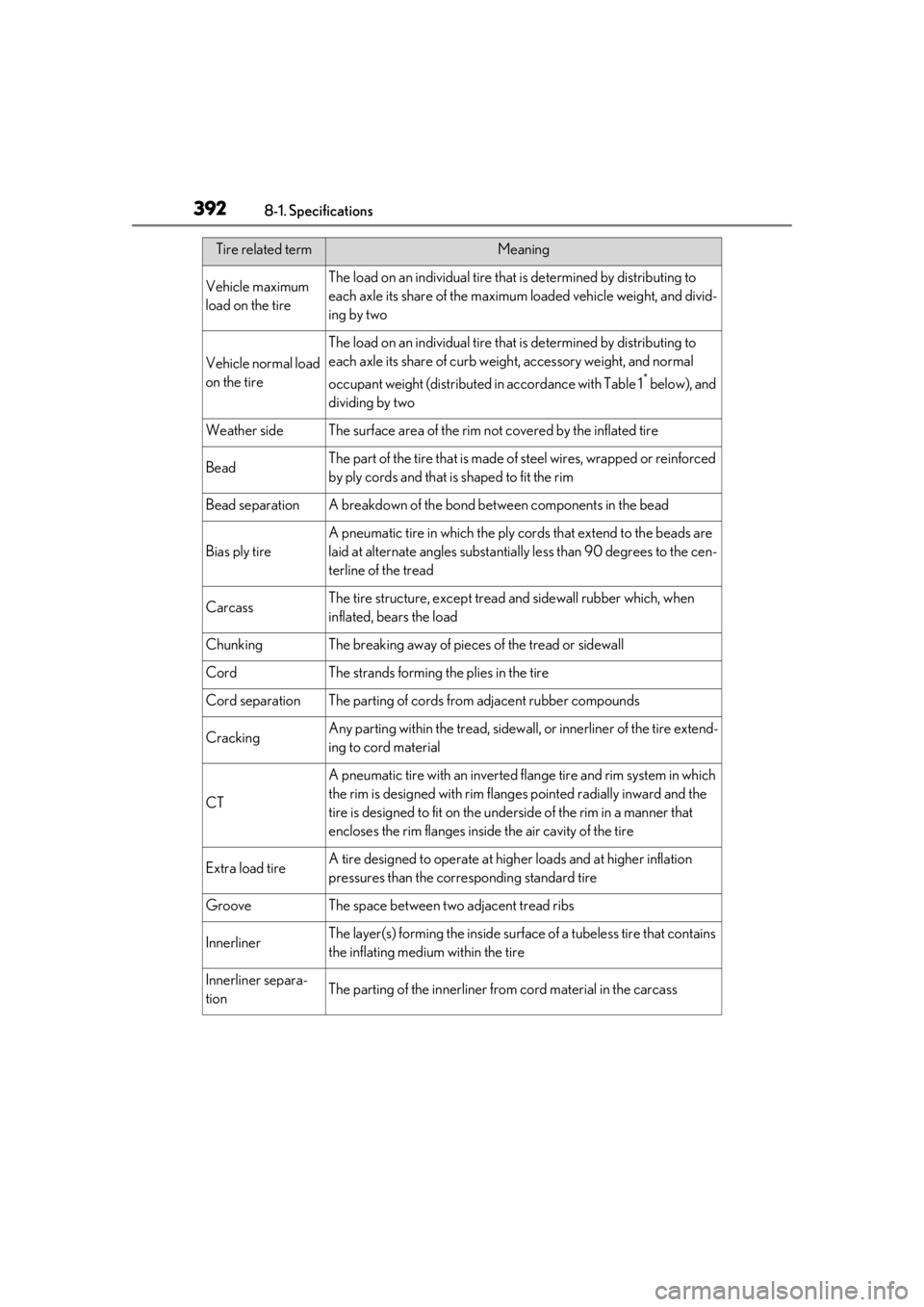
Vehicle maximum
load on the tireThe load on an individual tire that is determined by distributing to
each axle its share of the maximum loaded vehicle weight, and divid-
ing by two
Vehicle normal load
on the tire
The load on an individual tire that is determined by distributing to
each axle its share of curb weight, accessory weight, and normal
occupant weight (distributed in accordance with Table 1
* below), and
dividing by two
Weather sideThe surface area of the rim not covered by the inflated tire
BeadThe part of the tire that is made of steel wires, wrapped or reinforced
by ply cords and that is shaped to fit the rim
Bead separationA breakdown of the bond between components in the bead
Bias ply tire
A pneumatic tire in which the ply cords that extend to the beads are
laid at alternate angles substantia lly less than 90 degrees to the cen-
terline of the tread
CarcassThe tire structure, except tread and sidewall rubber which, when
inflated, bears the load
ChunkingThe breaking away of pieces of the tread or sidewall
CordThe strands forming the plies in the tire
Cord separationThe parting of cords from adjacent rubber compounds
CrackingAny parting within the tread, sidewall, or innerliner of the tire extend-
ing to cord material
CT
A pneumatic tire with an inverted fl ange tire and rim system in which
the rim is designed with rim flanges pointed radially inward and the
tire is designed to fit on the unde rside of the rim in a manner that
encloses the rim flanges inside the air cavity of the tire
Extra load tireA tire designed to operate at high er loads and at higher inflation
pressures than the corre sponding standard tire
GrooveThe space between two adjacent tread ribs
InnerlinerThe layer(s) forming the inside surfac e of a tubeless tire that contains
the inflating medium within the tire
Innerliner separa-
tionThe parting of the innerliner from cord material in the carcass
Tire related termMeaning
Page 393 of 436
3938-1. Specifications
8
Vehicle specifications
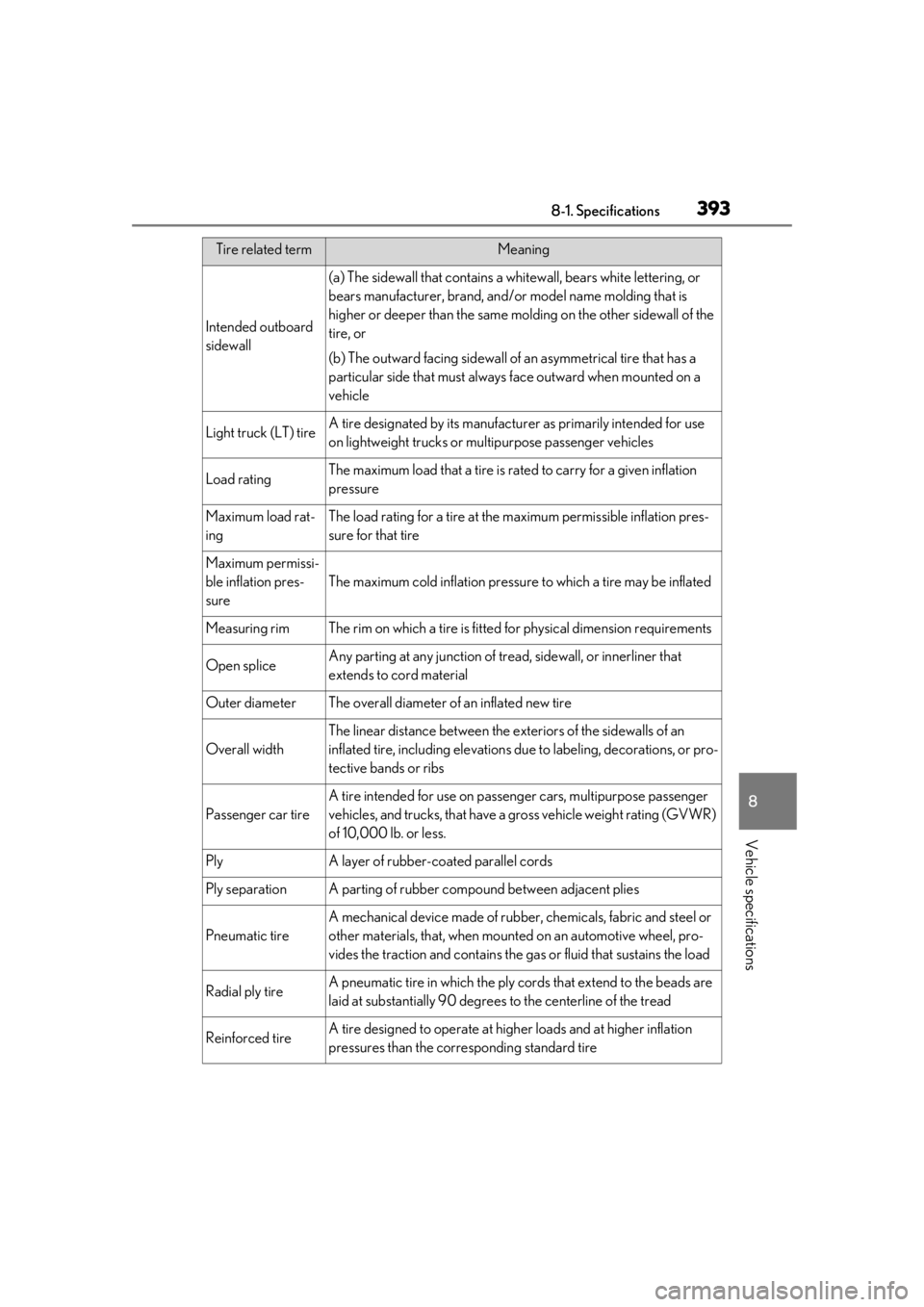
Intended outboard
sidewall
(a) The sidewall that contains a whitewall, bears white lettering, or
bears manufacturer, brand, and/or model name molding that is
higher or deeper than the same molding on the other sidewall of the
tire, or
(b) The outward facing sidewall of an asymmetrical tire that has a
particular side that must always face outward when mounted on a
vehicle
Light truck (LT) tireA tire designated by its manufactur er as primarily intended for use
on lightweight trucks or mu ltipurpose passenger vehicles
Load ratingThe maximum load that a tire is rated to carry for a given inflation
pressure
Maximum load rat-
ingThe load rating for a tire at the maximum permissible inflation pres-
sure for that tire
Maximum permissi-
ble inflation pres-
sure
The maximum cold inflation pressure to which a tire may be inflated
Measuring rimThe rim on which a tire is fitted for physical dimension requirements
Open spliceAny parting at any junction of tread, sidewall, or innerliner that
extends to cord material
Outer diameterThe overall diameter of an inflated new tire
Overall width
The linear distance between the exteriors of the sidewalls of an
inflated tire, including elevations du e to labeling, decorations, or pro-
tective bands or ribs
Passenger car tire
A tire intended for use on passenger cars, multipurpose passenger
vehicles, and trucks, that have a gr oss vehicle weight rating (GVWR)
of 10,000 lb. or less.
PlyA layer of rubber-c oated parallel cords
Ply separationA parting of rubber compound between adjacent plies
Pneumatic tire
A mechanical device made of rubber, chemicals, fabric and steel or
other materials, that, when mounted on an automotive wheel, pro-
vides the traction and contains the gas or fluid that sustains the load
Radial ply tireA pneumatic tire in which the ply cords that extend to the beads are
laid at substantially 90 degree s to the centerline of the tread
Reinforced tireA tire designed to operate at high er loads and at higher inflation
pressures than the corre sponding standard tire
Tire related termMeaning
Page 407 of 436
4078-3. Items to initialize
8
Vehicle specifications
8-3.Items to initialize
Items to initialize
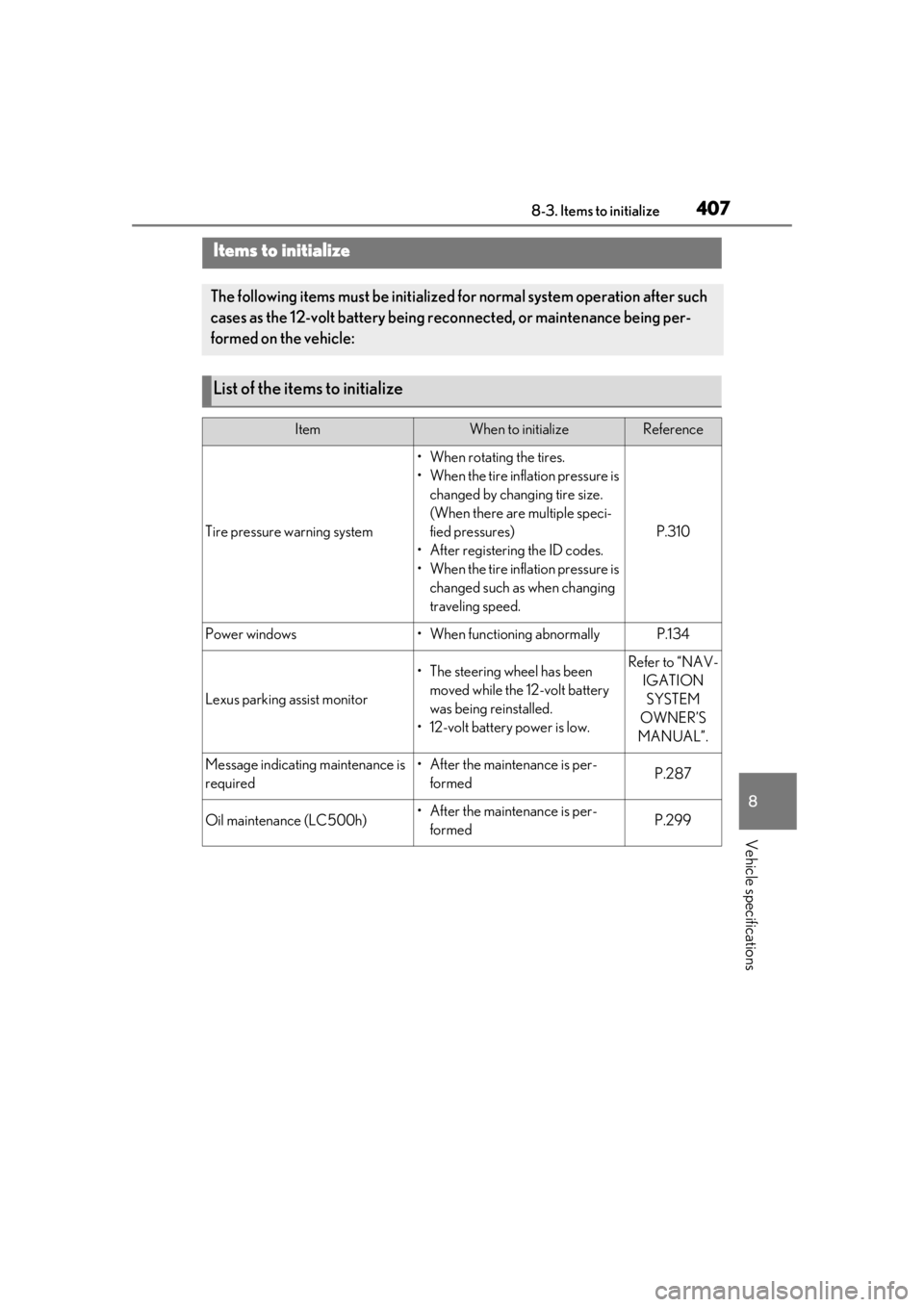
The following items must be initialized for normal system operation after such
cases as the 12-volt battery being re connected, or maintenance being per-
formed on the vehicle:
List of the items to initialize
ItemWhen to initializeReference
Tire pressure warning system
• When rotating the tires.
• When the tire inflation pressure is changed by changing tire size.
(When there are multiple speci-
fied pressures)
• After registering the ID codes.
• When the tire inflation pressure is changed such as when changing
traveling speed.
P.310
Power windows• When functioning abnormallyP.134
Lexus parking assist monitor
• The steering wheel has been moved while the 12-volt battery
was being reinstalled.
• 12-volt battery power is low.Refer to “NAV- IGATION SYSTEM
OWNER’S
MANUAL”.
Message indicating maintenance is
required• After the maintenance is per- formedP.287
Oil maintenance (LC500h)• After the maintenance is per-formedP.299