wheel lexus LFA 2012 Technical Information / LEXUS 2012 LFA: INSIDE THE LFA
[x] Cancel search | Manufacturer: LEXUS, Model Year: 2012, Model line: LFA, Model: Lexus LFA 2012Pages: 128, PDF Size: 5.91 MB
Page 68 of 128
66
Using the meter
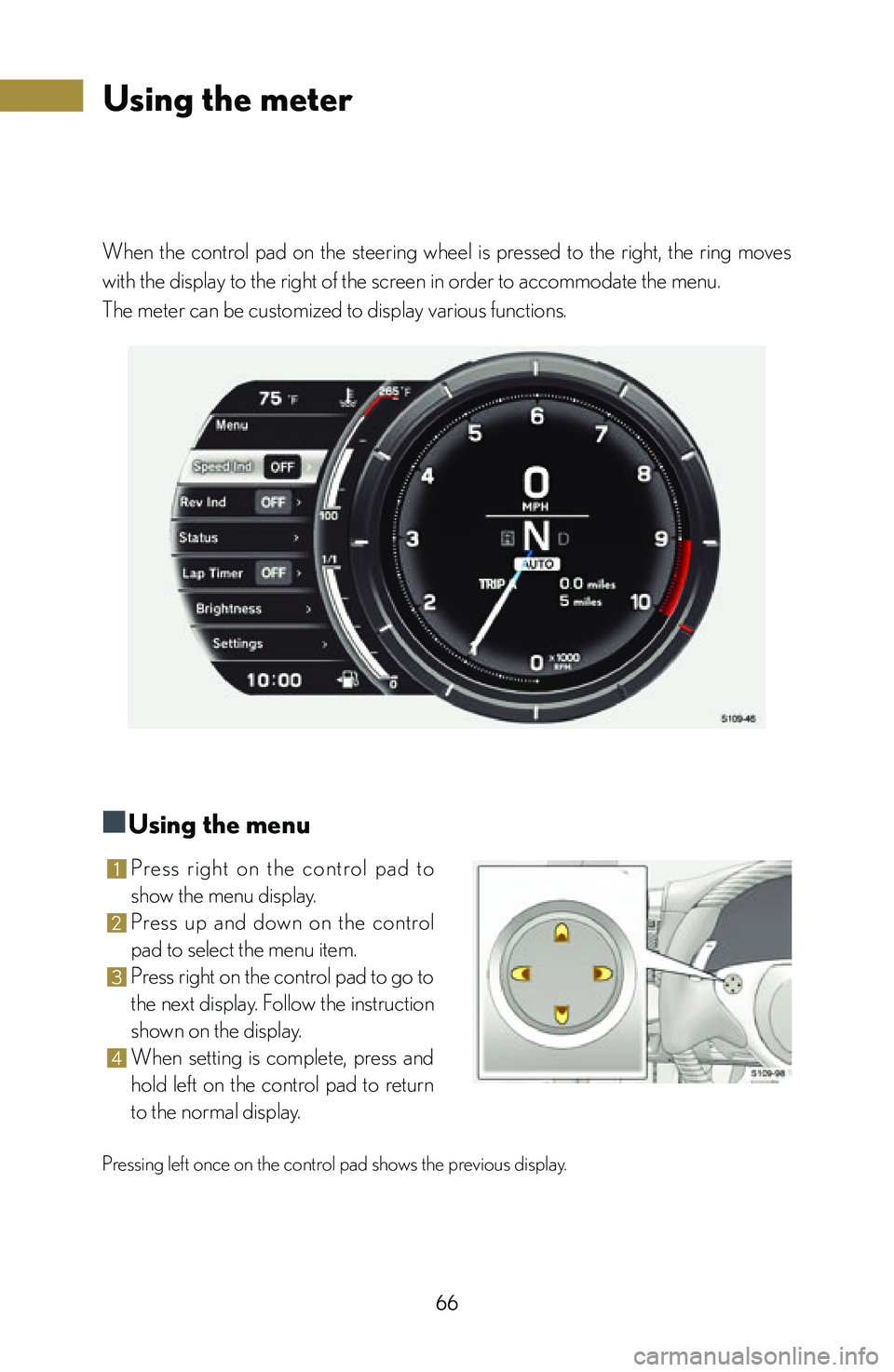
When the control pad on the steering wheel is pressed to the right, the ring moves
with the display to the right of the screen in order to accommodate the menu.
The meter can be customized to display various functions.
■
■Using the menu
1 Press right on the control pad to
show the menu display.
2 Press up and down on the control
pad to select the menu item.
3 Press right on the control pad to go to
the next display. Follow the instruction
shown on the display.
4 When setting is complete, press and
hold left on the control pad to return
to the normal display.
Pressing left once on the control pad shows the previous display.
Page 80 of 128
78
■
■Washing the vehicle
To prevent paint deterioration and corrosion on the body and components (wheels
etc.), wash the vehicle immediately if it becomes dirty. Hand washing is recommended
to preserve the paint finish.
1 Working from top to bottom, liberally apply water to the vehicle body, wheel wells
and underside of the vehicle to remove any dirt and dust.
2 Wash the vehicle body using a sponge or soft cloth, such as a chamois.
3 For hard-to-remove marks, use a neutral detergent and rinse thoroughly with
water.
4 Wipe away any water.
Maintaining the vehicle’s exterior
Page 94 of 128
92
Refer to the following points in order to preserve the performance and appearance
of the LFA during long-term storage. These points are only guidelines. To ensure that
appropriate steps are taken in consideration of the storage duration and environment,
consult your Lexus dealer in advance.
■
■Storage environment
A dry, covered, flat location away from natural elements such as wind, rain and direct
sunlight is ideal.
Exposure to the elements can cause corrosion and scratches, while long-term
exposure to direct sunlight can cause the interior and exterior finish to fade or become
discolored. Additionally, as moisture from the ground may cause corrosion even if the
vehicle is stored in a covered location, a dry place is ideal.
■
■Cleaning
As dirt becomes harder to remove with time, both the vehicle’s interior and exterior
should be cleaned before the vehicle is put into long-term storage.
■
■Tires
Inflate the tires to approximately 44 psi (300 kPa, 3.0 kgf/cm2 or,bar,) and use wheel
chocks to prevent the vehicle from moving.
In order to help reduce flat spots from occurring during storage, regularly rotate the
tires so that the same point is n’ot always resting on the ground. Additionally, if the
tires develop flat spots during the storage interval, drive the vehicle slowly until any flat
spot-induced vibrations are no longer felt before resuming normal use.
■
■Parking brake
Use wheel chocks to prevent the vehicle from moving as it should be stored with the
parking brake disengaged.
Advice for long-term storage
Page 98 of 128
96
■
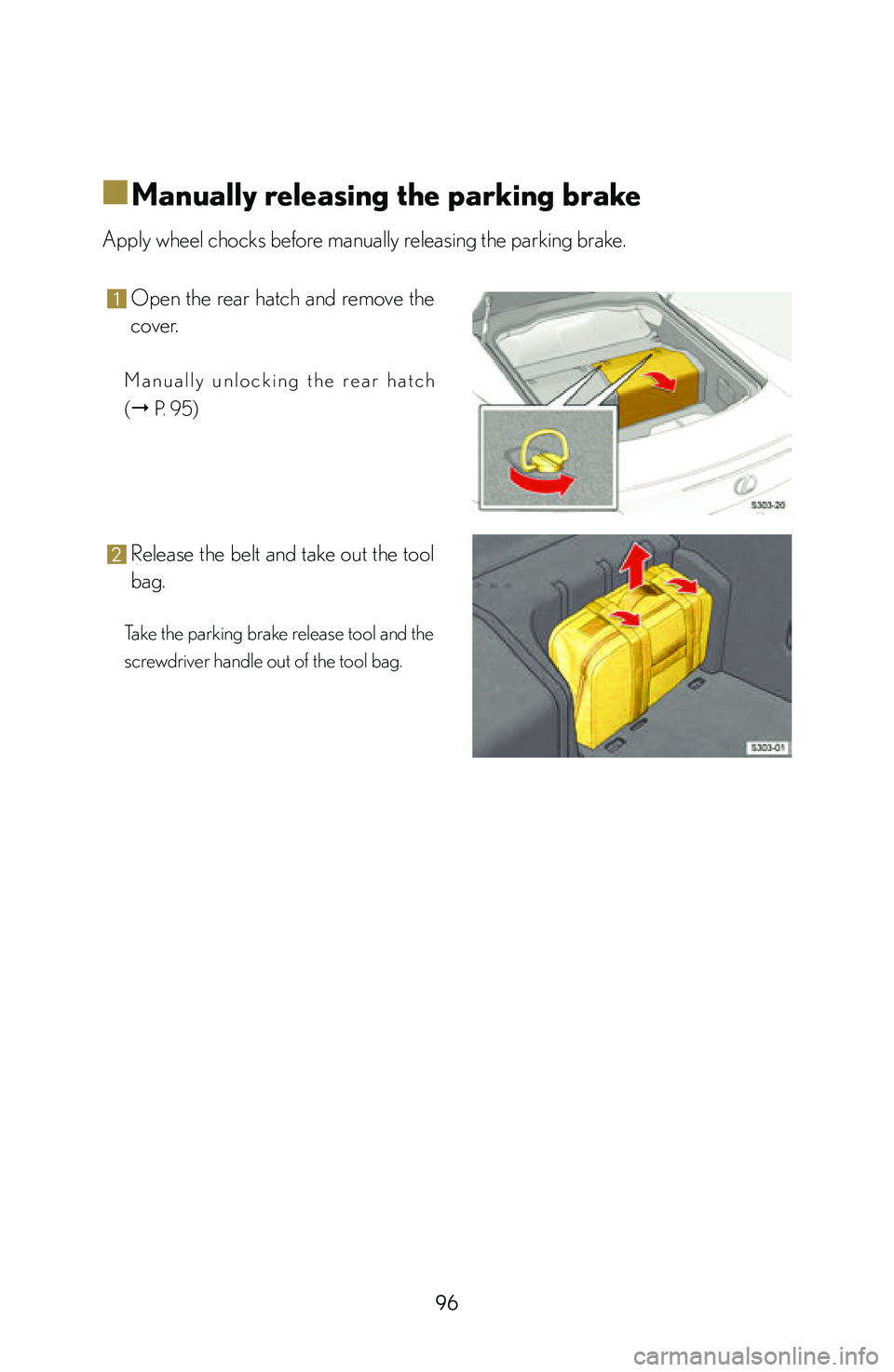
■Manually releasing the parking brake
Apply wheel chocks before manually releasing the parking brake.
1 Open the rear hatch and remove the
cover.
M a n u a l l y u n l o c k i n g t h e r e a r h a t c h
(
" P. 95)
2 Release the belt and take out the tool
bag.
Take the parking brake release tool and the
screwdriver handle out of the tool bag.
Page 102 of 128
100
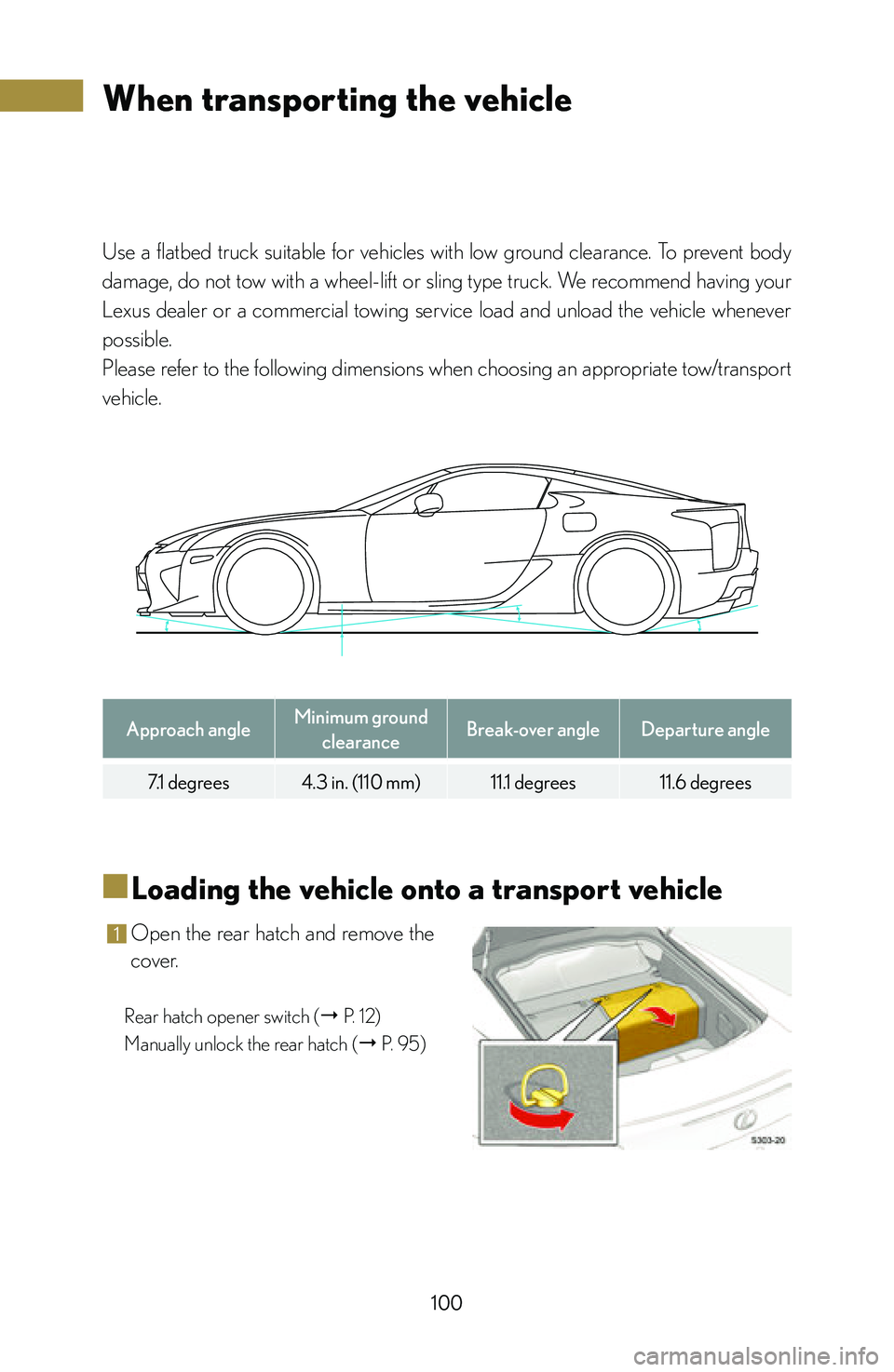
Use a flatbed truck suitable for vehicles with low ground clearance. To prevent body
damage, do not tow with a wheel-lift or sling type truck. We recommend having your
Lexus dealer or a commercial towing service load and unload the vehicle whenever
possible.
Please refer to the following dimensions when choosing an appropriate tow/transport
vehicle.
Approach angleMinimum ground
clearance Break-over angleDeparture angle
7.1 degrees4.3 in. (110 mm) 11.1 degrees11.6 degrees
■
■Loading the vehicle onto a transport vehicle
1 Open the rear hatch and remove the
cover.
Rear hatch opener switch (" P. 12)
Manually unlock the rear hatch (
" P. 95)
When transporting the vehicle
Page 114 of 128
112
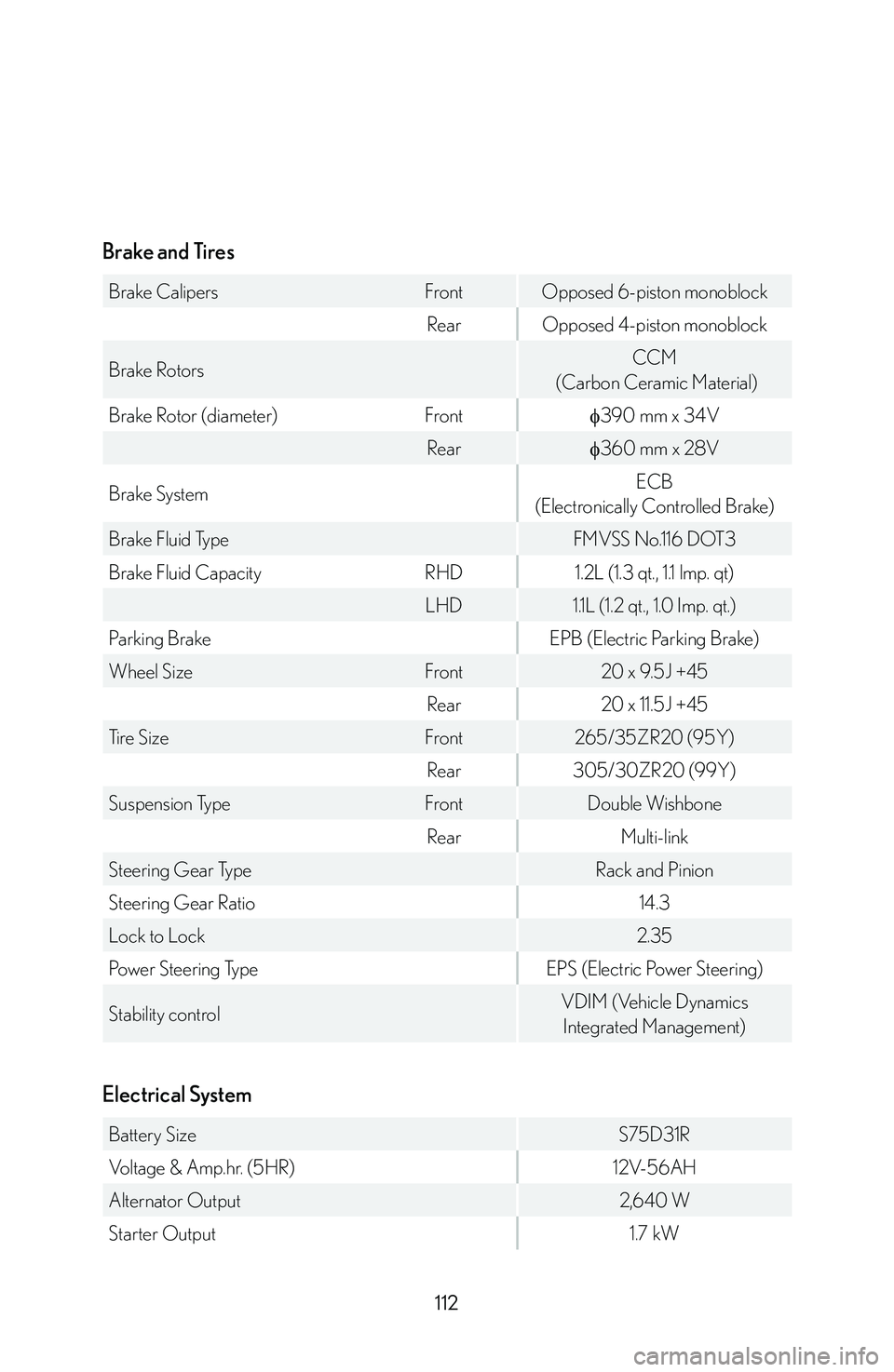
Brake and Tires
Brake Calipers FrontOpposed 6-piston monoblock
Rear Opposed 4-piston monoblock
Brake Rotors CCM
(Carbon Ceramic Material)
Brake Rotor (diameter) Front
f390 mm x 34V
Rear f360 mm x 28V
Brake System ECB
(Electronically Controlled Brake)
Brake Fluid Type FMVSS No.116 DOT3
Brake Fluid Capacity RHD1.2L (1.3 qt., 1.1 lmp. qt)
LHD 1.1L (1.2 qt., 1.0 Imp. qt.)
Parking Brake EPB (Electric Parking Brake)
Wheel Size Front20 x 9.5J +45
Rear 20 x 11.5J +45
Tire Size Front265/35ZR20 (95Y)
Rear 305/30ZR20 (99Y)
Suspension Type FrontDouble Wishbone
Rear Multi-link
Steering Gear Type Rack and Pinion
Steering Gear Ratio 14.3
Lock to Lock 2.35
Power Steering Type EPS (Electric Power Steering)
Stability control VDIM (Vehicle Dynamics
Integrated Management)
Electrical System
Battery Size S75D31R
Voltage & Amp.hr. (5HR) 12V-56AH
Alternator Output 2,640 W
Starter Output 1.7 kW
Page 116 of 128
114
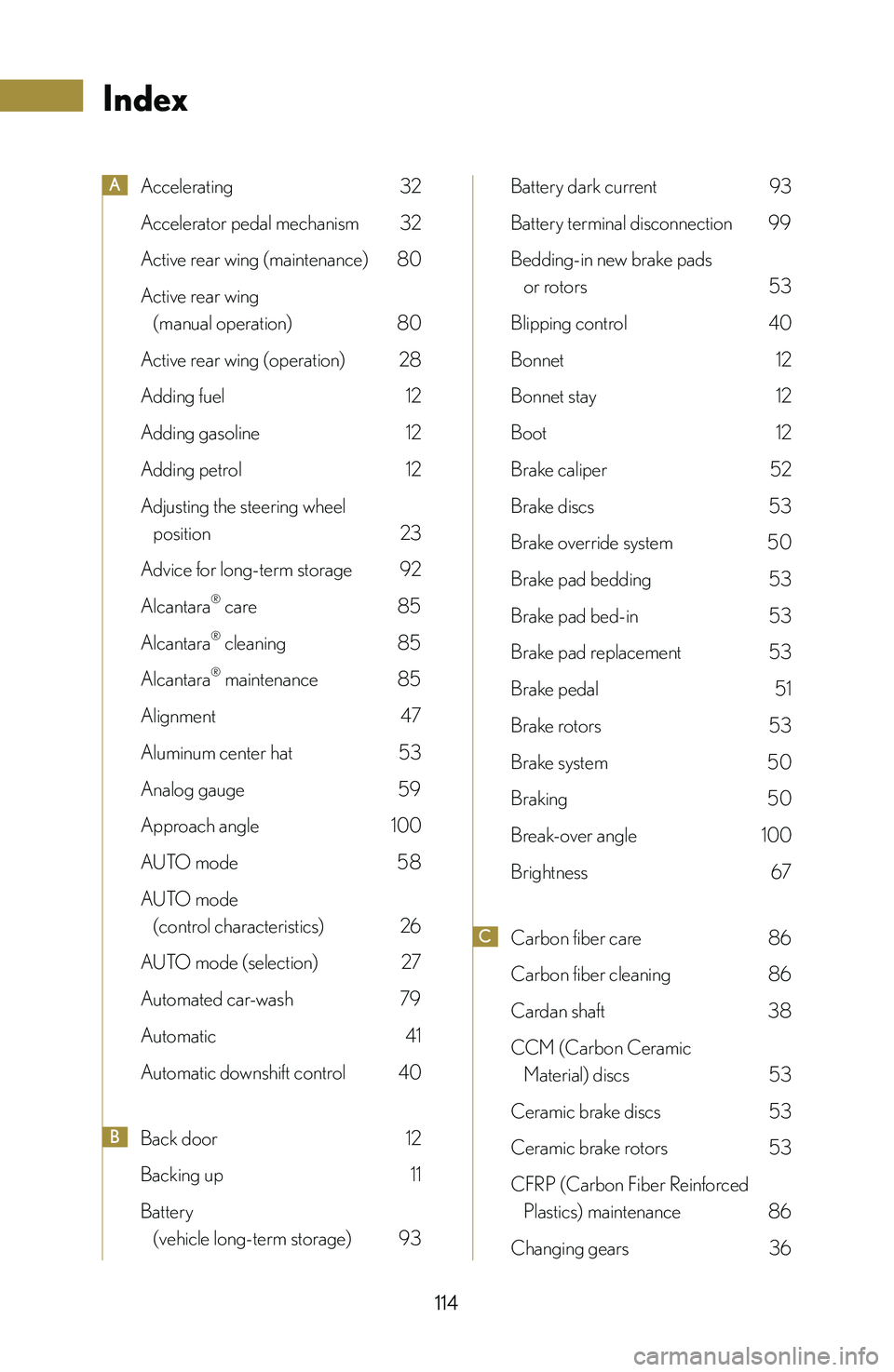
Index
AAccelerating 32
Accelerator pedal mechanism 32
Active rear wing (maintenance) 80
Active rear wing
(manual operation) 80
Active rear wing (operation) 28
Adding fuel 12
Adding gasoline 12
Adding petrol 12
Adjusting the steering wheel
position 23
Advice for long-term storage 92
Alcantara® care 85
Alcantara® cleaning 85
Alcantara® maintenance 85
Alignment 47
Aluminum center hat 53
Analog gauge 59
Approach angle 100
AUTO mode 58
AUTO mode
(control characteristics) 26
AUTO mode (selection) 27
Automated car-wash 79
Automatic 41
Automatic downshift control 40
BBack door 12
Backing up 11
Battery
(vehicle long-term storage) 93
Battery dark current 93
Battery terminal disconnection 99
Bedding-in new brake pads
or rotors 53
Blipping control 40
Bonnet 12
Bonnet stay 12
Boot 12
Brake caliper 52
Brake discs 53
Brake override system 50
Brake pad bedding 53
Brake pad bed-in 53
Brake pad replacement 53
Brake pedal 51
Brake rotors 53
Brake system 50
Braking 50
Break-over angle 100
Brightness 67
CCarbon fiber care 86
Carbon fiber cleaning 86
Cardan shaft 38
CCM (Carbon Ceramic
Material) discs 53
Ceramic brake discs 53
Ceramic brake rotors 53
CFRP (Carbon Fiber Reinforced
Plastics) maintenance 86
Changing gears 36
Page 118 of 128
116
Engine response 56
Engine speed control 40
Engine speed limiters 16, 17
Engine starting restrictions in
extremely low temperatures 17
“ENGINE START” switch 9
Engine switch 9
Engine type 16
EPB (Electric Parking Brake) 52
EPS (Electric Power Steering)
system 44
Exterior care 78
Exterior maintenance 78
FFlat bed transporting 100
Flat-bottomed steering wheel 45
Floating disc 53
Floating rotor 53
Floor mat usage 22
Floor-mounted brake pedal 51
Front brake caliper 52
Front brake rotor 53
Front counter gear 38
Front disc 53
Front rotor 53
Front suspension 47
Fuel 63
Fuel filler door 12
Fuel filler door manual unlock 95
Fuel gauge 63
Fuel level units selection 67
Fuel tank 63
Fuel tank cap 12
Fuel tank volume 12
Fuel type 12
Fuelling up 12
Fuse 93
GGas 63
Gas filler door 12
Gas filler door manual unlock 95
Gas level units selection 67
Gas tank 63
Gas tank cap 12
Gas tank volume 12
Gas type 12
Gauge 57
Gauge cluster 57
Gauges 57
Gear selection 36
Genuine leather maintenance 84
HHandbrake 9
Heel stopper 22, 51
Hood 12
Hood stand 12
IIdeal driving position 17
If the vehicle battery is discharged 94
Ignition switch 9
Page 122 of 128
120
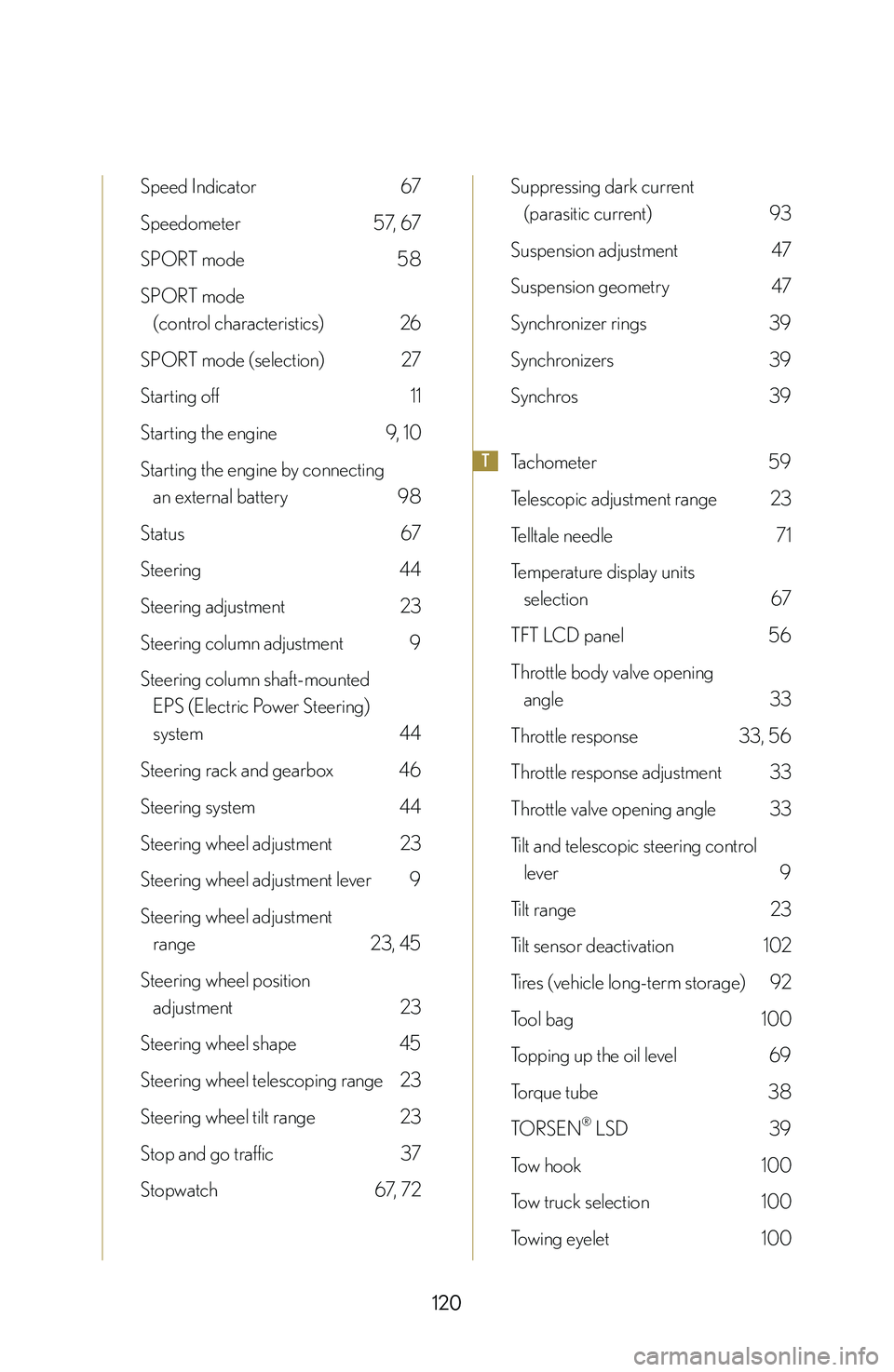
Speed Indicator 67
Speedometer 57, 67
SPORT mode 58
SPORT mode
(control characteristics) 26
SPORT mode (selection) 27
Starting off 11
Starting the engine 9, 1 0
Starting the engine by connecting
an external battery 98
Status 67
Steering 44
Steering adjustment 23
Steering column adjustment 9
Steering column shaft-mounted
EPS (Electric Power Steering)
system 44
Steering rack and gearbox 46
Steering system 44
Steering wheel adjustment 23
Steering wheel adjustment lever 9
Steering wheel adjustment
range 23, 45
Steering wheel position
adjustment 23
Steering wheel shape 45
Steering wheel telescoping range 23
Steering wheel tilt range 23
Stop and go traffic 37
Stopwatch 67 , 72
Suppressing dark current
(parasitic current) 93
Suspension adjustment 47
Suspension geometry 47
Synchronizer rings 39
Synchronizers 39
Synchros 39
TTachometer 59
Telescopic adjustment range 23
Telltale needle 71
Temperature display units
selection 67
TFT LCD panel 56
Throttle body valve opening
angle 33
Throttle response 33, 56
Throttle response adjustment 33
Throttle valve opening angle 33
Tilt and telescopic steering control
lever 9
Tilt range 23
Tilt sensor deactivation 102
Tires (vehicle long-term storage) 92
Tool bag 100
Topping up the oil level 69
Torque tube 38
TORSEN® LSD 39
Tow hook 100
Tow truck selection 100
Towing eyelet 100
Page 123 of 128
121
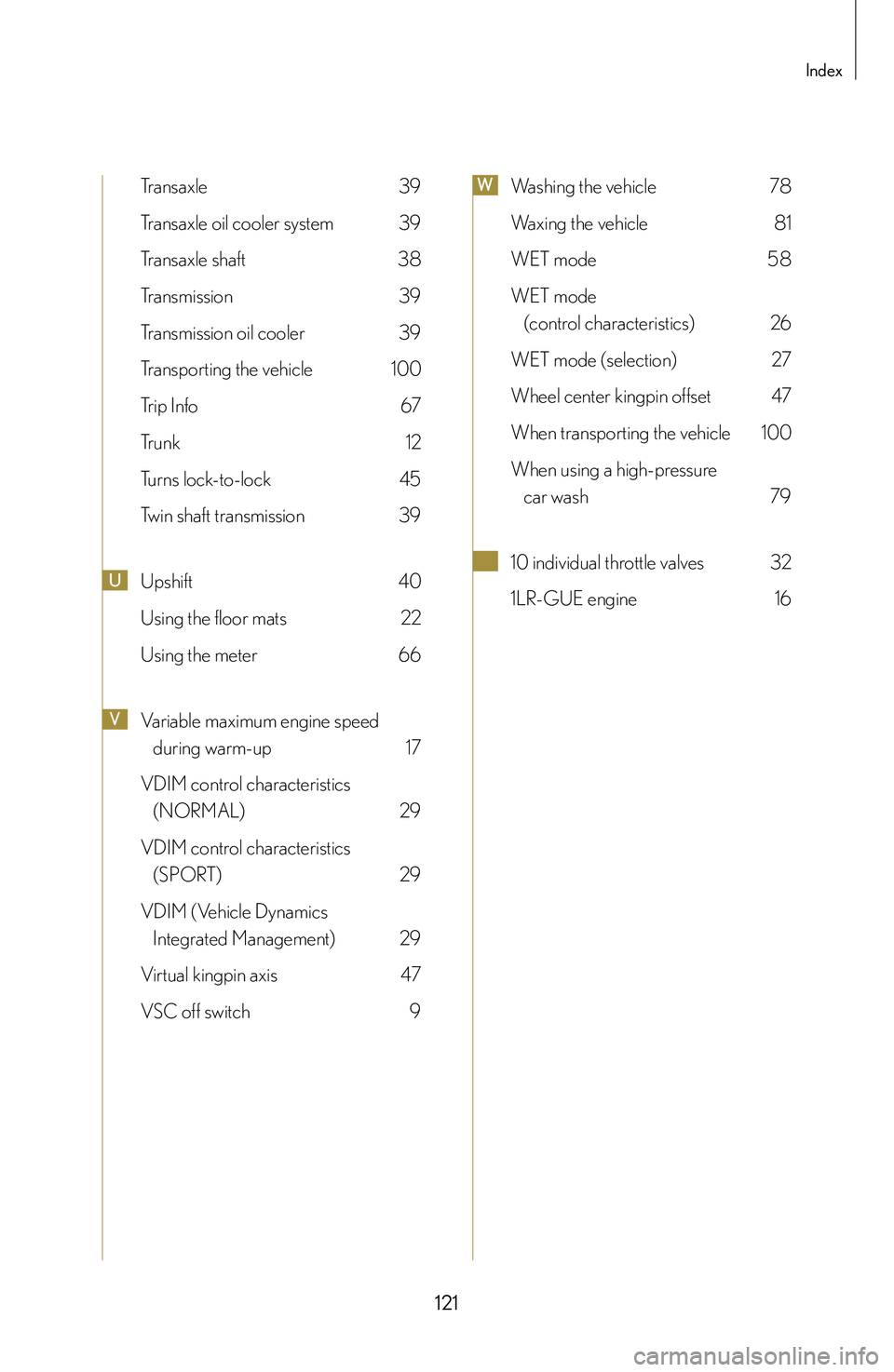
Index
Transaxle 39
Transaxle oil cooler system 39
Transaxle shaft 38
Transmission 39
Transmission oil cooler 39
Transporting the vehicle 100
Trip Info 67
Trunk 12
Turns lock-to-lock 45
Twin shaft transmission 39
UUpshift 40
Using the floor mats 22
Using the meter 66
VVariable maximum engine speed
during warm-up 17
VDIM control characteristics
(NORMAL) 29
VDIM control characteristics
(SPORT) 29
VDIM (Vehicle Dynamics
Integrated Management) 29
Virtual kingpin axis 47
VSC off switch 9
WWashing the vehicle 78
Waxing the vehicle 81
WET mode 58
WET mode
(control characteristics) 26
WET mode (selection) 27
Wheel center kingpin offset 47
When transporting the vehicle 100
When using a high-pressure
car wash 79
10 individual throttle valves 32
1LR-GUE engine 16