engine lexus LFA 2012 Technical Information / LEXUS 2012 LFA OWNERS MANUAL (OM77006U)
[x] Cancel search | Manufacturer: LEXUS, Model Year: 2012, Model line: LFA, Model: Lexus LFA 2012Pages: 420, PDF Size: 5.02 MB
Page 353 of 420
5
When trouble arises
351
5-2. Steps to take in an emergency
If your vehicle overheats
If your engine overheats:
Stop the vehicle in a safe place and turn off the air conditioning
system.
Check to see if steam is coming out from under the hood.
If you see steam:
Stop the engine. Care fully lift the hood after the steam subsides
and then restart the engine.
If you do not see steam:
Leave the engine running and carefully lift the hood.
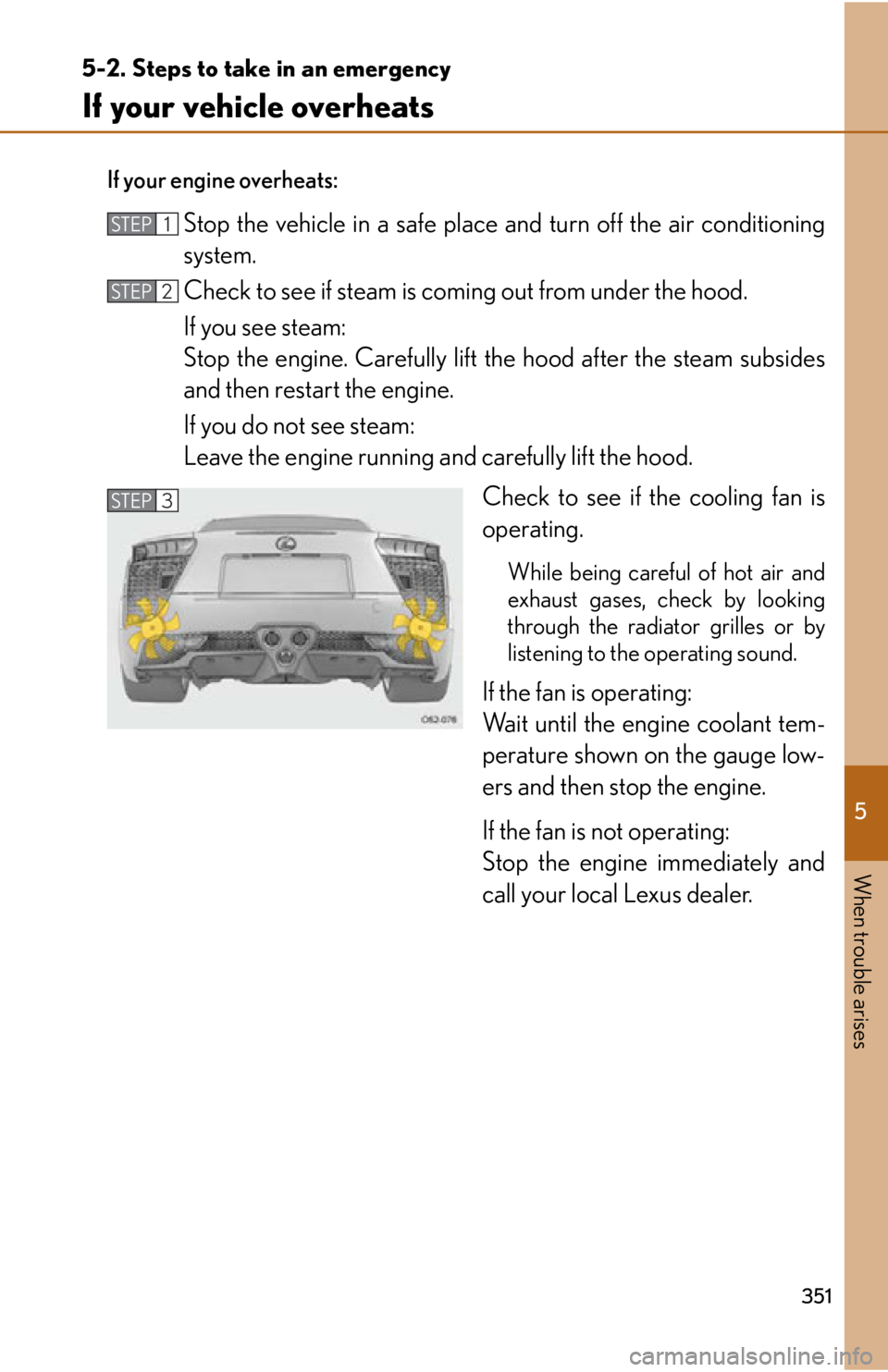
Check to see if the cooling fan is
operating.
While being careful of hot air and
exhaust gases, check by looking
through the radiator grilles or by
listening to the operating sound.
If the fan is operating:
Wait until the engine coolant tem-
perature shown on the gauge low-
ers and then stop the engine.
If the fan is not operating:
Stop the engine immediately and
call your local Lexus dealer.
STEP1
STEP2
STEP3
Page 354 of 420
352
5-2. Steps to take in an emergency
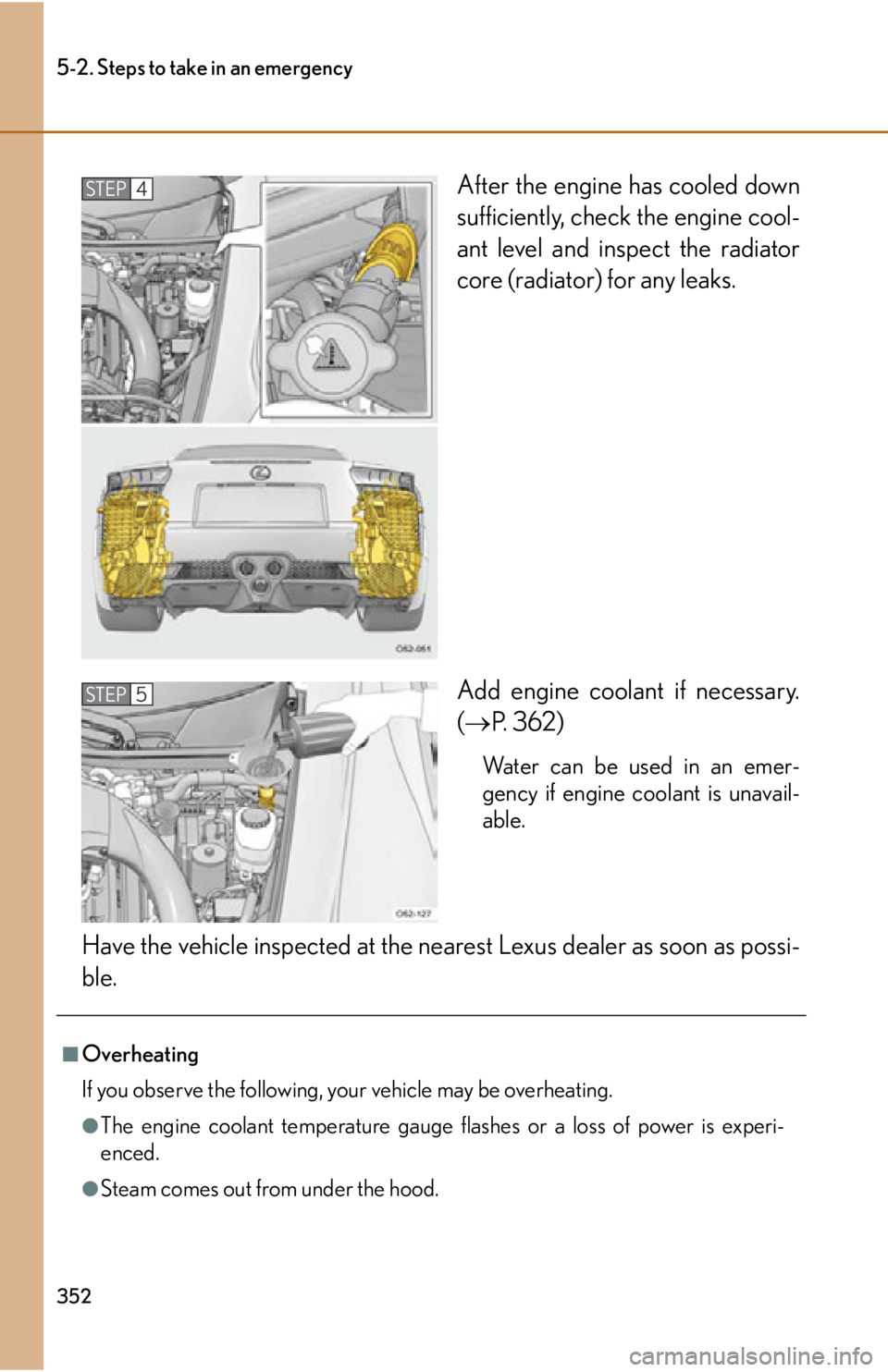
After the engine has cooled down
sufficiently, check the engine cool-
ant level and inspect the radiator
core (radiator) for any leaks.
Add engine coolant if necessary.
(P. 362)
Water can be used in an emer-
gency if engine coolant is unavail-
able.
Have the vehicle inspected at the ne arest Lexus dealer as soon as possi-
ble.
STEP4
STEP5
■Overheating
If you observe the following, your vehicle may be overheating.
●The engine coolant temperature gauge flashes or a loss of power is experi-
enced.
●Steam comes out from under the hood.
Page 355 of 420
5
When trouble arises
353
5-2. Steps to take in an emergency
CAUTION
■To prevent an accident or injury when inspecting under the hood of your vehicle
●If steam is seen coming from under the hood, do not open the hood until the
steam has subsided. The engine compartm ent may be very hot, causing serious
injury such as burns.
●Keep hands and clothing away from the drive belt while the engine is running.
●Do not loosen the coolant reservoir cap while the engine and radiator are hot.
Serious injury, such as burns, may resu lt from hot coolant and steam released
under pressure.
NOTICE
■When adding engine coolant
Wait until the engine has cooled do wn before adding engine coolant.
When adding coolant, do so slowly. Adding cool coolant to a hot engine too quickly
can cause damage to the engine.
Page 356 of 420
354
5-2. Steps to take in an emergency
If the vehicle becomes stuck
Carry out the following procedures if the tires spin or the vehicle becomes
stuck in mud, dirt, or snow.
Set the parking brake, select Neutral and stop the engine.
Remove the mud, snow, or sand from around the stuck tire.
Place wood, stones or some other material to help provide trac-
tion under the tires.
Restart the engine.
Select 1st gear or Reverse, release the parking brake and care-
fully apply the accelerator to free the vehicle.
Turn off VSC and TRAC if these functions are hampering your attempts
to free the vehicle. ( P. 1 6 7 )
CAUTION
■When attempting to free a stuck vehicle
If you choose to rock the vehicle back and forth to free it, make sure the surround-
ing area is clear, to avoid striking other vehicles, objects or persons. The vehicle
may also lunge forward or lunge back suddenly as it becomes free. Use extreme
caution.
■When operating the paddle shift switches/reverse selector switch
Be careful not to operate the paddle shift switches/reverse selector switch with the
accelerator pedal depressed.
This may lead to unexpected rapid acceleration of the vehicle that may cause an
accident and result in death or serious injury.
NOTICE
■To avoid damaging the transm ission and other components
●Avoid spinning the wheels and do not rev the engine.
●If the vehicle remains stuck after trying these procedures, the vehicle may require
towing to be freed.
STEP1
STEP2
STEP3
STEP4
STEP5
Page 357 of 420
5
When trouble arises
355
5-2. Steps to take in an emergency
If your vehicle has to be stopped in an emergency
Only in an emergency, such as if it becomes impossible to stop the vehicle in
the normal way, stop the vehicle using the following procedure:
Steadily step on the brake pedal with both feet and firmly depress
it.
Do not pump the brake pedal repeatedly as this will increase the dis-
tance required to slow the vehicle.
Select Neutral. ( P. 103)
If Neutral is selected After slowing down, stop the vehicle in a safe place by the road.
Stop the engine.
If Neutral cannot be selected Keep depressing the brake pedal with both feet to reduce vehicle
speed as much as possible.
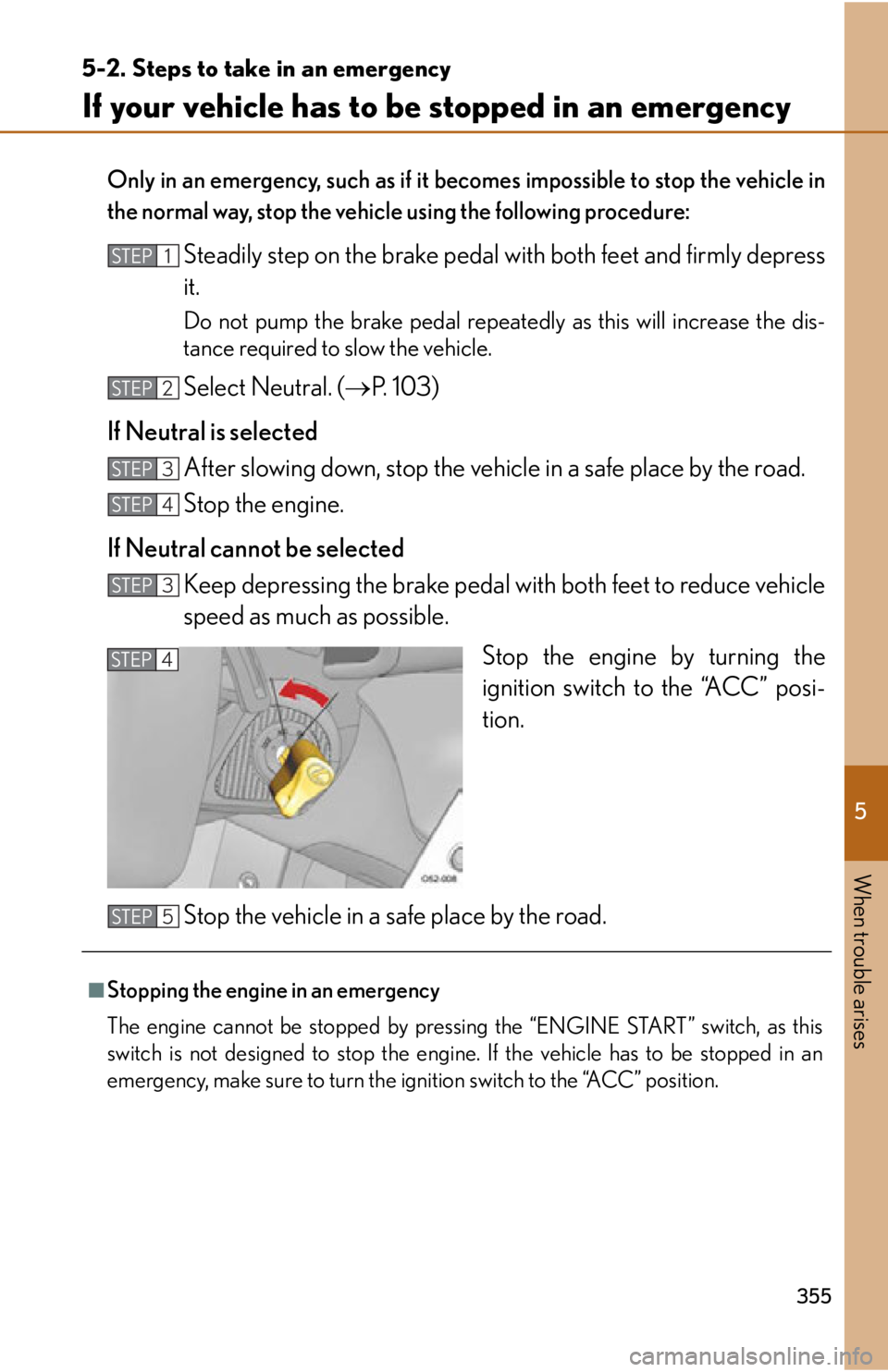
Stop the engine by turning the
ignition switch to the “ACC” posi-
tion.
Stop the vehicle in a safe place by the road.
STEP1
STEP2
STEP3
STEP4
STEP3
STEP4
■Stopping the engine in an emergency
The engine cannot be stopped by pressi ng the “ENGINE START” switch, as this
switch is not designed to stop the engine. If the vehicle has to be stopped in an
emergency, make sure to turn the ignition switch to the “ACC” position.
STEP5
Page 358 of 420

356
5-2. Steps to take in an emergency
CAUTION
■If the engine has to be turned off while driving
●If the engine is turned off, the power assist for the brakes and steering may not
function, making braking and steering more difficult. Decelerate as much as pos-
sible before turning off the engine.
●Never attempt to remove the key, as doing so will lock the steering wheel.
Page 361 of 420
359
6-1. Specifications
6
Vehicle specifications
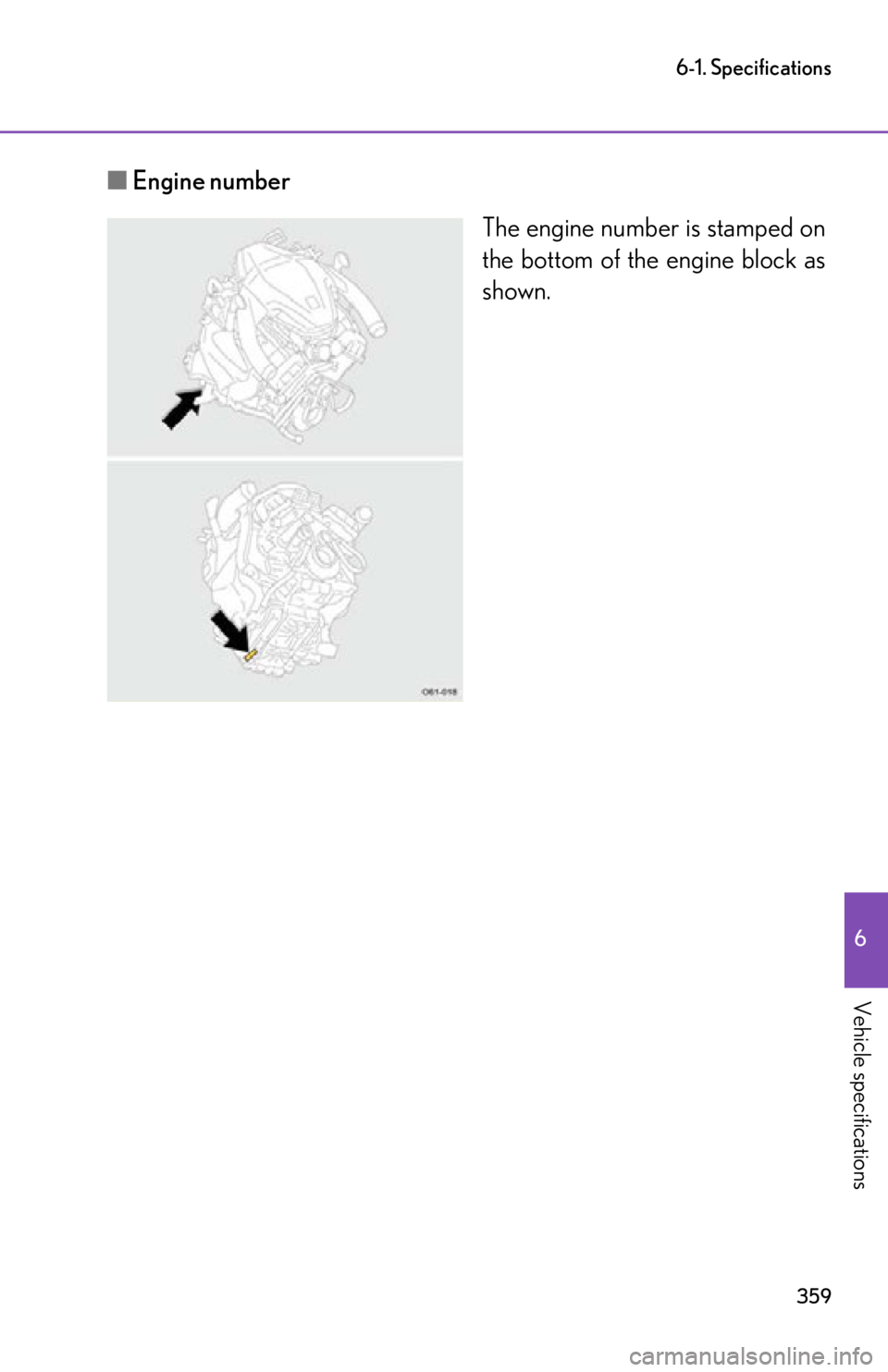
■Engine number
The engine number is stamped on
the bottom of the engine block as
shown.
Page 362 of 420
360
6-1. Specifications
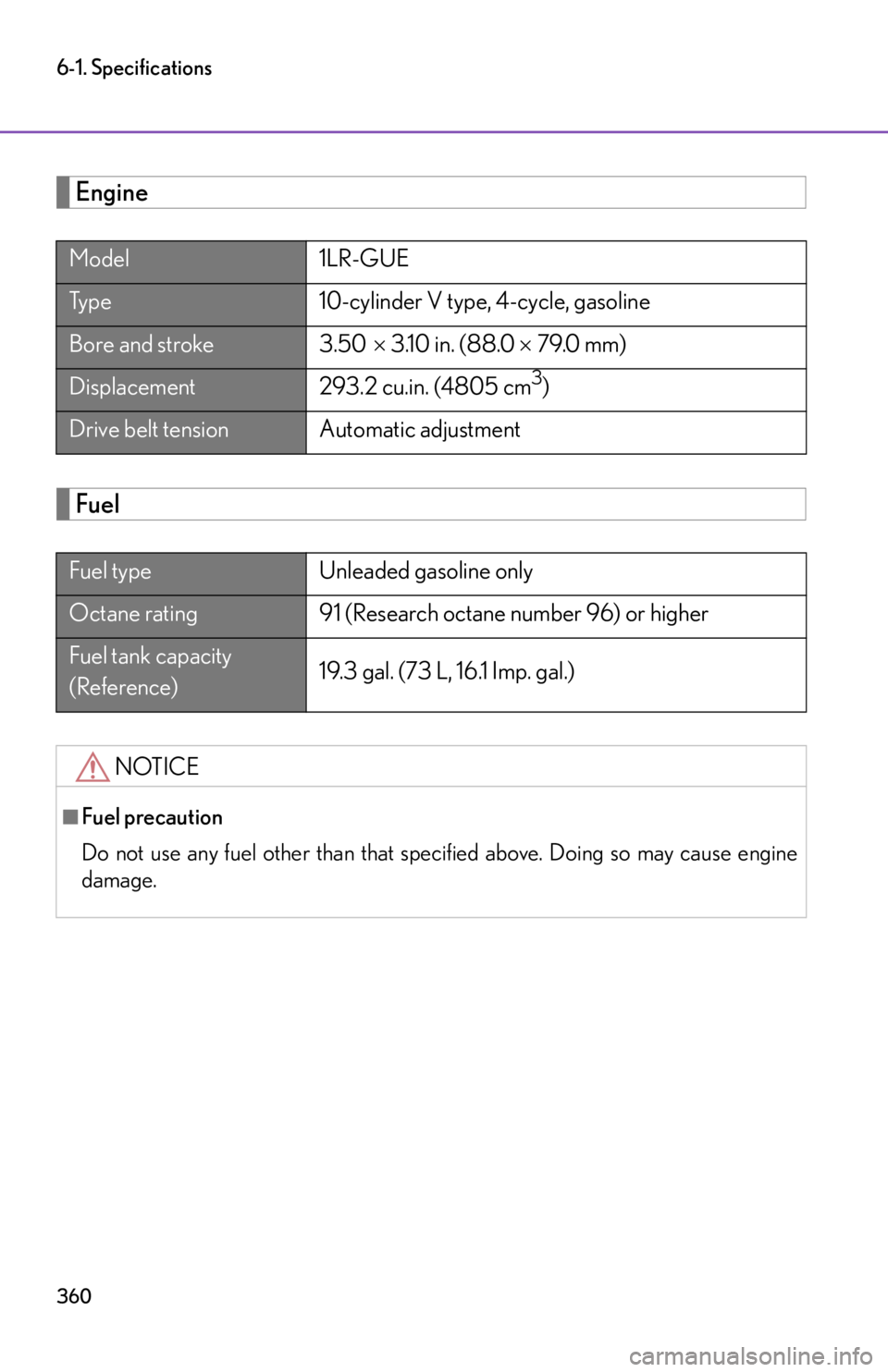
Engine
Fuel
Model1LR-GUE
Ty p e10-cylinder V type, 4-cycle, gasoline
Bore and stroke3.50 3.10 in. (88.0 79.0 mm)
Displacement 293.2 cu.in. (4805 cm3)
Drive belt tensionAutomatic adjustment
Fuel typeUnleaded gasoline only
Octane rating91 (Research octane number 96) or higher
Fuel tank capacity
(Reference)19.3 gal. (73 L, 16.1 Imp. gal.)
NOTICE
■Fuel precaution
Do not use any fuel other than that specified above. Doing so may cause engine
damage.
Page 363 of 420
361
6-1. Specifications
6
Vehicle specifications
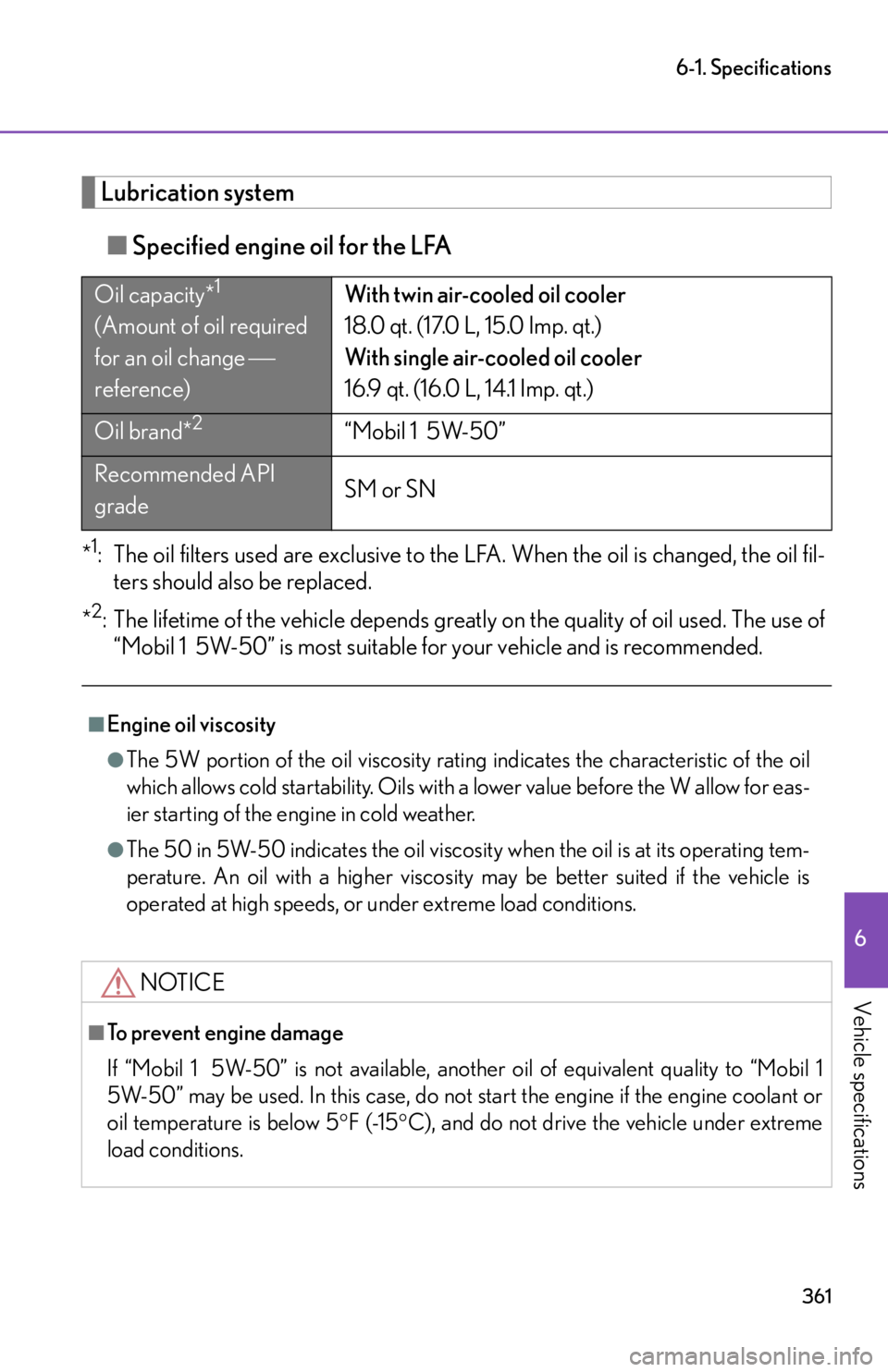
Lubrication system■ Specified engine oil for the LFA
*1: The oil filters used are exclusive to the LFA. When the oil is changed, the oil fil-
ters should also be replaced.
*
2: The lifetime of the vehicle depends greatly on the quality of oil used. The use of “Mobil 1 5W-50” is most suitable for your vehicle and is recommended.
Oil capacity*1
(Amount of oil required
for an oil change
reference) With twin air-cooled oil cooler
18.0 qt. (17.0 L, 15.0 Imp. qt.)
With single air-cooled oil cooler
16.9 qt. (16.0 L, 14.1 Imp. qt.)
Oil brand*2“Mobil 1 5W-50”
Recommended API
grade
SM or SN
■Engine oil viscosity
●The 5W portion of the oil viscosity rating
indicates the characteristic of the oil
which allows cold startability. Oils with a lower value before the W allow for eas-
ier starting of the engine in cold weather.
●The 50 in 5W-50 indicates the oil viscosit y when the oil is at its operating tem-
perature. An oil with a higher viscosity may be better suited if the vehicle is
operated at high speeds, or under extreme load conditions.
NOTICE
■To prevent engine damage
If “Mobil 1 5W-50” is not available, another oil of equivalent quality to “Mobil 1
5W-50” may be used. In this case, do not start the engine if the engine coolant or
oil temperature is below 5 F (-15C), and do not drive the vehicle under extreme
load conditions.
Page 364 of 420
362
6-1. Specifications
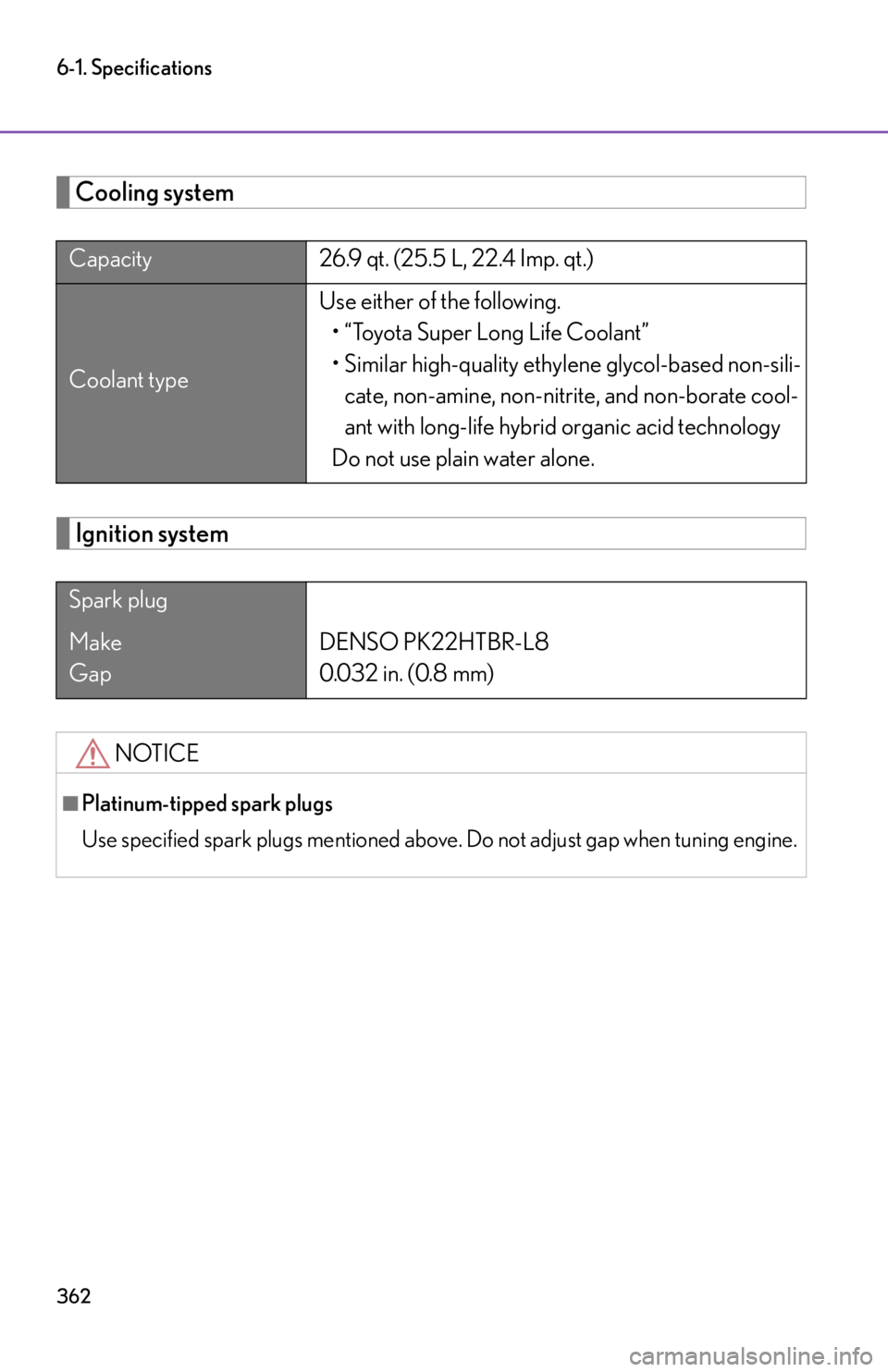
Cooling system
Ignition system
Capacity26.9 qt. (25.5 L, 22.4 Imp. qt.)
Coolant typeUse either of the following.
• “Toyota Super Long Life Coolant”
• Similar high-quality ethylene glycol-based non-sili- cate, non-amine, non-nitrite, and non-borate cool-
ant with long-life hybrid organic acid technology
Do not use plain water alone.
Spark plug
Make
Gap DENSO PK22HTBR-L8
0.032 in. (0.8 mm)
NOTICE
■Platinum-tipped spark plugs
Use specified spark pl
ugs mentioned above. Do not adjust gap when tuning engine.