engine lexus LFA 2012 Technical Information / LEXUS 2012 LFA (OM77006U) Repair Manual
[x] Cancel search | Manufacturer: LEXUS, Model Year: 2012, Model line: LFA, Model: Lexus LFA 2012Pages: 420, PDF Size: 5.02 MB
Page 226 of 420

224
3-5. Other interior features
Safety information for Safety ConnectImportant! Read this information before using Safety Connect.
■ Exposure to radio frequency signals
The Safety Connect sy stem installed in your ve hicle is a low-power
radio transmitter and receiver. It receives and also sends out radio fre-
quency (RF) signals.
In August 1996, the Federal Communications Commission (FCC)
adopted RF exposure guidelines with safety levels fo r mobile wireless
phones. Those guidelines are consistent with the safety standards pre-
viously set by the following U.S. and international standards bodies.
● ANSI (American National Standards Institute) C95.1 [1992]
● NCRP (National Council on Radi ation Protection and Measure-
ment) Report 86 [1986]
● ICNIRP (International Commission on Non-Ionizing Radiation Pro-
tection) [1996]
Those standards were based on co mprehensive and periodic evalua-
tions of the relevant scientific literature. Over 120 scientists, engineers,
and physicians from universities, an d government health agencies and
industries reviewed the available body of research to develop the
ANSI Standard (C95.1).
The design of Safety Connect co mplies with the FCC guidelines in
addition to those standards.
Page 229 of 420

Maintenance and care4
227
4-1. Maintenance and careCleaning and protecting the vehicle exterior............ 228
Cleaning and protecting the vehicle interior .............. 235
4-2. Maintenance Maintenance requirements ........................ 240
General maintenance .......... 242
Emission inspection and maintenance (I/M)
programs................................ 246 4-3. Do-it-yourself
maintenance
Do-it-yourself service precautions ............................ 247
Hood .......................................... 250
Positioning a floor jack ......... 253
Engine compartment ........... 256
Adding washer fluid .............. 264
Battery ...................................... 265
Tires............................................ 270
Tire inflation pressure............ 277
Wheels ....................................... 281
Air conditioning filter ........... 283
Wireless remote control battery .................................... 285
Checking and replacing fuses ........................................ 287
Light bulbs ................................ 299
Page 232 of 420
230
4-1. Maintenance and care
CAUTION
■When washing the vehicle
Do not apply water to the inside of the engine compartment. Doing so may cause
the electrical components etc. to catch fire.
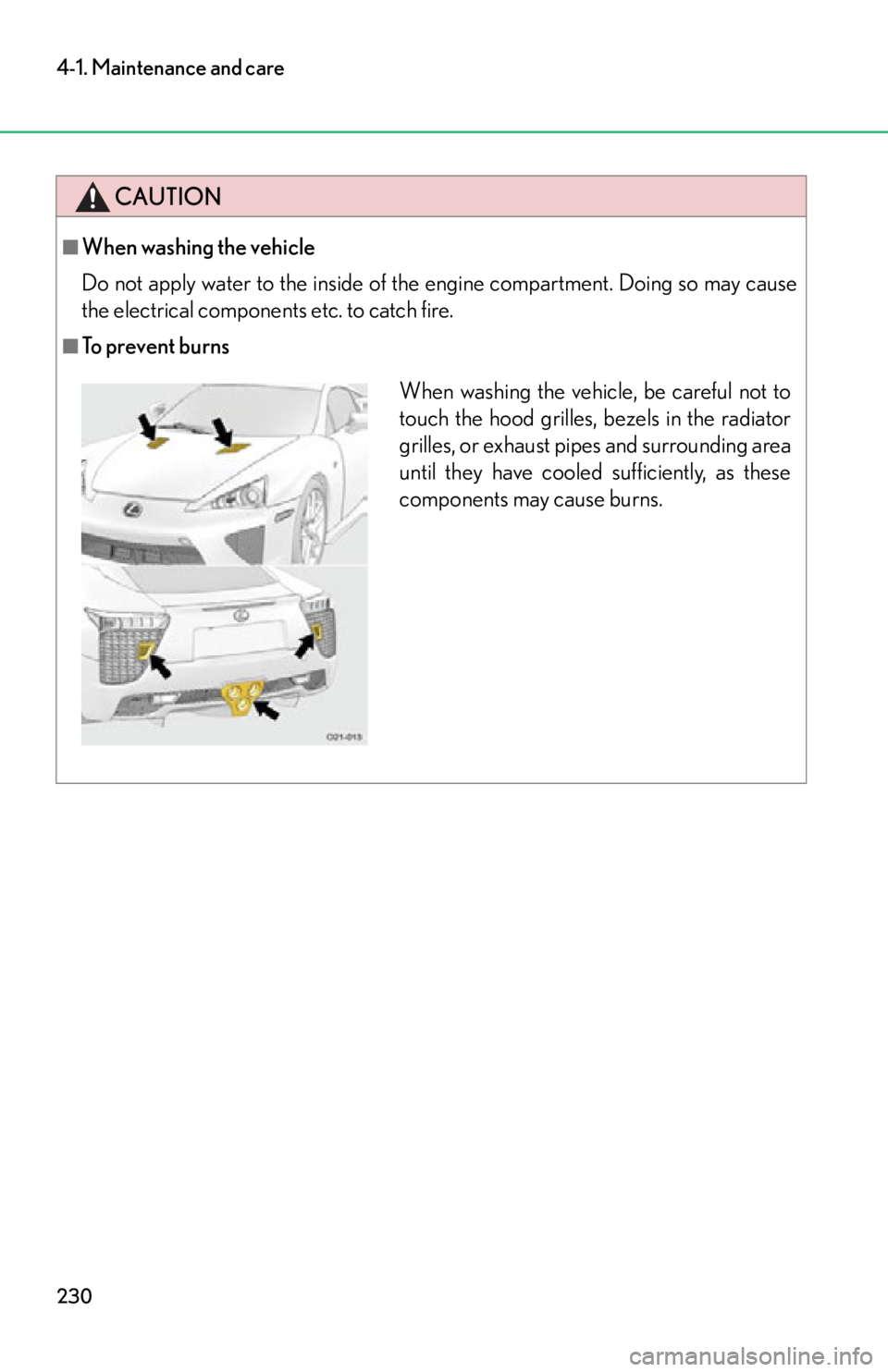
■To prevent burns
When washing the vehicle, be careful not to
touch the hood grilles, bezels in the radiator
grilles, or exhaust pipes and surrounding area
until they have cooled sufficiently, as these
components may cause burns.
Page 236 of 420
234
4-1. Maintenance and care
NOTICE
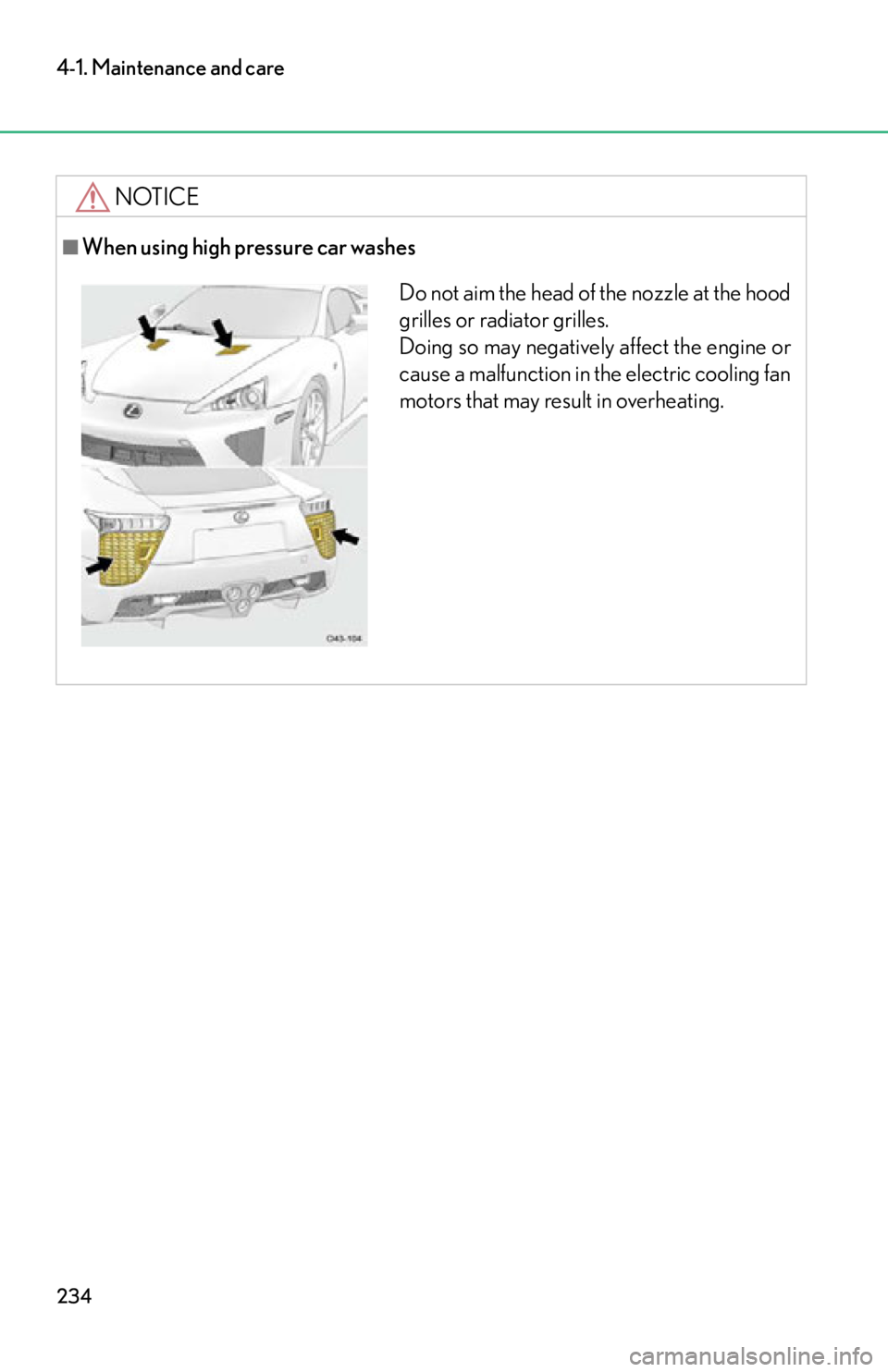
■When using high pressure car washes
Do not aim the head of the nozzle at the hood
grilles or radiator grilles.
Doing so may negatively affect the engine or
cause a malfunction in the electric cooling fan
motors that may result in overheating.
Page 243 of 420

241
4-2. Maintenance
4
Maintenance and care
CAUTION
■If your vehicle is not properly maintained
Improper maintenance could result in serious damage to the vehicle and possible
serious injury or death.
■Handling of the battery
●Engine exhaust, some of its constituents, and a wide variety of automobile com-
ponents contain or emit chemicals known to the State of California to cause can-
cer and birth defects and other reproductive harm. Work in a well ventilated area.
●Oils, fuels and fluids contained in vehicles as well as waste produced by compo-
nent wear contain or emit chemicals known to the State of California to cause
cancer and birth defects or other reproductive harm. Avoid exposure and wash
any affected area immediately.
●Battery posts, terminals and related accessories contain lead and lead com-
pounds which are known to cause brai n damage. Wash your hands after han-
dling. ( P. 2 6 5 )
Page 244 of 420
242
4-2. Maintenance
General maintenance
Listed below are the general maintenance items that should be performed at
the intervals specified in the “Warranty and Services Guide” or “Owners
Manual Supplement”. It is recommended that any problem you notice should
be brought to the attention of your Lexu s dealer or qualified service shop for
advice.
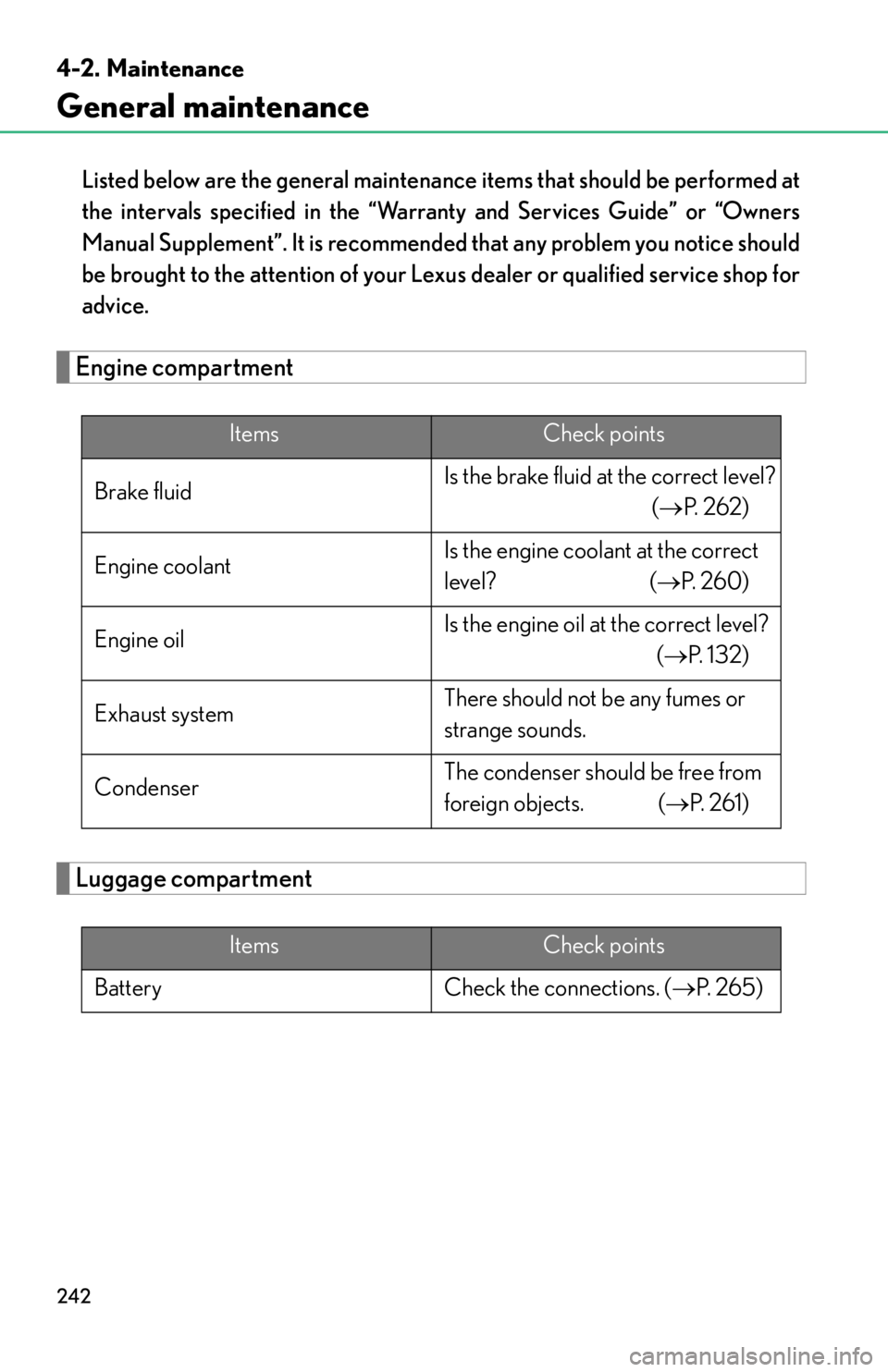
Engine compartment
Luggage compartment
ItemsCheck points
Brake fluid Is the brake fluid at the correct level?
(P. 2 6 2 )
Engine coolant Is the engine coolant at the correct
level? (
P. 2 6 0 )
Engine oil Is the engine oil at the correct level?
(P. 1 3 2 )
Exhaust system There should not be any fumes or
strange sounds.
Condenser The condenser should be free from
foreign objects. (
P. 2 6 1 )
ItemsCheck points
Battery Check the connections. ( P. 2 6 5 )
Page 246 of 420
244
4-2. Maintenance
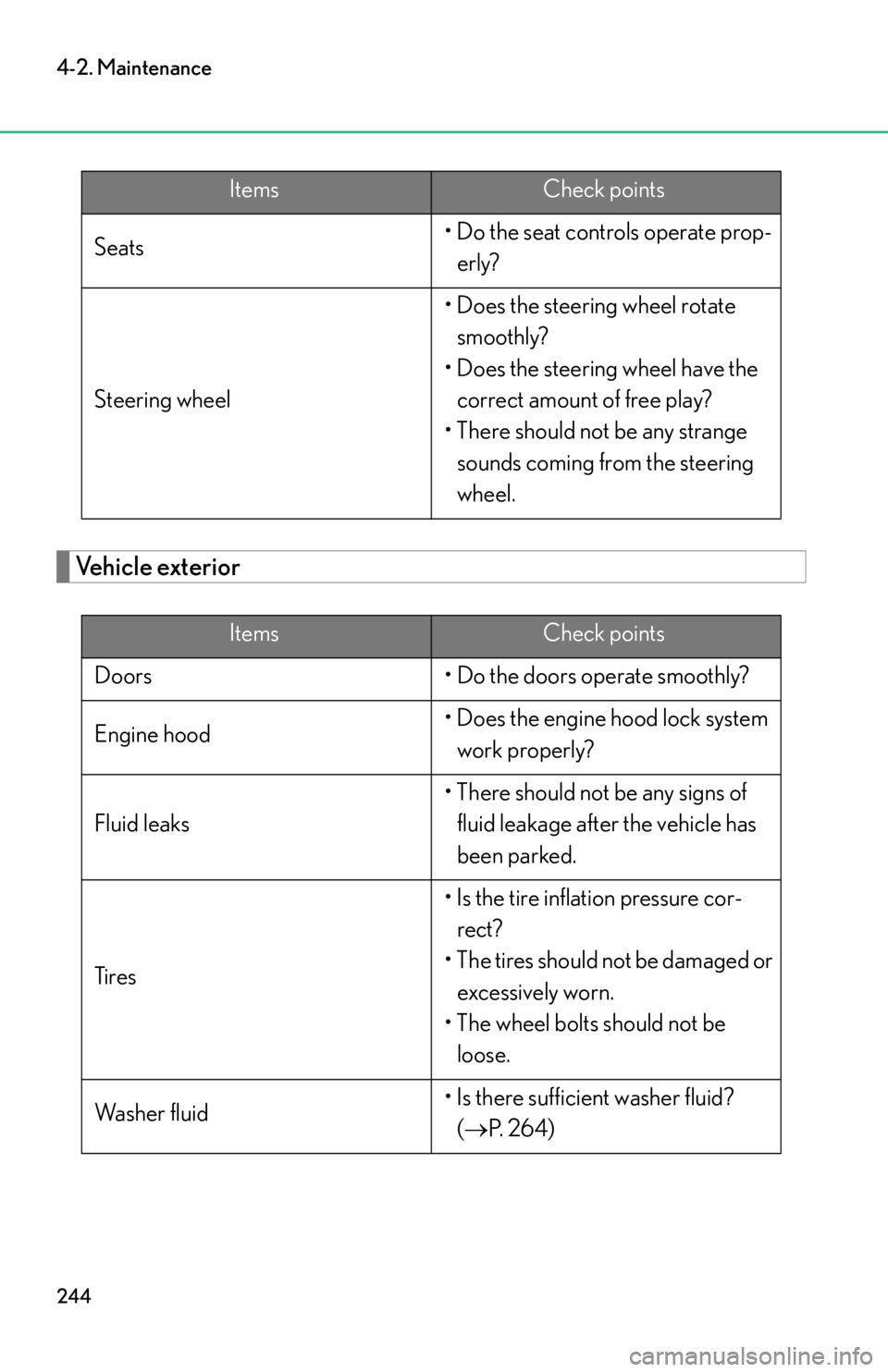
Vehicle exterior
Seats• Do the seat controls operate prop-
erly?
Steering wheel • Does the steering wheel rotate
smoothly?
• Does the steering wheel have the
correct amount of free play?
• There should not be any strange sounds coming from the steering
wheel.
ItemsCheck points
Doors • Do the doors operate smoothly?
Engine hood • Does the engine hood lock system
work properly?
Fluid leaks • There should not be any signs of
fluid leakage after the vehicle has
been parked.
Ti r e s • Is the tire inflation pressure cor-
rect?
• The tires should not be damaged or excessively worn.
• The wheel bolts should not be loose.
Wa s h e r f l u i d • Is there sufficient washer fluid?
( P. 2 6 4 )
ItemsCheck points
Page 247 of 420

245
4-2. Maintenance
4
Maintenance and care
CAUTION
■If the engine is running
Turn the engine off and ensure that there is adequate ventilation before performing
maintenance checks.
Page 249 of 420

247
4
Maintenance and care
4-3.Do-it-yourself maintenance
Do-it-yourself service precautions
If you perform maintenance yourself, be sure to follow the correct proce-
dures as given in these sections.
ItemsParts and tools
Battery condition ( P. 2 6 5 ) •Warm water
•Baking soda
•Grease
• Conventional wrench
(for the positive terminal clamp
bolt)
Brake fluid level ( P. 2 6 2 ) • FMVSS No.116 DOT 3 or SAE
J1703 brake fluid
•Rag or paper towel
•Funnel (used only for adding brake fluid)
Condenser ( P. 2 6 1 )
Engine coolant level ( P. 2 6 0 ) • “Toyota Super Long Life Coolant”
or similar high-quality ethylene gly-
col-based non-silicate, non-amine,
non-nitrite and non-borate coolant
with long-life hybrid organic acid
technology. “Toyota Super Long
Life Coolant” is pre-mixed with
50% coolant and 50% deionized
water.
•Funnel (used only for adding engine cool-
ant)
Engine oil level ( P. 2 5 7 ) • “Mobil 1 5W-50”
•Funnel
(used only for adding engine oil)
Fuses ( P. 2 8 7 ) • Fuse with same amperage rating as
original
Page 251 of 420
249
4-3. Do-it-yourself maintenance
4
Maintenance and care
CAUTION
The engine compartment contains many mechanisms and fluids that may move sud-
denly, become hot, or become electrically energized. To avoid death or serious injury,
observe the following precautions:
■When working on the engine compartment
●Keep hands, clothing, and tools away from the moving fan and engine drive belt.
●Be careful not to touch the engine, exhaust manifold, etc. right after driving as
they may be hot. Oil and other fluids may also be hot.
●Do not leave anything that may burn easily, such as paper or rags, in the engine
compartment.
●Do not smoke, cause sparks or expose an open flame to fuel. Fuel fumes are flam-
mable.
■When working near the electric cooling fan
Be sure the ignition switch is in the “LOCK” position.
With the ignition on, the electric cooling fan may automatically start to run if the air
conditioning is on. ( P. 2 6 1 )
■Safety glasses
Wear safety glasses to prevent flying or falling material, fluid spray, etc. from getting
in the eyes.
NOTICE
■If you remove the air cleaner filters
Driving with the air cleaner filters remo ved may cause excessive engine wear due
to dirt in the air. Also a backfire could cause a fire in the engine compartment.