ECU lexus LFA 2012 Technical Information / LEXUS 2012 LFA (OM77006U) User Guide
[x] Cancel search | Manufacturer: LEXUS, Model Year: 2012, Model line: LFA, Model: Lexus LFA 2012Pages: 420, PDF Size: 5.02 MB
Page 81 of 420
79
1-7. Safety information
1
Before driving
CAUTION
■Child restraint lock function belt precaution
Do not allow children to play with the child restraint lock function belt. If the belt
becomes twisted around a child’s neck, it will not be possible to pull the belt out
leading to choking or other serious in juries that could result in death.
If this occurs and the buckle cannot be un fastened, scissors should be used to cut
the belt behind the seat belt guide.
■When the child restraint system is not in use
●Keep the child restraint system properly secu red on the seat even if it is not in use.
Do not store the restraint unsecured in the passenger compartment.
●If it is necessary to detach the child restraint system, remove it from the vehicle.
This will prevent it from injuring occupa nts in the event of a sudden stop, sudden
swerve or an accident.
Page 82 of 420
80
1-7. Safety information
Installing child restraints
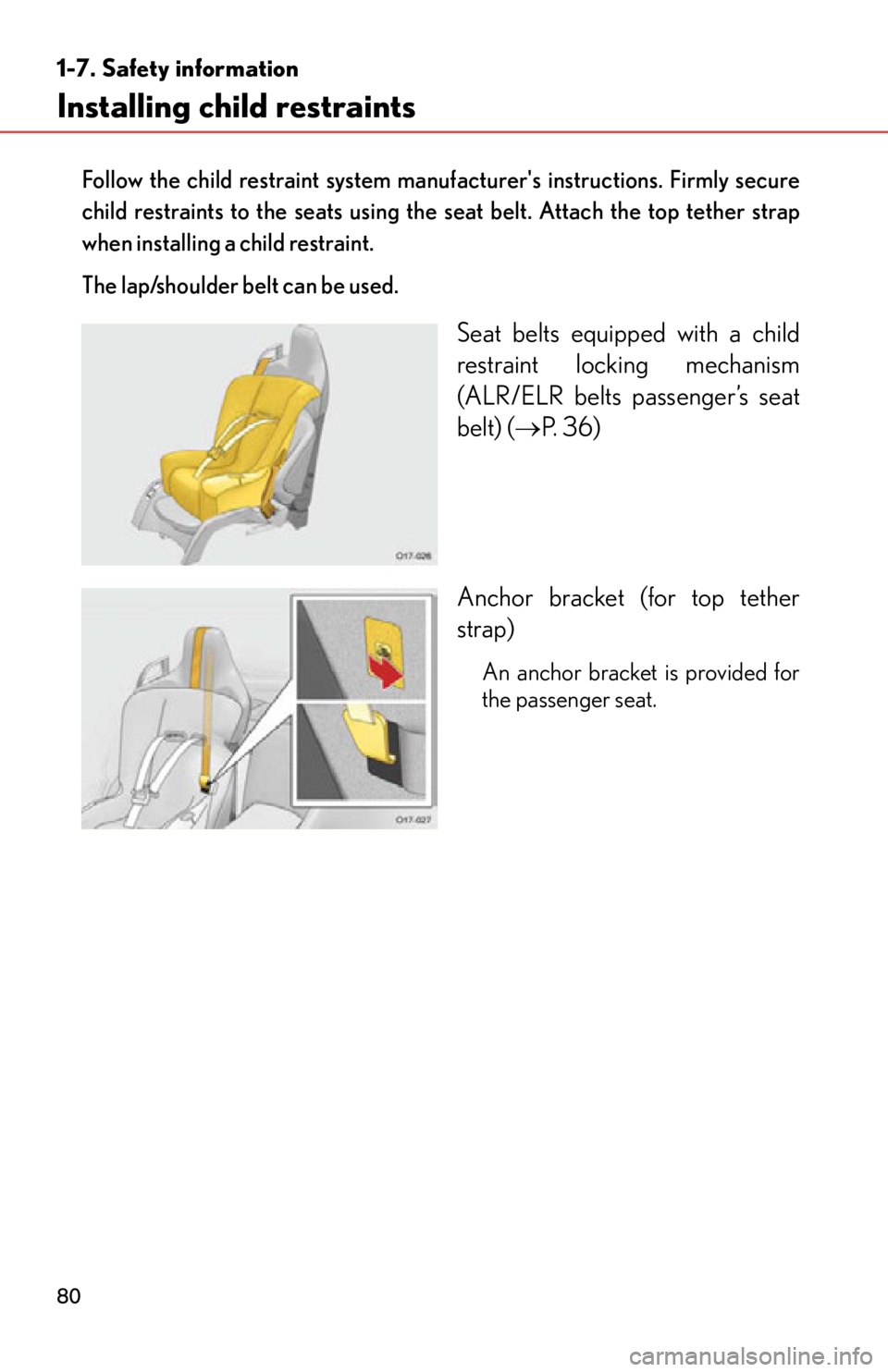
Follow the child restraint system manufacturer's instructions. Firmly secure
child restraints to the seats using the seat belt. Attach the top tether strap
when installing a child restraint.
The lap/shoulder belt can be used.
Seat belts equipped with a child
restraint locking mechanism
(ALR/ELR belts passenger’s seat
belt) ( P. 36)
Anchor bracket (for top tether
strap)
An anchor bracket is provided for
the passenger seat.
Page 84 of 420
82
1-7. Safety information
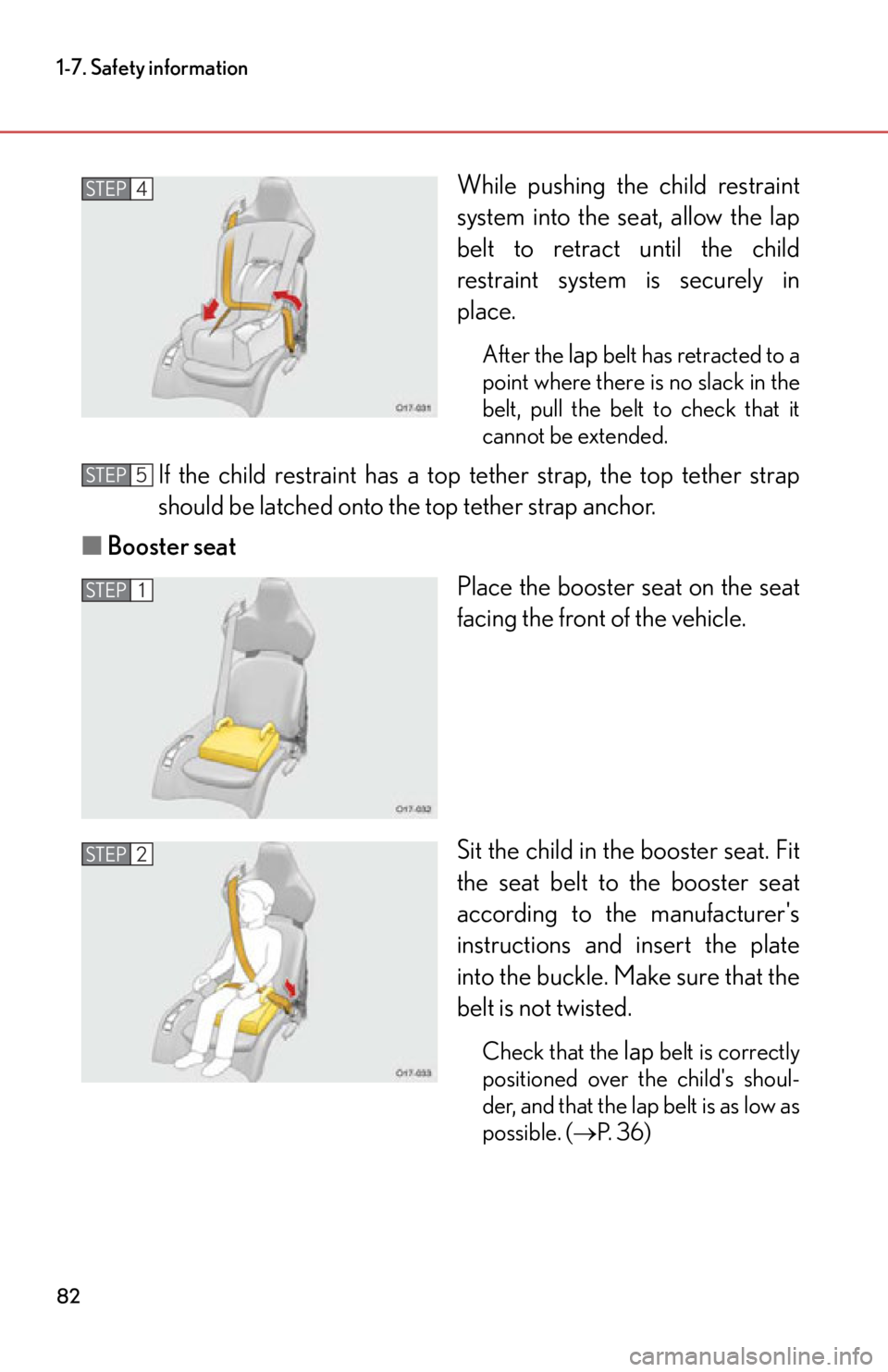
While pushing the child restraint
system into the seat, allow the lap
belt to retract until the child
restraint system is securely in
place.
After the lap belt has retracted to a
point where there is no slack in the
belt, pull the belt to check that it
cannot be extended.
If the child restraint has a top tether strap, the top tether strap
should be latched onto the top tether strap anchor.
■ Booster seat
Place the booster seat on the seat
facing the front of the vehicle.
Sit the child in the booster seat. Fit
the seat belt to the booster seat
according to the manufacturer's
instructions and insert the plate
into the buckle. Make sure that the
belt is not twisted.
Check that the lap belt is correctly
positioned over the child's shoul-
der, and that the lap belt is as low as
possible. ( P. 3 6 )
STEP4
STEP5
STEP1
STEP2
Page 85 of 420
83
1-7. Safety information
1
Before driving
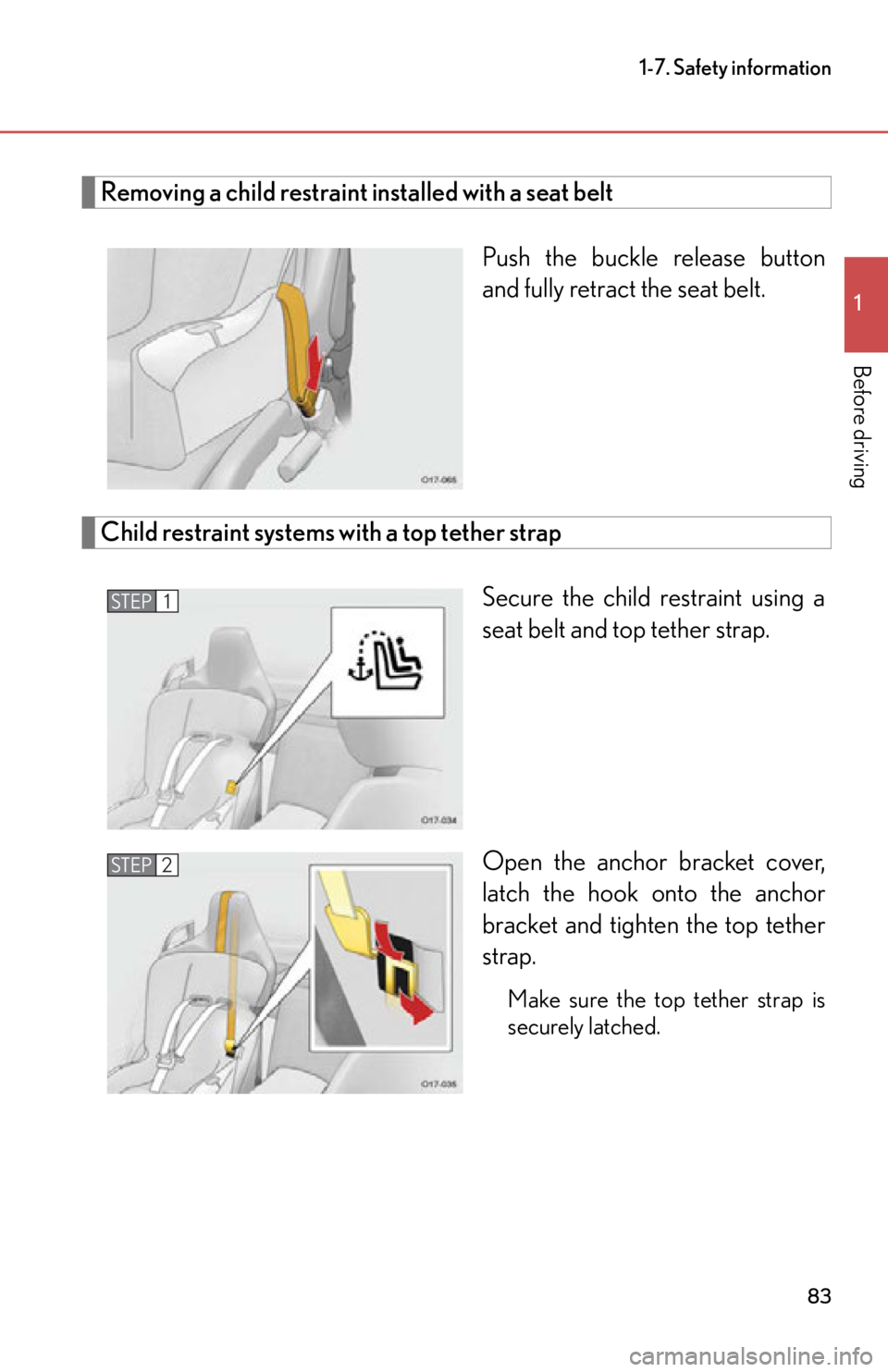
Removing a child restraint installed with a seat beltPush the buckle release button
and fully retract the seat belt.
Child restraint systems with a top tether strapSecure the child restraint using a
seat belt and top tether strap.
Open the anchor bracket cover,
latch the hook onto the anchor
bracket and tighten the top tether
strap.
Make sure the top tether strap is
securely latched.
STEP1
STEP2
Page 86 of 420
84
1-7. Safety information
■Laws and regulations pertaining to anchorages
Child restraint systems conforming to FMVSS213 or CMVSS213 specifications
can be used.
This vehicle is designed to conform to the SAE J1819.
CAUTION
■When installing a booster seat
To prevent the belt from going into ALR lo ck mode, do not fully extend the lap belt.
ALR mode causes the belt to tighten only. This could cause injury or discomfort to
the child. ( P. 3 8 )
■When installing a child restraint system
Follow the directions given in the child restraint system installation manual and fix
the child restraint system securely in place.
If the child restraint system is not correctl y fixed in place, the child or driver may be
seriously injured or even killed in the ev ent of sudden braking, sudden swerving or
an accident.
●When a booster seat is installed, always ensure that the shoulder belt is posi-
tioned across the center of the child's shoulder. The belt should be kept away
from the child's neck, but not so that it could fall off the child's shoulder. Failing to
do so may result in death or serious inju ry in the event of sudden braking, sudden
swerving or an accident.
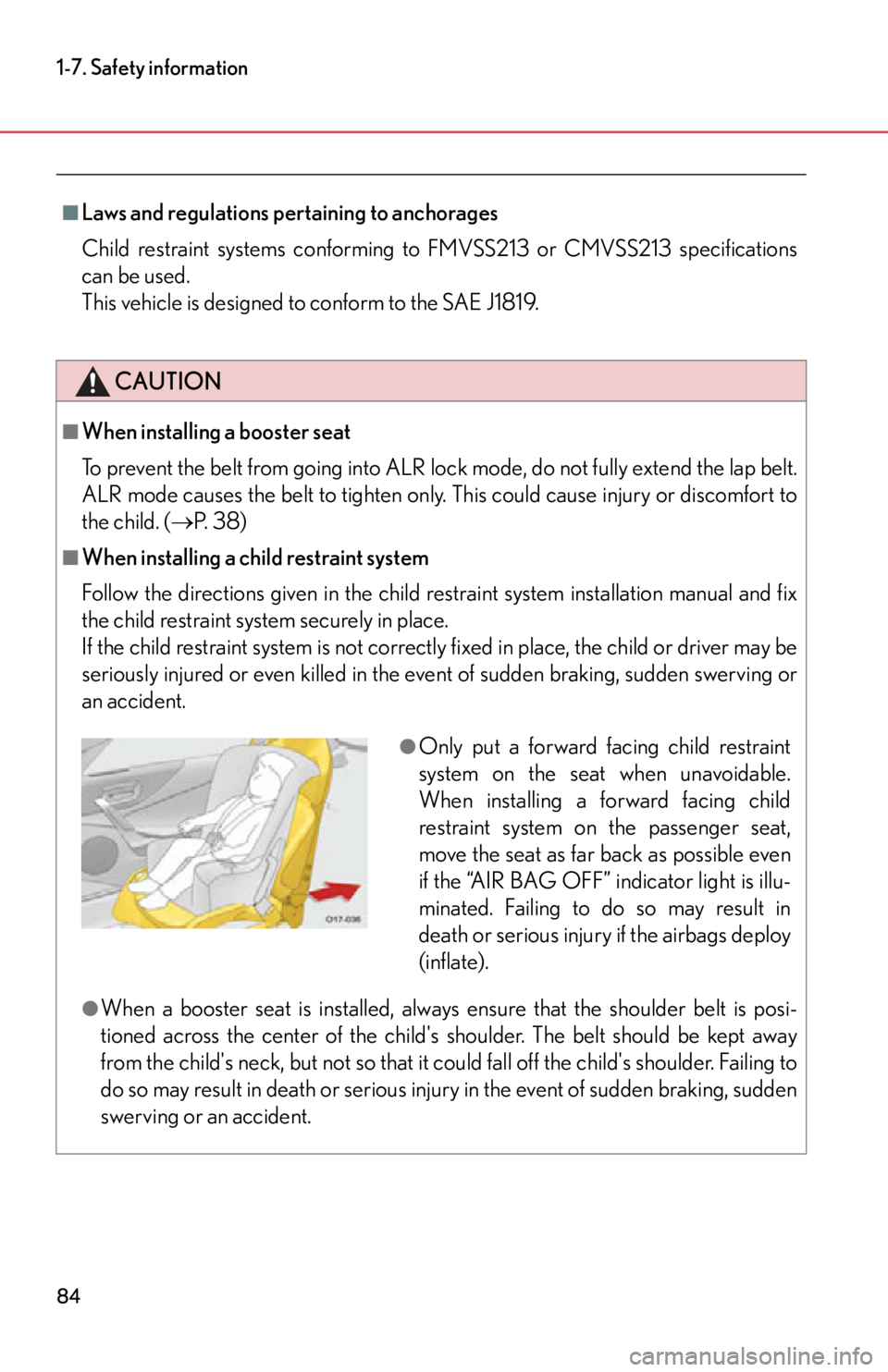
●Only put a forward facing child restraint
system on the seat when unavoidable.
When installing a forward facing child
restraint system on the passenger seat,
move the seat as far back as possible even
if the “AIR BAG OFF” in dicator light is illu-
minated. Failing to do so may result in
death or serious injury if the airbags deploy
(inflate).
Page 87 of 420

85
1-7. Safety information
1
Before driving
CAUTION
■When installing a child restraint system
●Ensure that the belt and plate are securely locked and the seat belt is not twisted.
●Push and pull the child restraint system from side to side and forward to be sure it
is secure.
●After securing a child restraint system, never adjust the seat.
●Follow all installation instructions provid ed by the child restraint system manufac-
turer.
Page 95 of 420

93
2-1. Driving procedures
2
When driving
CAUTION
■When the vehicle is stopped
●Do not race the engine.
• If the vehicle is in any gear other than Neutral the vehicle may accelerate sud-denly and unexpectedly, causing an accident.
• Running the engine at high speed while the vehicle is stopped may cause the exhaust system to overheat, which could result in a fire if flammable material is
nearby.
• Racing the engine may emit loud noise, and possibly cause a nuisance, espe- cially after just starting the engine. This is because the structure of the exhaust
pipes cause the sound emitted from the exhaust to be louder than usual for
approximately 1 minute after the engine is started.
●Do not leave the vehicle with the engine running for a long time.
If such a situation cannot be avoided, park the vehicle in an open space and
check that exhaust fumes do no t enter the vehicle interior.
●If the vehicle is stopped on an incline, in order to prevent accidents caused by the
vehicle rolling forward or backward, always depress the brake pedal and securely
apply the parking brake as needed.
■When the vehicle is parked
●Do not leave glasses, cigarette lighters, spray cans, or soft drink cans in the vehi-
cle when it is in the sun.
Doing so may result in the following:
• Gas may leak from a cigarette lighter or spray can, and may lead to a fire.
• The temperature inside the vehicle may cause the plastic lenses and plastic material of glasses to deform or crack.
• Soft drink cans may fracture, causing the contents to spray over the interior of
the vehicle, and may also cause a short circuit in the vehicle's electrical com-
ponents.
●Do not leave cigarette lighters in the vehicle. If a cigarette lighter is in a place such
as the glove box or on the floor, it may be lit accidentally when luggage is loaded
or the seat is adjusted, causing a fire.
●Do not attach adhesive discs to the wind shield or windows. Do not place contain-
ers such as air fresheners on the instru ment panel or dashboard. Adhesive discs
or containers may act as lenses, causing a fire in the vehicle.
Page 117 of 420

115
2-1. Driving procedures
2
When driving
Horn
To sound the horn, press the pad in
the middle of the steering wheel.
■After adjusting the steering wheel
Make sure that the steering wheel is securely locked.
The horn may not sound if the steering wheel is not securely locked. (P. 4 1 )
Page 163 of 420
161
2-3. Operating the lights and windshield wipers
2
When driving
■The windshield wipers and wa sher can be operated when
The ignition switch is in the “ON” position.
■Effects of vehicle speed on wiper operation
The time until the drip prevention wiper sweep occurs is changed depending on
vehicle speed.
When low speed wiper operation is selected , wiper operation will be switched from
low speed to intermittent wiper operatio n only when the vehicle is stationary.
(However, when the intermittent wiper interv al adjuster is adjusted to the highest
level, the mode will not switch.)
■Wiper reverse motion
If snow or similar substances build up around the windshield and prevent the wiper
from moving smoothly, the wiper may reverse direction before the end of its stroke
in order to secure driver vi sibility and to protect the system. This is normal and does
not indicate a malfunction.
■If no windshield washer fluid sprays
Check that the washer nozzles are not blocked if there is washer fluid in the wind-
shield washer fluid reservoir.
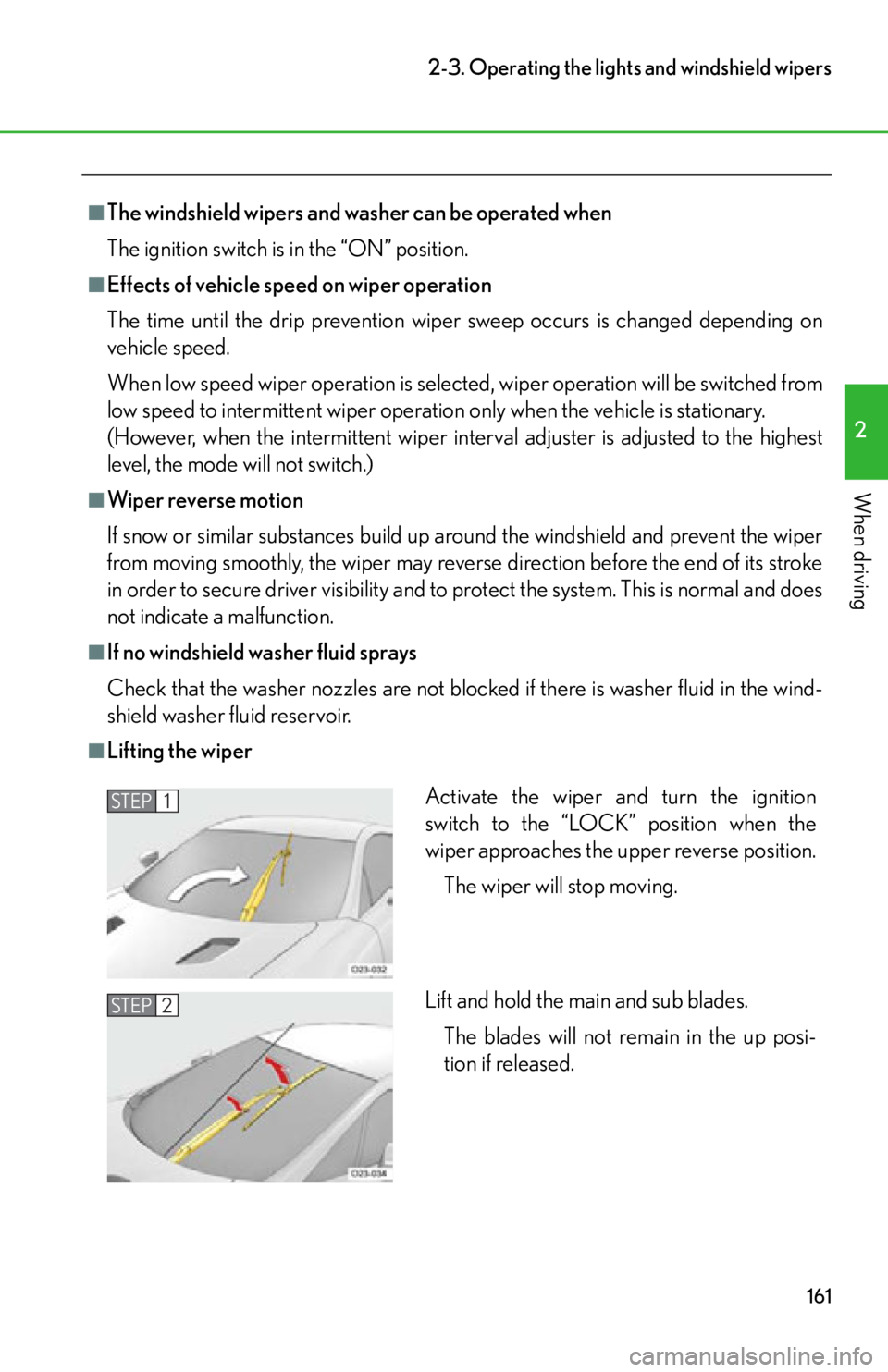
■Lifting the wiper
Activate the wiper and turn the ignition
switch to the “LOCK” position when the
wiper approaches the upper reverse position.
The wiper will stop moving.
Lift and hold the main and sub blades. The blades will not remain in the up posi-
tion if released.STEP1
STEP2
Page 178 of 420

176
2-5.Driving information
Cargo and luggage
Take notice of the following information about storage precautions, cargo
capacity and load:
●Stow cargo and luggage in the luggage compartment whenever possi-
ble.
● Be sure all items are secured in place.
● To maintain vehicle balance while driving, position luggage evenly
within the luggage compartment.
● For better fuel economy, do not carry unnecessary weight.
Capacity and distribution
Cargo capacity depends on the to tal weight of the occupants.
(Cargo capacity) = (Total load capa city) — (Total weight of occupants)
Steps for Determining Correct Load Limit
(1) Locate the statement “The combined weight of occupants and cargo should never exceed XXX kg or XXX lbs.” on your vehicle’s placard.
(2) Determine the combined weight of th e driver and passengers that will
be riding in your vehicle.
(3)Subtract the combined weight of the driver and passengers from
XXX kg or XXX lbs.
(4)The resulting figure equals the av ailable amount of cargo and luggage
load capacity.
For example, if the “XXX” amount equals 1400 lbs. and there will be
five 150 lb passengers in your vehicle, the amount of available cargo
and luggage load capacity is 650 lbs. (1400 750 (5150) = 650
lbs.)
(5)Determine the combined weight of luggage and cargo being loaded
on the vehicle. That weight may no t safely exceed the available cargo
and luggage load capacity calculated in Step 4.