brake lexus LFA 2012 Technical Information / LEXUS 2012 LFA (OM77006U) User Guide
[x] Cancel search | Manufacturer: LEXUS, Model Year: 2012, Model line: LFA, Model: Lexus LFA 2012Pages: 420, PDF Size: 5.02 MB
Page 95 of 420

93
2-1. Driving procedures
2
When driving
CAUTION
■When the vehicle is stopped
●Do not race the engine.
• If the vehicle is in any gear other than Neutral the vehicle may accelerate sud-denly and unexpectedly, causing an accident.
• Running the engine at high speed while the vehicle is stopped may cause the exhaust system to overheat, which could result in a fire if flammable material is
nearby.
• Racing the engine may emit loud noise, and possibly cause a nuisance, espe- cially after just starting the engine. This is because the structure of the exhaust
pipes cause the sound emitted from the exhaust to be louder than usual for
approximately 1 minute after the engine is started.
●Do not leave the vehicle with the engine running for a long time.
If such a situation cannot be avoided, park the vehicle in an open space and
check that exhaust fumes do no t enter the vehicle interior.
●If the vehicle is stopped on an incline, in order to prevent accidents caused by the
vehicle rolling forward or backward, always depress the brake pedal and securely
apply the parking brake as needed.
■When the vehicle is parked
●Do not leave glasses, cigarette lighters, spray cans, or soft drink cans in the vehi-
cle when it is in the sun.
Doing so may result in the following:
• Gas may leak from a cigarette lighter or spray can, and may lead to a fire.
• The temperature inside the vehicle may cause the plastic lenses and plastic material of glasses to deform or crack.
• Soft drink cans may fracture, causing the contents to spray over the interior of
the vehicle, and may also cause a short circuit in the vehicle's electrical com-
ponents.
●Do not leave cigarette lighters in the vehicle. If a cigarette lighter is in a place such
as the glove box or on the floor, it may be lit accidentally when luggage is loaded
or the seat is adjusted, causing a fire.
●Do not attach adhesive discs to the wind shield or windows. Do not place contain-
ers such as air fresheners on the instru ment panel or dashboard. Adhesive discs
or containers may act as lenses, causing a fire in the vehicle.
Page 96 of 420

94
2-1. Driving procedures
CAUTION
●Do not leave a door or window open if the curved glass is coated with a metal-
lized film such as a silver-colored one. Reflected sunlight may cause the glass to
act as a lens, causing a fire.
●Always apply the parking brake, select 1st gear or Reverse, stop the engine and
lock the vehicle.
Do not leave the vehicle unattend ed while the engine is running.
●Do not stop the engine without first chec king the gear indicator to confirm that
either 1st gear or Reverse is selected.
●Do not leave the engine running in an area with snow build-up, or where it is
snowing. If snowbanks build up around the vehicle while the engine is running,
exhaust gases may collect and enter the vehi cle. This may lead to death or a seri-
ous health hazard.
●Do not touch the hood grilles, bezels in the
radiator grilles, or exhaust pipes and sur-
rounding area while the engine is running
or immediately after tu rning the engine off.
Doing so may cause burns.
Page 97 of 420

95
2-1. Driving procedures
2
When driving
CAUTION
■Exhaust gases
Exhaust gases include harmful carbon monoxide (CO), which is colorless and
odorless. Inhaling exhaust gases may lead to death or a serious health hazard.
●If the vehicle is in a poorly ventilated ar ea, stop the engine. In a closed area, such
as a garage, exhaust gases may collect and enter the vehicle. This may lead to
death or a serious health hazard.
●The exhaust system should be checked occasionally. If there is a hole or crack
caused by corrosion, damage to a joint or abnormal exhaust noise, be sure to
have the vehicle inspected and repaired by your Lexus dealer. Failure to do so
may allow exhaust gases to enter the vehicl e, resulting in death or a serious health
hazard.
■When taking a nap in the vehicle
Always turn the engine off. If you take a nap with the engine on, you may acciden-
tally depress the accelerator and an accident or fire may occur due to engine over-
heating. In addition, if the vehicle is parked in a poorly ventilated area, exhaust gases
may enter the vehicle, leading to death or a serious health hazard.
■When braking the vehicle
●Be especially careful if the brakes are wet, such as when driving on wet or snowy
roads or immediately after washing the vehicle. When the brakes are wet, their
efficiency may be reduced and the vehicle may brake unevenly to the left or right.
The efficiency of the parking brake may also be reduced.
●The brake system consists of 3 individual hydraulic systems; if one of the systems
fails, the others will still operate. In th is case, the brake pedal should be depressed
more firmly than usual and the braking distance will increase. If this happens, do
not continue to drive the vehicle. If the brake system warning light (red indicator)
comes on together with the buzzer sound while driving, immediately stop the
vehicle in a safe place and contact your Lexus dealer.
Page 98 of 420

96
2-1. Driving procedures
NOTICE
■When driving the vehicle
●Do not depress the accelerator and brake pedals at the same time during driving.
If the brake pedal is depressed whil e driving with the accelerator pedal
depressed, driving torque may be restrained.
●Do not use the accelerator pedal or depress the accelerator and brake pedals at
the same time to hold the vehicle on a hill. Doing so may damage the clutch.
■When parking the vehicle
●Parking with the rear of the vehicle close to a wall or similar structure may cause
the area around the exhaust pipes to over heat. As this may result in damage to
the rear bumper or other components, be sure to park the vehicle rear end as far
away as possible from walls and other such structures.
●When it rains, do not park on a slope with an angle of 15 degrees or more, as rain-
water may enter the vehicle. If parking at such an angle is unavoidable, use wheel
chocks and place a car cover over the vehicle.
■Avoiding damage to vehicle parts
●Do not turn the steering wheel fully in either direction and hold it there for an
extended period of time.
Doing so may damage the power steering motor.
●When driving over bumps in the road, be careful and drive as slowly as possible
to avoid damaging the wheels, tires, underside of the vehicle, etc.
■If you get a flat tire while driving
A flat or damaged tire may cause the following situations. Hold the steering wheel
firmly and gradually depress the brak e pedal to slow down the vehicle.
●It may be difficult to control your vehicle.
●The vehicle will make abnormal sounds or vibrations.
●The vehicle will lean.
Information on what to do in case of a flat tire ( P. 3 3 2 )
Page 99 of 420

97
2-1. Driving procedures
2
When driving
NOTICE
■When encountering flooded roads
Do not drive on a road that has flooded after heavy rain etc. Doing so may cause the
following serious damage to the vehicle:
●Engine stalling
●Short in electrical components
●Engine damage caused by water immersion
In the event that you drive on a flooded road and the vehicle is flooded, be sure to
have your Lexus dealer check the following:
●Brake function
●Changes in quantity and quality of oil an d fluid used for the engine, transmission,
differential, etc.
●Lubrication problems of bearings, joints, etc.
Page 100 of 420

98
2-1. Driving procedures
Ignition switch
■Starting the engine
Sit in the driver’s seat and firmly depress the brake pedal.
Turn the ignition switch to the
“ON” position.
The current gear will be displayed
on the meter as a blinking symbol.
Pull both paddle shift switches at
the same time.
“N” will be displayed in the gear
indicator.
The indicator light on the steering
wheel illuminates in red.
Press the “ENGINE START”
switch.
After one press, the engine will
crank until it starts or for up to 20
seconds, whichever is less.
Continue depressing the brake
pedal until the engine is completely
started.
STEP1
STEP2
STEP3
STEP4
Page 102 of 420
100
2-1. Driving procedures
■If the engine does not start
●Repeat the procedure again. If the engine does not start after a few tries, the
“ENGINE START” switch may be malfunctioning. Have the vehicle inspected
by your Lexus dealer.
●Check to make sure that the brake pedal is firmly depressed and that “N” is dis-
played in the gear indicator. (If the brake pedal is not depressed or “N” is not
displayed, the engine will not start.)
●The engine immobilizer system may not have been deactivated. ( P. 5 3 )
●In order to protect the engine, the engine may not start when the engine coolant
temperature or the engine oil temperature is below -13 F (-25C). In that case,
a buzzer will sound and “Temp low Engine cannot be started” will be shown on
the meter. ( P. 3 2 7 )
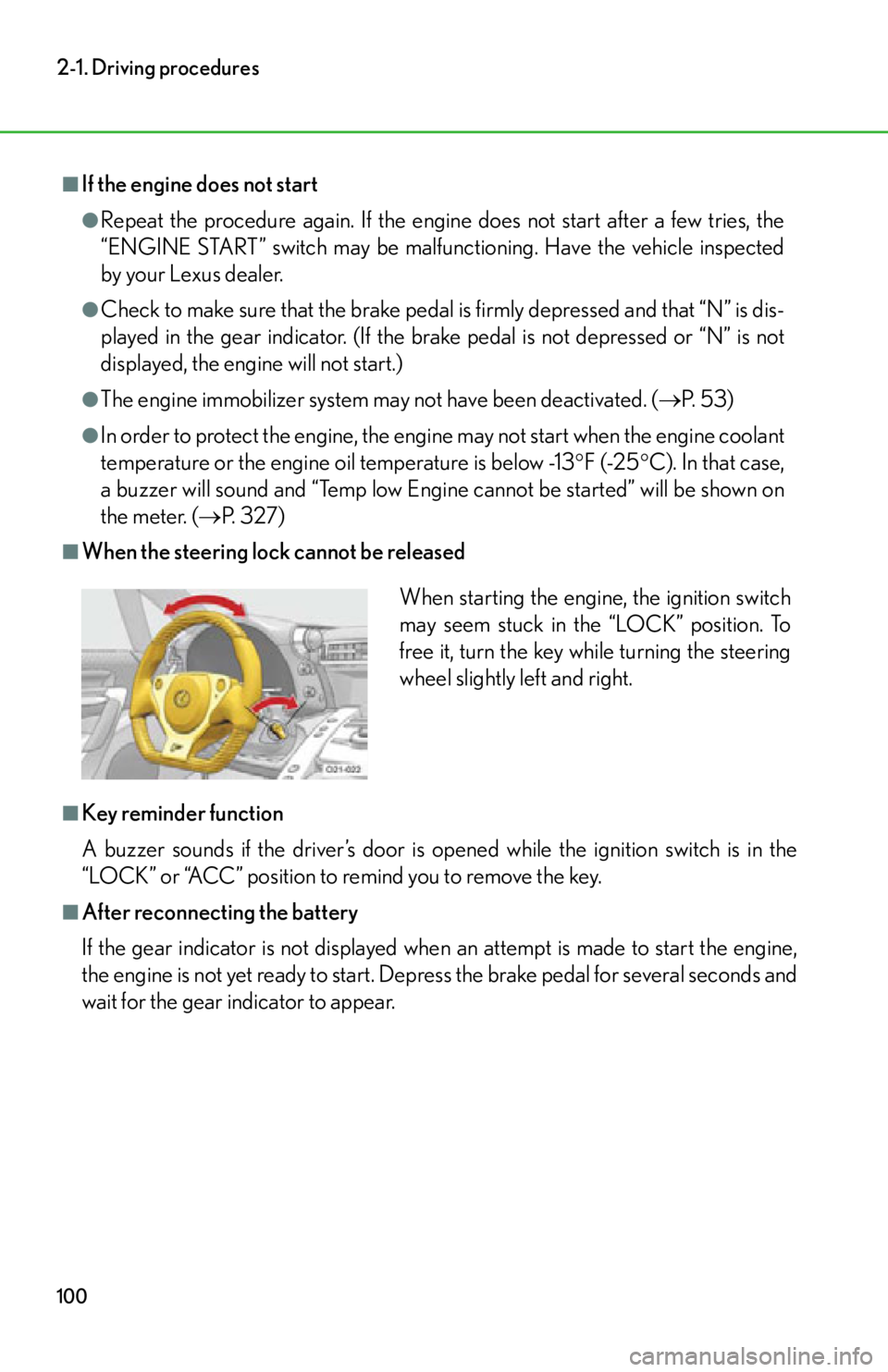
■When the steering lock cannot be released
■Key reminder function
A buzzer sounds if the driver’s door is opened while the ignition switch is in the
“LOCK” or “ACC” position to remind you to remove the key.
■After reconnecting the battery
If the gear indicator is not displayed when an attempt is made to start the engine,
the engine is not yet ready to start. Depr ess the brake pedal for several seconds and
wait for the gear indicator to appear.
When starting the engine, the ignition switch
may seem stuck in the “LOCK” position. To
free it, turn the key while turning the steering
wheel slightly left and right.
Page 112 of 420

110
2-1. Driving procedures
■Shift speed
●When the driving mode is changed, the shift speed levels will be set as follows:
●Shift shock increases as the shift speed becomes faster.
■When parking the vehicle
There is no P (Park) setting for the ASG. When parking the vehicle, set the parking
brake, select 1st gear or Reverse, and ch eck that the gear indicator shows “D1”, “1”
or “R” before stopping the engine.
●Approximately one second after the engine is stopped, the vehicle will enter a
parked gear state.
If the vehicle fails to enter a parked gear state, a buzzer sounds and the gear
indicator flashes. Select Neutral and then follow the same procedure again.
●Make sure to stop the engine. Opening the driver’s door without first stopping
the engine will cause a warning to sound and Neutral to be automatically
selected after 5 seconds. Even if the driver’s door is not opened, a warning will
sound and Neutral will be automatically selected after 90 seconds.
■ASG operating sounds
●Even when the engine is stopped, operating sounds of the electric oil pump may
be heard. This is normal and does not indicate a malfunction.
●As the drive train of the LFA is designed to be especially responsive to acceler-
ator pedal operation, a sound may be heard from the transaxle when driving at
low engine speeds. This does not indicate a malfunction.
■Customization that can be configured at your Lexus dealer
The sound pattern of the reverse warning buzzer can be changed.
(Customizable features P. 383)
Driving modeDefault levelAdjustable range
AUTO 2
SPORT 5 1 7
NORMAL 3
WET 1
Page 115 of 420

113
2-1. Driving procedures
2
When driving
Parking brake
For the parking brake, an electrical parking brake system is adopted.
Press the switch to set the park-
ing brake.
If the parking brake switch is oper-
ated when the ignition switch is not
in the “ON” position, the parking
brake indicator light will come on
and stay on for a while.
Press and hold the parking brake
switch if an emergency occurs and
it is necessary to operate the park-
ing brake while driving. The park-
ing brake is applied only while the
switch is being pressed.
Pull the switch to release the
parking brake.
Operate the parking brake switch
while depressing the brake pedal.
Make sure that the parking brake
indicator light goes off.
U.S.A.
Canada
■Parking brake operation
●When the ignition switch is not in th e “ON” position, the parking brake cannot
be released using the parking brake switch.
●If the parking brake is operated repeated ly over a short period of time, the sys-
tem may restrict operation to prevent over heating. In this case, “Parking brake
overheat” is shown on the meter. ( P. 3 2 7 )
■Parking brake operation sound
The motor sounds when the parking brake operates. This does not indicate a mal-
function.
■Parking brake indicator light
When the ignition switch is turned to the “ACC” or “LOCK” position with the park-
ing brake set, the parking brake indicator light will stay on for a while. This does not
indicate a malfunction.
Page 116 of 420

114
2-1. Driving procedures
■When there is a malfunction in the system
Warning lights and/or warning messages will turn on or flash. (P. 325, 327)
Depending on the condition, the parking brake indicator light may flash.
NOTICE
■When parking the vehicle
Before you leave the vehicle, set the parking brake, select 1st gear or Reverse, and
stop the engine. Make sure that the vehicle does not move.
■When the system malfunctions
Stop the vehicle in a safe place and check the warning messages.
■When the parking brake cannot be released due to a malfunction
Use the parking brake release tool to manually release the parking brake.
( P. 3 4 5 )
Driving the vehicle with the parking brake set will lead to brake components over-
heating, which may affect braking performance and increase brake wear.