stop start LEXUS LS430 2003 Factory Repair Manual
[x] Cancel search | Manufacturer: LEXUS, Model Year: 2003, Model line: LS430, Model: LEXUS LS430 2003Pages: 4500, PDF Size: 87.45 MB
Page 10 of 4500
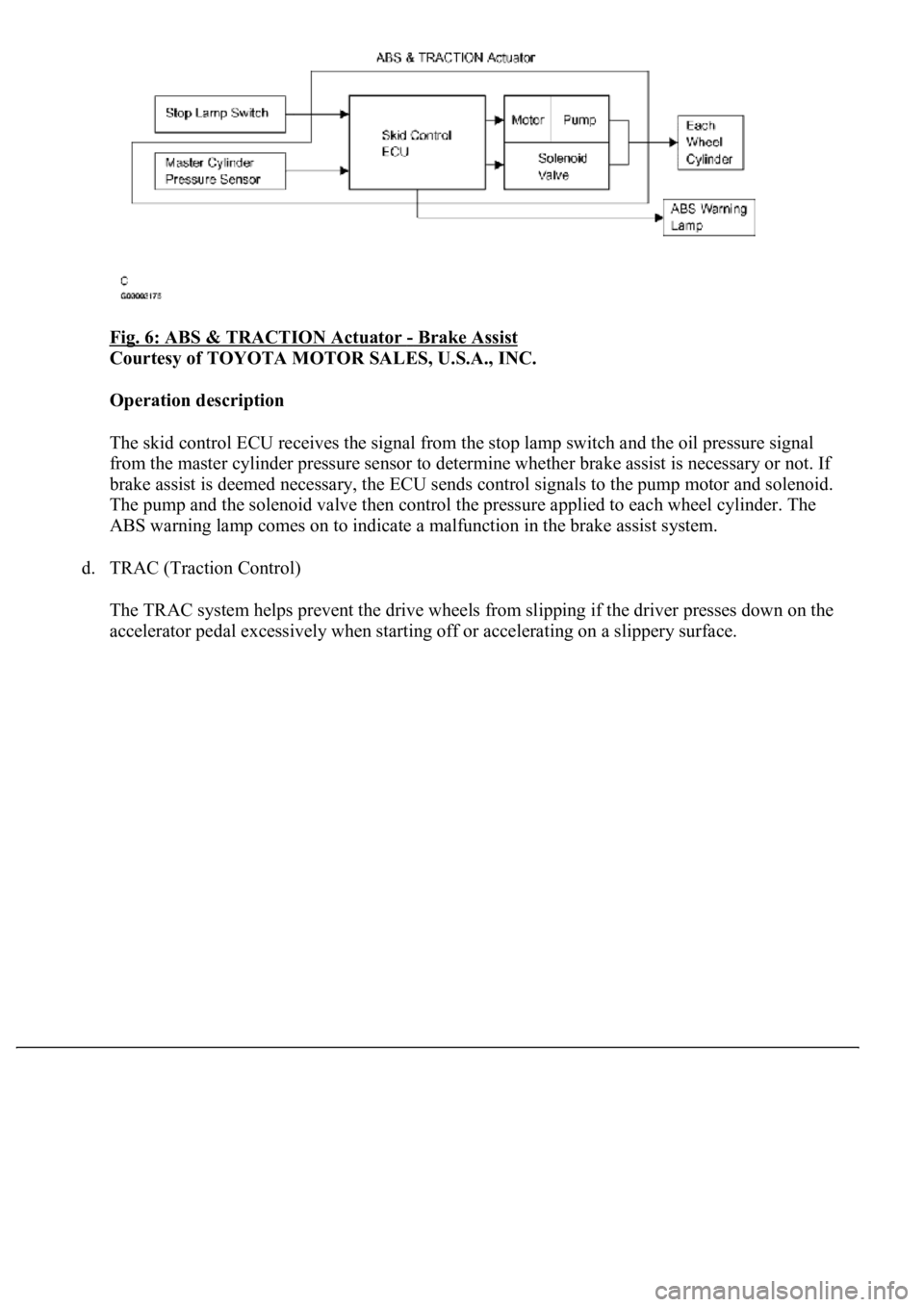
Fig. 6: ABS & TRACTION Actuator - Brake Assist
Courtesy of TOYOTA MOTOR SALES, U.S.A., INC.
Operation description
The skid control ECU receives the signal from the stop lamp switch and the oil pressure signal
from the master cylinder pressure sensor to determine whether brake assist is necessary or not. If
brake assist is deemed necessary, the ECU sends control signals to the pump motor and solenoid.
The pump and the solenoid valve then control the pressure applied to each wheel cylinder. The
ABS warning lamp comes on to indicate a malfunction in the brake assist system.
d. TRAC (Traction Control)
The TRAC system helps prevent the drive wheels from slipping if the driver presses down on the
accelerator pedal excessivel
y when starting off or accelerating on a slippery surface.
Page 32 of 4500
HINT:
The turning direction is not important.
Turning should be completed within 20 seconds. However, it is possible to change the
vehicle speed, stop or move backward.
2. Stop the vehicle and shift the shift lever to the P position, check that the skid control buzzer
sounds for 3 sec.
HINT:
If the skid control buzzer sounds, the sensor check is completed normally.
If the skid control buzzer does not sound, check the skid control buzzer circuit (see SKID
CONTROL BUZZER CIRCUIT ), then perform the sensor check again.
If the skid control buzzer still does not sound, there is a malfunction in the VSC sensor, so
check the DTC.
Drive the vehicle in a 180° circle. At the end of the turn, the direction of the vehicle should
be within 180° +/- 5° of its start position.
Do not spin the wheels.
Even if the VSC sensor check is completed normally, the multi-information displays "VSC
Test" (test mode).
Page 587 of 4500

10.INSPECT FOR CLOGGED AIR TUBE
a. Check the air tube visually for a clog or damage (see ON
-VEHICLE INSPECTION ).
OK:
Air tube is not clogged or damaged.
NG: REPAIR OR REPLACE AIR TUBE
OK: REPLACE SUSPENSION CONTROL ECU (SEE REPLACEMENT
)
CIRCUIT DESCRIPTION
The signal from the suspension control ECU operates the AIR SUS relay and the height control compressor
motor starts.
The height control compressor motor operates until the targeted vehicle height is reached. Then the height
control sensor sub-assy sends the signal to the suspension control ECU, and stops the height control compressor
motor.
Fig. 104: DTC C1751 And DTC C1752 Detecting Condition And Trouble Area
Courtesy of TOYOTA MOTOR SALES, U.S.A., INC.
INSPECTION PROCEDURE
1.CHECK HEIGHT CONTROL COMPRESSOR CIRCUIT (SEE DTC C1742 HEIGHT
CONTROL COMPRESSOR CIRCUIT )
2.CHECK AIR LEAKAGE (SEE ON
-VEHICLE INSPECTION )
OK:
No leaks
Page 961 of 4500
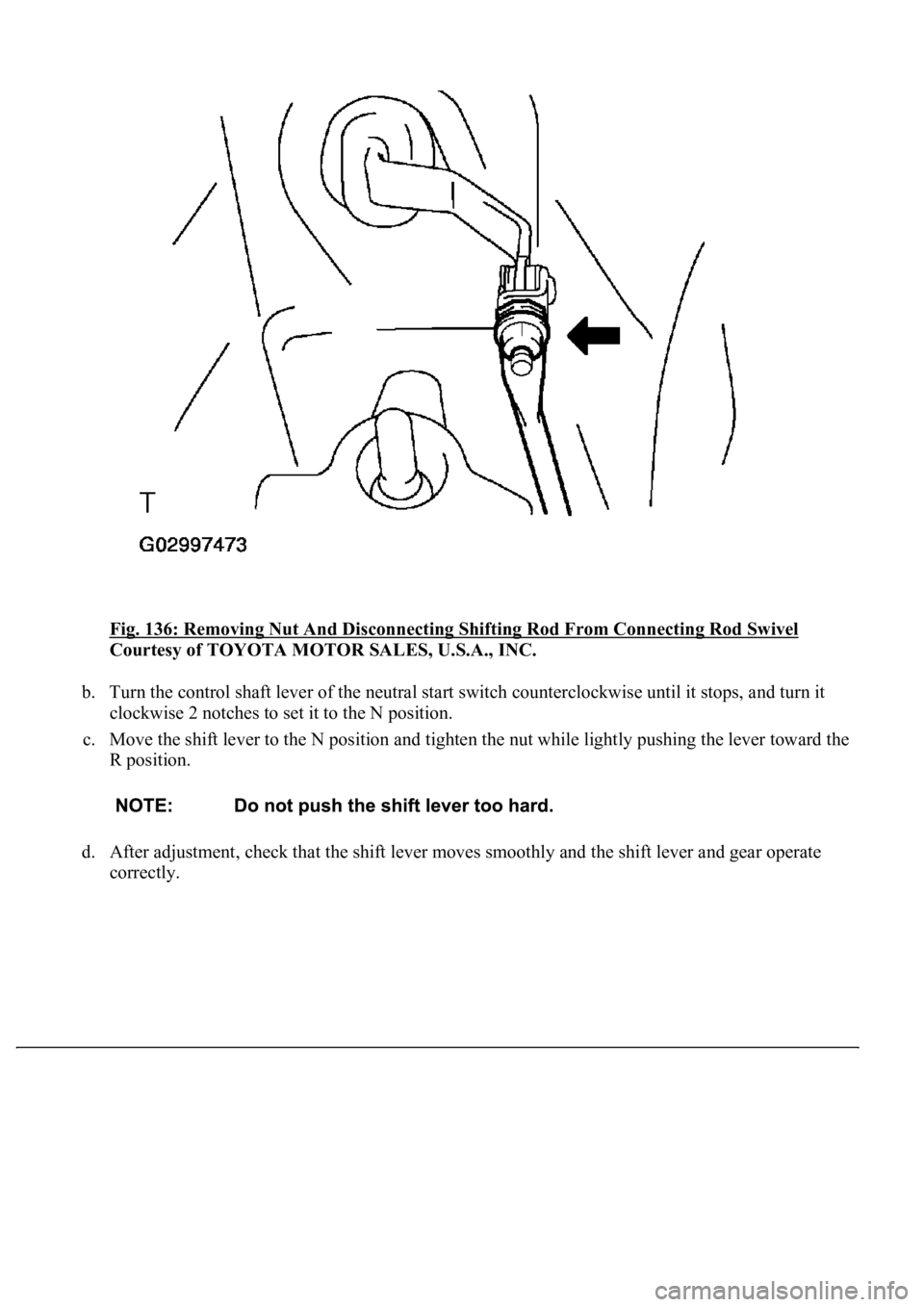
Fig. 136: Removing Nut And Disconnecting Shifting Rod From Connecting Rod Swivel
Courtesy of TOYOTA MOTOR SALES, U.S.A., INC.
b. Turn the control shaft lever of the neutral start switch counterclockwise until it stops, and turn it
clockwise 2 notches to set it to the N position.
c. Move the shift lever to the N position and tighten the nut while lightly pushing the lever toward the
R position.
d. After adjustment, check that the shift lever moves smoothly and the shift lever and gear operate
correctl
y.
Page 1022 of 4500
pedal reserve distance.
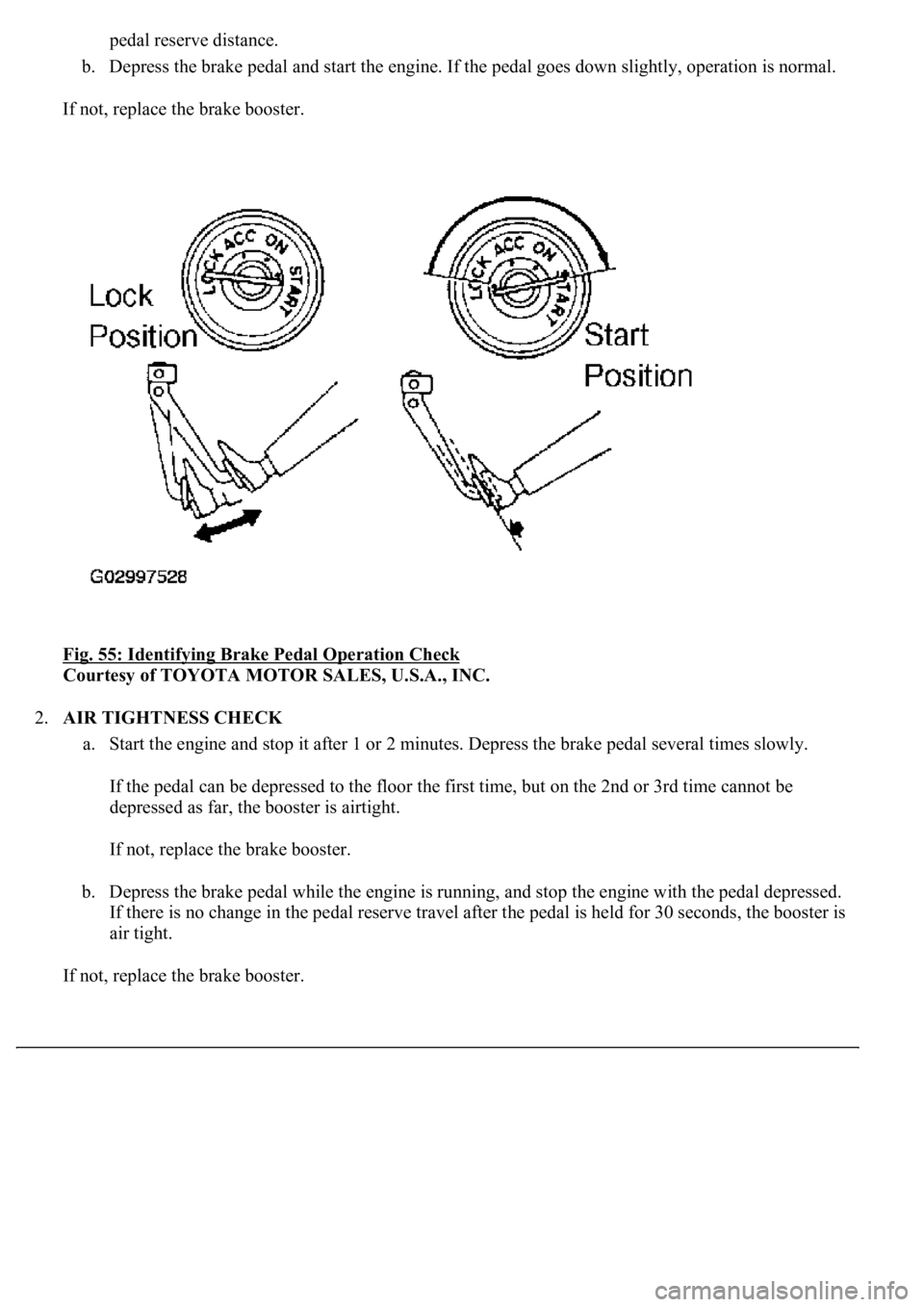
b. Depress the brake pedal and start the engine. If the pedal goes down slightly, operation is normal.
If not, replace the brake booster.
Fig. 55: Identifying Brake Pedal Operation Check
Courtesy of TOYOTA MOTOR SALES, U.S.A., INC.
2.AIR TIGHTNESS CHECK
a. Start the engine and stop it after 1 or 2 minutes. Depress the brake pedal several times slowly.
If the pedal can be depressed to the floor the first time, but on the 2nd or 3rd time cannot be
depressed as far, the booster is airtight.
If not, replace the brake booster.
b. Depress the brake pedal while the engine is running, and stop the engine with the pedal depressed.
If there is no change in the pedal reserve travel after the pedal is held for 30 seconds, the booster is
air tight.
If not, replace the brake booster.
Page 1518 of 4500

DISPLAY
DISPLAY ITEM DESCRIPTION
Check the circuits for each problem symptom in the order given in the table below, and proceed to the relevant
troubleshooting page.
REV RNG SENS
(Reverse range
sensor)
Fsde2,RFunction to set available sensors when shift
position is R.ALL/Fcrn4,R/Fsde2,R
NON-P/R RNG
SEN (Non P/R range
sensor)
FFunction to set available sensors when shift
position is not P or R.ALL/F,Rcrn2/F
SENSOR COND/N
(Sensor condition N
range)
ONFunction to make sensors available when shift
position is N.OFF/ON
F SIDE DIST SEN
(Front side distance
sensor)
LONG
Function to change maximum distance that front
side sensors are able to detect. (SHORT: 375
mm (14.76 in.), LONG: 500 mm (19.69 in.))
SHORT / LONG
DISPLAY (ITEM)DEFAULTCONTENTSSETTING
APPRCH DISP
OFF (Approach
display off)
OFF
Function to make multi-information display turn
off when vehicle starts to leave obstacles which
are within approximately 250 mm (9.84 in.) of
vehicle.
ON/OFF
DISP TIMEOUT
(Display timeout
time)
INVALID
Function to change time until multi-information
display turns off when detected distance by
sensors does not change.
5s/10s/20s/INVALID
SONAR DISP OFF
(Sonar display off
time)
3s
Function to change time until multi-information
display turns off after sensors stop detecting
obstacle.
1s/2s/3s/4s
Page 1864 of 4500
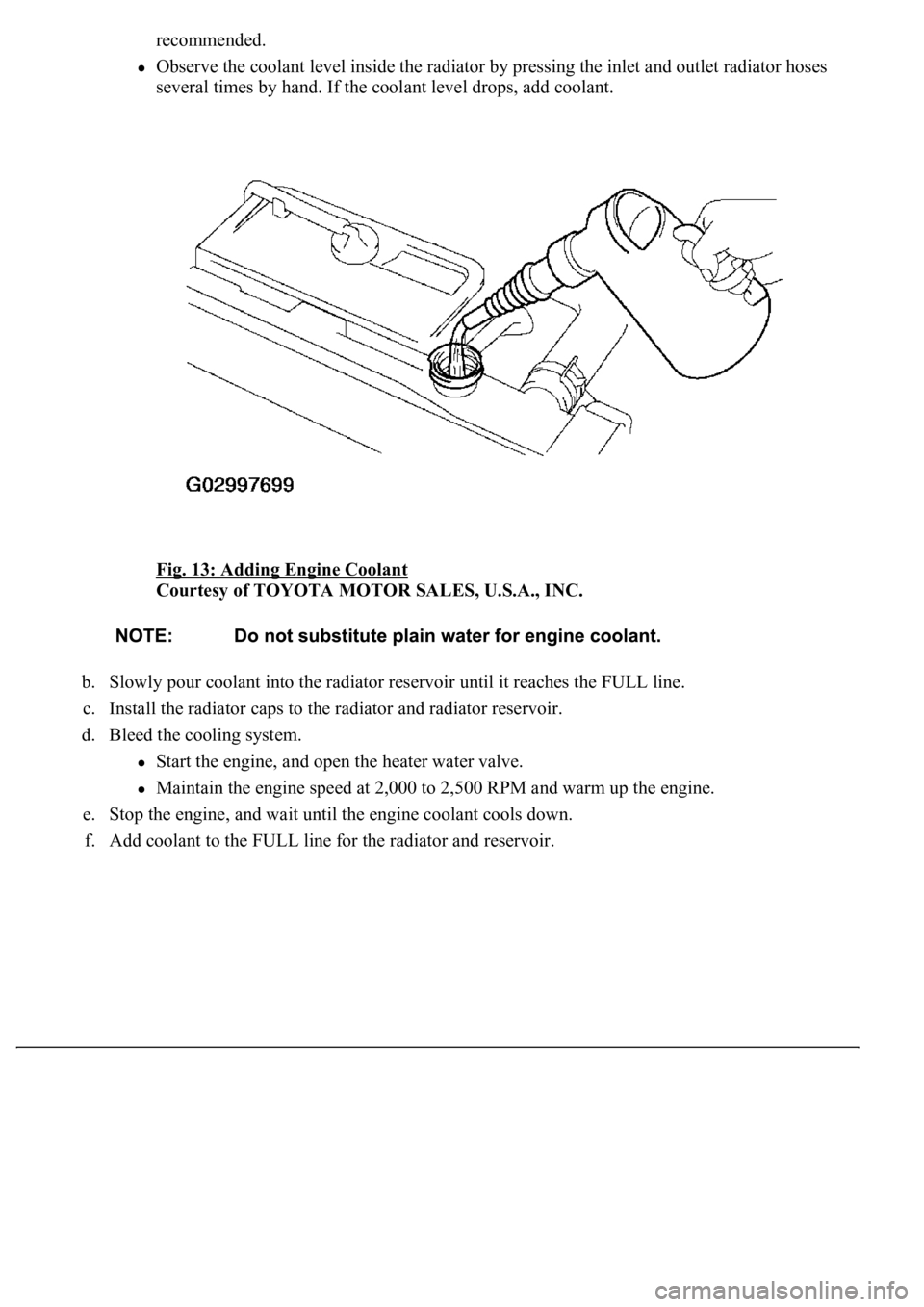
recommended.
<003200450056004800550059004800030057004b00480003004600520052004f0044005100570003004f004800590048004f0003004c00510056004c0047004800030057004b00480003005500440047004c004400570052005500030045005c0003005300
55004800560056004c0051004a00030057004b00480003004c[nlet and outlet radiator hoses
several times by hand. If the coolant level drops, add coolant.
Fig. 13: Adding Engine Coolant
Courtesy of TOYOTA MOTOR SALES, U.S.A., INC.
b. Slowly pour coolant into the radiator reservoir until it reaches the FULL line.
c. Install the radiator caps to the radiator and radiator reservoir.
d. Bleed the cooling system.
Start the engine, and open the heater water valve.
<00300044004c005100570044004c005100030057004b0048000300480051004a004c0051004800030056005300480048004700030044005700030015000f00130013001300030057005200030015000f001800130013000300350033003000030044005100
470003005a00440055005000030058005300030057004b0048[ engine.
e. Stop the engine, and wait until the engine coolant cools down.
f. Add coolant to the FULL line for the radiator and reservoir.
Page 1918 of 4500
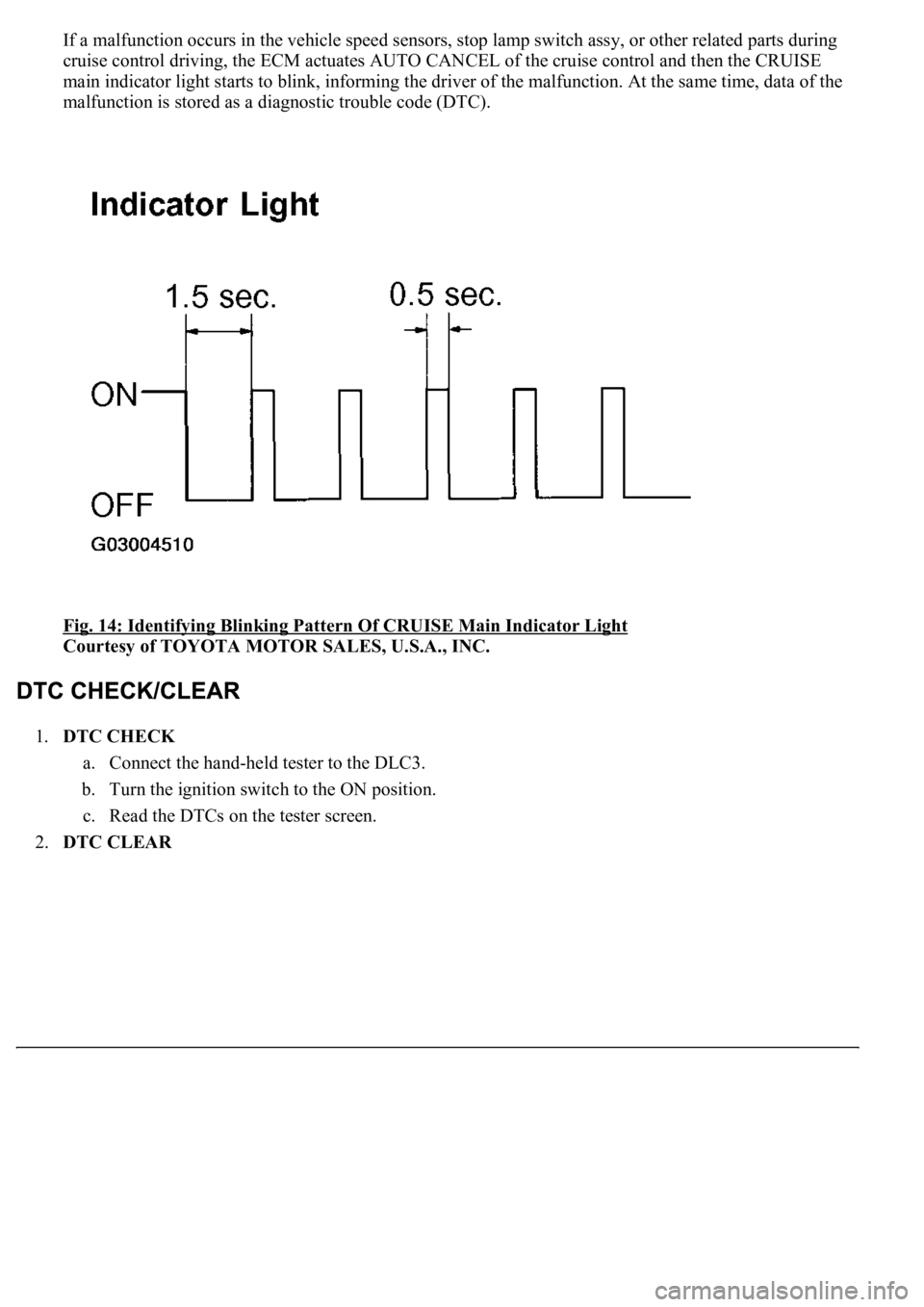
If a malfunction occurs in the vehicle speed sensors, stop lamp switch assy, or other related parts during
cruise control driving, the ECM actuates AUTO CANCEL of the cruise control and then the CRUISE
main indicator light starts to blink, informing the driver of the malfunction. At the same time, data of the
malfunction is stored as a diagnostic trouble code (DTC).
Fig. 14: Identifying Blinking Pattern Of CRUISE Main Indicator Light
Courtesy of TOYOTA MOTOR SALES, U.S.A., INC.
1.DTC CHECK
a. Connect the hand-held tester to the DLC3.
b. Turn the ignition switch to the ON position.
c. Read the DTCs on the tester screen.
2.DTC CLEAR
Page 2186 of 4500
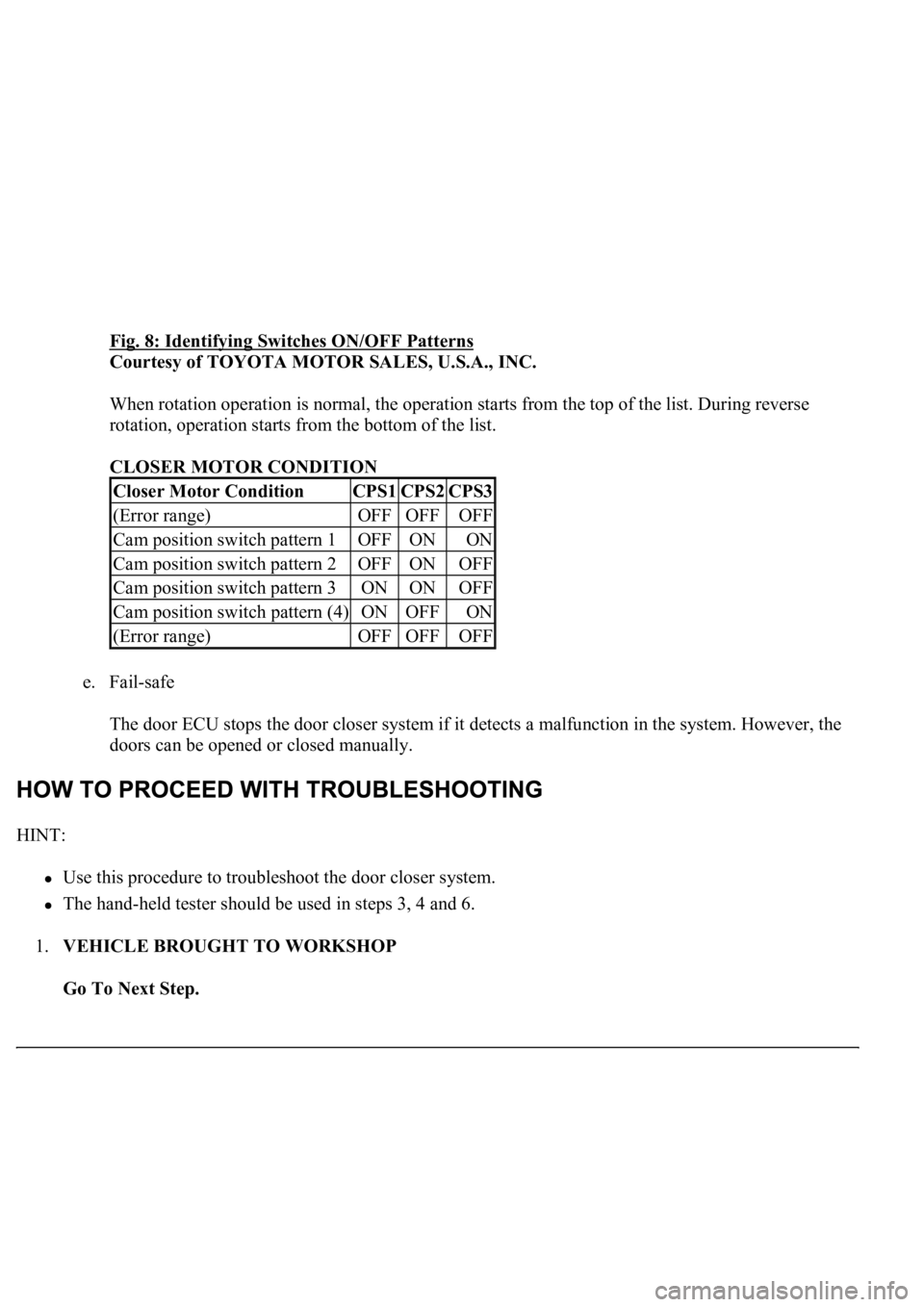
Fig. 8: Identifying Switches ON/OFF Patterns
Courtesy of TOYOTA MOTOR SALES, U.S.A., INC.
When rotation operation is normal, the operation starts from the top of the list. During reverse
rotation, operation starts from the bottom of the list.
CLOSER MOTOR CONDITION
e. Fail-safe
The door ECU stops the door closer system if it detects a malfunction in the system. However, the
doors can be opened or closed manually.
HINT:
Use this procedure to troubleshoot the door closer system.
The hand-held tester should be used in steps 3, 4 and 6.
1.VEHICLE BROUGHT TO WORKSHOP
Go To Next Step.
Closer Motor ConditionCPS1CPS2CPS3
(Error range)OFFOFFOFF
Cam position switch pattern 1OFFONON
Cam position switch pattern 2OFFONOFF
Cam position switch pattern 3ONONOFF
Cam position switch pattern (4)ONOFFON
(Error range)OFFOFFOFF
Page 2532 of 4500

1.GENERAL
a. The dynamic radar cruise control system has two cruise control modes: the constant speed control
mode and vehicle-to-vehicle distance control mode.
The vehicle-to-vehicle distance control mode is always selected when starting up the
dynamic radar cruise control system.
Operation of the constant speed control mode is the same as that for the conventional type
cruise control system.
b. This system maintains the vehicle running at the speed that the driver has set, as long as there are
no vehicles ahead in the same lane. Then, the system maintains the vehicle distance that has been
set by the driver.
If the system detects a vehicle moving at a slower speed ahead while the driver is driving at a
constant speed, it closes the throttle valve to decelerate. If further deceleration is required, the
system controls the brake actuator in order to apply the brakes. Thereafter, if there are no vehicles
ahead within the set vehicle-to-vehicle distance because either the vehicle ahead or the driver has
changed lanes, the system accelerates slowly to reach the set vehicle speed and resumes driving at
the constant speed.
c. The constant speed control mode is designed to maintain a constant cruising speed. The vehicle-to-
vehicle distance control mode is designed to control cruising at a constant speed function,
deceleration cruising function, follow-up cruising function and acceleration cruising function.
d. The millimeter wave radar sensor and the distance control ECU (cruise control ECU) control the
system while the vehicle-to-vehicle distance control mode is in operation, and send signals to each
actuator and ECU.
e. In vehicle-to-vehicle distance control mode, the dynamic radar cruise control system receives
signals from the yaw rate & deceleration sensor and the steering angle sensor. Based on these
signals, it then estimates curve radius and compensates for information on the preceding vehicle
while turning. It can also compensate for the brake control when approaching another vehicle.
f. This system judges the existence of a vehicle in front and the distance to it based on the signals
from the radar sensor while the vehicle-to-vehicle distance control mode is in operation. Using this
information, the system informs the driver of any danger with the warning buzzer, performs brake
control, and turns on the stop lamp when approaching the vehicle in front.
g. The following illustration shows a control example under the following conditions: own vehicle
speed is 100 km/h (62 mph) and the speed of the vehicle in front is 80 km/h (50 mph).