lights LEXUS LS430 2006 User Guide
[x] Cancel search | Manufacturer: LEXUS, Model Year: 2006, Model line: LS430, Model: LEXUS LS430 2006Pages: 419, PDF Size: 11.19 MB
Page 122 of 419

106
2-2. Instrument cluster
CAUTION
■If a safety system warning light does not come on
Should a safety system light such as ABS, TR
AC OFF or the airbag warning light
not come on when you start the engine, th is could mean that these systems are not
available to help protect you in an accident, which could result in death or serious
injury. Have the vehicle inspected by your Lexus dealer immediately if this occurs.
■ Warning lights
Warning lights inform the driver of a malfunction in the indicated vehi -
cle’s systems. (
P. 328 )
* These lights turn on when the ignition sw itch is turned to ON to indicate that
a system check is being performed. Th ey will turn off after the engine is
started on, or after a few seconds.
There may be a malfunction in a system if a
light does not come on, or if the
lights do not turn off. Have the vehicle inspected by your Lexus dealer.
*
(U.S.A)
(U.S.A) (Canada) (U.S.A) (Canada)
(Canada)
Page 126 of 419
110
2-3. Operating the headlight and windshield wipers
Headlight switch
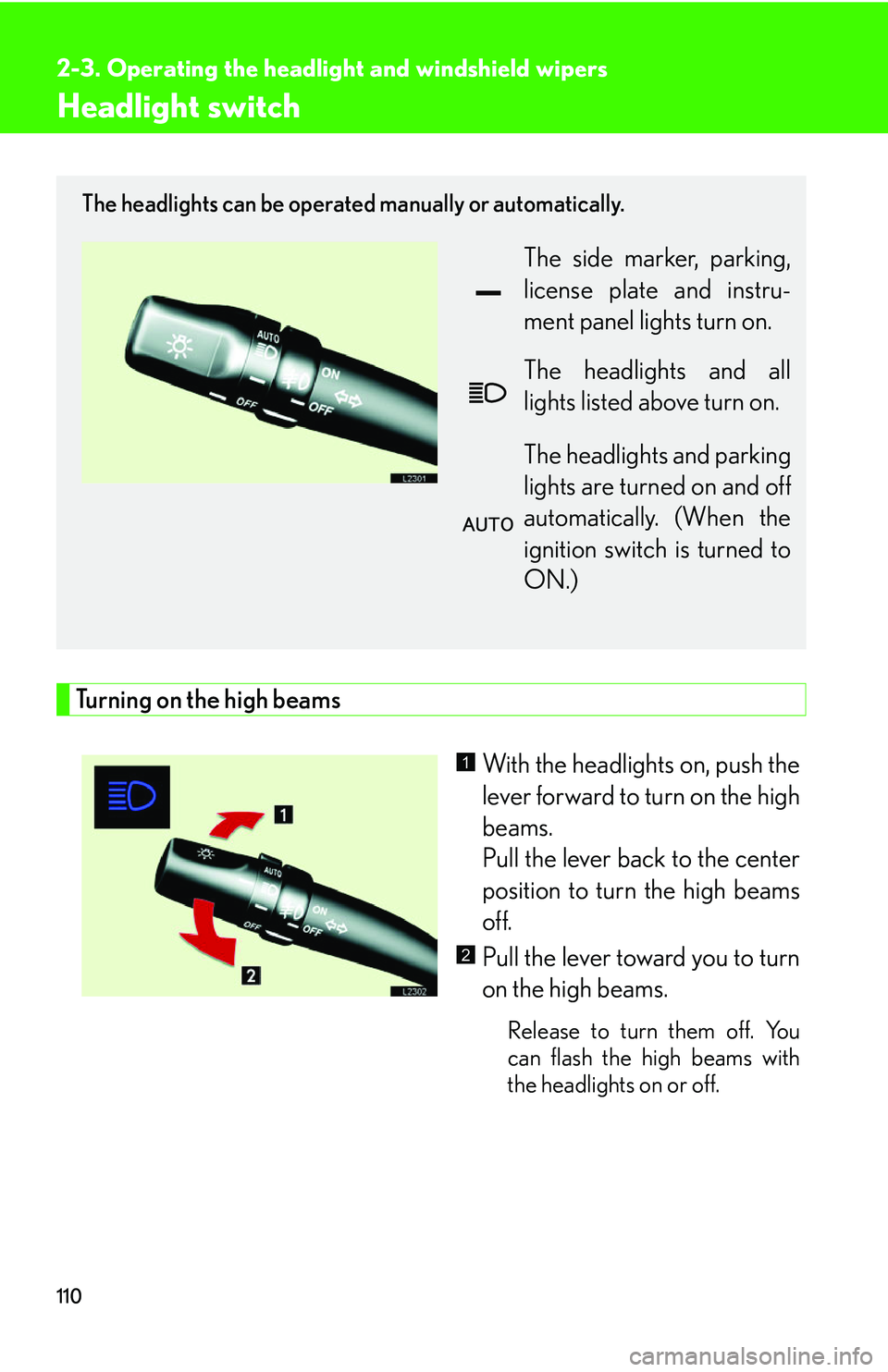
Turning on the high beams
With the headlights on, push the
lever forward to turn on the high
beams.
Pull the lever back to the center
position to turn the hi
gh beams
off.
Pull the lever toward you to turn
on the high beams.
Release to turn them off. You
can flash the high beams with
the headlights on or off.
The headlights can be operated manually or automatically.
The side marker, parking,
license plate and instru
-
ment panel lights turn on.
The headlights and all
lights listed abo
ve turn on.
The headlights and parking
lights ar
e turned on and off
automatically. (When the
ignition switch is turned to
ON.)
1
2
Page 127 of 419

111
2-3. Operating the headlight and windshield wipers
2
When driving
Daytime running light system
The headlights turn on automatically (at a reduced intensity) whenever the
engine is started and the parking brake is released to make your vehicle
more visible to other drivers. Dayt ime running lights are not designed for
use at night.
■Headlight control sensor
■Automatic light off system
The headlights turn off automatically if the engine is stopped and the driver’s door is
opened wh
ile the headlights are turned on.
To turn the headlights on again, turn the key to ON, or turn the light switch off once
and then
back to or position.
■Automatic headlight leveling system
The level of the headlights is
automatically adjusted according to the number of
passengers and the loading condition of the vehicle to ensure that the headlights do
not interfere other road users.
■Customization
The time it takes for the headlights to automatically turn on or off can be changed.
( P.384 )
The sensor may not function properly if an
object is placed on the sensor, or anything
that blocks the sensor is affixed to the wind-
shield.
Doing so interferes with the sensor detect-
ing the level of ambient light and may cause
the automatic headlight system malfunc-
tion.
Page 128 of 419

112
2-3. Operating the headlight and windshield wipers
Adaptive front lighting system (AFS)
To improve road illumination when turning, the right side headlight moves right
on right turns, and the left side headlight moves left on left turns.
Adaptive front lighting system
cancel switch
On
Off
When the system is canceled,
the “
AFS OFF” indicator lights
up in the instrument cluster.
1
2
3
■Operating conditions
The system starts to operate when the v
ehicle’s speed increases above 6 mph (10
km/h), and stops when the vehicles speed drops below 6 mph (10 km/h).
■When the “AFS OFF” indicator light flashes,
This indicates a system failure. Have your vehicle checked at your Lexus dealer.
NOTICE
■To prevent battery discharge
Do not leave the lights on longer than necessary when the engine is not running.
Page 129 of 419
113
2-3. Operating the headlight and windshield wipers
2
When driving
Fog light switch
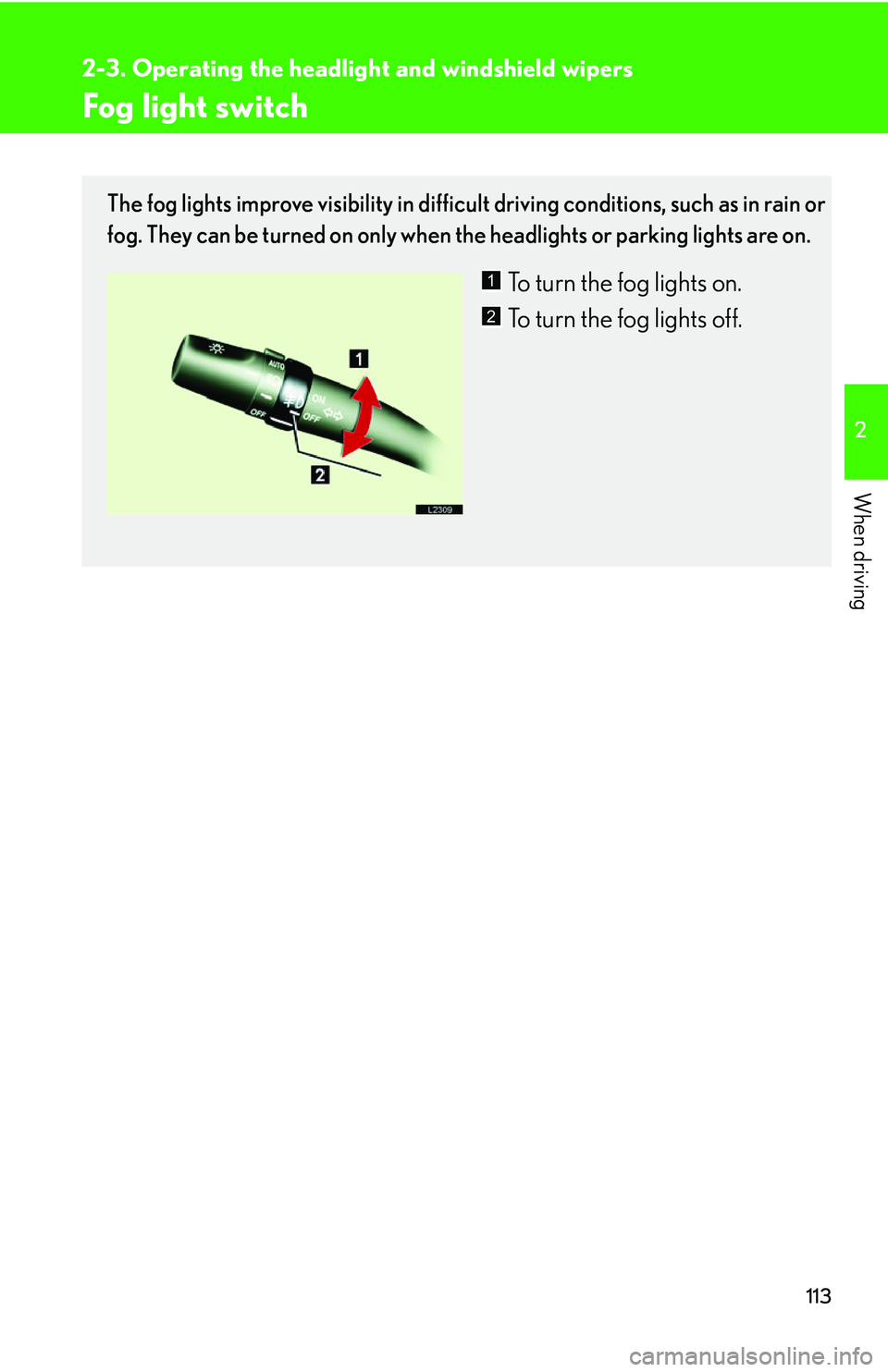
The fog lights improve visibility in difficult driving conditions, such as in rain or
fog. They can be turned on only when the headlights or parking lights are on.
To turn the fog lights on.
To turn the fog lights off.1
2
Page 131 of 419
115
2-3. Operating the headlight and windshield wipers
2
When driving
■Intermittent operation features
The time interval between sweeps decreases as vehicle speed increases. When
v
ehicle speed exceeds 12 mph (20 km/h) with the interval adjusted in the lowest
position, the time interval is set to the minimum 1.5 seconds.
If you stop the vehicle with the wiper switch in the “LO” position, the wipers auto -
matically change to intermittent operation.* This will not happen if the interval
adjuster is set
to the lowest position.
*This feature can be deactivated. ( P. 3 8 4 )
■Windshield wiper features
●When the washer button is pressed with the wipers OFF, the wipers will make 3
sweeps, then pause, then a final sweep to completely clear the windshield*. The
length of the pause will depend on the vehicle speed. The last sweep will not
happen if the vehicle is traveling above 106 mph (170 km/h).
*The last single sweep can be deactivated. ( P. 3 8 4 )
●When the windshield washer switch is pushed with the headlights on, the head -
light cleaners automatically operate once.
●The rear window and outside rear view mirror defoggers automatically turn on
when you operate the wipers.
Page 133 of 419
117
2-3. Operating the headlight and windshield wipers
2
When driving
Headlight cleaner switch
NOTICE
■When the washer fluid tank is empty
Do not use this function when the washer fluid tank is empty.
This may cause the washer fluid pump to overheat.
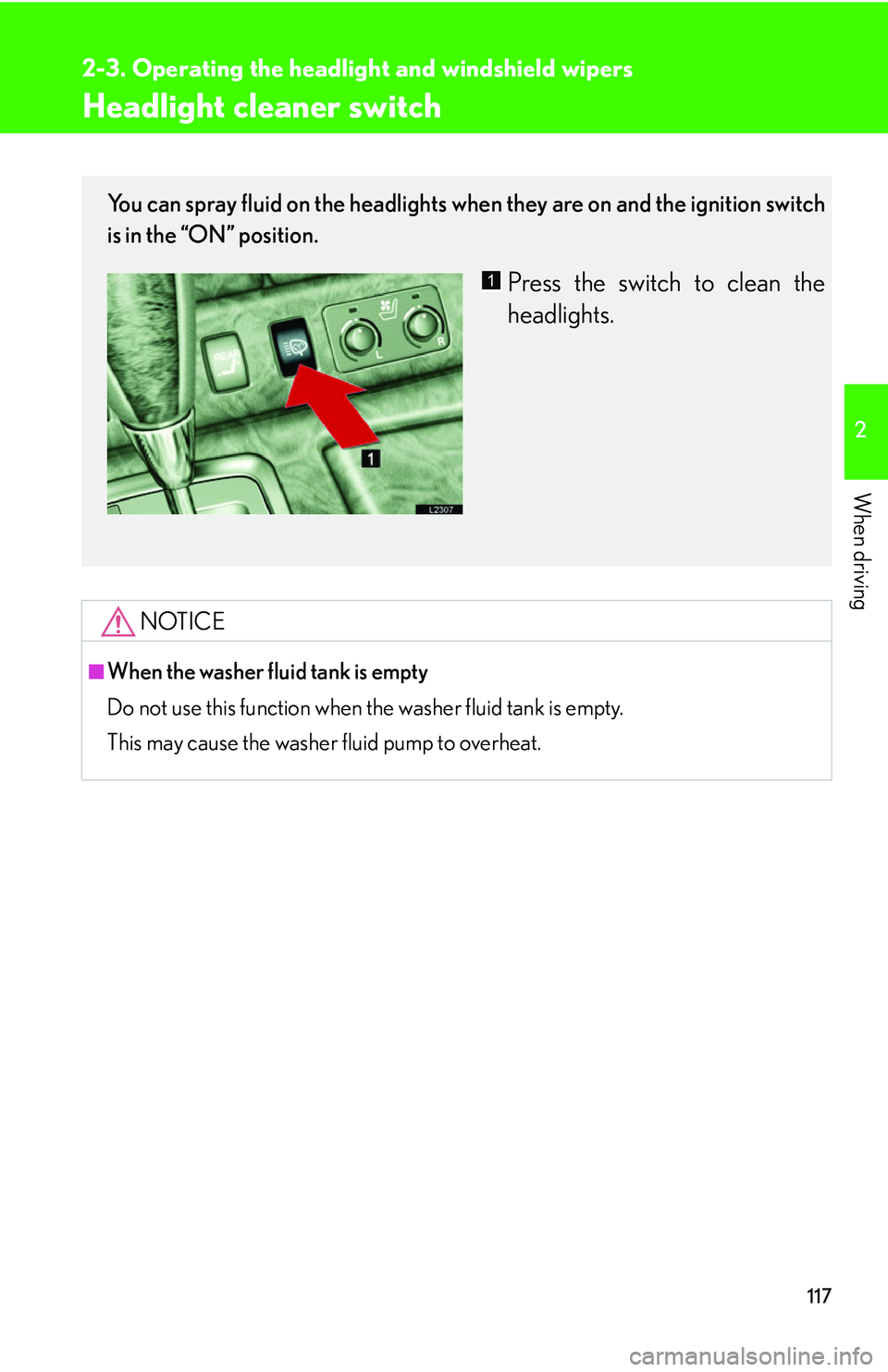
You can spray fluid on the headlights when they are on and the ignition switch
is in the “ON” position.
Press the switch to clean the
headlights.1
Page 140 of 419
124
2-4. Using other driving systems
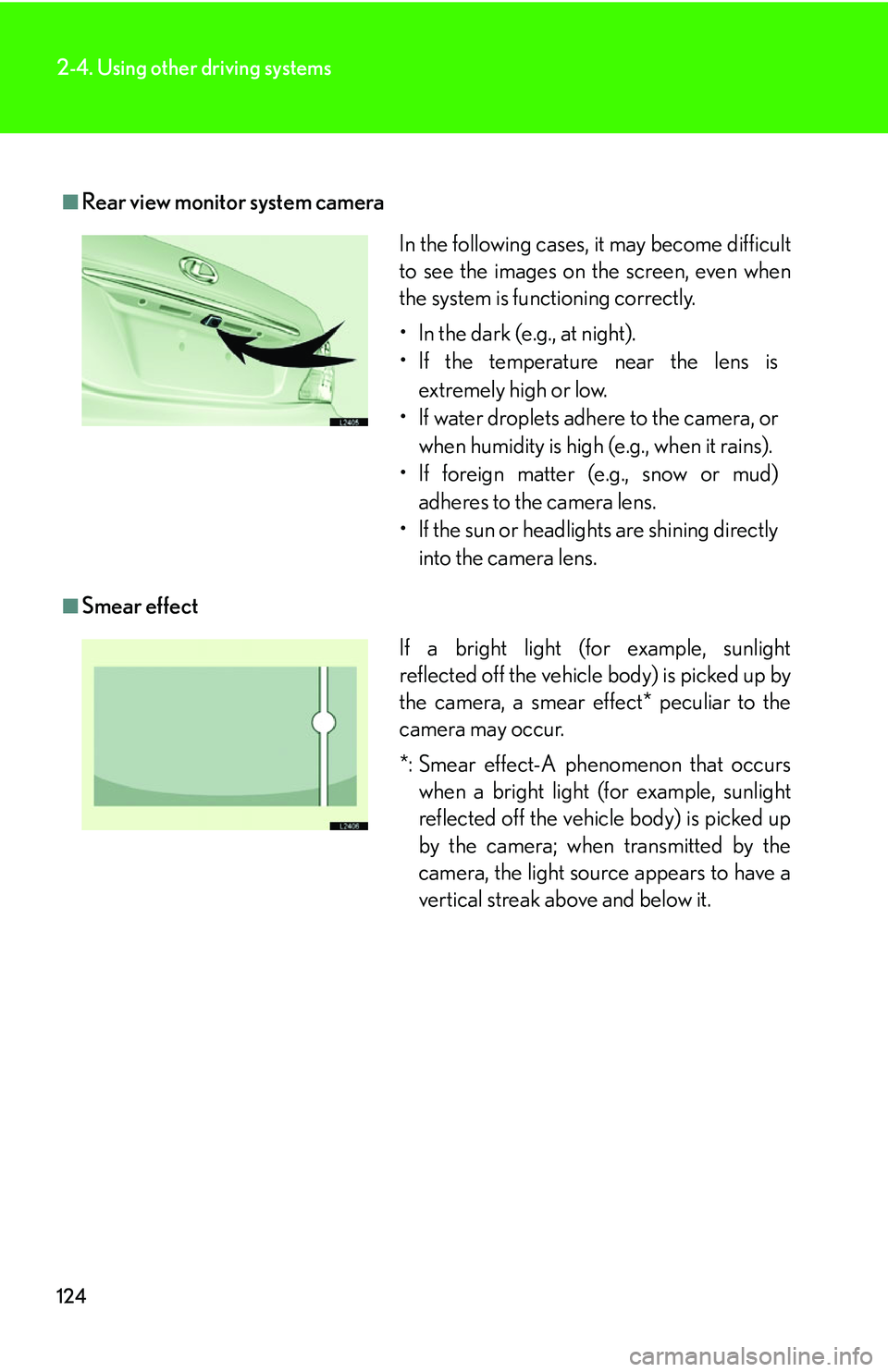
■Rear view monitor system camera
■Smear effect
In the following cases, it may become difficult
to see the images on the screen, even when
the system is functioning correctly.
• In the dark (e.g., at night).
• If the temperature near the lens is extremely high or low.
• If water droplets adhere to the camera, or when humidity is high (e.g., when it rains).
• If foreign matter (e.g., snow or mud) adheres to the camera lens.
• If the sun or headlights are shining directly
into the camera lens.
If a bright light (for example, sunlight
reflected off the vehicle body) is picked up by
the camera, a smear effect* peculiar to the
camera may occur.
*: Smear effect-A phenomenon that occurs when a bright light (for example, sunlight
reflected off the vehicle body) is picked up
by the camera; when transmitted by the
camera, the light source appears to have a
vertical streak above and below it.
Page 170 of 419
154
2-5. Driving information
■Before towing
●Ensure that your vehicle’s tires are properly inflated. (P.283 )
●Trailer tires should be inflated according to the trailer manufacturer’s recom -
mendation.
●All trailer lights must work to be legal.
●Confirm all lights work each time you connect them.
●Check that your vehicle remains level when a loaded or unloaded trailer is
hitched. Do not drive if the vehicle is not level, and check for improper tongue
load, overloading, worn suspension, or other possible causes.
●Make sure the trailer cargo is securely loaded.
●Check that your rear view mirrors conform to any federal, state/provincial or
local regulations. If they do not, instal l rear view mirrors appropriate for towing
purposes.
■Break-in schedule
Lexus recommends that you do not use a new vehicle or a vehicle with any new
p
ower train components (engine, transmissi on, differential, wheel bearing, etc.) to
tow a trailer for the first 500 miles (800 km) of driving.
■Maintenance
●If you tow a trailer, your vehicle will require more frequent maintenance due to
the additional load. (see “Owner’s Manual Supplement/ Scheduled Mainte -
nance”)
●Retighten the fixing bolts of the towing ball and bracket after approximately
600 miles (1000 km) of trailer towing.
Page 172 of 419
156
2-5. Driving information
Trailer towing tips
Your vehicle will handle differently when towing a trailer. The three main
causes of vehicle-trailer accidents are driver error, excessive speed and
improper trailer loading. Keep these in mind when towing.
• Before starting out, check the tra iler
’s lights and the vehicle-trailer
connections. Recheck after driving a short distance.
• Practice turning, stopping and reversi ng with the tr
ailer attached in an
area away from traffic until you be come accustomed to the feel of the
vehicle.
• Reversing with a trailer attached is dif
ficult and requires practice. Grip
the bottom of the steering wheel and move your hand to the left to
move the trailer to the left. Move yo ur hand to the right to move the
trailer to the right. (This is gene rally opposite to reversing without a
trailer attached.) Avoid sharp or prolonged turning. Have someone
guide you when reversing to redu ce the risk of an accident.
NOTICE
■When installing a trailer hitch
●Use only the position recommended by your Lexus dealer. Do not install the
trailer hitch on the bumper; this may cause body damage.
●Do not use axle-mounted hitches as they can cause damage to the axle housing,
wheel bearings, wheels or tires.
■Brakes
Lexus recommends trailers with brakes that conform to any applicable federal and
sta
te/provincial requlations.
■Do not directly splice trailer lights
Direct splicing may damage your vehicle’s electrical system and cause a malfunc -
tion.