warning LEXUS LS430 2006 Owner's Manual
[x] Cancel search | Manufacturer: LEXUS, Model Year: 2006, Model line: LS430, Model: LEXUS LS430 2006Pages: 419, PDF Size: 11.19 MB
Page 158 of 419
142
2-4. Using other driving systems
CAUTION
Any of the following conditions may result in-an accident which could cause death
or serious injury:
■The ABS may not operate effectively when:
●The limits of tire gripping performance have been exceeded.
●If the vehicle hydroplanes while driving at high speed while the road is wet or
slick.
■Stopping distance when the ABS is activated will exceed that of normal condi -
tions
The ABS is not designed to shorten the v
ehicle’s stopping distance. Always main -
tain a safe distance between you and the vehicle in front of you, particularly in the
fo
llowing situations.
• When driving on dirt, gravel or snow-covered roads
• When driving with tire chains
• When driving over bumps in the road
• When driving over roads with potholes or uneven roads
• When towing a trailer
■TRAC may not operate effectively when:
Directional control and power may not be ac hi
evable while driving on slippery road
surfaces, even if the TRAC system is operating.
Do not drive the vehicle in conditions where control and power may be lost.
■When the slip indicator flashe s and a warning buzzer sounds
This situation occurs immediately before VSC is activated. Always drive carefully.
R
eckless driving may cause an at the recommended level.
Exercise particular care when an indicator light flashes and a buzzer sounds.
■Replacing tires
Ensure that all tires are the same size an d
brand, have the same tread pattern, and
that the level of tire pressure is at the recommended level.
The ABS and VSC systems may not operate no rmal
ly if different tires are installed
to the vehicle.
Contact your Lexus dealer for further info rmati
on when replacing tires or wheels.
Page 160 of 419
144
2-4. Using other driving systems
CAUTION
■Pre-collision system limitations
●The Pre-Collision System is designed to help reduce the crash speed and dam-
age in certain frontal collisions only. It is not a collision avoidance system and is
no
t a substitute for safe and attentive driving. System effectiveness depends on
many factors, such as speed, dr iver input and road conditions.
●The sensor is able to detect objects in front of the vehicle within 10 degrees on
either side. If the object is out of range, or there is little to no millimeter wave
reflection, the sensor will not detect the object.
●Even if the system is operative in a collisio n, unless the seat belts are worn and the
brake pedal is depressed, the pre-collision seat belts and brake assist system will
operate.
■Failure Warning
If an error is detected, the master warn i
ng light comes on, a warning tone sounds
and the following warning message appears on the multi-information display.
( P.334 )
Page 166 of 419
150
2-5. Driving information
Regulations on the use of snow chains
●Regulations regarding the use of tire chains vary according to location
and type of road. Alwa ys check local regulations before installing
chains.
●Use SAE Class “S” type radial tire chains, with the exception of radial
cable chains or V-bar type chains.
• Install the chains on the rear tires.
• Refer to the explanation that comes with the tir
e chains for installa-
tion instructions.
●Retighten chains after driving 1 /4 - 1 /2 mile (0.5 - 1.0 km).
■If the chains are installed
The tire pressure warning system may not operate properly.
■Tire chain installation
Observe the following installation, removal and care precautions.
• Install and remove tire chains in a safe location.
• Install tire chains on the rear tires only. Do not install tire chains on front tir
es.
• Install the tire chains on rear tires as tightly as possible. Retighten chains af
ter driving 1 /4 - 1 /2 mile (0.5 - 1.0 km).
• Install tire chains following the inst ructions pr
ovided with the chains.
■When driving the vehicle
Accelerate the vehicle slowly and driv e at a reduced speed suitable to
road conditions.
■ When parking the v
ehicle
The parking brake may freeze up, prev enting it fr
om being released.,
Place the selector lever in P and park the vehicle without applying the
parking brake.
Page 252 of 419
236
3-5. Other interior features
Operating the HomeLink
Press the appropriate HomeLink button. The HomeLink indicator
light on the HomeLink
transceiver should turn on.
The HomeLink continues to send a signal for up to 20 seconds as long as
the button is pressed.
Erasing the entire HomeLink memory (all three programs)
Press and hold down the 2 outside buttons for 20 seconds until the
indicator light flashes.
If you sell your vehicle, be sure to erase the programs stored in the
HomeLink memory.
■Before programming
●Install a new battery in the transmitter.
●The battery side of the transmitter must be pointed away from the HomeLink.
■Certification for the garage door opener
This device complies with Part 15 of the F
CC Rules and with RSS-210 of the IC
Rules.
Operation is subject to the following two co
nditions: (1) This device may not cause
harmful interference, and (2) this device must accept any interference that may be
received, including interference that may cause undesired operation. WARNING:
This transmitter has been tested and comp lies with FCC and IC rules. Changes or
modifications not expressly approved by the party responsible for compliance
could void the user’s authority to operate the device.
Page 281 of 419
265
4-3. Do-it-yourself maintenance
4
Maintenance and care
■ How to read oil container labels
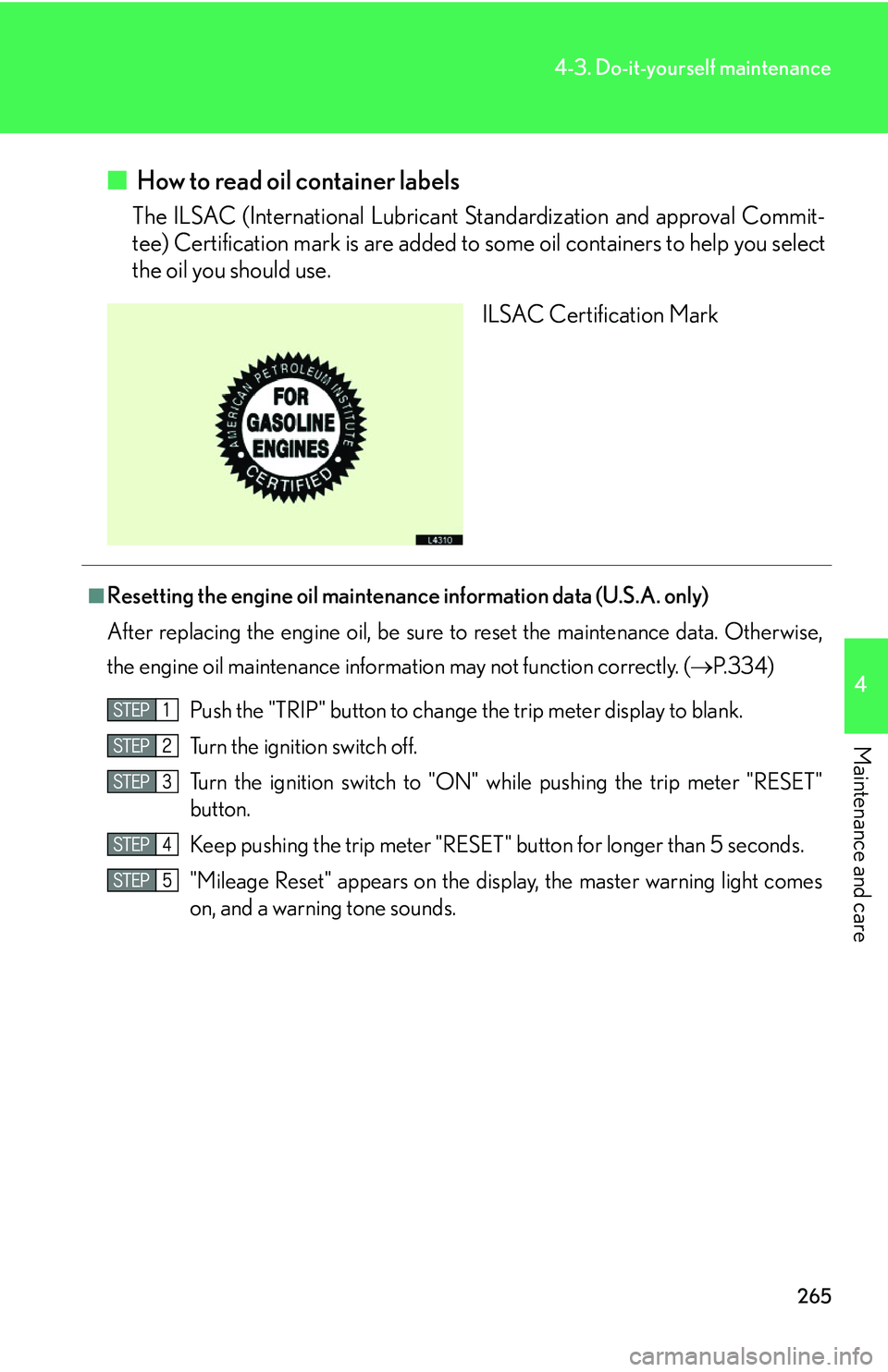
The ILSAC (International Lubricant Standardization and approval Commit -
tee) Certification mark is are added to some oil
containers to help you select
the oil you should use.
ILSAC Certification Mark
■Resetting the engine oil maintenance information data (U.S.A. only)
After replacing the engine oil, be sure to
reset the maintenance data. Otherwise,
the engine oil maintenance information may not function correctly. ( P.334 )
Push the "TRIP" button to change t
he trip meter display to blank.
Turn the ignition switch off.
Turn the ignition switch to "ON" while pushing
the trip meter "RESET"
button.
Keep pushing the trip meter "RESET " button for lon
ger than 5 seconds.
"Mileage Reset" appears on
the display, the master warning light comes
on, and a warning tone sounds.
Page 295 of 419
279
4-3. Do-it-yourself maintenance
4
Maintenance and care
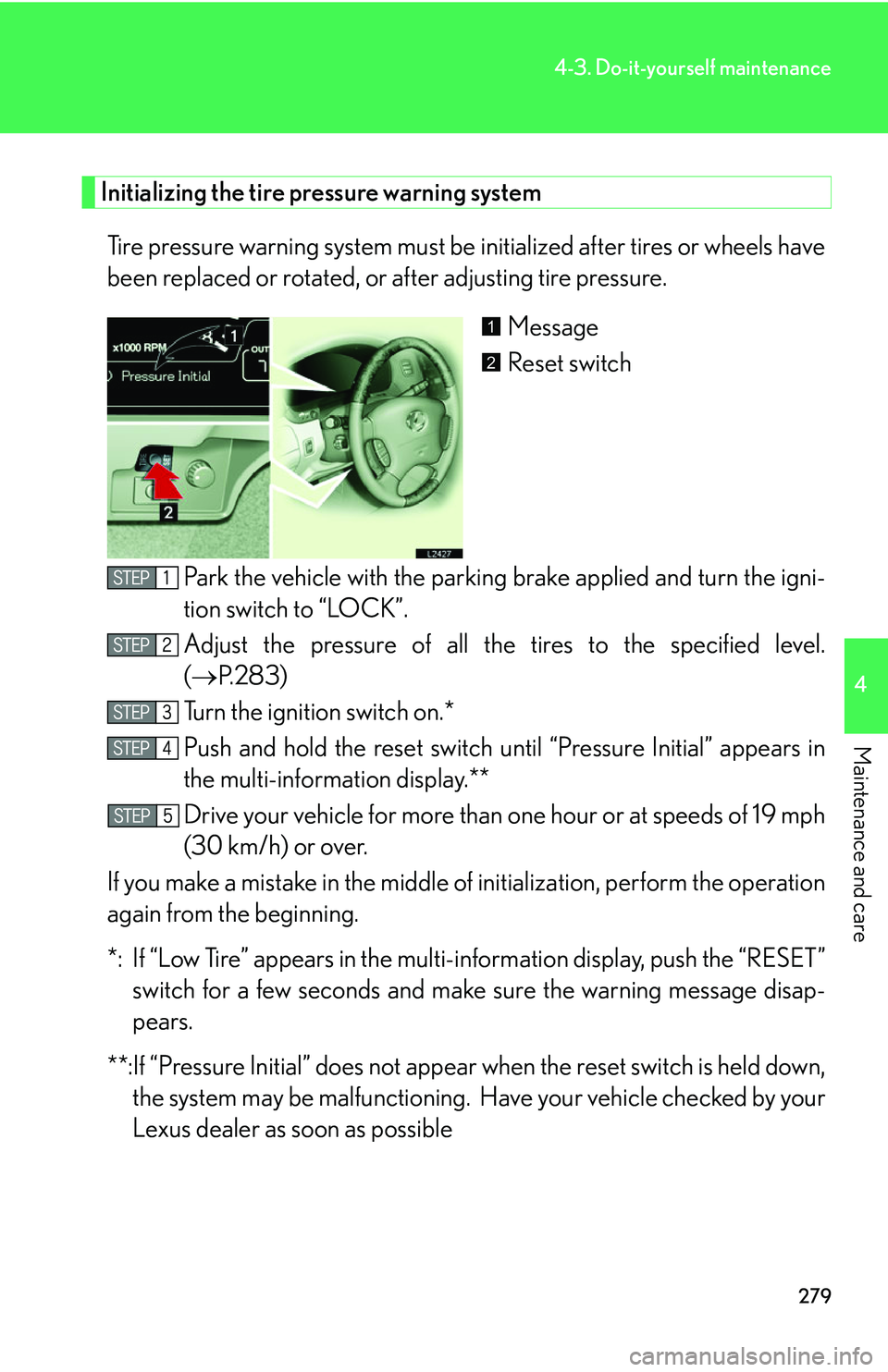
Initializing the tire pressure warning system
Tire pressure warning system must be initialized after tires or wheels have
been replaced or rotated, or after adjusting tire pressure.
Message
Reset switch
Park the vehicle with the parking br
ake applied and turn the igni-
tion switch to “LOCK”.
Adjust the pressure of all the tir
es to the specified level.
( P.283 )
Turn the ignition switch on.*
Push and hold the reset switch until “P
ressure Initial” appears in
the multi-information display.**
Drive your vehicle for more than one hour or at speeds of 1
9 mph
(30 km/h) or over.
If you make a mistake in the middle of initialization, per
form the operation
again from the beginning.
*: If “Low Tire” appears in the multi- information display
, push the “RESET”
switch for a few seconds and make sure the warning message disap-
pears.
**:If “Pressure Initial” does not appear when the r
eset switch is held down,
the system may be malfunctioning. Ha ve your vehicle checked by your
Lexus dealer as soon as possible
1
2
Page 298 of 419
282
4-3. Do-it-yourself maintenance
+
CAUTION
■When inspecting or replacing tires
Observe the following instructions, as failure to do so may cause dangerous han-
dling characteristics resulting in loss of contr
ol and could cause death or serious
injury.
• Do not mix radial, bias belted, or bias-ply tir
es on your vehicle, or use tires other
than the manufacturer’s recommended size.
• Do not mix summer and all season tires on your vehicle.
• Do not use tires other than the manufact ur
er’s designated tires, and never mix
tires or wheels of different size to the originals.
NOTICE
■To prevent malfunction of the tire pressure warning system
Do not push the reset switch without adjusting the tire inflation pressure to the spec-
ified level. Otherwise, the low tire pressure warning may not function correctly.
( P.334 )
■If tire pressure becomes low while driving
Do not continue driving, your ti r
es and/or wheels may be ruined.
Page 302 of 419
286
4-3. Do-it-yourself maintenance
CAUTION
■When inspecting and adjusting tire pressure
Be sure to reinstall the tire valve caps.
Without the valve caps, dirt or moisture c
ould get into the valve and cause air leak-
age, which could result in an accident. If the caps ha
ve been lost, have new ones put
on as soon as possible.
■Check tire pressure regularly
The tire pressure warning system will warn you when one or more of your tires are
si
gnificantly under-inflated. However, ther e are combinations which the system will
not detect (both tires on the same side or same axle). Thus it is important to check
the tire pressure of all tires regularly.
■Proper inflation is critical to safe tire performance
Keep your tires properly inflated. Otherwise, the following conditions may occur
and r
esult in an accident causi ng in death or serious injury.
•Excessive wear
• Uneven wear
• Poor handling
• Possibility of blowouts from an overheated tire
• Poor sealing of the tire bead
• Wheel deformation and/or tire separation
• A greater possibility of tire damage from road hazards
Page 335 of 419
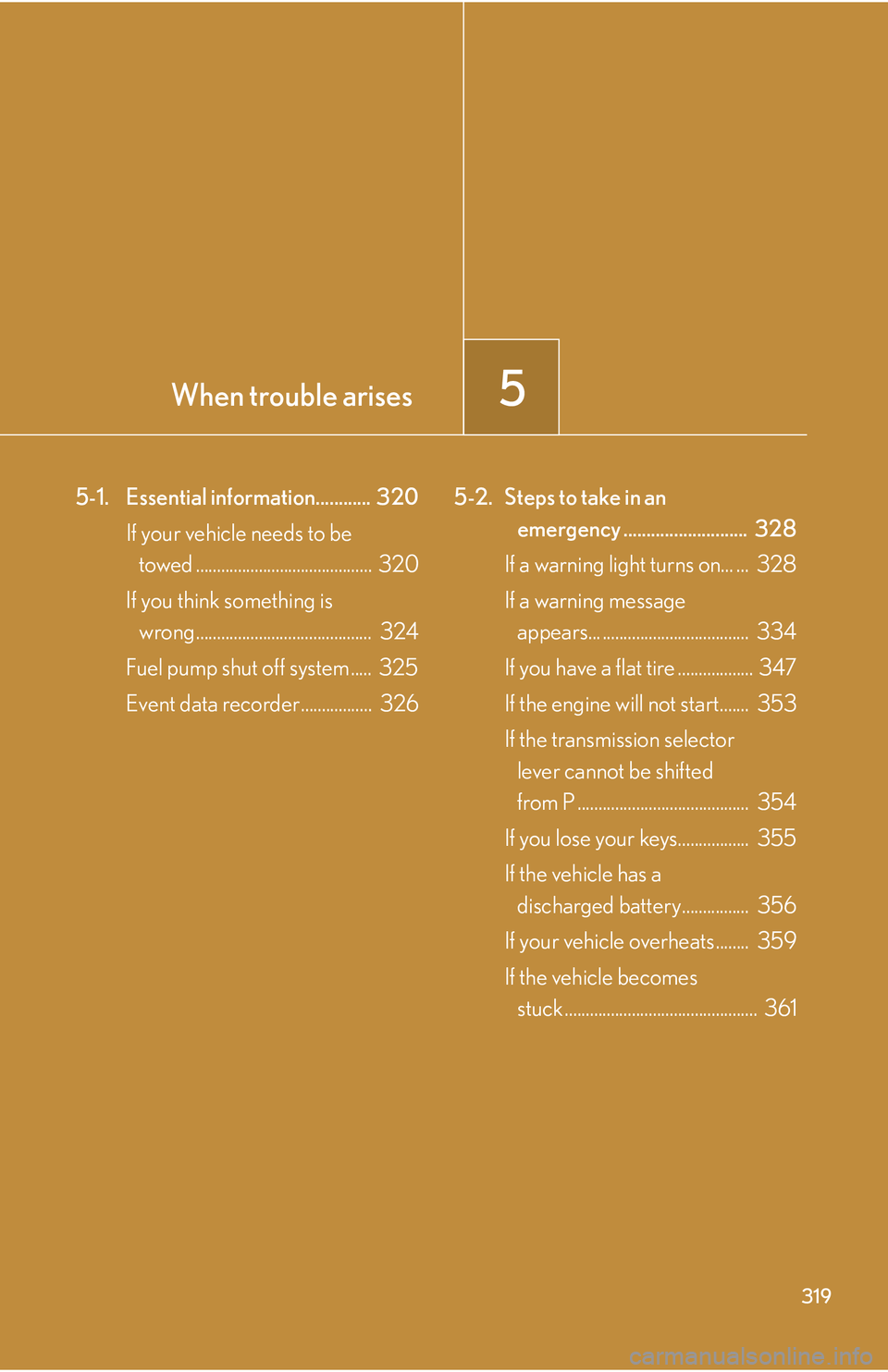
5When trouble arises
319
5-1. Essential information............ 320If your vehicle needs to be
towed .......................................... 320
If you think something is
wrong.......................................... 324
Fuel pump shut off system ..... 325
Event data recorder................. 326 5-2. Steps to take in an
emergency ........................... 328
If a warning light turns on... ... 328
If a warning message
appears... ................................... 334
If you have a flat tire .................. 347
If the engine will not star
t....... 353
If the transmission selector
lever cannot be shifted
from P ......................................... 354
If you lose your keys................. 355
If the vehicle has a
discharged battery................ 356
If your vehicle overheats........ 359
If the vehicle becomes
stuck .............................................. 361
Page 344 of 419
328
5-2. Steps to take in an emergency
If a warning light turns on...
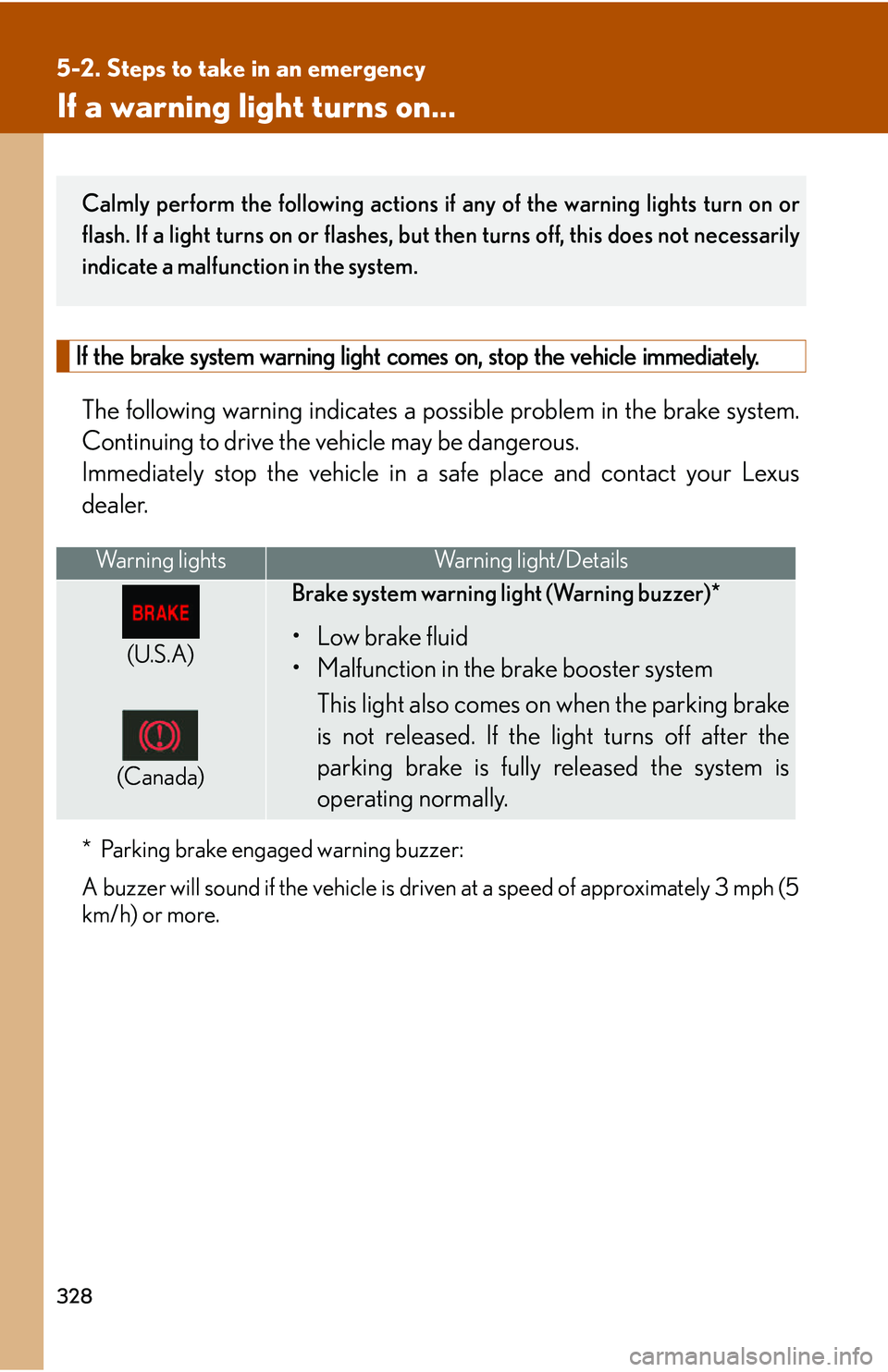
If the brake system warning light comes on, stop the vehicle immediately.
The following warning indicates a possible problem in the brake system.
Continuing to drive the vehicle may be dangerous.
Immediately stop the vehicl e in a safe place and contact y
our Lexus
dealer.
* Parking brake engaged warning buzzer:
A buzzer will sound if the vehicle is driv en at a speed of approximately 3 mph (5
km/h) or more.
Calmly perform the following actions if any of the warning lights turn on or
flash. If a light turns on or flashes, but then turns off, this does not necessarily
indicate a malfunction in the system.
Warning lightsWarning light/Details
(U.S.A)
(Canada)
Brake system warning light (Warning buzzer)*
• Low brake fluid
• Malfunction in the brake booster system This light also comes on when the parking brake
is not released. If the light turns off after the
parking brake is fully released the system is
operating normally.