lock LEXUS LS430 2006 Service Manual
[x] Cancel search | Manufacturer: LEXUS, Model Year: 2006, Model line: LS430, Model: LEXUS LS430 2006Pages: 419, PDF Size: 11.19 MB
Page 92 of 419
76
1-7. Safety information
Installing child restraints
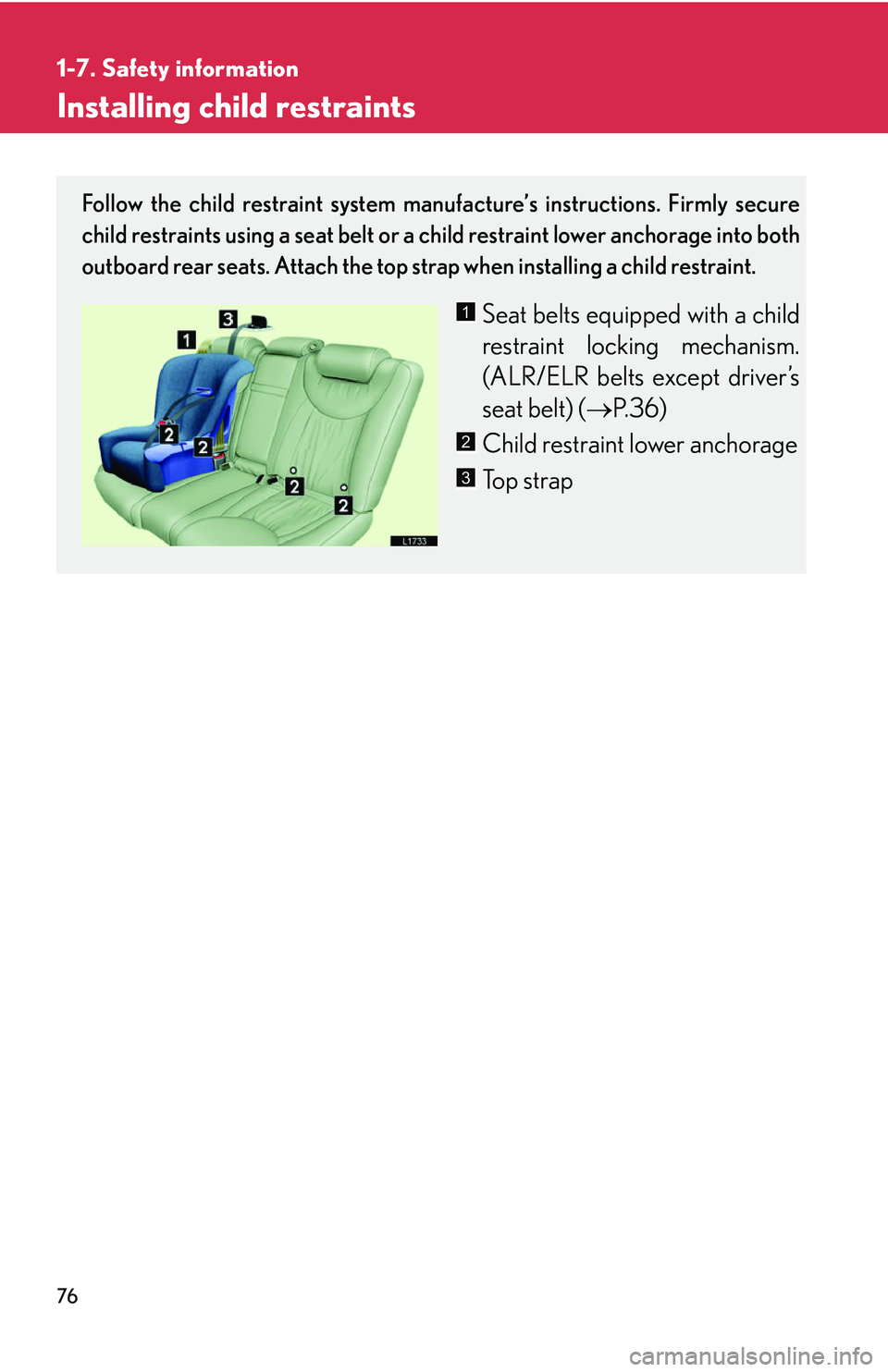
Follow the child restraint system manufacture’s instructions. Firmly secure
child restraints using a seat belt or a child restraint lower anchorage into both
outboard rear seats. Attach the top strap when installing a child restraint.
Seat belts equipped with a child
restraint locking mechanism.
(ALR/ELR belts e
xcept driver’s
seat belt) ( P.36 )
Child restraint lower anchorage
To p s t r a p
1
2
3
Page 94 of 419
78
1-7. Safety information
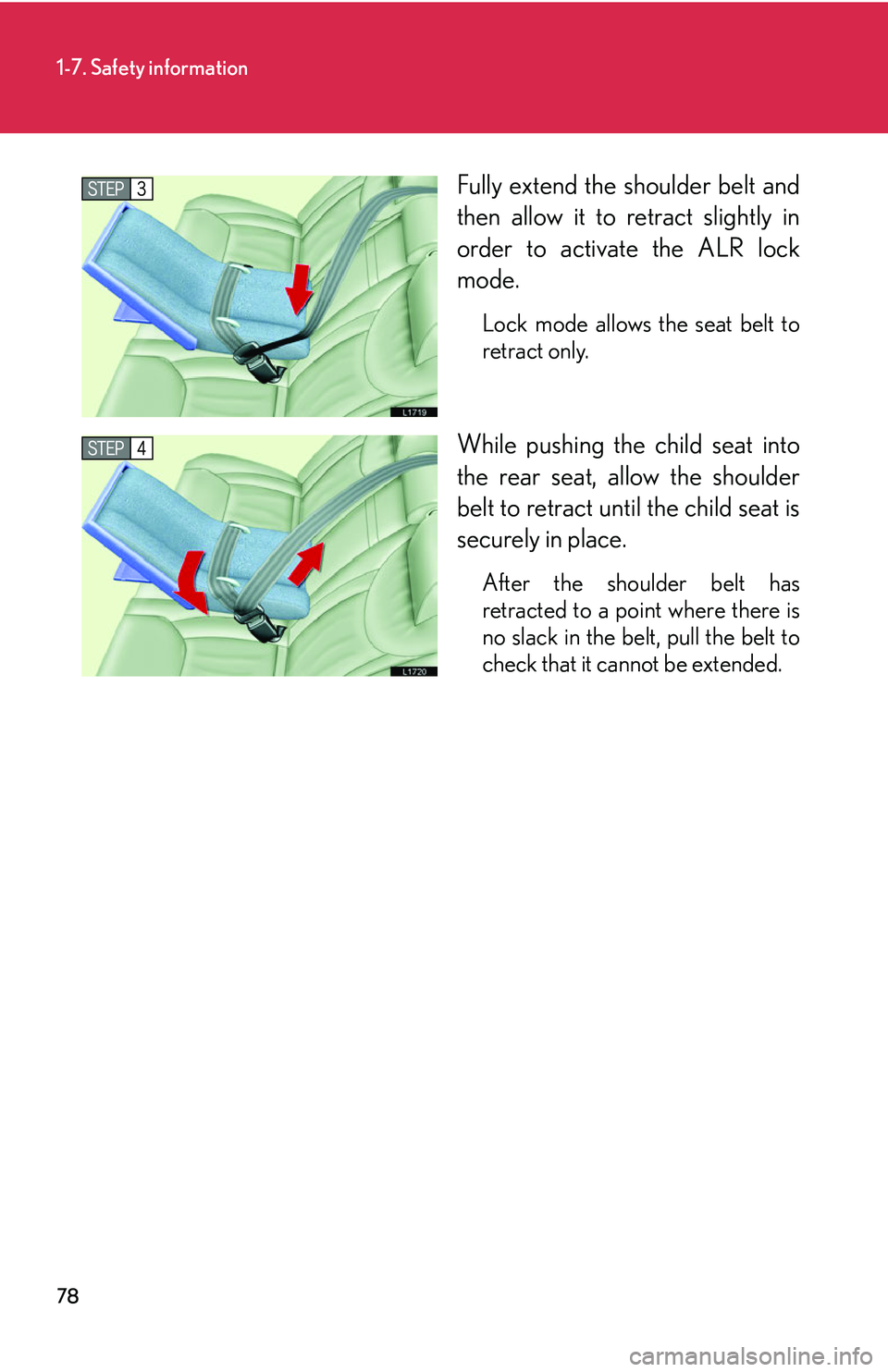
Fully extend the shoulder belt and
then allow it to retract slightly in
order to activate the ALR lock
mode.
Lock mode allows the seat belt to
retract only.
While pushing the child seat into
the rear seat, allow the shoulder
belt to retract until the child seat is
securely in place.
After the shoulder belt has
retracted to a point where there is
no slack in the belt, pull the belt to
check that it cannot be extended.
Page 95 of 419
79
1-7. Safety information
1
Before driving
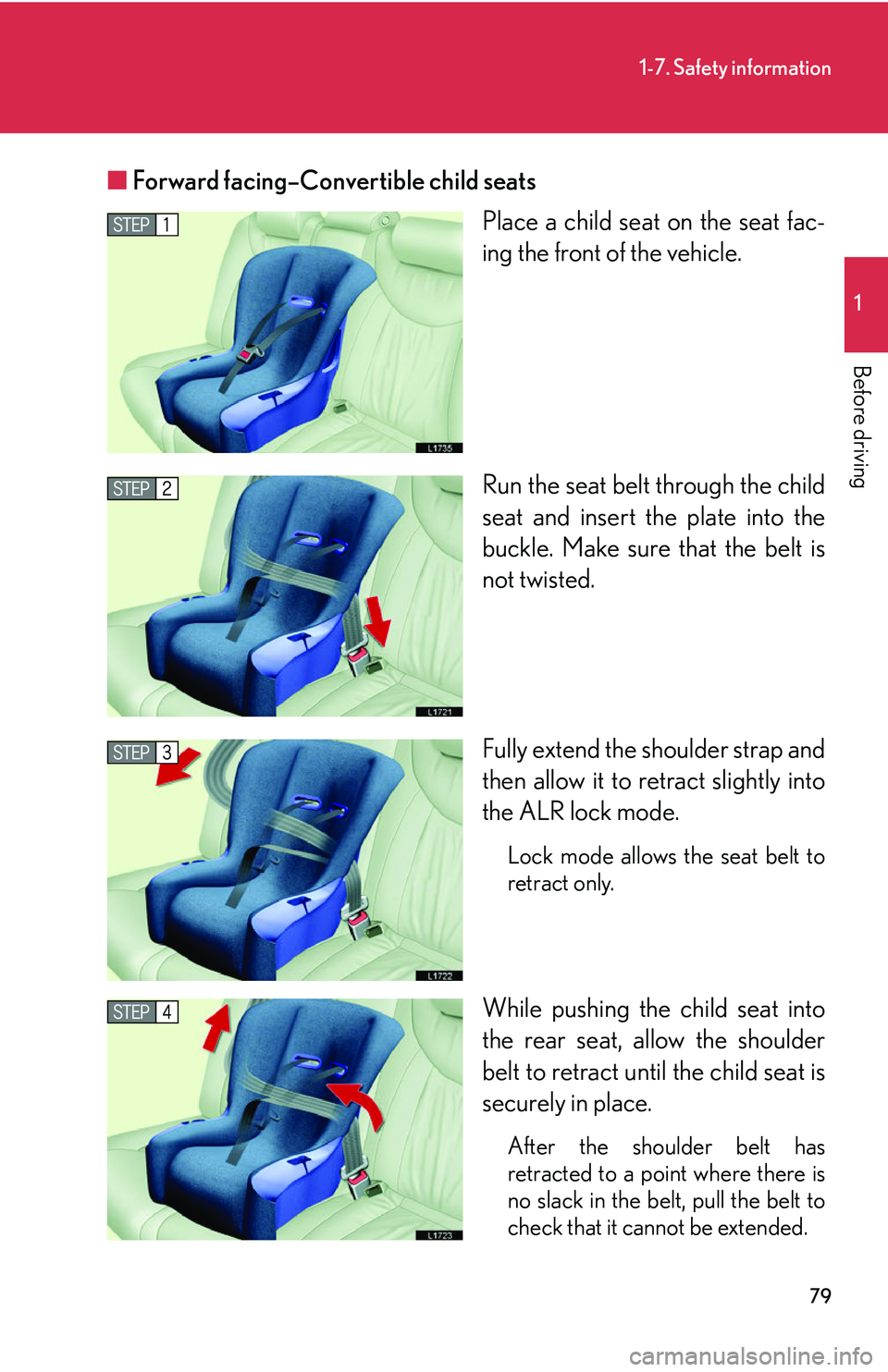
■Forward facing–Convertible child seats
Place a child seat on the seat fac-
ing the front of the vehicle.
Run the seat belt through the child
seat and inser
t the plate into the
buckle. Make sure that the belt is
not twisted.
Fully extend the shoulder strap and
then allo
w it to retract slightly into
the ALR lock mode.
Lock mode allows the seat belt to
retract only.
While pushing the child seat into
the rear seat, allow the shoulder
belt to retract until the child seat is
securely in place.
After the shoulder belt has
retracted to a point where there is
no slack in the belt, pull the belt to
check that it cannot be extended.
Page 97 of 419
81
1-7. Safety information
1
Before driving
CAUTION
■When installing the child restraint system
●When a booster seat is installed, always ensure that the shoulder belt is posi-
tioned across the center of the child’s shou lder
. The belt should be kept away from
the child’s neck, but not so that it could fall off the child's shoulder. Failing to do so
may result in death or serious injury in the event of an accident or sudden braking.
●Ensure that the belt and tab are securely locked and the seat belt is not twisted.
●Push and pull the child seat in different directions to be sure it is secure.
●Follow all installation instructions provid ed by the child restraint system manufac -
turer.
■Do not use the seat belt extender
If using the seat belt extender when inst al
ling a child seat, the seat belt will not
securely hold the child restraint system, which could cause death or serious injury
to the child or other passengers in the event of collision.
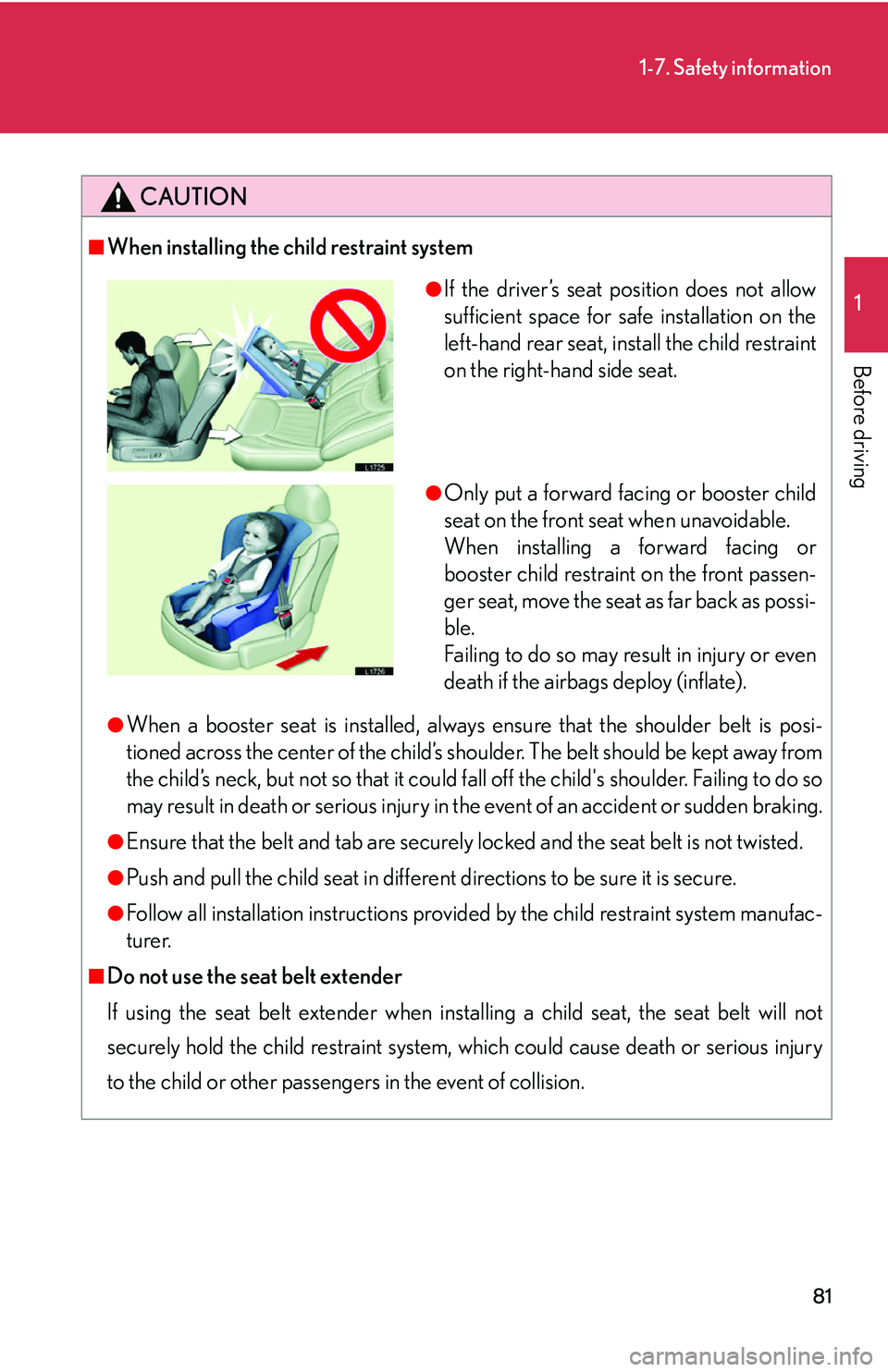
●If the driver’s seat position does not allow
sufficient space for safe installation on the
left-hand rear seat, install the child restraint
on the right-hand side seat.
●Only put a forward facing or booster child
seat on the front seat when unavoidable.
When installing a forward facing or
booster child restraint on the front passen-
ger seat, move the seat as far back as possi-
ble.
Failing to do so may result in injury or even
death if the airbags deploy (inflate).
Page 107 of 419
91
2-1. Driving procedures
2
When driving
CAUTION
■When the vehicle is parked
●Do not leave glasses, cigarette lighters, spray cans, or soft drink cans in the vehi-
cle in hot areas.
• Gas may leak from a cigarette lighter or spr
ay can, and may lead to a fire.
• The temperature inside the vehicle may cause the plastic lenses and plastic
m
aterial of glasses to deform or crack.
• Soft drink cans may fracture, causing the co ntents
to spray over the interior of
the vehicle, and may also cause a short circuit in the vehicle’s electrical com -
ponents.
●Always set the parking brake, shift the se lector lever to P, stop the engine and
lock the vehicle.
Do not leave the vehicle unattend ed
while the engine is running.
●Do not leave the engine running in an area with snow build up, or where snow is
expected to fall.
Exhaust gases may enter the interior of the vehicle and cause gas poisoning.
■When taking a nap in the vehicle
Always turn the engine off. Otherwise, you may accidentally move the selector
le
ver or press the accelerator pedal, which could cause an accident or fire due to
abnormal engine overheating. Additionally, if the vehicle is parked in a poorly venti-
lated area, exhaust fumes may enter the vehicle and cause gas poisoning.
Page 110 of 419
94
2-1. Driving procedures
Starting the engine
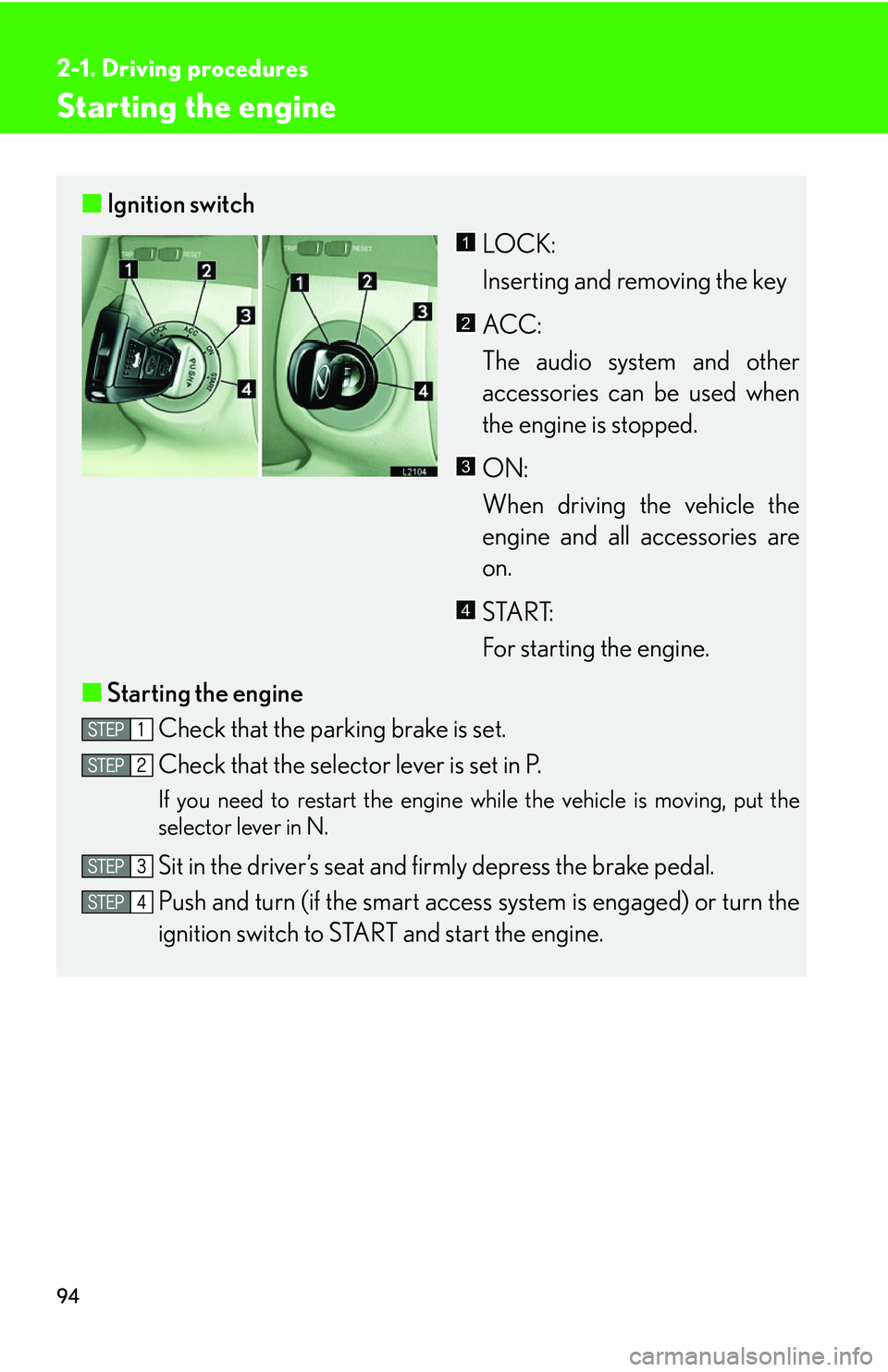
■Ignition switch
LOCK:
Inserting and removing the key
ACC:
The audio system and other
acces
sories can be used when
the engine is stopped.
ON:
When driving the vehicle the
engine an
d all accessories are
on.
START:
For starting the engine.
■ Star
ting the engine
Check that the parking brake is set.
Check that the selector lever is set in P.
If you need to restart the engine while the vehicle is moving, put the
selector lever in N.
Sit in the driver’s seat and firmly depress the brake pedal.
Push and turn (if the smart access s
ystem is engaged) or turn the
ignition switch to STAR T and star
t the engine.
1
2
3
4
Page 111 of 419
95
2-1. Driving procedures
2
When driving
■If the engine does not start
Check whether the other keys will start the engine.
If they work, your key may be broken. Have the key checked at your Lexus dealer.
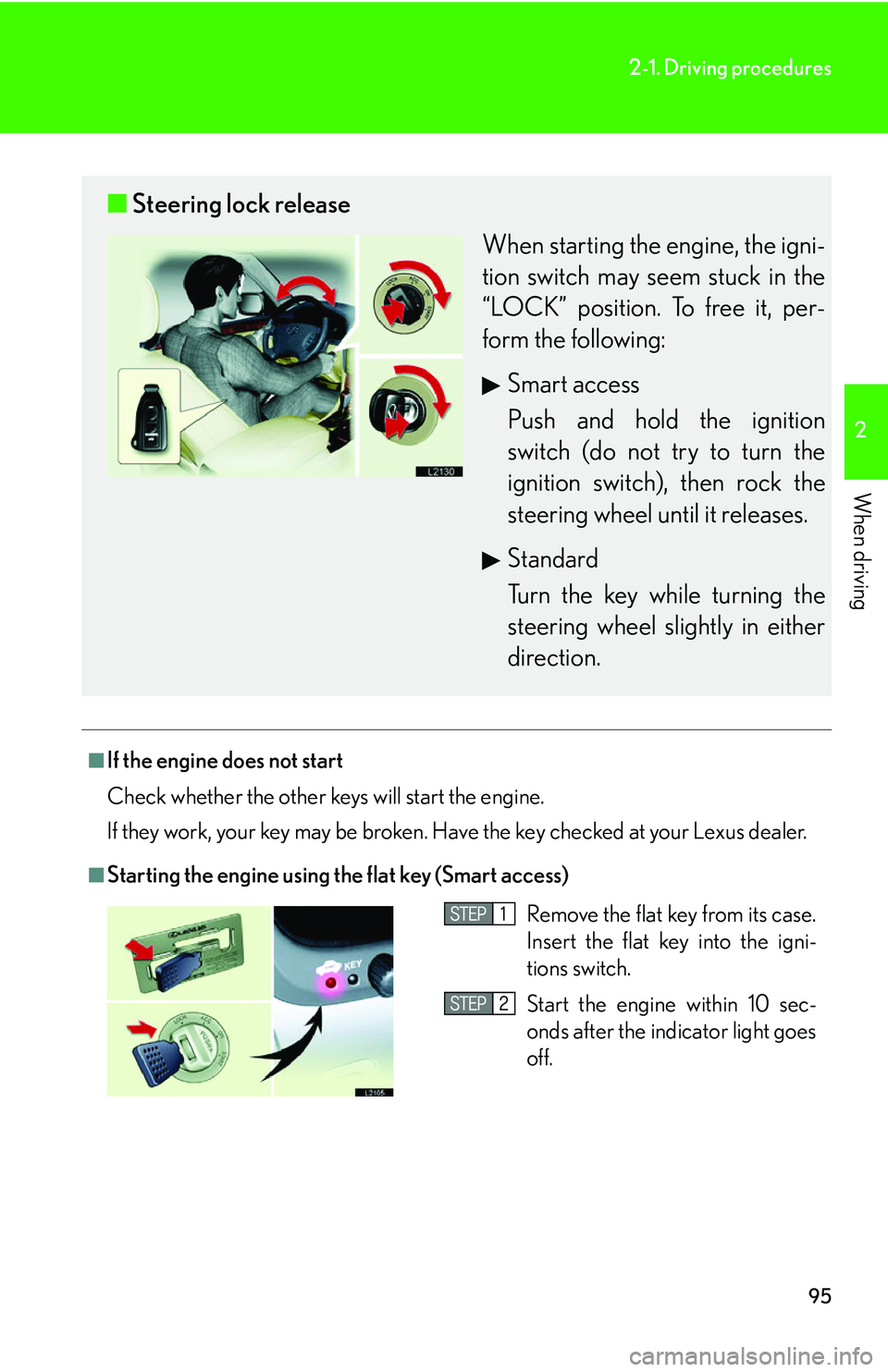
■Starting the engine using the flat key (Smart access)
■ Steering lock release
When starting the engine, the igni -
tion switch may seem stuck in the
“L
OCK” position. To free it, per -
form the following:
Smart access
Push and hold the ignition
s
witch (do not try to turn the
ignition switch), then rock the
steering wheel until it releases.
Standard
Turn the key while turning the
steering wheel slightly in either
dir
ection.
Remove the flat key from its case.
Insert the flat key into the igni-
tions switch.
Start the engine within 10 sec-
onds after the indicator light goes
off.
Page 127 of 419

111
2-3. Operating the headlight and windshield wipers
2
When driving
Daytime running light system
The headlights turn on automatically (at a reduced intensity) whenever the
engine is started and the parking brake is released to make your vehicle
more visible to other drivers. Dayt ime running lights are not designed for
use at night.
■Headlight control sensor
■Automatic light off system
The headlights turn off automatically if the engine is stopped and the driver’s door is
opened wh
ile the headlights are turned on.
To turn the headlights on again, turn the key to ON, or turn the light switch off once
and then
back to or position.
■Automatic headlight leveling system
The level of the headlights is
automatically adjusted according to the number of
passengers and the loading condition of the vehicle to ensure that the headlights do
not interfere other road users.
■Customization
The time it takes for the headlights to automatically turn on or off can be changed.
( P.384 )
The sensor may not function properly if an
object is placed on the sensor, or anything
that blocks the sensor is affixed to the wind-
shield.
Doing so interferes with the sensor detect-
ing the level of ambient light and may cause
the automatic headlight system malfunc-
tion.
Page 130 of 419
114
2-3. Operating the headlight and windshield wipers
Windshield wipers and washer
■Windshield wiper and washer operating conditions
The ignition switch must be turn
ed to ON position.
■If no windshield washer fluid sprays
Check that there is washer fluid
in the windshield washer fluid reservoir, and that the
washer nozzles are not blocked.
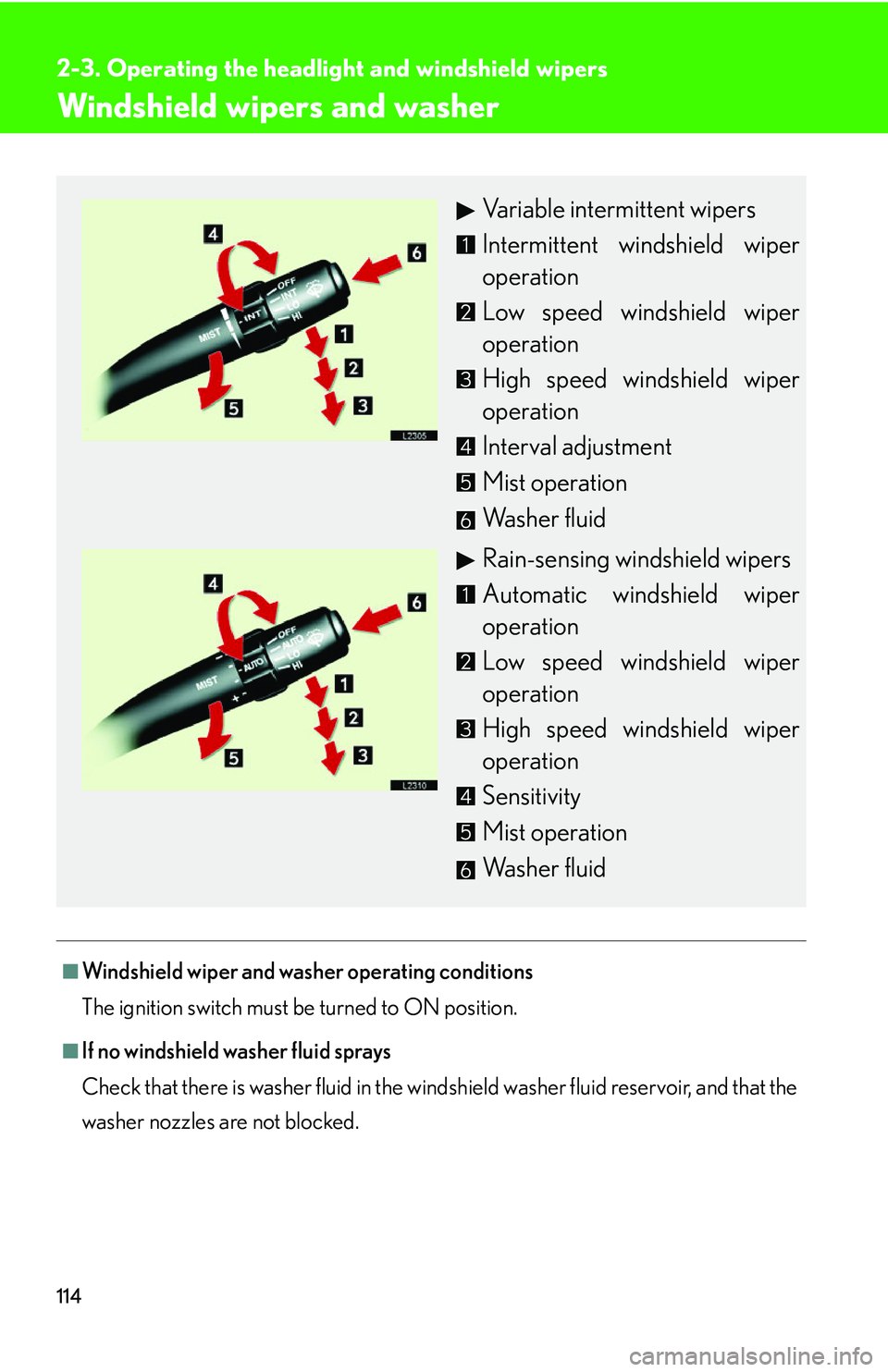
Variable intermittent wipers
Intermittent windshield wiper
operation
Low speed windshield wiper
operation
High speed windshield wiper
operation
Interval adjustment
Mist operation
Washer fluid
Rain-sensing windshield wipers
Automatic windshield wiper
operation
Low speed windshield wiper
operation
High speed windshield wiper
operation
Sensitivity
Mist operation
Washer fluid
Page 148 of 419
132
2-4. Using other driving systems
■Setting vehicle speed
Settings can be made when the vehicle
is traveling above 28 mph (45 km/h).
■Unsuitable conditions
You cannot set the speed in the following conditions:
• When the selector lever is in a position other than D, 4, 5, or 6.
• When driving in adverse weather conditions.
■Automatic cruise control cancellation
In the following cases, the preset speed is can ce
lled. If the system is restored, cruise
control enters the ready mode.
• The slip indicator light blinks and a warning tone sounds.
• The anti-lock braking system activates.
• Foreign matter adheres to the sensor.
• The driving pattern selector sw it
ch is set to “SNOW” mode.
• The wipers are operated at high speed (radar), or either high or low speeds (l
aser). This includes high and low speed operation with the wiper lever in the
AUTO position.
• The vehicle’s speed falls below 25 mph (40 km/h). In this case, you must apply th
e brakes manually to slow the vehicle.
If the preset speed automatically cancels out for other than the above reasons, the
sy
stem may have malfunctioned. Do not operate the dynamic radar/laser cruise
control. You may continue driving, howe ver have your vehicle checked by your
Lexus dealer at the earliest opportunity.