steering LEXUS LS460L 2016 Repair Manual
[x] Cancel search | Manufacturer: LEXUS, Model Year: 2016, Model line: LS460L, Model: LEXUS LS460L 2016Pages: 708, PDF Size: 36.57 MB
Page 524 of 708
5246-2. Maintenance
LS460/LS460L_GE (OM50G06E)
Refer to the following table for normal maintenance schedule items
requiring more frequent service specific to the type of severe conditions.
(For outline, see “Maintenance schedule requirements”.)
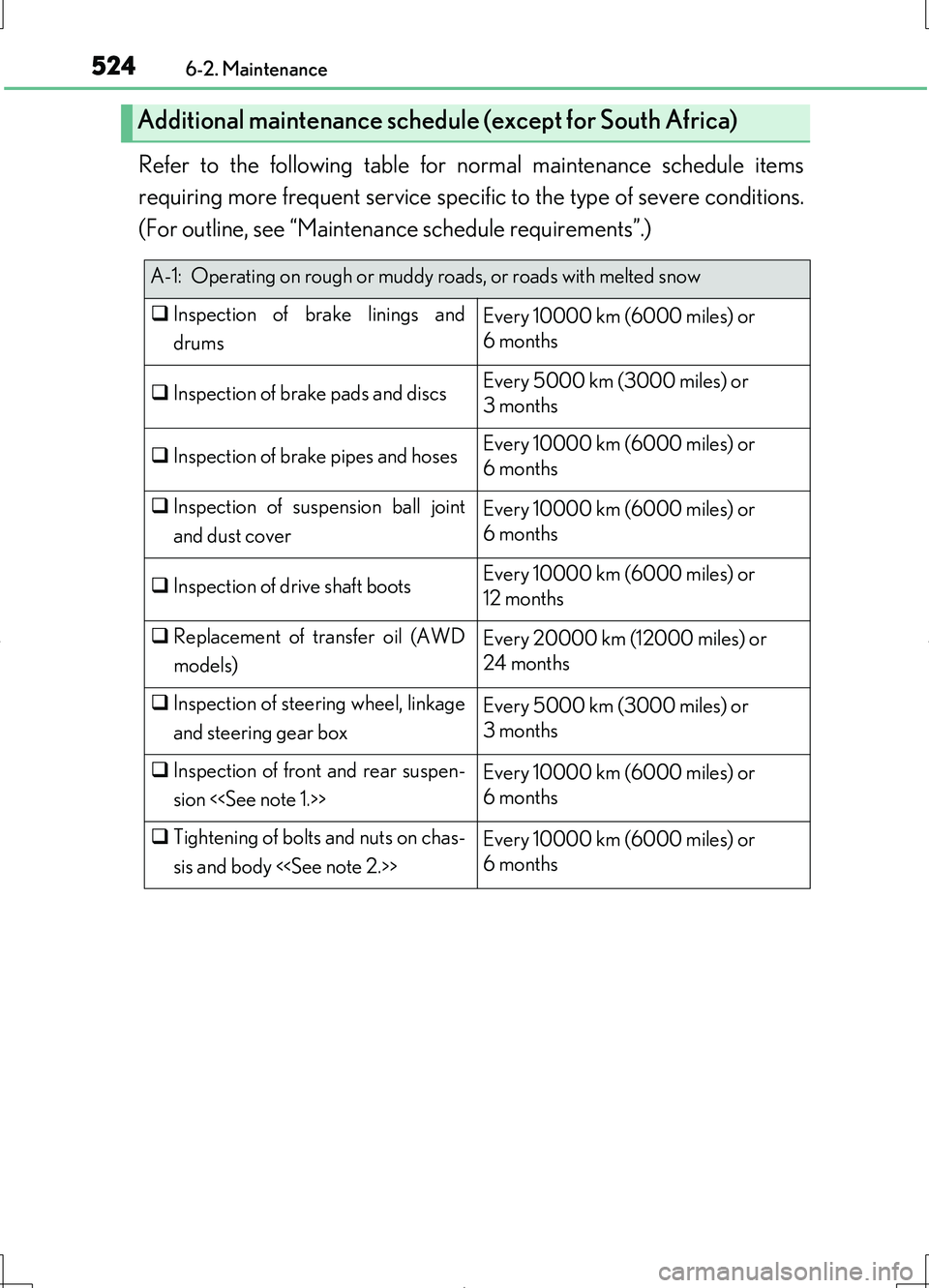
Additional maintenance schedule (except for South Africa)
A-1: Operating on rough or muddy ro ads, or roads with melted snow
Inspection of brake linings and
drums
Every 10000 km (6000 miles) or
6 months
Inspection of brake pads and discsEvery 5000 km (3000 miles) or
3 months
Inspection of brake pipes and hosesEvery 10000 km (6000 miles) or
6 months
Inspection of suspension ball joint
and dust cover
Every 10000 km (6000 miles) or
6 months
Inspection of drive shaft bootsEvery 10000 km (6000 miles) or
12 months
Replacement of transfer oil (AWD
models)
Every 20000 km (12000 miles) or
24 months
Inspection of steering wheel, linkage
and steering gear box
Every 5000 km (3000 miles) or
3 months
Inspection of front and rear suspen-
sion <
Every 10000 km (6000 miles) or
6 months
Tightening of bolts and nuts on chas-
sis and body <
Every 10000 km (6000 miles) or
6 months
Page 529 of 708
5296-2. Maintenance
6
Maintenance and care
LS460/LS460L_GE (OM50G06E)
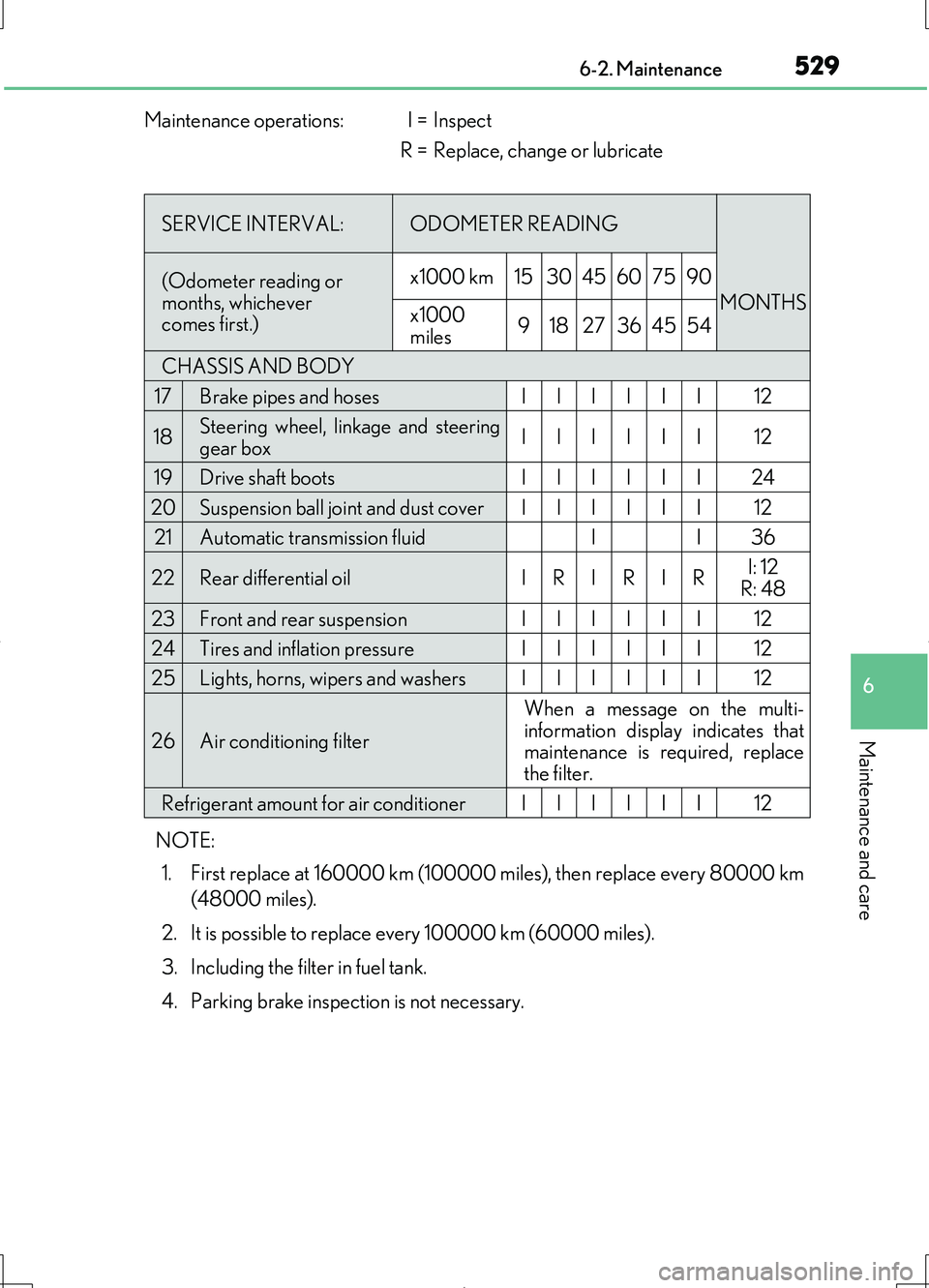
NOTE:
1. First replace at 160000 km (100000 miles), then replace every 80000 km
(48000 miles).
2. It is possible to replace every 100000 km (60000 miles).
3. Including the filter in fuel tank.
4. Parking brake inspection is not necessary.
CHASSIS AND BODY
17Brake pipes and hosesIIIIII12
18Steering wheel, linkage and steering
gear boxIIIIII12
19Drive shaft bootsIIIIII24
20Suspension ball joint and dust coverIIIIII12
21Automatic transmission fluidII36
22Rear differential oilIRIRIRI: 12
R: 48
23Front and rear suspensionIIIIII12
24Tires and inflation pressureIIIIII12
25Lights, horns, wipers and washersIIIIII12
26Air conditioning filter
When a message on the multi-
information display indicates that
maintenance is required, replace
the filter.
Refrigerant amount for air conditionerIIIIII12
Maintenance operations:I =Inspect
R =Replace, change or lubricate
SERVICE INTERVAL:ODOMETER READING
(Odometer reading or
months, whichever
comes first.)
x1000 km153045607590
MONTHSx1000
miles91827364554
Page 530 of 708
5306-2. Maintenance
LS460/LS460L_GE (OM50G06E)
Refer to the following table for normal maintenance schedule items
requiring more frequent service specific to the type of severe conditions.
(For outline, see “Maintenance schedule requirements”.)
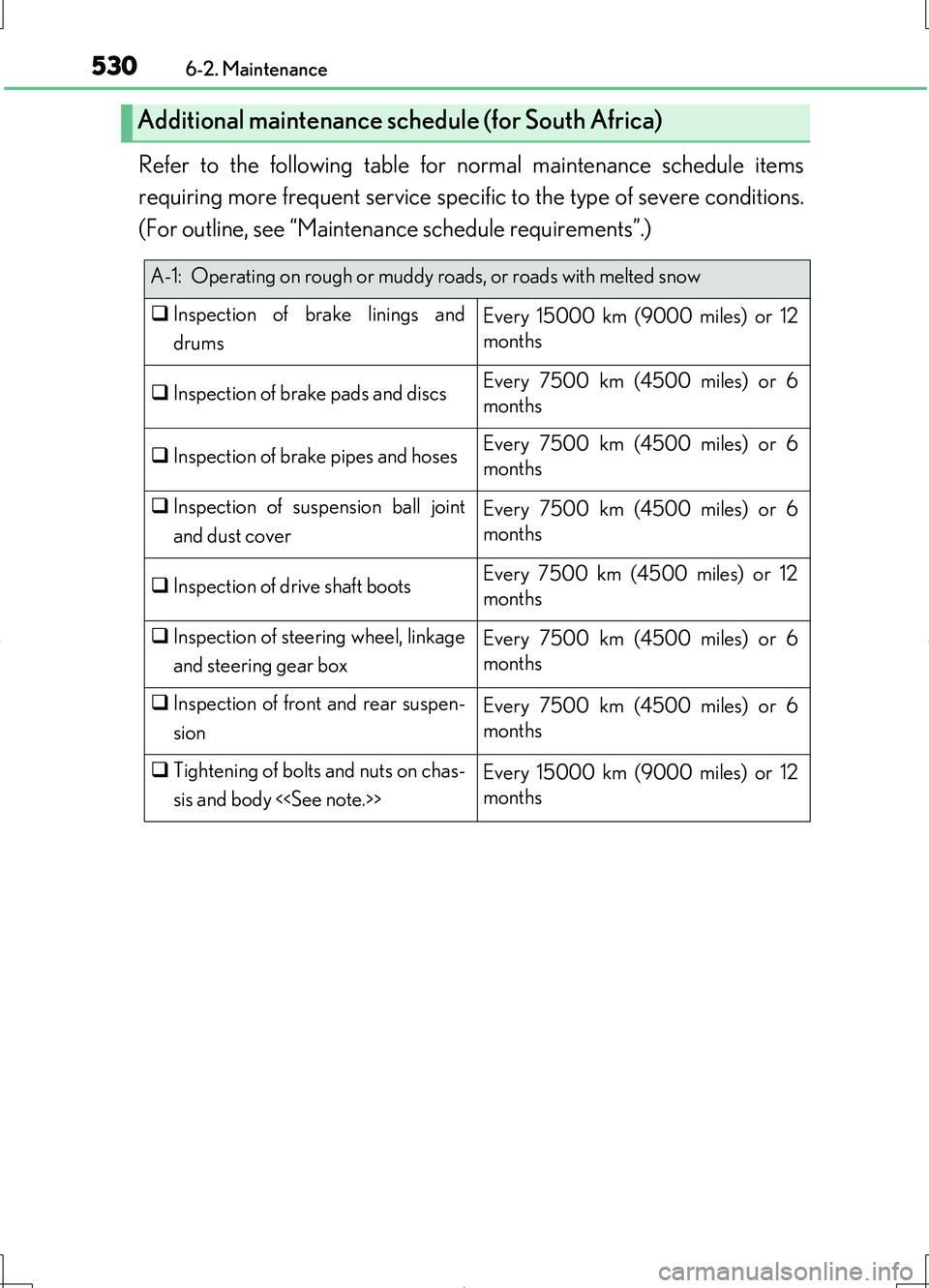
Additional maintenance schedule (for South Africa)
A-1: Operating on rough or muddy ro ads, or roads with melted snow
Inspection of brake linings and
drums
Every 15000 km (9000 miles) or 12
months
Inspection of brake pads and discsEvery 7500 km (4500 miles) or 6
months
Inspection of brake pipes and hosesEvery 7500 km (4500 miles) or 6
months
Inspection of suspension ball joint
and dust cover
Every 7500 km (4500 miles) or 6
months
Inspection of drive shaft bootsEvery 7500 km (4500 miles) or 12
months
Inspection of steering wheel, linkage
and steering gear box
Every 7500 km (4500 miles) or 6
months
Inspection of front and rear suspen-
sion
Every 7500 km (4500 miles) or 6
months
Tightening of bolts and nuts on chas-
sis and body <
Every 15000 km (9000 miles) or 12
months
Page 566 of 708
5666-3. Do-it-yourself maintenance
LS460/LS460L_GE (OM50G06E)
CAUTION
■Using tires of a different size
Do not use tires of a different size from those equipped when the vehicle was new,
as the front tire steering angle setting is designed for the original tire size. It is dan-
gerous to use an incorrect wheel and tire combination as this may result in reduced
vehicle stability.
■When initializing the tire pressure warning system (vehicles with the tire pressure
warning system)
Do not operate the tire pressure warning reset switch without first adjusting the tire
inflation pressure to the specified level. Otherwise, the tire pressure warning light
may not come on even if the tire inflation pressure is low, or it may come on when
the tire inflation pressure is actually normal.
■Caution regarding interference with electronic devices (vehicles with the tire
pressure warning system)
●Users of any electrical medical device other than implantable cardiac pacemak-
ers, cardiac resynchronization therapy-pacemakers or implantable cardioverter
defibrillators should consult the manufacturer of the device for information about
its operation under the influence of radio waves.
Radio waves could have unexpected effects on the operation of such medical
devices.
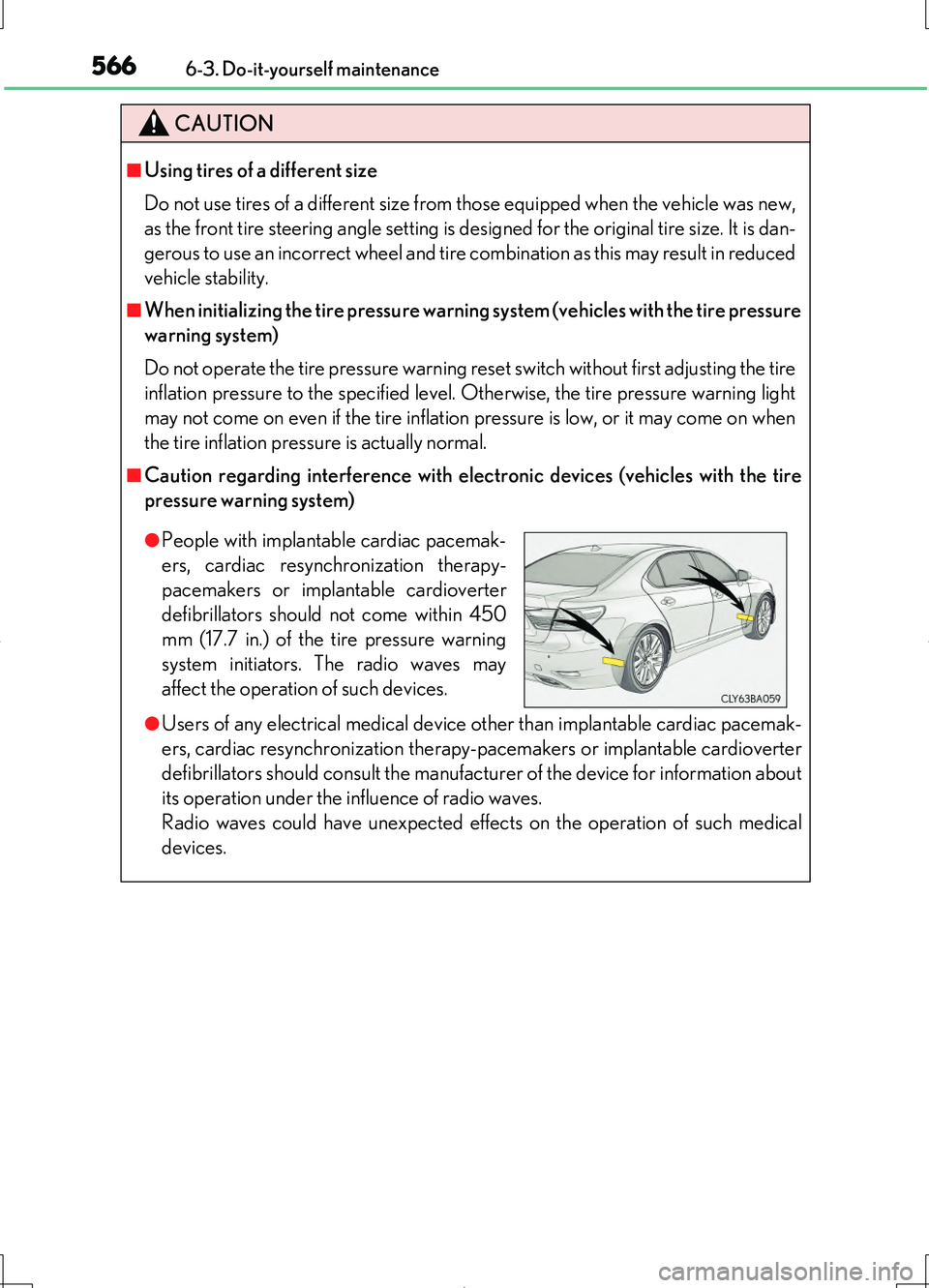
●People with implantable cardiac pacemak-
ers, cardiac resynchronization therapy-
pacemakers or implantable cardioverter
defibrillators should not come within 450
mm (17.7 in.) of the tire pressure warning
system initiators. The radio waves may
affect the operation of such devices.
Page 595 of 708
5957-1. Essential information
7
When trouble arises
LS460/LS460L_GE (OM50G06E)
Steadily step on the brake pedal with both feet and firmly depress it.
Do not pump the brake pedal repeatedly as this will increase the effort required to
slow the vehicle.
Shift the shift lever to N.
If the shift lever is shifted to N
After slowing down, stop the vehicle in a safe place by the road.
Stop the engine.
If the shift lever cannot be shifted to N
Keep depressing the brake pedal wi th both feet to reduce vehicle
speed as much as possible.
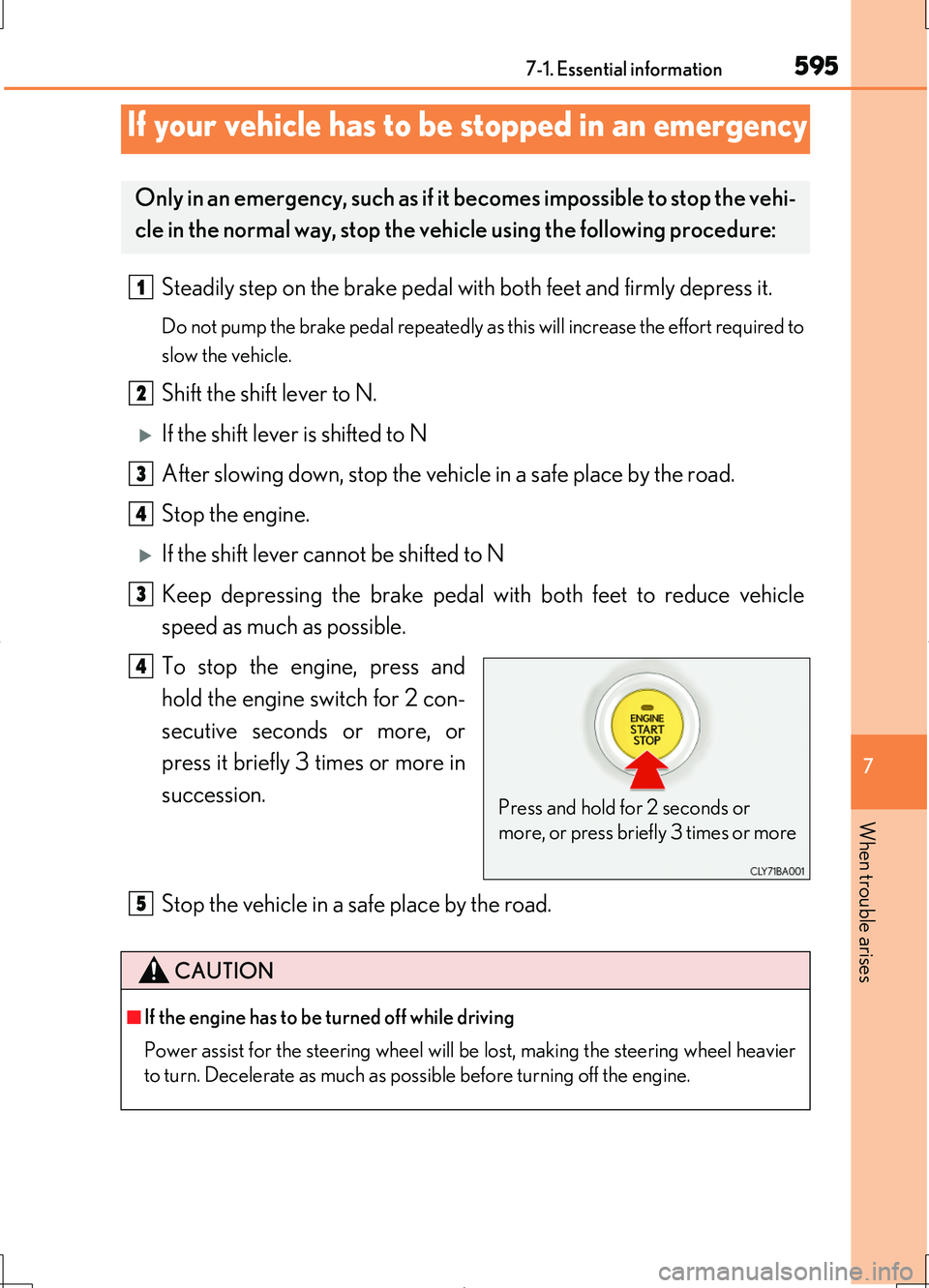
To stop the engine, press and
hold the engine switch for 2 con-
secutive seconds or more, or
press it briefly 3 times or more in
succession.
Stop the vehicle in a safe place by the road.
If your vehicle has to be stopped in an emergency
Only in an emergency, such as if it becomes impossible to stop the vehi-
cle in the normal way, stop the vehicle using the following procedure:
1
2
3
4
3
Press and hold for 2 seconds or
more, or press briefly 3 times or more
4
CAUTION
■If the engine has to be turned off while driving
Power assist for the steering wheel will be lost, making the steering wheel heavier
to turn. Decelerate as much as possible before turning off the engine.
5
Page 598 of 708
5987-2. Steps to take in an emergency
LS460/LS460L_GE (OM50G06E)
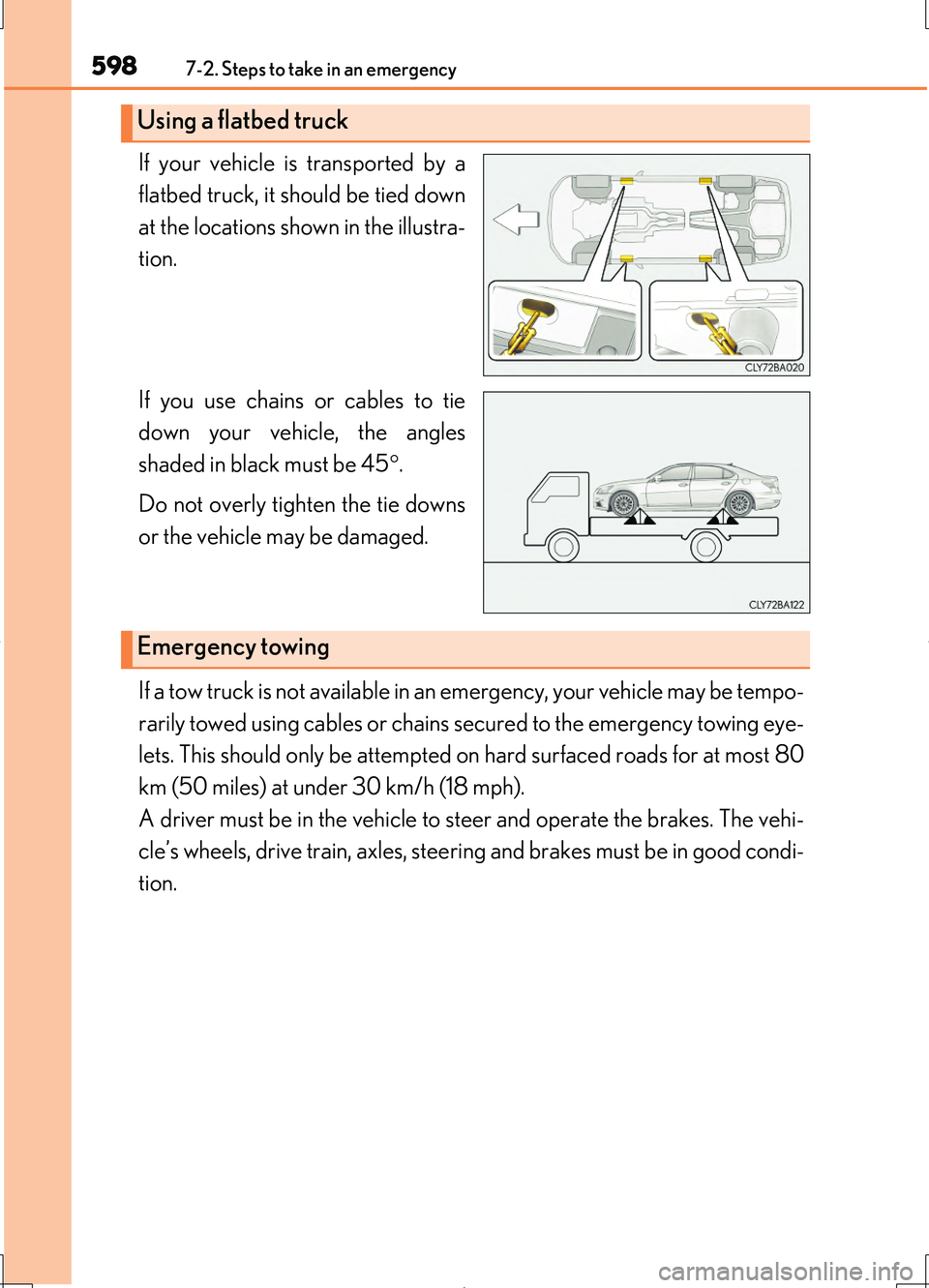
If your vehicle is transported by a
flatbed truck, it should be tied down
at the locations shown in the illustra-
tion.
If you use chains or cables to tie
down your vehicle, the angles
shaded in black must be 45 .
Do not overly tighten the tie downs
or the vehicle may be damaged.
If a tow truck is not available in an emergency, your vehicle may be tempo-
rarily towed using cables or chains secured to the emergency towing eye-
lets. This should only be attempted on hard surfaced roads for at most 80
km (50 miles) at under 30 km/h (18 mph).
A driver must be in the vehicle to steer and operate the brakes. The vehi-
cle’s wheels, drive train, axles, steering and brakes must be in good condi-
tion.
Using a flatbed truck
Emergency towing
Page 600 of 708
6007-2. Steps to take in an emergency
LS460/LS460L_GE (OM50G06E)
■While towing
If the engine is not running, the power assist for the brakes and steering will not func-
tion, making steering and braking more difficult.
■Wheel nut wrench
Wheel nut wrench is installed in trunk. ( P. 619)
CAUTION
Observe the following precautions.
Failure to do so may result in death or serious injury.
■When towing the vehicle
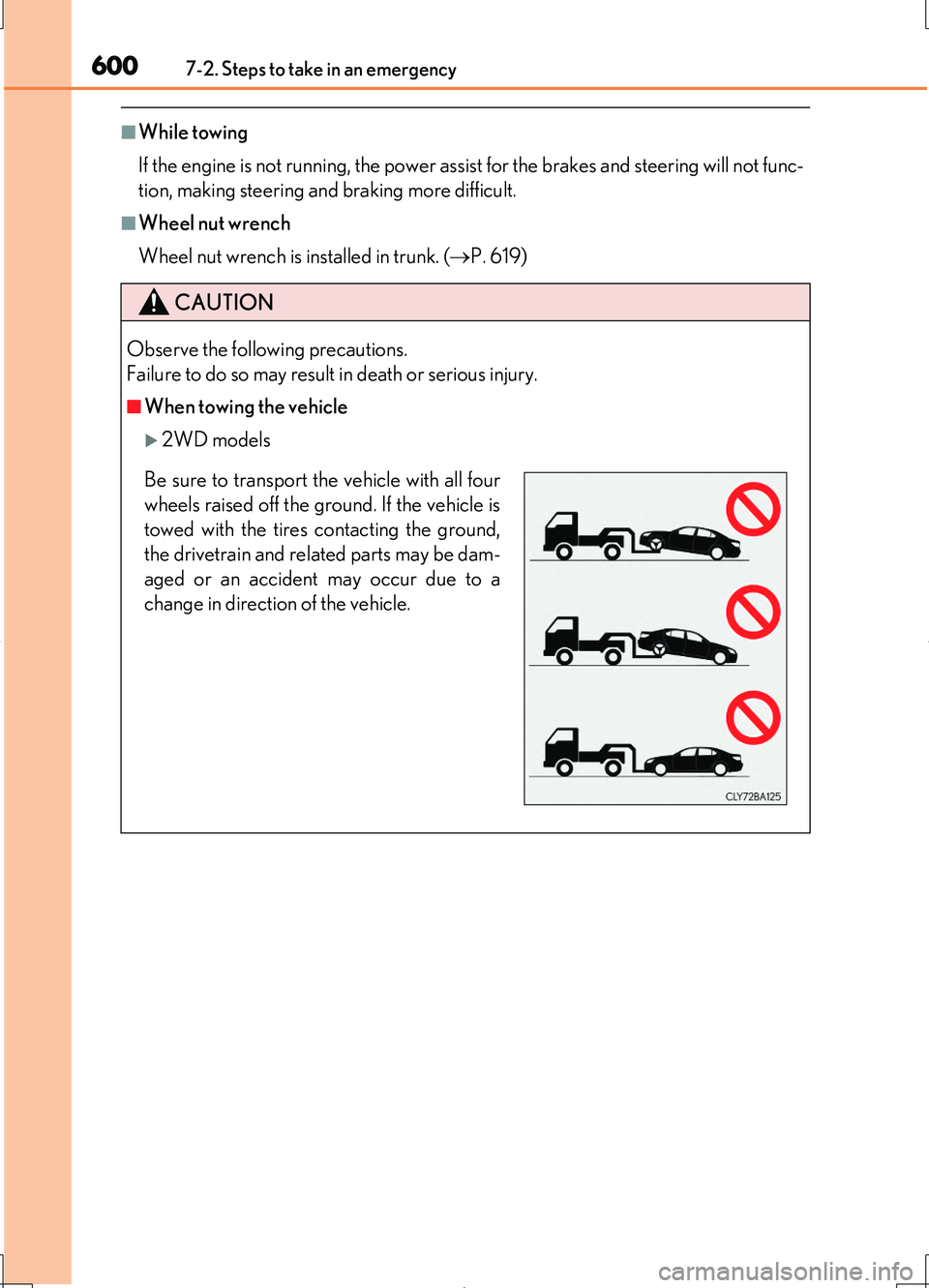
2WD models
Be sure to transport the vehicle with all four
wheels raised off the ground. If the vehicle is
towed with the tires contacting the ground,
the drivetrain and related parts may be dam-
aged or an accident may occur due to a
change in direction of the vehicle.
Page 601 of 708
6017-2. Steps to take in an emergency
7
When trouble arises
LS460/LS460L_GE (OM50G06E)
CAUTION
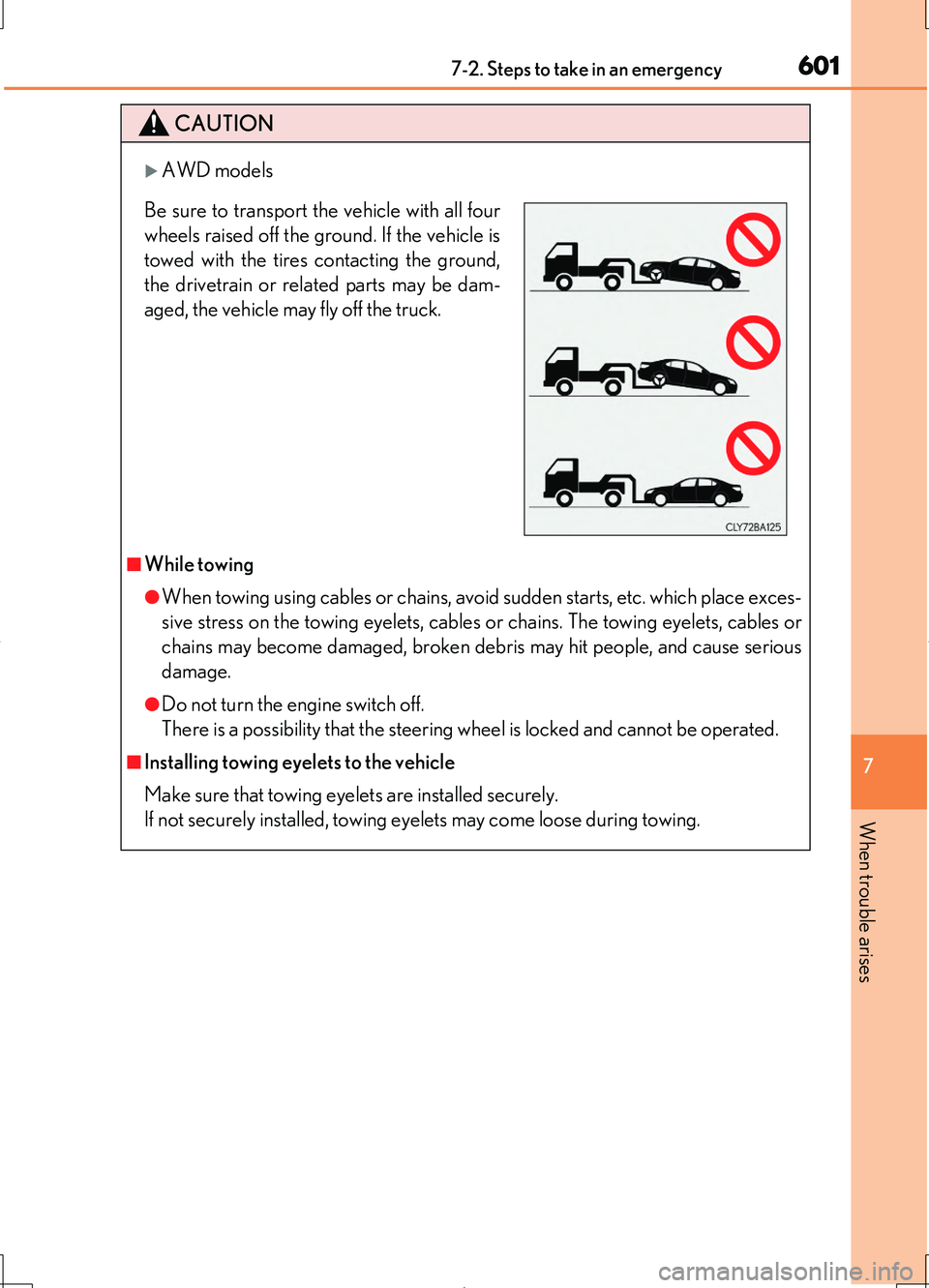
AWD models
■While towing
●When towing using cables or chains, avoid sudden starts, etc. which place exces-
sive stress on the towing eyelets, cables or chains. The towing eyelets, cables or
chains may become damaged, broken debris may hit people, and cause serious
damage.
●Do not turn the engine switch off.
There is a possibility that the steering wheel is locked and cannot be operated.
■Installing towing eyelets to the vehicle
Make sure that towing eyelets are installed securely.
If not securely installed, towing eyelets may come loose during towing.
Be sure to transport the vehicle with all four
wheels raised off the ground. If the vehicle is
towed with the tires contacting the ground,
the drivetrain or related parts may be dam-
aged, the vehicle may fly off the truck.
Page 602 of 708
6027-2. Steps to take in an emergency
LS460/LS460L_GE (OM50G06E)
NOTICE
■To prevent damage to the vehicle when towing using a wheel-lift type truck
●Do not tow the vehicle from the rear when the engine switch is off. The steering
lock mechanism is not strong enough to hold the front wheels straight.
●When raising the vehicle, ensure adequate ground clearance for towing at the
opposite end of the raised vehicle. Without adequate clearance, the vehicle
could be damaged while being towed.
■To prevent damage to the vehicle when towing with a sling-type truck
Do not tow with a sling-type truck, either from the front or rear.
■To prevent damage to the vehicle during emergency towing
Do not secure cables or chains to the suspension components.
Page 606 of 708
6067-2. Steps to take in an emergency
LS460/LS460L_GE (OM50G06E)
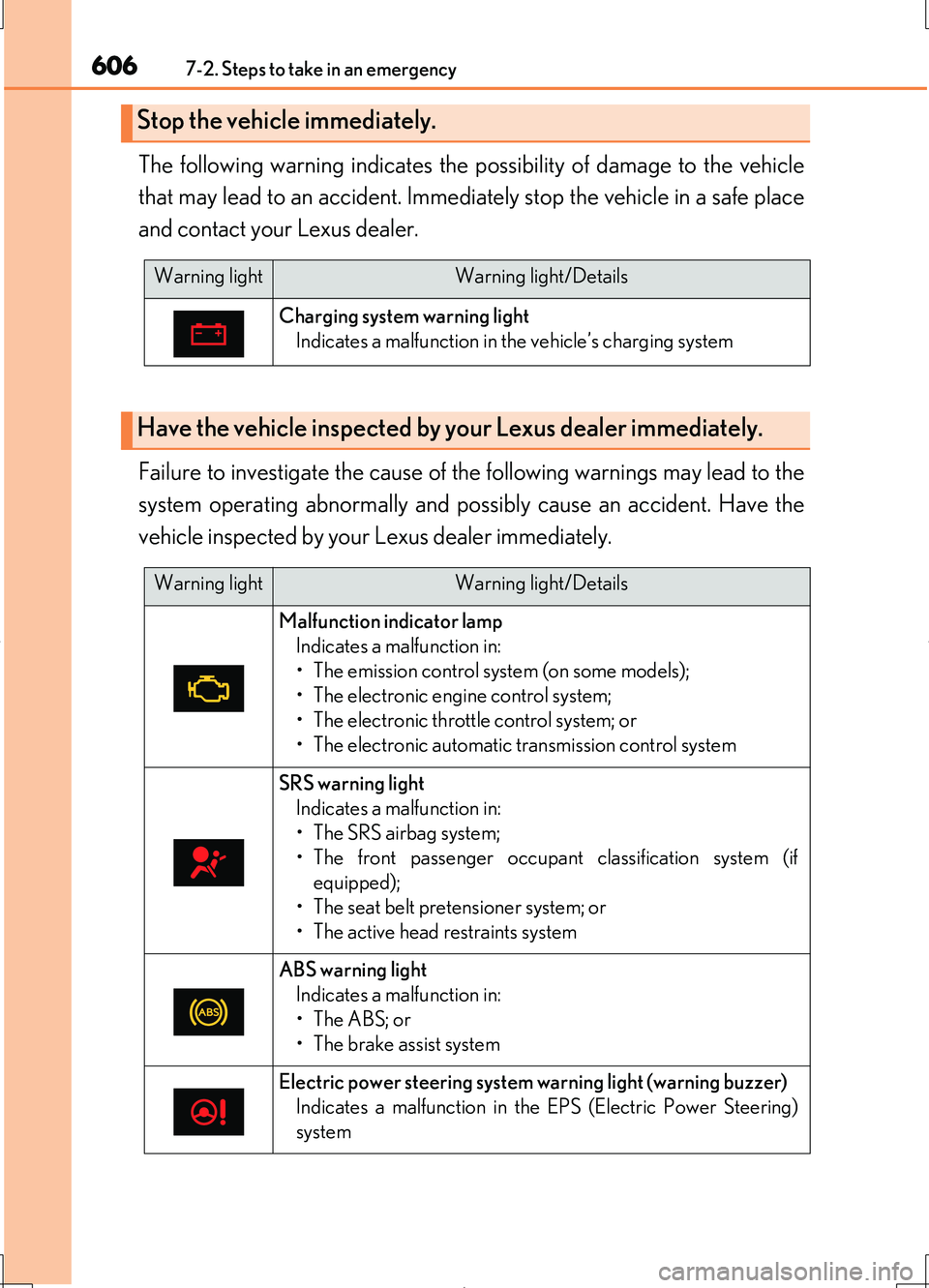
The following warning indicates the possibility of damage to the vehicle
that may lead to an accident. Immediately stop the vehicle in a safe place
and contact your Lexus dealer.
Failure to investigate the cause of the following warnings may lead to the
system operating abnormally and possibly cause an accident. Have the
vehicle inspected by your Lexus dealer immediately.
Stop the vehicle immediately.
Warning lightWarning light/Details
Charging system warning light
Indicates a malfunction in the vehicle’s charging system
Have the vehicle inspected by your Lexus dealer immediately.
Warning lightWarning light/Details
Malfunction indicator lamp
Indicates a malfunction in:
• The emission control system (on some models);
• The electronic engine control system;
• The electronic throttle control system; or
• The electronic automatic transmission control system
SRS warning light
Indicates a malfunction in:
• The SRS airbag system;
• The front passenger occupant classification system (if
equipped);
• The seat belt pretensioner system; or
• The active head restraints system
ABS warning light
Indicates a malfunction in:
•The ABS; or
• The brake assist system
Electric power steering system warning light (warning buzzer)
Indicates a malfunction in the EPS (Electric Power Steering)
system