capacity LEXUS LS500 2018 Owners Manual
[x] Cancel search | Manufacturer: LEXUS, Model Year: 2018, Model line: LS500, Model: LEXUS LS500 2018Pages: 514, PDF Size: 10.62 MB
Page 13 of 514
13Pictorial index
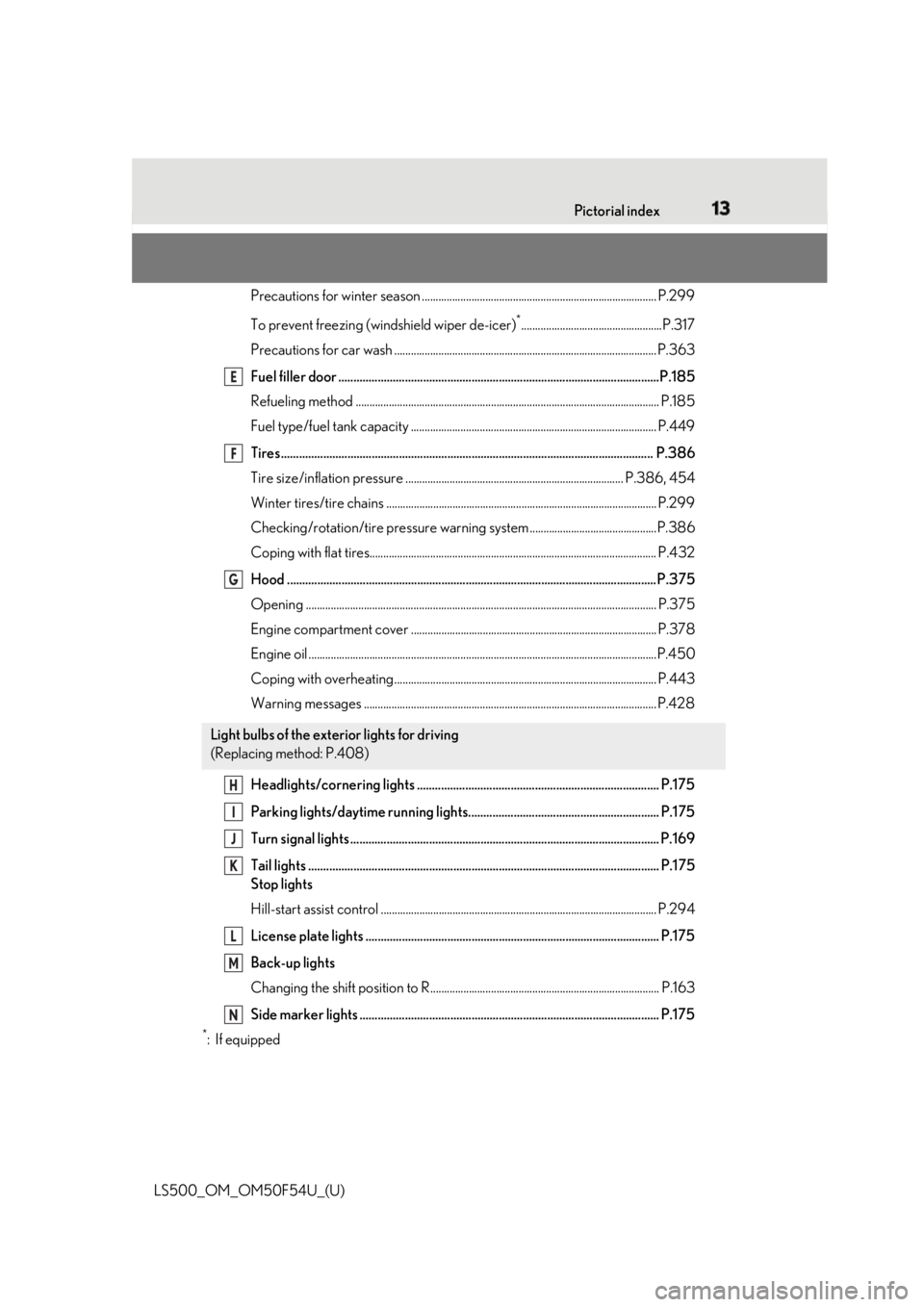
LS500_OM_OM50F54U_(U) Precautions for winter season .. ................................................................................... P.299
To prevent freezing (windshield wiper de-icer) *
...................................................P.317
Precautions for car wash ............................................................................................... P.363
Fuel filler door ..........................................................................................................P.185
Refueling method .............................................................................................................. P .185
Fuel type/fuel tank capacity ...... ................................................................................... P.449
Tires.......................................................................................................................... .P.386
Tire size/inflation pressure ............................ ................................................... P.386, 454
Winter tires/tire chains .................................................................................................. P.299
Checking/rotation/tire pressu re warning system..............................................P.386
Coping with flat tires........................................................................................................ P .432
Hood .......................................................................................................................... P .375
Opening ........................................................................................................................ ....... P.375
Engine compartment cover ......................................................................................... P.378
Engine oil ..................................................................................................................... .........P.450
Coping with overheating ............................................................................................... P.443
Warning messages .......................................................................................................... P.428
Headlights/cornering lights ................................................................................ P.175
Parking lights/daytime running lights............................................................... P.175
Turn signal lights ...................................................................................................... P.169
Tail lights .................................................................................................................... P.175
Stop lights
Hill-start assist control .................................................................................................... P. 294
License plate lights ................................................................................................. P.175
Back-up lights
Changing the shift position to R................................................................................... P.163
Side marker lights ................................................................................................... P.175 *
:If equipped Light bulbs of the exterior lights for driving
(Replacing method: P.408) E
F
G
H
I
J
K
L
M
N
Page 156 of 514
156 4-1. Before driving
LS500_OM_OM50F54U_(U) Cargo capacity depends on the total
weight of the occupants.
(Cargo capacity) = (Total load capac-
ity) — (Total weight of occupants)
Steps for Determining Correct Load
Limit —
(1) Locate the statement “The com-
bined weight of occupants and cargo
should never exceed XXX kg or XXX
lbs.” on your vehicle’s placard.
(2) Determine the combined weight of
the driver and passengers that will be
riding in your vehicle.
(3) Subtract the combined weight of
the driver and passengers from XXX
kg or XXX lbs.
(4) The resulting figure equals the
available amount of cargo and luggage
load capacity.
For example, if the “XXX” amount
equals 1400 lbs. and there will be five
150 lb passengers in your vehicle, the
amount of available cargo and luggage
load capacity is 650 lbs. (1400 − 750
(5 × 150) = 650 lbs.)
(5) Determine the combined weight of
luggage and cargo being loaded on
the vehicle. That weight may not safely
exceed the available cargo and lug-NOTICE
Information on what to do in case of a flat
tire ( → P.432)■
When encountering flooded roads
Do not drive on a road that has flooded
after heavy rain etc. Doing so may cause
the following serious damage to the vehi-
cle: ●
Engine stalling●
Short in electrical components●
Engine damage caused by water
immersion
In the event that you drive on a flooded
road and the vehicle is flooded, be sure
to have your Lexus dealer check the fol-
lowing: ●
Brake function●
Changes in quantity and quality of oil
and fluid used for the engine, transmis-
sion, transfer (AWD models), differen-
tial, etc.●
Lubricant condition for the propeller
shaft, bearings and suspension joints
(where possible), and the function of
all joints, bearings, etc.
If the shift control system is damaged by
flooding, it may not be possible to shift
the shift position to P, or from P to other
positions. In this case, contact your Lexus
dealer.
■
When parking the vehicle
Always set the parking brake, and shift
the shift position to P. Failure to do so
may cause the vehicle to move or the
vehicle may accelerate suddenly if the
accelerator pedal is accidentally
depressed. Cargo and luggage Take notice of the following infor-
mation about storage precautions,
cargo capacity and load:
Capacity and distribution
Page 157 of 514
1574-1. Before driving
LS500_OM_OM50F54U_(U) 4
Driving gage load capacity calculated in Step
4.
(6) If your vehicle will be towing a
trailer, load from your trailer will be
transferred to your vehicle. Consult
this manual to determine how this
reduces the available cargo and lug-
gage load capacity of your vehicle.
( → P.158)Lexus does not recommend towing a
trailer with your vehicle. Your vehicle is not
designed for trailer towing.
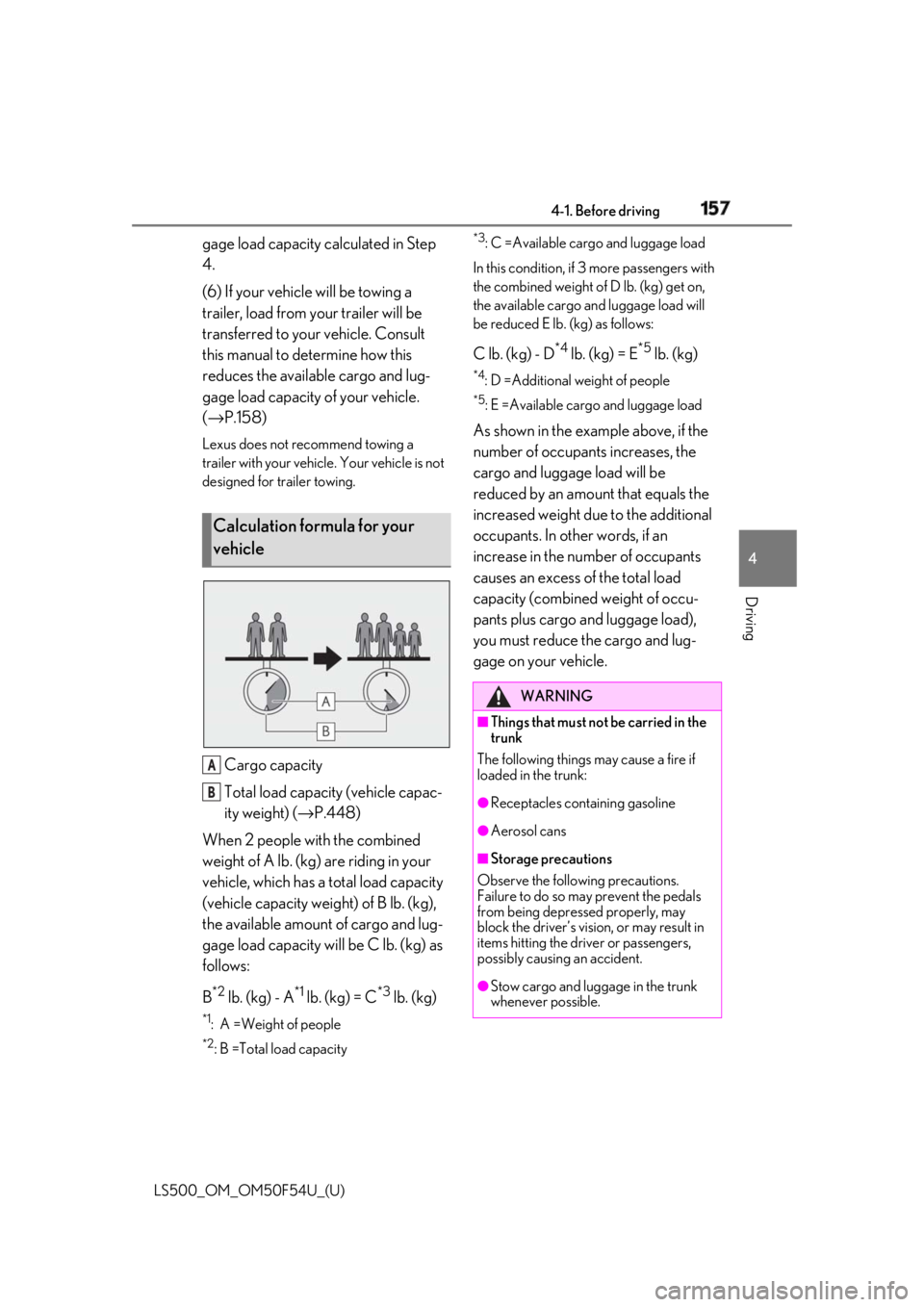
Cargo capacity
Total load capacity (vehicle capac-
ity weight) ( → P.448)
When 2 people with the combined
weight of A lb. (kg) are riding in your
vehicle, which has a total load capacity
(vehicle capacity weight) of B lb. (kg),
the available amount of cargo and lug-
gage load capacity will be C lb. (kg) as
follows:
B *2
lb. (kg) - A *1
lb. (kg) = C *3
lb. (kg)*1
: A =Weight of people *2
: B =Total load capacity *3
: C =Available cargo and luggage load
In this condition, if 3 more passengers with
the combined weight of D lb. (kg) get on,
the available cargo and luggage load will
be reduced E lb. (kg) as follows:
C lb. (kg) - D *4
lb. (kg) = E *5
lb. (kg)*4
: D =Additional weight of people *5
: E =Available cargo and luggage load
As shown in the example above, if the
number of occupant s increases, the
cargo and luggage load will be
reduced by an amount that equals the
increased weight due to the additional
occupants. In other words, if an
increase in the number of occupants
causes an excess of the total load
capacity (combined weight of occu-
pants plus cargo and luggage load),
you must reduce the cargo and lug-
gage on your vehicle.Calculation formula for your
vehicle
A
B WARNING■
Things that must not be carried in the
trunk
The following things may cause a fire if
loaded in the trunk:
●
Receptacles containing gasoline
●
Aerosol cans
■
Storage precautions
Observe the following precautions.
Failure to do so may prevent the pedals
from being depressed properly, may
block the driver’s vision, or may result in
items hitting the driver or passengers,
possibly causing an accident.
●
Stow cargo and luggage in the trunk
whenever possible.
Page 158 of 514
158 4-1. Before driving
LS500_OM_OM50F54U_(U) ■
Total load capacity and seating capacity
These details are also described on the tire
and loading information label. ( → P.399)WARNING●
Do not place cargo or luggage in or on
the following locations.
• At the feet of the driver
• On the front passenger or rear seats
(when stacking items)
• On the package tray
• On the instrument panel
•On the dashboard
• In front of the Center Display ●
Secure all items in the occupant com-
partment.■
Capacity and distribution●
Do not exceed the maximum axle
weight rating or the total vehicle
weight rating.●
Even if the total load of occupant’s
weight and the cargo load is less than
the total load capacity, do not apply the
load unevenly. Improper loading may
cause deterioration of steering or
braking control which may cause
death or serious injury. Vehicle load limits Vehicle load limits include total
load capacity, seating capacity,
towing capacity and cargo capac-
ity.
Total load capacity (vehicle
capacity weight): → P.448Total load capacity means the combined
weight of occupants, cargo and lug-
gage.
Seating capacity:5 occupants
(Front 2, Rear 3) Seating capacity means the maximum
number of occupants whose estimated
average weight is 150 lb. (68 kg) per
person.
Towing capacity Lexus does not recommend towing a
trailer with your vehicle.
Cargo capacity Cargo capacity may increase or
decrease depending on the weight and
the number of occupants.
WARNING
■
Overloading the vehicle
Do not overload the vehicle.
It may not only cause damage to the tires,
but also degrade steering and braking
ability, resulting in an accident.
Page 298 of 514
298 4-5. Using the driving support systems
LS500_OM_OM50F54U_(U) WARNING■
TRAC/VSC may not operate effec-
tively when
Directional control and power may not
be achievable while driving on slippery
road surfaces, even if the TRAC/VSC
system is operating. Drive the vehicle
carefully in conditions where stability and
power may be lost. ■
Hill-start assist control does not oper-
ate effectively when●
Do not overly rely on hill-start assist
control. Hill-start assist control may
not operate effectively on steep
inclines and roads covered with ice.●
Unlike the parking brake, hill-start
assist control is not intended to hold
the vehicle stationary for an extended
period of time. Do not attempt to use
hill-start assist control to hold the vehi-
cle on an incline, as doing so may lead
to an accident.■
When the TRAC/VSC is activated
(vehicles without Lexus Safety Sys-
tem+A)
The slip indicator light flashes. Always
drive carefully. Re ckless driving may
cause an accident. Exercise particular
care when the indicator light flashes.
■
When the TRAC/ABS/VSC is acti-
vated (vehicles with Lexus Safety Sys-
tem+A)
The slip indicator light flashes. Always
drive carefully. Re ckless driving may
cause an accident. Exercise particular
care when the indicator light flashes.
■
When the TRAC/VSC systems are
turned off
Be especially careful and drive at a speed
appropriate to the road conditions. As
these are the system s to help ensure
vehicle stability and driving force, do not
turn the TRAC/VSC systems off unless
necessary. ■
Secondary Collision Brake
Do not overly rely on the Secondary Col-
lision Brake. This system is designed to
help reduce the possibility of further
damage due to a secondary collision,
however, that effect changes according
to various conditions. Overly relying on
the system may result in death or serious
injury. ■
Replacing tires
Make sure that all ti res are of the speci-
fied size, brand, tread pattern and total
load capacity. In addition, make sure that
the tires are inflated to the recom-
mended tire inflation pressure level.
The ABS, TRAC and VSC systems will
not function correctly if different tires are
installed on the vehicle.
Contact your Lexus dealer for further
information when replacing tires or
wheels. ■
Handling of tires and the suspension
Using tires with any kind of problem or
modifying the suspensi on will affect the
driving assist systems, and may cause a
system to malfunction.
Page 315 of 514
3155-3. Using the air conditio ning system and defogger
LS500_OM_OM50F54U_(U) 5
Interior features ●
When the engine switch is turned off, the
current air conditioning settings will auto-
matically be registered to the electronic
key that was used to unlock the vehicle.●
The system may not operate correctly if
more than one electr onic key is in the
vicinity or if the smart access system with
push-button start is used to unlock a pas-
senger door.●
The doors that can recall the air condi-
tioning setting *
when unlocked using the
smart access system with push-button
start can be changed. For details, contact
your Lexus dealer. *
: The doors that can recall the driving
position memory are changed at the
same time.■
Operation of the air conditioning sys-
tem in Eco drive mode
In Eco drive mode, the air conditioning sys-
tem is controlled as follows to prioritize fuel
efficiency: ●
Engine speed and compressor operation
controlled to restri ct heating/cooling
capacity●
Fan speed restricted when automatic
mode is selected
To improve air condit ioning performance,
perform the following operations: ●
Turn off eco air conditioning mode
( → P.316) ●
Adjust the fan speed●
Turn off Eco drive mode ( → P.289)
■
When the outside temperature falls to
nearly 32°F (0°C)
The dehumidification function may not
operate even when “A/C” is selected.
■
Ventilation and air conditioning odors
●
To let fresh air in, set the air conditioning
system to the outside air mode.
●
During use, various odors from inside and
outside the vehicle may enter into and
accumulate in the air conditioning sys-
tem. This may then cause odor to be
emitted from the vents.
●
To reduce potential odors from occur- ring:
• It is recommended that the air condition-
ing system be set to outside air mode
prior to turning the vehicle off.
• The start timing of the blower may be
delayed for a short pe riod of time imme-
diately after the air conditioning system is
started in automatic mode or with the
micro dust and pollen filter on. ●
When parking, the system automatically
switches to outside air mode to encour-
age better air circulation throughout the
vehicle, helping to reduce odors that
occur when starting the vehicle. ■
Using the voice command system
Air conditioning system can be operated
using voice commands. For details, refer to
the “NAVIGATION AND MULTIMEDIA
SYSTEM OWNER’S MANUAL”. ■
Air conditioning filter
→ P.402 ■
Customization
Some functions can be customized.
( → P.468)
WARNING■
To prevent the windshield from fog-
ging up
Do not use the windshield defogger
switch during cool air operation in
extremely humid weather. The difference
between the temperature of the outside
air and that of the windshield can cause
the outer surface of the windshield to fog
up, blocking your vision.
■
When the outside rear view mirror
defoggers are operating
Do not touch the outside rear view mir-
ror surfaces, as they can become very
hot and burn you.
Page 387 of 514
3876-3. Do-it-yourself maintenance
LS500_OM_OM50F54U_(U) 6
Maintenance and care ■
When to replace your vehicle’s tires
Tires should be replaced if: ●
The treadwear indicators are showing on
a tire.●
You have tire damage such as cuts, splits,
cracks deep enough to expose the fabric,
and bulges indicating internal damage●
A tire goes flat repeatedly or cannot be
properly repaired due to the size or loca-
tion of a cut or other damage
If you are not sure, consult with your Lexus
dealer. ■
Tire life
Any tire over 6 years old must be checked
by a qualified technician even if it has sel-
dom or never been used or damage is not
obvious. ■
Maximum load of tire
Check that the maximum load of the
replacement tire is greater than 1/2 of the
Gross Axle Weight Ratings (GAWR) of
either the front axle or the rear axle, which-
ever is greater.
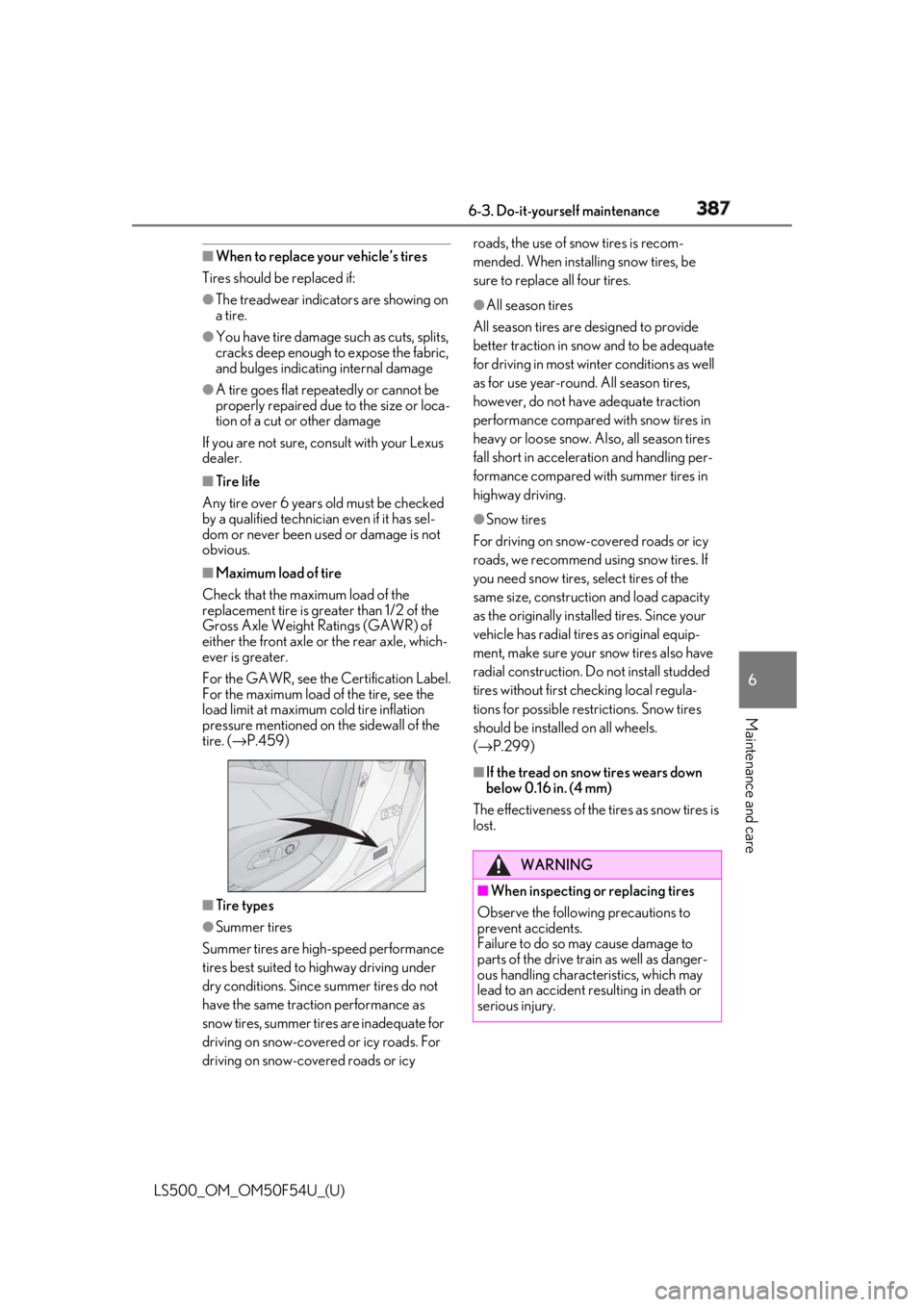
For the GAWR, see the Certification Label.
For the maximum load of the tire, see the
load limit at maximum cold tire inflation
pressure mentioned on the sidewall of the
tire. ( → P.459)
■
Tire types
●
Summer tires
Summer tires are high-speed performance
tires best suited to highway driving under
dry conditions. Since summer tires do not
have the same traction performance as
snow tires, summer tires are inadequate for
driving on snow-covered or icy roads. For
driving on snow-covered roads or icy roads, the use of snow tires is recom-
mended. When installing snow tires, be
sure to replace all four tires. ●
All season tires
All season tires are designed to provide
better traction in snow and to be adequate
for driving in most winter conditions as well
as for use year-round. All season tires,
however, do not have adequate traction
performance compared with snow tires in
heavy or loose snow. Also, all season tires
fall short in accelerati on and handling per-
formance compared with summer tires in
highway driving. ●
Snow tires
For driving on snow-covered roads or icy
roads, we recommend using snow tires. If
you need snow tires, select tires of the
same size, construction and load capacity
as the originally instal led tires. Since your
vehicle has radial tires as original equip-
ment, make sure your snow tires also have
radial construction. Do not install studded
tires without first checking local regula-
tions for possible restrictions. Snow tires
should be installed on all wheels.
( → P.299) ■
If the tread on snow tires wears down
below 0.16 in. (4 mm)
The effectiveness of the tires as snow tires is
lost.
WARNING
■
When inspecting or replacing tires
Observe the following precautions to
prevent accidents.
Failure to do so may cause damage to
parts of the drive train as well as danger-
ous handling characteristics, which may
lead to an accident resulting in death or
serious injury.
Page 400 of 514
400 6-3. Do-it-yourself maintenance
LS500_OM_OM50F54U_(U) 1 Remove the tire valve cap.
2 Press the tip of the tire pressure
gauge onto the tire valve.
3 Read the pressure using the gauge
gradations.
4 If the tire inflation pressure is not at
the recommended level, adjust the
pressure.
If you add too much air, press the
center of the valve to deflate.
5 After completing the tire inflation
pressure measurem ent and adjust-
ment, apply soapy water to the
valve and check for leakage.
6 Put the tire valve cap back on. ■
Tire inflation pressure check interval
You should check tire inflation pressure
every two weeks, or at least once a month.
Do not forget to check the spare. ■
Effects of incorrect tire inflation pres-
sure
Driving with incorrect ti re inflation pressure
may result in the following: ●
Reduced fuel economy●
Reduced driving comfort and poor han-
dling●
Reduced tire life due to wear●
Reduced safety●
Damage to the drive train
If a tire needs frequent inflating, have it
checked by your Lexus dealer.
■
Instructions for checking tire inflation
pressure
When checking tire inflation pressure,
observe the following:
●
Check only when the tires are cold.
If your vehicle has been parked for at
least 3 hours or has not been driven for
more than 1 mile or 1.5 km, you will get an
accurate cold tire in flation pressure read- ing. ●
Always use a tire pressure gauge.
It is difficult to judge if a tire is properly
inflated based only on its appearance. ●
It is normal for the ti re inflation pressure
to be higher after driving as heat is gen-
erated in the tire. Do not reduce tire infla-
tion pressure after driving. ●
Never exceed the vehicle capacity
weight.
Passengers and luggage weight should
be placed so that the vehicle is balanced.
WARNING■
Proper inflation is critical to save tire
performance
Keep your tires properly inflated.
If the tires are not properly inflated, the
following conditions may occur which
could lead to an accident resulting in
death or serious injury: ●
Excessive wear ●
Uneven wear ●
Poor handling ●
Possibility of blowouts resulting from
overheated tires
●
Air leaking from between tire and
wheel
●
Wheel deformation and/or tire dam-
age
●
Greater possibility of tire damage
while driving (due to road hazards,
expansion joints, sharp edges on the
road, etc.)
NOTICE
■
When inspecting and adjusting tire
inflation pressure
Be sure to put the tire valve caps back on.
If a valve cap is not installed, dirt or mois-
ture may get into the valve and cause an
air leak, resulting in decreased tire infla-
tion pressure.
Page 441 of 514
4417-2. Steps to take in an emergency
LS500_OM_OM50F54U_(U) 7
When trouble arises low speed for an extended period, such
as in heavy traffic.■
When the battery is removed or dis-
charged●
Information stored in the ECU is cleared.
When the battery is depleted, have the
vehicle inspected at your Lexus dealer.●
Some systems may require initialization.
( → P.482)■
When removing the battery terminals
When the battery terminals are removed,
the information stored in the ECU is
cleared. Before removi ng the battery termi-
nals, contact your Lexus dealer. ■
Charging the battery
The electricity stored in the battery will dis-
charge gradually even when the vehicle is
not in use, due to natural discharge and the
draining effects of certain electrical appli-
ances. If the vehicle is left for a long time,
the battery may discharge, and the engine
may be unable to start. (The battery
recharges automatically during driving.) ■
When recharging or replacing the bat-
tery●
In some cases, it may not be possible to
unlock the doors using the smart access
system with push-button start when the
battery is discharged. Use the wireless
remote control or the mechanical key to
lock or unlock the doors.●
The engine may not start on the first
attempt after the battery has recharged
but will start normally after the second
attempt. This is not a malfunction.●
The engine switch mode is memorized by
the vehicle. When the battery is recon-
nected, the system will return to the
mode it was in before the battery was dis-
charged. Before di sconnecting the bat-
tery, turn the engine switch off.
If you are unsure what mode the engine
switch was in befo re the battery dis-
charged, be especially careful when
reconnecting the battery.
■
When replacing the battery
●
Use a Central Degassing type battery
(European Regulations). ●
Use a battery with the same case size as
the previous battery and an epuivalent
20 hour rate capacity (20HR) or greater.
• If the sizes differ, the battery cannot be
properly secured.
• If the 20 hour rate capacity is low, even if
the time period where the vehicle is not
used is a short time, the battery may dis-
charge and the engine may not be able to
start. ●
Use a battery with a handle. If a battery
without a handle is used, removal is more
difficult. ●
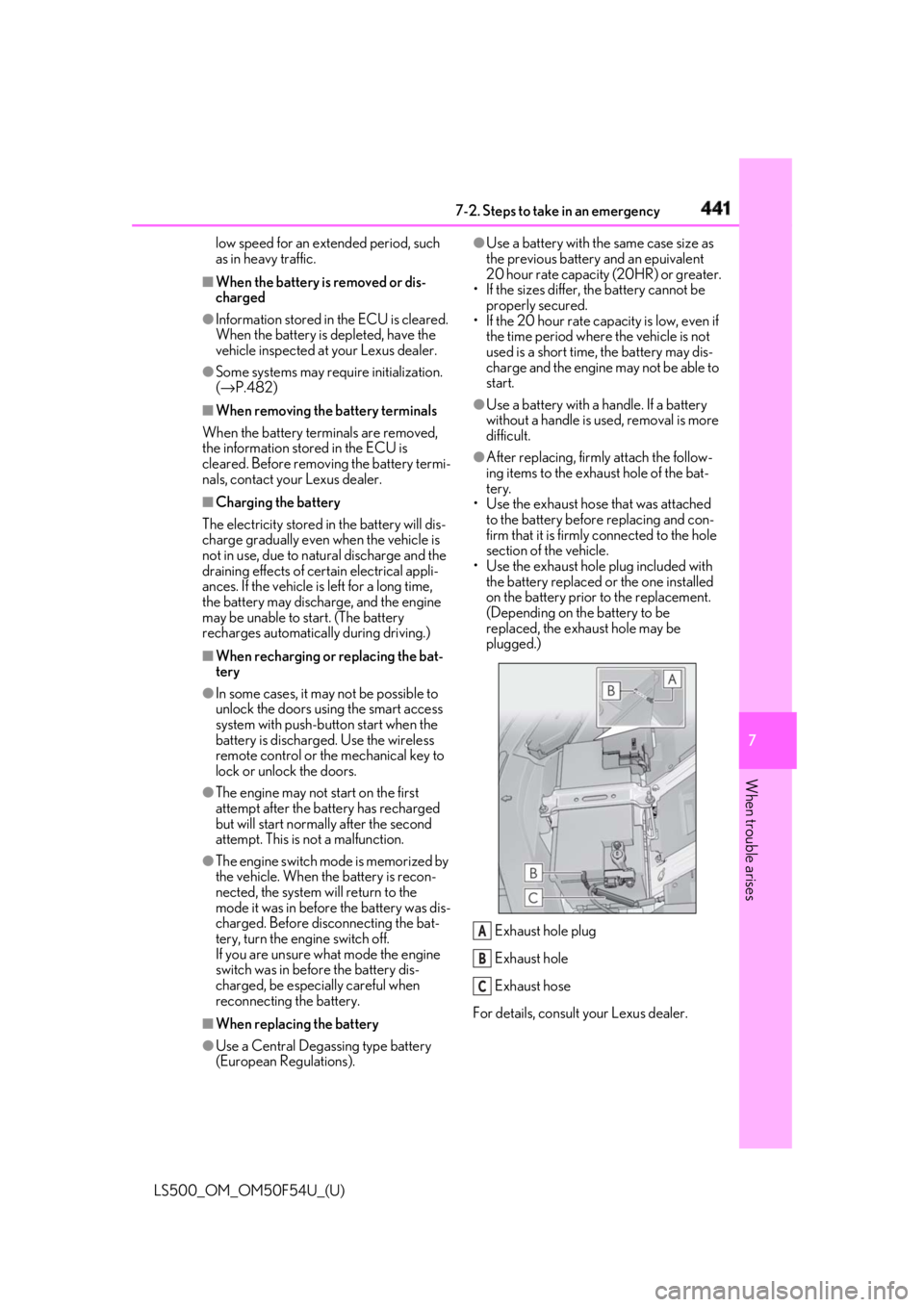
After replacing, firm ly attach the follow-
ing items to the exhaust hole of the bat-
tery.
• Use the exhaust hose that was attached
to the battery before replacing and con-
firm that it is firmly connected to the hole
section of the vehicle.
• Use the exhaust hole plug included with
the battery replaced or the one installed
on the battery prior to the replacement.
(Depending on the battery to be
replaced, the exhaust hole may be
plugged.)
Exhaust hole plug
Exhaust hole
Exhaust hose
For details, consult your Lexus dealer. A
B
C
Page 450 of 514
448 8-1. Specifications
LS500_OM_OM50F54U_(U) 8-1.Specifications
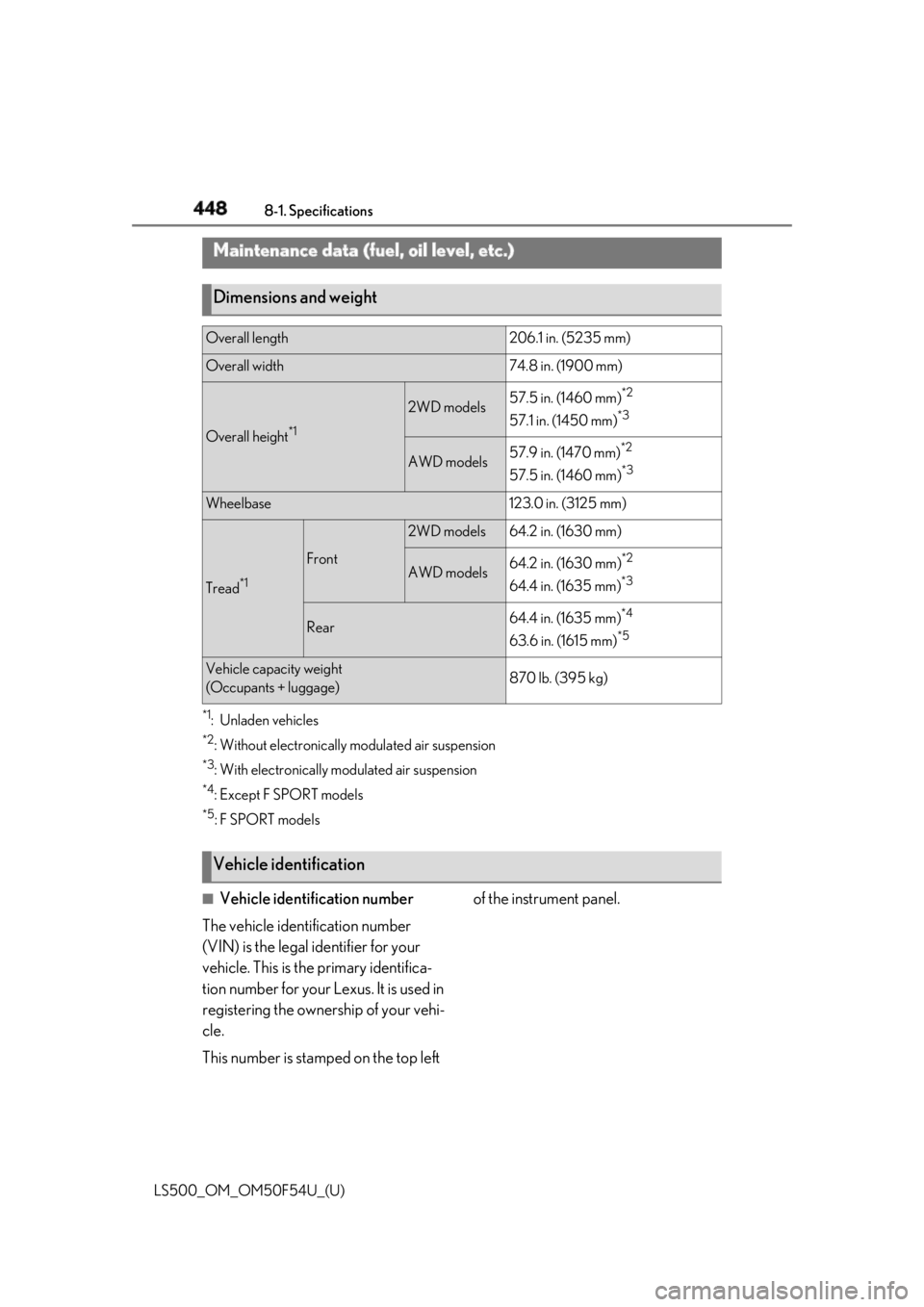
*1
: Unladen vehicles *2
: Without electronically modulated air suspension *3
: With electronically mo dulated air suspension*4
:Except F SPORT models *5
:F SPORT models
■
Vehicle identification number
The vehicle identification number
(VIN) is the legal identifier for your
vehicle. This is the primary identifica-
tion number for your Lexus. It is used in
registering the ownership of your vehi-
cle.
This number is stamped on the top left of the instrument panel.Maintenance data (fue l, oil level, etc.)
Dimensions and weight Overall length 206.1 in. (5235 mm)
Overall width 74.8 in. (1900 mm)
Overall height *1
2WD models 57.5 in. (1460 mm) *2
57.1 in. (1450 mm) *3
AWD models 57.9 in. (1470 mm) *2
57.5 in. (1460 mm) *3
Wheelbase 123.0 in. (3125 mm)
Tread *1
Front 2WD models 64.2 in. (1630 mm)
AWD models 64.2 in. (1630 mm) *2
64.4 in. (1635 mm) *3
Rear 64.4 in. (1635 mm) *4
63.6 in. (1615 mm) *5
Vehicle capacity weight
(Occupants + luggage) 870 lb. (395 kg)
Vehicle identification