towing LEXUS LS500 2018 Owners Manual
[x] Cancel search | Manufacturer: LEXUS, Model Year: 2018, Model line: LS500, Model: LEXUS LS500 2018Pages: 514, PDF Size: 10.62 MB
Page 2 of 514
2
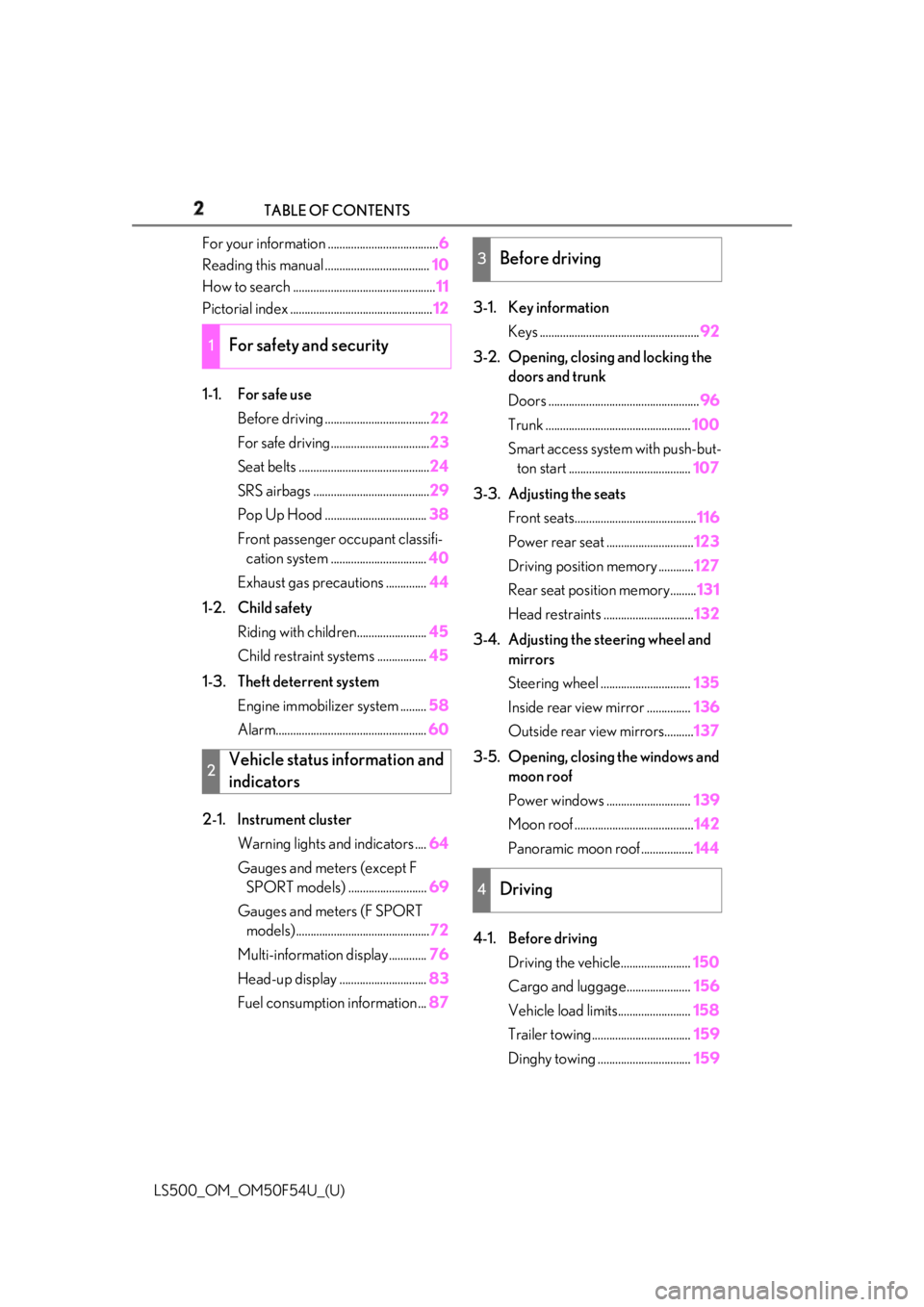
LS500_OM_OM50F54U_(U) TABLE OF CONTENTS
For your information ...................................... 6
Reading this manual .................................... 10
How to search ................................................. 11
Pictorial index ................................................. 12
1-1. For safe use
Before driving .................................... 22
For safe driving.................................. 23
Seat belts ............................................. 24
SRS airbags ........................................ 29
Pop Up Hood ................................... 38
Front passenger occupant classifi-
cation system ................................. 40
Exhaust gas precautions .............. 44
1-2. Child safety
Riding with children........................ 45
Child restraint systems ................. 45
1-3. Theft deterrent system
Engine immobilizer system ......... 58
Alarm.................................................... 60
2-1. Instrument cluster
Warning lights and indicators .... 64
Gauges and meters (except F
SPORT models) ........................... 69
Gauges and meters (F SPORT
models) .............................................. 72
Multi-information display............. 76
Head-up display .............................. 83
Fuel consumption information ... 87 3-1. Key information
Keys ....................................................... 92
3-2. Opening, closing and locking the
doors and trunk
Doors .................................................... 96
Trunk .................................................. 100
Smart access system with push-but-
ton start .......................................... 107
3-3. Adjusting the seats
Front seats.......................................... 116
Power rear seat .............................. 123
Driving position memory ............ 127
Rear seat position memory......... 131
Head restraints ............................... 132
3-4. Adjusting the steering wheel and
mirrors
Steering wheel ............................... 135
Inside rear view mirror ............... 136
Outside rear view mirrors.......... 137
3-5. Opening, closing the windows and
moon roof
Power windows ............................. 139
Moon roof ......................................... 142
Panoramic moon roof .................. 144
4-1. Before driving
Driving the vehicle........................ 150
Cargo and luggage...................... 156
Vehicle load limits......................... 158
Trailer towing.................................. 159
Dinghy towing ................................ 1591
For safety and security
2
Vehicle status information and
indicators 3
Before driving
4
Driving
Page 14 of 514

14 Pictorial index
LS500_OM_OM50F54U_(U) ■ Instrument panel
Engine switch ........................................................................................................... P.160
Starting the engine/changing the modes ......... ....................................................... P.160
Emergency stop of the engine ........................ ............................................................. P.410
When the engine will not start ..................................................................................... P.433
Warning messages .......................................................................................................... P.428
Shift lever................................................................................................................... P .163
Changing the shift position ............................................................................................ P.165
Precautions for towing .....................................................................................................P.41 2
Meters .................................................................................................................. P.69, 7 2
Reading the meters/adjusting the instru ment panel light............ P.69, 71, 72, 75
Warning lights/indicator lights ...................................................................................... P.64
When a warning light turns on ..................................................................................... P.418
Multi-information display ....................................................................................... P.76
Display ........................................................................................................................ .............. P.76
When a warning message is displayed.................................................................... P.428
Parking brake switch ............................................................................................. P.170 A
B
C
D
E
Page 52 of 514
52 1-2. Child safety
LS500_OM_OM50F54U_(U) ■
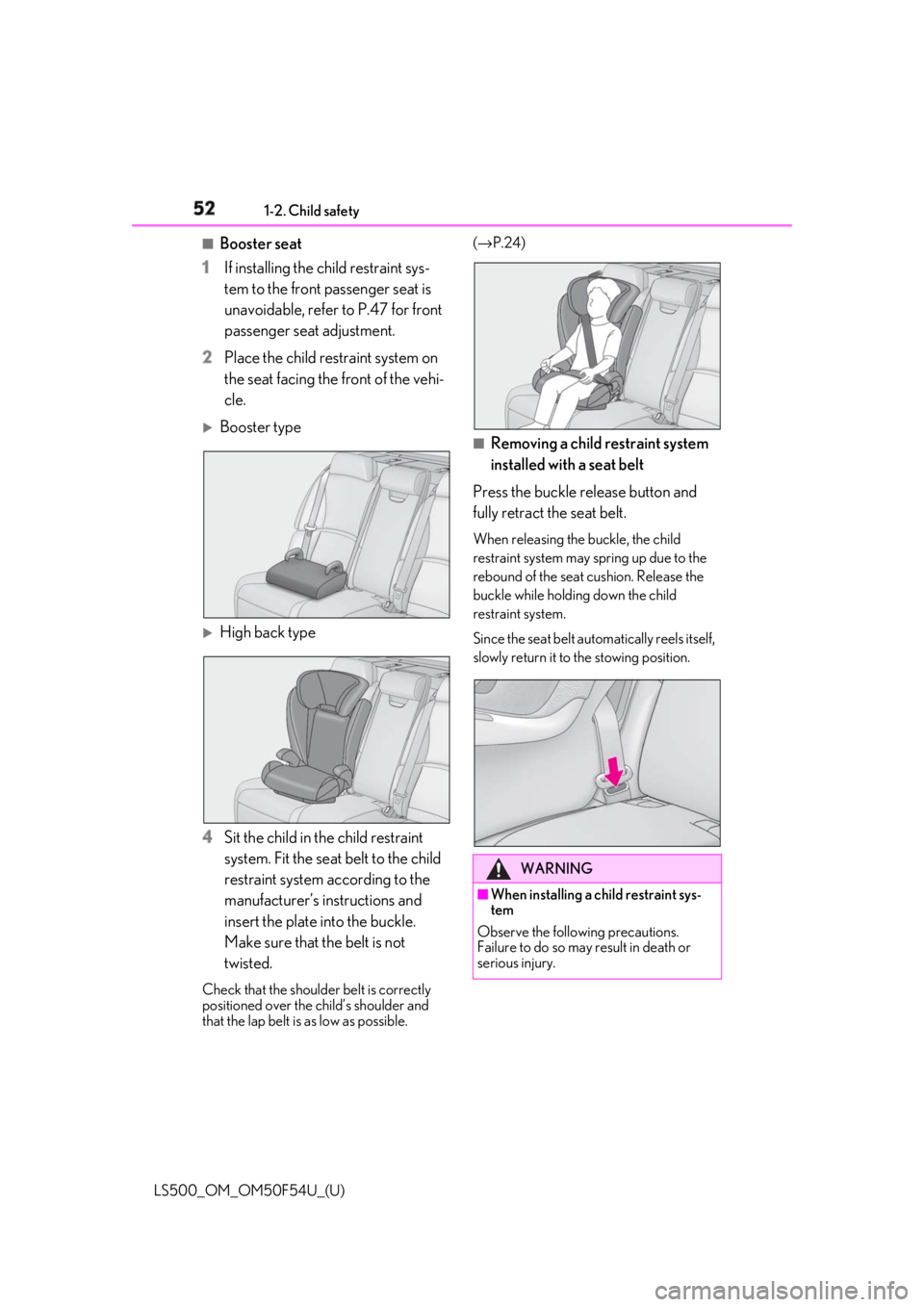
Booster seat
1 If installing the child restraint sys-
tem to the front passenger seat is
unavoidable, refer to P.47 for front
passenger seat adjustment.
2 Place the child restraint system on
the seat facing the front of the vehi-
cle.
Booster type
High back type
4 Sit the child in the child restraint
system. Fit the seat belt to the child
restraint system according to the
manufacturer’s in structions and
insert the plate into the buckle.
Make sure that the belt is not
twisted.Check that the shoulder belt is correctly
positioned over the child’s shoulder and
that the lap belt is as low as possible. ( → P.24)
■
Removing a child restraint system
installed with a seat belt
Press the buckle release button and
fully retract the seat belt. When releasing the buckle, the child
restraint system may sp ring up due to the
rebound of the seat cushion. Release the
buckle while holding down the child
restraint system.
Since the seat belt auto matically reels itself,
slowly return it to the stowing position.
WARNING
■
When installing a child restraint sys-
tem
Observe the following precautions.
Failure to do so may result in death or
serious injury.
Page 138 of 514
138 3-4. Adjusting the steering wheel and mirrors
LS500_OM_OM50F54U_(U) nor “R”.
To set the mirror angle used when the vehi-
cle is reversing, adjust the mirror angle at a
desired position with the shift position in R.
The adjusted angle will be memorized and
the mirror will automatically tilt to the mem-
orized angle whenever the shift position is
shifted to R from next time.
The memorized downward tilt position of
the mirror is linked to the normal position
(angle adjusted with the shift position in
other than R). Therefore, if the normal posi-
tion is changed after adjustment, the tilt
position will also change.
When the normal position is changed, read-
just the angle in reversing.
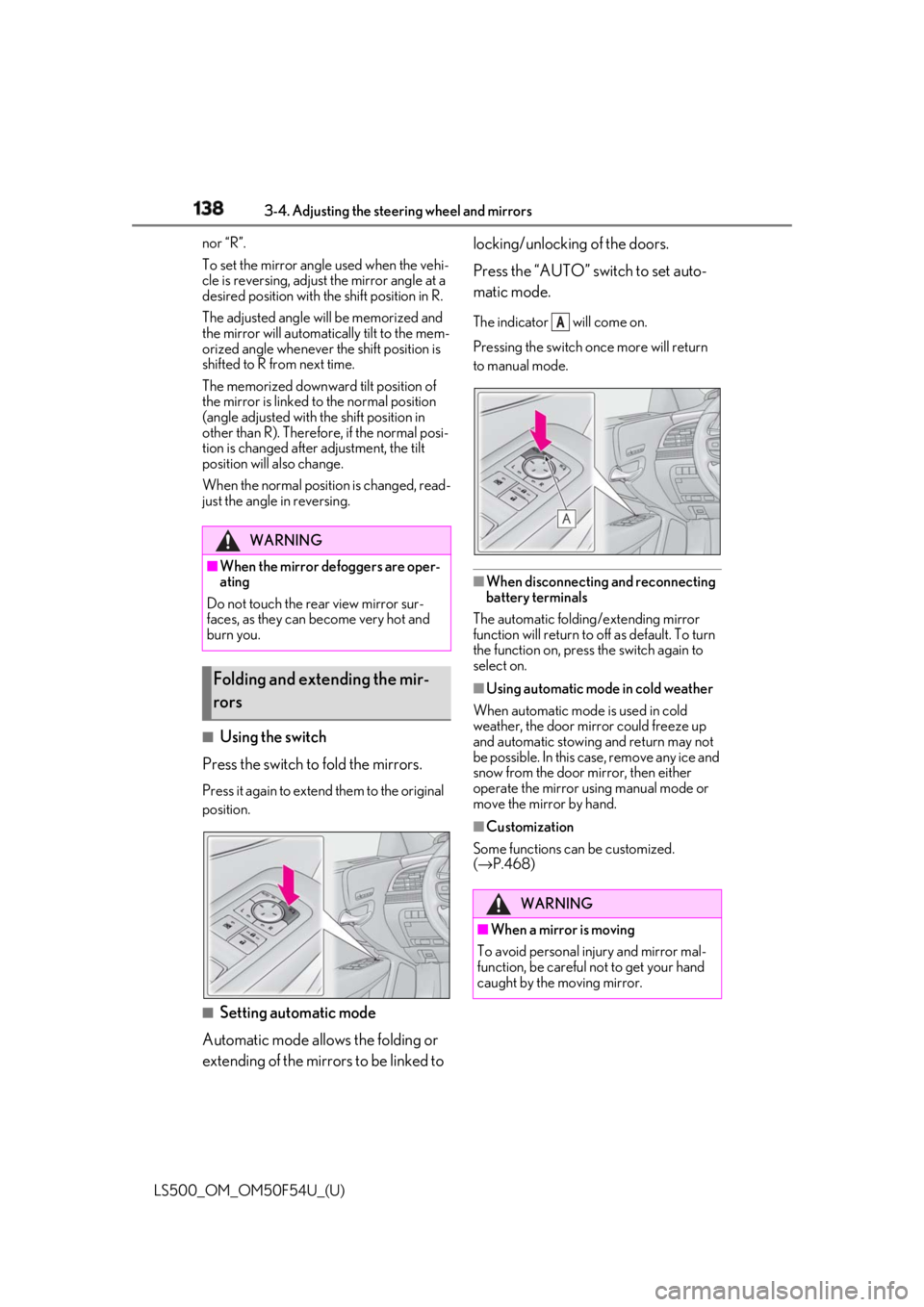
■
Using the switch
Press the switch to fold the mirrors. Press it again to extend them to the original
position.
■
Setting automatic mode
Automatic mode allows the folding or
extending of the mirrors to be linked to locking/unlocking of the doors.
Press the “AUTO” switch to set auto-
matic mode. The indicator will come on.
Pressing the switch on ce more will return
to manual mode.
■
When disconnecting and reconnecting
battery terminals
The automatic folding/extending mirror
function will return to off as default. To turn
the function on, press the switch again to
select on. ■
Using automatic mode in cold weather
When automatic mode is used in cold
weather, the door mirror could freeze up
and automatic stowing and return may not
be possible. In this case, remove any ice and
snow from the door mirror, then either
operate the mirror using manual mode or
move the mirror by hand. ■
Customization
Some functions can be customized.
( → P.468)WARNING■
When the mirror defoggers are oper-
ating
Do not touch the rear view mirror sur-
faces, as they can become very hot and
burn you.
Folding and extending the mir-
rors
WARNING
■
When a mirror is moving
To avoid personal injury and mirror mal-
function, be careful not to get your hand
caught by the moving mirror. A
Page 149 of 514
149
LS500_OM_OM50F54U_(U) 4 4
Driving Driving .
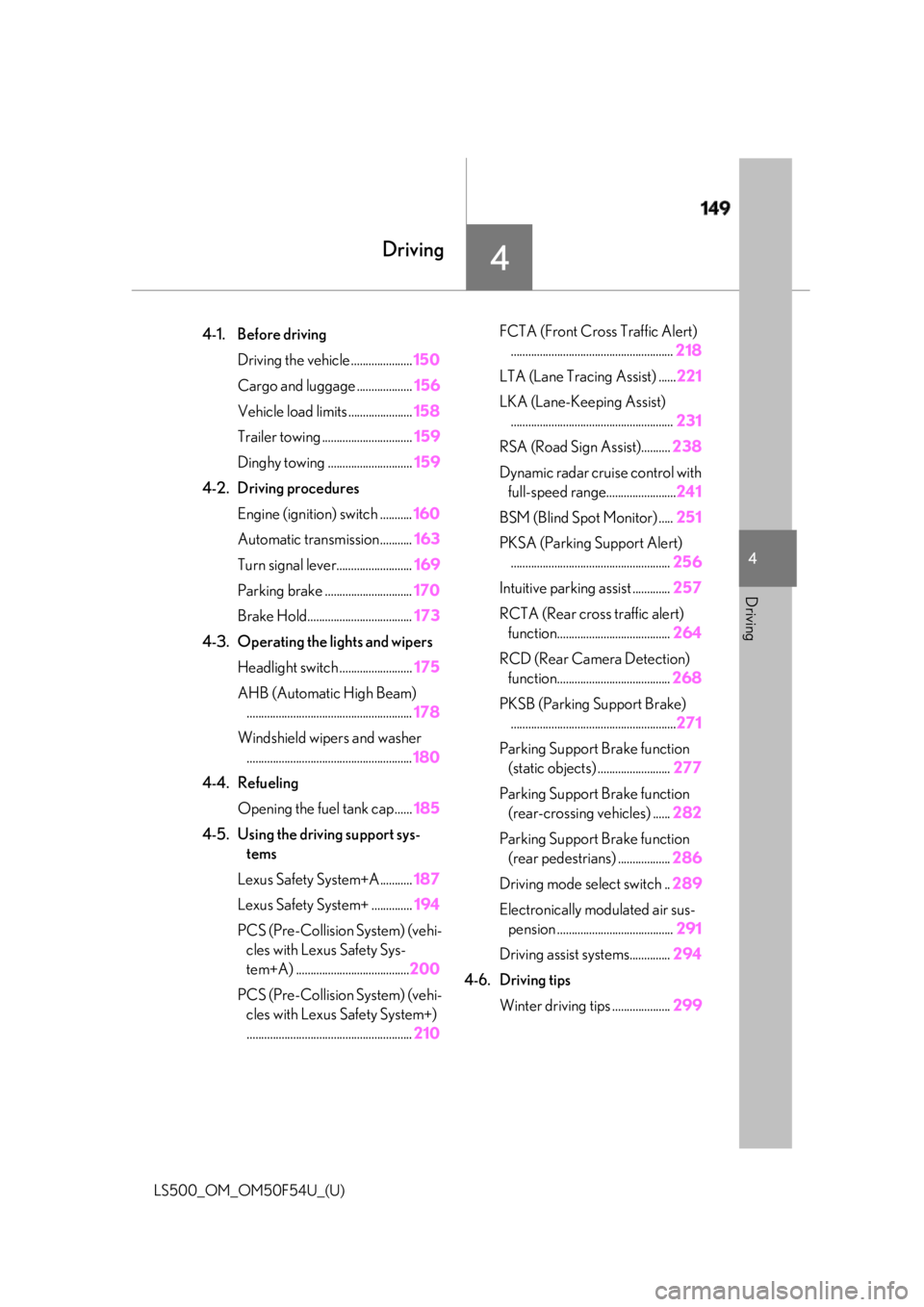
4-1. Before driving
Driving the vehicle ..................... 150
Cargo and luggage ................... 156
Vehicle load limits ...................... 158
Trailer towing ............................... 159
Dinghy towing ............................. 159
4-2. Driving procedures
Engine (ignition) switch ........... 160
Automatic transmission........... 163
Turn signal lever.......................... 169
Parking brake .............................. 170
Brake Hold.................................... 173
4-3. Operating the lights and wipers
Headlight switch ......................... 175
AHB (Automatic High Beam)
......................................................... 178
Windshield wipers and washer
......................................................... 180
4-4. Refueling
Opening the fuel tank cap...... 185
4-5. Using the driving support sys-
tems
Lexus Safety System+A........... 187
Lexus Safety System+ .............. 194
PCS (Pre-Collision System) (vehi-
cles with Lexus Safety Sys-
tem+A) ....................................... 200
PCS (Pre-Collision System) (vehi-
cles with Lexus Safety System+)
......................................................... 210 FCTA (Front Cross Traffic Alert)
........................................................ 218
LTA (Lane Tracing Assist) ...... 221
LKA (Lane-Keeping Assist)
........................................................ 231
RSA (Road Sign Assist).......... 238
Dynamic radar cruise control with
full-speed range........................ 241
BSM (Blind Spot Monitor) ..... 251
PKSA (Parking Support Alert)
....................................................... 256
Intuitive parking assist ............. 257
RCTA (Rear cross traffic alert)
function....................................... 264
RCD (Rear Camera Detection)
function....................................... 268
PKSB (Parking Support Brake)
......................................................... 271
Parking Support Brake function
(static objects) ......................... 277
Parking Support Brake function
(rear-crossing vehicles) ...... 282
Parking Support Brake function
(rear pedestrians) .................. 286
Driving mode select switch .. 289
Electronically modulated air sus-
pension ........................................ 291
Driving assist systems.............. 294
4-6. Driving tips
Winter driving tips .................... 299
Page 157 of 514
1574-1. Before driving
LS500_OM_OM50F54U_(U) 4
Driving gage load capacity calculated in Step
4.
(6) If your vehicle will be towing a
trailer, load from your trailer will be
transferred to your vehicle. Consult
this manual to determine how this
reduces the available cargo and lug-
gage load capacity of your vehicle.
( → P.158)Lexus does not recommend towing a
trailer with your vehicle. Your vehicle is not
designed for trailer towing.
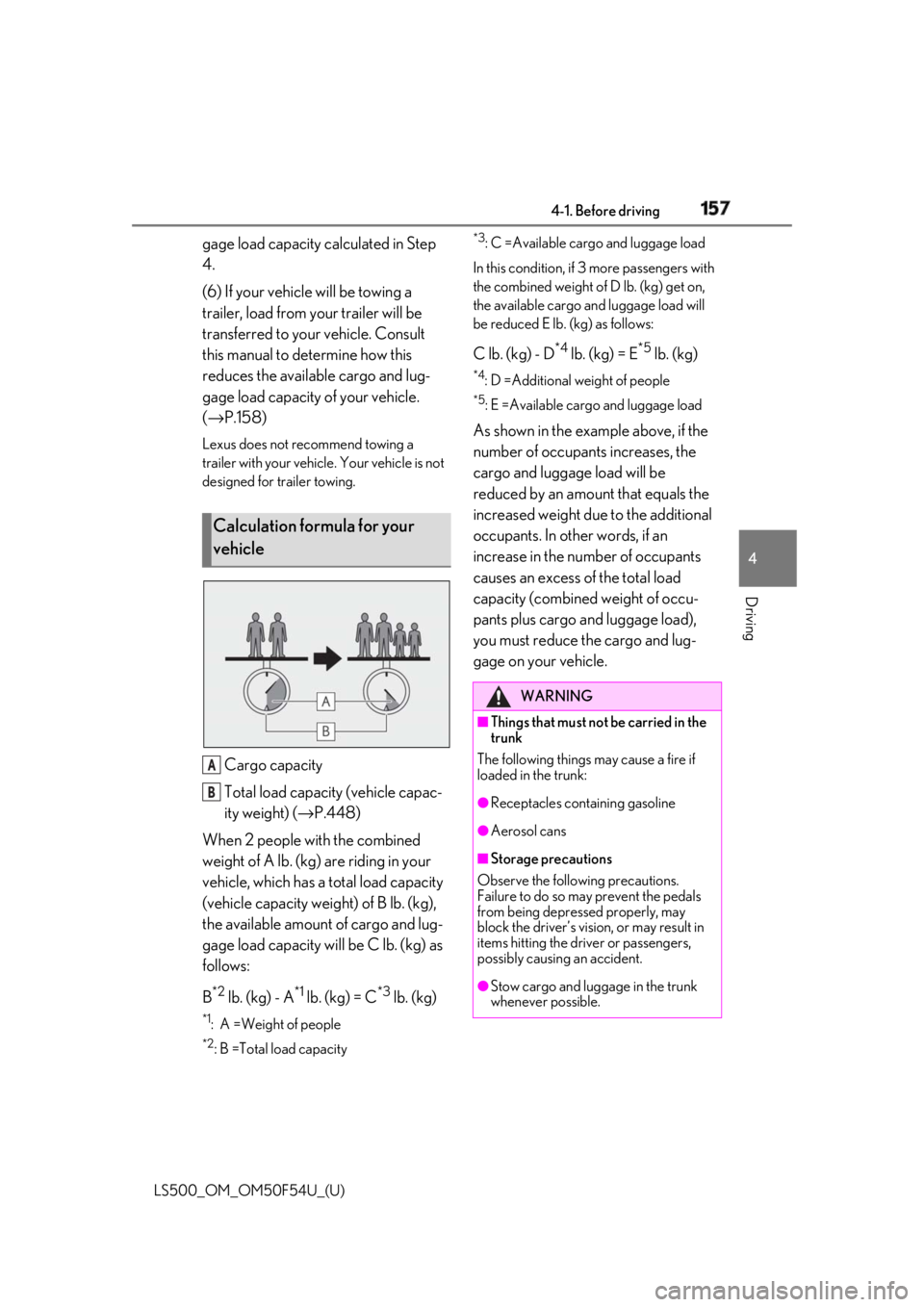
Cargo capacity
Total load capacity (vehicle capac-
ity weight) ( → P.448)
When 2 people with the combined
weight of A lb. (kg) are riding in your
vehicle, which has a total load capacity
(vehicle capacity weight) of B lb. (kg),
the available amount of cargo and lug-
gage load capacity will be C lb. (kg) as
follows:
B *2
lb. (kg) - A *1
lb. (kg) = C *3
lb. (kg)*1
: A =Weight of people *2
: B =Total load capacity *3
: C =Available cargo and luggage load
In this condition, if 3 more passengers with
the combined weight of D lb. (kg) get on,
the available cargo and luggage load will
be reduced E lb. (kg) as follows:
C lb. (kg) - D *4
lb. (kg) = E *5
lb. (kg)*4
: D =Additional weight of people *5
: E =Available cargo and luggage load
As shown in the example above, if the
number of occupant s increases, the
cargo and luggage load will be
reduced by an amount that equals the
increased weight due to the additional
occupants. In other words, if an
increase in the number of occupants
causes an excess of the total load
capacity (combined weight of occu-
pants plus cargo and luggage load),
you must reduce the cargo and lug-
gage on your vehicle.Calculation formula for your
vehicle
A
B WARNING■
Things that must not be carried in the
trunk
The following things may cause a fire if
loaded in the trunk:
●
Receptacles containing gasoline
●
Aerosol cans
■
Storage precautions
Observe the following precautions.
Failure to do so may prevent the pedals
from being depressed properly, may
block the driver’s vision, or may result in
items hitting the driver or passengers,
possibly causing an accident.
●
Stow cargo and luggage in the trunk
whenever possible.
Page 158 of 514
158 4-1. Before driving
LS500_OM_OM50F54U_(U) ■
Total load capacity and seating capacity
These details are also described on the tire
and loading information label. ( → P.399)WARNING●
Do not place cargo or luggage in or on
the following locations.
• At the feet of the driver
• On the front passenger or rear seats
(when stacking items)
• On the package tray
• On the instrument panel
•On the dashboard
• In front of the Center Display ●
Secure all items in the occupant com-
partment.■
Capacity and distribution●
Do not exceed the maximum axle
weight rating or the total vehicle
weight rating.●
Even if the total load of occupant’s
weight and the cargo load is less than
the total load capacity, do not apply the
load unevenly. Improper loading may
cause deterioration of steering or
braking control which may cause
death or serious injury. Vehicle load limits Vehicle load limits include total
load capacity, seating capacity,
towing capacity and cargo capac-
ity.
Total load capacity (vehicle
capacity weight): → P.448Total load capacity means the combined
weight of occupants, cargo and lug-
gage.
Seating capacity:5 occupants
(Front 2, Rear 3) Seating capacity means the maximum
number of occupants whose estimated
average weight is 150 lb. (68 kg) per
person.
Towing capacity Lexus does not recommend towing a
trailer with your vehicle.
Cargo capacity Cargo capacity may increase or
decrease depending on the weight and
the number of occupants.
WARNING
■
Overloading the vehicle
Do not overload the vehicle.
It may not only cause damage to the tires,
but also degrade steering and braking
ability, resulting in an accident.
Page 159 of 514
1594-1. Before driving
LS500_OM_OM50F54U_(U) 4
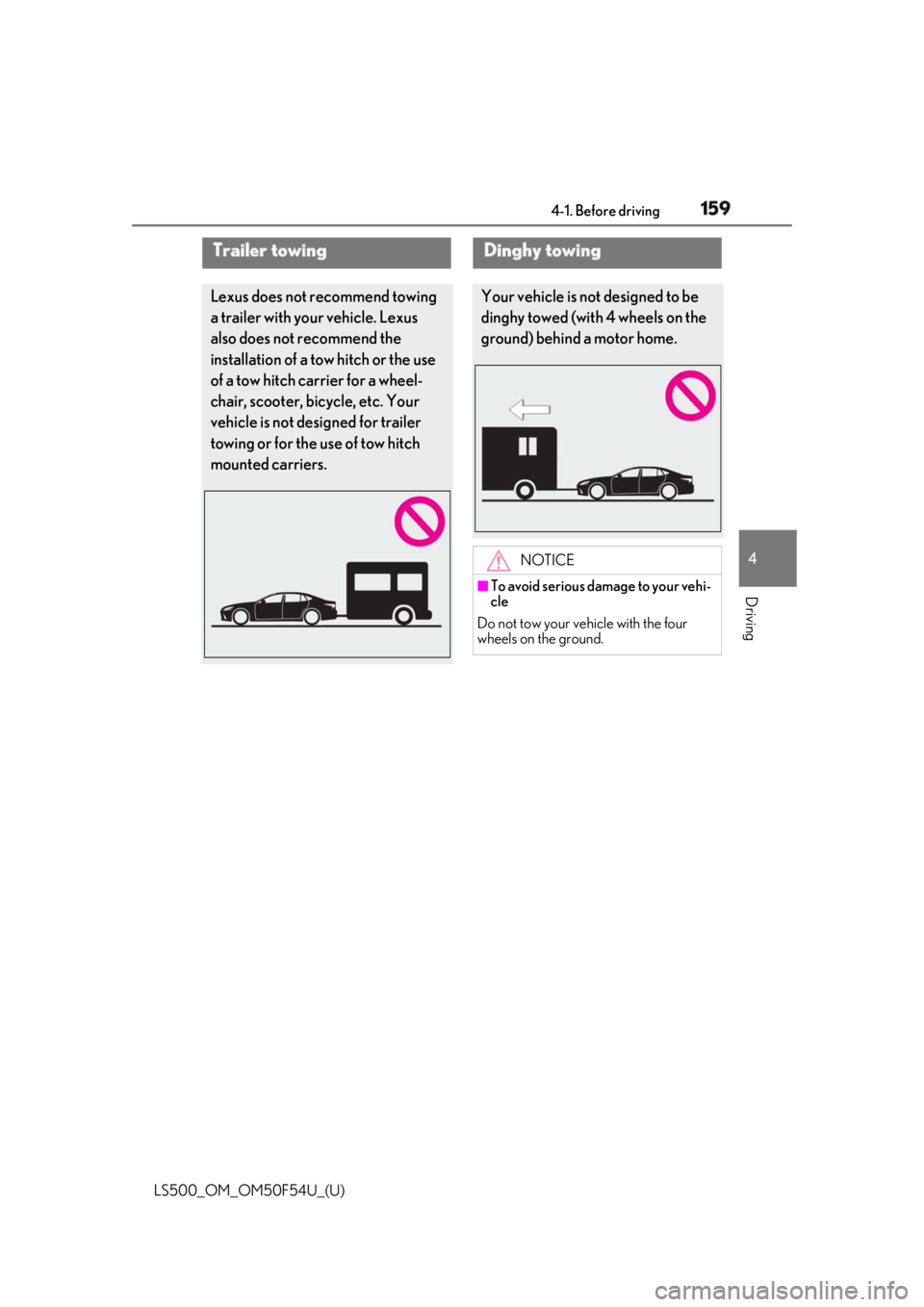
Driving Trailer towing Lexus does not recommend towing
a trailer with your vehicle. Lexus
also does not recommend the
installation of a tow hitch or the use
of a tow hitch carrier for a wheel-
chair, scooter, bicycle, etc. Your
vehicle is not desi gned for trailer
towing or for the use of tow hitch
mounted carriers. Dinghy towing Your vehicle is not designed to be
dinghy towed (with 4 wheels on the
ground) behind a motor home.
NOTICE■
To avoid serious damage to your vehi-
cle
Do not tow your vehicle with the four
wheels on the ground.
Page 203 of 514
2034-5. Using the driving support systems
LS500_OM_OM50F54U_(U) 4
Driving ■
Enabling/disabling the pre-colli-
sion system
The pre-collision system can be
enabled/disabled on ( → P.76) of
the multi-information display. The system is automa tically enabled each
time the engine switch is turned to IGNI-
TION ON mode
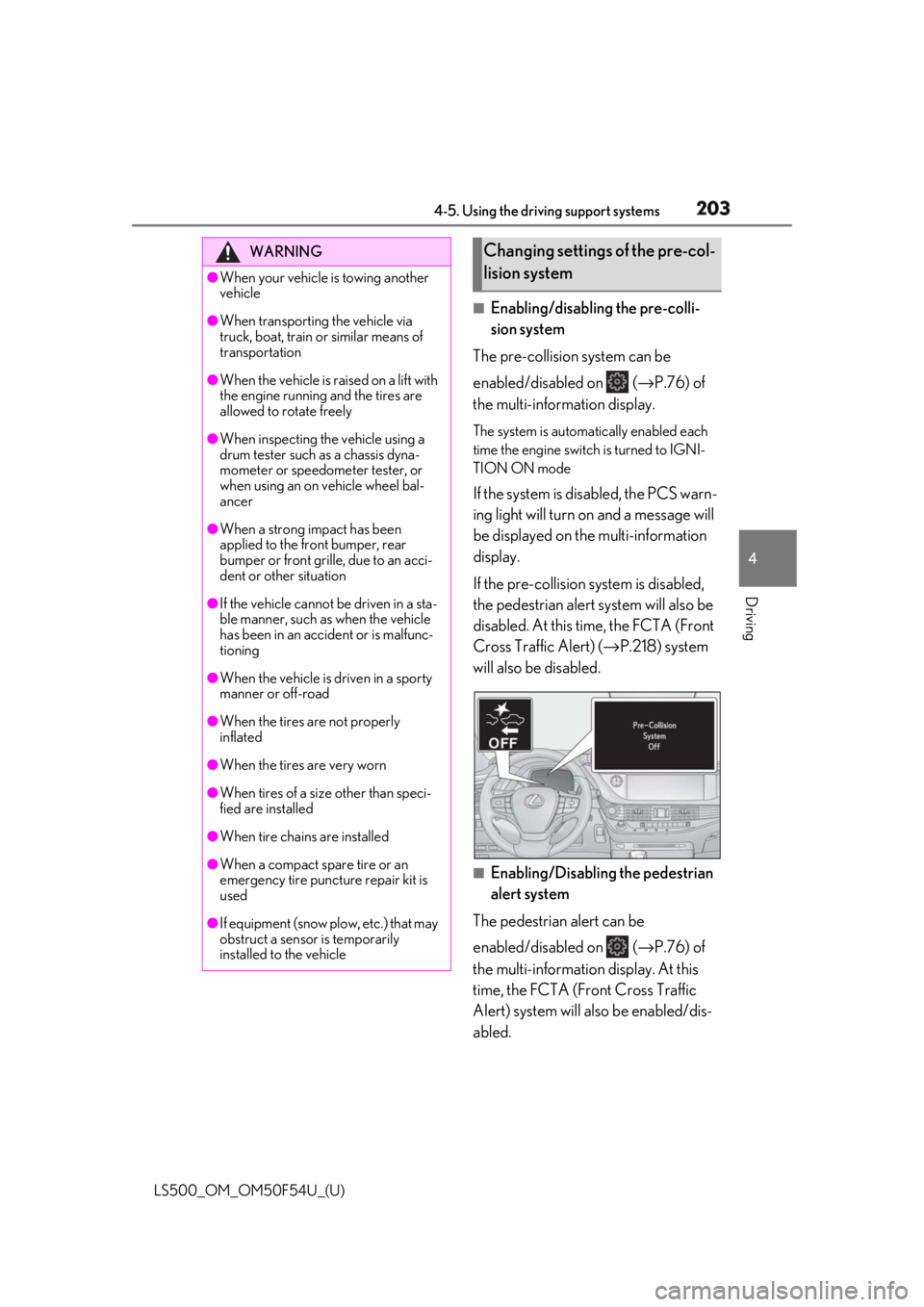
If the system is disabled, the PCS warn-
ing light will turn on and a message will
be displayed on the multi-information
display.
If the pre-collision sy stem is disabled,
the pedestrian alert system will also be
disabled. At this time, the FCTA (Front
Cross Traffic Alert) ( → P.218) system
will also be disabled.
■
Enabling/Disabling the pedestrian
alert system
The pedestrian alert can be
enabled/disabled on ( → P.76) of
the multi-information display. At this
time, the FCTA (Front Cross Traffic
Alert) system will also be enabled/dis-
abled.WARNING●
When your vehicle is towing another
vehicle●
When transporting the vehicle via
truck, boat, train or similar means of
transportation●
When the vehicle is raised on a lift with
the engine running and the tires are
allowed to rotate freely●
When inspecting the vehicle using a
drum tester such as a chassis dyna-
mometer or speedometer tester, or
when using an on vehicle wheel bal-
ancer●
When a strong impact has been
applied to the front bumper, rear
bumper or front grille, due to an acci-
dent or other situation●
If the vehicle cannot be driven in a sta-
ble manner, such as when the vehicle
has been in an accident or is malfunc-
tioning●
When the vehicle is driven in a sporty
manner or off-road●
When the tires are not properly
inflated
●
When the tires are very worn
●
When tires of a size other than speci-
fied are installed
●
When tire chains are installed
●
When a compact spare tire or an
emergency tire puncture repair kit is
used
●
If equipment (snow plow, etc.) that may
obstruct a sensor is temporarily
installed to the vehicle Changing settings of the pre-col-
lision system
Page 212 of 514
212 4-5. Using the driving support systems
LS500_OM_OM50F54U_(U) WARNING■
Limitations of the pre-collision system●
The driver is solely responsible for safe
driving. Always drive safely, taking
care to observe your surroundings.
Do not use the pre-collision system
instead of normal braking operations
under any circumstances. This system
will not prevent collisions or lessen col-
lision damage or injury in every situa-
tion. Do not overly rely on this system.
Failure to do so may lead to an acci-
dent, resulting in death or serious
injury.●
Although this system is designed to
help avoid a collision or help reduce
the impact of the coll ision, its effective-
ness may change according to various
conditions, therefore the system may
not always be able to achieve the same
level of performance.
Read the following conditions care-
fully. Do not overly rely on this system
and always drive carefully.
• Conditions under which the system
may operate even if there is no possi-
bility of a collision: → P.214
• Conditions under which the system
may not operate properly: → P.216
●
Do not attempt to test the operation of
the pre-collision system yourself, as the
system may not operate properly, pos-
sibly leading to an accident.
■
Pre-collision braking●
When the pre-collision braking func-
tion is operating, a large amount of
braking force will be applied.
●
If the vehicle is stopped by the opera-
tion of the pre-collision braking func-
tion, the pre-collision braking function
operation will be canceled after
approximately 2 seco nds. Depress the
brake pedal as necessary. ●
The pre-collision braking function may
not operate if certain operations are
performed by the driver. If the acceler-
ator pedal is being depressed strongly
or the steering wheel is being turned,
the system may determine that the
driver is taking evasive action and pos-
sibly prevent the pre-collision braking
function from operating. ●
In some situations, while the pre-colli-
sion braking function is operating,
operation of the function may be can-
celed if the accelerator pedal is
depressed strongly or the steering
wheel is turned and the system deter-
mines that the driver is taking evasive
action. ●
If the brake pedal is being depressed,
the system may determine that the
driver is taking evasive action and pos-
sibly delay the operat ion timing of the
pre-collision braking function. ■
When to disable the pre-collision sys-
tem
In the following situations, disable the
system, as it may not operate properly,
possibly leading to an accident resulting
in death or serious injury: ●
When the vehicle is being towed
●
When your vehicle is towing another
vehicle
●
When transporting the vehicle via
truck, boat, train or similar means of
transportation
●
When the vehicle is raised on a lift with
the engine running and the tires are
allowed to rotate freely
●
When inspecting the vehicle using a
drum tester such as a chassis dyna-
mometer or speedometer tester, or
when using an on vehicle wheel bal-
ancer
●
When a strong impact is applied to the
front bumper or front grille, due to an
accident or other reasons