tire LEXUS LS500 2021 Owners Manual
[x] Cancel search | Manufacturer: LEXUS, Model Year: 2021, Model line: LS500, Model: LEXUS LS500 2021Pages: 520, PDF Size: 9.81 MB
Page 1 of 520
LS500_U
1
2
3
4
5
6
7
8
9
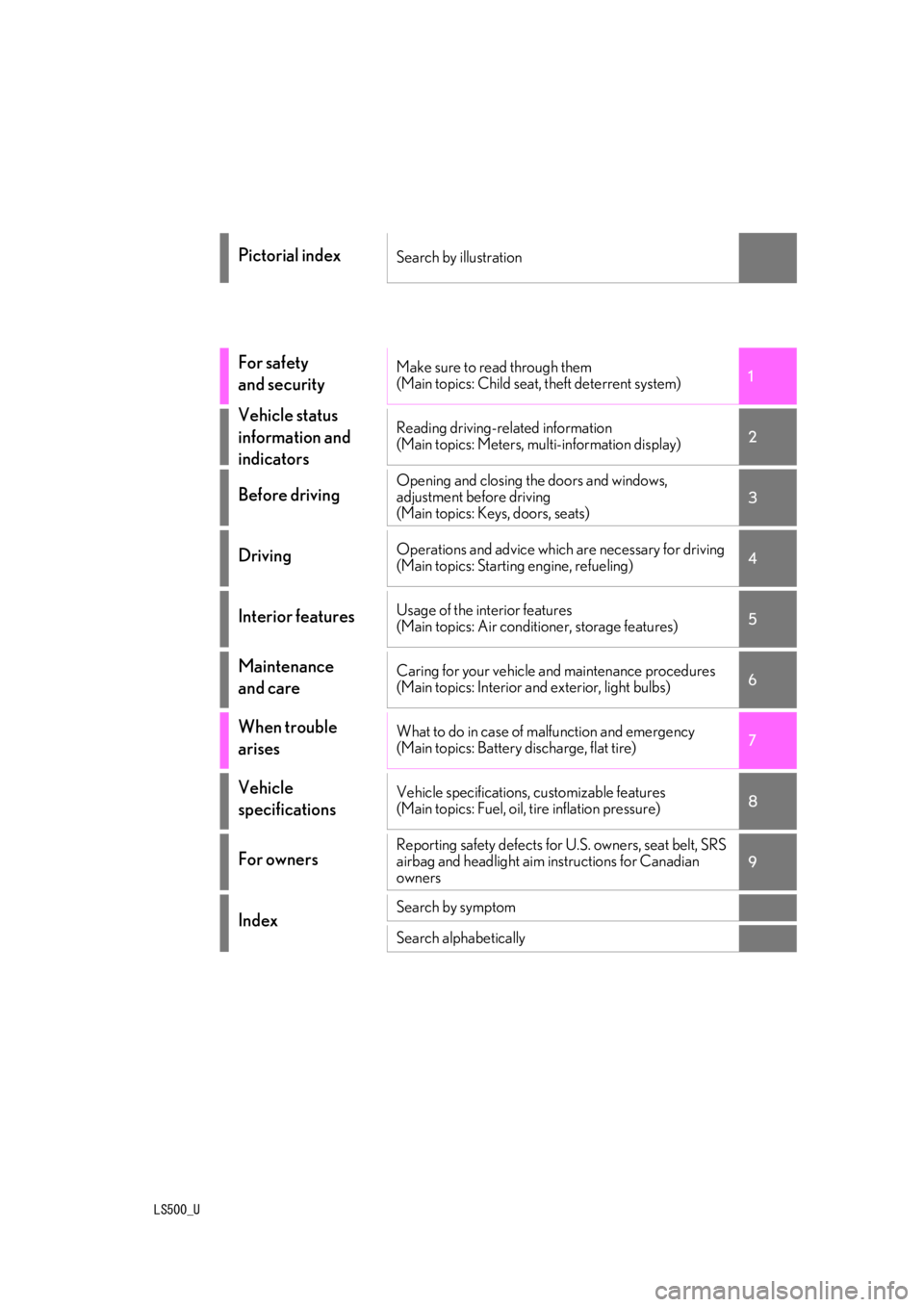
Pictorial indexSearch by illustration
For safety
and securityMake sure to read through them
(Main topics: Child seat, theft deterrent system)
Vehicle status
information and
indicatorsReading driving-related information
(Main topics: Meters, multi-information display)
Before drivingOpening and closing the doors and windows,
adjustment before driving
(Main topics: Keys, doors, seats)
DrivingOperations and advice which are necessary for driving
(Main topics: Starting engine, refueling)
Interior featuresUsage of the interior features
(Main topics: Air conditioner, storage features)
Maintenance
and careCaring for your vehicle and maintenance procedures
(Main topics: Interior and exterior, light bulbs)
When trouble
arisesWhat to do in case of malfunction and emergency
(Main topics: Battery discharge, flat tire)
Vehicle
specificationsVehicle specifications, customizable features
(Main topics: Fuel, oil, tire inflation pressure)
For ownersReporting safety defects for U.S. owners, seat belt, SRS
airbag and headlight aim in structions for Canadian
owners
IndexSearch by symptom
Search alphabetically
Page 4 of 520
4TABLE OF CONTENTS
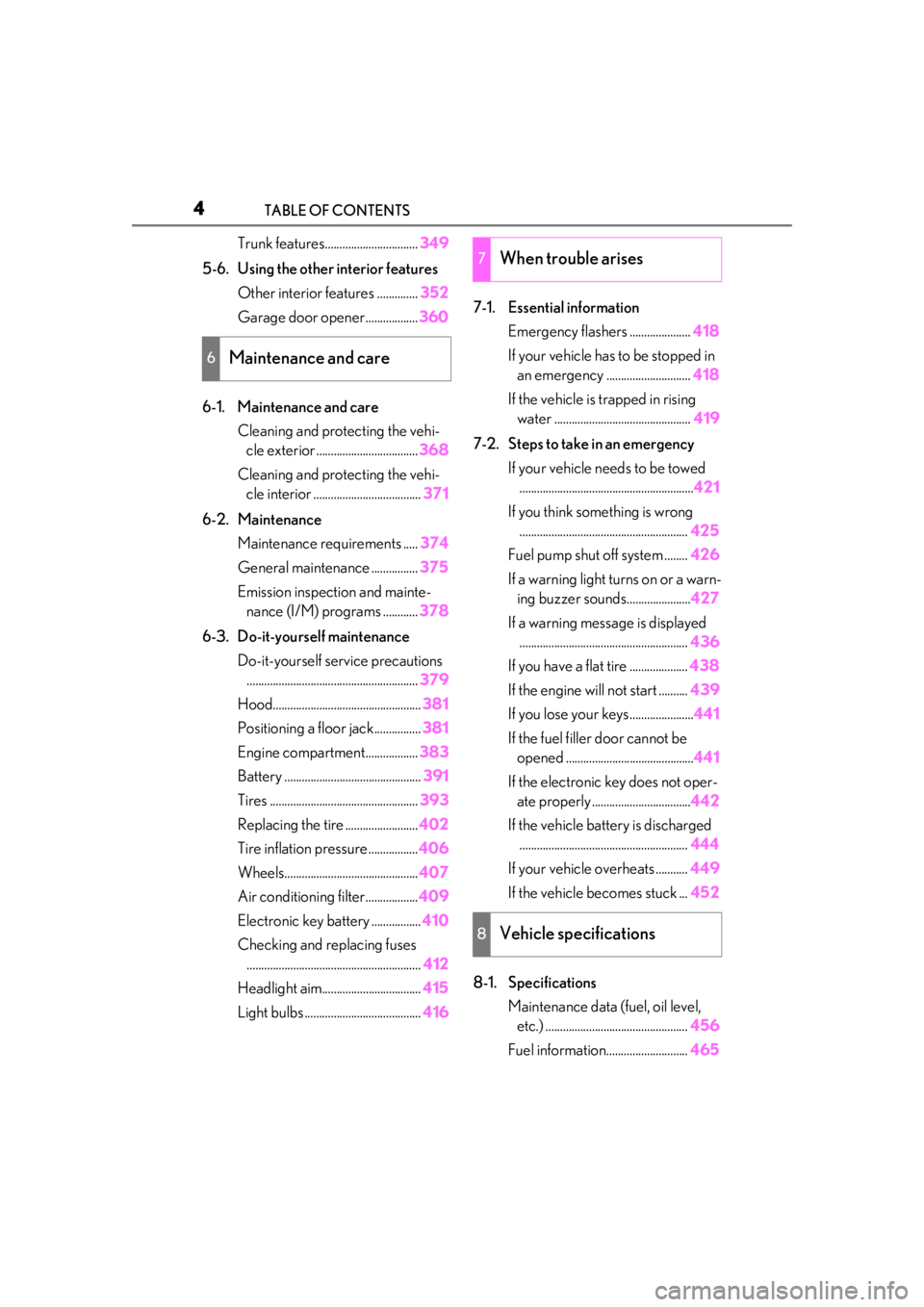
Trunk features................................349
5-6. Using the other interior features Other interior features .............. 352
Garage door opener.................. 360
6-1. Maintenance and care Cleaning and protecting the vehi-cle exterior ................................... 368
Cleaning and protecting the vehi- cle interior ..................................... 371
6-2. Maintenance Maintenance requirements ..... 374
General maintenance ................ 375
Emission inspection and mainte- nance (I/M) programs ............ 378
6-3. Do-it-yourself maintenance Do-it-yourself service precautions........................................................... 379
Hood................................................... 381
Positioning a floor jack................ 381
Engine compartment.................. 383
Battery ............................................... 391
Tires ................................................... 393
Replacing the tire ......................... 402
Tire inflation pressure ................. 406
Wheels.............................................. 407
Air conditioning filter..................409
Electronic key battery ................. 410
Checking and replacing fuses ............................................................ 412
Headlight aim.................................. 415
Light bulbs ........................................ 4167-1. Essential information
Emergency flashers ..................... 418
If your vehicle has to be stopped in an emergency ............................. 418
If the vehicle is trapped in rising water ............................................... 419
7-2. Steps to take in an emergency If your vehicle needs to be towed............................................................ 421
If you think something is wrong .......................................................... 425
Fuel pump shut off system ........ 426
If a warning light turns on or a warn- ing buzzer sounds...................... 427
If a warning messa ge is displayed
.......................................................... 436
If you have a flat tire .................... 438
If the engine will not start .......... 439
If you lose your keys...................... 441
If the fuel filler door cannot be opened ............................................ 441
If the electronic key does not oper- ate properly .................................. 442
If the vehicle battery is discharged .......................................................... 444
If your vehicle overheats ........... 449
If the vehicle becomes stuck ... 452
8-1. Specifications Maintenance data (fuel, oil level, etc.) ................................................. 456
Fuel information .
........................... 465
6Maintenance and care
7When trouble arises
8Vehicle specifications
Page 5 of 520

5TABLE OF CONTENTS
1
2
3
4
5
6
7
8
9
Tire information.............................467
8-2. Customization Customizable features............... 476
8-3. Initialization Items to initialize ........................... 490
9-1. For owners Reporting safety defects for U.S. owners ........................................... 492
Seat belt instructions for Canadian owners (in French).................... 492
SRS airbag instructions for Cana- dian owners (in French).......... 494
Headlight aim instructions for Canadian owners (in French)
........................................................... 500
What to do if... (Troubleshooting) ........................................................... 504
Alphabetical Index....................... 507
9For owners
Index
Page 9 of 520
9
your Lexus dealer before you scrap
your vehicle.
Special handling may apply, See
www.dtsc.ca.gov/hazard-
ouswaste/perchlorate.
Your vehicle has components that may
contain perchlorate. These compo-
nents may include the airbags, seat belt
pretensioners, Pop Up Hood system,
wireless remote control batteries, and
the batteries in the tire pressure warn-
ing valve and transmitters.
Perchlorate Material
WARNING
■General precautions while driving
Driving under the infl uence: Never drive
your vehicle when un der the influence of
alcohol or drugs that have impaired your
ability to operate your vehicle. Alcohol
and certain drugs delay reaction time,
impair judgment and reduce coordina-
tion, which could lead to an accident that
could result in death or serious injury.
Defensive driving: Always drive defen-
sively. Anticipate mistakes that other
drivers or pedestrians might make and
be ready to avoid accidents.
Driver distraction: Always give your full
attention to driving. Anything that dis-
tracts the driver, such as adjusting con-
trols, talking on a cellular phone or
reading can result in a collision with
resulting death or serious injury to you,
your occupants or others.
■General precaution regarding chil-
dren’s safety
Never leave children unattended in the
vehicle, and never allow children to have
or use the key.
Children may be able to start the vehicle
or shift the vehicle into neutral. There is
also a danger that children may injure
themselves by playing with the windows,
the moon roof, or other features of the
vehicle. In addition, heat build-up or
extremely cold temperatures inside the
vehicle can be fatal to children.
Page 13 of 520
13Pictorial index
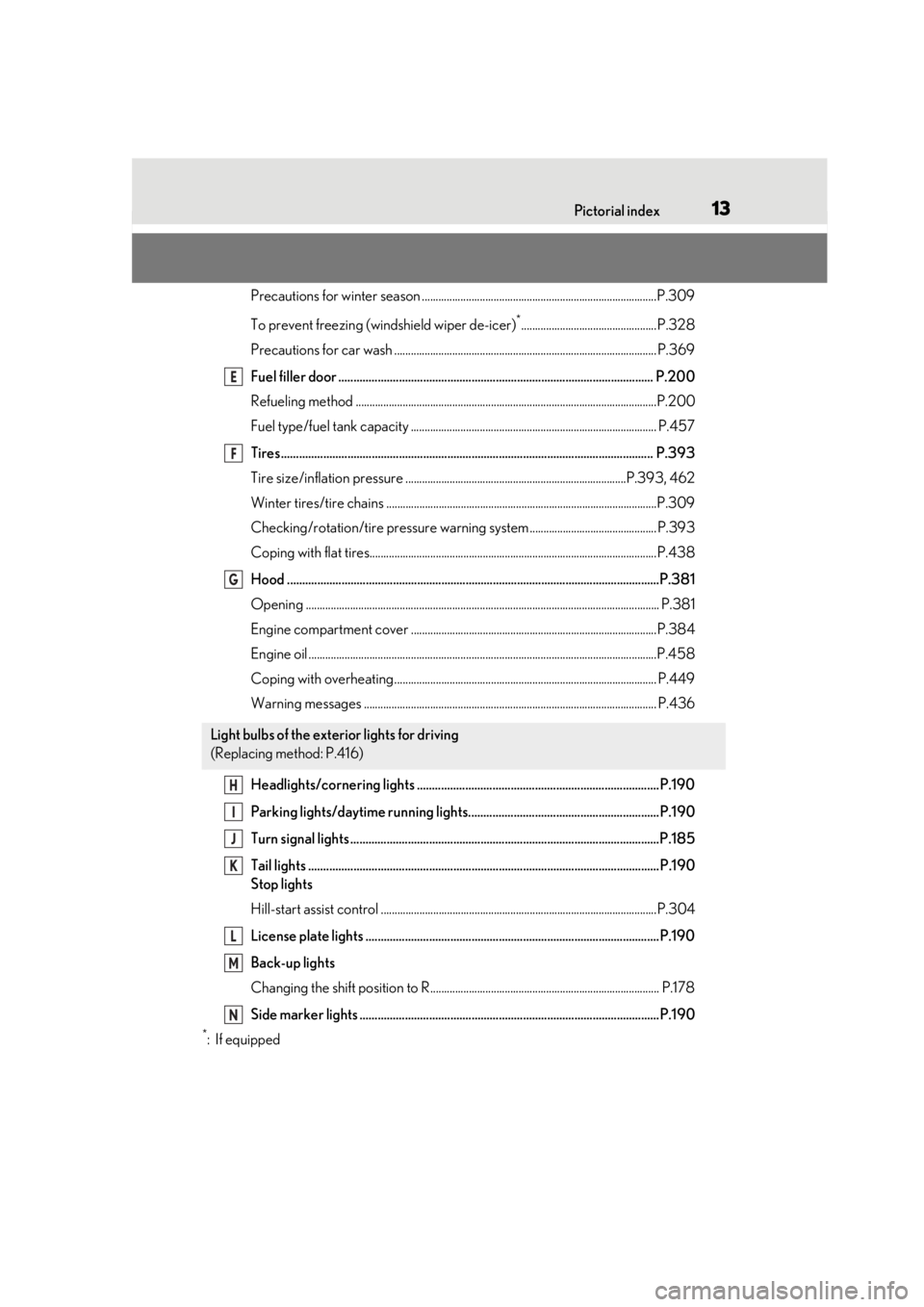
Precautions for winter season .....................................................................................P.309
To prevent freezing (windshield wiper de-icer)
*.................................................P.328
Precautions for car wash ............................................................................................... P.369
Fuel filler door ........................................................................................................ P.200
Refueling method .............................................................................................................P. 200
Fuel type/fuel tank capacity ...... ................................................................................... P.457
Tires.......................................................................................................................... .P.393
Tire size/inflation pressure ......................... .......................................................P.393, 462
Winter tires/tire chains ..................................................................................................P.309
Checking/rotation/tire pressure warning system.............................................. P.393
Coping with flat tires........................................................................................................P .438
Hood ........................................................................................................................... P.381
Opening ........................................................................................................................ ........ P.381
Engine compartment cover .........................................................................................P.384
Engine oil ..................................................................................................................... .........P.458
Coping with overheating ............................................................................................... P.449
Warning messages .......................................................................................................... P.436
Headlights/cornering lights ................................................................................P.190
Parking lights/daytime running lights...............................................................P.190
Turn signal lights ......................................................................................................P.185
Tail lights .................................................................................................................... P.190
Stop lights
Hill-start assist control ....................................................................................................P. 304
License plate lights .................................................................................................P.190
Back-up lights
Changing the shift position to R................................................................................... P.178
Side marker lights ...................................................................................................P.190
*:If equipped
Light bulbs of the exterior lights for driving
(Replacing method: P.416)
E
F
G
H
I
J
K
L
M
N
Page 23 of 520

231-1. For safe use
1
For safety and security
Adjust the angle of the seatback so
that you are sitting straight up and
so that you do not have to lean for-
ward to steer. (P.121)
Adjust the seat so that you can
depress the pedals fully and so that
your arms bend slightly at the
elbow when gripping the steering
wheel. ( P.121)
Lock the head restraint in place
with the center of the head restraint
closest to the top of your ears.
( P.138)
Wear the seat belt correctly.
( P.24) Make sure that all occupants are wear-
ing their seat belts before driving the
vehicle. (
P.24)
Use a child restraint system appropri-
ate for the child until the child becomes
large enough to properly wear the
vehicle’s seat belt. ( P.45)
Make sure that you can see backward
clearly by adjusting the inside and out-
side rear view mirrors properly.
( P.142, 143, 151)
For safe driving
For safe driving, adjust the seat and
mirror to an appropriate position
before driving.
Correct driving posture
WARNING
■For safe driving
Observe the following precautions.
Failure to do so may result in death or
serious injury.
A
B
C
D
●Do not adjust the position of the
driver’s seat while driving.
Doing so could cause the driver to lose
control of the vehicle.
●Do not place a cushion between the
driver or passenger and the seatback.
A cushion may prevent correct pos-
ture from being achieved, and reduce
the effectiveness of the seat belt and
head restraint.
●Do not place anything under the front
seats.
Objects placed under the front seats
may become jammed in the seat
tracks and stop the seat from locking in
place. This may lead to an accident
and the adjustment mechanism may
also be damaged.
●Always observe the legal speed limit
when driving on public roads.
●When driving over long distances, take
regular breaks before you start to feel
tired.
Also, if you feel tired or sleepy while
driving, do not force yourself to con-
tinue driving and take a break immedi-
ately.
Correct use of the seat belts
Adjusting the mirrors
Page 38 of 520
381-1. For safe use
■PCS-linked Pop Up Hood operation
control
If the PCS (Pre-Collision System) deter-
mines that the possibility of a collision with a
pedestrian or bicyclist is high, the Pop Up
Hood will be prepared to operate.
■Pop Up Hood operational conditions
The Pop Up Hood will operate when the
vehicle detects an impact such as the fol-
lowing:
●The front bumper detects a frontal impact
equivalent to or grea ter than that of a
pedestrian while the vehicle being driven
within the operational speed range of
approximately 16 to 34 mph (25 to 55
km/h). (The system is operated by an
impact of threshold le vel or greater, even
in the case of a minor collision that may
not leave a trace on the front bumper.
Also, depending on the impact condi-
tions or vehicle speed, the system may
operate by a collision with a light or small
object or a small animal.)
●In other situations, such as the following
the system may operate when an impact
is applied to the lowe r part of the vehicle
or front bumper:
• Colliding with a curb
• Falling into a deep hole
•Landing hard
• Hitting the slope of a parking lot, an undulating road, a protruding object or
falling object
■Conditions under which the Pop Up
Hood may not operate properly
●If a pedestrian collides with the right or
left corner of the front bumper or the side
of the vehicle. As such impacts may be
difficult to detect, the system may not
operate.
●If the vehicle speed is not detected cor-
rectly, such as if the vehicle is sliding side-
ways, the system may not operate
properly.
■Conditions under which the Pop Up
Hood will not operate
The Pop Up Hood will not operate in the
following situations:
●Colliding with a lying person
●A frontal impact applied to the front
bumper while driving at speeds outside
of the operational speed range
●A side impact or rear impact
●A vehicle rollover (In some accident situ-
ations, the Pop Up Hood may operate.)
WARNING
■When the Pop Up Hood is operated
●Do not pull the hood lock release lever.
Doing so after the Pop Up Hood has
operated will further raise the hood
and may cause an injury. Do not drive
with the hood raised, as doing so may
block the driver’s vision, possibly caus-
ing an accident.
●Do not forcibly push down the hood.
As the popped up hood cannot be
lowered by hand, doing so may deform
the hood or cause an injury.
●If the Pop Up Hood has operated, have
it replaced by your Lexus dealer. If the
Pop Up Hood has operated, stop the
vehicle in a safe place and contact
your Lexus dealer.
●Do not touch the lifters immediately
after the Pop Up Hood has operated,
as the lifters may be hot and burn you.
NOTICE
■Pop Up Hood precautions
●Make sure to close the hood before
driving, as the system may not operate
properly if the hood is not fully closed.
●Make sure that all 4 tires are of the
specified size and inflated to the speci-
fied tire pressure. If tires of a different
size are used, the system may not
operate properly.
●If something has hit the area around
the front bumper, the sensors may be
damaged even if the Pop Up Hood has
not operated. Have the vehicle
inspected by your Lexus dealer.
Page 62 of 520

621-3. Lexus Enform
location.
■Stolen Vehicle Location
If your vehicle is stolen, Safety Connect
can work with local authorities to assist
them in locating and recovering the
vehicle. After filing a police report, call
the Safety Connect response center at
1-800-25-LEXUS
(1-800-255-3987) in the United
States, 1-877-539-8777 in Puerto
Rico or 1-800-265- 3987 in Canada,
and follow the prompts for Safety Con-
nect to initiate this service.
In addition to assisting law enforce-
ment with recovery of a stolen vehicle,
Safety-Connect-equipped vehicle
location data may, under certain cir-
cumstances, be shared with third par-
ties to locate your vehicle. Further
information is available at Lexus.com.
■Emergency Assistance Button
(“SOS”)
In the event of an emergency on the
road, push the “SOS” button to reach
the Safety Connect response center.
The answering agent will determine
your vehicle’s location, assess the
emergency, and dispatch the neces-
sary assistance required.
If you accidentally press the “SOS” button,
tell the response-center agent that you are
not experiencing an emergency.
■Enhanced Roadside Assistance
Enhanced Roadside Assistance adds
GPS data to the already included war-
ranty-based Lexus roadside service.
Subscribers can press the “SOS” but-
ton to reach a Safety Connect response-center agent, who can help
with a wide range of needs, such as:
towing, flat tire, fuel delivery, etc. For a
description of the Roadside Assistance
services and their limitations, please
see the Safety Connect Terms and
Conditions, which are available at
Lexus.com.
Important! Read this information about
exposure to radio frequency signals
before using Safety Connect;
The Safety Connect system installed in
your vehicle is a low-power radio trans-
mitter and receiver. It receives and also
sends out radio frequency (RF) signals.
In August 1996, the Federal Commu-
nications Commission (FCC) adopted
RF exposure guidelines with safety lev-
els for mobile wireless phones. Those
guidelines are consistent with the
safety standards previously set by the
following U.S. and international stan-
dards bodies.
ANSI (American National Stan-
dards Institute) C95.1 [1992]
NCRP (National Council on Radia-
tion Protection and Measurement)
Report 86 [1986]
ICNIRP (International Commission
on Non-Ionizing Radiation Protec-
tion) [1996]
Those standards were based on com-
prehensive and periodic evaluations of
the relevant scientific literature. Over
Safety information for Safety
Connect
Page 71 of 520

712-1. Instrument cluster
2
Vehicle status information and indicators
Warning lights inform the driver of mal-
functions in the indicated vehicle’s sys-
tems.
*1: These lights come on when the engine switch is turned to IGNITION ON
mode to indicate that a system check is
Warning lights
(U.S.A.)
Brake system warning light*1
( P.427)
(red)
(Canada)
Brake system warning light*1
( P.427)
(yellow)
Brake system warning light*1
( P.427)
High coolant temperature
warning light
*2 ( P.427)
Charging system warning
light
*2 ( P.428)
Low engine oil pressure warn-
ing light
*2 ( P.428)
(U.S.A.)
Malfunction indicator lamp*1
( P.428)
(Canada)
Malfunction indicator lamp*1
( P.428)
SRS warning light
*1 ( P.428)
Pop Up Hood warning light
*1
( P.429)
(U.S.A.)
ABS warning light*1 ( P.429)
(Canada)
ABS warning light*1 ( P.429)
Inappropriate pedal operation
warning light
*2 ( P.429)
(red)
Electric power steering system
warning light
*1 ( P.430)
(yellow)
Electric power st eering system
warning light
*1 ( P.430)
Low fuel level warning light
( P.430)
Driver’s and front passenger’s
seat belt re minder light
( P.430)
Rear passengers’ seat
belt reminder lights
(except F SPORT mod-
els) ( P.431)
Rear passengers’ seat belt
reminder lights (F SPORT mod-
els) ( P.431)
Tire pressure warning light
*1
( P.431)
(orange)
LTA indicator ( P.431)
(flashes)
RCD OFF indicator (if
equipped) ( P.432)
(flashes or
illuminates)PCS warning light*1 ( P.432)
Slip indicator
*1 ( P.432)
(flashes)
(U.S.A.)
Parking brake indicator
( P.433)
(flashes)
(Canada)
Parking brake indicator
( P.433)
(flashes)
Brake hold operated indicator*1
( P.433)
Page 84 of 520
842-1. Instrument cluster
/ : Select menu icons
/ : Change displayed con-
tent, scroll up/down the screen and
move the cursor up/down
Press: Enter/Set
Press and hold: Reset
Move the main meter
* and return
to the previous screen
Call sending/receiving and history
display
Linked with the hands-free system, sending
or receiving call is displayed. For details
regarding the hands-fr ee system, refer to
the “NAVIGATION AND MULTIMEDIA
SYSTEM OWNER’S MANUAL”.
*:F SPORT models
■Display items (except F SPORT
models)
Press or of the meter control
switch and select . Then press
or to display the following items:
Drive information 1
Drive information 2
Eco Driving Indicator
Boost gauge
Tire pressure ( P.395)
Display off
■Display items (F SPORT models)
Main meter in center position
Press or of the meter control
switch to display the following items:
Drive information 1
Drive information 2
Tire pressure ( P.395)
Gear positions
Units
Display off
Driving support system information
*
( P.87)
*: Can be selected when a driving support
system is enabled. ( P.238, 254)
Main meter moved to the right
Press or of the meter control
switch and select . Then press
or to display the following items:
Drive information 1
Drive information 2
Eco Driving Indicator
Boost gauge
G-force
Gear Position
Tire pressure ( P.395)
Display off
■Drive information 1/Drive infor-
mation 2
Displays drive information such as the
following:
Use the displayed values as a reference
only.
Drive information 1
• Current fuel consumption
• Average fuel economy (after reset)
Drive information 2
Content of driving information
A
B
C
D