warning light LEXUS LS500 2021 Owners Manual
[x] Cancel search | Manufacturer: LEXUS, Model Year: 2021, Model line: LS500, Model: LEXUS LS500 2021Pages: 520, PDF Size: 9.81 MB
Page 435 of 520
4357-2. Steps to take in an emergency
7
When trouble arises
WARNING
■If a blowout or sudden air leakage
should occur
The tire pressure warning system may
not activate immediately.
■Maintenance of the tires
Each tire, including the spare (if pro-
vided), should be checked monthly when
cold and inflated to the inflation pressure
recommended by the vehicle manufac-
turer on the vehicle placard or tire infla-
tion pressure label (tire and load
information label). (I f your vehicle has
tires of a different size than the size indi-
cated on the vehicle placard or tire infla-
tion pressure label [tire and load
information label], yo u should determine
the proper tire infl ation pressure for
those tires.)
As an added safety feature, your vehicle
has been equipped with a tire pressure
monitoring system (TPMS-tire pressure
warning system) that illuminates a low
tire pressure telltale (tire pressure warn-
ing light) when one or more of your tires
is significantly under-inflated. Accord-
ingly, when the low tire pressure telltale
(tire pressure warnin g light) illuminates,
you should stop and check your tires as
soon as possible, and inflate them to the
proper pressure. Driving on a signifi-
cantly under-inflated tire causes the tire
to overheat and can lead to tire failure.
Under-inflation also reduces fuel effi-
ciency and tire tread life, and may affect
the vehicle’s handling and stopping abil-
ity.
Please note that the TPMS (tire pressure
warning system) is not a substitute for
proper tire maintenance, and it is the
driver’s responsibility to maintain correct
tire pressure, even if under-inflation has
not reached the level to trigger illumina-
tion of the TPMS low tire pressure telltale
(tire pressure warning light).
Your vehicle has also been equipped with
a TPMS (tire pressure warning system)
malfunction indicator to indicate when
the system is not operating properly. The
TPMS (tire pressure warning system)
malfunction indicator is combined with
the low tire pressure telltale (tire pres-
sure warning light) . When the system
detects a malfunction, the telltale will
flash for approximately one minute and
then remain continuously illuminated.
This sequence will continue upon subse-
quent vehicle start-ups as long as the
malfunction exists. When the malfunction
indicator is illuminated, the system may
not be able to detect or signal low tire
pressure as intended.
TPMS (tire pressure warning system)
malfunctions may occur for a variety of
reasons, including the installation of
replacement or alternate tires or wheels
on the vehicle that prevent the TPMS
(tire pressure warning system) from func-
tioning properly. Always check the
TPMS (tire pressure warning system)
malfunction telltale after replacing one
or more tires or wheels on your vehicle to
ensure that the replacement or alternate
tires and wheels allow the TPMS (tire
pressure warning system) to continue to
function properly.
NOTICE
■To ensure the tire pressure warning
system operates properly
Do not install tires with different specifi-
cations or makers, as the tire pressure
warning system may not operate prop-
erly.
Page 436 of 520
4367-2. Steps to take in an emergency
■Warning messages
The warning messages explained below
may differ from the actual messages
according to operation conditions and vehi-
cle specifications.
■Warning buzzer
In some cases, the bu zzer may not be heard
due to being in a noisy location or audio
sound.
■If “Engine Oil Level Low Add or
Replace” is displayed
The engine oil level is low. Check the level
of the engine oil, and add if necessary.
This message may appear if the vehicle is
stopped on a slope. Move the vehicle to a
level surface and check to see if the mes-
sage disappears.
■If “Engine Stoppe d Steering Power
Low” is displayed
This message is displa yed if the engine is stopped while driving.
When steering wheel operations are
heavier than usual, gr
ip the steering wheel
firmly and operate it using more force than
usual.
■If “Auto Power Off to Conserve Battery”
is displayed
Power was turned off due to the automatic
power off function. Next time when starting
the engine, increase the engine speed
slightly and maintain that level for approxi-
mately 5 minutes to recharge the battery.
■If “Headlight System Malfunction Visit
Your Dealer” is displayed
The following systems may be malfunction-
ing. Have the vehicle inspected by your
Lexus dealer immediately.
●The LED headlight system
●AFS (Adaptive Front-lighting System)
●The automatic headlight leveling system
●AHB (Automatic High Beam)
■If “Radar Cruise Control Unavailable
See Owner's Manual” is displayed
The dynamic radar cruise control with
full-speed range system is suspended tem-
porarily or until the problem shown in the
message is re solved. (causes and coping
methods: P.207, 213)
■If “Radar Cruise Control Unavailable” is
displayed
The dynamic radar cruise control with
full-speed range system cannot be used
temporarily. Use the system when it
becomes available again.
■If a message that indicates the malfunc-
tion of front camera is displayed
The following systems may be suspended
until the problem shown in the message is
resolved. ( P.207, 213, 432)
●PCS (Pre-Collision system)
●LTA (Lane Tracing Assist)
●Dynamic radar cruise control with
full-speed range
●RSA (Road Sign Assist) (if equipped)
●AHB (Automatic High Beam)
If a warning message is dis-
played
The multi-information display
shows warnings for system malfunc-
tions and incorrectly performed
operations, and messages that indi-
cate a need for maintenance.
When a message is displayed, per-
form the appropriate corrective
action for the message.
If a warning message is displayed
again after the appropriate actions
have been performed, contact your
Lexus dealer.
Additionally, if a warning light
comes on or flashes at the same
time that a warning message is dis-
played, take the appropriate cor-
rective action for the warning light.
( P.427)
Page 438 of 520
4387-2. Steps to take in an emergency
Take your vehicle to the nearest Lexus
dealer or authorized tire dealer as
soon as possible if any tire goes flat.
For XXX/XXRXX size tires
The vehicle can be driven for a maximum
of 50 miles (80 km) at a speed below 50
mph (80 km/h) after the tire pressure
warning light comes on. (P.431)
For XXX/XXRFXX size tires
The vehicle can be driven for a maximum
of 100 miles (160 km) at a speed below 50
mph (80 km/h) after the tire pressure
warning light comes on. ( P.431)
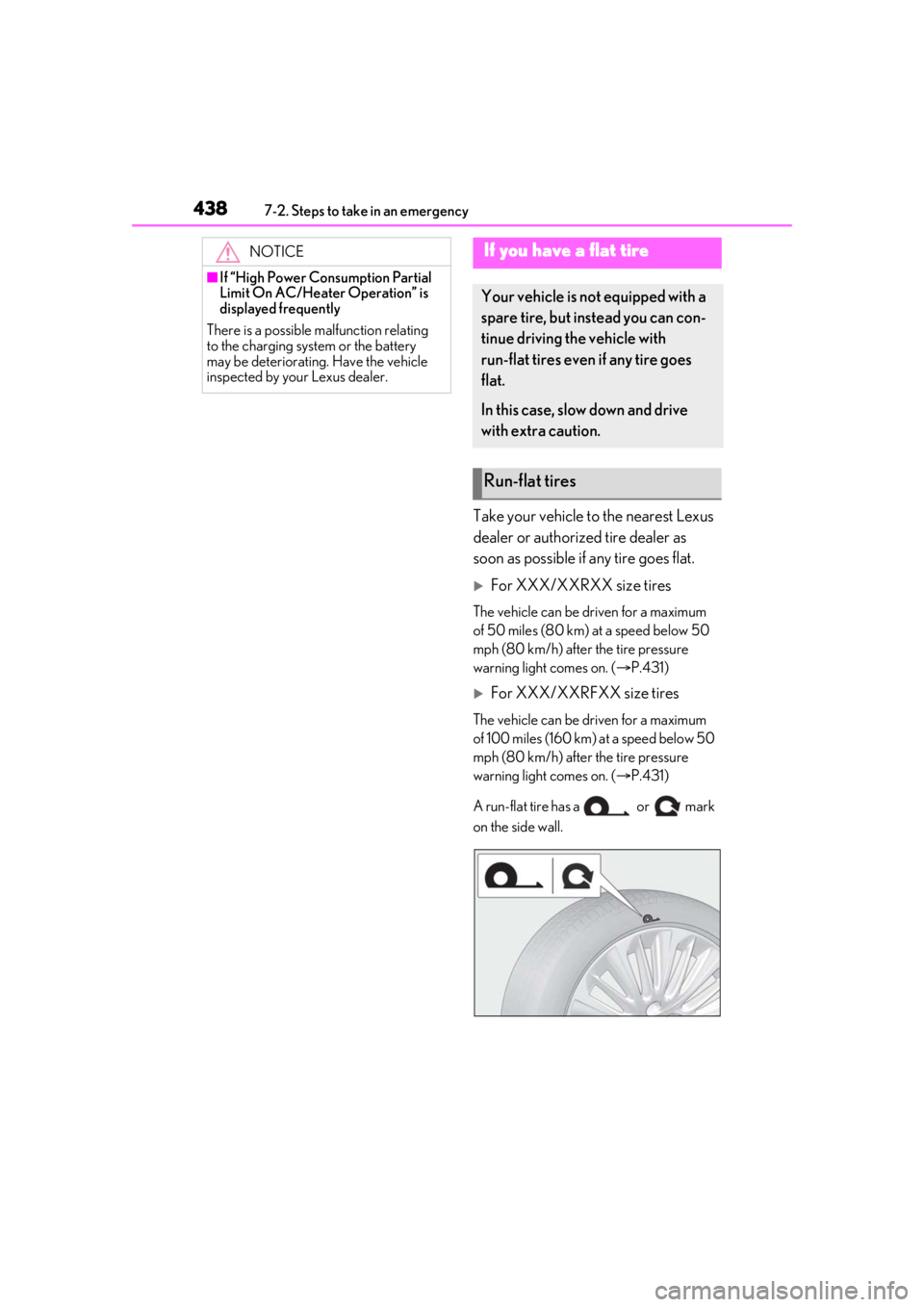
A run-flat tire has a or mark
on the side wall.
NOTICE
■If “High Power Consumption Partial
Limit On AC/Heater Operation” is
displayed frequently
There is a possible malfunction relating
to the charging system or the battery
may be deteriorating. Have the vehicle
inspected by your Lexus dealer.
If you have a flat tire
Your vehicle is not equipped with a
spare tire, but instead you can con-
tinue driving the vehicle with
run-flat tires even if any tire goes
flat.
In this case, slow down and drive
with extra caution.
Run-flat tires
Page 439 of 520
4397-2. Steps to take in an emergency
7
When trouble arises
■In some conditions (such as at high tem-
peratures)
For XXX/XXRXX size tires: You cannot
continue driving for up to 80 miles (50
km).
For XXX/XXRFXX size tires: You cannot
continue driving for up to 160 miles (100
km).
■For the detailed information on run-flat
tires
See the tire warranty booklet.
One of the following may be the cause
of the problem:
There may not be sufficient fuel in
the vehicle’s tank.
Refuel the vehicle.
The engine may be flooded.
Try to restart the engine again fol-
lowing correct starting procedures.
( P.174)
There may be a malfunction in the
engine immobilizer system.
( P.64)
There may be a malfunction in the
shift control system.
* ( P.177, 437)
*: It may not be possible to shift the shift
position from P.
One of the following may be the cause
of the problem:
The battery may be discharged.
NOTICE
■When replacing the tires
When removing or fitting the wheels,
tires or the tire pressure warning valve
and transmitter, contact your Lexus
dealer as the tire pr essure warning valve
and transmitter may be damaged if not
handled correctly.
■When driving over bumps
If a vehicle has a flat tire, the vehicle
height will be lower than usual. Ensure
that nothing strikes the bottom of the
vehicle.
■To avoid damage to the tire pressure
warning valves and transmitters
When a tire is repaired with liquid seal-
ants, the tire pressu re warning valve and
transmitter may not operate properly. If a
liquid sealant is used , contact your Lexus
dealer or other qualified service shop as
soon as possible. Make sure to replace
the tire pressure warning valve and trans-
mitter when replacing the tire. ( P.398)
If the engine will not start
If the engine will not start even
though correct starting procedures
are being followed (P.174), con-
sider each of the following points:
The engine will not start even
though the starter motor oper-
ates normally.
The starter motor turns over
slowly, the interior lights and
headlights are dim, or the horn
does not sound or sounds at a low
volume.
Page 448 of 520
4487-2. Steps to take in an emergency
●Use a battery with a handle. If a battery
without a handle is used, removal is more
difficult.
●After replacing, firmly attach the follow-
ing items to the exhaust hole of the bat-
tery.
• Use the exhaust hose that was attached to the battery before replacing and con-
firm that it is firmly connected to the hole
section of the vehicle.
• Use the exhaust hole plug included with
the battery replaced or the one installed
on the battery prior to the replacement.
(Depending on the battery to be
replaced, the exhaust hole may be
plugged.)
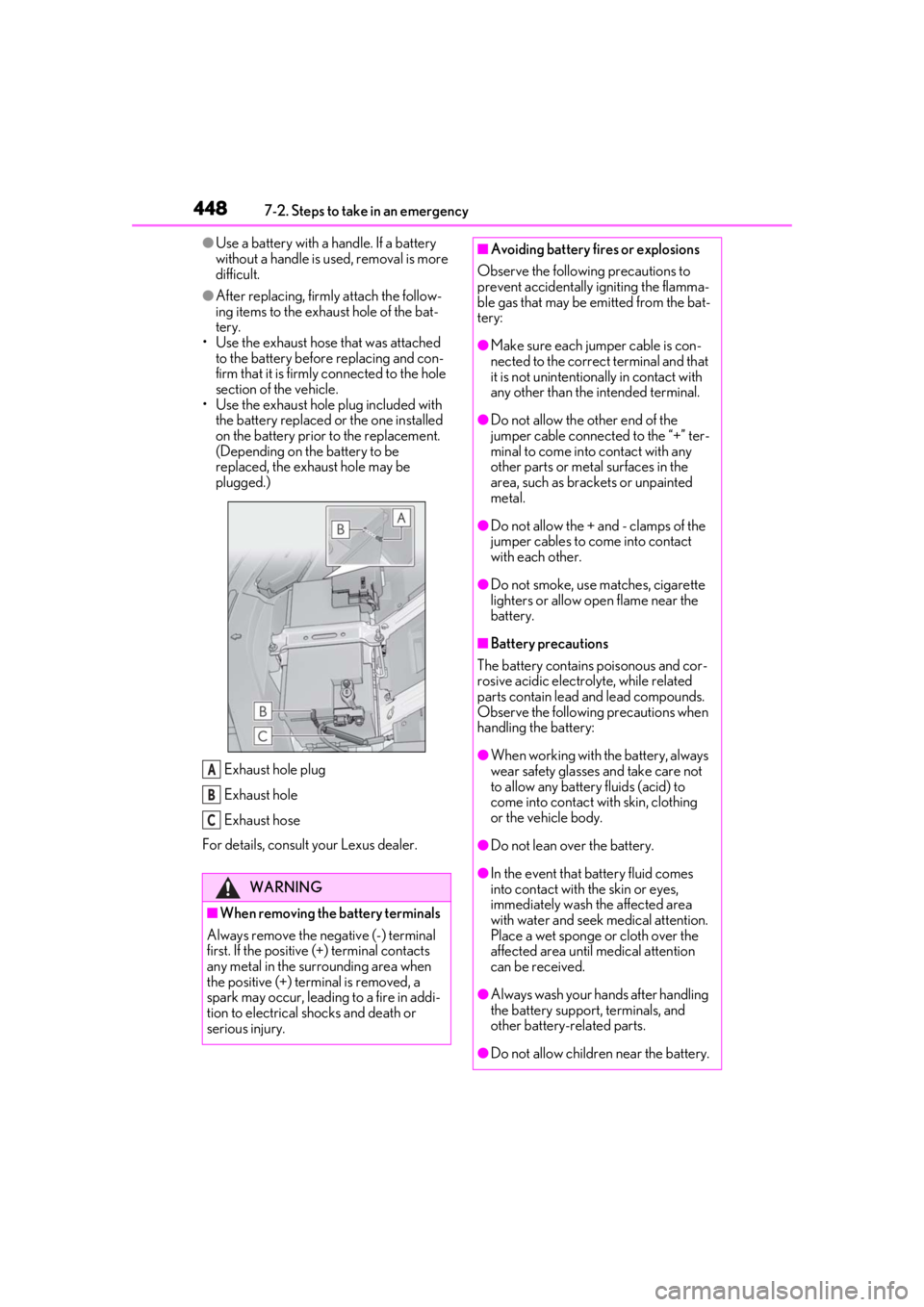
Exhaust hole plug
Exhaust hole
Exhaust hose
For details, consult your Lexus dealer.
WARNING
■When removing the battery terminals
Always remove the negative (-) terminal
first. If the positive (+) terminal contacts
any metal in the surrounding area when
the positive (+) terminal is removed, a
spark may occur, leading to a fire in addi-
tion to electrical shocks and death or
serious injury.
A
B
C
■Avoiding battery fires or explosions
Observe the following precautions to
prevent accidentally igniting the flamma-
ble gas that may be emitted from the bat-
tery:
●Make sure each jumper cable is con-
nected to the correct terminal and that
it is not unintentionally in contact with
any other than the intended terminal.
●Do not allow the other end of the
jumper cable connected to the “+” ter-
minal to come into contact with any
other parts or meta l surfaces in the
area, such as brackets or unpainted
metal.
●Do not allow the + and - clamps of the
jumper cables to come into contact
with each other.
●Do not smoke, use matches, cigarette
lighters or allow open flame near the
battery.
■Battery precautions
The battery contains poisonous and cor-
rosive acidic electrol yte, while related
parts contain lead and lead compounds.
Observe the following precautions when
handling the battery:
●When working with the battery, always
wear safety glasses and take care not
to allow any battery fluids (acid) to
come into contact with skin, clothing
or the vehicle body.
●Do not lean over the battery.
●In the event that battery fluid comes
into contact with the skin or eyes,
immediately wash the affected area
with water and seek medical attention.
Place a wet sponge or cloth over the
affected area until medical attention
can be received.
●Always wash your ha nds after handling
the battery support, terminals, and
other battery-related parts.
●Do not allow children near the battery.
Page 461 of 520
4618-1. Specifications
8
Vehicle specifications
further details.
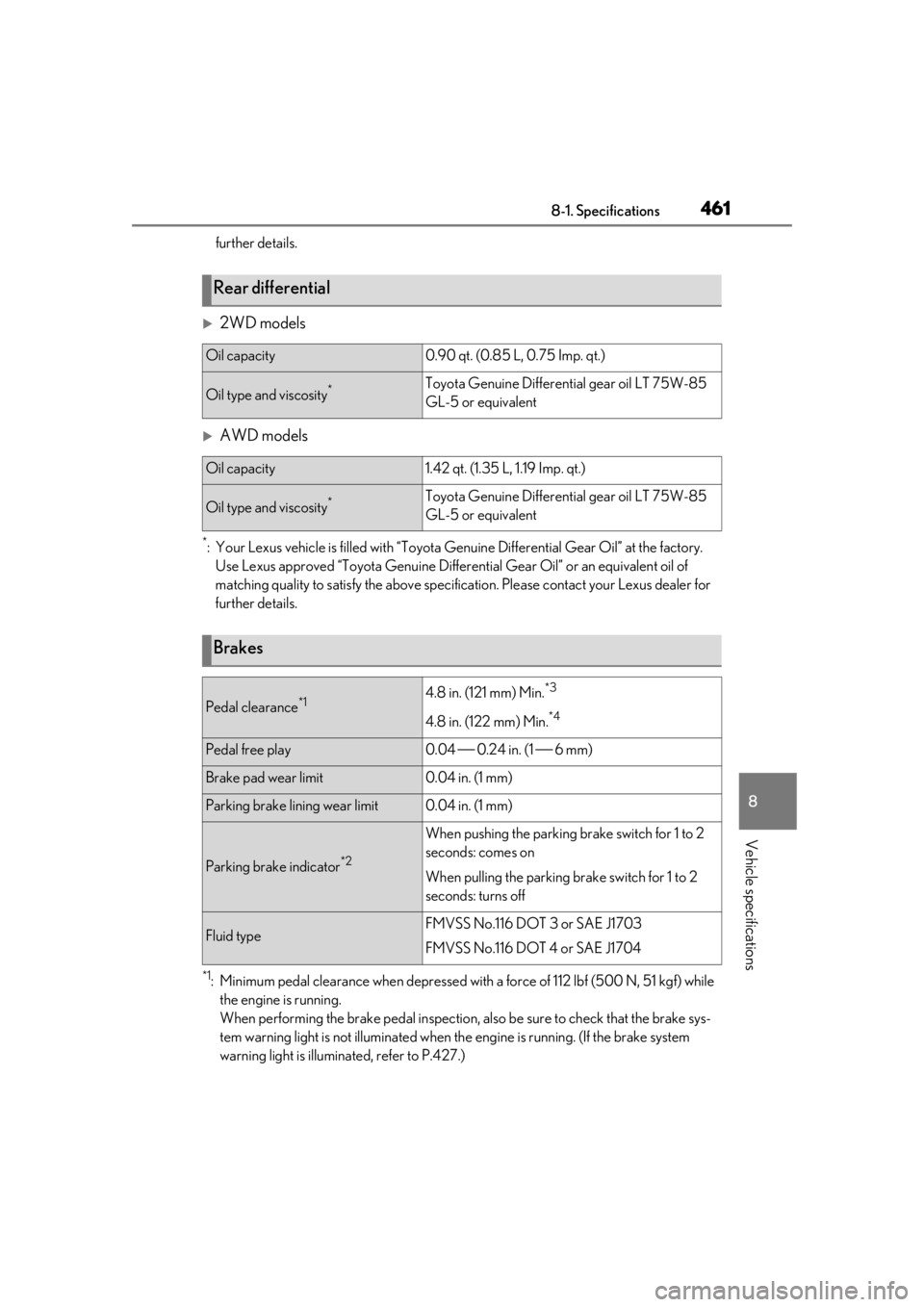
2WD models
AWD models
*: Your Lexus vehicle is filled with “Toyota Genuine Differential Gear Oil” at the factory.
Use Lexus approved “Toyota Ge nuine Differential Gear Oil” or an equivalent oil of
matching quality to satisfy th e above specification. Please contact your Lexus dealer for
further details.
*1: Minimum pedal clearance when depressed with a force of 112 lbf (500 N, 51 kgf) while
the engine is running.
When performing the brake pedal inspection, also be sure to check that the brake sys-
tem warning light is not illuminated when th e engine is running. (If the brake system
warning light is illuminated, refer to P.427.)
Rear differential
Oil capacity0.90 qt. (0.85 L, 0.75 Imp. qt.)
Oil type and viscosity*Toyota Genuine Differential gear oil LT 75W-85
GL-5 or equivalent
Oil capacity1.42 qt. (1.35 L, 1.19 Imp. qt.)
Oil type and viscosity*Toyota Genuine Differential gear oil LT 75W-85
GL-5 or equivalent
Brakes
Pedal clearance*14.8 in. (121 mm) Min.*3
4.8 in. (122 mm) Min.*4
Pedal free play0.04 0.24 in. (1 6 mm)
Brake pad wear limit0.04 in. (1 mm)
Parking brake lining wear limit0.04 in. (1 mm)
Parking brake indicator*2
When pushing the parking brake switch for 1 to 2
seconds: comes on
When pulling the parking brake switch for 1 to 2
seconds: turns off
Fluid typeFMVSS No.116 DOT 3 or SAE J1703
FMVSS No.116 DOT 4 or SAE J1704
Page 462 of 520
4628-1. Specifications
*2: Make sure to confirm that the brake warning light (yellow) does not illuminate. (If the brake warning light illuminates, refer to P.427.)
*3: Vehicles without Lexus Safety System + A
*4: Vehicles with Lexus Safety System + A
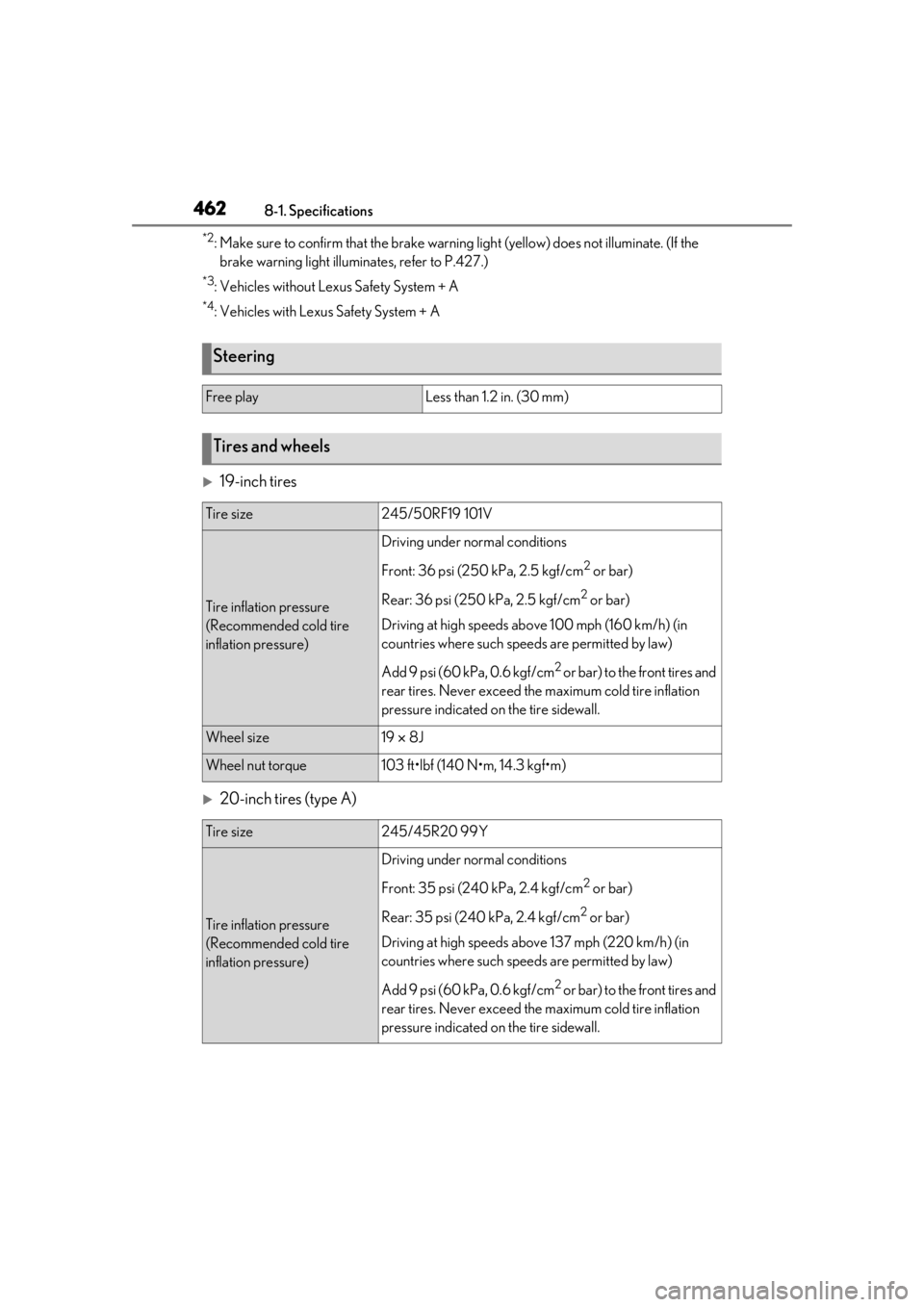
19-inch tires
20-inch tires (type A)
Steering
Free playLess than 1.2 in. (30 mm)
Tires and wheels
Tire size245/50RF19 101V
Tire inflation pressure
(Recommended cold tire
inflation pressure)
Driving under normal conditions
Front: 36 psi (250 kPa, 2.5 kgf/cm
2 or bar)
Rear: 36 psi (250 kPa, 2.5 kgf/cm
2 or bar)
Driving at high speeds above 100 mph (160 km/h) (in
countries where such speeds are permitted by law)
Add 9 psi (60 kPa, 0.6 kgf/cm
2 or bar) to the front tires and
rear tires. Never exceed the maximum cold tire inflation
pressure indicated on the tire sidewall.
Wheel size19 8J
Wheel nut torque103 ft•lbf (140 N•m, 14.3 kgf•m)
Tire size245/45R20 99Y
Tire inflation pressure
(Recommended cold tire
inflation pressure)
Driving under normal conditions
Front: 35 psi (240 kPa, 2.4 kgf/cm
2 or bar)
Rear: 35 psi (240 kPa, 2.4 kgf/cm
2 or bar)
Driving at high speeds above 137 mph (220 km/h) (in
countries where such speeds are permitted by law)
Add 9 psi (60 kPa, 0.6 kgf/cm
2 or bar) to the front tires and
rear tires. Never exceed the maximum cold tire inflation
pressure indicated on the tire sidewall.
Page 483 of 520
4838-2. Customization
8
Vehicle specifications
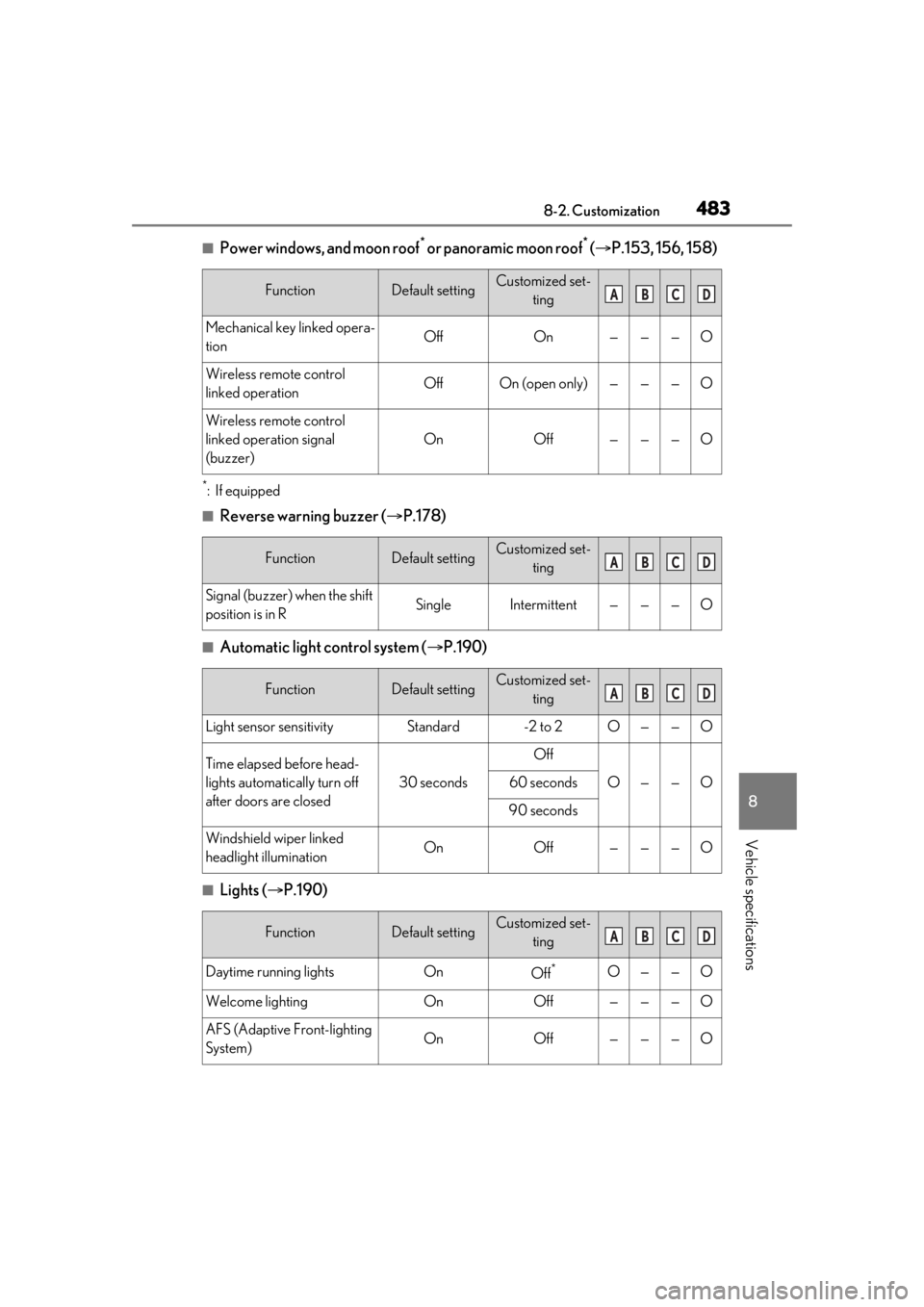
■Power windows, and moon roof* or panoramic moon roof* ( P.153, 156, 158)
*:If equipped
■Reverse warning buzzer ( P.178)
■Automatic light control system ( P.190)
■Lights ( P.190)
FunctionDefault settingCustomized set-
ting
Mechanical key linked opera-
tionOffOn———O
Wireless remote control
linked operationOffOn (open only)———O
Wireless remote control
linked operation signal
(buzzer)
OnOff———O
FunctionDefault settingCustomized set-ting
Signal (buzzer) when the shift
position is in RSingleIntermittent———O
FunctionDefault settingCustomized set-ting
Light sensor sensitivityStandard-2 to 2O——O
Time elapsed before head-
lights automatically turn off
after doors are closed
30 seconds
Off
O——O60 seconds
90 seconds
Windshield wiper linked
headlight illuminationOnOff———O
FunctionDefault settingCustomized set-ting
Daytime running lightsOnOff*O——O
Welcome lightingOnOff———O
AFS (Adaptive Front-lighting
System)OnOff———O
ABCD
ABCD
ABCD
ABCD
Page 505 of 520
505What to do if... (Troubleshooting)
In this case, the engine can be started in a
temporary way. (P.443)
Is the battery discharged?
( P.444)
It is locked automatically to prevent
theft of the vehicle. ( P.174)
Is the window lock switch pressed?
The power window except for the one at
the driver’s seat cannot be operated if the
window lock switch is pressed. ( P.155)
The auto power off function will be
operated if the vehicle is left in
ACCESSORY mode for a period of
time. ( P.177)
The seat belt reminder light is flash-
ing
Are the driver and the front passenger
wearing the seat belts? ( P.430)
The parking brake indicator is on
Is the parking brake released? ( P.186)
Depending on the situation, other
types of warning buzzer may also sound. (
P.427, 436)
Did anyone inside the vehicle open
a door during setting the alarm?
The sensor detects it and the alarm sounds.
( P.66)
Do one of the following to deactivate
or stop the alarms:
Except for Canada: Unlock the
doors.
Except for Canada: Open the trunk.
For Canada: Unlock the doors or
open the trunk using the entry func-
tion or wireless remote control.
Turn the engine switch to ACCES-
SORY or IGNITION ON mode, or
start the engine. (The alarm will be
deactivated or stopped after a few
seconds.)
Is the message displayed on the
multi-information display?
Check the message on the multi-informa-
tion display. ( P.436)
When a warning light turns on or a
warning message is displayed, refer
to P.427, 436.
The steering wheel cannot be
turned after the engine is
stopped
The windows do not open or
close by operating the power
window switches
The engine switch is turned off
automatically
A warning buzzer sounds during
driving
An alarm is activated and the
horn sounds
A warning buzzer sounds when
leaving the vehicle
A warning light turns on or a
warning message is displayed
Page 507 of 520

507Alphabetical Index
Alphabetical Index
A
A/CAir conditioning filter ...............................409
Front automatic air conditioning system......................................................................... 323
Front seat concentr ated airflow mode
(S-FLOW).................................................330
Micro dust and pollen filter...................330
Rear automatic air conditioning system ......................................................................... 333
ABS (Anti-lock Brake System).............. 304 Warning light ............................................... 429
Active stabilizer suspension system .... 304
Adaptive Front-lighting System (AFS) .192
Adaptive Variable Suspension System304
AFS (Adaptive Front-lighting System) .192
AHB (Automatic High Beam) .................193
Air conditioning filter ................................. 409
Air conditioning system Air conditioning filter ...............................409
Front automatic air conditioning system......................................................................... 323
Front seat concentr ated airflow mode
(S-FLOW).................................................330
Micro dust and pollen filter...................330
Rear automatic air conditioning system ......................................................................... 333
Airbags Airbag operating conditions..................... 31
Airbag precautions for your child ........ 34
Correct driving posture .............................23
Curtain shield airbag operating condi- tions ...................................................................32
Curtain shield airbag precautions ....... 34
Front passenger occupant classification system ............................................................. 40
General airbag precautions ................... 34
Locations of airbags.................................... 29
Modification and disposal of airbags . 36
Side airbag operating conditions ..........32
Side airbag precautions ............................ 34 Side and curtain shie
ld airbags operating
conditions ...................................................... 32
Side and curtain shield airbags precau- tions .................................................................. 34
SRS airbags...................................................... 29
SRS warning light.......................................428
Alarm ................................................................... 66 Warning buzzer ......................................... 427
Anchor brackets ..................................... 46, 55
Antennas (smart acc ess system with
push-button start)........................................ 113
Anti-lock Brake System (ABS).............. 304 Warning light ............................................... 429
Approach warning...................................... 260
Armrest............................................................ 353
Assist grips ..................................................... 353
Audio system-linked display ...................... 87
Automatic headlight leveling system ..... 191
Automatic High Beam ................................193
Automatic light control system................. 191
Automatic transmission ..............................178 M mode ........................................................... 183
Paddle shift switches .......................182, 183
Snow mode.................................................... 182
Auxiliary boxes ................................. 348, 350
Average fuel economy................................. 84
Average vehicle speed ................................ 84
B
Back-up lights Replacing light bulbs ................................. 416
Battery Battery checking ......................................... 391
If the battery is discharged .................... 444
Preparing and checking before winter......................................................................... 309
Warning light ...............................................428
Blind Spot Monitor (BSM)....................... 264
Boost gauge...................................................... 86
Brake Brake hold ......................................................188
Fluid........................................................ 389, 461