air condition LEXUS LS500 2021 Owners Manual
[x] Cancel search | Manufacturer: LEXUS, Model Year: 2021, Model line: LS500, Model: LEXUS LS500 2021Pages: 520, PDF Size: 9.81 MB
Page 1 of 520

LS500_U
1
2
3
4
5
6
7
8
9
Pictorial indexSearch by illustration
For safety
and securityMake sure to read through them
(Main topics: Child seat, theft deterrent system)
Vehicle status
information and
indicatorsReading driving-related information
(Main topics: Meters, multi-information display)
Before drivingOpening and closing the doors and windows,
adjustment before driving
(Main topics: Keys, doors, seats)
DrivingOperations and advice which are necessary for driving
(Main topics: Starting engine, refueling)
Interior featuresUsage of the interior features
(Main topics: Air conditioner, storage features)
Maintenance
and careCaring for your vehicle and maintenance procedures
(Main topics: Interior and exterior, light bulbs)
When trouble
arisesWhat to do in case of malfunction and emergency
(Main topics: Battery discharge, flat tire)
Vehicle
specificationsVehicle specifications, customizable features
(Main topics: Fuel, oil, tire inflation pressure)
For ownersReporting safety defects for U.S. owners, seat belt, SRS
airbag and headlight aim in structions for Canadian
owners
IndexSearch by symptom
Search alphabetically
Page 3 of 520
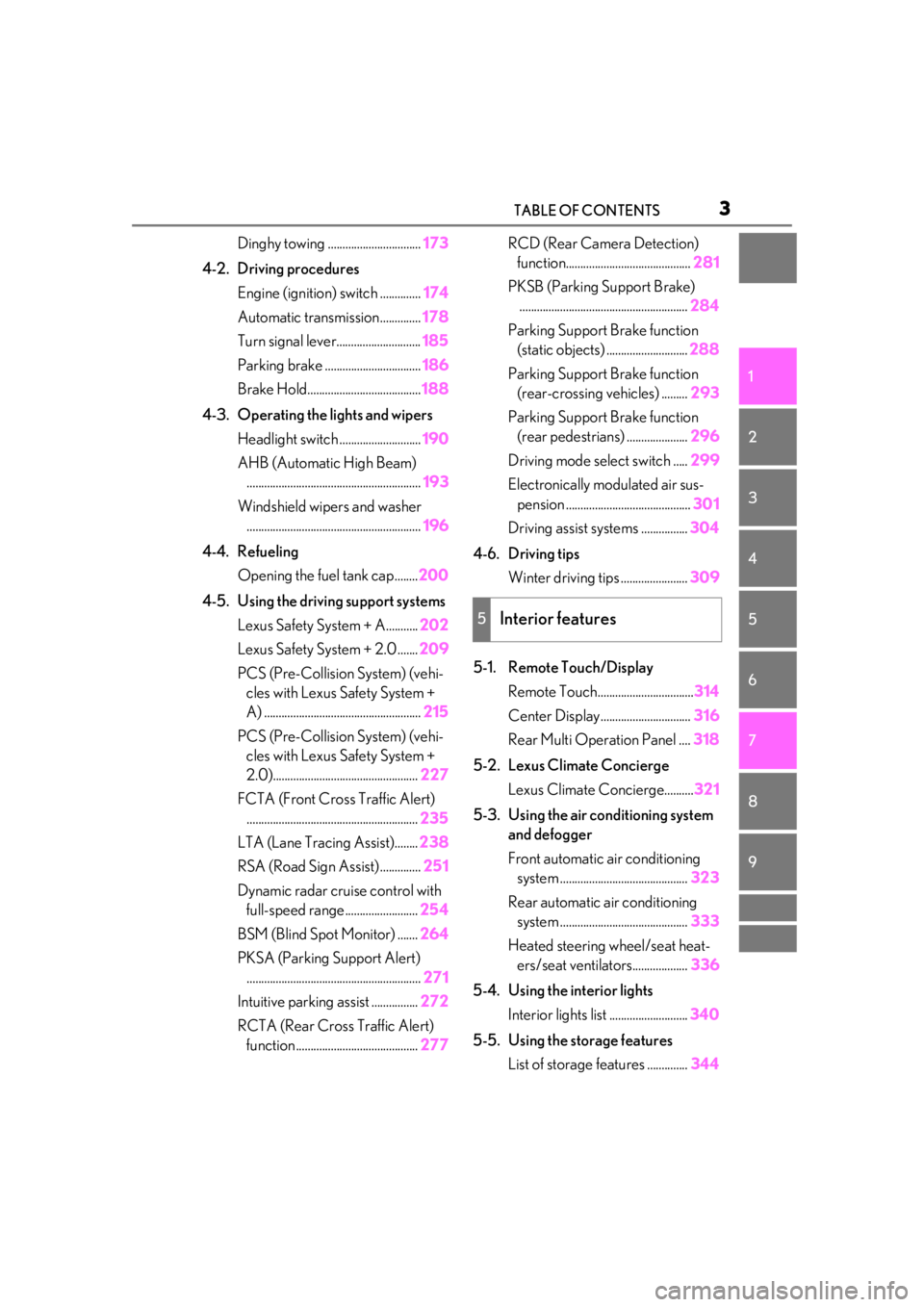
3TABLE OF CONTENTS
1
2
3
4
5
6
7
8
9
Dinghy towing ................................173
4-2. Driving procedures Engine (ignition) switch .............. 174
Automatic transmission.............. 178
Turn signal lever............................. 185
Parking brake ................................. 186
Brake Hold....................................... 188
4-3. Operating the lights and wipers Headlight switch ............................ 190
AHB (Automatic High Beam) ............................................................ 193
Windshield wipers and washer ............................................................ 196
4-4. Refueling Opening the fuel tank cap........ 200
4-5. Using the driving support systems Lexus Safety System + A........... 202
Lexus Safety System + 2.0 ....... 209
PCS (Pre-Collision System) (vehi- cles with Lexus Safety System +
A) ...................................................... 215
PCS (Pre-Collision System) (vehi- cles with Lexus Safety System +
2.0).................................................. 227
FCTA (Front Cross Traffic Alert) ........................................................... 235
LTA (Lane Tracing Assist)........ 238
RSA (Road Sign Assist) .............. 251
Dynamic radar crui se control with
full-speed range......................... 254
BSM (Blind Spot Monitor) ....... 264
PKSA (Parking Support Alert) ............................................................ 271
Intuitive parking assist ................ 272
RCTA (Rear Cross Traffic Alert) function .......................................... 277RCD (Rear Camera Detection)
function........................................... 281
PKSB (Parking Support Brake) .......................................................... 284
Parking Support Brake function (static objects) ............................ 288
Parking Support Brake function (rear-crossing vehicles) ......... 293
Parking Support Brake function (rear pedestrians) ..................... 296
Driving mode select switch ..... 299
Electronically modulated air sus- pension ........................................... 301
Driving assist systems ................ 304
4-6. Driving tips Winter driving tips ....................... 309
5-1. Remote Touch/Display Remote Touch.................................314
Center Display............................... 316
Rear Multi Operation Panel .... 318
5-2. Lexus Climate Concierge Lexus Climate Concierge.......... 321
5-3. Using the air conditioning system and defogger
Front automatic air conditioning
system ............................................ 323
Rear automatic air conditioning system ............................................ 333
Hea t
ed steering wheel/seat heat-
ers/seat ventilators................... 336
5-4. Using the interior lights Interior lights list ........................... 340
5-5. Using the storage features List of storage features .............. 344
5Interior features
Page 4 of 520

4TABLE OF CONTENTS
Trunk features................................349
5-6. Using the other interior features Other interior features .............. 352
Garage door opener.................. 360
6-1. Maintenance and care Cleaning and protecting the vehi-cle exterior ................................... 368
Cleaning and protecting the vehi- cle interior ..................................... 371
6-2. Maintenance Maintenance requirements ..... 374
General maintenance ................ 375
Emission inspection and mainte- nance (I/M) programs ............ 378
6-3. Do-it-yourself maintenance Do-it-yourself service precautions........................................................... 379
Hood................................................... 381
Positioning a floor jack................ 381
Engine compartment.................. 383
Battery ............................................... 391
Tires ................................................... 393
Replacing the tire ......................... 402
Tire inflation pressure ................. 406
Wheels.............................................. 407
Air conditioning filter..................409
Electronic key battery ................. 410
Checking and replacing fuses ............................................................ 412
Headlight aim.................................. 415
Light bulbs ........................................ 4167-1. Essential information
Emergency flashers ..................... 418
If your vehicle has to be stopped in an emergency ............................. 418
If the vehicle is trapped in rising water ............................................... 419
7-2. Steps to take in an emergency If your vehicle needs to be towed............................................................ 421
If you think something is wrong .......................................................... 425
Fuel pump shut off system ........ 426
If a warning light turns on or a warn- ing buzzer sounds...................... 427
If a warning messa ge is displayed
.......................................................... 436
If you have a flat tire .................... 438
If the engine will not start .......... 439
If you lose your keys...................... 441
If the fuel filler door cannot be opened ............................................ 441
If the electronic key does not oper- ate properly .................................. 442
If the vehicle battery is discharged .......................................................... 444
If your vehicle overheats ........... 449
If the vehicle becomes stuck ... 452
8-1. Specifications Maintenance data (fuel, oil level, etc.) ................................................. 456
Fuel information .
........................... 465
6Maintenance and care
7When trouble arises
8Vehicle specifications
Page 15 of 520

15Pictorial index
Applying/releasing the parking brake...................................................................... P.186
Precautions for winter season ...................................................................................... P.310
Warning buzzer/messages.......................................................................................... P.436
Turn signal lever ......................................................................................................P.185
Headlight switch......................................................................................................P.190
Headlights/parking lights/tail lights/license plate lig hts/daytime running lights
............................................................................................................................... .................... P.190
AHB (Automatic High Beam)............................ .......................................................... P.193
Windshield wiper and washer switch ................................................................ P.196
Usage.......................................................................................................................... ............ P.196
Adding washer fluid .........................................................................................................P.3 90
Warning messages .......................................................................................................... P.436
Emergency flasher switch ....................................................................................P.418
Hood lock release lever ........................................................................................P.381
Tilt and telescopic steering contro l switch................................ .................... ... P.141
Adjustment ..................................................................................................................... ........ P.141
Driving position memory ................................................................................................ P.133
Air conditioning system ...................................................................................... P.323
Usage.......................................................................................................................... ........... P.323
Rear window defogger................................................................................................... P.323
Audio system
*
Brake hold switch ................................................................................................... P.188
Trunk opener main switch ..................................................................................... P.112
*: Refer to “NAVIGATION AND MULTIMEDIA SYSTEM OWNER’S MANUAL”.
F
G
H
I
J
K
L
M
N
Page 31 of 520

311-1. For safe use
1
For safety and security
Driver’s seat belt buckle switch
Airbag sensor assembly
Front impact sensors
Pop Up Hood computer assembly
Your vehicle is equipped with ADVANCED AIRBAGS designed based on the US
motor vehicle safety standards (FMVSS208). The airbag sensor assembly (ECU)
controls airbag deployment based on information obtained from the sensors etc.
shown in the system components diagram above. This information includes crash
severity and occupant information. As the airbags deploy, a chemical reaction in
the inflators quickly fills the airbags with no n-toxic gas to help restrain the motion of
the occupants.
■If the SRS airbags deploy (inflate)
●Slight abrasions, burns, bruising etc., may
be sustained from SRS airbags, due to the
extremely high speed deployment (infla-
tion) by hot gases.
●A loud noise and white powder will be
emitted.
●Parts of the airbag module (steering
wheel hub, airbag cover and inflator) as
well as the seats, parts of the front and
rear pillars, and roof side rails, may be hot
for several minutes. The airbag itself may
also be hot.
●The windshield may crack.
●All of the doors will be unlocked.
( P.103)
●The brakes and stop lights will be con-
trolled automatically. ( P.305)
●The interior lights will turn on automati-
cally. ( P.343)
●The emergency flashers will be turned on
automatically. ( P.418)
●Fuel supply to the engine will be stopped.
( P.426)
●For Lexus Enform Safety Connect sub-
scribers, if any of the following situations
occur, the system is designed to send an
emergency call to the response center,
notifying them of the vehicle’s location
(without needing to push the “SOS” but-
ton) and an agent will attempt to speak
with the occupants to ascertain the level of emergency and assistance required. If
the occupants are unable to communi-
cate, the agent automatically treats the
call as an emergency and helps to dis-
patch the necessary emergency services.
(
P.58)
• An SRS airbag is deployed.
• A seat belt pretensioner is activated.
• The vehicle is involved in a severe rear-end collision.
■PCS-linked SRS airbag deployment
control (vehicles with Lexus Safety Sys-
tem + A)
If the PCS (Pre-Collision System) deter-
mines that the possibility of a side collision is
high, the SRS side and curtain shield air-
bags will be prepared to operate.
■SRS airbag deployment conditions (SRS
front airbags/SRS seat cushion airbags)
●The SRS front airbags and SRS seat cush-
ion airbags will deploy in the event of an
impact that exceed s the set threshold
level (the level of fo rce corresponding to
an approximately 12 - 18 mph [20 - 30
km/h] frontal collision with a fixed wall
that does not move or deform).
However, this threshol d velocity will be
considerably higher in the following situa-
tions:
• If the vehicle strikes an object, such as a parked vehicle or sign pole, which can
move or deform on impact
• If the vehicle is involved in an underride
collision, such as a collision in which the
Q
R
S
T
Page 32 of 520
321-1. For safe use
front of the vehicle underrides, or goes
under, the bed of a truck
●Depending on the type of collision, it is
possible that only the seat belt preten-
sioners will activate.
●The SRS front airbags for the front pas-
senger will not activate if there is no pas-
senger sitting in the front passenger seat.
However, the SRS fr ont airbags for the
front passenger may deploy if luggage is
put in the seat, even if the seat is unoccu-
pied.
●The SRS seat cushion airbags on the rear
seat will not operate if the occupant is not
wearing a seat belt.
■SRS airbag deployment conditions (SRS
side and curtain shield airbags)
●The SRS side and curtain shield airbags
will deploy in the even t of an impact that
exceeds the set thresh old level (the level
of force corresponding to the impact
force produced by an approximately
3300 lb. [1500 kg] vehicle colliding with
the vehicle cabin from a direction per-
pendicular to the vehi cle orientation at an
approximate speed of 12 - 18 mph [20 -
30 km/h]).
●Both SRS curtain shield airbags may
deploy in the event of a severe side colli-
sion.
●Both SRS curtain shield airbags will
deploy in the event of vehicle rollover.
●Both SRS curtain shield airbags may also
deploy in the event of a severe frontal col-
lision.
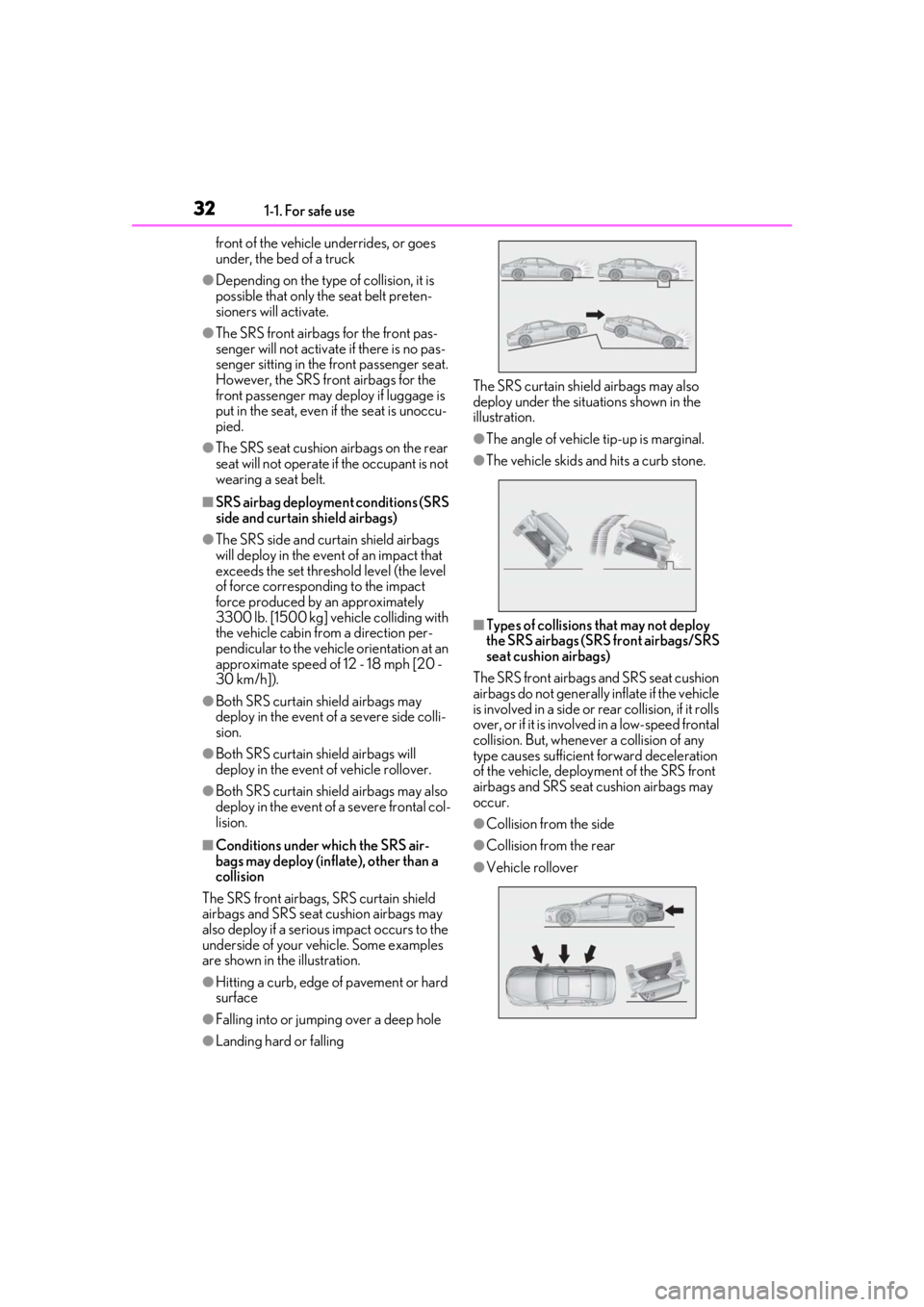
■Conditions under which the SRS air-
bags may deploy (inf late), other than a
collision
The SRS front airbags, SRS curtain shield
airbags and SRS seat cushion airbags may
also deploy if a serious impact occurs to the
underside of your vehicle. Some examples
are shown in the illustration.
●Hitting a curb, edge of pavement or hard
surface
●Falling into or jumping over a deep hole
●Landing hard or falling The SRS curtain shield
airbags may also
deploy under the situations shown in the
illustration.
●The angle of vehicle tip-up is marginal.
●The vehicle skids and hits a curb stone.
■Types of collisions that may not deploy
the SRS airbags (SRS front airbags/SRS
seat cushion airbags)
The SRS front airbags and SRS seat cushion
airbags do not generally inflate if the vehicle
is involved in a side or rear collision, if it rolls
over, or if it is involv ed in a low-speed frontal
collision. But, whenever a collision of any
type causes sufficient forward deceleration
of the vehicle, deploy ment of the SRS front
airbags and SRS seat cushion airbags may
occur.
●Collision from the side
●Collision from the rear
●Vehicle rollover
Page 40 of 520
401-1. For safe use
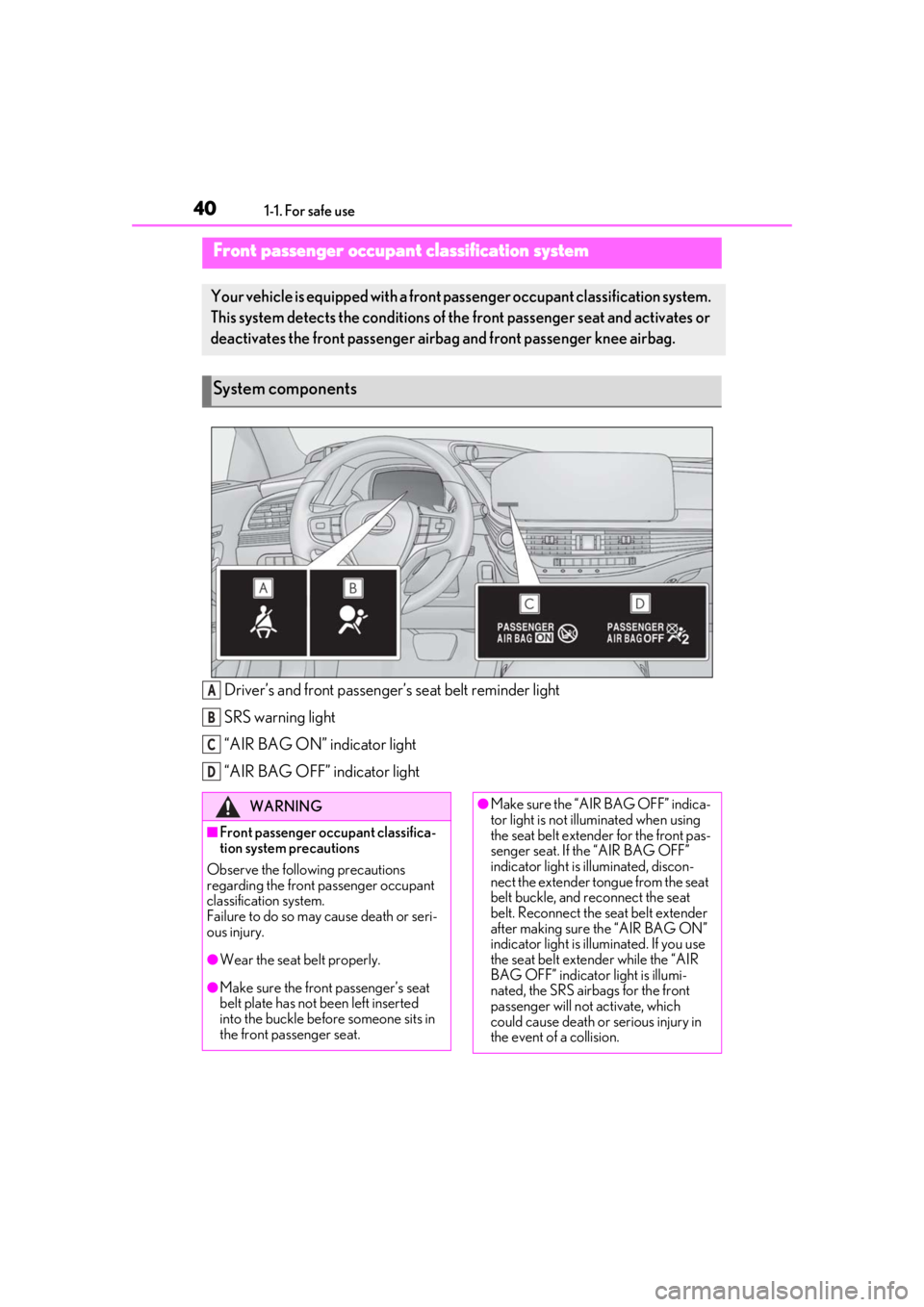
Driver’s and front passenger’s seat belt reminder light
SRS warning light
“AIR BAG ON” indicator light
“AIR BAG OFF” indicator light
Front passenger occupant classification system
Your vehicle is equipped with a front pa ssenger occupant classification system.
This system detects the conditions of th e front passenger seat and activates or
deactivates the front passenger airb ag and front passenger knee airbag.
System components
A
B
C
D
WARNING
■Front passenger occupant classifica-
tion system precautions
Observe the following precautions
regarding the front passenger occupant
classification system.
Failure to do so may cause death or seri-
ous injury.
●Wear the seat belt properly.
●Make sure the fron t passenger’s seat
belt plate has not been left inserted
into the buckle before someone sits in
the front passenger seat.
●Make sure the “AIR BAG OFF” indica-
tor light is not illuminated when using
the seat belt extender for the front pas-
senger seat. If the “AIR BAG OFF”
indicator light is illuminated, discon-
nect the extender tongue from the seat
belt buckle, and re connect the seat
belt. Reconnect the seat belt extender
after making sure the “AIR BAG ON”
indicator light is illuminated. If you use
the seat belt extender while the “AIR
BAG OFF” indicator light is illumi-
nated, the SRS airbags for the front
passenger will not activate, which
could cause death or serious injury in
the event of a collision.
Page 42 of 520
421-1. For safe use
■Adult*1
■Child*4
■Child restraint system with infant*5
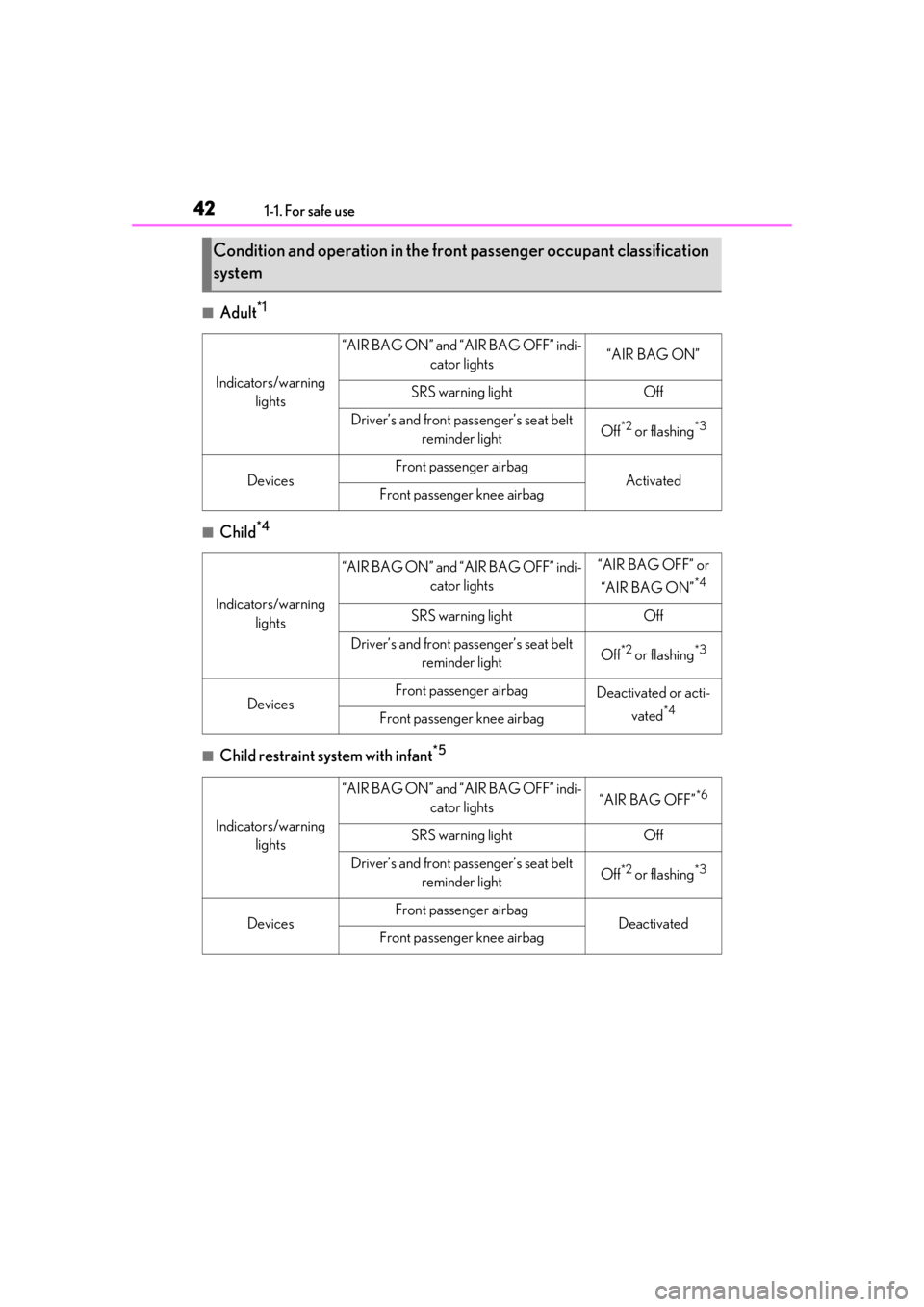
Condition and operation in the front passenger occupant classification
system
Indicators/warning lights
“AIR BAG ON” and “AIR BAG OFF” indi- cator lights“AIR BAG ON”
SRS warning lightOff
Driver’s and front passenger’s seat belt reminder lightOff*2 or flashing*3
DevicesFront passenger airbagActivatedFront passenger knee airbag
Indicators/warning lights
“AIR BAG ON” and “AIR BAG OFF” indi- cator lights“AIR BAG OFF” or
“AIR BAG ON”
*4
SRS warning lightOff
Driver’s and front passenger’s seat belt reminder lightOff*2 or flashing*3
DevicesFront passenger airbagDeactivated or acti-
vated
*4Front passenger knee airbag
Indicators/warning lights
“AIR BAG ON” and “AIR BAG OFF” indi- cator lights“AIR BAG OFF”*6
SRS warning lightOff
Driver’s and front passenger’s seat belt reminder lightOff*2 or flashing*3
DevicesFront passenger airbagDeactivatedFront passenger knee airbag
Page 61 of 520

611-3. Lexus Enform
1
For safety and security
●Safety Connect is available beginning Fall
2009 on select Lexus models (in the
contiguous United States only). Contact
with the Safety Connect response center
is dependent upon the telematics device
being in operative condition, cellular con-
nection availability, and GPS satellite sig-
nal reception, which ca n limit the ability to
reach the response center or receive
emergency service support. Enrollment
and Telematics Subscription Service
Agreement required. A variety of sub-
scription terms is available; charges vary
by subscription term selected and loca-
tion.
●Automatic Collision Notification, Emer-
gency Assistance and Stolen Vehicle
Location will function in the United
States, including Hawaii and Alaska,
Puerto Rico and in Canada, and
Enhanced Roadside Assistance will func-
tion in the United States, Puerto Rico and
in Canada.
●Automatic Collision Notification, Emer-
gency Assistance, Stolen Vehicle and
Enhanced Road Assist ance will not func-
tion in the United States Virgin Islands.
For vehicles first sold in the USVI, no
Safety Connect services will function in
and outside the United States Virgin
Islands.
●Safety Connect services are not subject
to section 255 of the Telecommunica-
tions Act and the device is not TTY com-
patible.
■Languages
The Safety Connect response center will
offer support in multiple languages. The
Safety Connect system will offer voice
prompts in English, Spanish, and French.
Please indicate your language of choice
when enrolling.
■When contacting the response center
You may be unable to contact the response
center if the network is busy.
When the engine switch is turned to
IGNITION ON mode, the red indica-
tor light comes on for 2 seconds then
turns off. Afterward, the green indica-
tor light comes on, indicating that the
service is active.
The following indicator light patterns
indicate specific system usage condi-
tions:
Green indicator light on = Active
service
Green indicator light flashing =
Safety Connect call in process
Red indicator light (except at vehi-
cle start-up) = System malfunction
(contact your Lexus dealer)
No indicator light (off) = Safety
Connect service not active
■Automatic Collision Notification
In case of either airbag deployment or
severe rear-end collision, the system is
designed to automatically call the
response center. The responding agent
receives the vehicle’s location and
attempts to speak with the vehicle
occupants to assess the level of emer-
gency. If the occupants are unable to
communicate, the agent automatically
treats the call as an emergency, con-
tacts the nearest emergency services
provider to describe the situation, and
requests that assistance be sent to the
Safety Connect LED light Indi-
cators
Safety Connect services
Page 115 of 520
1153-2. Opening, closing and locking the doors and trunk
3
Before driving
take some time to unlock the doors.
• The electronic key has been left in an area of approximately 6 ft. (2 m) of the
outside of the vehicle for 10 minutes or
longer.
• The smart access system with push-but-
ton start has not been used for 5 days or
longer.
●If the smart access system with push-but-
ton start has not been used for 14 days or
longer, the doors cannot be unlocked at
any doors except the driver’s door. In this
case, take hold of the driver’s door han-
dle, or use the wireless remote control or
the mechanical key, to unlock the doors.
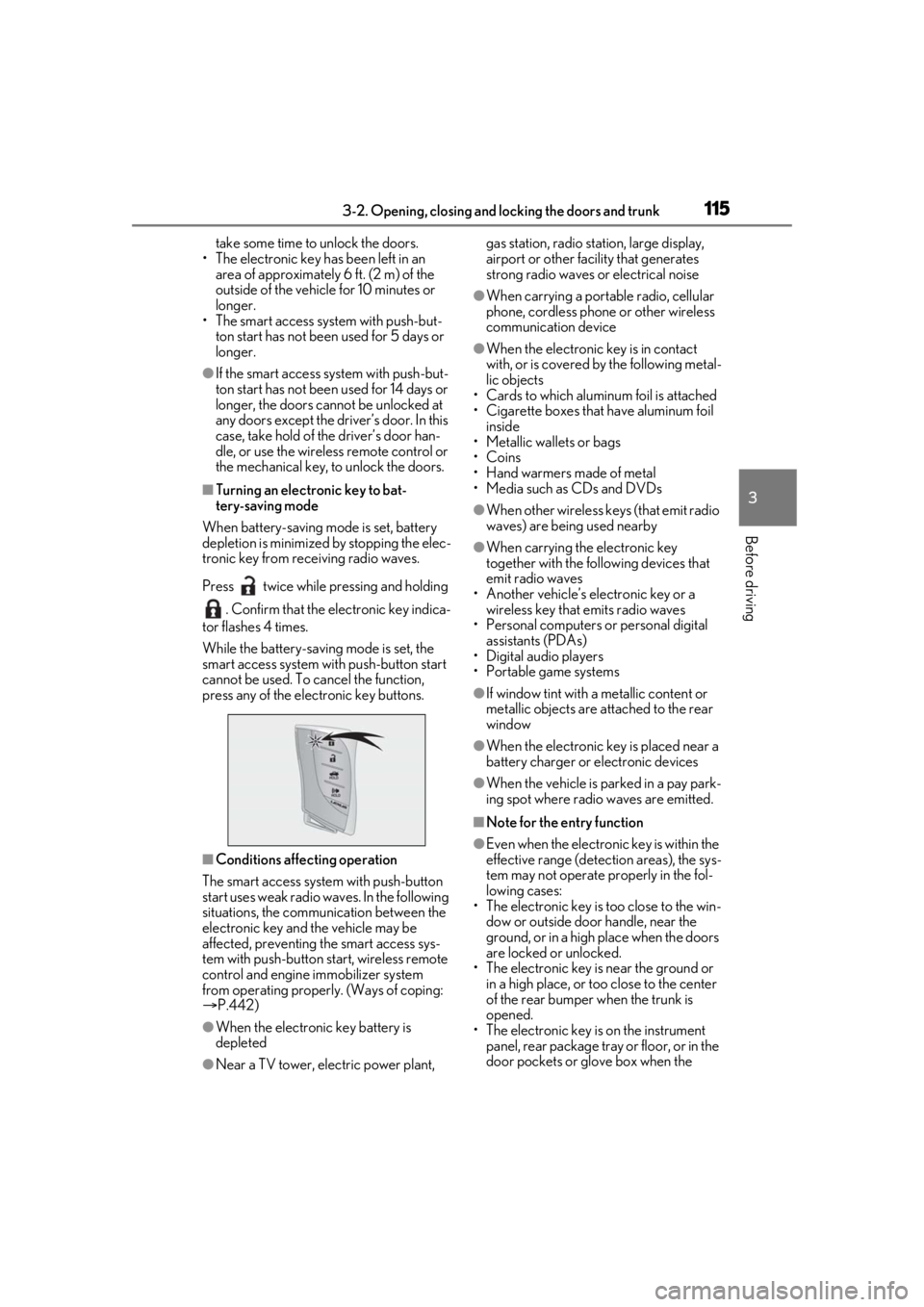
■Turning an electronic key to bat-
tery-saving mode
When battery-saving mode is set, battery
depletion is minimized by stopping the elec-
tronic key from re ceiving radio waves.
Press twice while pressing and holding . Confirm that the electronic key indica-
tor flashes 4 times.
While the battery-saving mode is set, the
smart access system with push-button start
cannot be used. To cancel the function,
press any of the electronic key buttons.
■Conditions affe cting operation
The smart access system with push-button
start uses weak radio waves. In the following
situations, the communication between the
electronic key and the vehicle may be
affected, preventing the smart access sys-
tem with push-button start, wireless remote
control and engine immobilizer system
from operating properly. (Ways of coping:
P.442)
●When the electronic key battery is
depleted
●Near a TV tower, electric power plant, gas station, radio stat
ion, large display,
airport or other fac ility that generates
strong radio waves or electrical noise
●When carrying a portable radio, cellular
phone, cordless phone or other wireless
communication device
●When the electronic key is in contact
with, or is covered by the following metal-
lic objects
• Cards to which aluminum foil is attached
• Cigarette boxes that have aluminum foil
inside
• Metallic wallets or bags
•Coins
• Hand warmers made of metal
• Media such as CDs and DVDs
●When other wireless keys (that emit radio
waves) are being used nearby
●When carrying the electronic key
together with the following devices that
emit radio waves
• Another vehicle’s electronic key or a wireless key that emits radio waves
• Personal computers or personal digital assistants (PDAs)
• Digital audio players
• Portable game systems
●If window tint with a metallic content or
metallic objects are attached to the rear
window
●When the electronic key is placed near a
battery charger or electronic devices
●When the vehicle is parked in a pay park-
ing spot where radio waves are emitted.
■Note for the entry function
●Even when the electronic key is within the
effective range (detection areas), the sys-
tem may not operate properly in the fol-
lowing cases:
• The electronic key is too close to the win- dow or outside door handle, near the
ground, or in a high place when the doors
are locked or unlocked.
• The electronic key is near the ground or in a high place, or too close to the center
of the rear bumper when the trunk is
opened.
• The electronic key is on the instrument
panel, rear package tray or floor, or in the
door pockets or glove box when the