engine LEXUS LS500H 2019 Owners Manual
[x] Cancel search | Manufacturer: LEXUS, Model Year: 2019, Model line: LS500H, Model: LEXUS LS500H 2019Pages: 523, PDF Size: 15.79 MB
Page 4 of 523

4TABLE OF CONTENTS
LS500h_OM_(U)_1809
5-4. Using the interior lightsInterior lights list............................. 341
5-5. Using the storage features List of storage features............... 345
Trunk features................................ 350
5-6. Using the other interior features Other interior features .............. 353
Garage door opener.................. 360
6-1. Maintenance and care Cleaning and protecting the vehi-cle exterior ................................... 368
Cleaning and protecting the vehi- cle interior ..................................... 371
6-2. Maintenance Maintenance requirements ..... 375
General maintenance ................ 376
Emission inspection and mainte- nance (I/M) programs ............ 379
6-3. Do-it-yourself maintenance Do-it-yourself service precautions........................................................... 380
Hood.................................................. 382
Positioning a floor jack............... 382
Engine compartment.................. 384
12-volt battery................................ 390
Tires ................................................... 392
Replacing the tire .......................... 401
Tire inflation pressure ................. 405
Wheels.............................................. 406
Air conditioning filter..................408
Electronic key battery ................ 409
Checking and replacing fuses .. 411
Light bulbs ........................................ 4147-1. Essential information
Emergency flashers ..................... 416
If your vehicle has to be stopped in an emergency ............................. 416
If the vehicle is trapped in rising water ................................................ 417
7-2. Steps to take in an emergency If your vehicle needs to be towed........................................................... 419
If you think something is wrong .......................................................... 423
If a warning light turns on or a warn- ing buzzer sounds...................... 424
If a warning messa ge is displayed
.......................................................... 434
If you have a flat tire .................... 439
If the hybrid syst em will not start
.......................................................... 440
If you lose your keys..................... 442
If the fuel filler door cannot be opened ........................................... 442
If the electronic key does not oper- ate properly ................................. 443
If the 12-volt battery is discharged .......................................................... 445
If your vehicle overheats ........... 450
If the vehicle becomes stuck ... 454
8-1. Specifications Mainte
nance data (fuel, oil level,
etc.) ................................................. 458
Fuel information............................ 468
Tire information ............................ 470
6Maintenance and care
7When trouble arises
8Vehicle specifications
Page 7 of 523

7
LS500h_OM_(U)_1809
hybrid vehicles emit approximately the
same amount of electromagnetic
waves as the conventional gasoline
powered vehicles or home electronic
appliances despite of their electro-
magnetic shielding.
Unwanted noise may occur in the
reception of the mobile two-way radio.
The vehicle is equipped with sophisti-
cated computers that will record cer-
tain data, such as:
The recorded data varies according to
the vehicle grade level and options
with which it is equipped.
These computers do not record con-
versations or sounds, and only record
images outside of the vehicle in certain
situations.
• Engine speed / Electric motor speed (traction motor speed)
• Accelerator status
•Brake status
• Vehicle speed
• Operation status of the driving assist systems, such as the ABS and
pre-collision system
• Images from the front camera (avail- able only when certain safety sys-
tems are activated, which varies
depending on the vehicle specifica-
tions).
Data Transmission
Your vehicle may transmit the data
recorded in these computers to Lexus
without notification to you.
Data usage
Lexus may use the data recorded in this
computer to diagnose malfunctions, con-
duct research and development, and
improve quality.
Lexus will not disclose the recorded data to
a third party except:
• With the consent of the vehicle owner or
with the consent of the lessee if the vehi-
cle is leased
• In response to an official request by the police, a court of law or a government
agency
• For use by Lexus in a lawsuit
• For research purposes where the data is not tied to a specific vehicle or vehicle
owner
Recorded image information can be
erased by your Lexus dealer.
The image recording function can be dis-
abled. However, if the function is disabled,
data from when the pre-collision system
operates will not be available.
To learn more abou t the vehicle data
collected, used and shared by
Lexus, please visit
www.lexus.com/privacyvts/
.
If your Lexus has Lexus Enform and if
you have subscribed to those services,
please refer to the Lexus Enform
Telematics Subscription Service
Agreement for information on data
collected and its usage.
To learn more about the vehicle data
collected, used and shared by Lexus,
please visit
www.lexus.com/privacyvts/
.
Vehicle data recordings
Usage of data collected through Lex-
us Enform (U.S. mainland only)
Page 13 of 523
13Pictorial index
LS500h_OM_(U)_1809
Precautions for winter season .. ...................................................................................P.309
To prevent freezing (windshield wiper de-icer)
*.................................................P.328
Precautions for car wash ............................................................................................... P.369
Fuel filler door .......................................................................................................... P.197
Refueling method ............................................................................................................... P.197
Fuel type/fuel tank capacity ...... ................................................................................... P.459
Tires.......................................................................................................................... ..P.392
Tire size/inflation pressure ............................ ....................................................P.392, 464
Winter tires/tire chains ..................................................................................................P.309
Checking/rotation/tire pressure warning system.............................................. P.392
Coping with flat tires........................................................................................................ P .439
Hood ......................................................................................................................... P. 382
Opening ........................................................................................................................ .......P.382
Engine compartment cover .........................................................................................P.385
Engine oil ..................................................................................................................... .........P.460
Coping with overheating ...............................................................................................P.450
Warning messages .......................................................................................................... P.434
Headlights/cornering lights ................................................................................ P.187
Parking lights/daytime running lights............................................................... P.187
Turn signal lights ......................................................................................................P.182
Tail lights .................................................................................................................... P.187
Stop lights
Hill-start assist control ....................................................................................................P. 302
License plate lights ................................................................................................. P.187
Back-up lights
Changing the shift position to R....................................................................................P.176
Side marker lights ................................................................................................... P.187
*:If equipped
Light bulbs of the exterior lights for driving
(Replacing method: P.414)
E
F
G
H
I
J
K
L
M
N
Page 31 of 523

311-1. For safe use
LS500h_OM_(U)_1809
1
For safety and security
Driver’s seat position sensor
Driver’s seat belt buckle switch
Airbag sensor assembly
Front impact sensors
Pop Up Hood computer assembly
Your vehicle is equipped with ADVANCED AIRBAGS designed based on the US
motor vehicle safety standards (FMVSS208). The airbag sensor assembly (ECU)
controls airbag deployment based on information obtained from the sensors etc.
shown in the system components diagram above. This information includes crash
severity and occupant information. As the airbags deploy, a chemical reaction in
the inflators quickly fills the airbags with no n-toxic gas to help restrain the motion of
the occupants.
■If the SRS airbags deploy (inflate)
●Slight abrasions, burns, bruising etc., may
be sustained from SRS airbags, due to the
extremely high speed deployment (infla-
tion) by hot gases.
●A loud noise and white powder will be
emitted.
●Parts of the airbag module (steering
wheel hub, airbag cover and inflator) as
well as the seats, parts of the front and
rear pillars, and roof side rails, may be hot
for several minutes. The airbag itself may
also be hot.
●The windshield may crack.
●The hybrid system will be stopped and
fuel supply to the engine will be stopped.
( P.69)
●All of the doors will be unlocked.
( P.113)
●The brakes and stop lights will be con-
trolled automatically. ( P.302)
●The interior lights will turn on automati-
cally. ( P.343)
●The emergency flashers will be turned on
automatically. ( P.416)
●For Lexus Enform Safety Connect sub-
scribers, if any of the following situations
occur, the system is designed to send an
emergency call to the response center,
notifying them of the vehicle’s location (without needing to push the “SOS” but-
ton) and an agent will attempt to speak
with the occupants to ascertain the level
of emergency and assistance required. If
the occupants are unable to communi-
cate, the agent automatically treats the
call as an emergency and helps to dis-
patch the necessary emergency services.
(
P.58)
• An SRS airbag is deployed.
• A seat belt pretensioner is activated.
• The vehicle is involved in a severe rear-end collision.
■PCS-linked SRS airbag deployment
control (vehicles with Lexus Safety Sys-
tem + A)
If the PCS (Pre-Collision System) deter-
mines that the possibility of a side collision is
high, the SRS side and curtain shield air-
bags will be prepared to operate.
■SRS airbag deployment conditions (SRS
front airbags/SRS seat cushion airbags)
●The SRS front airbags and SRS seat cush-
ion airbags will deploy in the event of an
impact that exceed s the set threshold
level (the level of fo rce corresponding to
an approximately 12 - 18 mph [20 - 30
km/h] frontal collision with a fixed wall
that does not move or deform).
However, this threshol d velocity will be
considerably higher in the following situa-
tions:
P
Q
R
S
T
Page 38 of 523
381-1. For safe use
LS500h_OM_(U)_1809
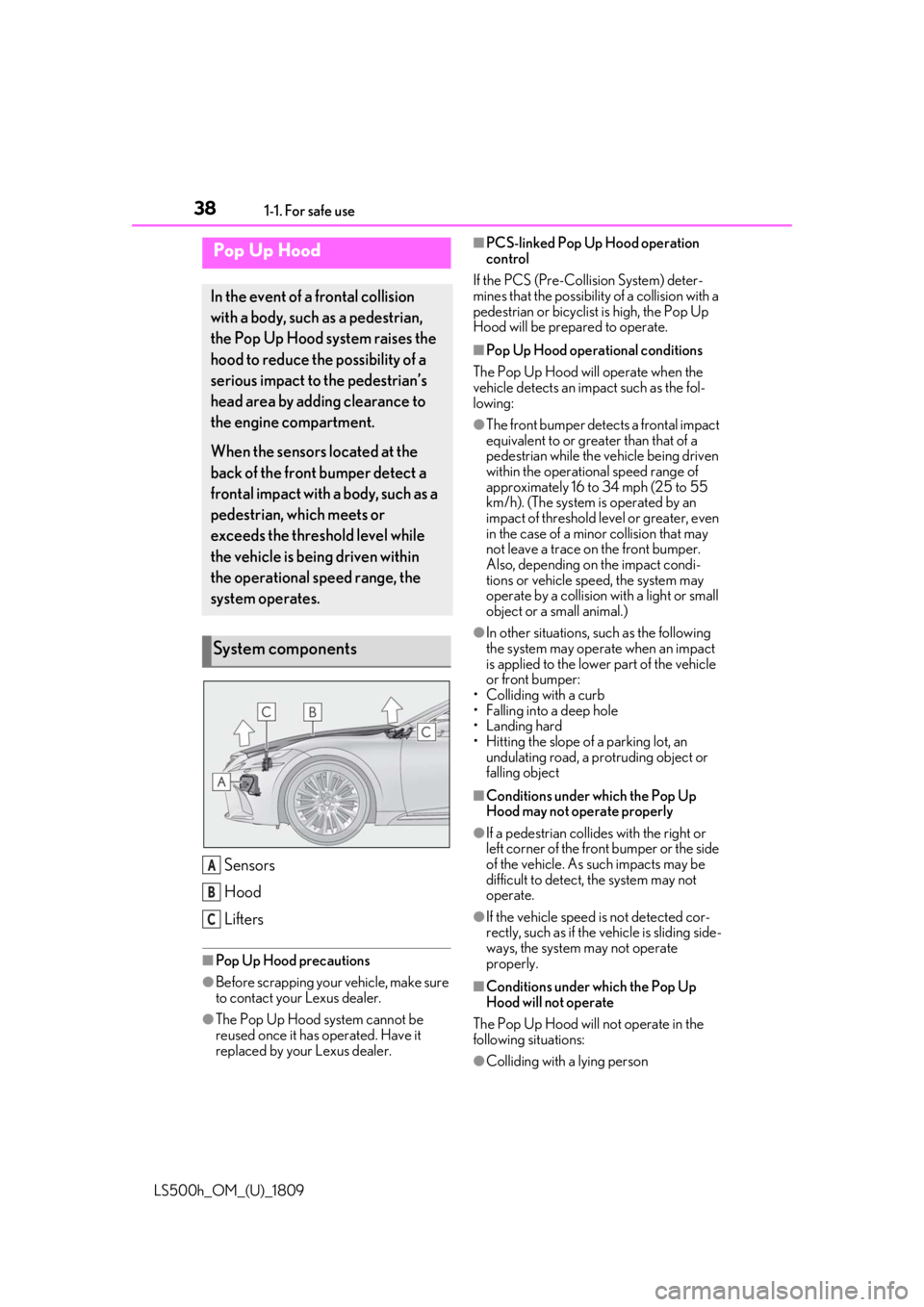
Sensors
Hood
Lifters
■Pop Up Hood precautions
●Before scrapping your vehicle, make sure
to contact your Lexus dealer.
●The Pop Up Hood system cannot be
reused once it has operated. Have it
replaced by your Lexus dealer.
■PCS-linked Pop Up Hood operation
control
If the PCS (Pre-Collision System) deter-
mines that the possibilit y of a collision with a
pedestrian or bicyclist is high, the Pop Up
Hood will be prepared to operate.
■Pop Up Hood operational conditions
The Pop Up Hood will operate when the
vehicle detects an impact such as the fol-
lowing:
●The front bumper detects a frontal impact
equivalent to or grea ter than that of a
pedestrian while the vehicle being driven
within the operational speed range of
approximately 16 to 34 mph (25 to 55
km/h). (The system is operated by an
impact of threshold level or greater, even
in the case of a minor collision that may
not leave a trace on the front bumper.
Also, depending on the impact condi-
tions or vehicle speed, the system may
operate by a collision with a light or small
object or a small animal.)
●In other situations, such as the following
the system may operate when an impact
is applied to the lower part of the vehicle
or front bumper:
• Colliding with a curb
• Falling into a deep hole
•Landing hard
• Hitting the slope of a parking lot, an undulating road, a pr otruding object or
falling object
■Conditions under which the Pop Up
Hood may not operate properly
●If a pedestrian collides with the right or
left corner of the front bumper or the side
of the vehicle. As such impacts may be
difficult to detect, the system may not
operate.
●If the vehicle speed is not detected cor-
rectly, such as if the vehicle is sliding side-
ways, the system may not operate
properly.
■Conditions under which the Pop Up
Hood will not operate
The Pop Up Hood will not operate in the
following situations:
●Colliding with a lying person
Pop Up Hood
In the event of a frontal collision
with a body, such as a pedestrian,
the Pop Up Hood system raises the
hood to reduce the possibility of a
serious impact to the pedestrian’s
head area by adding clearance to
the engine compartment.
When the sensors located at the
back of the front bumper detect a
frontal impact with a body, such as a
pedestrian, which meets or
exceeds the threshold level while
the vehicle is being driven within
the operational speed range, the
system operates.
System components
A
B
C
Page 63 of 523
631-4. Hybrid system
LS500h_OM_(U)_1809
1
For safety and security
1-4.Hybrid system
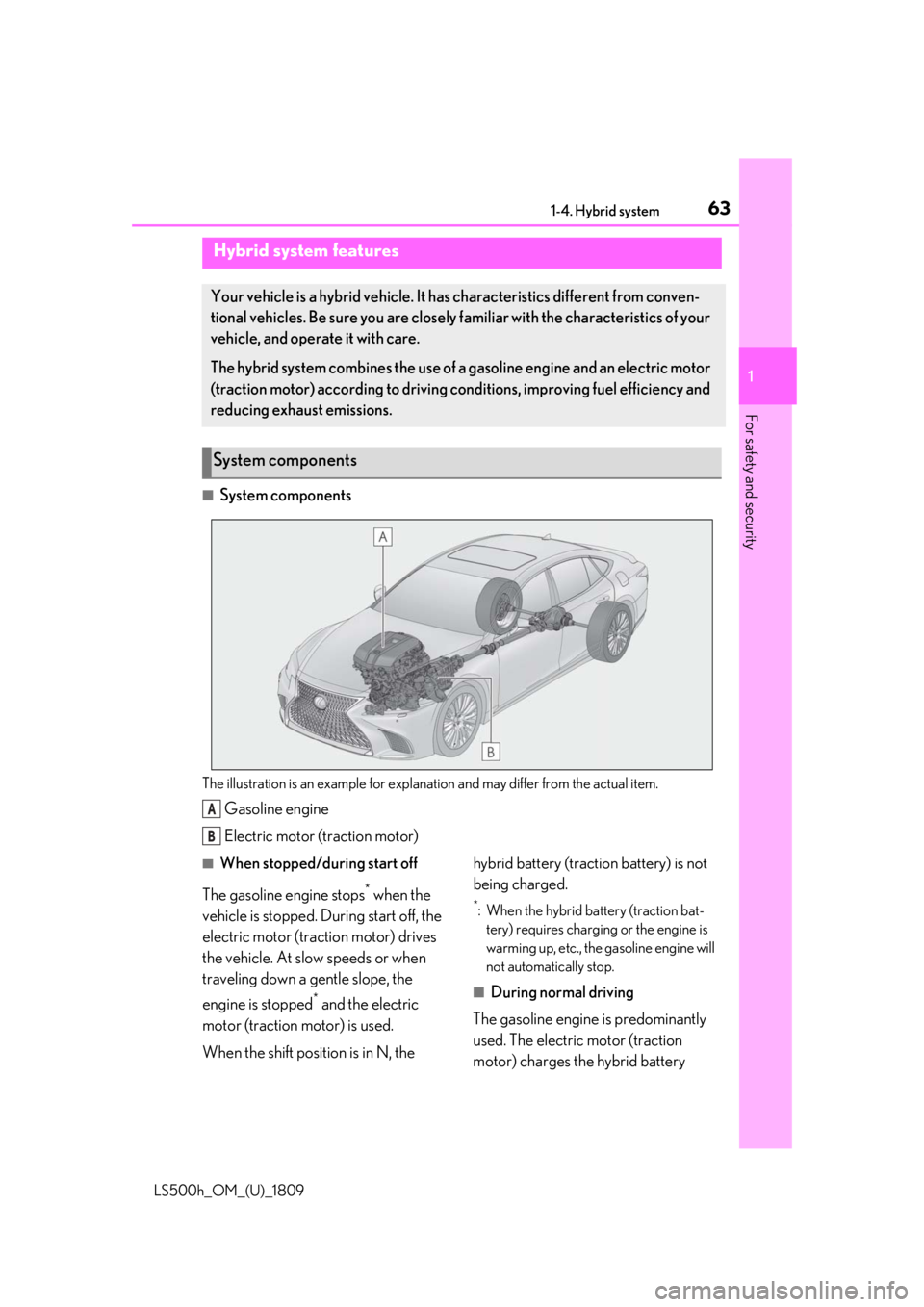
■System components
The illustration is an example for explanation and may differ from the actual item.
Gasoline engine
Electric motor (traction motor)
■When stopped/during start off
The gasoline engine stops
* when the
vehicle is stopped. During start off, the
electric motor (traction motor) drives
the vehicle. At slow speeds or when
traveling down a gentle slope, the
engine is stopped
* and the electric
motor (traction motor) is used.
When the shift position is in N, the hybrid battery (traction battery) is not
being charged.
*: When the hybrid battery (traction bat-
tery) requires charging or the engine is
warming up, etc., the gasoline engine will
not automatically stop.
■During normal driving
The gasoline engine is predominantly
used. The electric motor (traction
motor) charges the hybrid battery
Hybrid system features
Your vehicle is a hybrid vehicle. It has characteristics different from conven-
tional vehicles. Be sure you are closely familiar with the characteristics of your
vehicle, and operate it with care.
The hybrid system combines the use of a gasoline engine and an electric motor
(traction motor) according to driving conditions, improving fuel efficiency and
reducing exhaust emissions.
System components
A
B
Page 64 of 523
641-4. Hybrid system
LS500h_OM_(U)_1809
(traction battery) as necessary.
■When accelerating sharply
When the accelerator pedal is
depressed heavily, the power of the
hybrid battery (traction battery) is
added to that of the gasoline engine via
the electric motor (traction motor).
■When braking (regenerative brak-
ing)
The wheels operate the electric motor
(traction motor) as a power generator,
and the hybrid battery (traction bat-
tery) is charged.
■Regenerative braking
In the following situations, kinetic energy is
converted to electric energy and decelera-
tion force can be obta ined in conjunction
with the recharging of the hybrid battery
(traction battery).
●The accelerator pedal is released while
driving with the shift position in D or M.
●The brake pedal is depressed while driv-
ing with the shift position in D or M.
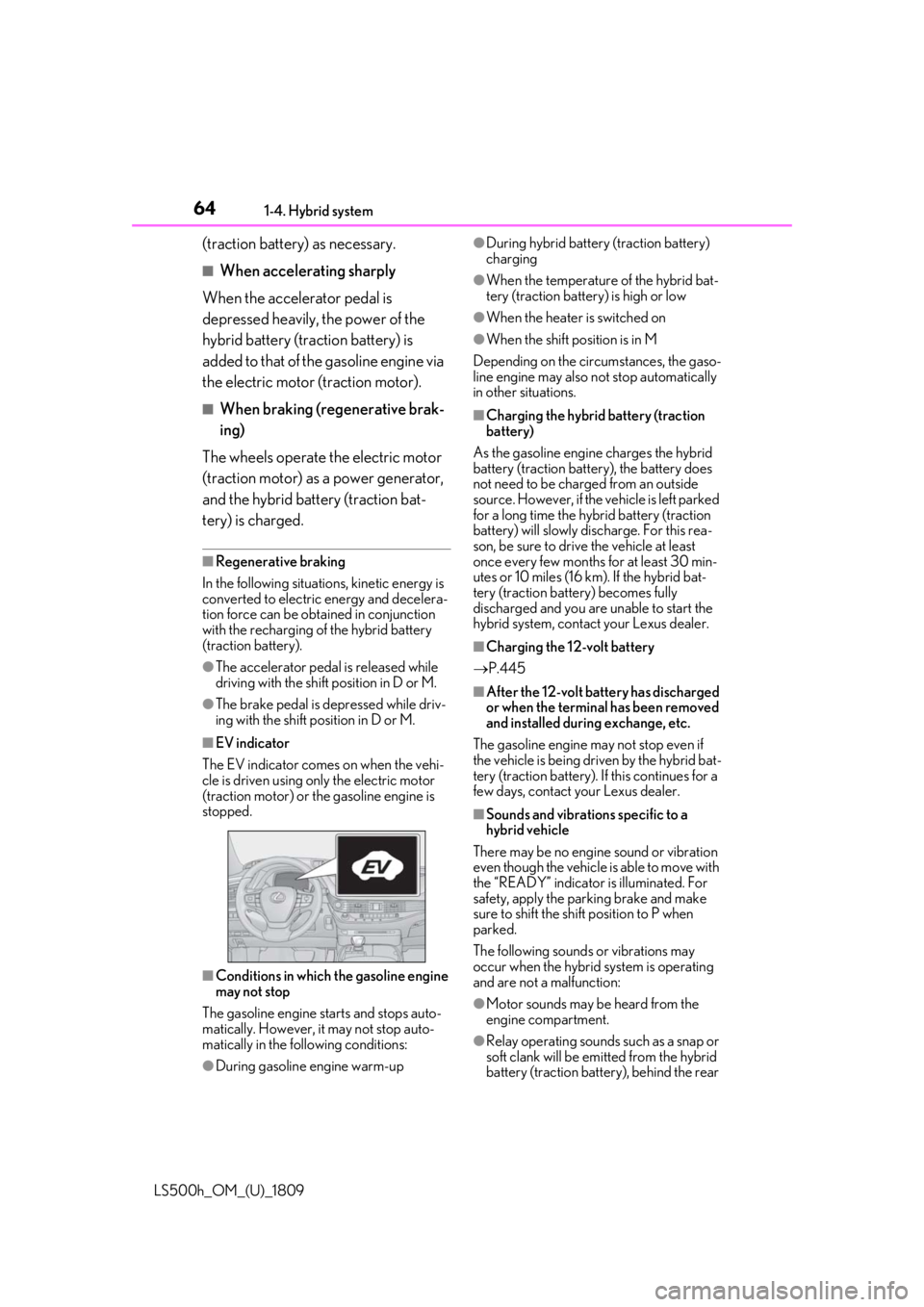
■EV indicator
The EV indicator comes on when the vehi-
cle is driven using only the electric motor
(traction motor) or th e gasoline engine is
stopped.
■Conditions in which the gasoline engine
may not stop
The gasoline engine starts and stops auto-
matically. However, it may not stop auto-
matically in the following conditions:
●During gasoline engine warm-up
●During hybrid battery (traction battery)
charging
●When the temperature of the hybrid bat-
tery (traction battery) is high or low
●When the heater is switched on
●When the shift position is in M
Depending on the circumstances, the gaso-
line engine may also not stop automatically
in other situations.
■Charging the hybrid battery (traction
battery)
As the gasoline engine charges the hybrid
battery (traction battery), the battery does
not need to be charged from an outside
source. However, if the vehicle is left parked
for a long time the hybrid battery (traction
battery) will slowly discharge. For this rea-
son, be sure to drive the vehicle at least
once every few months for at least 30 min-
utes or 10 miles (16 km ). If the hybrid bat-
tery (traction battery) becomes fully
discharged and you are unable to start the
hybrid system, contact your Lexus dealer.
■Charging the 12-volt battery
P.445
■After the 12-volt battery has discharged
or when the terminal has been removed
and installed during exchange, etc.
The gasoline engine may not stop even if
the vehicle is being driven by the hybrid bat-
tery (traction battery). If this continues for a
few days, contact your Lexus dealer.
■Sounds and vibrations specific to a
hybrid vehicle
There may be no engine sound or vibration
even though the vehicle is able to move with
the “READY” indicator is illuminated. For
safety, apply the parking brake and make
sure to shift the shift position to P when
parked.
The following sounds or vibrations may
occur when the hybrid system is operating
and are not a malfunction:
●Motor sounds may be heard from the
engine compartment.
●Relay operating sounds such as a snap or
soft clank will be em itted from the hybrid
battery (traction battery), behind the rear
Page 65 of 523

651-4. Hybrid system
LS500h_OM_(U)_1809
1
For safety and security
seats, when the hybrid system is started
or stopped.
●Sounds may be heard from the hybrid
battery (traction battery) behind the rear
seats when the hybrid system starts or
stops.
●Sounds from the hybrid system may be
heard when the trunk lid is open.
●Sounds may be heard from the transmis-
sion when the gasoline engine starts or
stops, when driving at low speeds, or
during idling.
●Engine sounds may be heard when
accelerating sharply.
●Sounds may be heard due to regenera-
tive braking when the brake pedal is
depressed or as the accelerator pedal is
released.
●Vibration may be felt or sounds may be
heard when the gasoline engine starts or
stops.
●Cooling fan sounds may be heard from
the air intake vents on the both sides of
the rear seatback.
■Maintenance, repair, recycling, and dis-
posal
Contact your Lexus dealer regarding main-
tenance, repair, recycling and disposal. Do
not dispose of the vehicle yourself.
■Customization
Some functions can be customized.
( P.479)
When driving with the gasoline engine
stopped, a sound, which changes in
accordance with the driving speed, will
be played in order to warn people
nearby of the vehicle’s approach. The
sound will stop when the vehicle speed
exceeds approximately 15 mph (25
km/h).
■Vehicle proximity notification system
In the following cases, the vehicle proximity
notification system may be difficult for sur-
rounding people to hear.
●In very noisy areas
●In the wind or the rain
Also, as the vehicle proximity notification
system is installed on the front of the vehicle,
it may be more difficult to hear from the rear
of the vehicle compared to the front.
■Customization
Some functions can be customized.
( P.479)
Vehicle proximity notification
system
Page 77 of 523
772-1. Instrument cluster
LS500h_OM_(U)_1809
2
Vehicle status information and indicators
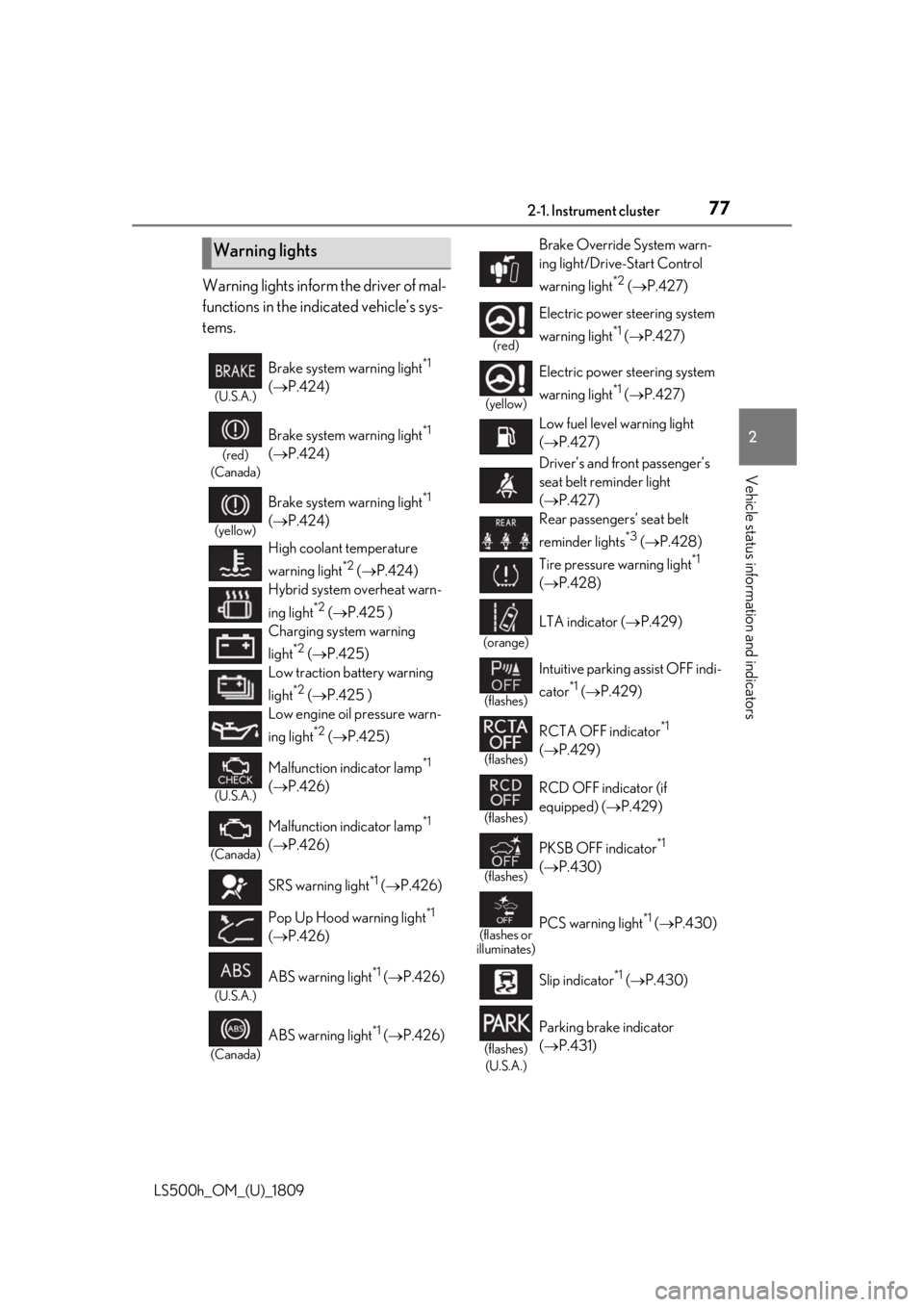
Warning lights inform the driver of mal-
functions in the indicated vehicle’s sys-
tems.
Warning lights
(U.S.A.)
Brake system warning light*1
( P.424)
(red)
(Canada)
Brake system warning light*1
( P.424)
(yellow)
Brake system warning light*1
( P.424)
High coolant temperature
warning light
*2 ( P.424)
Hybrid system overheat warn-
ing light
*2 ( P.425 )
Charging system warning
light
*2 ( P.425)
Low traction battery warning
light
*2 ( P.425 )
Low engine oil pressure warn-
ing light
*2 ( P.425)
(U.S.A.)
Malfunction indicator lamp*1
( P.426)
(Canada)
Malfunction indicator lamp*1
( P.426)
SRS warning light
*1 ( P.426)
Pop Up Hood warning light
*1
( P.426)
(U.S.A.)
ABS warning light*1 ( P.426)
(Canada)
ABS warning light*1 ( P.426)
Brake Override System warn-
ing light/Drive-Start Control
warning light
*2 ( P.427)
(red)
Electric power steering system
warning light
*1 ( P.427)
(yellow)
Electric power steering system
warning light
*1 ( P.427)
Low fuel level warning light
( P.427)
Driver’s and front passenger’s
seat belt reminder light
( P.427)
Rear passengers’ seat belt
reminder lights
*3 ( P.428)
Tire pressure warning light
*1
( P.428)
(orange)
LTA indicator ( P.429)
(flashes)
Intuitive parking assist OFF indi-
cator
*1 ( P.429)
(flashes)
RCTA OFF indicator*1
( P.429)
(flashes)
RCD OFF indicator (if
equipped) ( P.429)
(flashes)
PKSB OFF indicator*1
( P.430)
(flashes or
illuminates)PCS warning light*1 ( P.430)
Slip indicator
*1 ( P.430)
(flashes)
(U.S.A.)
Parking brake indicator
( P.431)
Page 81 of 523
812-1. Instrument cluster
LS500h_OM_(U)_1809
2
Vehicle status information and indicators
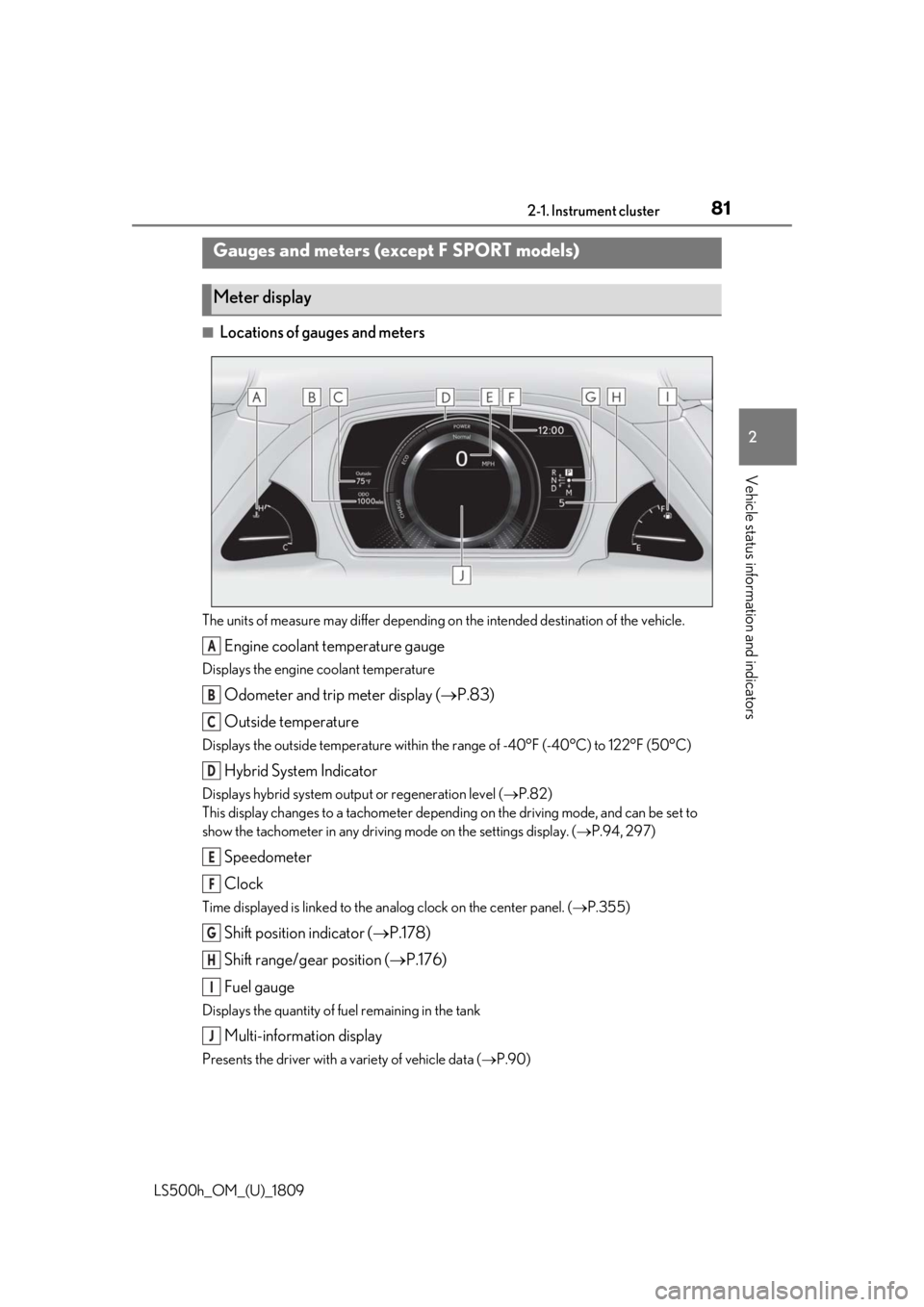
■Locations of gauges and meters
The units of measure may differ depending on the intended destination of the vehicle.
Engine coolant temperature gauge
Displays the engine coolant temperature
Odometer and trip meter display (P.83)
Outside temperature
Displays the outside temperature within the range of -40°F (-40°C) to 122°F (50°C)
Hybrid System Indicator
Displays hybrid system outp ut or regeneration level (P.82)
This display changes to a tachometer depending on the driving mode, and can be set to
show the tachometer in any driving mode on the settings display. ( P.94, 297)
Speedometer
Clock
Time displayed is linked to the analog clock on the center panel. (P.355)
Shift position indicator ( P.178)
Shift range/gear position ( P.176)
Fuel gauge
Displays the quantity of fuel remaining in the tank
Multi-information display
Presents the driver with a variety of vehicle data ( P.90)
Gauges and meters (except F SPORT models)
Meter display
A
B
C
D
E
F
G
H
I
J