belt LEXUS LS600H 2015 Owner's Guide
[x] Cancel search | Manufacturer: LEXUS, Model Year: 2015, Model line: LS600H, Model: LEXUS LS600H 2015Pages: 620, PDF Size: 7.66 MB
Page 64 of 620
621-1. For safe use
LS600hL_U(OM50E41U)
Studies have shown that installing a child restraint on a rear seat is much
safer than installing one on the front passenger seat.
●Choose a child restraint system that suits your vehicle and is appropri-
ate to the age and size of the child.
●For installation details, follow the instructions provided with the child
restraint system.
General installation instructions are provided in this manual. ( P. 6 6 )
Child restraint systems
A child restraint system for a small ch ild or baby must itself be properly
restrained on the seat with the LATCH anchors or the lap portion of the
lap/shoulder belt.
The laws of all 50 states of the U .S.A. and Canada now require the use
of child restraint systems.
Points to remember
Page 65 of 620
631-1. For safe use
1
For safety and security
LS600hL_U(OM50E41U)
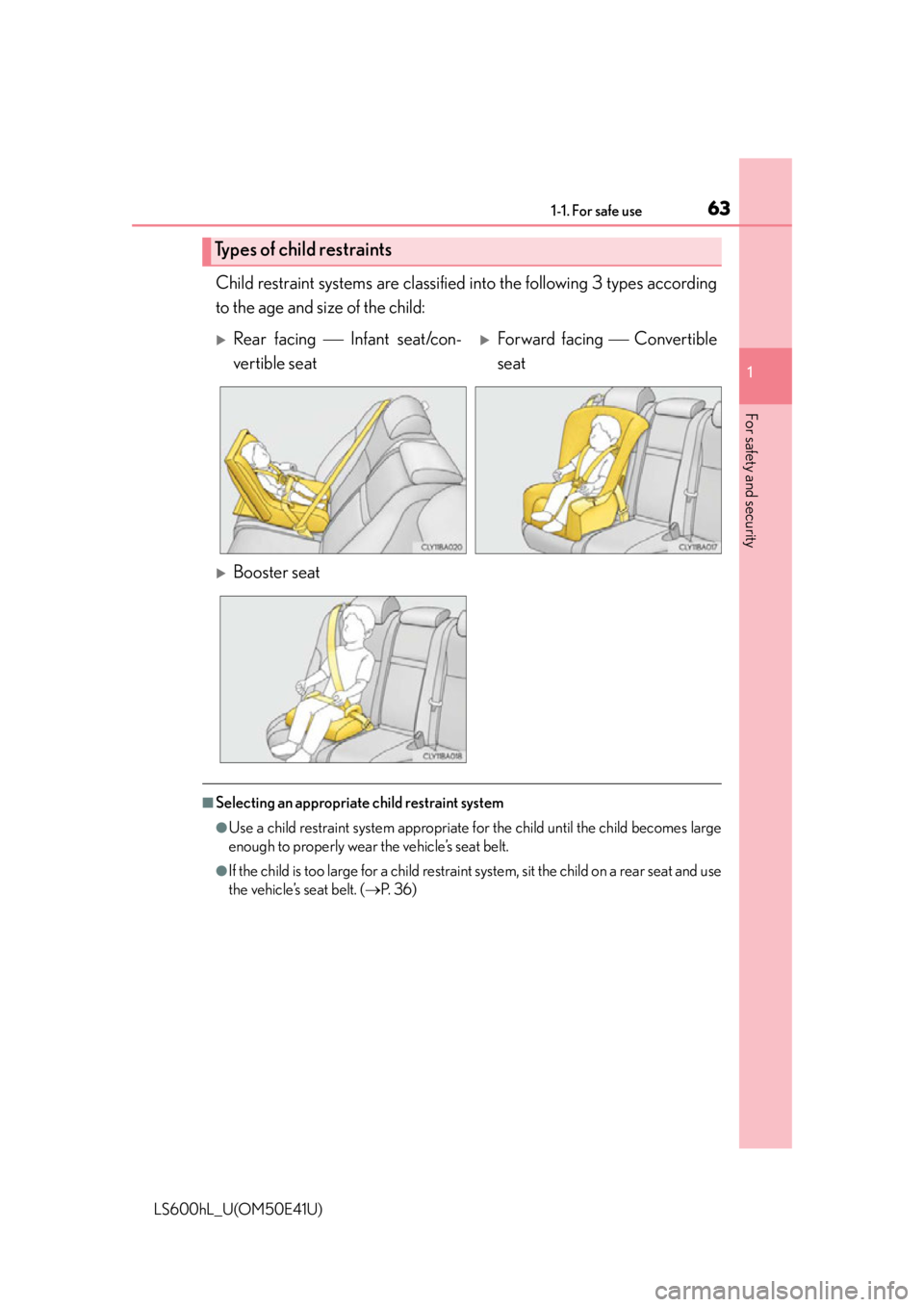
Child restraint systems are classified into the following 3 types according
to the age and size of the child:
■Selecting an appropriate child restraint system
●Use a child restraint system appropriate for the child until the child becomes large
enough to properly wear the vehicle’s seat belt.
●If the child is too large for a child restraint system, sit the child on a rear seat and use
the vehicle’s seat belt. ( P. 3 6 )
Types of child restraints
Rear facing Infant seat/con-
vertible seatForward facing Convertible
seat
Booster seat
Page 66 of 620
641-1. For safe use
LS600hL_U(OM50E41U)
CAUTION
■Child restraint precautions
●For effective protection in automobile accidents and sudden stops, a child must
be properly restrained, using a seat belt or child restraint system depending on
the age and size of the child. Holding a child in your arms is not a substitute for a
child restraint system. In an accident, the child can be crushed against the wind-
shield, or between you and the vehicle’s interior.
●Lexus strongly urges the use of a proper child restraint system that conforms to
the size of the child, installed on the rear seat. According to accident statistics, the
child is safer when properly restrained in the rear seat than in the front seat.
●Never install a rear-facing child restraint system on the front passenger seat even
if the “AIR BAG OFF” indicator light is illuminated.
In the event of an accident, the force of the rapid inflation of the front passenger
airbag can cause death or serious injury to the child if the rear-facing child
restraint system is installed on the front passenger seat.
●A forward-facing child restraint system may be installed on the front passenger
seat only when it is unavoidable. A child restraint system that requires a top tether
strap should not be used in the front passenger seat since there is no top tether
strap anchor for the front passenger seat. Adjust the seatback as upright as possi-
ble and always move the seat as far back as possible even if the “AIR BAG OFF”
indicator light is illuminated, because the front passenger airbag could inflate with
considerable speed and force. Otherwise, the child may be killed or seriously
injured.
●Do not use the seat belt extender when in stalling a child restraint system on the
front or rear passenger seat. If installing a child restraint system with the seat belt
extender connected to the seat belt, the seat belt will not securely hold the child
restraint system, which could cause death or serious injury to the child or other
passengers in the event of an accident.
●Do not allow the child to lean his/her head or any part of his/her body against the
door or the area of the seat, front and rear pillars or roof side rails from which the
SRS side airbags or SRS curtain shield airbags deploy even if the child is seated in
the child restraint system. It is dangerou s if the SRS side airbags and curtain shield
airbags inflate, and the impact could cause death or serious injury to the child.
●Make sure you have complied with all installation instructions provided by the
child restraint manufacturer and that the sy stem is properly secured. If it is not
secured properly, it may cause death or seri ous injury to the child in the event of a
sudden stop or accident.
Page 67 of 620
651-1. For safe use
1
For safety and security
LS600hL_U(OM50E41U)
CAUTION
■When children are in the vehicle
Do not allow children to play with the seat belt. If the seat belt becomes twisted
around a child’s neck, it may lead to choking or other serious injuries that could
result in death.
If this occurs and the buckle cannot be unfastened, scissors should be used to cut
the belt.
■When the child restraint system is not in use
●Keep the child restraint system properly secu red on the seat even if it is not in use.
Do not store the child restraint system unsecured in the passenger compartment.
●If it is necessary to detach the child restraint system, remove it from the vehicle or
store it securely in the trunk. This will prevent it from injuring passengers in the
event of a sudden stop or accident.
Page 68 of 620
661-1. For safe use
LS600hL_U(OM50E41U)
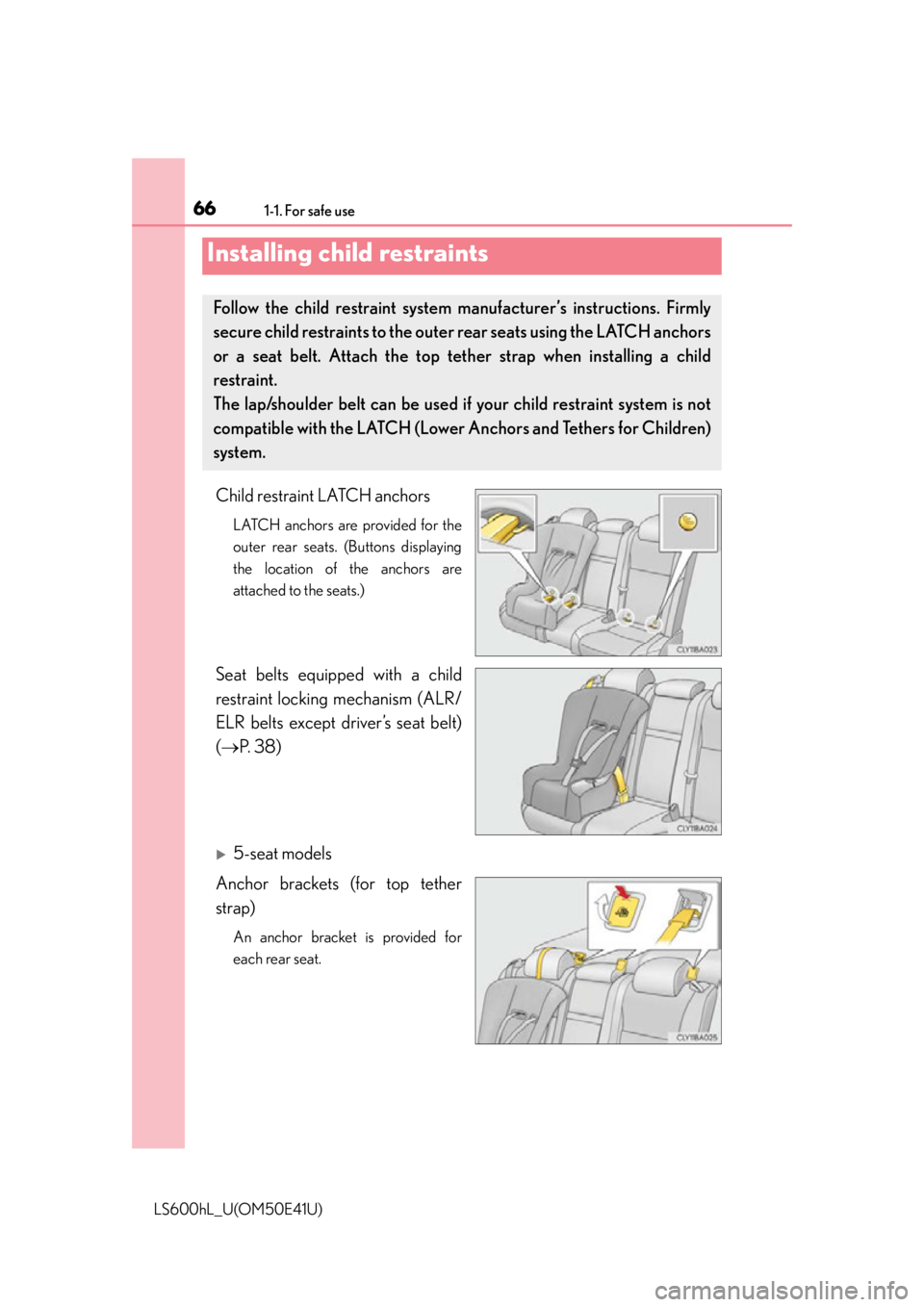
Child restraint LATCH anchors
LATCH anchors are provided for the
outer rear seats. (Buttons displaying
the location of the anchors are
attached to the seats.)
Seat belts equipped with a child
restraint locking mechanism (ALR/
ELR belts except driver’s seat belt)
(P. 38)
5-seat models
Anchor brackets (for top tether
strap)
An anchor bracket is provided for
each rear seat.
Installing child restraints
Follow the child restraint system manufacturer’s instructions. Firmly
secure child restraints to the outer rear seats using the LATCH anchors
or a seat belt. Attach the top tether strap when installing a child
restraint.
The lap/shoulder belt can be used if your child restraint system is not
compatible with the LATCH (Lower Anchors and Tethers for Children)
system.
Page 71 of 620
691-1. For safe use
1
For safety and security
LS600hL_U(OM50E41U)
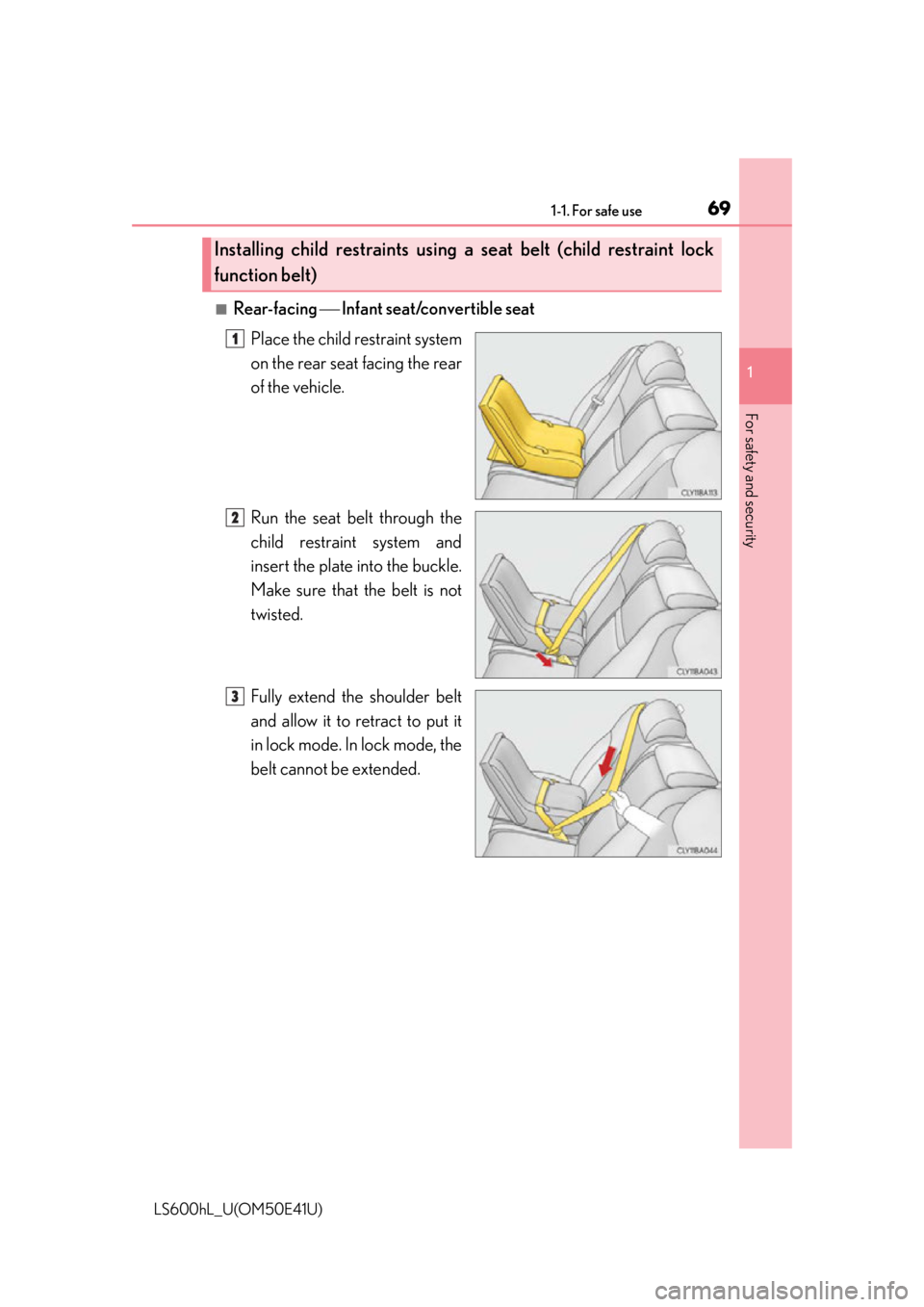
■Rear-facing Infant seat/convertible seat
Place the child restraint system
on the rear seat facing the rear
of the vehicle.
Run the seat belt through the
child restraint system and
insert the plate into the buckle.
Make sure that the belt is not
twisted.
Fully extend the shoulder belt
and allow it to retract to put it
in lock mode. In lock mode, the
belt cannot be extended.
Installing child restraints using a seat belt (child restraint lock
function belt)
1
2
3
Page 72 of 620
701-1. For safe use
LS600hL_U(OM50E41U)
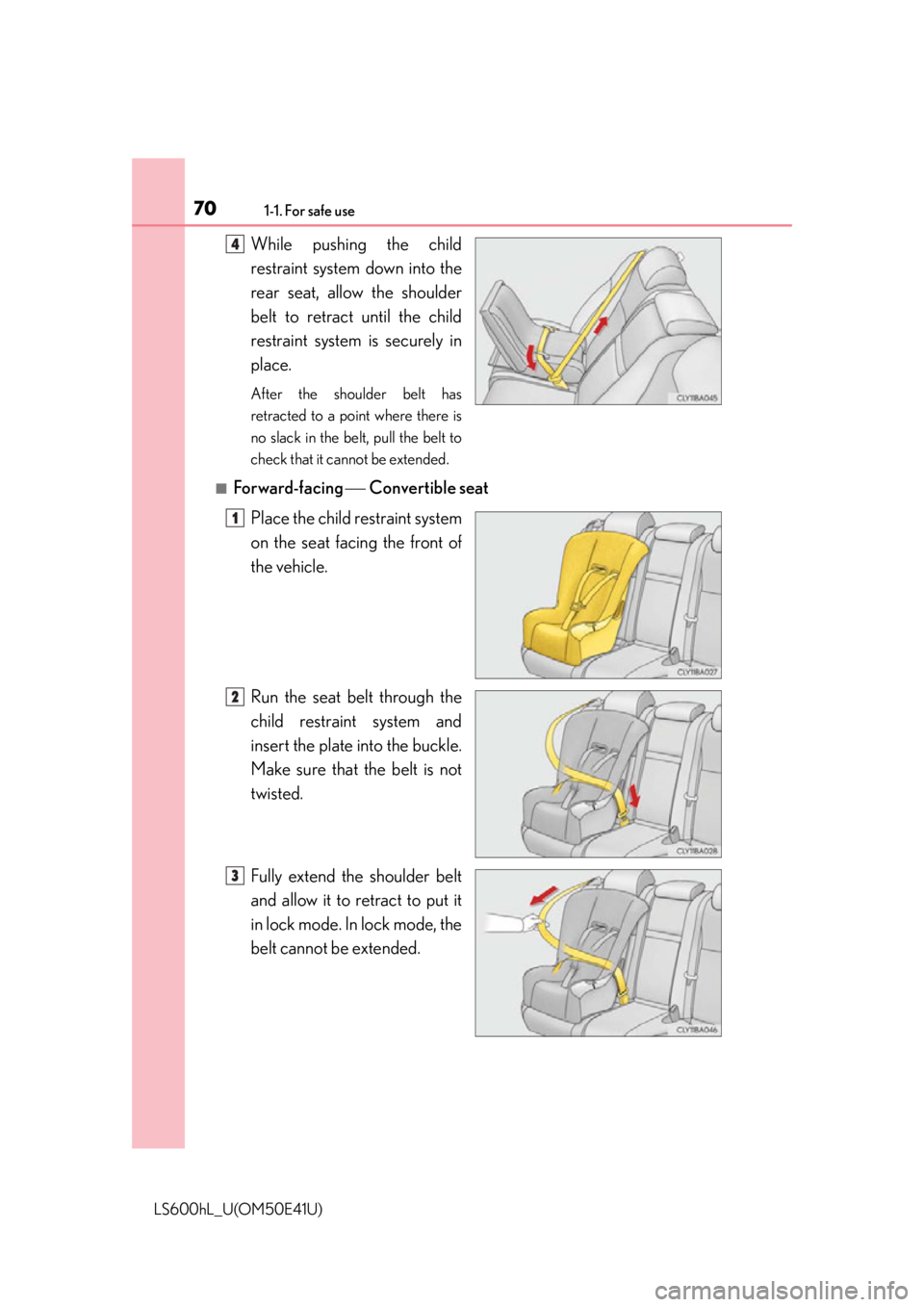
While pushing the child
restraint system down into the
rear seat, allow the shoulder
belt to retract until the child
restraint system is securely in
place.
After the shoulder belt has
retracted to a point where there is
no slack in the belt, pull the belt to
check that it cannot be extended.
■Forward-facing Convertible seat
Place the child restraint system
on the seat facing the front of
the vehicle.
Run the seat belt through the
child restraint system and
insert the plate into the buckle.
Make sure that the belt is not
twisted.
Fully extend the shoulder belt
and allow it to retract to put it
in lock mode. In lock mode, the
belt cannot be extended.
4
1
2
3
Page 73 of 620
711-1. For safe use
1
For safety and security
LS600hL_U(OM50E41U)
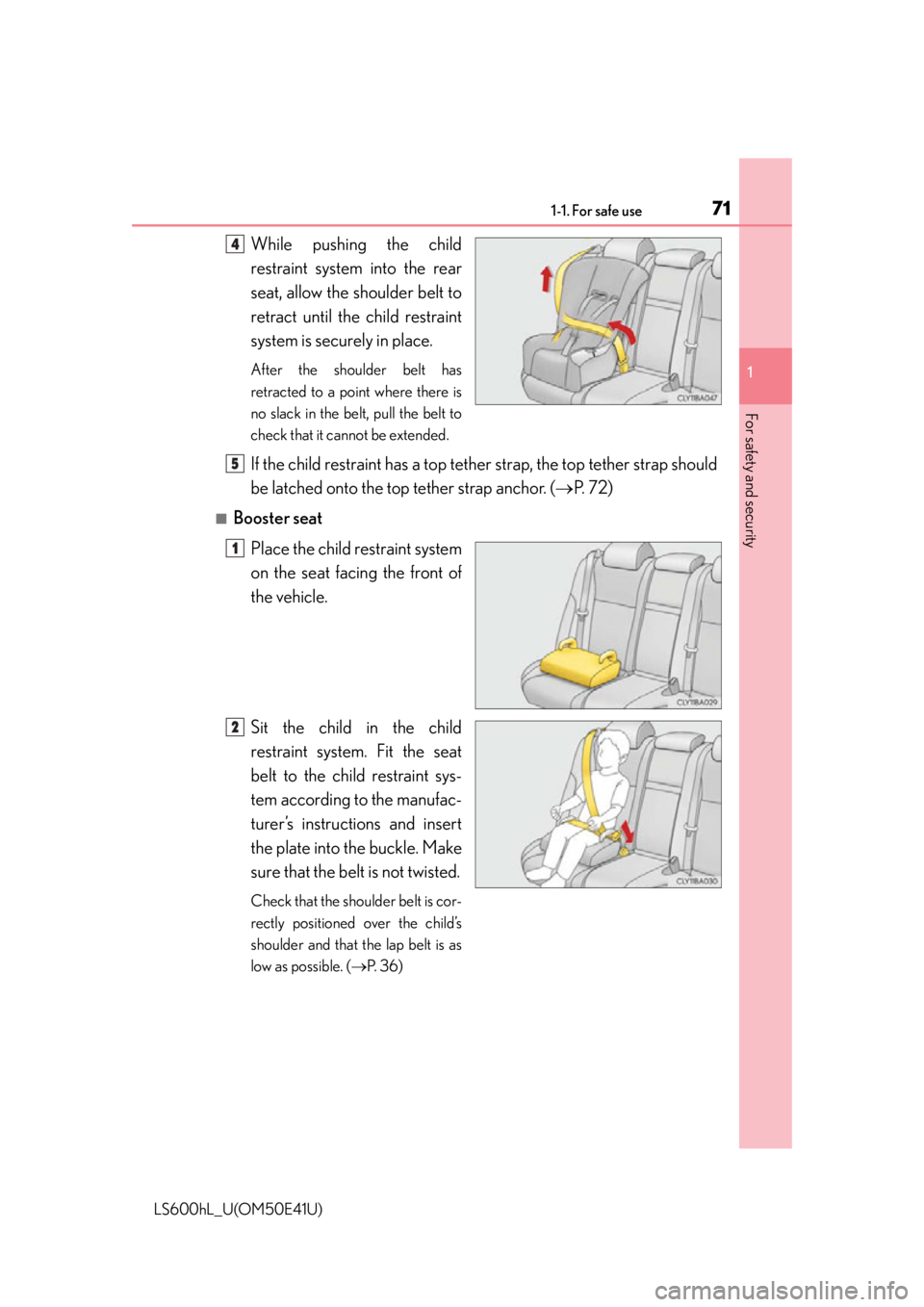
While pushing the child
restraint system into the rear
seat, allow the shoulder belt to
retract until the child restraint
system is securely in place.
After the shoulder belt has
retracted to a point where there is
no slack in the belt, pull the belt to
check that it cannot be extended.
If the child restraint has a top tether strap, the top tether strap should
be latched onto the top tether strap anchor. ( P. 7 2 )
■Booster seat
Place the child restraint system
on the seat facing the front of
the vehicle.
Sit the child in the child
restraint system. Fit the seat
belt to the child restraint sys-
tem according to the manufac-
turer’s instructions and insert
the plate into the buckle. Make
sure that the belt is not twisted.
Check that the shoulder belt is cor-
rectly positioned over the child’s
shoulder and that the lap belt is as
low as possible. ( P. 3 6 )
4
5
1
2
Page 74 of 620
721-1. For safe use
LS600hL_U(OM50E41U)
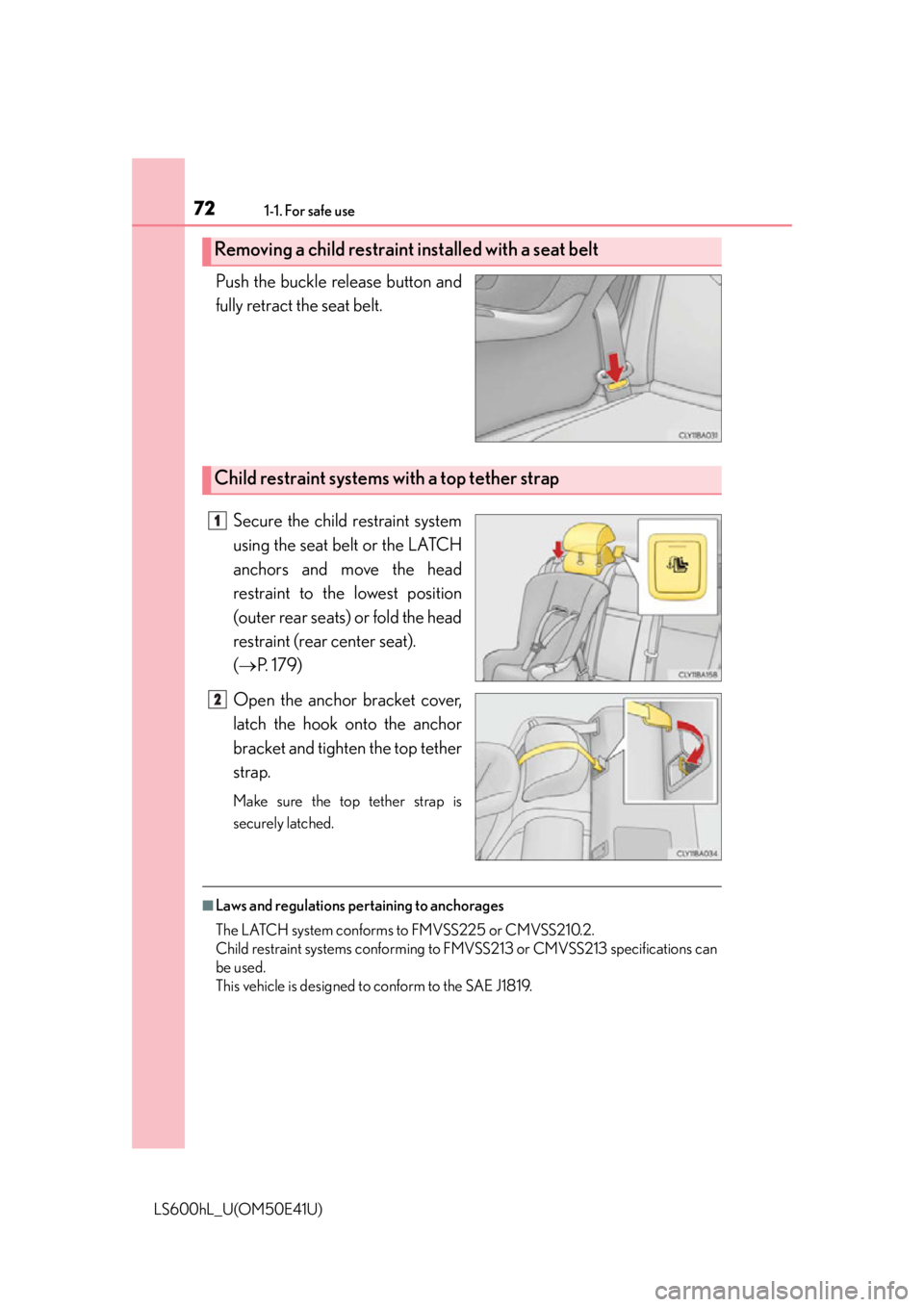
Push the buckle release button and
fully retract the seat belt. Secure the child restraint system
using the seat belt or the LATCH
anchors and move the head
restraint to the lowest position
(outer rear seats) or fold the head
restraint (rear center seat).
( P. 1 7 9 )
Open the anchor bracket cover,
latch the hook onto the anchor
bracket and tighten the top tether
strap.
Make sure the top tether strap is
securely latched.
■Laws and regulations pertaining to anchorages
The LATCH system conforms to FMVSS225 or CMVSS210.2.
Child restraint systems conforming to FM VSS213 or CMVSS213 specifications can
be used.
This vehicle is designed to conform to the SAE J1819.
Removing a child restraint installed with a seat belt
Child restraint systems with a top tether strap
1
2
Page 75 of 620
731-1. For safe use
1
For safety and security
LS600hL_U(OM50E41U)
CAUTION
■When installing a booster seat
To prevent the belt from going into ALR lock mode, do not fully extend the shoul-
der belt. ALR mode causes the belt to tighten only. This could cause injury or dis-
comfort to the child. (P. 3 8 )
■When installing a child restraint system
Follow the directions given in the child restraint system installation manual and fix
the child restraint system securely in place.
If the child restraint system is not correctly fixed in place, the child or other passen-
gers may be seriously injured or even kill ed in the event of sudden braking or an
accident.
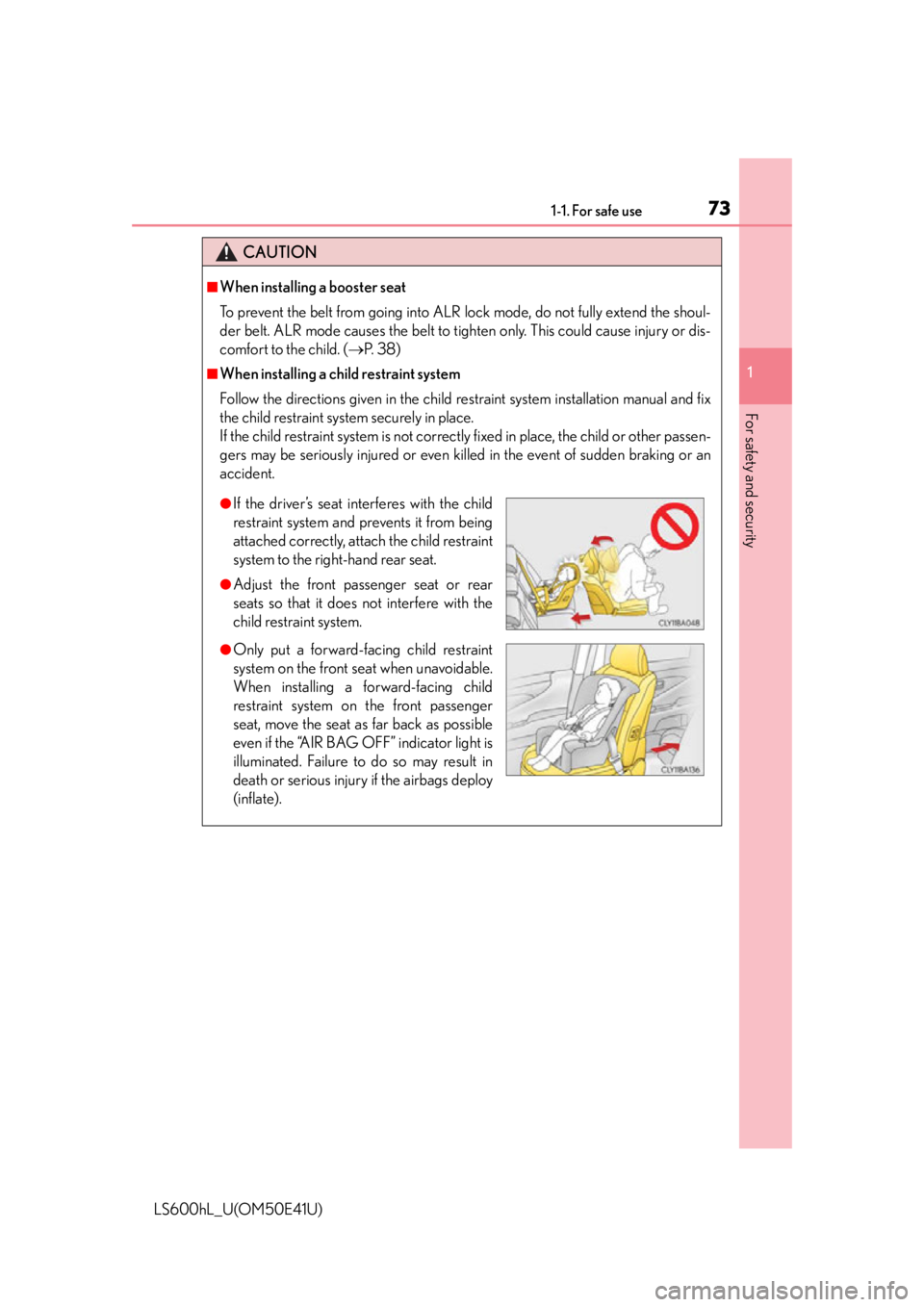
●If the driver’s seat interferes with the child
restraint system and prevents it from being
attached correctly, attach the child restraint
system to the righ t-hand rear seat.
●Adjust the front passenger seat or rear
seats so that it does not interfere with the
child restraint system.
●Only put a forward-facing child restraint
system on the front se at when unavoidable.
When installing a forward-facing child
restraint system on the front passenger
seat, move the seat as far back as possible
even if the “AIR BAG OFF” indicator light is
illuminated. Failure to do so may result in
death or serious injury if the airbags deploy
(inflate).