child restraint LEXUS LX470 2007 User Guide
[x] Cancel search | Manufacturer: LEXUS, Model Year: 2007, Model line: LX470, Model: LEXUS LX470 2007Pages: 426, PDF Size: 10.95 MB
Page 90 of 426

72
1-7. Safety information
Child restraint systems
Points to rememberStudies have shown that installing a ch ild restraint on a rear seat is much
safer than installing one to the front passenger seat.
● Choose a child restraint system approp riate to the age and size of the
child.
● For installation details, follow the instructions provided with the child
restraint system.
General installation instructions ar e provided in this manual. (P. 7 5 )
Types of child restraints
Child restraint systems are classified into the following 3 types according
to the age and size of the child.
Infant seat
A child restraint system for a small child or baby must itself be properly
restrained on the seat with the lap portion of the lap/shoulder belt.
The laws of all 50 states of the U.S.A. and Canada now require the use of
child restraint systems.
Page 91 of 426

73
1-7. Safety information
1
Before driving
Convertible seat
Booster seat
■When the child restraint system is not in use
Leave the child restraint system properly secured on the seat. Do not store the
restraint loosely on a passenger se at or in the luggage compartment.
■Selecting an appropriate child restraint system
Get an appropriate child restraint system for the child. If a child is too large for a
child restraint system, sit the child on a rear seat and use the vehicle's seat belt.
( P. 2 4 )
Page 92 of 426

74
1-7. Safety information
CAUTION
■Child restraint precautions
●For effective protection in automobile accidents and sudden stops, a child must
be properly restrained, using a seat belt or child restraint system depending on
the age and size of the child. Holding a child in your arms is not a substitute for a
child restraint system. In an accident, th e child can be crushed against the wind-
shield, or between you and the vehicle's interior.
●Lexus strongly urges the use of a proper child restraint system that conforms to
the size of the child, installed on the rear seat. According to accident statistics, the
child is safer when properly restrained in the rear seat than in the front seat.
●Never install a rear-facing child restraint system on the front passenger seat even
if the AIRBAG OFF indicator light illuminat es. In the event of an accident, the
force of the rapid inflation of the front passenger airbag can cause death or seri-
ous injury to the child if the rear-facing child restraint system is installed on the
front passenger seat.
●A forward-facing child restraint system shou ld allowed to be installed on the front
passenger seat only when it is unavoidable. Always move the seat as far back as
possible even if th e AIRBAG OFF indicator light i lluminates, because the front
passenger airbag could inflate with considerable speed and force. Otherwise,
the child may be killed or seriously injured.
●Do not use the seat belt extender when installing a child restraint system on the
front or rear passenger seat. If installing a child restraint system with the seat belt
extender connected to the seat belt, the seat belt will not securely hold the child
restraint system, which could cause death or serious injury to the child or other
passengers in the event of collision.
●Do not allow the child to lean his/her head or any part of his/her body against the
door or the area of the seat, front pillar or roof side rail from which the side air-
bags or curtain shield airbags deploy even if the child is seated in the child
restraint system. It is dangerous if the side airbags and curtain shield airbags
inflate, and the impact could cause death or serious injury to the child.
●Make sure you have complied with all inst allation instructions provided by the
child restraint manufacturer and that the sy stem is properly secured. If it is not
secured properly, it may cause death or seri ous injury to the child in the event of a
sudden stop or accident.
Page 93 of 426
75
1
1-7. Safety information
Before driving
Installing child restraints
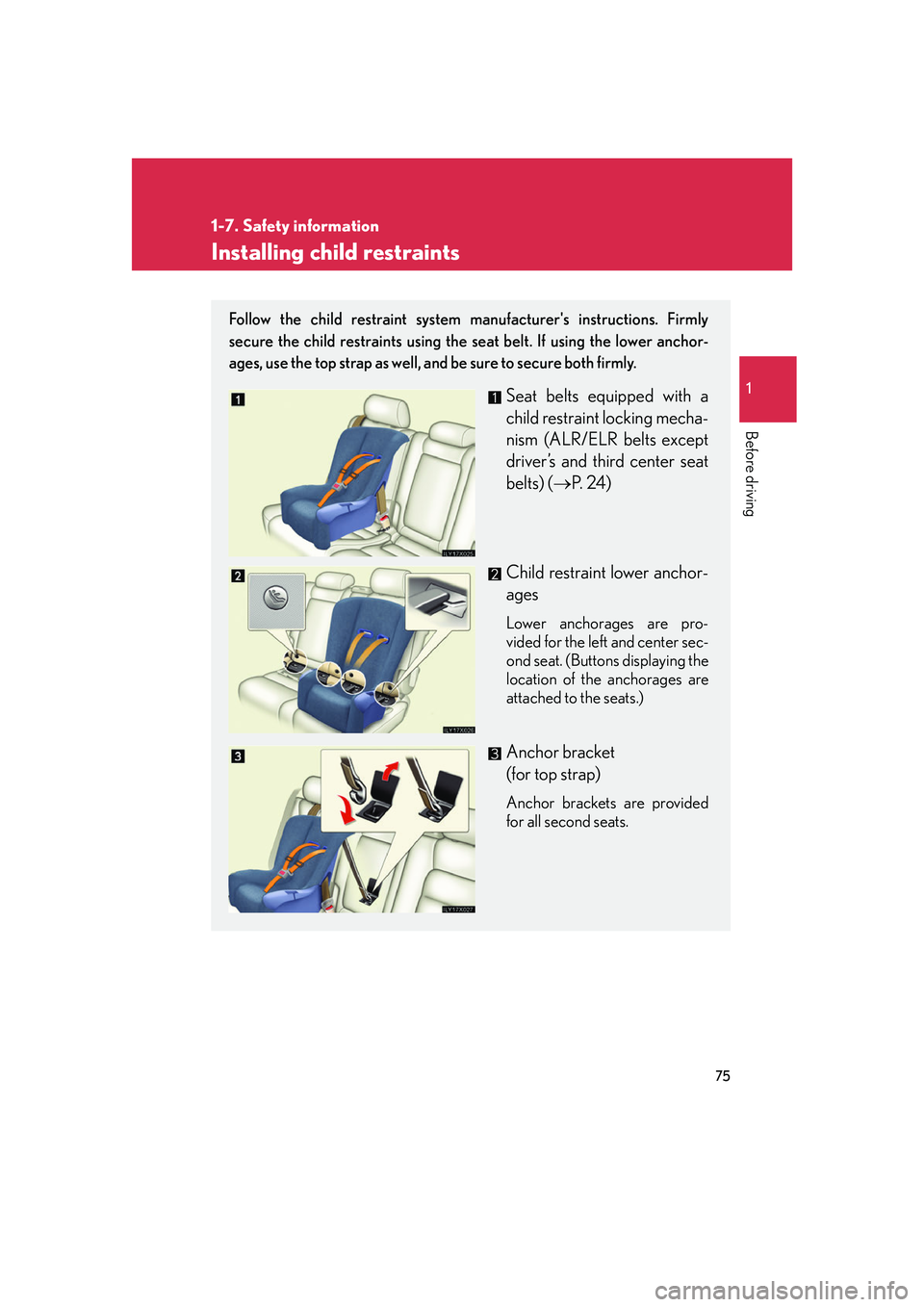
Follow the child restraint system manufacturer's instructions. Firmly
secure the child restraints using the seat belt. If using the lower anchor-
ages, use the top strap as well, and be sure to secure both firmly.
Seat belts equipped with a
child restraint locking mecha-
nism (ALR/ELR belts except
driver’s and third center seat
belts) ( P. 2 4 )
Child restraint lower anchor-
ages
Lower anchorages are pro-
vided for the left and center sec-
ond seat. (Buttons displaying the
location of the anchorages are
attached to the seats.)
Anchor bracket
(for top strap)
Anchor brackets are provided
for all second seats.
Page 94 of 426
76
1-7. Safety information
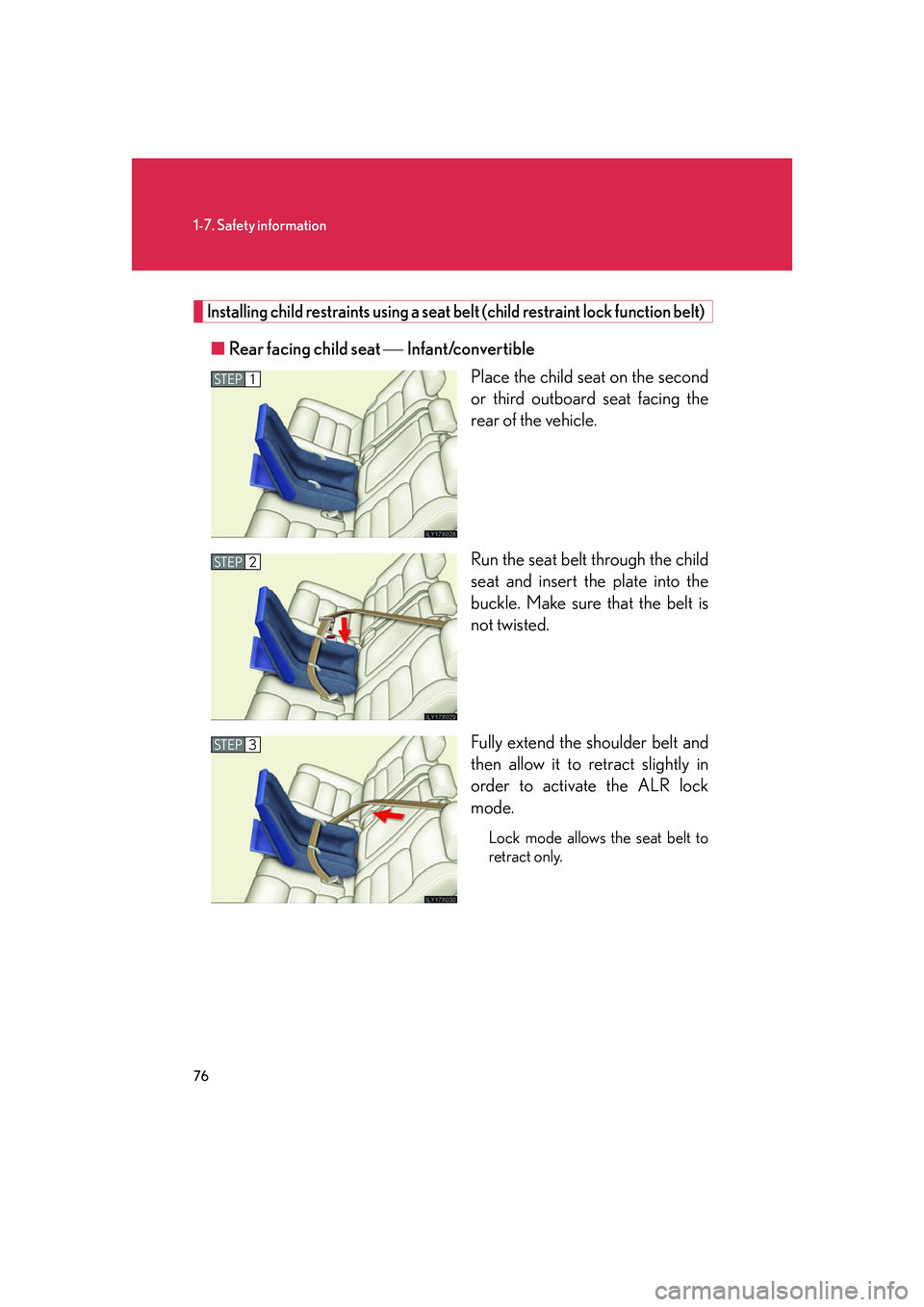
Installing child restraints using a seat belt (child restraint lock function belt)
■Rear facing child seat Infant/convertible
Place the child seat on the second
or third outboard seat facing the
rear of the vehicle.
Run the seat belt through the child
seat and insert the plate into the
buckle. Make sure that the belt is
not twisted.
Fully extend the shoulder belt and
then allow it to retract slightly in
order to activate the ALR lock
mode.
Lock mode allows the seat belt to
retract only.
STEP1
STEP2
STEP3
Page 97 of 426

79
1-7. Safety information
1
Before driving
Installing child restraints using a seat belt (2-point type seat belt)■ Rear facing child seat Infant/convertible
Place the child seat on the third
center seat facing the rear of the
vehicle.
Run the seat belt through the child
seat and insert the plate into the
buckle. Make sure that the belt is
not twisted.
While pushing the child seat down
into the seat, allow the belt to tight
by pulling its free end until the child
seat is securely in place.
STEP1
STEP2
STEP3
Page 98 of 426

80
1-7. Safety information
Removing a child restraint installed with a seat beltPush the buckle release button
and fully retract the seat belt.
Installation with child restraint lower anchoragesFold the seatback forward and
then back to the 1st lock position
(most upright position) until it locks
into place.
Take off the cover between the
seat cushion and seatback and
confirm the position of the lower
anchorages below the symbol in
the seatback.
STEP1
STEP2
Page 99 of 426

81
1-7. Safety information
1
Before driving
Type ALatch the hooks of the lower straps
onto the anchorages.
If the child restraint has a top strap,
the top strap should be latched
onto the anchorage.
For owners in Canada:
The symbol on a child restraint sys-
tem indicates the presence of a
lower anchorage system.
Type B Latch the buckles onto the anchor-
ages.
If the child restraint has a top strap,
the top strap should be latched
onto the anchorage.
For owners in Canada:
The symbol on a child restraint sys-
tem indicates the presence of a
lower anchorage system.
Canada only
STEP3
Canada only
STEP3
Page 100 of 426
82
1-7. Safety information
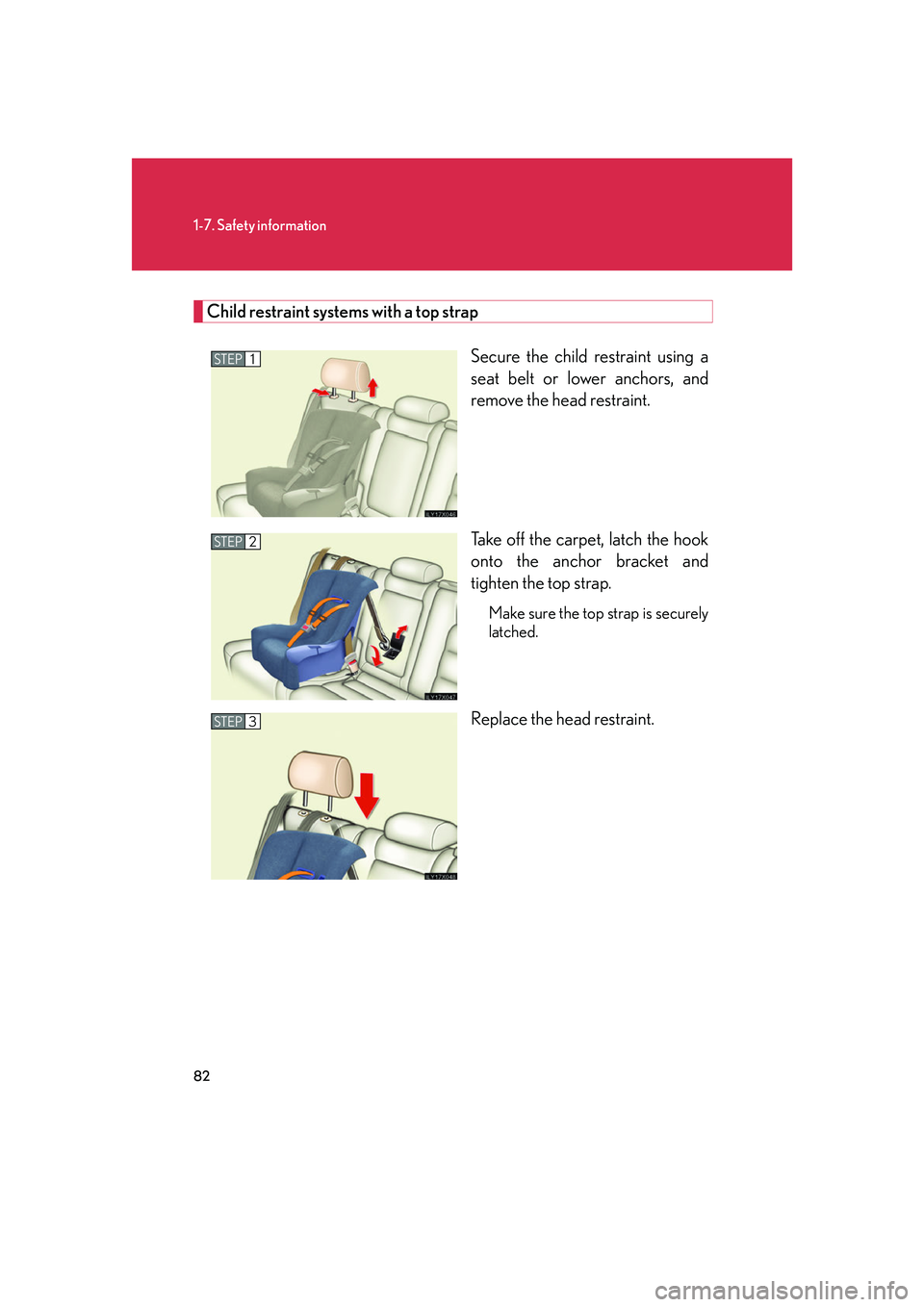
Child restraint systems with a top strapSecure the child restraint using a
seat belt or lower anchors, and
remove the head restraint.
Take off the carpet, latch the hook
onto the anchor bracket and
tighten the top strap.
Make sure the top strap is securely
latched.
Replace the head restraint.
STEP1
STEP2
STEP3
Page 101 of 426

83
1-7. Safety information
1
Before driving
■Laws and regulations pertaining to anchorages
Anchorages conform to FMVSS225 or CMVSS210.2.
Child restraint systems conforming to FMVSS213 or CMVSS213 specifications
can be used.
This vehicle is designed to conform to the SAE J1819.
CAUTION
■When installing a booster seat
Do not fully extend the shoulder belt to prevent the belt from going to ALR lock
mode: ( P. 2 6 )
●ALR mode causes the belt to tighten only which could cause injury or discomfort
to the child.
●Do not allow the child to play with the seat belt or the child could be killed or seri-
ous injured.