fuel LEXUS LX470 2007 User Guide
[x] Cancel search | Manufacturer: LEXUS, Model Year: 2007, Model line: LX470, Model: LEXUS LX470 2007Pages: 426, PDF Size: 10.95 MB
Page 107 of 426

89
2-1. Driving procedures
2
When driving
■Breaking in your new Lexus
To extend the life of the vehicle, the following precautions are recommended to
observe:
●For the first 200 miles (300 km):
Avoid sudden stops.
●For the first 500 miles (800 km):
Do not tow a trailer.
●For the first 1000 miles (1600 km):
• Do not drive at extremely high speeds.
• Avoid sudden acceleration.
• Do not drive continuously in the low gears.
• Do not drive at a constant speed for extended periods.
■Operating your vehicle in a foreign country
Comply with the relevant vehicle registration laws and confirm the availability of the
correct fuel. (P. 3 7 0 )
Page 117 of 426

99
2-1. Driving procedures
2
When driving
■Shift position uses
*: To improve fuel consumption and reduce noises, set the shift lever in the
“D” position for normal driving.
Shift positionFunction
PParking the vehicle or starting the engine
RReversing
NNeutral
DNormal driving*
4Position for engine braking
3,2Position for more powerful engine braking
LPosition for maximum engine braking
Page 123 of 426
105
2-2. Instrument cluster
2
When driving
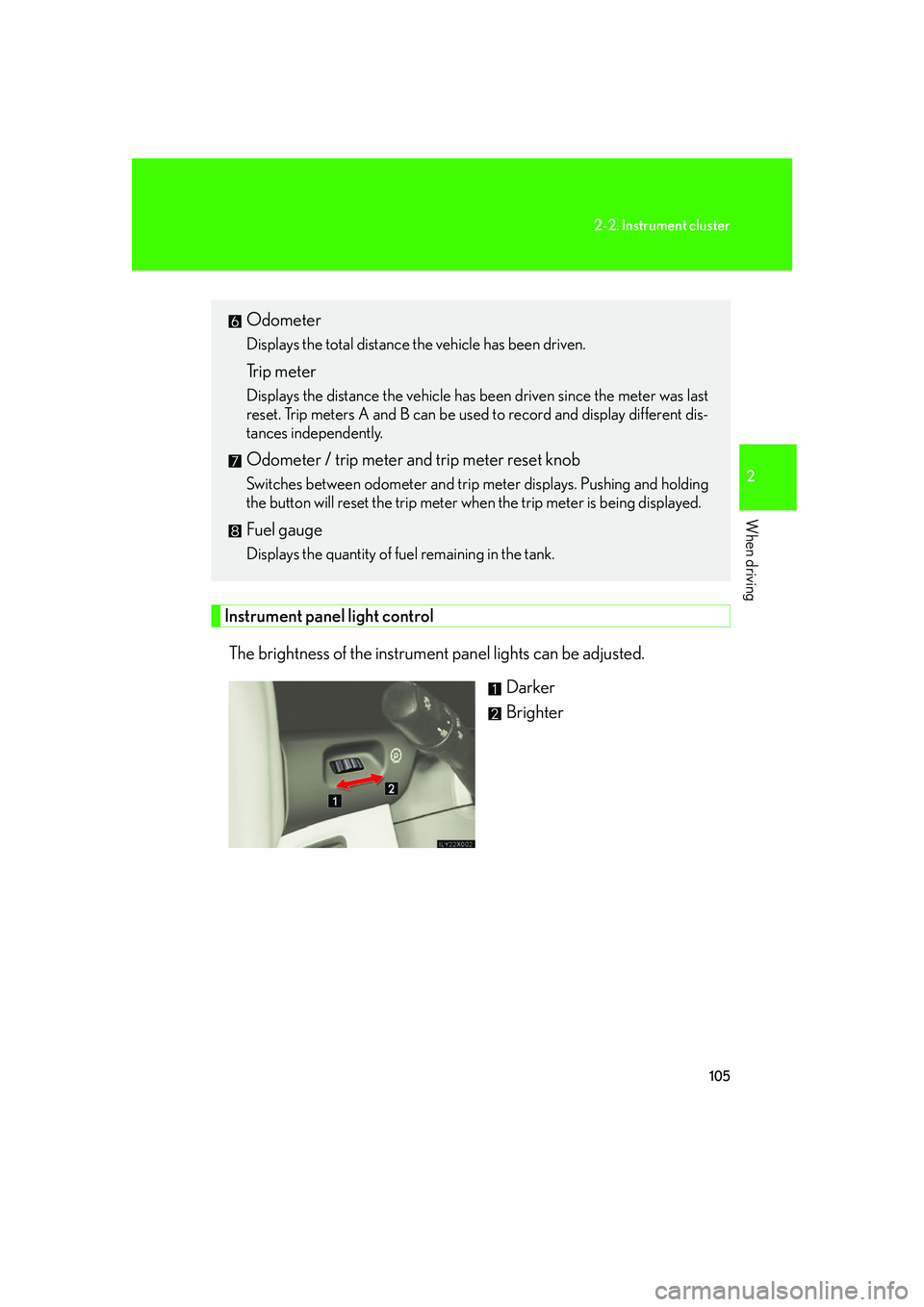
Instrument panel light controlThe brightness of the instrument panel lights can be adjusted. Darker
Brighter
Odometer
Displays the total distance the vehicle has been driven.
Trip meter
Displays the distance the vehicle has been driven since the meter was last
reset. Trip meters A and B can be used to record and display different dis-
tances independently.
Odometer / trip meter and trip meter reset knob
Switches between odometer and trip meter displays. Pushing and holding
the button will reset the trip meter when the trip meter is being displayed.
Fuel gauge
Displays the quantity of fuel remaining in the tank.
Page 129 of 426

111
2-2. Instrument cluster
2
When driving
■Driving range
■ Average fuel consumption
■ Current fuel consumption
Displays the estimated maximum distance that can
be driven with the quantity of fuel remaining.
This distance is computed based on your average fuel
consumption. As a result, the actual distance that can be
driven may differ from that displayed.
Displays the average fuel consumption since the
vehicle was last refueled.
Displays the current rate of fuel consumption.
■Changing the unit shown on the display
Push and hold the “MODE” sw itch until the unit flashes.
Push the “MODE” switch.
STEP1
Push the “RESET” switch to change the unit. The unit on the outside temperature display
is also changed.STEP2
STEP3
Page 169 of 426

151
2-5. Driving information
2
When driving
Cargo and luggage
Capacity and distributionCargo capacity depends on the to tal weight of the occupants.
(Cargo capacity) = (Total load capa city) — (Total weight of occupants)
Steps for Determining Correct Load Limit—
(1) Locate the statement “The combined weight of occupants and cargo should never exceed XXX kg or XXX lbs.” on your vehicle’s
placard.
(2) Determine the combined weight of the driver and passengers that
will be riding in your vehicle.
(3) Subtract the combined weight of the driver and passengers from
XXX kg or XXX lbs.
(4) The resulting figure equals the av ailable amount of cargo and lug-
gage load capacity.
For example, if the “XXX” amount equals 1400 lbs. and there will be
five 150 lb passengers in your vehi cle, the amount of available cargo
and luggage load capacity is 650 lbs. (1400 - 750 (5 150) = 650
lbs.)
(5) Determine the combined weight of luggage and cargo being
loaded on the vehicle.
That weight may not safely exc eed the available cargo and luggage
load capacity calculated in Step 4.
Take notice of the following information about storage precautions, cargo
capacity and load.
● Stow cargo and luggage in the luggage compartment whenever
possible. Be sure all items are secured in place.
● Be careful to keep the vehicle level. Placing the weight as far for-
ward as possible helps maintain vehicle balance.
● For better fuel economy, do not carry unnecessary weight.
Page 178 of 426

160
2-5. Driving information
Trailer towing
Your vehicle is designed primarily as a passenger-and-load carrying vehi-
cle. Towing a trailer will have an adverse effect on handling, performance,
braking, durability, and fuel consumpt ion. For your safety and the safety of
others, do not overload the vehicle or trailer.
Lexus warranties do not apply to damage or malfunction caused by towing
a trailer for commercial purposes.
■ Weight limits
Confirm that the total trailer weight , gross vehicle weight, gross axle
weight and trailer tongue lo ad are all within the limits.
■ Gross vehicle weight
The gross vehicle weight must no t exceed the Gross Vehicle Weight
Rating (GVWR) indicated on the Certification Label. The gross
vehicle weight is the sum weight of the unloaded vehicle, driver, pas-
sengers, luggage, hitch and trail er tongue load. Also included is the
weight of any special equipment installed on your vehicle.
■ Gross axle weight
The load on either the front or rear axle resulting from distribution of
the gross vehicle weight on both axles must not exceed the Gross
Axle Weight Rating (GAWR) lis ted on the Certification Label.
Certification Label
Page 278 of 426

260
4-1. Maintenance and care
Cleaning and protecting the vehicle exterior
■Automatic car washes
●Fold the mirrors back and retract the antenna before washing the vehicle.
●Brushes used in automatic car washes may scratch the vehicle surface and
harm your vehicle’s paint.
■High pressure automatic car washes
Do not allow the nozzles of the car wash to come within close proximity of the win-
dows. Before entering an automatic car wash, check that the fuel filler door is
closed.
■Aluminum wheels
Remove any dirt immediately by using a neutral detergent. Do not use hard brushes
or abrasive cleaners. Do not use strong or harsh chemical cleaners. Use the same
mild detergent and wax as used on the paint.
■Bumpers and side moldings
Do not scrub with abrasive cleaners.
Perform the following to protect the vehicle and maintain it in prime condi-
tion.
● Working from top to bottom, liber ally apply water to the vehicle
body, wheel wells and underside of the vehicle to remove any dirt
and dust.
Wash the vehicle body using a sponge or soft cloth, such as a chamois.
● For hard-to-remove marks, use car wash soap and rinse thor-
oughly with water.
● Wipe away any water.
● If water no longer beads on clea n paint, apply wax when the vehi-
cle body is cool.
Page 284 of 426

266
4-2. Maintenance
■Allow inspection and repairs to be performed by a Lexus dealer
●Lexus technicians are well-trained speciali sts and are kept up to date with the
latest service information. They are well informed about the operations of all
systems on your vehicle.
●Keep a copy of the repair order. It proves that the maintenance that has been
performed is under warranty coverage. If any problem should arise while your
vehicle is under warranty, your Lexus de aler will promptly take care of it.
CAUTION
■Warning in handling of battery, oils, fuels, and fluids
●Engine exhaust, some of its constituents, and a wide variety of automobile com-
ponents contain or emit chemicals known to the State of California to cause can-
cer and birth defects and other reproductive harm. Work in a well ventilated area.
●Oils, fuels and fluids contained in vehicles as well as waste produced by compo-
nent wear contain or emit chemicals known to the State of California to cause
cancer and birth defects or other reproductive harm. Avoid exposure and wash
any affected area immediately.
●Battery posts, terminals and related accessories contain lead and lead com-
pounds which are known to cause brain damage. Wash your hands after han-
dling. (P. 2 8 8 )
●Used engine oil contains chemicals that have been shown to cause cancer in lab-
oratory animals. Avoid prolonged and repeated contact. Always protect your
skin by washing thorough ly with soap and water.
Page 288 of 426
270
4-2. Maintenance
Emission inspection and maintenance (I/M) programs
Some states have vehicle emission inspection programs which include
OBD (On Board Diagnostics) checks. The OBD system monitors the oper-
ation of the emission control system.
■ If the malfunction indicator lamp comes on
The OBD system determines that a problem exists somewhere in
the emission control system. Your vehicle may not pass the I/M test
and may need to be repaired. Contact your Lexus dealer to service
the vehicle.
■ Your vehicle may not pass the I/M test:
●When the battery is disconnected or discharged
Readiness codes that are set during ordinary driving are erased.
Also, depending on your driving habits, the readiness codes may
not be completely set.
● When the fuel tank cap is loose
The malfunction indicator lamp comes on as a temporary mal-
function and your vehicle may not pass the I/M test.
■ When the malfunction indicator la mp goes off after several driv-
ing trips
The error code in the OBD system will not be cleared unless the
vehicle is driven 40 or more times.
■ If your vehicle does not pass the I/M test
Contact your Lexus dealer to prep are the vehicle for re-testing.
Page 292 of 426

274
4-3. Do-it-yourself maintenance
CAUTION
The engine compartment contains many mechanisms and fluids that may move sud-
denly, become hot, or become electrically energized. To avoid death or serious injury.
■When working on the engine compartment
●Keep hands, clothing, and tools away from the moving fan and engine drive belt.
●Be careful not to touch the engine, inverter, radiator, exhaust manifold, etc. right
after driving as they may be hot. Oil and other fluids may also be hot.
●Do not leave anything that may burn easily, such as paper or rags, in the engine
compartment.
●Do not smoke, cause sparks or expose an open flame to fuel or the battery. Fuel
and battery fumes are flammable.
●Be extremely cautious when working on the battery. It contains poisonous and
corrosive sulfuric acid.
■When working near the electric cooling fan or radiator grille
Be sure the ignition is off. With the ignition in on, the electric cooling fan may auto-
matically start to run if the air conditioning is on and/or if the coolant temperature is
high.
( P. 2 8 3 )
■When working on or under the vehicle
●Do not get under the vehicle with just the jack supporting it.
Always use automotive jack stands or other solid supports.
●Use eye protection to prevent flying or falling material, fluid spray, etc. from get-
ting in your eyes.
NOTICE
■If you remove the air cleaner filter
Driving with the air cleaner filter removed may cause excessive engine wear due to
dirt in the air. Also a backfire could cause a fire in the engine compartment.