steering wheel LEXUS LX470 2007 User Guide
[x] Cancel search | Manufacturer: LEXUS, Model Year: 2007, Model line: LX470, Model: LEXUS LX470 2007Pages: 426, PDF Size: 10.95 MB
Page 82 of 426

64
1-7. Safety information
CAUTION
■SRS airbag precautions
●Do not use seat accessories which cover the front seat as they may interfere with
inflation of the front passenger airbag.
●Do not use seat accessories which cover the parts where the SRS side airbags
inflate as they may interfere with inflation of the airbags.
●Do not strike or apply significant levels of force to the area of the SRS airbag
components shown on P. 55. Doing so ca n cause the SRS airbags to malfunction.
●Do not touch any of the component parts immediately after the SRS airbags have
deployed (inflated) as they may be hot.
●If breathing becomes difficult after the SRS airbag has deployed, open a door or
window to allow fresh air in, or leave the vehicle if it is safe to do so. Wash off any
residue as soon as possible to prevent skin irritation.
●If the areas where the SRS airbags are stored, such as the steering wheel pad and
front pillar garnish, are damaged or cracked, have them replaced by your Lexus
dealer.
●Do not attach anything to or lean anything
against areas such as the dashboard or
steering wheel pad. These items can
become projectiles when SRS driver and
front passenger airbags deploy.
●Do not attach anything to areas such as the
door, windshield glass, side door glass,
front, center and roof side garnish, roof
interior or assist grip.
●Do not hang coat hangers or other hard
objects on the coat hooks. All of these
items could become projectiles and seri-
ously injure or kill you, should the SRS cur-
tain shield airbag deploy.
Page 83 of 426
65
1-7. Safety information
1
Before driving
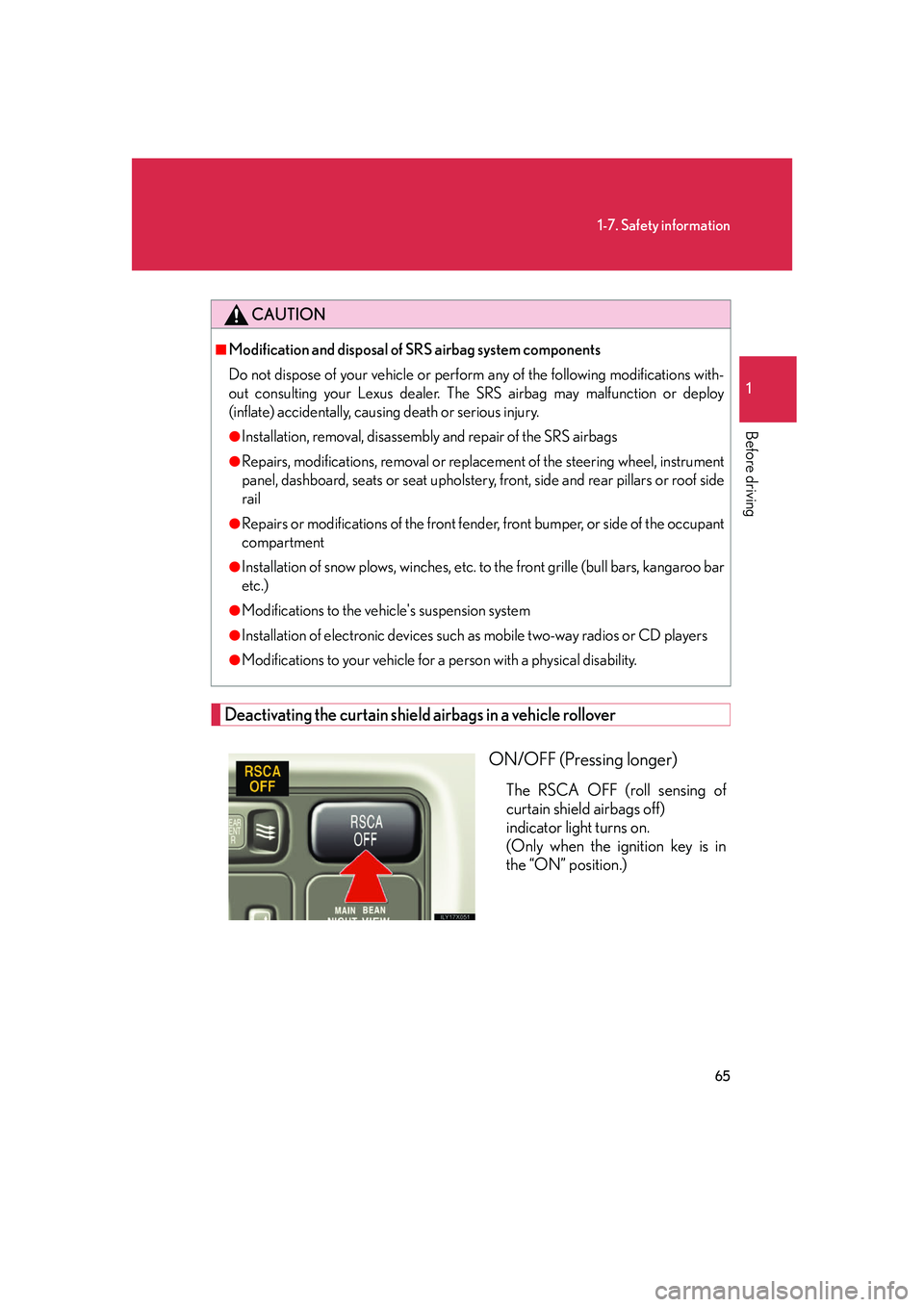
Deactivating the curtain shield airbags in a vehicle rollover
ON/OFF (Pressing longer)
The RSCA OFF (roll sensing of
curtain shield airbags off)
indicator light turns on.
(Only when the ignition key is in
the “ON” position.)
CAUTION
■Modification and disposal of SRS airbag system components
Do not dispose of your vehicle or perfor m any of the following modifications with-
out consulting your Lexus dealer. The SRS airbag may malfunction or deploy
(inflate) accidentally, causing death or serious injury.
●Installation, removal, disassembly and repair of the SRS airbags
●Repairs, modifications, removal or replace ment of the steering wheel, instrument
panel, dashboard, seats or seat upholstery, front, side and rear pillars or roof side
rail
●Repairs or modifications of the front fend er, front bumper, or side of the occupant
compartment
●Installation of snow plows, winches, etc. to the front grille (bull bars, kangaroo bar
etc.)
●Modifications to the vehi cle's suspension system
●Installation of electronic devices such as mobile two-way radios or CD players
●Modifications to your vehicle for a person with a physical disability.
Page 109 of 426
91
2-1. Driving procedures
2
When driving
CAUTION
■When driving the vehicle
●Use engine braking (downshift) to maintain a safe speed when driving down a
steep hill.
Using the brakes continuously may cause the brakes to overheat and lose effec-
tiveness. (P. 9 9 )
●When stopped on an inclined surface, use the brake pedal and parking brake to
prevent the vehicle from rolling backward or forward and causing an accident.
●Be careful when driving on slippery surfaces, as the vehicle may spin or skid when
downshifting, rapidly accelerating, braking or turning.
●Do not adjust the position of the steering wheel, the seat, or the inside or outside
rear view mirrors while driving.
Doing so may result in a loss of vehicle control that can cause accidents that may
result in death or serious injury.
●Always check that all passengers' arms, heads or other parts of their bodies are
not outside the vehicle, as this may result in death or serious injury.
●Do not drive in excess of the speed limit. Even if the legal speed limit permits it, do
not drive over 85 mph (140 km/h) unless your vehicle has high-speed capability
tires. Driving over 85 mph (140 km/h) may result in tire failure, loss of control and
possible injury. Be sure to consult a tire dealer to determine whether the tires on
your vehicle are high-speed capability tires or not before driving at such speeds.
●If you drive through deep water over ab out 500 mm (20 in.) in depth, put the
vehicle height in the HI (High) mode with the active height select switch and then
turn off the active height control suspension by pushing the height control switch.
Drive your vehicle at 30 km/h (19 mph) or lower speed.
Page 112 of 426

94
2-1. Driving procedures
NOTICE
■While driving the vehicle
Do not use the accelerator pedal or depress accelerator and brake pedals together
to hold the vehicle on a hill.
■When parking the vehicle
Always put the shift lever in “P”. Failure to do so may cause the vehicle to move or
the vehicle may accelerate suddenly if the accelerator pedal is accidentally
depressed.
■Avoiding damage to vehicle parts
●Do not turn the steering wheel fully in either direction and hold it there for a long
time.
Doing so may damage the power steering pump.
●When driving over bumps in the road, drive as slowly as possible to avoid damag-
ing the wheels, underside of the vehicle, etc.
■If you hear a squealing or scraping no ise (brake pad wear limit indicators)
Have your Lexus dealer check and replac e the brake pads as soon as possible.
The rotor damage can result if the pads are not replaced when needed.
It is dangerous to drive the vehicle when the wear limits of the brake pads and/or
that of the brake discs are exceeded.
■If you get a flat tire while driving
A flat or damaged tire may cause the following situations. Hold the steering wheel
firmly and gradually press the brak e pedal to slow down the vehicle.
●It may be difficult to control your vehicle.
●The vehicle will make abnormal sounds.
●The vehicle will behave abnormally.
Replace a flat tire with a new one. ( P. 3 4 6 )
Page 113 of 426
![LEXUS LX470 2007 User Guide 95
2-1. Driving procedures
2
When driving
Starting the engine
]
■Turning the key from “ACC” to “LOCK”
■Ignition switch
LOCK:
The steering wheel is locked
and the key can be removed.
ACC:
S](/img/36/58005/w960_58005-112.png "LEXUS LX470 2007 User Guide 95
2-1. Driving procedures
2
When driving
Starting the engine
]
■Turning the key from “ACC” to “LOCK”
■Ignition switch
LOCK:
The steering wheel is locked
and the key can be removed.
ACC:
S")
95
2-1. Driving procedures
2
When driving
Starting the engine
]
■Turning the key from “ACC” to “LOCK”
■Ignition switch
LOCK:
The steering wheel is locked
and the key can be removed.
ACC:
Some electrical components
such as the audio system can be
used.
ON:
All electrical components can
be used.
START
■ Starting the engine
Check that the parking brake is set.
Check that the shift lever is set in “P”.
Sit in the driver’s seat and firmly depress the brake pedal.
Turn the ignition key to the “START” position and start the
engine.
STEP1
STEP2
STEP3
STEP4
Shift the shift lever to “P”.
Push in the key and turn to the
“LOCK” position.STEP1
STEP2
Page 114 of 426

96
2-1. Driving procedures
T■Steering lock release
■ If the engine does not start
The engine immobilizer system may not have been deactivated. (P. 4 7 )
■Starting the engine using the flat key
Put the key case away when the indicator light goes out. This means the
engine immobilizer system has turned off.
Start the engine within 60 seconds after the indicator light goes off.
When starting the engine, the ignition switch
may seem stuck in the “LOCK” position. To
free it, turn the ignition key while turning the
steering wheel sightly in either direction.
Remove the flat key from its case. Insert the
key into the ignition switch. STEP1
Bring the key case close to the ignition switch
within 10 seconds as indicated by an arrow. STEP2
STEP3
STEP4
Page 152 of 426

134
2-4. Using other driving systems
■If the vehicle height does not change
If the vehicle is loaded too heavily, or the undercarriage has come into contact with
the road surface, the vehicle height cannot be raised/lowered. In this case, the indi-
cator lights will change as follows:
●The current mode indicator light will turn off, and the target mode indicator light
will begin flashing.
●The target mode indicator light will turn off, and the original mode indicator light
will be lit once more. (The vehicle height does not change.)
■In the following cases AHC will not operate
●The brake pedal has been depressed for longer than 5 seconds while the vehi-
cle is stopped.
●The suspension fluid temperature is lower than -22°F (-30°C).
●Driving on bumpy roads which may cause the suspension to fully elongate.
●If the steering wheel is abruptly turned more than 3/4 of a revolution with the
center differential lock system activated.
■Cold weather operation
It may take longer for the vehicle height to change if the suspension fluid tempera-
ture drops below -5°F (-15°C).
AHC does not operate when the suspension fluid temperature drops below -22°F
(-30°C).
●In this case, the selected height mode indicator light will flash when the height
mode select switch is pressed, however the vehicle height will not change.
Once the engine has warmed the suspension fluid to within normal operating
limits, AHC will begin operating and the vehicle height will automatically
change to the selected mode.
●When the suspension fluid is around -22°F (-30°C), the vehicle height may not
be able to be raised, even if AHC is operating. In this case, push “ ▼” then “▲ ”
on the height mode select switch after further warming the engine to select the
desired vehicle height.
Page 160 of 426

142
2-4. Using other driving systems
Driving assist systems
When the VSC system is operatingIf the vehicle is in danger of slip-
ping, the slip indicator light flashes
and buzzer sounds to indicate that
the VSC systems have been
engaged.
To help enhance driving safety and performance, the following systems
operate automatically in response to various driving situations. Be aware,
however, that these systems are supplementary and should not be relied
upon too heavily when operating the vehicle.
■ABS (Anti-lock Brake System)
Restrains the vehicle from slipping when driving on slick road surfaces or
in the event of sudden braking.
■BA (Brake Assist)
Generates an increased level of braking force after the brake pedal is
depressed, when the system detects a panic stop situation.
■VSC (Vehicle Stability Control)
Helps the driver to control skidding when swerving suddenly or turning on
slippery road surfaces.
■ TRAC (Active Traction Control)
Maintains drive power and prevents the 4 wheels from spinning when
starting the vehicle or accelerating on slippery roads.
■VGRS (Variable Gear Ratio Steering)
Adjusts the wheel turning angle in accordance with the vehicle speed and
steering wheel movement.
Page 162 of 426
144
2-4. Using other driving systems
■Sounds and vibrations caused by the ABS, BA, VSC, TRAC and VGRS systems
●A sound may be heard from the engine compartment when the engine is
started or just after the vehicle begins to move. This sound does not indicate that
a malfunction has occurred in any of these systems.
●Any of the following conditions may occur when the above systems are operat-
ing. None of these indicates that a malfunction has occurred.
• Vibrations may be felt through the vehicle body and steering.
• A motor sound may be heard after the vehicle comes to a stop.
• The brake pedal may pulsate slightly after the ABS is activated.
• The brake pedal may move down slightly after the ABS is activated.
■VGRS is disabled in the following situations
●During stopping or the steering wheel has been moved for a long time while
driving at lower speeds.
●After the engine is restarted at less than -22°F (-30°C).
●If you disconnect the batter y with the steering wheel turned, the center position
of the steering wheel could be slightly and temporary changed. To initialize the
VGRS, drive for a short while.
Page 167 of 426
149
2-5. Driving information
2
When driving
CAUTION
■Off-road driving precautions
Always observe the following precautions to help minimize the risk of serious per-
sonal injury or damage to your vehicle:
●Drive carefully when off the road. Do not take unnecessary risks by driving in
dangerous places.
●Do not grip the steering wheel spokes wh en driving off-road. A bad bump could
jerk the wheel and injure your hands. Keep both hands and especially your
thumbs on the outside of the rim.
●Always check your brakes for effectiveness immediately after driving in sand,
mud, water or snow.
●After driving through tall grass, mud, rock, sand, rivers, etc., check that there is no
grass, bush, paper, rags, stone, sand, etc. adhering or trapped on the underbody.
Clear off any such matter from the underbody. If the vehicle is used with these
materials trapped or adhering to the underbody, a breakdown or fire could occur.
●When driving off-road or in rugged te rrain, do not drive at excessive speeds,
jump, make sharp turns, strike objects, etc. This may cause loss of control or vehi-
cle rollover causing death or serious injury. You are also risking expensive dam-
age to your vehicle’s suspension and chassis.
NOTICE
■To prevent the water damage
Take all necessary safety measures to ensure that water dama ge to the engine or
other components does not occur.
●Water entering the engine air intake will cause severe engine damage.
●Water entering the automatic transmission will cause deterioration in shift quality,
locking up of your transmission accompanied by vibration, and ultimately dam-
age.
●Water can wash the grease from wheel bearings, causing rusting and premature
failure, and may also enter the differentials, transmission and transfer case, reduc-
ing the gear oil’s lubricating qualities.