brake LEXUS LX470 2007 Owner's Manual
[x] Cancel search | Manufacturer: LEXUS, Model Year: 2007, Model line: LX470, Model: LEXUS LX470 2007Pages: 426, PDF Size: 10.95 MB
Page 168 of 426

150
2-5. Driving information
NOTICE
■When you drive through water
If driving through water, such as when crossing shallow streams, first check the
depth of the water and the bottom of the river bed for firmness. Drive slowly and
avoid deep water.
■Inspection after off-road driving
●Sand and mud that has accumulated in brake drums and around brake discs may
affect braking efficiency and may damage brake system components.
●Always perform a maintenance inspection after each day of off-road driving that
has taken you through rough terrain, sand, mud, or water. For scheduled mainte-
nance information, refer to the “Warra nty and Services Guide/Owner’s Manual
Supplement/Schedul ed Maintenance”.
Page 175 of 426
157
2-5. Driving information
2
When driving
■Before driving the vehicle
Perform the following according to the driving conditions.
● Do not try to forcibly open a w indow or move a wiper that is fro-
zen. Pour warm water over the frozen area to melt the ice. Wipe
away the water immediately to prevent it from freezing.
● To ensure proper operation of the climate control system fan,
remove any snow that has accumu lated on the air inlet vents in
front of the windshield.
● Remove any ice that has accumul ated on the vehicle chassis.
● Periodically check for and remove any excess ice or snow that
may have accumulated in the wheel well or on the brakes.
■ When driving the vehicle
Accelerate the vehicle slowly and dr ive at a reduced speed suitable
to road conditions.
■ When parking the vehicle
Park the vehicle and move the shift lever to “P” without setting the
parking brake. The parking brake may freeze up, preventing it from
being released.
Page 183 of 426

165
2-5. Driving information
2
When driving
CAUTION
■To avoid accident or injury
●The total trailer weight (trailer weight plus the weight of cargo) must not exceed
6500 lb. (2948 kg).
●If a trailer and cargo weight over 2000 lb. (907 kg), use a sway control device
with sufficient capacity.
●The gross combined weight (sum of your vehicle weight plus its load and the total
trailer weight) must not exceed 12400 lb. (5625 kg).
●Do not exceed the trailer hitch assembly weight, gross vehicle weight, gross axle
weight and trailer tongue load capacities.
●Never load more weight in the back than in the front of the trailer. About 60% of
the load should be in the front half of the trailer, and the remaining 40% in the
rear.
●Set the vehicle height to the “LO” mode an d turn off the active height control sus-
pension to prevent the vehicle heig ht from automatically changing.
●The tow hitch receiver installed on your vehicle must never be used on another
vehicle.
■Hitches
●If you wish to install a trailer hitch, contact your Lexus dealer.
●Use only a hitch that conforms to the total trailer weight requirement.
●Follow the directions supplied by the hitch manufacturer.
●Lubricate the hitch ball with a light coat of grease.
●Remove the trailer hitch whenever you are not towing a trailer. After removing
the hitch, seal any mounting hole in the vehicle body to prevent entry of any sub-
stances into the vehicle.
■When towing a trailer
●If the total trailer weight exceeds 1000 lb . (453 kg), trailer brakes are required.
●Never tap into your vehicle’s hydraulic system, as this will lower the vehicle’s brak-
ing effectiveness.
●Never tow a trailer without using a safety chain securely attached to both the
trailer and the vehicle. If damage occurs to the coupling unit or hitch ball, there is
danger of the trailer wandering into another lane.
Page 184 of 426

166
2-5. Driving information
Trailer towing tipsYour vehicle will handle differently when towing a trailer. The 3 main
causes of vehicle-trailer accidents are driver error, excessive speed and
improper trailer loading. Keep the following in mind when towing.
● Before starting out, check the trailer lights and the vehicle-trailer con-
nections. Recheck after driving a short distance.
● Practice turning, stopping and reversing with the trailer attached in an
area away from traffic until you be come accustomed to the feel of the
vehicle.
NOTICE
■When installing a trailer hitch
●Use only the position recommended by your Lexus dealer. Do not install the
trailer hitch on the bumper; this may cause body damage.
●Do not use axle-mounted hitches, as they can cause damage to the axle housing,
wheel bearings, wheels or tires.
■Brakes
Lexus recommends trailers with brakes that conform to all applicable federal and
state/provincial regulations.
■Safety chain
A safety chain must always be used between the towing vehicle and the trailer.
Leave sufficient slack in the chain for turns. The chain should cross under the trailer
tongue to prevent the tongue from droppi ng to the ground in the case that it
becomes damaged or separated. For the correct safety chain installation proce-
dure, ask your Lexus dealer.
■Do not directly splice trailer lights
Directly splicing trailer lights may dama ge your vehicle’s electrical system and
cause a malfunction.
Page 185 of 426

167
2-5. Driving information
2
When driving
●Reversing with a trailer attached is difficult and requires practice Grip
the bottom of the steering wheel and move your hand to the left to
move the trailer to the left. Move yo ur hand to the right to move the
trailer to right. (This is generally opposite to reversing without a trailer
attached.) Avoid sharp or prolon ged turning. Have someone guide
you when reversing to reduce the risk of an accident.
● As stopping distance is increased when towing a trailer, vehicle-to-
vehicle distance should be increas ed. For each 10 mph (16 km/h) of
speed, allow at least one vehicle and trailer length.
● Avoid sudden braking as you may sk id, resulting in jackknifing and loss
of control. This is especially true on wet or slippery surfaces.
● Avoid jerky starts or sudden acceleration.
● Avoid jerky steering and sharp turn s, and slow down before making
turns.
● Note that when making a turn, the tr ailer wheels will be closer than the
vehicle wheels to the inside of th e turn. Compensate by making a
larger than normal turning radius.
● Crosswinds and rough roads will ad versely affect handling of your
vehicle and trailer, causing sway. Peri odically check the rear to prepare
for being passed by large trucks or buses, which may cause your vehi-
cle and trailer to sway. If swaying occurs, firmly grip the steering wheel,
reduce speed immediately but gradually, and steer straight ahead.
Never increase speed. If you make no extreme correction with the
steering or brakes, your vehi cle and trailer will stabilize.
● Take care when passing other vehi cles. Passing requires considerable
distance. After passing a vehicle, do not forget the length of your
trailer, and be sure you have plenty of room before changing lanes.
● In order to maintain efficient eng ine braking and electrical charging
performance, do not use overdrive. Transmission shift range position
must be in 4.
Page 186 of 426
![LEXUS LX470 2007 Owners Manual 168
2-5. Driving information
●Due to the added load of the trailer, your vehicle’s engine may overheat
on hot days (at temperatures over 85
F[30C] when driving up a long
or steep grade. If](/img/36/58005/w960_58005-185.png "LEXUS LX470 2007 Owners Manual 168
2-5. Driving information
●Due to the added load of the trailer, your vehicle’s engine may overheat
on hot days (at temperatures over 85
F[30C] when driving up a long
or steep grade. If")
168
2-5. Driving information
●Due to the added load of the trailer, your vehicle’s engine may overheat
on hot days (at temperatures over 85
F[30C] when driving up a long
or steep grade. If the engine coolant temperature gauge indicates
overheating, immediately turn off th e air conditioning (if in use), pull
your vehicle off the road and stop in a safe spot. (
P. 363)
● Always place wheel blocks under both the vehicle and the trailer
wheels when parking. Apply the pa rking brake firmly, and put the
transmission in P. Avoid parking on a slope, but if unavoidable, do so
only after performing the following:
Apply the brakes and keep them applied.
Have someone place wheel blocks under both the vehicle and
trailer wheels.
When the wheel blocks are in pl ace, release the brakes slowly
until the blocks absorb the load.
Apply the parking brake firmly.
Shift into “P” and turn off the engine.
● When restarting after parking on a slope:
With the transmission in the “P” position, start the engine. Be sure
to keep the brake pedal pressed.
Shift into 3, 2, 1, or “R” position (if reversing).
Release the parking brake and br ake pedal, and slowly pull or
back away from the wheel blocks. Stop and apply the brakes.
Have someone retrieve the blocks.
STEP1STEP1
STEP2STEP2
STEP1STEP3STEP3
STEP1STEP4
STEP1STEP5STEP5
STEP1STEP1
STEP2STEP2
STEP1STEP3STEP3
STEP1STEP4
Page 187 of 426

169
2-5. Driving information
2
When driving
CAUTION
■To avoid an accident
●Do not exceed 45 mph (72 km/h) or the posted towing speed limit, whichever is
lower. A instability (swaying) of the towing vehicle-trailer combination increases
as speed increases, exceeding 45 mph (72 km/h) may cause loss of control.
●Slow down and downshift before descending steep or long downhill grades. Do
not make sudden downshifts.
●Avoid holding the brake pedal down too long or applying the brakes too fre-
quently.
This could cause the brakes to overheat and result in reduced braking efficiency.
Page 285 of 426
267
4-2. Maintenance
4
Maintenance and care
General maintenance
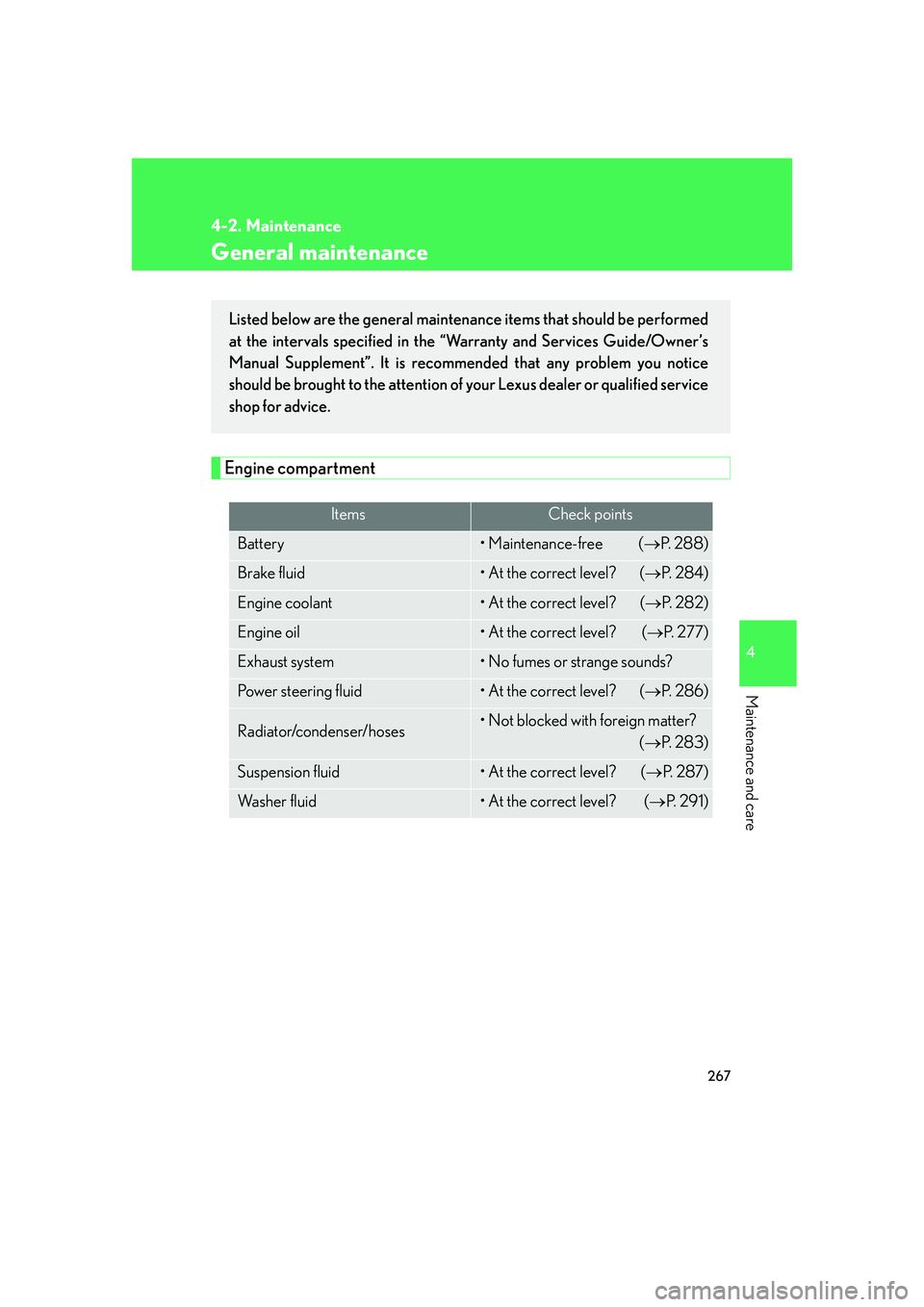
Engine compartment
ItemsCheck points
Battery• Maintenance-free (P. 2 8 8 )
Brake fluid• At the correct level? ( P. 2 8 4 )
Engine coolant• At the correct level? ( P. 2 8 2 )
Engine oil• At the correct level? ( P. 2 7 7 )
Exhaust system• No fumes or strange sounds?
Power steering fluid• At the correct level? (P. 2 8 6 )
Radiator/condenser/hoses • Not blocked with foreign matter?
(P. 2 8 3 )
Suspension fluid• At the correct level? ( P. 2 8 7 )
Wa s h e r f l u i d• At the correct level? ( P. 2 9 1 )
Listed below are the general maintenance items that should be performed
at the intervals specified in the “Warranty and Services Guide/Owner’s
Manual Supplement”. It is recomme nded that any problem you notice
should be brought to the attention of your Lexus dealer or qualified service
shop for advice.
Page 286 of 426

268
4-2. Maintenance
Vehicle interior
ItemsCheck points
Accelerator pedal• Moves smoothly (without uneven pedal effort or catching)?
Automatic transmission “Park”
mechanism• Can the vehicle be hold securely on an incline with the shift lever in
“P”?
Brake pedal
• Moves smoothly?
• Does it have appropriate clearance and correct amount of free play?
Brakes
• Pulls to one side when applied?
• Loss of brake effectiveness?
• Spongy feeling brake pedal?
• Pedal almost touches floor?
Head restraints• Move smoothly and lock securely?
Indicators/buzzers• Function properly?
Lights• Do all the lights come on?
• Headlights aimed correctly?
Pa r k i n g b r a ke
• Moves smoothly?
• Can hold the vehicle securely on an incline?
Seat belts
• Does the seat belt system operate smoothly?
• Are the belts undamaged?
Seats• Do the seat controls operate prop- erly?
Page 289 of 426
271
4
Maintenance and care
4-3. Do-it-yourself maintenance
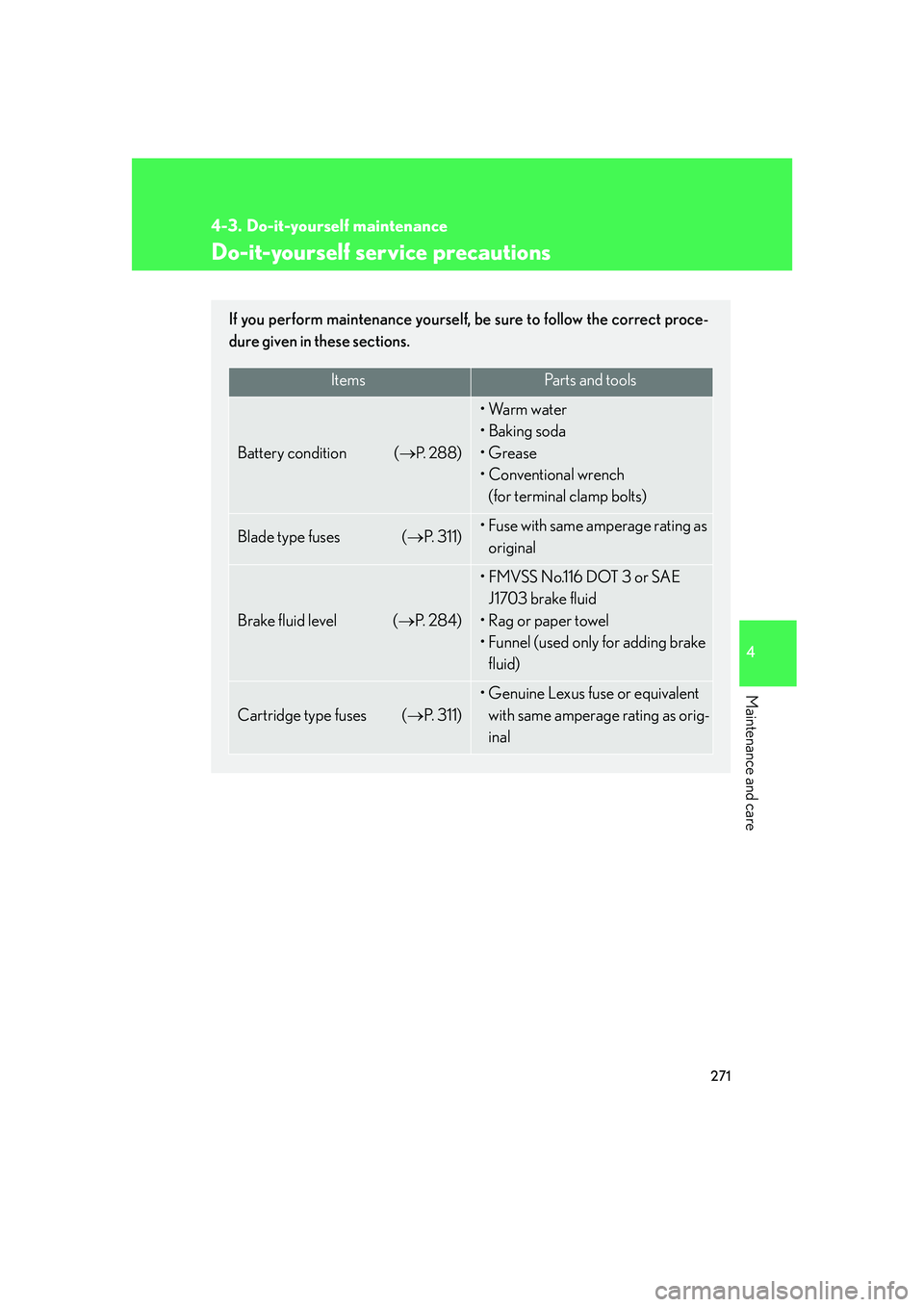
Do-it-yourself service precautions
If you perform maintenance yourself, be sure to follow the correct proce-
dure given in these sections.
ItemsPa r t s a n d t o o l s
Battery condition (P. 2 8 8)
•Warm water
• Baking soda
•Grease
• Conventional wrench
(for terminal clamp bolts)
Blade type fuses ( P. 3 1 1 )• Fuse with same amperage rating as
original
Brake fluid level ( P. 2 8 4 )
• FMVSS No.116 DOT 3 or SAE
J1703 brake fluid
•Rag or paper towel
• Funnel (used only for adding brake
fluid)
Cartridge type fuses ( P. 3 1 1 )
• Genuine Lexus fuse or equivalent
with same amperage rating as orig-
inal