height LEXUS LX470 2007 Owner's Manual
[x] Cancel search | Manufacturer: LEXUS, Model Year: 2007, Model line: LX470, Model: LEXUS LX470 2007Pages: 426, PDF Size: 10.95 MB
Page 183 of 426

165
2-5. Driving information
2
When driving
CAUTION
■To avoid accident or injury
●The total trailer weight (trailer weight plus the weight of cargo) must not exceed
6500 lb. (2948 kg).
●If a trailer and cargo weight over 2000 lb. (907 kg), use a sway control device
with sufficient capacity.
●The gross combined weight (sum of your vehicle weight plus its load and the total
trailer weight) must not exceed 12400 lb. (5625 kg).
●Do not exceed the trailer hitch assembly weight, gross vehicle weight, gross axle
weight and trailer tongue load capacities.
●Never load more weight in the back than in the front of the trailer. About 60% of
the load should be in the front half of the trailer, and the remaining 40% in the
rear.
●Set the vehicle height to the “LO” mode an d turn off the active height control sus-
pension to prevent the vehicle heig ht from automatically changing.
●The tow hitch receiver installed on your vehicle must never be used on another
vehicle.
■Hitches
●If you wish to install a trailer hitch, contact your Lexus dealer.
●Use only a hitch that conforms to the total trailer weight requirement.
●Follow the directions supplied by the hitch manufacturer.
●Lubricate the hitch ball with a light coat of grease.
●Remove the trailer hitch whenever you are not towing a trailer. After removing
the hitch, seal any mounting hole in the vehicle body to prevent entry of any sub-
stances into the vehicle.
■When towing a trailer
●If the total trailer weight exceeds 1000 lb . (453 kg), trailer brakes are required.
●Never tap into your vehicle’s hydraulic system, as this will lower the vehicle’s brak-
ing effectiveness.
●Never tow a trailer without using a safety chain securely attached to both the
trailer and the vehicle. If damage occurs to the coupling unit or hitch ball, there is
danger of the trailer wandering into another lane.
Page 306 of 426

288
4-3. Do-it-yourself maintenance
■Checking the fluid level
Check the fluid level under the unloaded condition.
Start the engine and put the vehicle height in the “LO” (Low)
mode and then “N” (Normal) mode.
Turn off the ignition switch about 30 seconds after the “N” (Nor-
mal) mode indicator light comes on.
Make sure the fluid level is between “MAX” and “MIN”.
If the fluid level is lower than “MIN ”, have suspension fluid AHC filled by
your Lexus dealer.
Battery
■ Exterior
Make sure that the battery terminals ar e not corroded and that there are
no loose connections, cracks, or loose clamps.
Terminals
Hold-down clamp
STEP1
STEP2
STEP3
Page 332 of 426

314
4-3. Do-it-yourself maintenance
Fuse layout and amperage ratings■ Engine compartment
FuseAmpereCircuit
1ABS NO.240Anti-lock brake system
2ABS NO.150Anti-lock brake system
3AHC50Active height control suspension
(AHC)
4WIP-S7. 5No circuit
5TOW I N G30Trailer lights
6MIR HTR15Outside rear view mirror defogger
7RR HTR10Rear air conditioning system
8HAZ-TRN15Emergency flashers, Turn signal lights
Page 334 of 426
316
4-3. Do-it-yourself maintenance
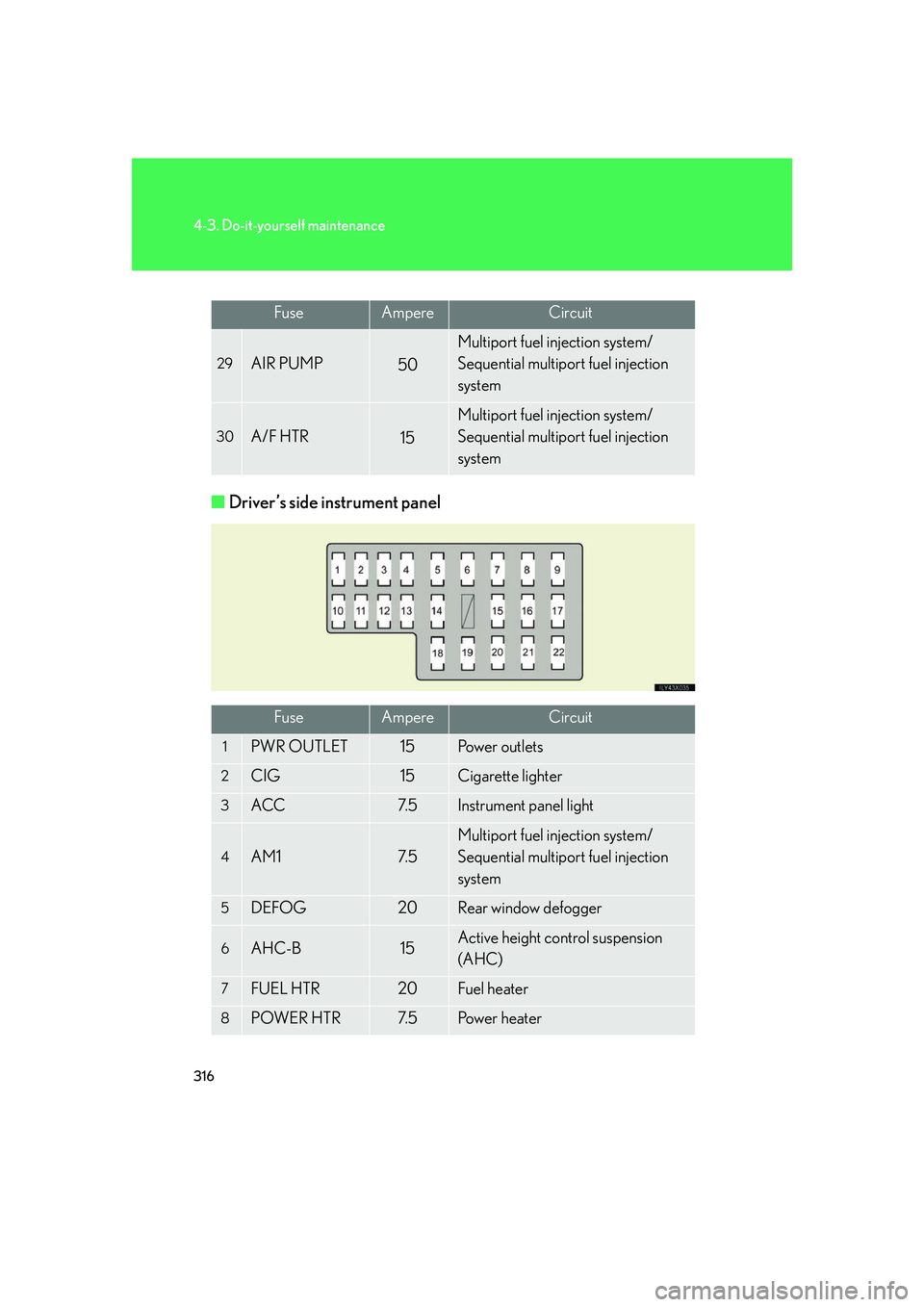
■Driver’s side instrument panel
FuseAmpereCircuit
29AIR PUMP50
Multiport fuel injection system/
Sequential multiport fuel injection
system
30A/F HTR15
Multiport fuel injection system/
Sequential multiport fuel injection
system
FuseAmpereCircuit
1PWR OUTLET15Po w e r o u t l e t s
2CIG15Cigarette lighter
3ACC7. 5Instrument panel light
4AM17. 5
Multiport fuel injection system/
Sequential multiport fuel injection
system
5DEFOG20Rear window defogger
6AHC-B15Active height control suspension
(AHC)
7FUEL HTR20Fuel heater
8POWER HTR7. 5Po w e r h e a t e r
Page 335 of 426

317
4-3. Do-it-yourself maintenance
4
Maintenance and care
FuseAmpereCircuit
9AHC-IG20Active height control suspension
(AHC)
10EFI or ECD No.210Emission control system
11GAUGE 110Gauges and meters
12ECU-IG 110
Multiport fuel injection system/
Sequential multiport fuel injection
system
13ECU-B110Navigation system
14DBL LOCK15Double lock system
15A/C15Air conditioning system
16STOP15Stop lights
17OBD-27. 5On-board diagnosis system
18IDLE UP7. 5Idle-up system
19LH SEAT30Power seat system
20DOOR25Power door lock system, Power win-
dows
21SUN ROOF25Electronic moon roof
22RR WIPER15Rear wiper system
Page 347 of 426

5
When trouble arises
329
5-1. Essential information
■Emergency towing procedureThe ignition key must be in the “ACC” or the “ON” (engine running) posi-
tion.
Put the four-wheel drive control lever in “H”. (The center differential is
unlocked.)
Put the vehicle height in the “N” mode and push the height control switch
to turn off the AHC.
Put the shift lever in “N”.
Release the parking brake.
CAUTION
■While towing
●Use extreme caution when towing the vehicle.
Avoid sudden starts or erratic driving maneuvers which place excessive stress on
the emergency towing hook and the cable or chain.
●If the engine is not running, the power assi st for the brakes and steering will not
function, making steering and braking more difficult.
NOTICE
■To prevent causing serious damage to the transmission
Never tow this vehicle wheels on the ground.
STEP1
STEP2
STEP3
STEP4
STEP5
Page 364 of 426
346
5-2. Steps to take in an emergency
If you have a flat tire
Remove the flat tire and replace it with the spare provided.
■Before jacking up the vehicle
●Stop the vehicle on a hard, flat surface.
● Set the parking brake.
● Shift the shift lever to “P”.
● Turn off the active height control suspension. ( P. 130.)
● Stop the engine.
● Turn on the emergency flashers.
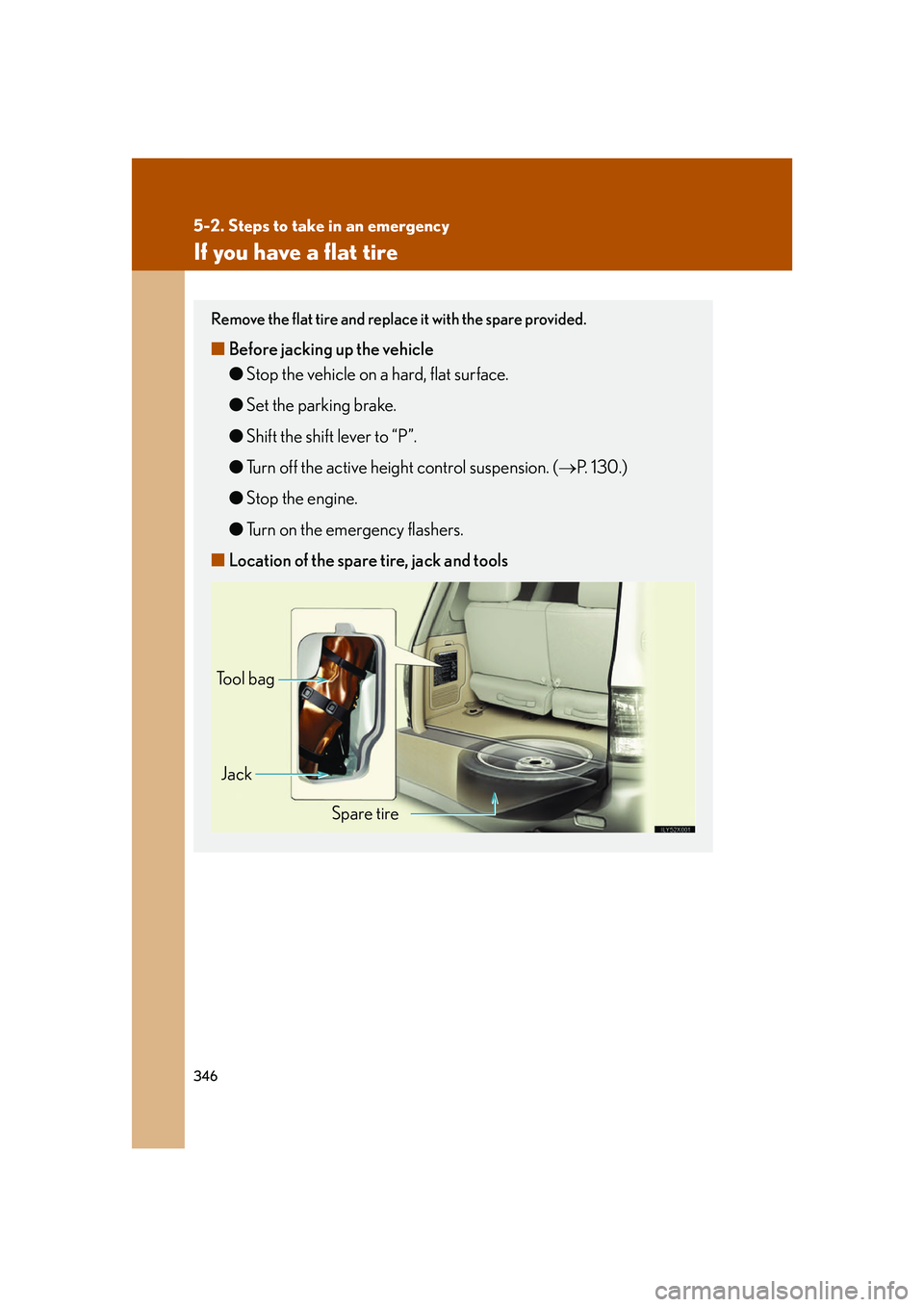
■ Location of the spare tire, jack and tools
Tool bag
Spare tire
Jack
Page 372 of 426

354
5-2. Steps to take in an emergency
CAUTION
■Using the tire jack
Improper use of the tire jack may lead to death or injuries due to the vehicle sud-
denly falling off the jack.
●Do not use the tire jack for any purpose other than replacing tires or installing and
removing tire chains.
●Only use the tire jack that comes with this vehicle for replacing a flat tire.
Do not use it on other vehicles, and do not use other tire jacks for replacing tires
on this vehicle.
●Always check that the tire jack is securely set to the jack point.
●Be sure to turn off the active height control suspension and stop the engine.
●Do not raise the vehicle while someone is in it.
●When raising the vehicle, do not put an object on or under the jack.
●Do not raise the vehicle to a height greate r than that required to replace the tire.
●Use a jack stand if it is necessary to get under the vehicle.
●Do not put any part of your body under the vehicle supported by a jack.
●Do not start or run the engine while your vehicle is supported by the jack.
Take particular care when lowering the vehicle to ensure that no one working on or
near the vehicle may be injured.
■Using the jack handle
Tighten all the jack handle bolts securely using a Phillips-head screwdriver, to pre-
vent the extension parts from coming apart unexpectedly.
Page 386 of 426

368
6-1. Specifications
Maintenance data
Dimensions and weight
*: Unladen vehicle
Overall length192.5 in. (4890 mm)
Overall width76.4 in. (1940 mm)
Overall height *72.8 in. (1850 mm)
Wheelbase112.2 in. (2850 mm)
Tr e a dFront63.8 in. (1620 mm)
Rear63.6 in. (1615 mm)
Vehicle capacity weight
(Occupants + luggage)1200 lb. (545 kg)
Towing capacity
(trailer weight + cargo weight)6500 lb. (2948 kg)
Page 401 of 426

383
6-1. Specifications
6
Vehicle specifications
Tire size■ Typical tire size information
The illustration indicates typical
tire size.
Ti r e u s e
(P = Passenger car,
T = Temporary use)
Section width (millimeters)
Aspect ratio
(tire height to section width)
Tire construction code
(R = Radial, D = Diagonal)
Wheel diameter (inches)
Load index (2 or 3 digits)
Speed symbol
(alphabet with one letter)
■ Tire dimensions
Section width
Ti r e h e i g h t
Wheel diameter