steering LEXUS LX470 2007 Owner's Manual
[x] Cancel search | Manufacturer: LEXUS, Model Year: 2007, Model line: LX470, Model: LEXUS LX470 2007Pages: 426, PDF Size: 10.95 MB
Page 162 of 426
144
2-4. Using other driving systems
■Sounds and vibrations caused by the ABS, BA, VSC, TRAC and VGRS systems
●A sound may be heard from the engine compartment when the engine is
started or just after the vehicle begins to move. This sound does not indicate that
a malfunction has occurred in any of these systems.
●Any of the following conditions may occur when the above systems are operat-
ing. None of these indicates that a malfunction has occurred.
• Vibrations may be felt through the vehicle body and steering.
• A motor sound may be heard after the vehicle comes to a stop.
• The brake pedal may pulsate slightly after the ABS is activated.
• The brake pedal may move down slightly after the ABS is activated.
■VGRS is disabled in the following situations
●During stopping or the steering wheel has been moved for a long time while
driving at lower speeds.
●After the engine is restarted at less than -22°F (-30°C).
●If you disconnect the batter y with the steering wheel turned, the center position
of the steering wheel could be slightly and temporary changed. To initialize the
VGRS, drive for a short while.
Page 167 of 426
149
2-5. Driving information
2
When driving
CAUTION
■Off-road driving precautions
Always observe the following precautions to help minimize the risk of serious per-
sonal injury or damage to your vehicle:
●Drive carefully when off the road. Do not take unnecessary risks by driving in
dangerous places.
●Do not grip the steering wheel spokes wh en driving off-road. A bad bump could
jerk the wheel and injure your hands. Keep both hands and especially your
thumbs on the outside of the rim.
●Always check your brakes for effectiveness immediately after driving in sand,
mud, water or snow.
●After driving through tall grass, mud, rock, sand, rivers, etc., check that there is no
grass, bush, paper, rags, stone, sand, etc. adhering or trapped on the underbody.
Clear off any such matter from the underbody. If the vehicle is used with these
materials trapped or adhering to the underbody, a breakdown or fire could occur.
●When driving off-road or in rugged te rrain, do not drive at excessive speeds,
jump, make sharp turns, strike objects, etc. This may cause loss of control or vehi-
cle rollover causing death or serious injury. You are also risking expensive dam-
age to your vehicle’s suspension and chassis.
NOTICE
■To prevent the water damage
Take all necessary safety measures to ensure that water dama ge to the engine or
other components does not occur.
●Water entering the engine air intake will cause severe engine damage.
●Water entering the automatic transmission will cause deterioration in shift quality,
locking up of your transmission accompanied by vibration, and ultimately dam-
age.
●Water can wash the grease from wheel bearings, causing rusting and premature
failure, and may also enter the differentials, transmission and transfer case, reduc-
ing the gear oil’s lubricating qualities.
Page 172 of 426
154
2-5. Driving information
CAUTION
■Storage precautions
●Do not stack anything in the luggage compartment higher than the seatbacks.
Such items may be thrown about and possibly injure people in the vehicle during
sudden braking or in an accident.
●Do not drive with objects on top of the instrument panel.
They may interfere with the driver’s field of view or move during sharp accelera-
tion or turning, thus impairing the driver ’s control of the vehicle. In an accident
they may injure the vehicle occupants.
●Secure all items in the occupant compartment, as they may shift and injure some-
one during an accident or sudden braking.
●Never allow anyone to ride in the luggage compartment. It is not designed for
passengers. They should ride in their seat s with their seat belts properly fastened.
Otherwise, they are much more likely to suffer serious injury, in the event of sud-
den braking or a collision.
■Weight of the load
●Do not exceed the maximum axle weight ra ting or the total vehicle weight rating.
●Even if the total load of occupant's weight and the cargo load is less than the total
load capacity, do not apply the load unevenly. Improper loading may cause dete-
rioration of steering or braking control which may cause death or serious injury.
Page 173 of 426

155
2-5. Driving information
2
When driving
Vehicle load limits
■Total load capacity and seating capacity
These details are also described on the tire and loading information label.
( P. 3 0 2 )
CAUTION
■Overloading the vehicle
Do not overload the vehicle.
It may not only cause damage to the tire s, but also degrade steering and braking
ability, resulting in an accident.
Vehicle load limits include total lo ad capacity, seating capacity, towing
capacity and cargo capacity.
■ Total load capacity: 1200 lb. (545 kg)
Total load capacity means the comb ined weight of occupants, cargo
and luggage.
■ Seating capacity: 8 occupants (Front 2, Rear 6)
Seating capacity means the maximu m number of occupants whose
estimated average weight is 150 lb. (68 kg) per person.
Even if the number of occupants ar e within the seating capacity, do
not exceed the total load capacity.
■ Towing capacity: 6500 lb. (2948 kg)
Towing capacity means the maximu m gross trailer weight (trailer
weight plus its cargo weight) that you vehicle is able to tow.
■ Cargo capacity
Cargo capacity may inc rease or decrease depending on the weight
and the number of occupants.
Page 185 of 426

167
2-5. Driving information
2
When driving
●Reversing with a trailer attached is difficult and requires practice Grip
the bottom of the steering wheel and move your hand to the left to
move the trailer to the left. Move yo ur hand to the right to move the
trailer to right. (This is generally opposite to reversing without a trailer
attached.) Avoid sharp or prolon ged turning. Have someone guide
you when reversing to reduce the risk of an accident.
● As stopping distance is increased when towing a trailer, vehicle-to-
vehicle distance should be increas ed. For each 10 mph (16 km/h) of
speed, allow at least one vehicle and trailer length.
● Avoid sudden braking as you may sk id, resulting in jackknifing and loss
of control. This is especially true on wet or slippery surfaces.
● Avoid jerky starts or sudden acceleration.
● Avoid jerky steering and sharp turn s, and slow down before making
turns.
● Note that when making a turn, the tr ailer wheels will be closer than the
vehicle wheels to the inside of th e turn. Compensate by making a
larger than normal turning radius.
● Crosswinds and rough roads will ad versely affect handling of your
vehicle and trailer, causing sway. Peri odically check the rear to prepare
for being passed by large trucks or buses, which may cause your vehi-
cle and trailer to sway. If swaying occurs, firmly grip the steering wheel,
reduce speed immediately but gradually, and steer straight ahead.
Never increase speed. If you make no extreme correction with the
steering or brakes, your vehi cle and trailer will stabilize.
● Take care when passing other vehi cles. Passing requires considerable
distance. After passing a vehicle, do not forget the length of your
trailer, and be sure you have plenty of room before changing lanes.
● In order to maintain efficient eng ine braking and electrical charging
performance, do not use overdrive. Transmission shift range position
must be in 4.
Page 189 of 426

Interior features3
171
3-1. Using the air conditioning system and defogger ........... 172
Automatic air conditioning system (without navigation
system).......................................... 172
Rear air conditioning controls........................................ 180
Rear window and outside rear view mirror defoggers........... 182
3-2. Using the audio system ......... 183 Audio system type (without navigation system) .................. 183
Using the radio ............................ 185
Using the cassette player........ 194
Using the CD player .................. 197
Optimal use of the audio system ......................................... 204
Using the steering switches ...................................... 206
Rear seat audio system .......... 209 3-3. Using the interior lights ........ 212
Interior lights list .......................... 212
3-4. Using the storage features ................................... 215
List of storage features ............ 215
3-5. Other interior features......... 221 Sun visors ....................................... 221
Vanity mirror ............................... 222
Clock.............................................. 223
Outside temperature display ......................................... 224
Ashtrays ........................................ 225
Cigarette lighter ........................ 227
Power outlet ................................ 228
Seat heaters ................................ 230
Coat hooks .................................. 232
Armrest ......................................... 233
Floor mats .................................... 234
Luggage compartment features....................................... 235
Garage door opener............... 237
Compass....................................... 242
Lexus Link System .................... 246
Page 201 of 426

183
3
Interior features
3-2. Using the audio system
Audio system type (without navigation system)
■Using cellular phones
Interference may be heard through the audio system's speakers if a cellular phone
is being used inside or close to the ve hicle while the audio system is operating.
Owners of models equipped with a navigation system should refer to the
“Navigation System Owner's Manual”.
CD player with changer, cassette player and AM/FM radio.
Ti t l ePa g e
Using the radioP. 1 8 5
Using the cassette playerP. 1 9 4
Using the CD playerP. 1 9 7
Optimal use of the audio systemP. 2 0 4
Using the steering switchesP. 2 0 6
Rear seat audio systemP. 2 0 9
Page 224 of 426
![LEXUS LX470 2007 Owners Manual 206
3-2. Using the audio system
Using the steering switches
]
Turning on the powerPress when the audio system is turned OFF.
Changing the audio source
Press when the audio system is turned ON. T](/img/36/58005/w960_58005-223.png "LEXUS LX470 2007 Owners Manual 206
3-2. Using the audio system
Using the steering switches
]
Turning on the powerPress when the audio system is turned OFF.
Changing the audio source
Press when the audio system is turned ON. T")
206
3-2. Using the audio system
Using the steering switches
]
Turning on the powerPress when the audio system is turned OFF.
Changing the audio source
Press when the audio system is turned ON. The audio source
changes as follows each time the bu tton is pressed. If a cassette tape or
CD is not inserted, that mode will be skipped.
Vehicles with CD player:
FM(1, 2) cassette player CD player AM SAT (1, 2, 3)
Vehicles with DVD player:
FM(1, 2) cassette player DVD player AM SAT (1, 2, 3)
Some audio features can be controlled using the switches on the steering
wheel.
Vo l u m e
Radio: Select radio stations
Cassette: Fast forward, rewind
and selecting tracks
CD: Select tracks and discs
DVD*: Select tracks, discs and chapter
Power on, select audio
source
*: If equipped
Page 226 of 426

208
3-2. Using the audio system
Selecting a disc in the CD or DVD playerPress to select the CD or DVD player.
Press and hold or on until you hear a beep.
CAUTION
■To reduce the risk of an accident
Exercise care when operating the audio switches on the steering wheel.
STEP1
STEP2
Page 285 of 426
267
4-2. Maintenance
4
Maintenance and care
General maintenance
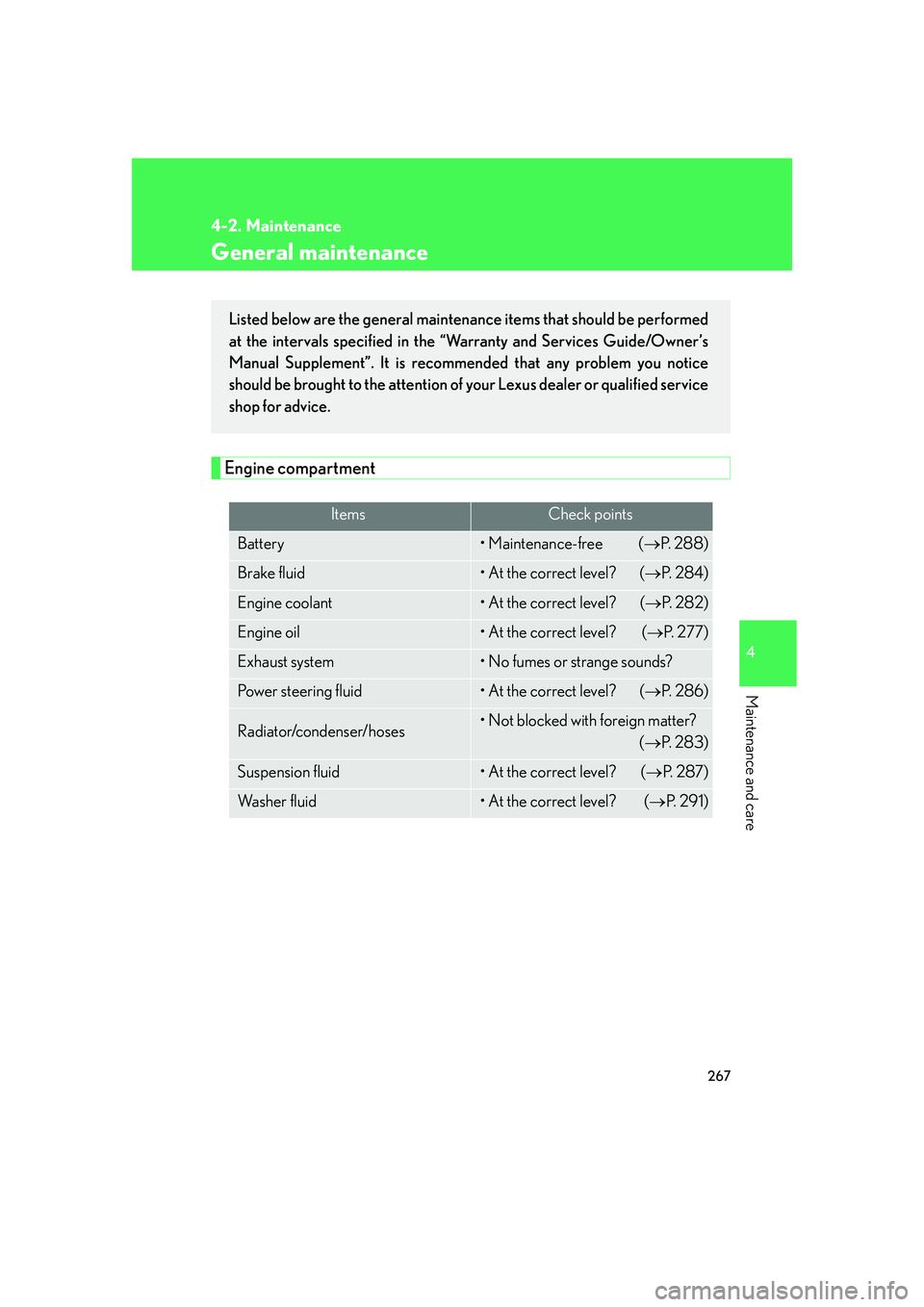
Engine compartment
ItemsCheck points
Battery• Maintenance-free (P. 2 8 8 )
Brake fluid• At the correct level? ( P. 2 8 4 )
Engine coolant• At the correct level? ( P. 2 8 2 )
Engine oil• At the correct level? ( P. 2 7 7 )
Exhaust system• No fumes or strange sounds?
Power steering fluid• At the correct level? (P. 2 8 6 )
Radiator/condenser/hoses • Not blocked with foreign matter?
(P. 2 8 3 )
Suspension fluid• At the correct level? ( P. 2 8 7 )
Wa s h e r f l u i d• At the correct level? ( P. 2 9 1 )
Listed below are the general maintenance items that should be performed
at the intervals specified in the “Warranty and Services Guide/Owner’s
Manual Supplement”. It is recomme nded that any problem you notice
should be brought to the attention of your Lexus dealer or qualified service
shop for advice.