height LEXUS LX570 2014 Owner's Manual
[x] Cancel search | Manufacturer: LEXUS, Model Year: 2014, Model line: LX570, Model: LEXUS LX570 2014Pages: 956, PDF Size: 16.4 MB
Page 357 of 956

3572-4. Using other driving systems
2
When driving
LX570_OM_OM60L21U_(U) ●
Pre-collision brake assist
• Vehicle speed is greater than about 19 mph (30 km/h).
• The speed at which your vehicle is approaching the obstacle or the vehicle
running ahead of you is greater than about 19 mph (30 km/h).
• The brake pedal is depressed. ●
AV S
• Vehicle speed is greater than about 4 mph (5 km/h).
• The speed at which your vehicle is approaching the obstacle or the vehicle
running ahead of you is greater than about 19 mph (30 km/h).■
Conditions that may trigger the system even if there is no possibility of collision ●
When there is an object by the roadside at the entrance to a curve ●
When passing an oncoming vehicle on a curve ●
When driving over a narrow iron bridge●
When there is a metal object on the road surface ●
When driving on an uneven road surface (nose up, nose down)●
When passing an oncoming vehicle on a left-turn ●
When your vehicle rapidly closes on the vehicle in front ●
When a grade separation/interchange, sign, billboard, or other structure
appears to be directly in the vehicle’s line of travel ●
When climbing a steep hill causes an over head billboard or ot her metallic struc-
ture to appear directly in the vehicle’s line of travel ●
When an extreme change in vehicle height occurs ●
When the axis of the radar is out of adjustment ●
When passing through certain toll gates ●
When passing through an overpass ●
When passing through a tunnel
When the system is activated in the situations described above there is also a possi-
bility that the seat belts will retract quickly and the brakes will be applied with a force
greater than normal. When the seat belt is locked in the retracted position, stop the
vehicle in a safe place, release the seat belt and refasten.
Page 361 of 956

3612
When driving
LX570_OM_OM60L21U_(U) 2-5. Driving information
Off-road precautions Off-road vehicle feature
● Specific design characteristics give it a higher center of gravity than
ordinary passenger cars. This vehicle design feature causes this type of
vehicle to be more likely to rollover . And, utility vehicles have a signifi-
cantly higher rollover rate than other types of vehicles.
● An advantage of the higher ground clearance is a better view of the
road allowing you to anticipate problems.
● It is not designed for cornering at the same speeds as ordinary passen-
ger cars any more than low-slung sp orts cars are designed to perform
satisfactorily under off-road cond itions. Therefore, sharp turns at
excessive speeds may cause rollover. This vehicle belongs to the utility vehicle class, which has higher ground
clearance and narrower tread in relation to the height of its center of grav-
ity to make it capable of performing in a wide variety of off-road applica-
tions.
Page 377 of 956

3772-5. Driving information
2
When driving
LX570_OM_OM60L21U_(U) CAUTION■
Driving with snow tires
Observe the following precautions to reduce the risk of accidents.
Failing to do so may result in a loss of vehicle control and cause death or serious
injury. ●
Use tires of the size specified for your vehicle. ●
Maintain the recommended level of tire inflation pressure. ●
Do not drive in excess of 75 mph (120 km/h), regardless of the type of snow tires
being used. ●
Snow tires should be installed on all wheels.■
Driving with tire chains
Observe the following precautions to reduce the risk of accidents.
Failing to do so may result in the vehicle being unable to be driven safely, and may
cause death or serious injury. ●
Do not drive in excess of the speed limit specified for the tire chains being used or
30 mph (50 km/h), whichever is lower. ●
Avoid driving on bumpy road surfaces or over potholes. ●
Avoid sudden acceleration, abrupt steeri ng, sudden braking and shifting opera-
tions that cause sudden engine braking. ●
Slow down sufficiently before entering a curve to ensure that vehicle control is
maintained.■
When installing tire chains
Turn off the vehicle height control.
The vehicle height may change due to the automatic leveling function and you may
catch part of your body in the vehicle, resulting in an accident. ( P. 3 1 8 )
Page 385 of 956
3852-5. Driving information
2
When driving
LX570_OM_OM60L21U_(U) Trailer Tongue Weight
● A recommended tongue weight varies in accordance with the types of
trailers or towing as described below.
● To ensure the recommended values shown below, the trailer must be
loaded by referring to the following instructions.
• Tongue Weight
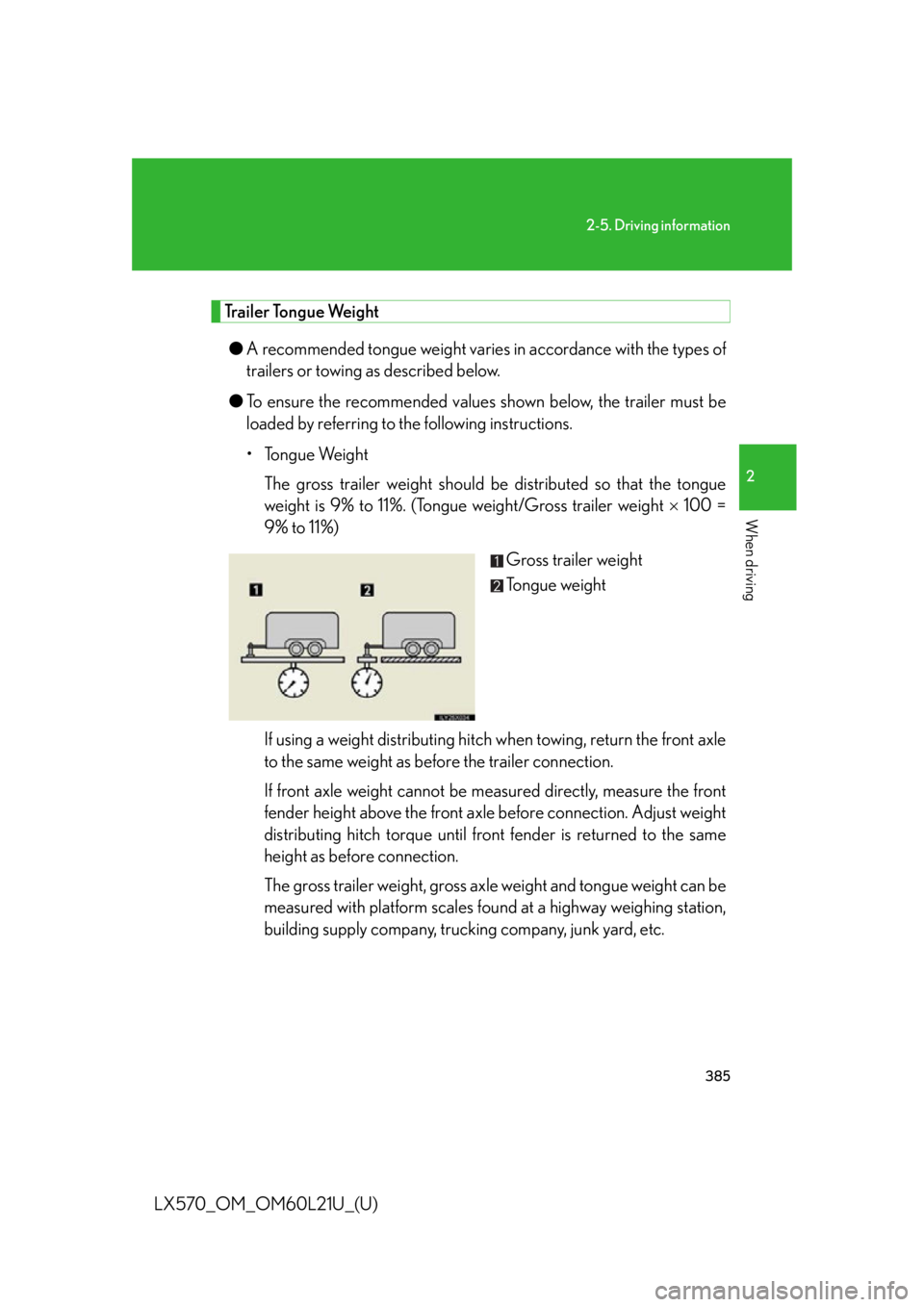
The gross trailer weight should be distributed so that the tongue
weight is 9% to 11%. (Tongue we ight/Gross trailer weight 100 =
9% to 11%)
Gross trailer weight
Tongue weight
If using a weight distri buting hitch when towing , return the front axle
to the same weight as before the trailer connection.
If front axle weight cannot be mea sured directly, measure the front
fender height above the front axle before connection. Adjust weight
distributing hitch torque until fr ont fender is returned to the same
height as before connection.
The gross trailer weight, gross axle weight and tongue weight can be
measured with platform scales foun d at a highway weighing station,
building supply company, truck ing company, junk yard, etc.
Page 389 of 956

3892-5. Driving information
2
When driving
LX570_OM_OM60L21U_(U) Connecting and disconnecting a trailer
Stop your vehicle and a trailer in line and perform the following:
● Connecting a trailer
Put the 4-Wheel AHC in the “LO” (low) mode.
Turn off the “ENGINE START STOP” switch or the 4-Wheel
AHC.
Connect a trailer.
Turn on the “ENGINE START STOP” switch or the 4-Wheel
AHC.
Select the “N” (normal) mode with the height select switch. When a vehicle loaded with four occupants tows a trailer of about
4000 lb. (1800 kg) with more than about 400 lb. (180 kg) tongue
load, the normal mode may not be se lected. However, there is no prob-
lem to continue normal driving. Dr ive with sufficient care because of
large load. STEP 1
STEP 2
STEP 3
STEP 4
STEP 5
Page 390 of 956

3902-5. Driving information
LX570_OM_OM60L21U_(U) ● Disconnecting a trailer
Put the 4-Wheel AHC in the “LO” (low) mode. (Make sure the
vehicle height is in the “LO” mode by pulling the switch to “ ” on
the height select switch.)
Turn off the “ENGINE START STOP” switch or the 4-Wheel
AHC.
Set the supporting leg of a trail er on the ground and raise the
hitch by 4 in. (100 mm).
Turn on the “ENGINE START STOP” switch or the 4-Wheel
AHC.
Wait for about 20 seconds until th e rear vehicle height is lowered
by the automatic leveling function.
Make sure the hitch is disconnected. If not, raise the hitch higher
and repeat steps 2 through 5.
Move the vehicle forward in the “LO” mode where the hitch does
not touch anything in the “N” (normal) mode.
Put the 4-Wheel AHC in the “N” mode. STEP 1
STEP 2
STEP 3
STEP 4
STEP 5
STEP 6
STEP 7
STEP 8
Page 394 of 956
3942-5. Driving information
LX570_OM_OM60L21U_(U) ■
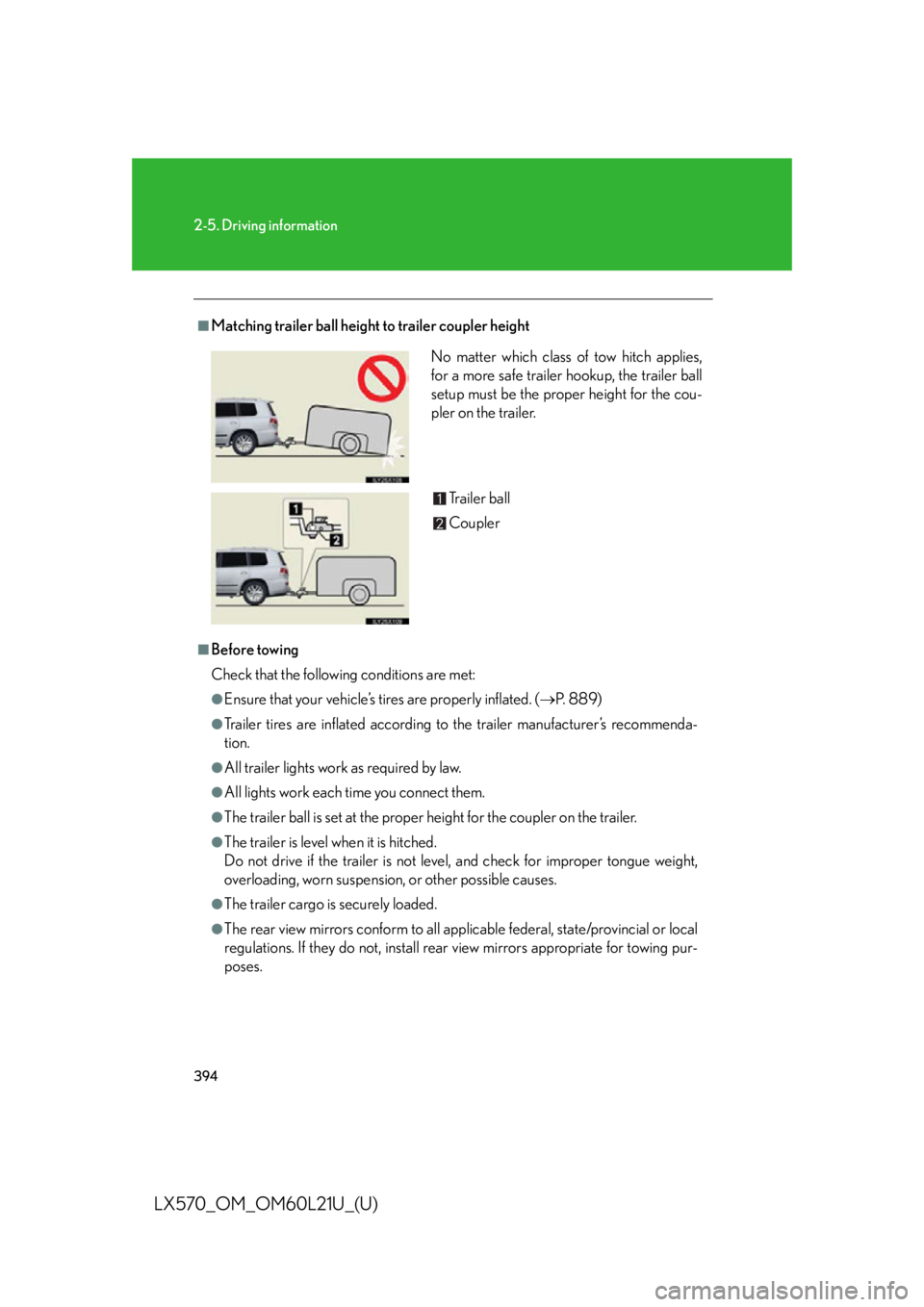
Matching trailer ball height to trailer coupler height
■
Before towing
Check that the following conditions are met: ●
Ensure that your vehicle’s tires are properly inflated. ( P. 8 8 9 )●
Trailer tires are inflated according to the trailer manufacturer’s recommenda-
tion. ●
All trailer lights work as required by law. ●
All lights work each time you connect them. ●
The trailer ball is set at the proper height for the coupler on the trailer. ●
The trailer is level when it is hitched.
Do not drive if the trailer is not level, and check for improper tongue weight,
overloading, worn suspension , or other possible causes.●
The trailer cargo is securely loaded. ●
The rear view mirrors conform to all applicable federal, state/provincial or local
regulations. If they do not, install rear view mirrors appropriate for towing pur-
poses. No matter which class of tow hitch applies,
for a more safe trailer hookup, the trailer ball
setup must be the proper height for the cou-
pler on the trailer.
Trailer ball
Coupler
Page 396 of 956

3962-5. Driving information
LX570_OM_OM60L21U_(U) ●
After the trailer swaying has stopped:
• Stop in a safe place. Get all occupants out of the vehicle.
• Check the tires of the vehicle and the trailer.
• Check the load in the trailer.
Make sure the load has not shifted.
Make sure the tongue weight is appropriate, if possible.
• Check the load in the vehicle.
Make sure the vehicle is not ov erloaded after occupants get in.
If you cannot find any problems, the speed at which trailer swaying occurred is
beyond the limit of your particular vehicle-trailer combination.
Drive at a lower speed to prevent instability. Remember that swaying of the towing
vehicle-trailer increases as speed increases.
CAUTION■
Trailer towing precautions ●
To tow a trailer safely, use extreme care and drive the vehicle in accordance with
the trailer’s characteristics and operating conditions. Failure to do so could cause
an accident resulting in death or seriou s injury. Vehicle stability and braking per-
formance are affected by trailer stability, brake setting and performance, and the
hitch. Your vehicle will handle differently when towing a trailer.●
Set the vehicle height to the “LO” mode and turn off the 4-Wheel AHC when you
connect a trailer, otherwise the vehicle height may change due to the automatic
leveling function, and you may catch part of your body in the vehicle, resulting in
an accident. ( P. 3 1 8 )
Page 816 of 956

8145-1. Essential information
LX570_OM_OM60L21U_(U) Emergency towing
If a tow truck is not available, in an emergency your vehicle may be tem-
porarily towed using a cable or cha in secured to the towing hook. This
should only be attempted on hard, surfaced roads for short distances at
low speeds.
A driver must be in the vehicle to s teer and operate the brakes. The vehi-
cle’s wheels, drive train, axles, steering and brakes must be in good condi-
tion.
Towing hook
■
Emergency towing procedure
The “ENGINE START STOP” switch must be in ACCESSORY mode
(engine off) or IGNITION ON mode (engine running).
Put the four-wheel drive control switch in “H4”. (The center differential is
unlocked.)
Put the vehicle height in the “N” mode and press the height control OFF
switch to turn off the height control. ( P. 3 1 8 )
Put the shift lever in “N”.
Release the parking brake.STEP 1
STEP 2
STEP 3
STEP 4
STEP 5
Page 862 of 956

8605-2. Steps to take in an emergency
LX570_OM_OM60L21U_(U) CAUTION■
Using the tire jack
Improper use of the tire jack may lead to death or serious injuries due to the vehicle
suddenly falling off the jack. ●
Do not use the tire jack for any purpose ot her than replacing tires or installing and
removing tire chains. ●
Only use the tire jack that comes with this vehicle for replacing a flat tire.
Do not use it on other vehicles, and do no t use other tire jacks for replacing tires
on this vehicle. ●
Always check that the tire jack is securely set to the jack point.●
Be sure to turn off the 4-Wh eel AHC and stop the engine.●
Do not put any part of your body under the vehicle supported by a jack. ●
Do not start or run the engine while your vehicle is supported by the jack. ●
Do not raise the vehicle while someone is in it. ●
When raising the vehicle, do not put an object on or under the jack. ●
Do not raise the vehicle to a height greate r than that required to replace the tire.●
Use a jack stand if it is necessary to get under the vehicle.
Take particular care when lowering the vehicle to ensure that no one working on or
near the vehicle will be injured. ■
Using the jack handle
Tighten all the jack handle bolts securely using a Phillips-head screwdriver, to pre-
vent the extension parts from coming apart unexpectedly.