brakes LEXUS LX570 2015 User Guide
[x] Cancel search | Manufacturer: LEXUS, Model Year: 2015, Model line: LX570, Model: LEXUS LX570 2015Pages: 960, PDF Size: 11.33 MB
Page 259 of 960

2592-4. Using other driving systems
2
When driving
LX570_OM_OM60L96U_(U) ■
Sensor detection information ●
The sensor’s detection areas are limited to the areas around the vehicle’s front
corner and rear bumpers. ●
Certain vehicle conditions and the surrounding environment may affect the
ability of the sensor to correctly detect obstacles. Particular instances where
this may occur are listed below.
• There is dirt, snow or ice on the sens or. (Wiping the sensors will resolve this
problem.)
• The sensor is frozen. (Thawing the area will resolve this problem.)
In especially cold weather, if a sensor is frozen the screen may show an
abnormal display, or obstacles may not be detected.
• The sensor is covered in any way.
• The vehicle is leaning considerably to one side.
• On an extremely bumpy road, on an incline, on gravel, or on grass
• The vicinity of the vehicle is noisy due to vehicle horns, motorcycle engines,
air brakes of large vehicles, or other loud noises producing ultrasonic waves.
• There is another vehicle equipped with parking assist sensor s in the vicinity.
• The sensor is coated with a sheet of spray or heavy rain.
• The vehicle is equipped with a fender pole or wireless antenna.
• Towing hook is installed.
• The bumper or sensor receives a strong impact.
• The vehicle is approaching a tall or curved curb.
• In harsh sunlight or intense cold weather
• The area directly under the bumpers is not detected.
• If obstacles draw too close to the sensor.
• A non-genuine Lexus suspension (low ered suspension etc.) is installed.
• People may not be detected if they are wearing certain types of clothing.
In addition to the examples above, there are instances in which, because of their
shape, signs and other objects may be ju dged by the sensor to be closer than
they are.
Page 349 of 960

3492-4. Using other driving systems
2
When driving
LX570_OM_OM60L96U_(U) Driving assist systems To help enhance driving safety and performance, the following systems
operate automatically in response to various driving situations. Be aware,
however, that these systems are supplementary and should not be relied
upon too heavily when operating the vehicle.
■ Multi Terrain ABS (Anti-lock Brake System) Helps to prevent wheel lock when the brakes are applied suddenly, or if
the brakes are applied while driving on a slippery road surface, or in off-
road conditions (such as rough roads, sand and mud).
■ Brake assist Generates an increased level of br aking force after the brake pedal is
depressed, when the system detects a panic stop situation.
■ VSC (Vehicle Stability Control) Helps the driver to control skidding when swerving suddenly or turning on
slippery road surfaces.
■ Active TRAC (Traction Control) Helps to maintain driv e power and prevent the 4 wheels from spinning
when starting the vehicle or a ccelerating on slippery roads.
■ Hill-start assist control Helps to prevent the vehicle from ro lling backwards when starting on an
incline or slippery slope.
■ VGRS (Variable Gear Ratio Steering) Helps to adjust the wheel turning an gle in accordance with the vehicle
speed and steering wheel movement.
■ PCS (Pre-Collision System) (if equipped) P. 357
Page 356 of 960

3562-4. Using other driving systems
LX570_OM_OM60L96U_(U) CAUTION■
Trailer Sway Control precaution
The Trailer Sway Control system is not able to reduce trailer sway in all situations.
Depending on many factors such as the cond itions of the vehicle, trailer, road sur-
face, and driving environment, the Trailer Sway Control system may not be effec-
tive. Refer to your trailer ow ner’s manual for information on how to tow your trailer
properly. ■
If trailer sway occurs
Observe the following precautions.
Failing to do so may cause death or serious injury.●
Firmly grip the steering wh eel. Steer straight ahead.
Do not try to control trailer swaying by turning the steering wheel. ●
Begin releasing the accelerator pedal immediately but very gradually to reduce
speed.
Do not increase speed. Do not apply vehicle brakes.
If you make no extreme correction with the steering or brakes, your vehicle and
trailer should stabilize. ( P. 397)
Page 357 of 960

3572-4. Using other driving systems
2
When driving
LX570_OM_OM60L96U_(U) Pre-Collision System
: If equippedWhen the radar sensor detects possibilit y of a frontal collision, the pre-col-
lision systems such as the brakes and seat belts are automatically engaged
to lessen impact as well as vehicle damage.
■ Pre-collision seat belts (front seats only) If the pre-collision sensor detects that a collision is unavoidable, the pre-
collision system will retract the seat belt before the collision occurs.
The same will happen if the driver makes an emergency braking or loses
control of the vehicle. ( P. 94)
However, when the VSC system is disabled, the system will not operate in
the event of skidding.
■ Pre-collision brake assist When there is a high possibility of a frontal collision, the system applies
greater braking force in relation to how strongly the brake pedal is
depressed. The system may not warn the driver using a warning light,
warning display and buzzer when the system detects and judges braking
operations.
■ AVS control When the system determines that there is a high possibility of a frontal col-
lision, the AVS optimizes the damping effect. ( P. 331)
Page 359 of 960

3592-4. Using other driving systems
2
When driving
LX570_OM_OM60L96U_(U) ●
Pre-collision brake assist
• Vehicle speed is greater than about 19 mph (30 km/h).
• The speed at which your vehicle is ap proaching the obstacle or the vehicle
running ahead of you is greate r than about 19 mph (30 km/h).
• The brake pedal is depressed. ●
AVS
• Vehicle speed is greater than about 4 mph (5 km/h).
• The speed at which your vehicle is ap proaching the obstacle or the vehicle
running ahead of you is greate r than about 19 mph (30 km/h).■
Conditions that may trigger the system even if there is no possibility of collision●
When there is an object by the roadside at the entrance to a curve ●
When passing an oncoming vehicle on a curve ●
When driving over a narrow iron bridge ●
When there is a metal object on the road surface ●
When driving on an uneven road surface (nose up, nose down)●
When passing an oncoming vehicle on a left-turn●
When your vehicle rapidly clos es on the vehicle in front●
When a grade separation/interchange, sign, billboard, or other structure
appears to be directly in the vehicle’s line of travel ●
When climbing a steep hill causes an overhead billboard or other metallic
structure to appear directly in the vehicle’s line of travel ●
When an extreme change in vehicle height occurs ●
When the axis of the radar is out of adjustment ●
When passing through certain toll gates●
When passing through an overpass ●
When passing through a tunnel
When the system is activated in the situations described above there is also a possi-
bility that the seat belts will retract quic kly and the brakes will be applied with a
force greater than normal. When the seat be lt is locked in the retracted position,
stop the vehicle in a safe place, release the seat belt and refasten.
Page 366 of 960

3662-5. Driving information
LX570_OM_OM60L96U_(U) CAUTION■
Off-road driving precautions
Always observe the following precautions to minimize the risk of serious personal
injury or damage to your vehicle: ●
Drive carefully when off the road. Do no t take unnecessary risks by driving in
dangerous places. ●
Do not grip the steering wheel spokes when driving off-road. A bad bump could
jerk the wheel and injure your hands. Keep both hands and especially your
thumbs on the outside of the rim. ●
Always check your brakes for effectiveness immediately after driving in sand,
mud, water or snow. ●
After driving through tall grass, mud, rock, sand, rivers, etc., ch eck that there is no
grass, bush, paper, rags, stone, sand, et c. adhering or trapped on the underbody.
Clear off any such matter fr om the underbody. If the vehicle is used with these
materials trapped or adhering to the underbody, a breakdown or fire could
occur. ●
When driving off-road or in rugged te rrain, do not drive at excessive speeds,
jump, make sharp turns, strike objects, etc. This may cause loss of control or vehi-
cle rollover causing death or serious in jury. You are also risking expensive dam-
age to your vehicle’s suspension and chassis.
Page 377 of 960
3772-5. Driving information
2
When driving
LX570_OM_OM60L96U_(U) ■ Before driving the vehicle
Perform the following according to the driving conditions.
● Do not try to forcibly open a window or mo ve a wiper that is fro-
zen. Pour warm water over the froz en area to melt the ice. Wipe
away the water immediately to prevent it from freezing.
● To ensure proper operation of the climate control system fan,
remove any snow that has accumula ted on the air inlet vents in
front of the windshield.
● Check for and remove any exce ss ice or snow that may have
accumulated on the exterior lights, vehicle’s roof, chassis, around
the tires or on the brakes.
● Remove any snow or mud from the bottom of your shoes before
getting in the vehicle.
■ When driving the vehicle
Accelerate the vehicle slowly, k eep a safe distance between you
and the vehicle ahead, and drive at a reduced speed suitable to road
conditions.
■ When parking the vehicle
Park the vehicle and move the shift lever to “P” without setting the
parking brake. The parking brake may freeze up, preventing it from
being released. If necessary, bl ock the wheels to prevent inadvert-
ent sliding or creeping.
Page 381 of 960
3812-5. Driving information
2
When driving
LX570_OM_OM60L96U_(U) Trailer towing Your vehicle is designed primarily as a passenger-and-load-carrying vehi-
cle. Towing a trailer can have an a dverse impact on handling, performance,
braking, durability, and fuel consumption. For your safety and the safety of
others, you must not overload your vehicle or trailer. You must also ensure
that you are using appropriate towing equipment, that the towing equip-
ment has been installed correctly an d used properly, and that you employ
the requisite driving habits.
Vehicle-trailer stability and braking performance are affected by trailer
stability, brake performance and setting, trailer brakes, the hitch and hitch
systems (if equipped).
To tow a trailer safely, use extreme care and drive the vehicle in accor-
dance with your trailer’s characteristics and operating conditions.
Lexus warranties do not apply to dama ge or malfunction caused by towing
a trailer for commercial purposes.
Contact your Lexus dealer for further information about additional
requirements such as towing kits, etc.
Page 383 of 960
3832-5. Driving information
2
When driving
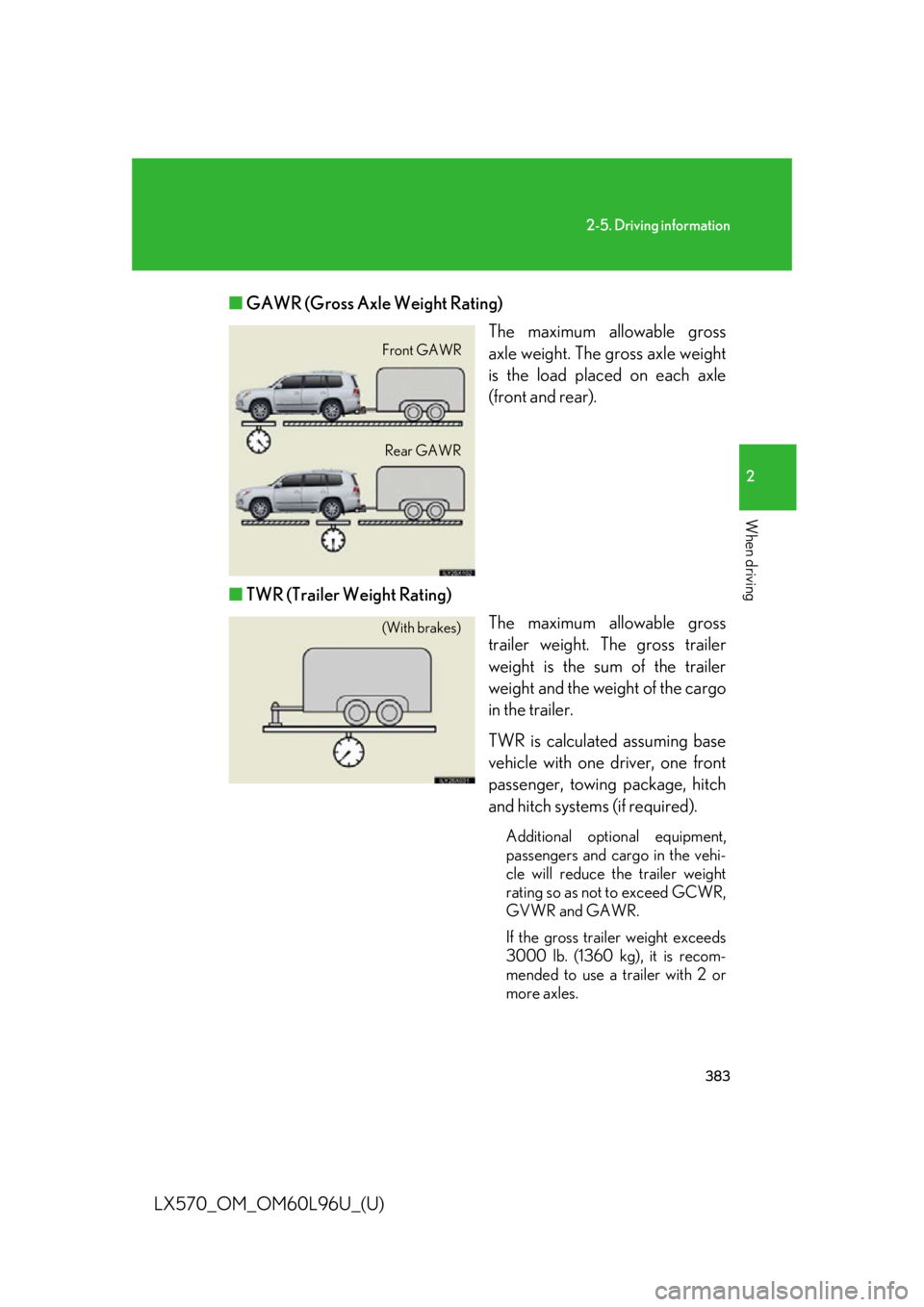
LX570_OM_OM60L96U_(U) ■ GAWR (Gross Axle Weight Rating)
The maximum allowable gross
axle weight. The gross axle weight
is the load placed on each axle
(front and rear).
■ TWR (Trailer Weight Rating)
The maximum allowable gross
trailer weight. The gross trailer
weight is the sum of the trailer
weight and the weight of the cargo
in the trailer.
TWR is calculated assuming base
vehicle with one driver, one front
passenger, towing package, hitch
and hitch systems (if required). Additional optional equipment,
passengers and cargo in the vehi-
cle will reduce the trailer weight
rating so as not to exceed GCWR,
GVWR and GAWR.
If the gross trailer weight exceeds
3000 lb. (1360 kg), it is recom-
mended to use a trailer with 2 or
more axles.Front GAWR
Rear GAWR
(With brakes)
Page 384 of 960
3842-5. Driving information
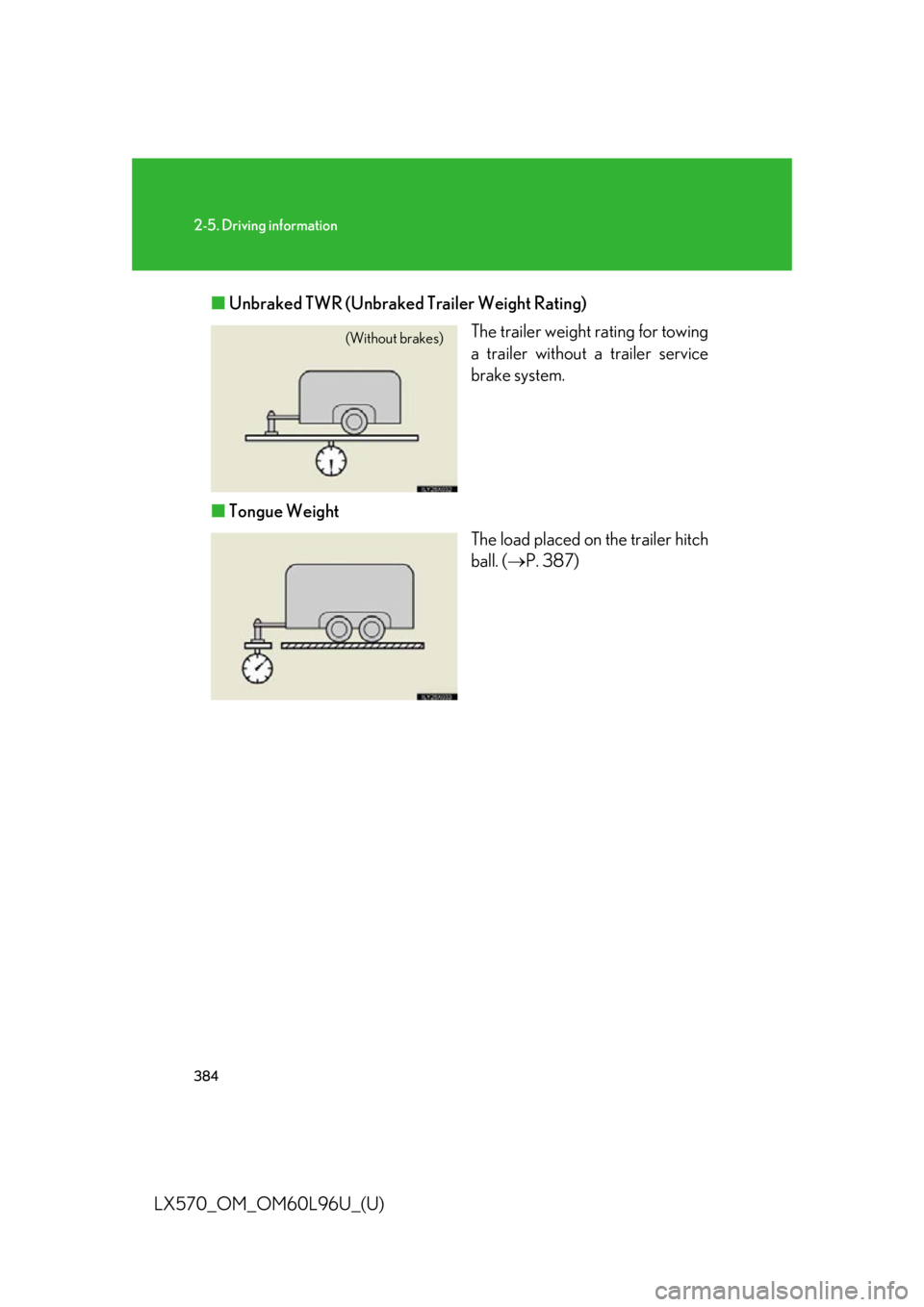
LX570_OM_OM60L96U_(U) ■ Unbraked TWR (Unbraked Trailer Weight Rating)
The trailer weight rating for towing
a trailer without a trailer service
brake system.
■ Tongue Weight
The load placed on the trailer hitch
ball. ( P. 387)(Without brakes)