brake LEXUS LX570 2016 Repair Manual
[x] Cancel search | Manufacturer: LEXUS, Model Year: 2016, Model line: LX570, Model: LEXUS LX570 2016Pages: 632, PDF Size: 10.34 MB
Page 316 of 632
316
LX570_OM_OM60N01U_(U) 4-5. Using the driving support systems
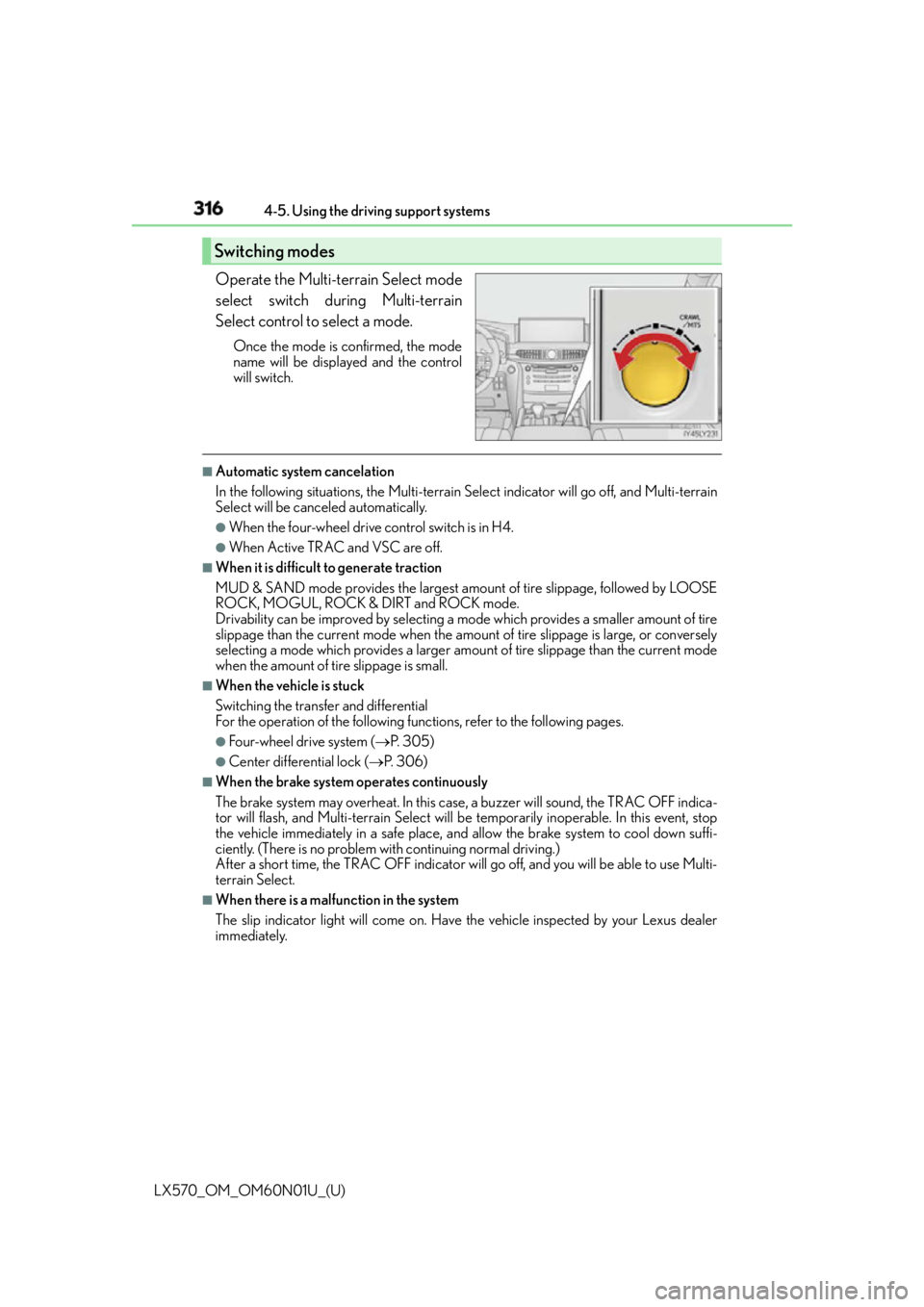
Operate the Multi-terrain Select mode
select switch during Multi-terrain
Select control to select a mode. Once the mode is confirmed, the mode
name will be displayed and the control
will switch. ■
Automatic system cancelation
In the following situations, the Multi-terrain Se lect indicator will go off, and Multi-terrain
Select will be canceled automatically. ●
When the four-wheel drive control switch is in H4. ●
When Active TRAC and VSC are off. ■
When it is difficult to generate traction
MUD & SAND mode provides the largest amount of tire slippage, followed by LOOSE
ROCK, MOGUL, ROCK & DIRT and ROCK mode.
Drivability can be improved by selecting a mo de which provides a smaller amount of tire
slippage than the current mode when the amount of tire slippage is large, or conversely
selecting a mode which provides a larger amou nt of tire slippage than the current mode
when the amount of ti re slippage is small.■
When the vehicle is stuck
Switching the transfer and differential
For the operation of the following functions, refer to the following pages. ●
Four-wheel drive system ( P. 3 0 5 )●
Center differential lock ( P. 3 0 6 )■
When the brake system operates continuously
The brake system may overheat. In this case, a buzzer will sound, the TRAC OFF indica-
tor will flash, and Multi-terrain Select will be temporarily inoperable. In this event, stop
the vehicle immediately in a safe place, and allow the brake system to cool down suffi-
ciently. (There is no problem wi th continuing normal driving.)
After a short time, the TRAC OFF indicator will go off, and you will be able to use Multi-
terrain Select. ■
When there is a malfunction in the system
The slip indicator light will come on. Have the vehicle inspected by your Lexus dealer
immediately.Switching modes
Page 379 of 632
379
LX570_OM_OM60N01U_(U) 4-5. Using the driving support systems
4
Driving
Driving assist systems ◆ Multi Terrain ABS (Anti-lock Brake System) Helps to prevent wheel lock when the brakes are applied suddenly, or if the brakes are
applied while driving on a slippery road su rface, or in off-road conditions (such as
rough roads, sand and mud)
◆ Brake assist Generates an increased leve l of braking force after the brake pedal is depressed
when the system detects a panic stop situation
◆ VSC (Vehicle Stability Control) Helps the driver to control skidding when swerving suddenly or turning on slippery
road surfaces
◆ Active TRAC (Traction Control) Helps to maintain drive power and prevent the 4 wheels from spinning when starting
the vehicle or accelerating on slippery roads, or in off-road conditions
◆ Hill-start assist control Helps to reduce the backward movement of the vehicle when starting on an incline or
slippery slope
◆ AVS (Adaptive Variable Suspension system) By independently controlling the damping force of the shock absorbers for each of
the 4 wheels according to the road and dr iving conditions, this system helps riding
comfort with superior stee ring stability, and helps good vehicle posture. When
SPORT S+ mode is selected by the drivin g mode select switches, the damping force
is suitable for sporty driving. ( P. 2 8 6 )
◆ VGRS (Variable Gear Ratio Steering) Helps to adjust the wheel turning angle in accordance with the vehicle speed and
steering wheel movement.
◆ Trailer Sway Control Helps the driver to control trailer sway by selectively applying brake pressure for indi-
vidual wheels and reducing engine to rque when trailer sway is detected.
Trailer Sway Control is part of the VSC system and will not operate if VSC turned off
or experiences a malfunction.To help enhance driving safety and performance, the following systems oper-
ate automatically in response to various driving situations. Be aware, however,
that these systems are supplementary and should not be relied upon too
heavily when operating the vehicle.
Page 380 of 632
380
LX570_OM_OM60N01U_(U) 4-5. Using the driving support systems
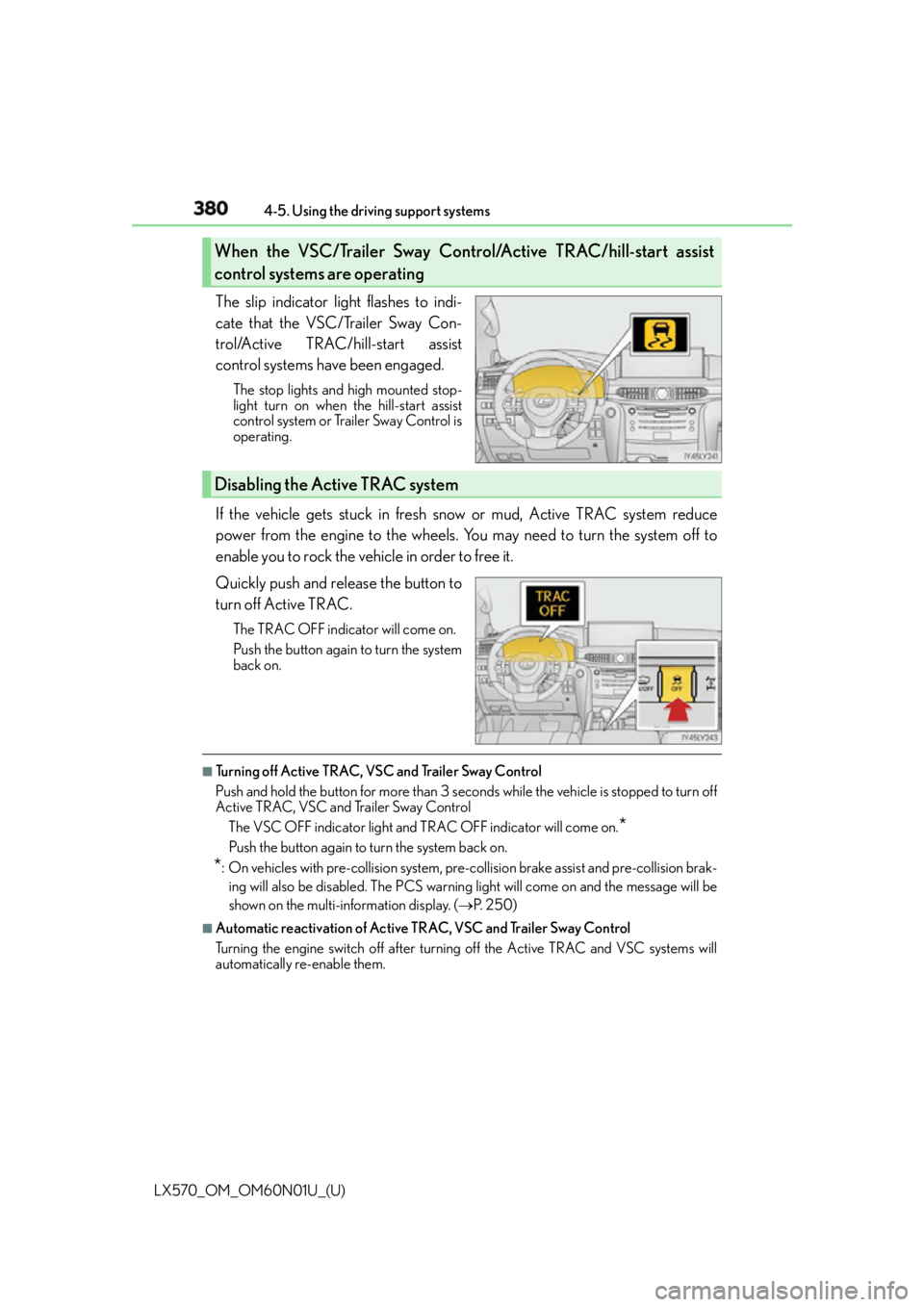
The slip indicator light flashes to indi-
cate that the VSC/Trailer Sway Con-
trol/Active TRAC/hill-start assist
control systems have been engaged. The stop lights and high mounted stop-
light turn on when the hill-start assist
control system or Trailer Sway Control is
operating.
If the vehicle gets stuck in fresh snow or mud, Active TRAC system reduce
power from the engine to the wheels. You may need to turn the system off to
enable you to rock the vehicle in order to free it.
Quickly push and release the button to
turn off Active TRAC. The TRAC OFF indicator will come on.
Push the button again to turn the system
back on.
■
Turning off Active TRAC, VSC and Trailer Sway Control
Push and hold the button for more than 3 seconds while the vehicle is stopped to turn off
Active TRAC, VSC and Trailer Sway Control
The VSC OFF indicator light and TRAC OFF indicator will come on.
*Push the button again to turn the system back on.
* : On vehicles with pre-collision system, pre-collision brake assist and pre-collision brak-
ing will also be disabled. The PCS warning light will come on and the message will be
shown on the multi-information display. ( P. 2 5 0 )■
Automatic reactivation of Active TRAC, VSC and Trailer Sway Control
Turning the engine switch off after turning off the Active TRAC and VSC systems will
automatically re-enable them.When the VSC/Trailer Sway Control/Active TRAC/hill-start assist
control systems are operating
Disabling the Active TRAC system
Page 381 of 632

LX570_OM_OM60N01U_(U) 3814-5. Using the driving support systems
4
Driving ■
Automatic Active TRAC reactivation
If only the Active TRAC system is turned off, the Active TRAC system will turn on when
vehicle speed increases. ■
Automatic Active TRAC, VSC and Trailer Sway Control reactivation
If the Active TRAC, VSC and Trailer Sway Control are turned off, the systems will not
turn on even when vehicle speed increases. ■
If the brake system overheats
The brake system may overheat. In this cas e, a buzzer will sound, and the TRAC OFF
indicator will flash, and Active TRAC and hill- start assist control will be temporarily inop-
erable. In this event, stop the vehicle immediately in a safe place, and allow the brake sys-
tem to cool down sufficiently until the TR AC OFF indicator goes off. (There is no
problem with continuing normal driving.) ■
Sounds and vibrations caused by the Mult i Terrain ABS, brake assist, Active TRAC,
VSC, Trailer Sway Control, hill-start assist control and VGRS ●
A sound may be heard from the engine compartment when the engine is started or just
after the vehicle begins to move. This sound does not indicate that a malfunction has
occurred in any of these systems. ●
Any of the following condit ions may occur when the above systems are operating.
None of these indicates that a malfunction has occurred.
• Vibrations may be felt through the vehicle body and steering.
• A motor sound may be heard after the vehicle comes to a stop.
• The brake pedal may pulsate slightly af ter the Multi Terrain ABS is activated.
• The brake pedal may move down slightly after the Multi Terrain ABS is activated. ■
Hill-start assist cont rol is operational when●
The shift lever is in D or S. ●
The brake pedal is not depressed. ■
VGRS is disabled in the following situations ●
During stopping or the steering wheel has been moved for a long time while driving at
lower speeds. ●
After the engine is restarted at less than -22°F (-30°C). ●
If you disconnect the battery with the steeri ng wheel turned, the center position of the
steering wheel could be slightly and tempor ary changed. To initialize the VGRS, drive
for a short while.
Page 383 of 632

LX570_OM_OM60N01U_(U) 3834-5. Using the driving support systems
4
Driving WA R N I N G ■
Replacing tires
Make sure that all tires are of the same size, brand, tread pattern and total load capac-
ity. In addition, make sure that the tires are inflated to the specified tire pressure level.
The Multi Terrain ABS, Active TRAC, VSC an d Trailer Sway Control will not function
correctly if different tires are fitted on the vehicle.
Contact your Lexus dealer for further information when replacing tires or wheels. ■
Handling of tires and suspension
Using tires with any kind of problem or modi fying the suspension will affect the driving
assist systems, and may caus e the system to malfunction.■
Trailer Sway Control precaution
The Trailer Sway Control system is not able to reduce trailer sway in all situations.
Depending on many factors such as the condit ions of the vehicle, trailer, road surface,
and driving environment, the Trailer Sway Co ntrol system may not be effective. Refer to
your trailer owner’s manual for information on how to tow your trailer properly. ■
If trailer sway occurs
Observe the following precautions.
Failing to do so may caus e death or serious injury.●
Firmly grip the steering wh eel. Steer straight ahead.
Do not try to control trailer swaying by turning the steering wheel. ●
Begin releasing the accelerator pedal i mmediately but very gradually to reduce
speed.
Do not increase speed. Do not apply vehicle brakes.
If you make no extreme correction with the steering or brakes, your vehicle and trailer
should stabilize. ( P. 2 0 1 )
Page 384 of 632
384
LX570_OM_OM60N01U_(U) 4-6. Driving tips
Winter driving tips ●
Use fluids that are appropriate to the prevailing outside temperatures.
•Engine oil
• Engine coolant
• Washer fluid ●
Have a service technician inspect the condition of the battery. ●
Have the vehicle fitted with four snow tires or purchase a set of tire chains for
the rear tires.
*Ensure that all tires are the same size and br and, and that chains match the size of the
tires.
* : Tire chains cannot be mounted on vehicles with 21-inch tires
Perform the following according to the driving conditions: ●
Do not try to forcibly open a window or move a wiper that is frozen. Pour
warm water over the frozen area to melt the ice. Wipe away the water imme-
diately to prevent it from freezing. ●
To ensure proper operation of the climate control system fan, remove any
snow that has accumulated on the air in let vents in front of the windshield.●
Check for and remove any excess ice or snow that may have accumulated on
the exterior lights, vehicle’s roof, chassis, around the tires or on the brakes. ●
Remove any snow or mud from the bottom of your shoes before getting in the
vehicle.Carry out the necessary preparations and inspections before driving the vehi-
cle in winter. Always drive the vehicle in a manner appropriate to the prevail-
ing weather conditions.
Pre-winter preparations
Before driving the vehicle
Page 385 of 632
LX570_OM_OM60N01U_(U) 3854-6. Driving tips
4
Driving Accelerate the vehicle slowly, keep a safe distance between you and the vehicle
ahead, and drive at a reduced speed suitable to road conditions.
Park the vehicle and move the shift lever to P without setting the parking brake.
The parking brake may freeze up, preventing it from being released. If necessary,
block the wheels to prevent in advertent sliding or creeping.When the parking brake is in automatic mode, release the parking brake after shifting
the shift lever to P. ( P. 2 1 7 )
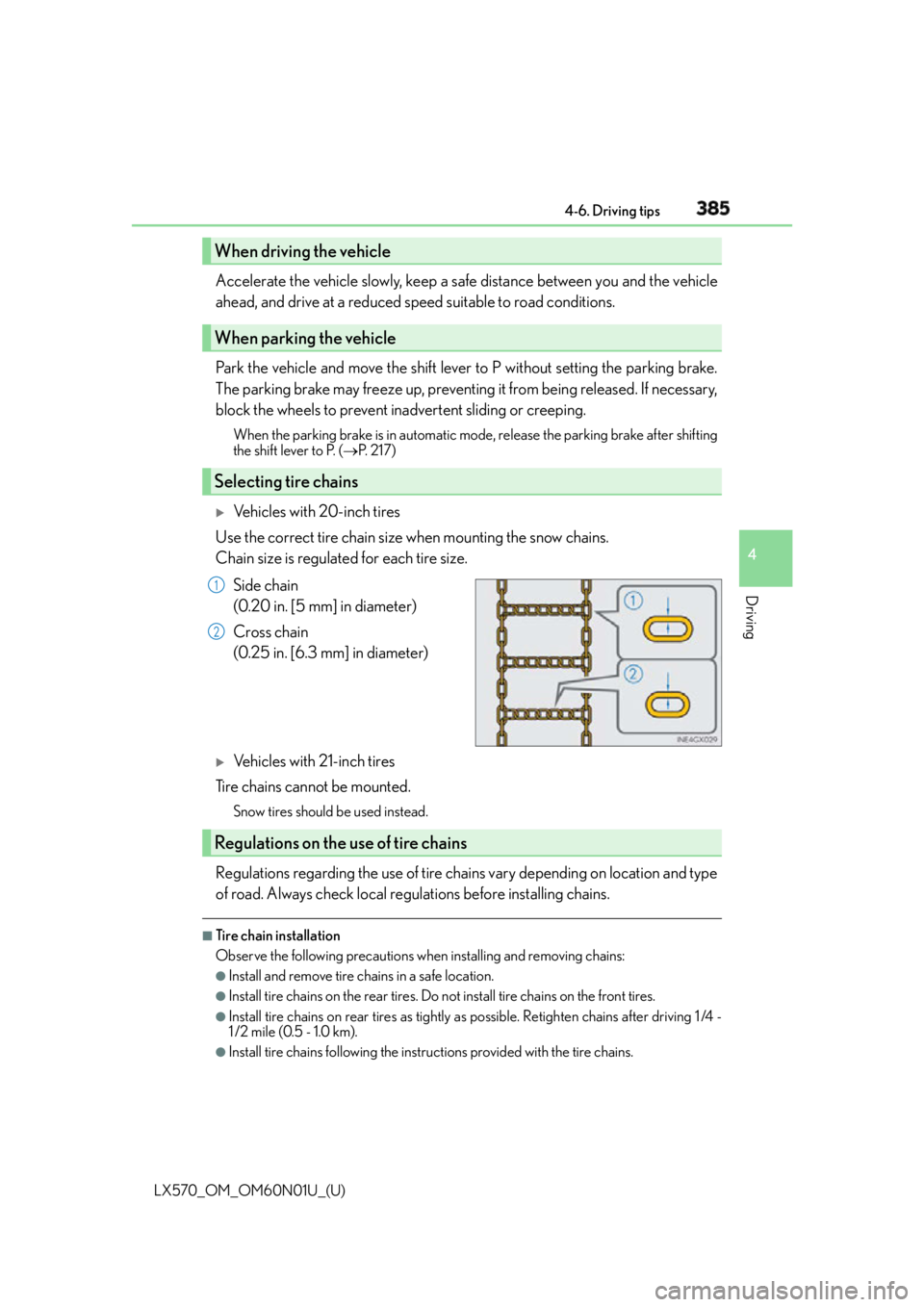
Vehicles with 20-inch tires
Use the correct tire chain size when mounting the snow chains.
Chain size is regulated for each tire size.
Side chain
(0.20 in. [5 mm] in diameter)
Cross chain
(0.25 in. [6.3 mm] in diameter)
Vehicles with 21-inch tires
Tire chains cannot be mounted. Snow tires should be used instead.
Regulations regarding the use of tire chains vary depending on location and type
of road. Always check local regulations before installing chains. ■
Tire chain installation
Observe the following precautions wh en installing and removing chains:●
Install and remove tire chains in a safe location. ●
Install tire chains on the rear tires. Do not install tire chains on the front tires. ●
Install tire chains on rear tires as tightly as possible. Retighten chai ns after driving 1 /4 -
1 /2 mile (0.5 - 1.0 km). ●
Install tire chains following the instru ctions provided with the tire chains.When driving the vehicle
When parking the vehicle
Selecting tire chains 1
2
Regulations on the use of tire chains
Page 390 of 632

390
LX570_OM_OM60N01U_(U) 4-6. Driving tips
WA R N I N G ■
Off-road driving precautions
Always observe the following precautions to minimize the risk of death, serious injury
or damage to your vehicle: ●
Drive carefully when off the road. Do not ta ke unnecessary risks by driving in danger-
ous places. ●
Do not grip the steering wheel spokes when driving off-road. A bad bump could jerk
the wheel and injure your hands. Keep both hands and especially your thumbs on the
outside of the rim. ●
Always check your brakes for effectivenes s immediately after driving in sand, mud,
water or snow. ●
After driving through tall grass, mud, rock, sand, rivers, etc., check that there is no
grass, bush, paper, rags, stone, sand, etc. adhering or trapped on the underbody.
Clear off any such matter from the underbody. If the vehicle is used with these materi-
als trapped or adhering to the underb ody, a breakdown or fire could occur.●
When driving off-road or in rugged terrai n, do not drive at excessive speeds, jump,
make sharp turns, strike objects, etc. This may cause loss of control or vehicle rollover
causing death or serious injury. You are also risking expensive damage to your vehi-
cle’s suspension and chassis.
Page 391 of 632

LX570_OM_OM60N01U_(U) 3914-6. Driving tips
4
Driving NOTICE ■
To prevent the water damage
Take all necessary safety measures to ensure that water damage to the engine or other
components does not occur. ●
Water entering the engine air intake will cause severe engine damage. ●
Water entering the automatic transmission will cause deterioration in shift quality,
locking up of your transmission accompan ied by vibration, and ultimately damage.●
Water can wash the grease from wheel be arings, causing rusting and premature fail-
ure, and may also enter the differentials, tr ansmission and transfer case, reducing the
gear oil’s lubricating qualities. ■
When you drive through water
If driving through water, such as when crossing shallow streams, first check the depth of
the water and the bottom of the riverbed for firmness. Drive slowly and avoid deep
water. ■
Inspection after off-road driving ●
Sand and mud that has accumulated in brake drums and around brake discs may
affect braking efficiency and may damage brake system components. ●
Always perform a maintenance inspection after each day of off-road driving that has
taken you through rough terr ain, sand, mud, or water. For scheduled maintenance
information, refer to the “Warranty and Services Guide”, “Owner’s Manual Supple-
ment” or “Scheduled Maintenance”.
Page 460 of 632
460
LX570_OM_OM60N01U_(U) 6-1. Maintenance and care
NOTICE ■
To prevent paint deterioration and corrosio n on the body and components (aluminum
wheels etc.) ●
Wash the vehicle immediately in the following cases:
• After driving near the sea coast
• After driving on salted roads
• If coal tar or tree sap is present on the paint surface
• If you see dead insects, insect droppings or bird droppings on the paint
• After driving in an area contaminated wi th soot, oily smoke, mine dust, iron pow-
der or chemical substances
• If the vehicle becomes heavily soiled in dust or mud
• If liquids such as benzene and gaso line are spilled on the paint surface●
If the paint is chipped or scratche d, have it repaired immediately.●
To prevent the wheels from corroding, remo ve any dirt and store in a place with low
humidity when storing wheels. ■
Cleaning the exterior lights ●
Wash carefully. Do not use organic substances or scrub with a hard brush.
This may damage the su rfaces of the lights.●
Do not apply wax on the surfaces of the lights.
Wax may cause damage to the lenses. ■
When using an automatic car wash
Set the wiper switch to the off position.
If the wiper switch is in “AUTO”, the wipers may operate and the wiper blades may be
damaged. ■
When using a high pressure car wash
Do not bring the nozzle tip close to boots (rubber or resin manufactured cover), con-
nectors or the following parts. The parts may be damaged if they come into contact
with high-pressure water.
• Traction related parts
•Steering parts
• Suspension parts
•Brake parts