tire type LEXUS LX570 2016 Owners Manual
[x] Cancel search | Manufacturer: LEXUS, Model Year: 2016, Model line: LX570, Model: LEXUS LX570 2016Pages: 632, PDF Size: 10.34 MB
Page 15 of 632
15Pictorial index
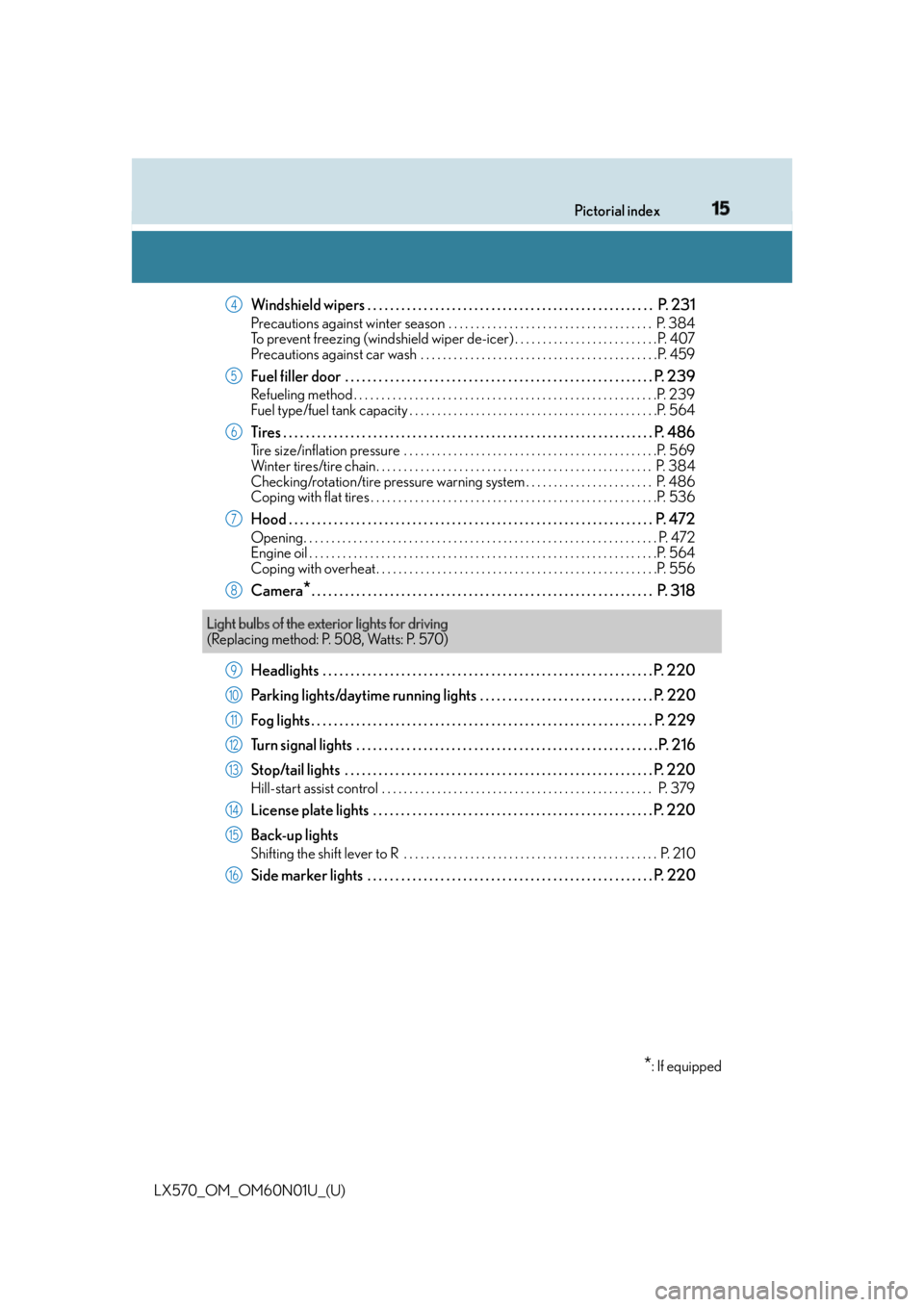
LX570_OM_OM60N01U_(U) Windshield wipers . . . . . . . . . . . . . . . . . . . . . . . . . . . . . . . . . . . . . . . . . . . . . . . . . . . P. 231 Precautions against winter season . . . . . . . . . . . . . . . . . . . . . . . . . . . . . . . . . . . . . P. 384
To prevent freezing (windshield wiper de-icer) . . . . . . . . . . . . . . . . . . . . . . . . . .P. 407
Precautions against car wash . . . . . . . . . . . . . . . . . . . . . . . . . . . . . . . . . . . . . . . . . . .P. 459
Fuel filler door . . . . . . . . . . . . . . . . . . . . . . . . . . . . . . . . . . . . . . . . . . . . . . . . . . . . . . . P . 239Refueling method . . . . . . . . . . . . . . . . . . . . . . . . . . . . . . . . . . . . . . . . . . . . . . . . . . . . . . .P. 239
Fuel type/fuel tank capacity . . . . . . . . . . . . . . . . . . . . . . . . . . . . . . . . . . . . . . . . . . . . .P. 564
Tires . . . . . . . . . . . . . . . . . . . . . . . . . . . . . . . . . . . . . . . . . . . . . . . . . . . . . . . . . . . . . . . . . . P. 486Tire size/inflation pressure . . . . . . . . . . . . . . . . . . . . . . . . . . . . . . . . . . . . . . . . . . . . . .P. 569
Winter tires/tire chain. . . . . . . . . . . . . . . . . . . . . . . . . . . . . . . . . . . . . . . . . . . . . . . . . . P. 3 84
Checking/rotation/tire pressure warning system . . . . . . . . . . . . . . . . . . . . . . . P. 486
Coping with flat tires . . . . . . . . . . . . . . . . . . . . . . . . . . . . . . . . . . . . . . . . . . . . . . . . . . . .P. 536
Hood . . . . . . . . . . . . . . . . . . . . . . . . . . . . . . . . . . . . . . . . . . . . . . . . . . . . . . . . . . . . . . . . . P. 472Opening. . . . . . . . . . . . . . . . . . . . . . . . . . . . . . . . . . . . . . . . . . . . . . . . . . . . . . . . . . . . . . . . P. 472
Engine oil . . . . . . . . . . . . . . . . . . . . . . . . . . . . . . . . . . . . . . . . . . . . . . . . . . . . . . . . . . . . . . .P. 564
Coping with overheat . . . . . . . . . . . . . . . . . . . . . . . . . . . . . . . . . . . . . . . . . . . . . . . . . . .P. 556
Camera
* . . . . . . . . . . . . . . . . . . . . . . . . . . . . . . . . . . . . . . . . . . . . . . . . . . . . . . . . . . . . . P. 31 8
Headlights . . . . . . . . . . . . . . . . . . . . . . . . . . . . . . . . . . . . . . . . . . . . . . . . . . . . . . . . . . . P. 220
Parking lights/daytime running lights . . . . . . . . . . . . . . . . . . . . . . . . . . . . . . . P. 220
Fog lights . . . . . . . . . . . . . . . . . . . . . . . . . . . . . . . . . . . . . . . . . . . . . . . . . . . . . . . . . . . . . P. 229
Turn signal lights . . . . . . . . . . . . . . . . . . . . . . . . . . . . . . . . . . . . . . . . . . . . . . . . . . . . . .P . 216
Stop/tail lights . . . . . . . . . . . . . . . . . . . . . . . . . . . . . . . . . . . . . . . . . . . . . . . . . . . . . . . P . 220Hill-start assist control . . . . . . . . . . . . . . . . . . . . . . . . . . . . . . . . . . . . . . . . . . . . . . . . . P. 379
License plate lights . . . . . . . . . . . . . . . . . . . . . . . . . . . . . . . . . . . . . . . . . . . . . . . . . . P. 220
Back-up lights Shifting the shift lever to R . . . . . . . . . . . . . . . . . . . . . . . . . . . . . . . . . . . . . . . . . . . . . . P. 21 0
Side marker lights . . . . . . . . . . . . . . . . . . . . . . . . . . . . . . . . . . . . . . . . . . . . . . . . . . . P. 220 4
5
6
7
8
Light bulbs of the exterior lights for driving
(Replacing method: P. 508, Watts: P. 570)
* : If equipped9
10
11
12
13
14
15
16
Page 333 of 632
LX570_OM_OM60N01U_(U) 3334-5. Using the driving support systems
4
Driving ■
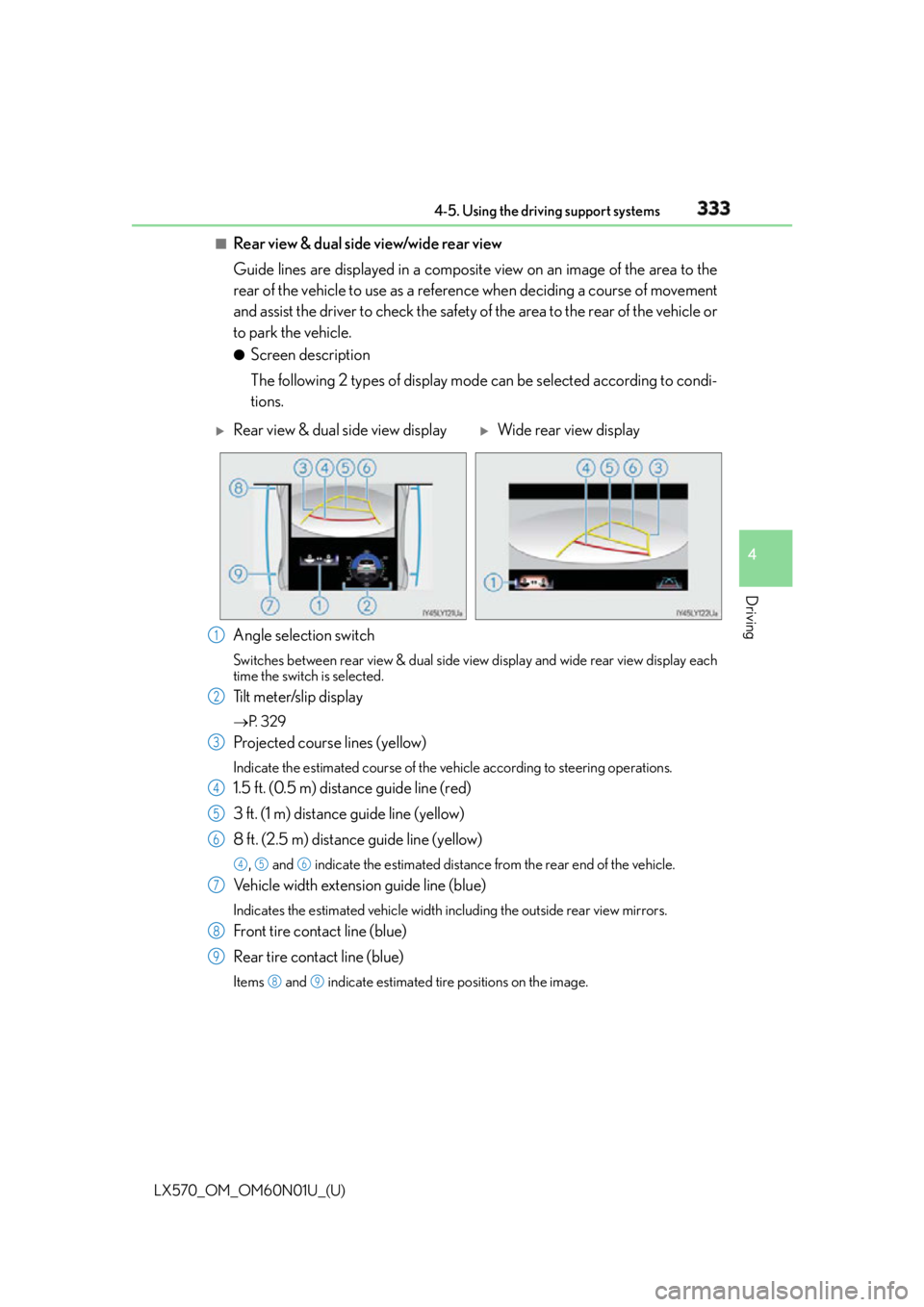
Rear view & dual side view/wide rear view
Guide lines are displayed in a composite view on an image of the area to the
rear of the vehicle to use as a reference when deciding a course of movement
and assist the driver to check the safety of the area to the rear of the vehicle or
to park the vehicle. ●
Screen description
The following 2 types of display mode can be selected according to condi-
tions.
Angle selection switch Switches between rear view & dual side vi ew display and wide rear view display each
time the switch is selected.
Tilt meter/slip display P. 3 2 9
Projected course lines (yellow) Indicate the estimated course of the vehicle according to steering operations.
1.5 ft. (0.5 m) distance guide line (red)
3 ft. (1 m) distance guide line (yellow)
8 ft. (2.5 m) distance guide line (yellow) , and indicate the estimated distance from the rear end of the vehicle.
Vehicle width extension guide line (blue) Indicates the estimated vehicle width including the outside rear view mirrors.
Front tire contact line (blue)
Rear tire contact line (blue) Items and indicate estimated tire positions on the image.
Rear view & dual side view display
Wide rear view display
1
2
3
4
5
6 4 5 6
7
8
9 8 9
Page 385 of 632
LX570_OM_OM60N01U_(U) 3854-6. Driving tips
4
Driving Accelerate the vehicle slowly, keep a safe distance between you and the vehicle
ahead, and drive at a reduced speed suitable to road conditions.
Park the vehicle and move the shift lever to P without setting the parking brake.
The parking brake may freeze up, preventing it from being released. If necessary,
block the wheels to prevent in advertent sliding or creeping.When the parking brake is in automatic mode, release the parking brake after shifting
the shift lever to P. ( P. 2 1 7 )
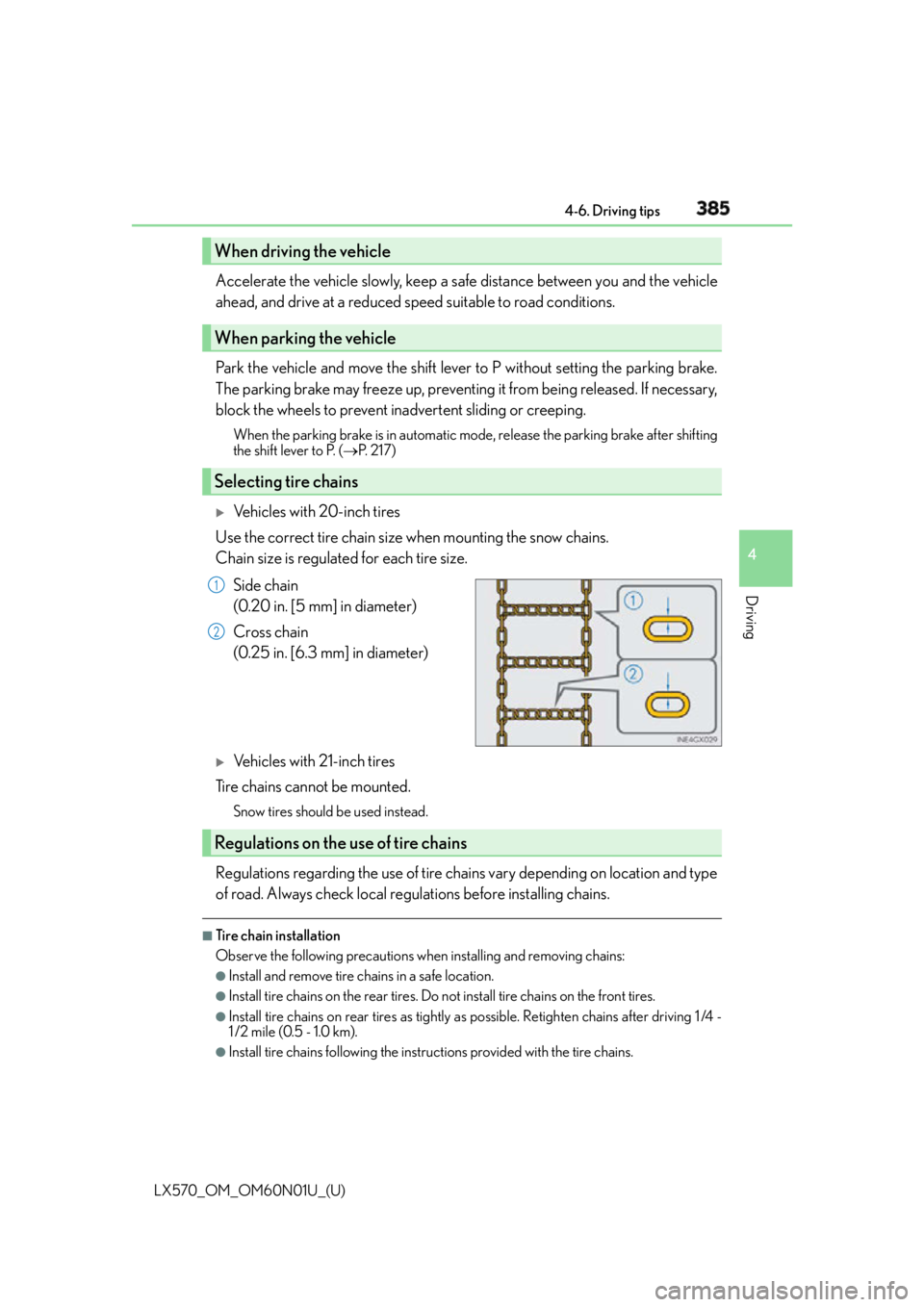
Vehicles with 20-inch tires
Use the correct tire chain size when mounting the snow chains.
Chain size is regulated for each tire size.
Side chain
(0.20 in. [5 mm] in diameter)
Cross chain
(0.25 in. [6.3 mm] in diameter)
Vehicles with 21-inch tires
Tire chains cannot be mounted. Snow tires should be used instead.
Regulations regarding the use of tire chains vary depending on location and type
of road. Always check local regulations before installing chains. ■
Tire chain installation
Observe the following precautions wh en installing and removing chains:●
Install and remove tire chains in a safe location. ●
Install tire chains on the rear tires. Do not install tire chains on the front tires. ●
Install tire chains on rear tires as tightly as possible. Retighten chai ns after driving 1 /4 -
1 /2 mile (0.5 - 1.0 km). ●
Install tire chains following the instru ctions provided with the tire chains.When driving the vehicle
When parking the vehicle
Selecting tire chains 1
2
Regulations on the use of tire chains
Page 386 of 632
386
LX570_OM_OM60N01U_(U) 4-6. Driving tips
WA R N I N G ■
Driving with snow tires
Observe the following precautions to reduce the risk of accidents.
Failure to do so may result in a loss of ve hicle control and cause death or serious injury.●
Use tires of the specified size. ●
Maintain the recommended level of air pressure. ●
Do not drive in excess of 75 mph (120 km/h), regardless of the type of snow tires
being used. ●
Use snow tires on all, not just some wheels.■
Driving with tire chains (vehicles with 20-inch tires)
Observe the following precautions to reduce the risk of accidents.
Failing to do so may result in the vehicle being unable to be driven safely, and may
cause death or serious injury. ●
Do not drive in excess of the speed limit specified for the tire chains being used, or 30
mph (50 km/h), whichever is lower. ●
Avoid driving on bumpy road surfaces or over potholes. ●
Avoid sudden acceleration, ab rupt steering, sudden bra king and shifting operations
that cause sudden engine braking. ●
Slow down sufficiently before entering a cu rve to ensure that vehicle control is main-
tained. ●
Do not use LDA (Lane Departure Alert) system. (if equipped) ■
When installing tire chains (vehicles with 20-inch tires)
Turn off the vehicle height control.
The vehicle height may change due to the automatic leveling function and you may
catch part of your body in the ve hicle, resulting in an accident. ( P. 300)
NOTICE ■
Repairing or replacing snow tires
Request repairs or replacement of snow tires from Lexus dealers or legitimate tire
retailers.
This is because the removal and attachment of snow tires affects the operation of the
tire pressure warning valves and transmitters. ■
Fitting tire chains (vehicles with 20-inch tires)
The tire pressure warning valves and transmitters may not function correctly when tire
chains are fitted.
Page 490 of 632

490
LX570_OM_OM60N01U_(U) 6-3. Do-it-yourself maintenance■
Tire types ●
Summer tires
Summer tires are high-speed performance tires best suited to highway driving under
dry conditions. Since summer tires do not have the same traction performance as
snow tires, summer tires are inadequate for driving on snow-covered or icy roads. For
driving on snow-covered roads or icy roads, the use of snow tires is recommended.
When installing snow tires, be sure to replace all four tires. ●
All season tires
All season tires are designed to provide better traction in snow and to be adequate for
driving in most winter conditions, as well as for use year round. All season tires, how-
ever, do not have adequate traction performance compared with snow tires in heavy
or loose snow. Also, all season tires fall short in acceleration and handling perfor-
mance compared with summer tires in highway driving. ●
Snow tires
For driving on snow-covered roads or icy roads, we recommend using snow tires. If
you need snow tires, select tires of the same size, construction and load capacity as the
originally installed tires. Since your vehicle has radial tires as original equipment, make
sure your snow tires also have radial cons truction. Do not install studded tires without
first checking local regulations for possible re striction. Snow tires should be installed
on all wheels. ( P. 3 8 4 )■
Initializing the tire pressure warning system
Initialize the tire pressure warning system with the tire inflation pressure adjusted to the
specified level. ■
If the tread on snow tires wears down below 0.16 in. (4 mm)
The effectiveness of the tires as snow tires is lost. ■
If you press the tire pressure warning reset switch accidentally
If initialization is performed, adjust the tire inflation pressure to the specified level and ini-
tialize the tire pressure warning system again. ■
Situations in which the tire pressure warning system may not operate properly ●
In the following cases, the tire pressure warning system may not operate properly.
• If non-genuine Lexus wheels are used.
• A tire has been replaced with a tire that is not an OE (Original Equipment) tire.
• A tire has been replaced with a tire that is not of the specified size.
• Tire chains etc. are equipped.
• An auxiliary-supported run-flat tire is equipped.
• If a window tint that affects the radio wave signals is installed.
• If there is a lot of snow or ice on the vehicle, particularly around the wheels or wheel
housings.
• If the tire inflation pressure is extremely higher than the specified level.
• If the spare tire is in a location subject to poor radio wave signal reception.
• If a large metallic object wh ich can interfere with signal reception is put near the
spare tire.
• If tires not equipped with the tire pressure warning valves and transmitters are used.
• If the ID code on the tire pressure warning valves and transmitters is not registered
in the tire pressure warning computer.
Page 499 of 632
499
LX570_OM_OM60N01U_(U) 6-3. Do-it-yourself maintenance
6
Maintenance and care
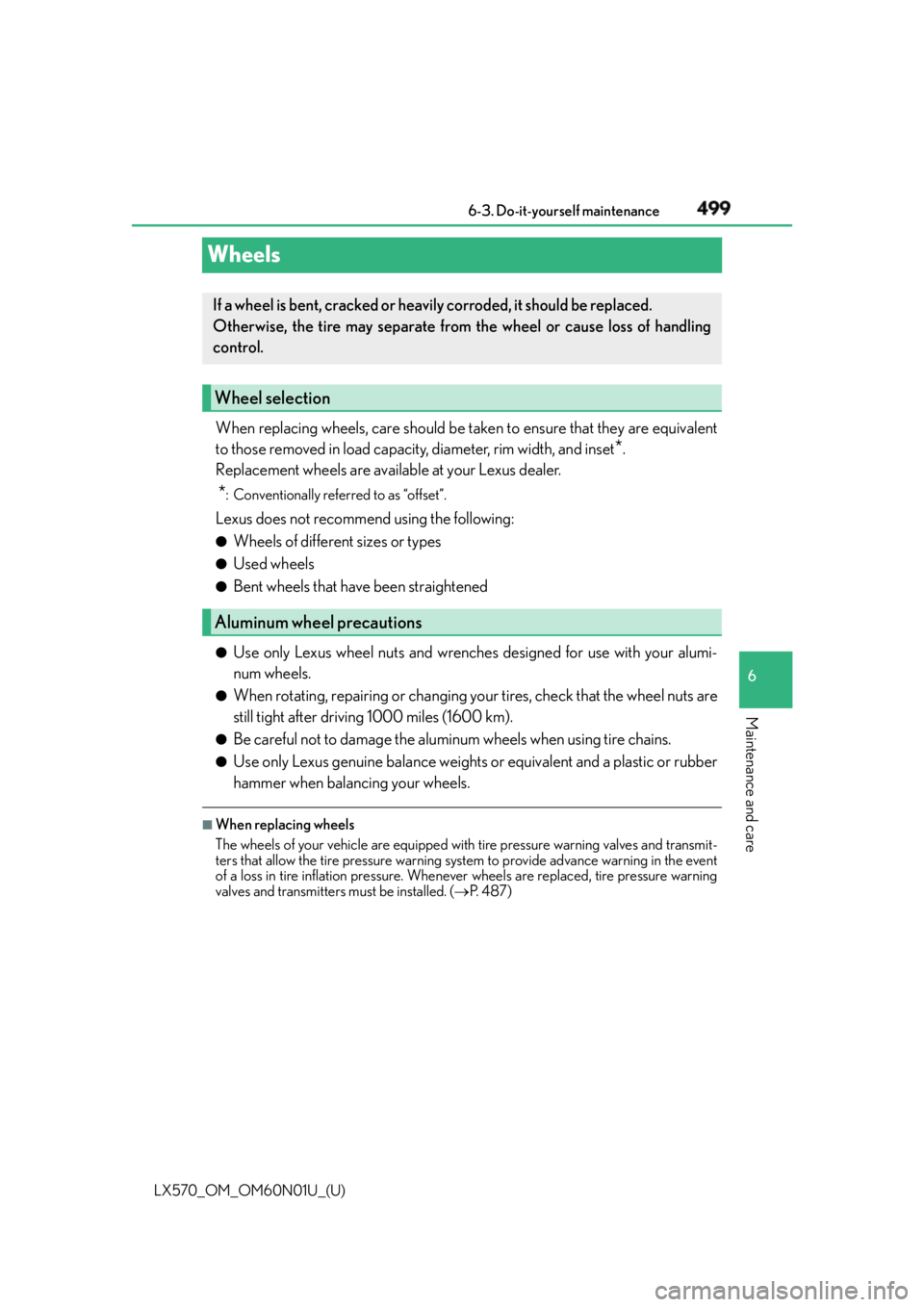
Wheels When replacing wheels, care should be taken to ensure that they are equivalent
to those removed in load capacity , diameter, rim width, and inset
* .
Replacement wheels are available at your Lexus dealer.
* : Conventionally referred to as “offset”.
Lexus does not recommend using the following: ●
Wheels of different sizes or types ●
Used wheels ●
Bent wheels that have been straightened ●
Use only Lexus wheel nuts and wrenches designed for use with your alumi-
num wheels. ●
When rotating, repairing or changing your tires, check that the wheel nuts are
still tight after driving 1000 miles (1600 km). ●
Be careful not to damage the aluminum wheels when using tire chains. ●
Use only Lexus genuine balance weights or equivalent and a plastic or rubber
hammer when balancing your wheels. ■
When replacing wheels
The wheels of your vehicle are equipped with tire pressure warning valves and transmit-
ters that allow the tire pressure warning system to provide advance warning in the event
of a loss in tire inflation pressure. Whenever wheels are replaced, tire pressure warning
valves and transmitters must be installed. ( P. 4 8 7 )If a wheel is bent, cracked or heavily corroded, it should be replaced.
Otherwise, the tire may separate from the wheel or cause loss of handling
control.
Wheel selection
Aluminum wheel precautions
Page 569 of 632
LX570_OM_OM60N01U_(U) 5698-1. Specifications
8
Vehicle specifications
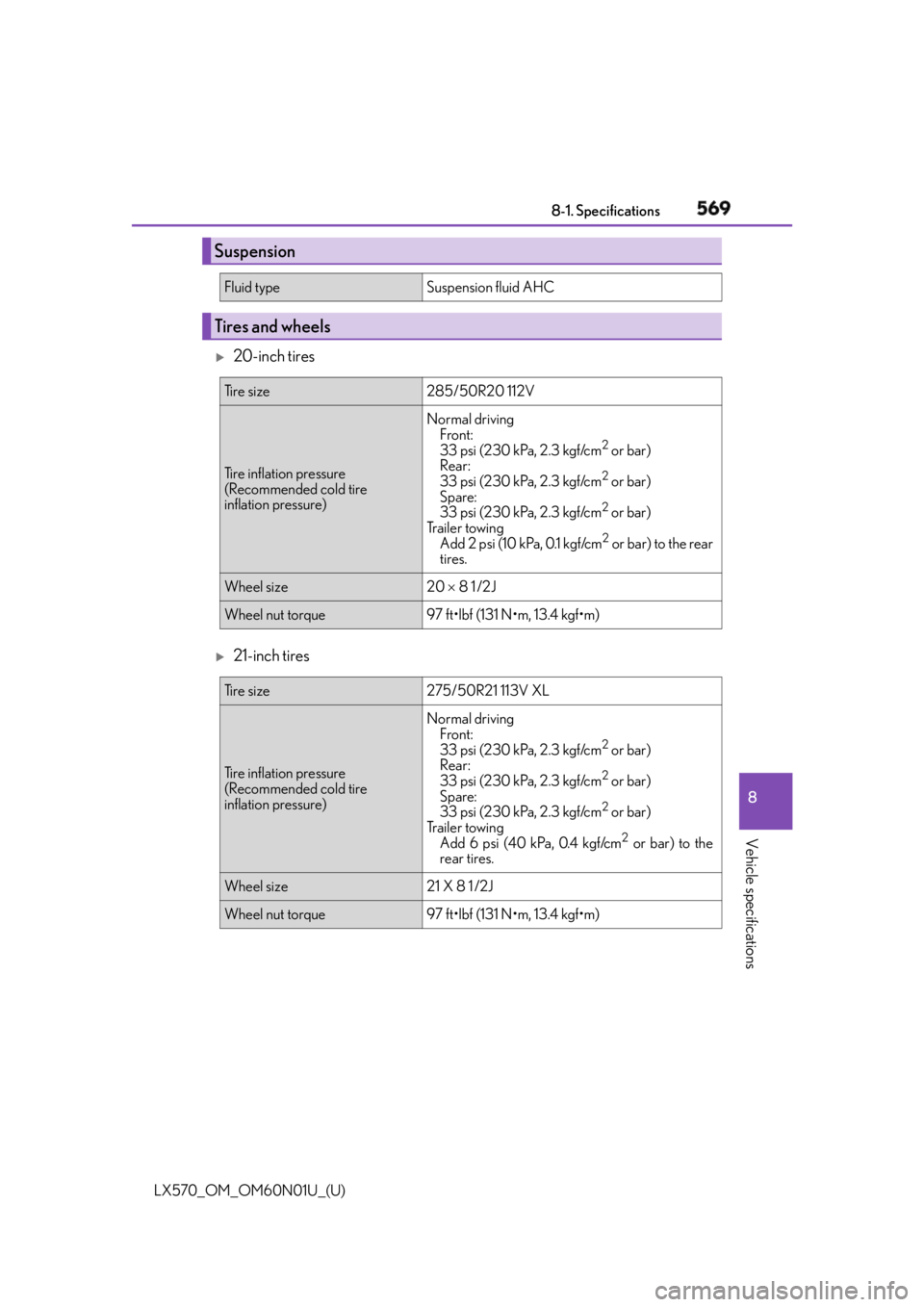
20-inch tires
21-inch tiresSuspension Fluid type Suspension fluid AHC
Tires and wheels Ti r e s i z e 285/50R20 112V
Tire inflation pressure
(Recommended cold tire
inflation pressure) Normal driving
Front:
33 psi (230 kPa, 2.3 kgf/cm 2
or bar)
Rear:
33 psi (230 kPa, 2.3 kgf/cm 2
or bar)
Spare:
33 psi (230 kPa, 2.3 kgf/cm 2
or bar)
Trailer towing
Add 2 psi (10 kPa, 0.1 kgf/cm 2
or bar) to the rear
tires.
Wheel size 20 8 1 /2J
Wheel nut torque 97 ft•lbf (131 N•m, 13.4 kgf•m)
Ti r e s i z e 275/50R21 113V XL
Tire inflation pressure
(Recommended cold tire
inflation pressure) Normal driving
Front:
33 psi (230 kPa, 2.3 kgf/cm 2
or bar)
Rear:
33 psi (230 kPa, 2.3 kgf/cm 2
or bar)
Spare:
33 psi (230 kPa, 2.3 kgf/cm 2
or bar)
Trailer towing
Add 6 psi (40 kPa, 0.4 kgf/cm 2
or bar) to the
rear tires.
Wheel size 21 X 8 1 /2J
Wheel nut torque 97 ft•lbf (131 N•m, 13.4 kgf•m)
Page 574 of 632
574
LX570_OM_OM60N01U_(U) 8-1. Specifications
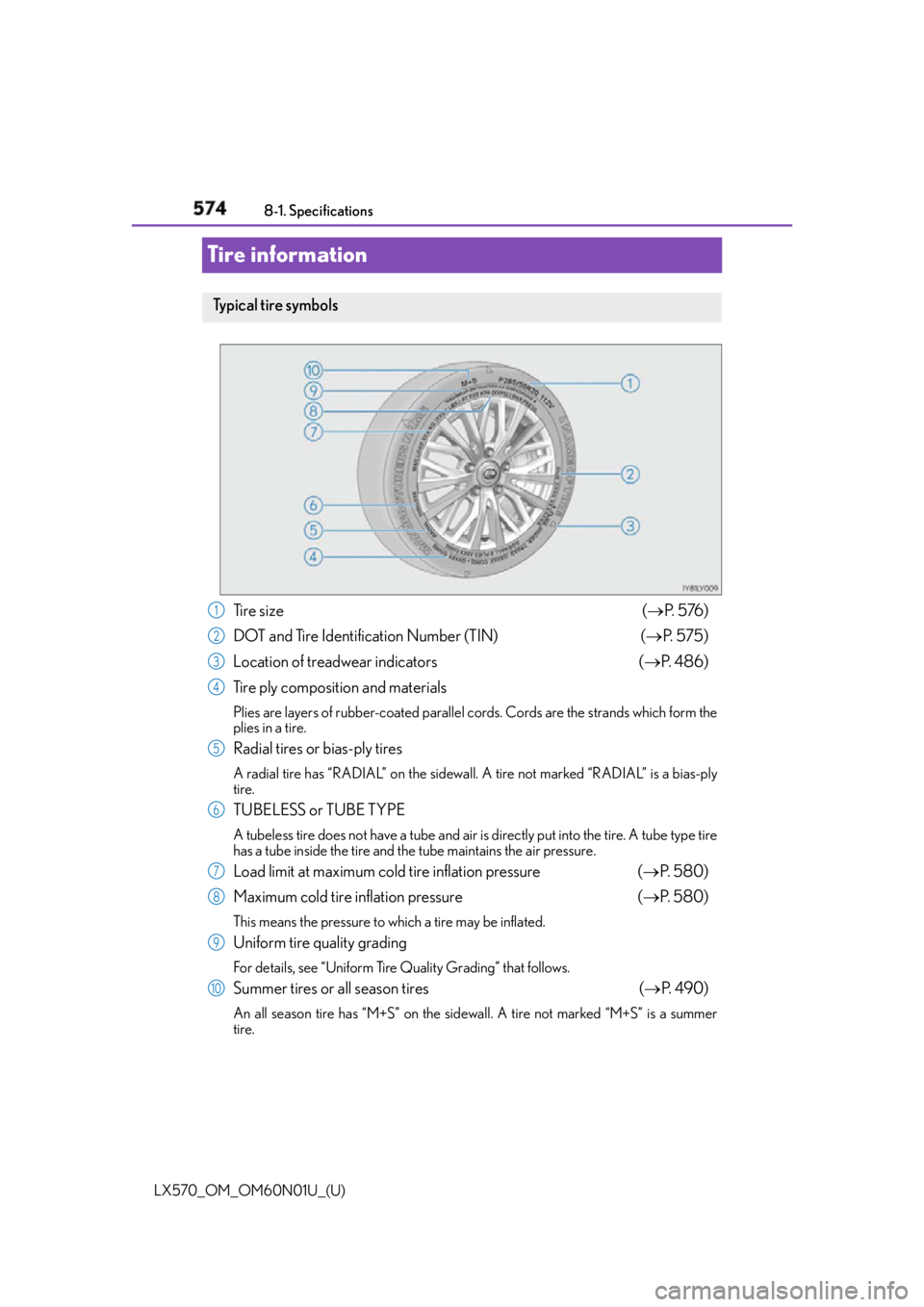
Tire information
Ti r e s i z e ( P. 5 76 )
DOT and Tire Identification Number (TIN) ( P. 5 7 5 )
Location of treadwear indicators ( P. 4 8 6 )
Tire ply composition and materials Plies are layers of rubber-coated parallel co rds. Cords are the strands which form the
plies in a tire.
Radial tires or bias-ply tires A radial tire has “RADIAL” on the sidewall. A tire not marked “RADIAL” is a bias-ply
tire.
TUBELESS or TUBE TYPE A tubeless tire does not have a tube and air is directly put into the tire. A tube type tire
has a tube inside the tire and the tube maintains the air pressure.
Load limit at maximum cold tire inflation pressure ( P. 5 8 0 )
Maximum cold tire inflation pressure ( P. 5 8 0 )This means the pressure to which a tire may be inflated.
Uniform tire quality grading For details, see “Uniform Tire Quality Grading” that follows.
Summer tires or all season tires ( P. 4 9 0 )An all season tire has “M+S” on the sidewall. A tire not marked “M+S” is a summer
tire.Ty p i c a l t i r e s y m b o l s
1
2
3
4
5
6
7
8
9
10
Page 575 of 632

LX570_OM_OM60N01U_(U) 5758-1. Specifications
8
Vehicle specifications DOT symbol
*Tire Identification Number (TIN)
Tire manufacturer’s identification
mark
Ti r e s i z e c o d e
Manufacturer’s optional tire type
code (3 or 4 letters)
Manufacturing week
Manufacturing year
* : The DOT symbol certifies that the tire co nforms to applicable Federal Motor Vehicle
Safety Standards.Typical DOT and Tire Identification Number (TIN) 1
2
3
4
5
6
7
Page 581 of 632
LX570_OM_OM60N01U_(U) 5818-1. Specifications
8
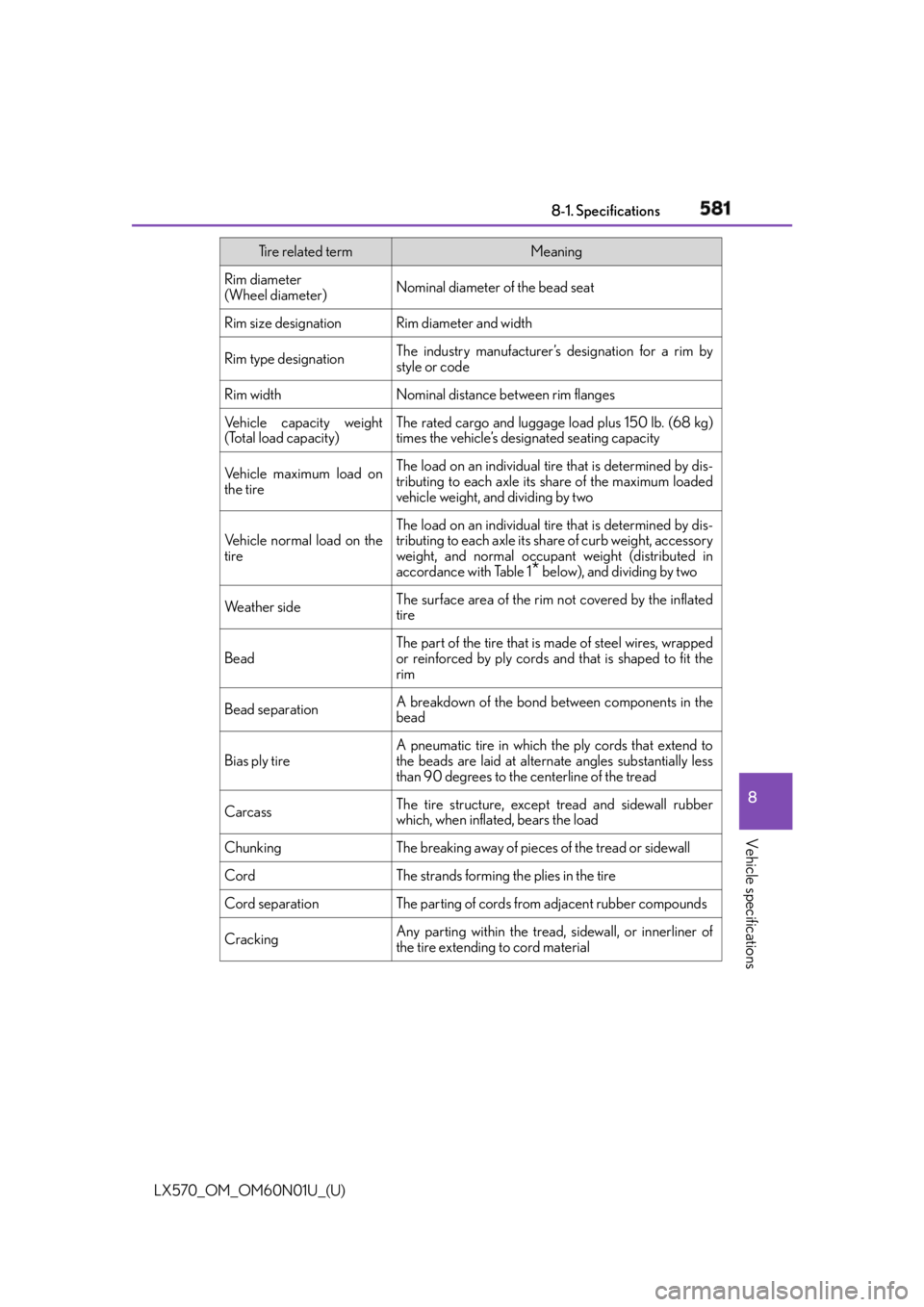
Vehicle specifications Rim diameter
(Wheel diameter) Nominal diameter of the bead seat
Rim size designation Rim diameter and width
Rim type designation The industry manufacturer’s designation for a rim by
style or code
Rim width Nominal distance between rim flanges
Vehicle capacity weight
(Total load capacity) The rated cargo and luggage load plus 150 lb. (68 kg)
times the vehicle’s designated seating capacity
Vehicle maximum load on
the tire The load on an individual tire that is determined by dis-
tributing to each axle its share of the maximum loaded
vehicle weight, and dividing by two
Vehicle normal load on the
tire The load on an individual tire that is determined by dis-
tributing to each axle its sh are of curb weight, accessory
weight, and normal occupant weight (distributed in
accordance with Table 1
* below), and dividing by two
We a t h e r s i d e The surface area of the rim not covered by the inflated
tire
Bead The part of the tire that is made of steel wires, wrapped
or reinforced by ply cords and that is shaped to fit the
rim
Bead separation A breakdown of the bond be tween components in the
bead
Bias ply tire A pneumatic tire in which the ply cords that extend to
the beads are laid at altern ate angles substantially less
than 90 degrees to the centerline of the tread
Carcass The tire structure, except tread and sidewall rubber
which, when inflated, bears the load
Chunking The breaking away of pieces of the tread or sidewall
Cord The strands forming th e plies in the tire
Cord separation The parting of cords from adjacent rubber compounds
Cracking Any parting within the tread, sidewall, or innerliner of
the tire extending to cord materialTire related term Meaning