steering LEXUS LX570 2016 Manual PDF
[x] Cancel search | Manufacturer: LEXUS, Model Year: 2016, Model line: LX570, Model: LEXUS LX570 2016Pages: 632, PDF Size: 8.94 MB
Page 470 of 632

470
LX570_OM_OM60N01U_(U)6-3. Do-it-yourself maintenance
Do-it-yourself service precautions
If you perform maintenance yourself, be sure to follow the correct procedures
as given in these sections.
ItemsPa r t s a n d t o o l s
Battery condition
(
P. 4 8 2 )•Warm water• Baking soda•Grease
• Conventional wrench (for terminal clamp bolts)
Brake fluid level
( P. 4 7 9 )• FMVSS No.116 DOT 3 or SAE J1703 brake fluid
• Rag or paper towel
• Funnel (used only for adding brake fluid)
Engine coolant level
( P. 4 7 8 )
• “Toyota Super Long Life Coolant” or similar high quality eth-
ylene glycol-based non-silicate, non-amine, non-nitrite and
non-borate coolant with long-life hybrid organic acid tech-
nology.
For the U.S.A.:
“Toyota Super Long Life Coolant” is pre-mixed with 50 %
coolant and 50 % deionized water.
For Canada:
“Toyota Super Long Life Coolant” is pre-mixed with 55 %
coolant and 45 % deionized water.
• Funnel (used only for adding coolant)
Engine oil level
( P. 4 7 5 )
• “Toyota Genuine Motor Oil” or equivalent
• Rag or paper towel
• Funnel (used only for adding engine oil)
Fuses ( P. 505)• Fuse with same amperage rating as original
Light bulbs
( P. 5 0 8 )
• Bulb with same number and wattage rating as original
• Phillips-head screwdriver•Flathead screwdriver
•Wrench
Power steering fluid
level ( P. 4 8 1 )
• Automatic transmission fluid DEXRON® II or III
• Rag or paper towel
• Funnel (used only for adding power steering fluid)
Radiator and
condenser
( P. 4 7 9 )
Tire inflation
pressure ( P. 4 9 5 )• Tire pressure gauge• Compressed air source
Wa s h e r f l u i d
( P. 4 8 5 )• Water or washer fluid containi ng antifreeze (for winter use)
• Funnel (used only for adding water or washer fluid)
Page 473 of 632

473
LX570_OM_OM60N01U_(U)6-3. Do-it-yourself maintenance
6
Maintenance and care
Engine compartment
Power steering fluid reservoir
(P. 4 8 1 )
Engine oil level dipstick (P. 4 7 5 )
Engine coolant reservoir ( P. 4 7 8 )
Engine oil filler cap ( P. 4 76 )Brake fluid reservoir (
P. 4 7 9 )
Fuse box ( P. 505)
Wa s h e r f l u i d t a n k ( P. 4 8 5 )
Battery ( P. 4 8 2 )
Cooling fans
Condenser ( P. 4 7 9 )
Radiator ( P. 4 7 9 )1
2
3
4
5
6
7
8
9
10
11
Page 481 of 632

LX570_OM_OM60N01U_(U)
4816-3. Do-it-yourself maintenance
6
Maintenance and care
■Fluid level
The fluid level should be within the appropriate range.Full (when cold)
Add fluid (when cold)
Full (when hot)
Add fluid (when hot)
Hot: The vehicles has been driven around 50 mph (80 km/h) for 20 min- utes, or slightly longer in frigid temperatures.
(Fluid temperature, 140 F - 175 F [60 C - 80 C]).
Cold: The engine has not been run for about 5 hours. (Room temperature, 50 F - 85 F [10 C - 30 C]).
■Checking the fluid level
Make sure to check the fluid type and prepare the necessary items.
Clean all dirt off the reservoir.
Remove the cap by turnin g it counterclockwise.
Wipe the dipstick clean.
Reinstall the cap and remove it again.
Check the fluid level.
Power steering fluid
1
2
3
4
Fluid typeAutomatic transmission fluid DEXRON® II or III
ItemsRag or paper, clean funnel (only for adding fluid)
1
2
3
4
5
Page 482 of 632
482
LX570_OM_OM60N01U_(U)6-3. Do-it-yourself maintenance
Check the battery as follows.
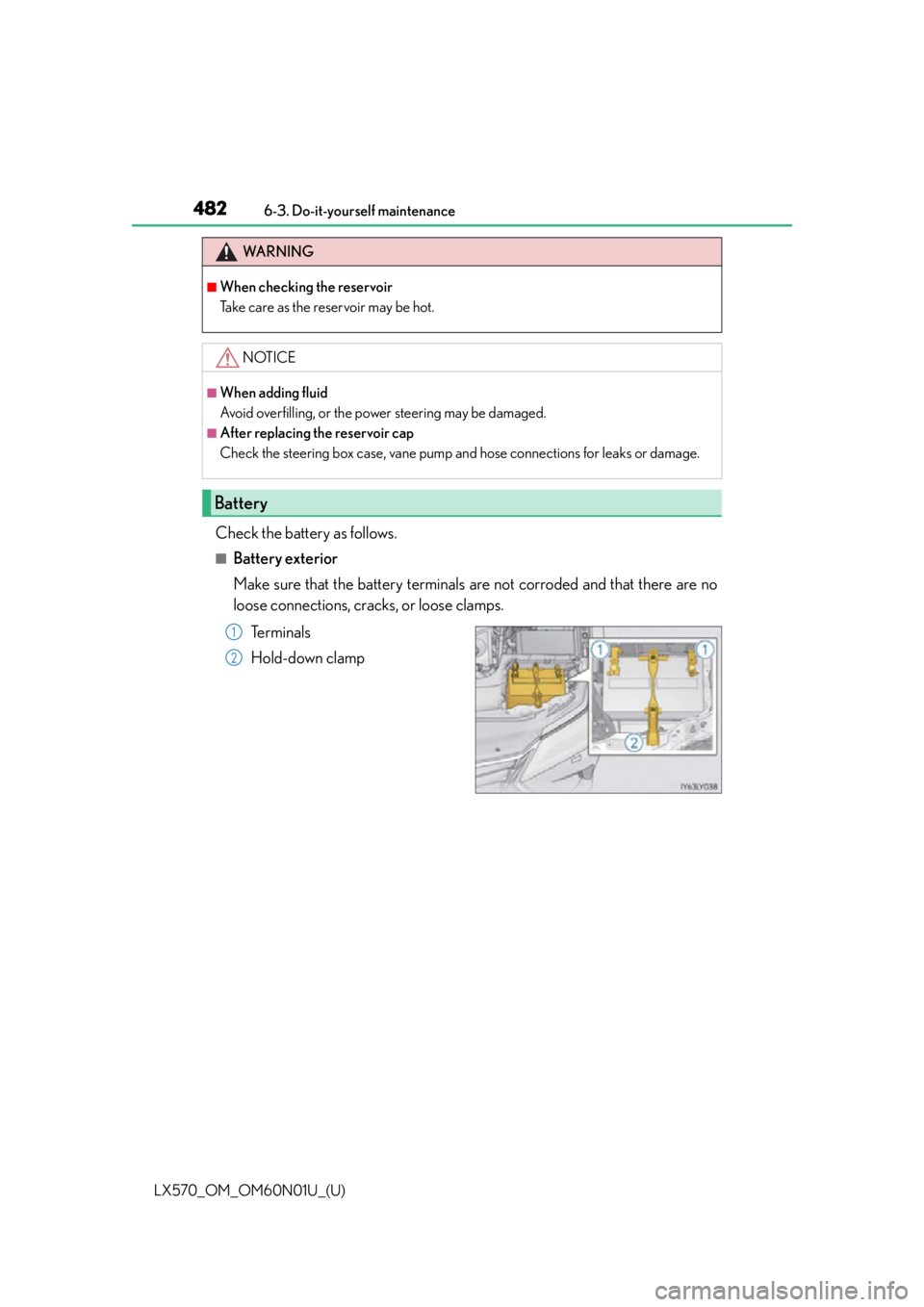
■Battery exterior
Make sure that the battery terminals are not corroded and that there are no
loose connections, cracks, or loose clamps.
Te r m i n a l s
Hold-down clamp
WA R N I N G
■When checking the reservoir
Take care as the reservoir may be hot.
NOTICE
■When adding fluid
Avoid overfilling, or the powe r steering may be damaged.
■After replacing the reservoir cap
Check the steering box case, vane pump an d hose connections for leaks or damage.
Battery
1
2
Page 515 of 632
515
LX570_OM_OM60N01U_(U)
7
When trouble arises
7-1. Essential information
If your vehicle has to be stopped in an emergency
Steadily step on the brake pedal with both feet and firmly depress it.
Do not pump the brake pedal repeatedly as this will increase the effort required to
slow the vehicle.
Shift the shift lever to N.
If the shift lever is shifted to N
After slowing down, stop the vehicle in a safe place by the road.
Stop the engine.
If the shift lever cannot be shifted to N
Keep depressing the brake pedal with both feet to reduce vehicle speed as
much as possible.
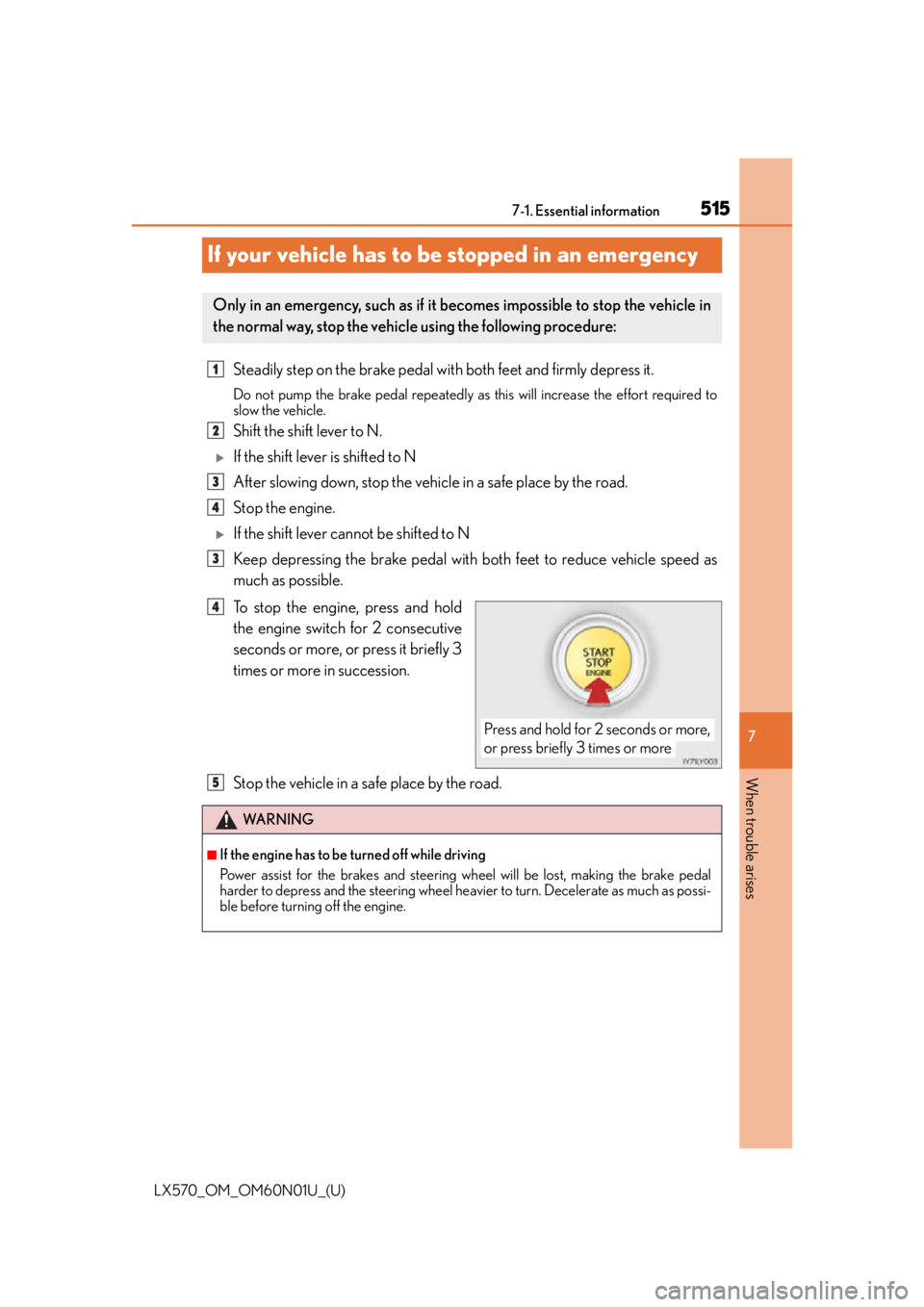
To stop the engine, press and hold
the engine switch for 2 consecutive
seconds or more, or press it briefly 3
times or more in succession.
Stop the vehicle in a safe place by the road.
Only in an emergency, such as if it becomes impossible to stop the vehicle in
the normal way, stop the vehicle using the following procedure:
1
2
3
4
3
Press and hold for 2 seconds or more,
or press briefly 3 times or more
4
WA R N I N G
■If the engine has to be turned off while driving
Power assist for the brakes and steering wheel will be lost, making the brake pedal
harder to depress and the steering wheel heavier to turn. Decelerate as much as possi-
ble before turning off the engine.
5
Page 518 of 632
5187-2. Steps to take in an emergency
LX570_OM_OM60N01U_(U)
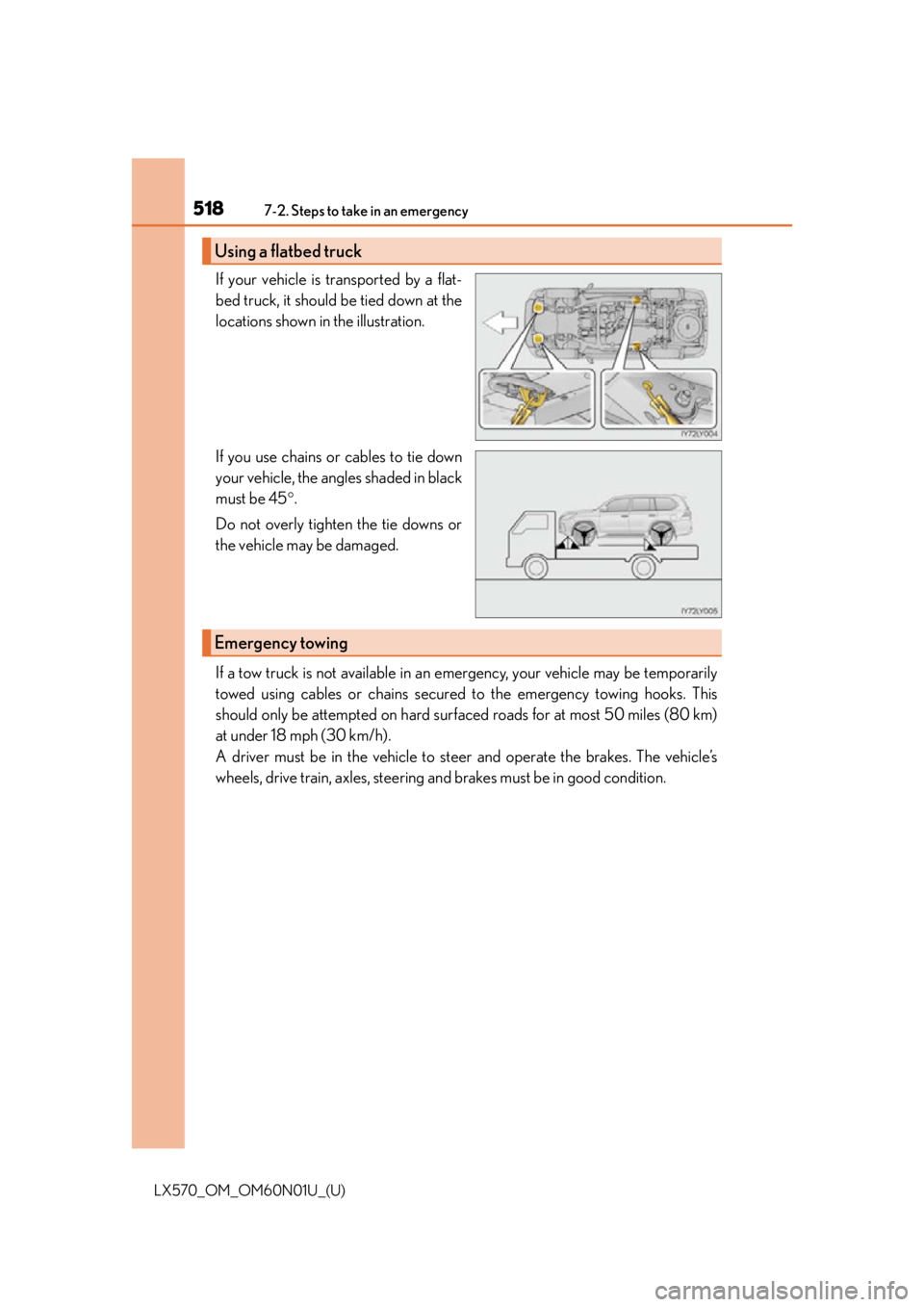
If your vehicle is transported by a flat-
bed truck, it should be tied down at the
locations shown in the illustration.
If you use chains or cables to tie down
your vehicle, the angles shaded in black
must be 45.
Do not overly tighten the tie downs or
the vehicle may be damaged.
If a tow truck is not available in an emergency, your vehicle may be temporarily
towed using cables or chains secured to the emergency towing hooks. This
should only be attempted on hard su rfaced roads for at most 50 miles (80 km)
at under 18 mph (30 km/h).
A driver must be in the vehicle to steer and operate the brakes. The vehicle’s
wheels, drive train, axles, steering an d brakes must be in good condition.
Using a flatbed truck
Emergency towing
Page 519 of 632
5197-2. Steps to take in an emergency
LX570_OM_OM60N01U_(U)
7
When trouble arises
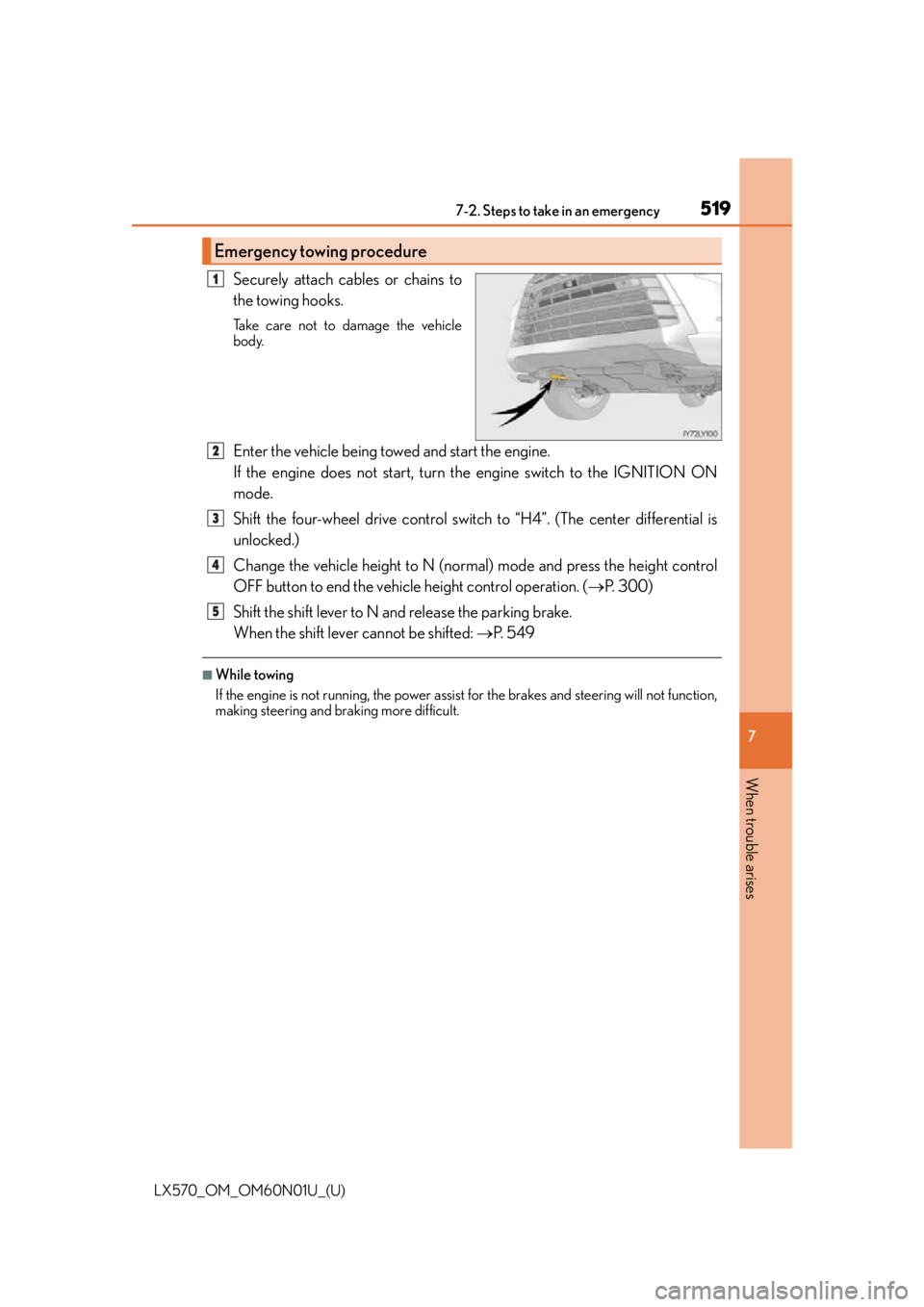
Securely attach cables or chains to
the towing hooks.
Take care not to damage the vehicle
body.
Enter the vehicle being towed and start the engine.
If the engine does not start, turn the engine switch to the IGNITION ON
mode.
Shift the four-wheel drive control switch to “H4”. (The center differential is
unlocked.)
Change the vehicle height to N (normal) mode and press the height control
OFF button to end the vehicle height control operation. ( P. 3 0 0 )
Shift the shift lever to N and release the parking brake.
When the shift lever cannot be shifted: P. 5 4 9
■While towing
If the engine is not running, the power assist for the brakes and steering will not function,
making steering and br aking more difficult.
Emergency towing procedure
1
2
3
4
5
Page 520 of 632
5207-2. Steps to take in an emergency
LX570_OM_OM60N01U_(U)
WA R N I N G
Observe the following precautions.
Failure to do so may result in death or serious injury.
■When towing the vehicle
■While towing
●When towing using cables or chains, avoid sudden starts, etc. which place excessive
stress on the towing hooks, cables or chains . The towing hooks, cables or chains may
become damaged, broken debris may hit people and cause serious damage.
●Do not turn the engine switch off.
There is a possibility that the steering wheel is locked and cannot be operated.
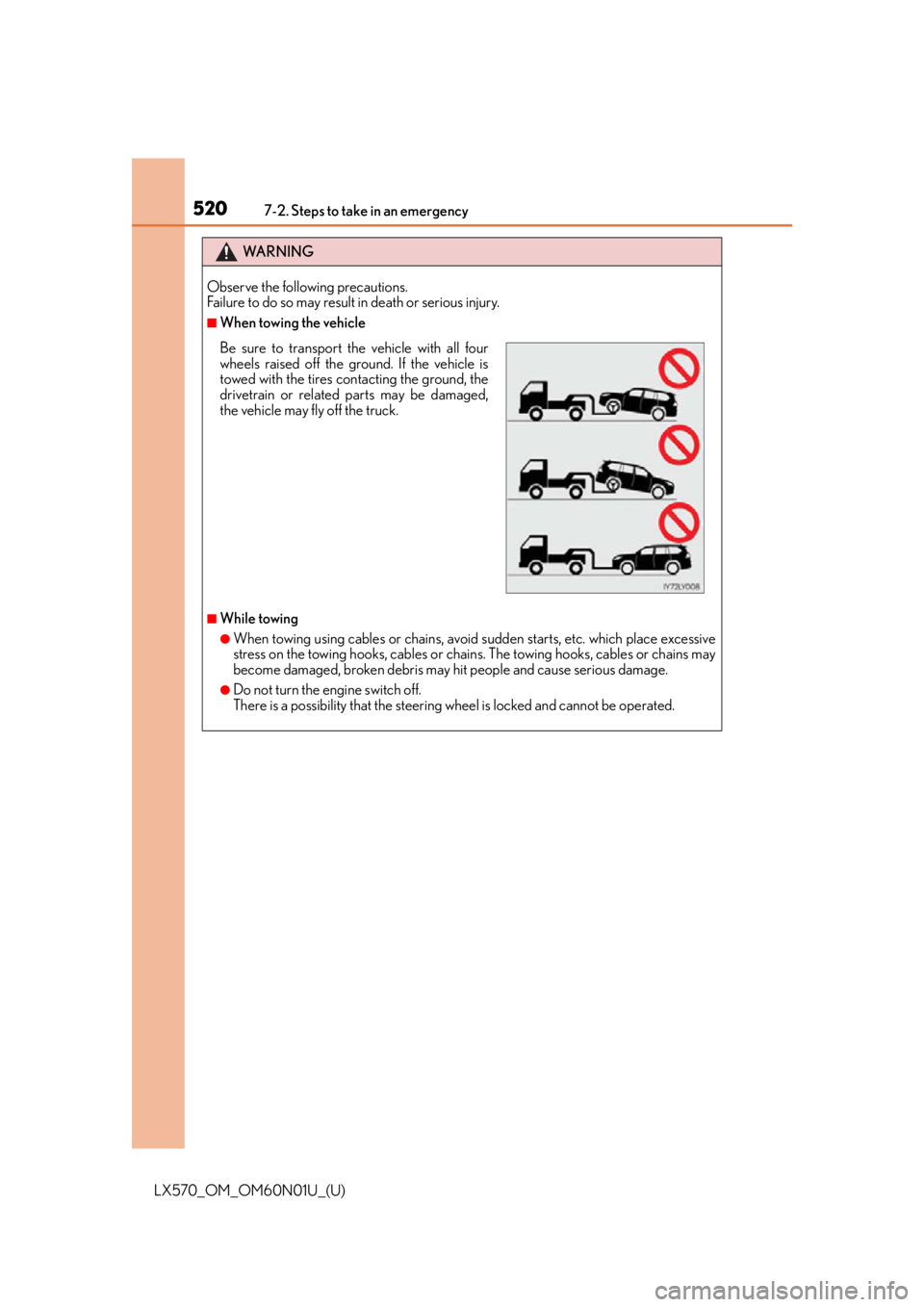
Be sure to transport the vehicle with all four
wheels raised off the ground. If the vehicle is
towed with the tires contacting the ground, the
drivetrain or related parts may be damaged,
the vehicle may fly off the truck.
Page 521 of 632
5217-2. Steps to take in an emergency
LX570_OM_OM60N01U_(U)
7
When trouble arises
NOTICE
■To prevent damage to the vehicle when towing using a wheel-lift type truck
●Do not tow the vehicle from the rear when the engine switch is off. The steering lock
mechanism is not strong enough to hold the front wheels straight.
●When raising the vehicle, ensure adequate ground clearance for towing at the oppo-
site end of the raised vehicle. Without adequate clearance, the vehicle could be dam-
aged while being towed.
■To prevent damage to the vehicle when towing with a sling-type truck
Do not tow with a sling-type truck, either from the front or rear.
■To prevent damage to the vehicle during emergency towing
Do not secure cables or chains to the suspension components.
■To avoid serious damage to your vehicle
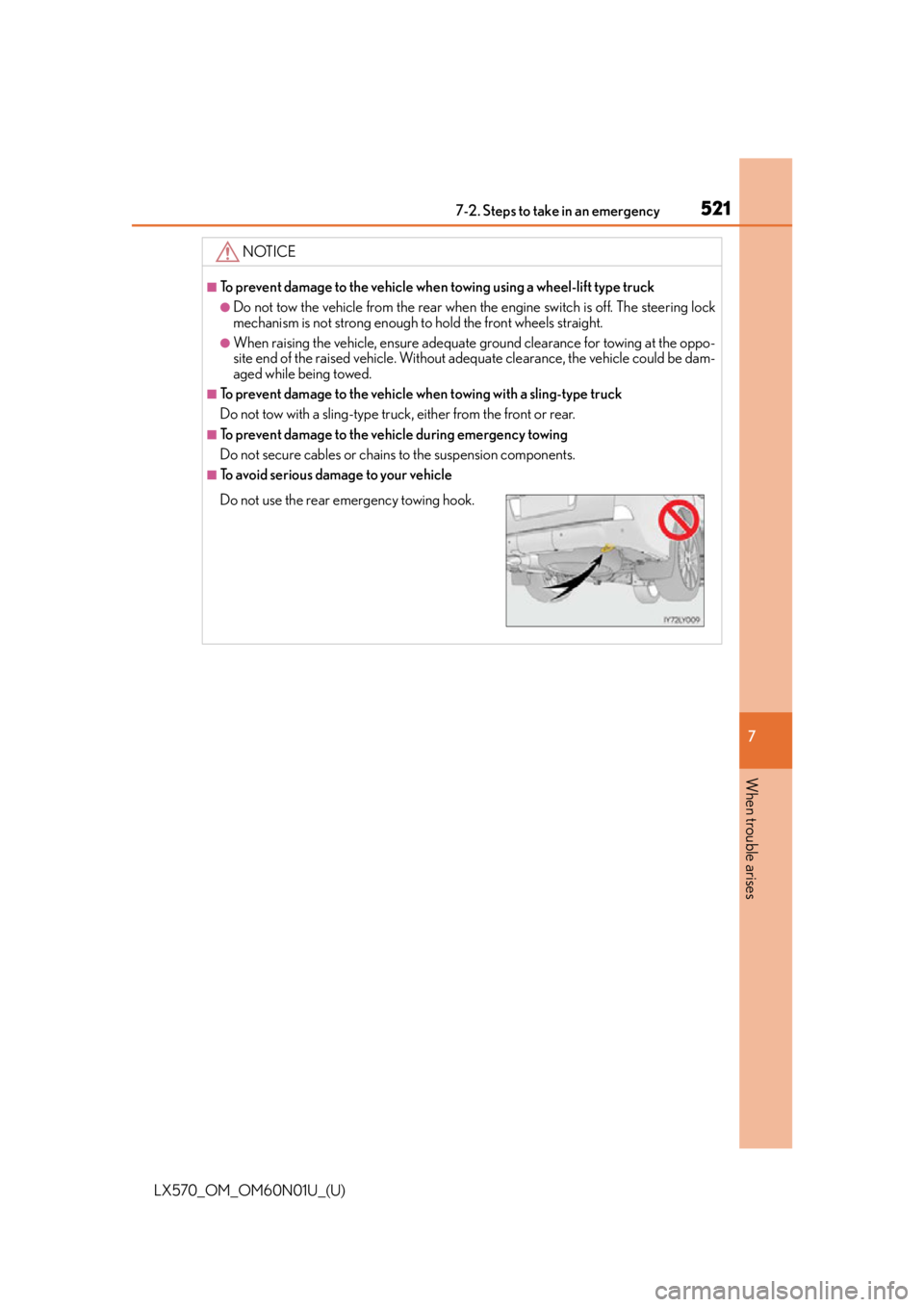
Do not use the rear emergency towing hook.
Page 526 of 632
5267-2. Steps to take in an emergency
LX570_OM_OM60N01U_(U)
(Flashes)
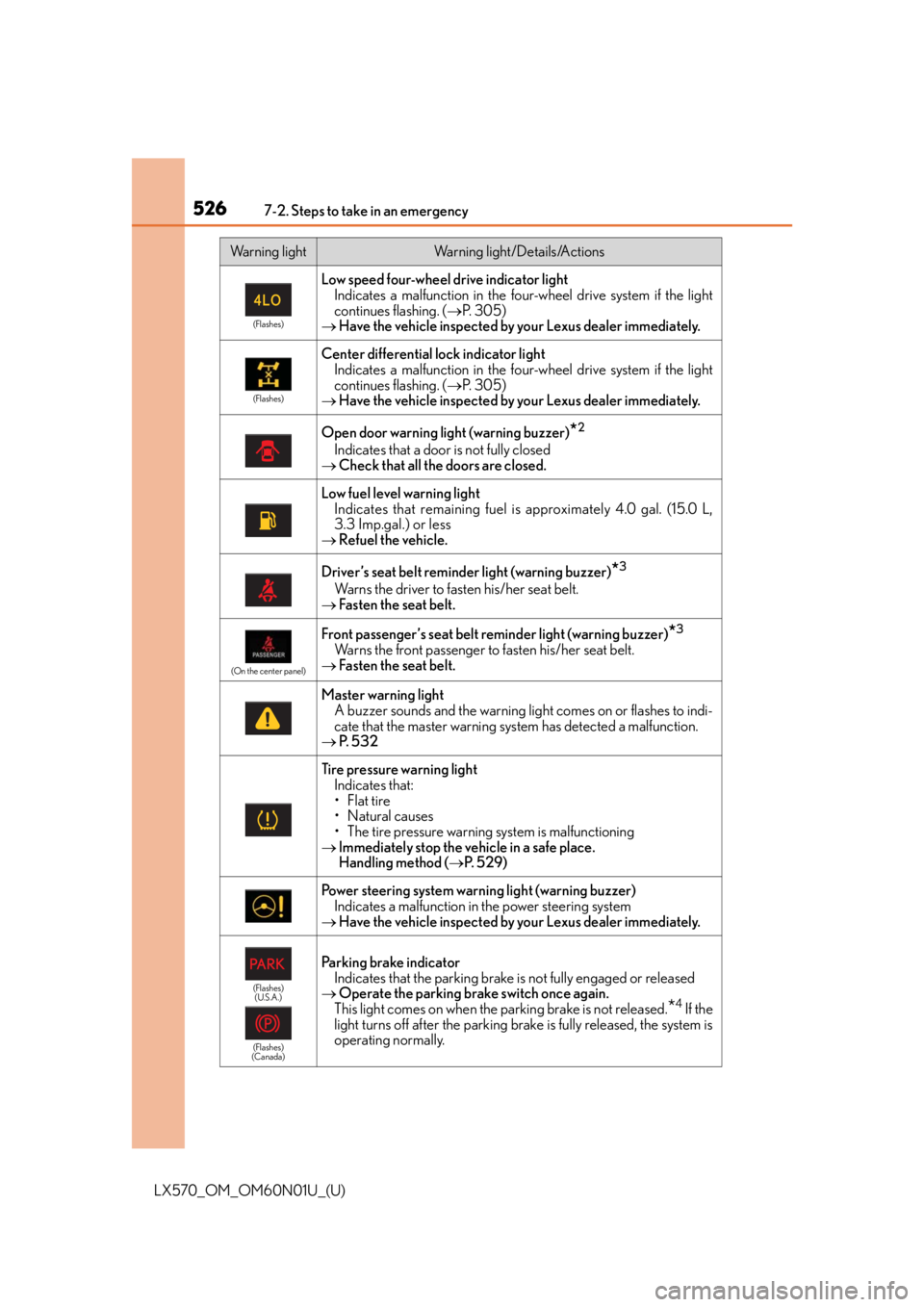
Low speed four-wheel drive indicator lightIndicates a malfunction in the four -wheel drive system if the light
continues flashing. ( P. 3 0 5 )
Have the vehicle inspected by your Lexus dealer immediately.
(Flashes)
Center differential lock indicator light
Indicates a malfunction in the four -wheel drive system if the light
continues flashing. ( P. 3 0 5 )
Have the vehicle inspected by your Lexus dealer immediately.
Open door warning light (warning buzzer)*2
Indicates that a door is not fully closed
Check that all the doors are closed.
Low fuel level warning light
Indicates that remaining fuel is approximately 4.0 gal. (15.0 L,
3.3 Imp.gal.) or less
Refuel the vehicle.
Driver’s seat belt reminder light (warning buzzer)*3
Warns the driver to fast en his/her seat belt.
Fasten the seat belt.
(On the center panel)
Front passenger’s seat belt reminder light (warning buzzer)*3
Warns the front passenger to fasten his/her seat belt.
Fasten the seat belt.
Master warning light
A buzzer sounds and the warning light comes on or flashes to indi-
cate that the master warning sy stem has detected a malfunction.
P. 5 3 2
Tire pressure warning light
Indicates that:
•Flat tire
• Natural causes
• The tire pressure warning system is malfunctioning
Immediately stop the vehicle in a safe place.
Handling method ( P. 5 2 9 )
Power steering system warning light (warning buzzer)
Indicates a malfunction in the power steering system
Have the vehicle inspected by your Lexus dealer immediately.
(Flashes)
(U.S.A.)
(Flashes)
(Canada)
Parking brake indicator Indicates that the parking brake is not fully engaged or released
Operate the parking brake switch once again.
This light comes on when the parking brake is not released.
*4 If the
light turns off after the parking brake is fully released, the system is
operating normally.
Warning lightWarning light/Details/Actions