check LEXUS LX570 2021 Manual Online
[x] Cancel search | Manufacturer: LEXUS, Model Year: 2021, Model line: LX570, Model: LEXUS LX570 2021Pages: 635, PDF Size: 10.47 MB
Page 480 of 635

480
LX570_OM_OM60T33U_(U)6-3. Do-it-yourself maintenance
■Adding engine oil
If the oil level is below or near the
low level mark, add engine oil of the
same type as already in the engine.
Make sure to check the oil type and
prepare the items needed before adding
oil.
Remove the oil filler cap by turning it counterclockwise.
Add engine oil slowly, checking the dipstick.
Install the oil filler cap by turning it clockwise.
■Engine oil consumption
A certain amount of engine oil will be consumed while driving. In the following situations,
oil consumption may increase, and engine oil may need to be refilled in between oil
maintenance intervals.
●When the engine is new, for example directly after purchasing the vehicle or after
replacing the engine
●If low quality oil or oil of an inappropriate viscosity is used
●When driving at high engine speeds or with a heavy load, when towing, or when driving
while accelerating or decelerating frequently
●When leaving the engine idling for a long time, or when driving frequently through
heavy traffic
■After changing the engine oil
The engine oil maintenance data should be reset. Perform the following procedures:
Press or of the meter control switches, select .
Press or of the meter control swit ches, select “Oil Maintenance” and then
press .
Select the “Yes” and press .
A message is displayed on th e multi-information display.
Engine oil selectionP. 564
Oil quantity (Low Full)1.6 qt. (1.5 L, 1.3 Imp.qt.)
ItemsClean funnel
1
2
3
1
2
3
4
Page 481 of 635

LX570_OM_OM60T33U_(U)
4816-3. Do-it-yourself maintenance
6
Maintenance and care
WARNING
■Used engine oil
●Used engine oil contains potentially harmful contaminants which may cause skin dis-
orders such as inflammation or skin canc er, so care should be taken to avoid pro-
longed and repeated contact. To remove used engine oil from your skin, wash
thoroughly with soap and water.
●Dispose of used oil and filters only in a sa fe and acceptable manner. Do not dispose of
used oil and filters in household trash, in sewers or onto the ground. Call your Lexus
dealer, service station or auto parts store for information concerning recycling or dis-
posal.
●Do not leave used engine oil within the reach of children.
NOTICE
■To prevent serious engine damage
Check the oil level on regular basis.
■When replacing the engine oil
●Be careful not to spill engine oil on the vehicle components.
●Avoid overfilling, or the engine could be damaged.
●Check the oil level on the dipstick every time you refill the vehicle.
●Be sure the engine oil filler cap is properly tightened.
Page 482 of 635
482
LX570_OM_OM60T33U_(U)6-3. Do-it-yourself maintenance
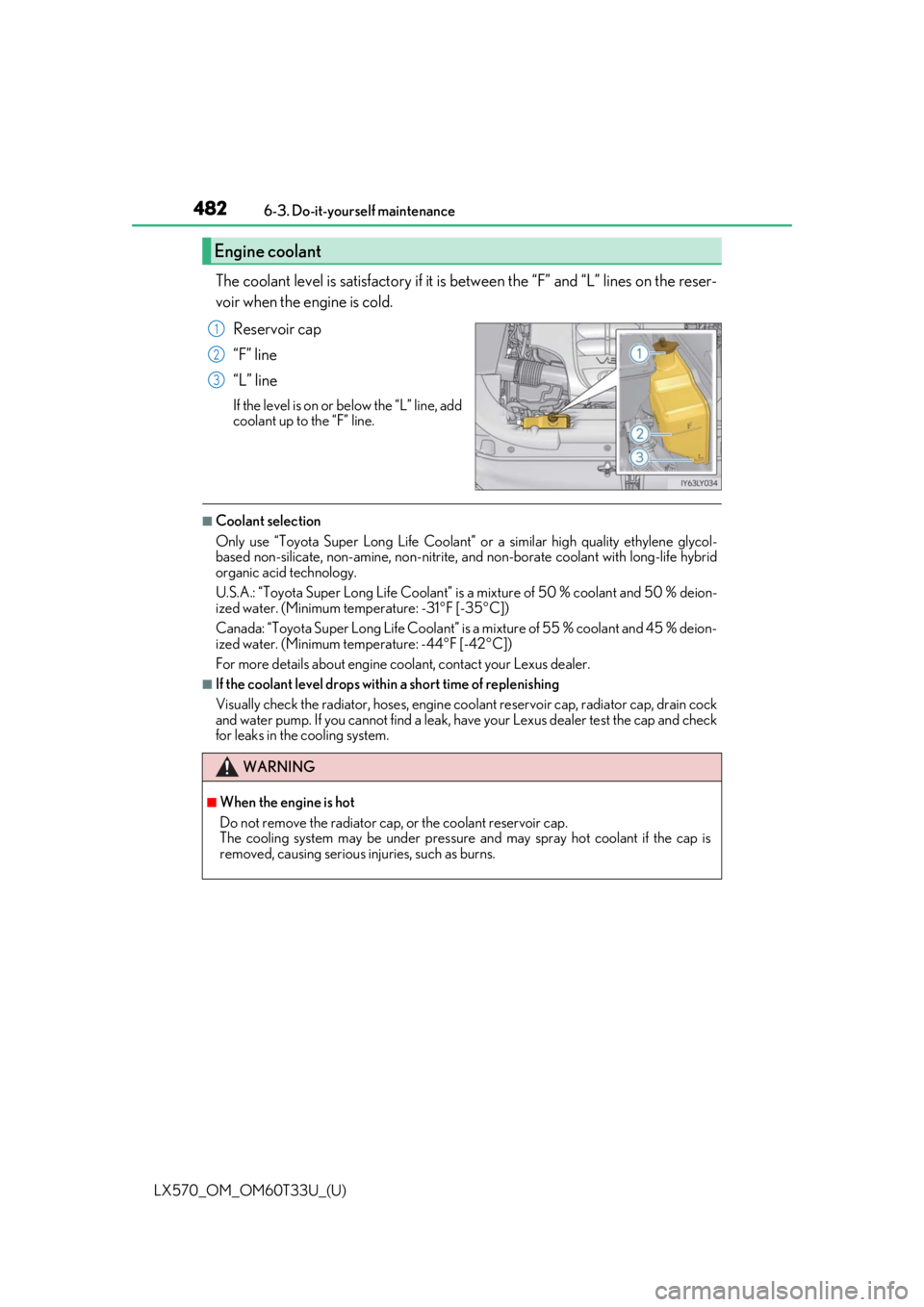
The coolant level is satisfactory if it is between the “F” and “L” lines on the reser-
voir when the engine is cold.
Reservoir cap
“F” line
“L” line
If the level is on or below the “L” line, add
coolant up to the “F” line.
■Coolant selection
Only use “Toyota Super Long Life Coolant” or a similar high quality ethylene glycol-
based non-silicate, non-amine, non-nitrite, and non-borate coolant with long-life hybrid
organic acid technology.
U.S.A.: “Toyota Super Long Life Coolant” is a mixture of 50 % coolant and 50 % deion-
ized water. (Minimum temperature: -31 F [-35 C])
Canada: “Toyota Super Long Life Coolant” is a mixture of 55 % coolant and 45 % deion-
ized water. (Minimum temperature: -44 F [-42 C])
For more details about engine coolant, contact your Lexus dealer.
■If the coolant level drops within a short time of replenishing
Visually check the radiator, hoses, engine c oolant reservoir cap, radiator cap, drain cock
and water pump. If you cannot find a leak, have your Lexus dealer test the cap and check
for leaks in the cooling system.
Engine coolant
1
2
3
WARNING
■When the engine is hot
Do not remove the radiator cap, or the coolant reservoir cap.
The cooling system may be under pressure and may spray hot coolant if the cap is
removed, causing serious injuries, such as burns.
Page 483 of 635
LX570_OM_OM60T33U_(U)
4836-3. Do-it-yourself maintenance
6
Maintenance and care
Check the radiator and condenser and clear any foreign objects.
If either of the above parts is extremely dirty or you are not sure of their condi-
tion, have your vehicle checked by your Lexus dealer.
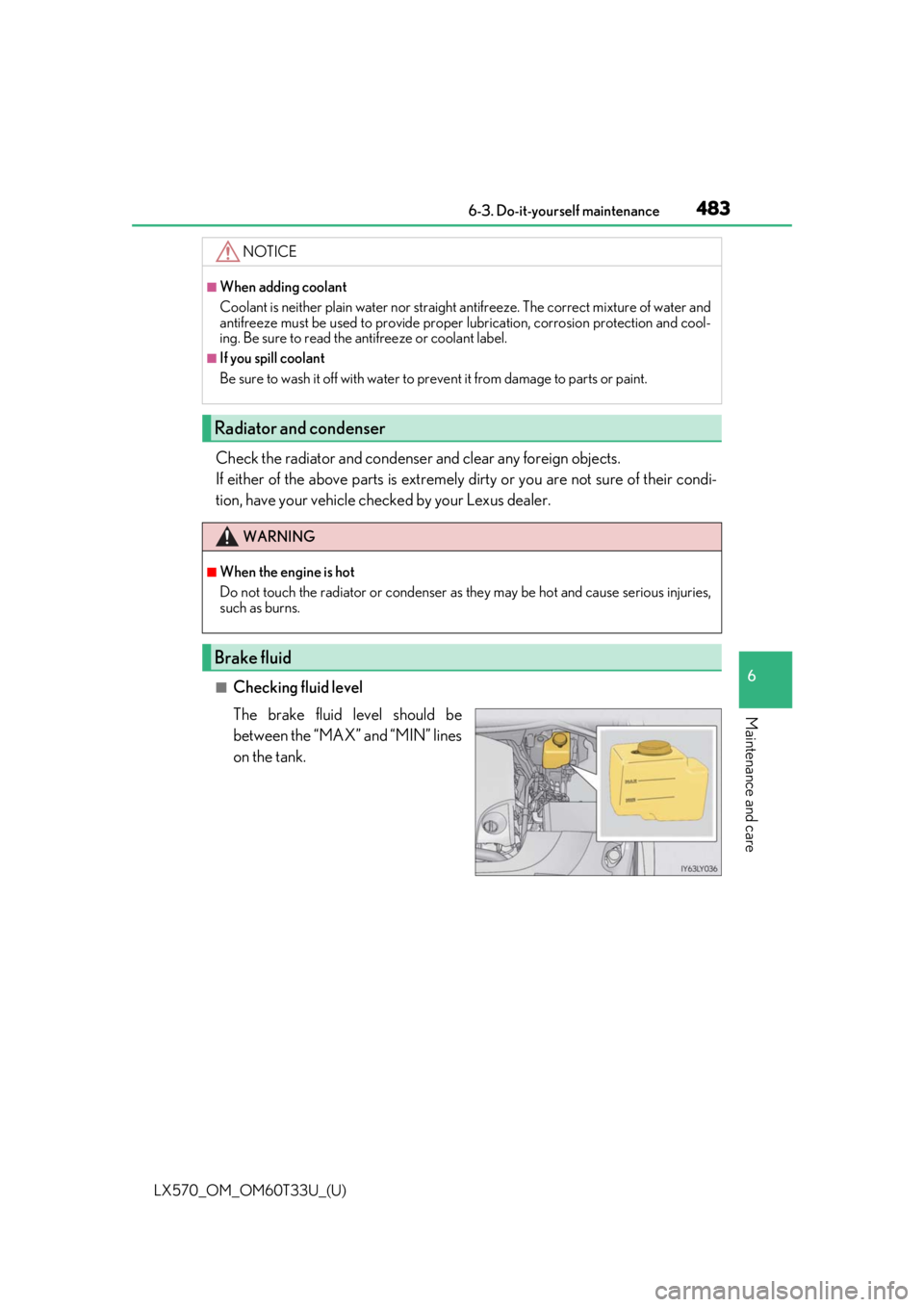
■Checking fluid level
The brake fluid level should be
between the “MAX” and “MIN” lines
on the tank.
NOTICE
■When adding coolant
Coolant is neither plain water nor straight antifreeze. The correct mixture of water and
antifreeze must be used to provide proper lubrication, corrosion protection and cool-
ing. Be sure to read the antifreeze or coolant label.
■If you spill coolant
Be sure to wash it off with water to pr event it from damage to parts or paint.
Radiator and condenser
WARNING
■When the engine is hot
Do not touch the radiator or condenser as they may be hot and cause serious injuries,
such as burns.
Brake fluid
Page 484 of 635
484
LX570_OM_OM60T33U_(U)6-3. Do-it-yourself maintenance
■Adding fluid
Make sure to check the fluid type and prepare the necessary item.
■Refilling brake fluid
Turn the engine switch off.
Depress the brake pedal more than 40 times.
Remove the reservoir cap by hand. Ad d brake fluid up to the “MAX” line.
If you do not follow the procedure above, the reservoir may overflow.
■Brake fluid can absorb moisture from the air
Excess moisture in the fluid can cause a dang erous loss of braking efficiency. Use only
newly opened brake fluid.
Fluid typeFMVSS No.116 DOT 3 or SAE J1703 brake fluid
ItemsClean funnel
WARNING
■When filling the reservoir
Take care because brake fluid can harm yo ur hands or eyes and damage painted sur-
faces. If fluid gets on your eyes, flush the affected area with clean water immediately. If
you still experience discomfort, see a doctor.
NOTICE
■If the fluid level is low or high
It is normal for the brake fluid level to go down slightly as the brake pads wear or when
the fluid level in the accumulator is high. If the reservoir needs freq uent refilling, it may
indicate a serious problem.
1
2
3
Page 485 of 635
LX570_OM_OM60T33U_(U)
4856-3. Do-it-yourself maintenance
6
Maintenance and care
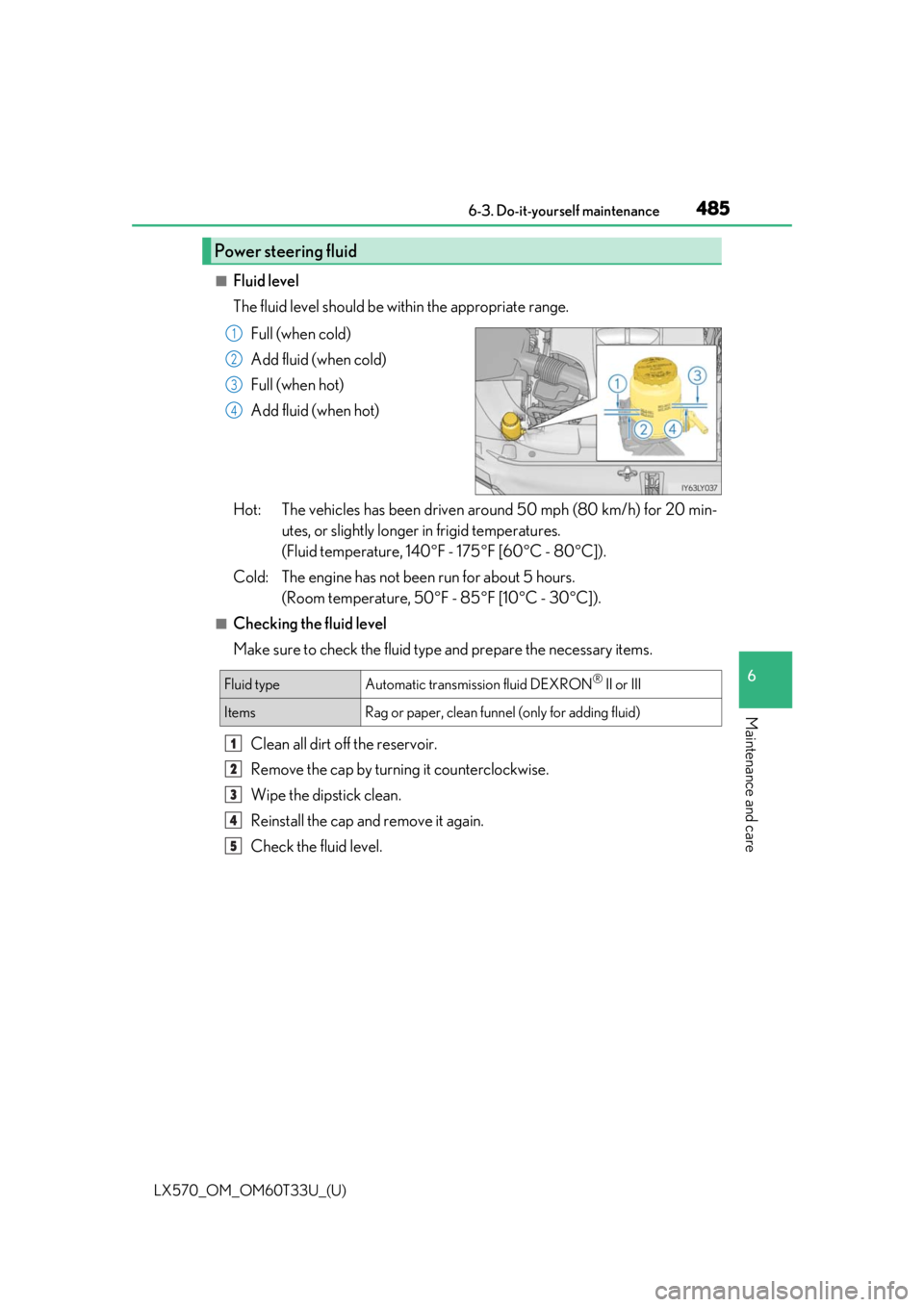
■Fluid level
The fluid level should be within the appropriate range.Full (when cold)
Add fluid (when cold)
Full (when hot)
Add fluid (when hot)
Hot: The vehicles has been driven around 50 mph (80 km/h) for 20 min- utes, or slightly longer in frigid temperatures.
(Fluid temperature, 140 F - 175 F [60 C - 80 C]).
Cold: The engine has not been run for about 5 hours. (Room temperature, 50 F - 85 F [10 C - 30 C]).
■Checking the fluid level
Make sure to check the fluid type and prepare the necessary items.
Clean all dirt off the reservoir.
Remove the cap by turnin g it counterclockwise.
Wipe the dipstick clean.
Reinstall the cap and remove it again.
Check the fluid level.
Power steering fluid
1
2
3
4
Fluid typeAutomatic transmission fluid DEXRON® II or III
ItemsRag or paper, clean funnel (only for adding fluid)
1
2
3
4
5
Page 486 of 635
486
LX570_OM_OM60T33U_(U)6-3. Do-it-yourself maintenance
Check the battery as follows.
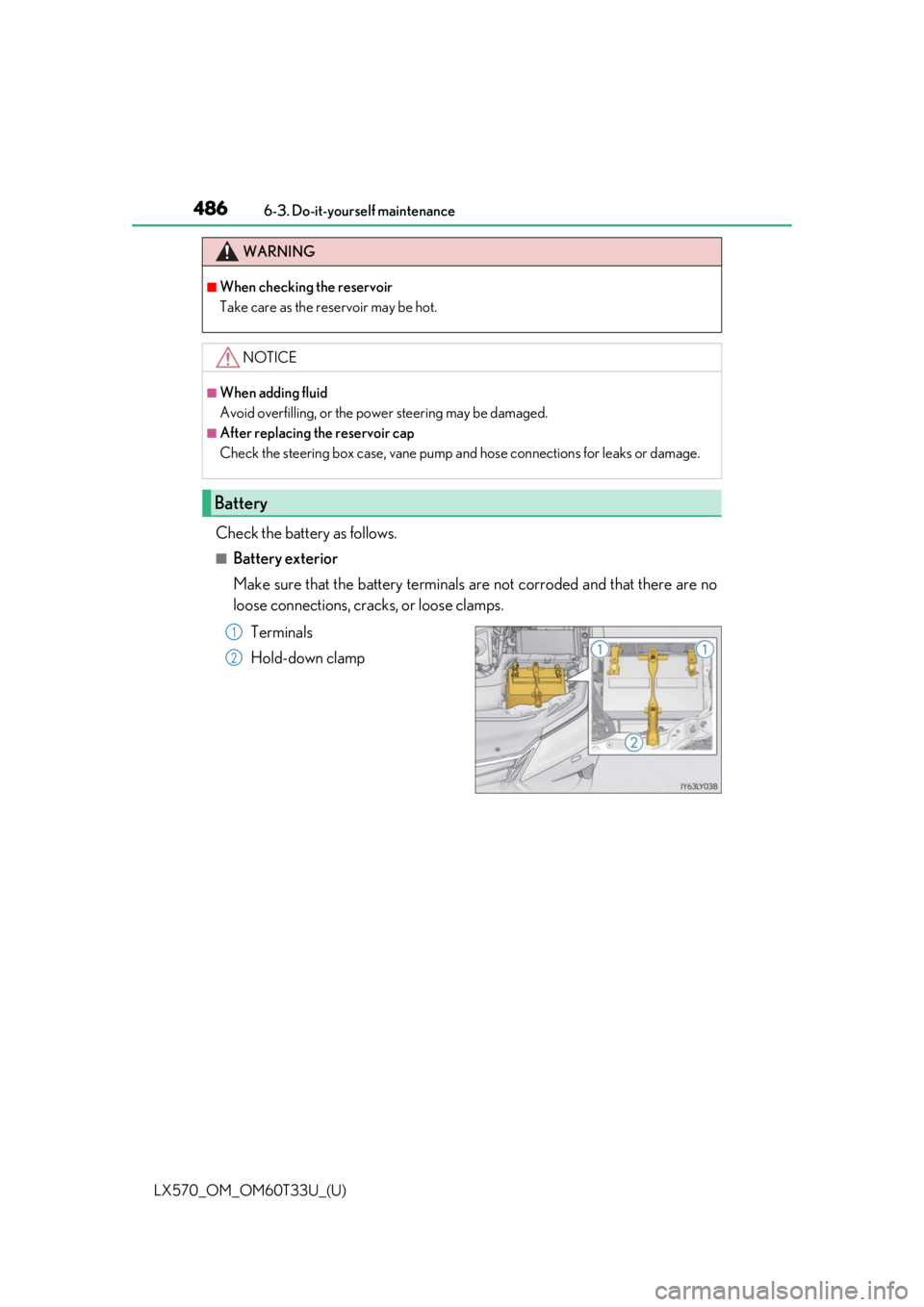
■Battery exterior
Make sure that the battery terminals
are not corroded and that there are no
loose connections, cracks, or loose clamps.
Terminals
Hold-down clamp
WARNING
■When checking the reservoir
Take care as the reservoir may be hot.
NOTICE
■When adding fluid
Avoid overfilling, or the powe r steering may be damaged.
■After replacing the reservoir cap
Check the steering box case, vane pump an d hose connections for leaks or damage.
Battery
1
2
Page 490 of 635
490
LX570_OM_OM60T33U_(U)6-3. Do-it-yourself maintenance
Tires
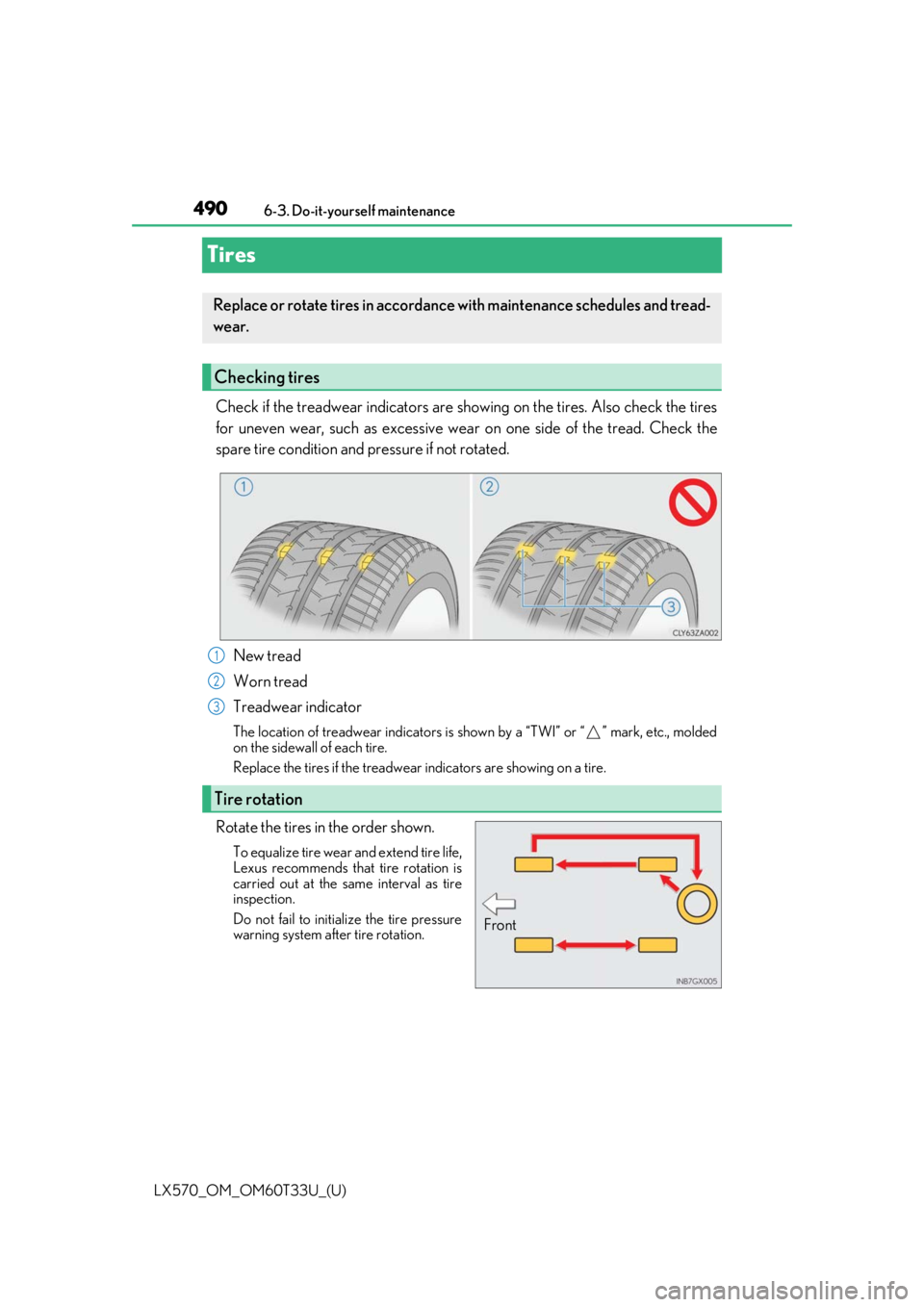
Check if the treadwear indicators are showing on the tires. Also check the tires
for uneven wear, such as excessive wear
on one side of the tread. Check the
spare tire condition and pressure if not rotated.
New tread
Worn tread
Treadwear indicator
The location of treadwear indicators is shown by a “TWI” or “ ” mark, etc., molded
on the sidewall of each tire.
Replace the tires if the treadwear indicators are showing on a tire.
Rotate the tires in the order shown.
To equalize tire wear and extend tire life,
Lexus recommends that tire rotation is
carried out at the same interval as tire
inspection.
Do not fail to initialize the tire pressure
warning system after tire rotation.
Replace or rotate tires in accordance with maintenance schedules and tread-
wear.
Checking tires
Tire rotation
1
2
3
Front
Page 493 of 635

LX570_OM_OM60T33U_(U)
4936-3. Do-it-yourself maintenance
6
Maintenance and care
■When to replace your vehicle’s tires
Tires should be replaced if:
●The treadwear indicators are showing on a tire.
●You have tire damage such as cuts, splits, cracks deep enough to expose the fabric, and
bulges indicating internal damage
●A tire goes flat repeatedly or cannot be properly repaired due to the size or location of
a cut or other damage
If you are not sure, consult with your Lexus dealer.
■Replacing tires and wheels
If the ID code of the tire pressure warning valve and transmitter is not registered, the tire
pressure warning system will not work proper ly. After driving for about 20 minutes, the
tire pressure warning light comes on after blinking for 1 minute to indicate a system mal-
function.
■Tire life
Any tire over 6 years old must be checked by a qualified technician even if it has seldom
or never been used or damage is not obvious.
■Routine tire inflation pressure checks
The tire pressure warning syst em does not replace routine tire inflation pressure checks.
Make sure to check tire inflat ion pressure as part of your routine of daily vehicle checks.
■Maximum load of tire
Check that the number given by dividing the maximum load by 1.10 of the replacement
tire is greater than 1/2 of the Gross Axle We ight Ratings (GAWR) of either the front axle
or the rear axle, whichever is greater.
For the GAWR, see the Certification Label. For
the maximum load of the tire, see the load limit
at maximum cold tire inflation pressure men-
tioned on the sidewall of the tire. ( P. 573)
Page 494 of 635

494
LX570_OM_OM60T33U_(U)6-3. Do-it-yourself maintenance
■Tire types
●Summer tires
Summer tires are high-speed performance ti
res best suited to highway driving under
dry conditions. Since summer tires do not have the same traction performance as
snow tires, summer tires are inadequate for driving on snow-covered or icy roads. For
driving on snow-covered roads or icy road s, the use of snow tires is recommended.
When installing snow tires, be sure to replace all four tires.
●All season tires
All season tires are designed to provide better traction in snow and to be adequate for
driving in most winter conditions, as well as for use year round. All season tires, how-
ever, do not have adequate traction perfor mance compared with snow tires in heavy
or loose snow. Also, all season tires fall short in acceleration and handling perfor-
mance compared with summer tires in highway driving.
●Snow tires
For driving on snow-covered roads or icy roads, we recommend using snow tires. If
you need snow tires, select ti res of the same size, construction and load capacity as the
originally installed tires. Since your vehicle has radial tires as original equipment, make
sure your snow tires also have radial cons truction. Do not install studded tires without
first checking local regulations for possible re striction. Snow tires should be installed
on all wheels. ( P. 390)
■Initializing the tire pressure warning system
Initialize the tire pressure warn ing system with the tire inflation pressure adjusted to the
specified level.
■If the tread on snow tires wears down below 0.16 in. (4 mm)
The effectiveness of the tire s as snow tires is lost.
■If you press the tire pressure warning reset switch accidentally
If initialization is performed, adjust the tire inflation pressure to the specified level and ini-
tialize the tire pressure warning system again.
■Situations in which the tire pressure warning system may not operate properly
●In the following cases, the tire pressure warning system may not operate properly.
• If non-genuine Lexus wheels are used.
• A tire has been replaced with a tire that is not an OE (Original Equipment) tire.
• A tire has been replaced with a tire that is not of the specified size.
• Tire chains etc. are equipped.
• An auxiliary-supported run-flat tire is equipped.
• If a window tint that affects th e radio wave signals is installed.
• If there is a lot of snow or ice on the vehi cle, particularly around the wheels or wheel
housings.
• If the tire inflation pressure is extr emely higher than the specified level.
• If the spare tire is in a location subj ect to poor radio wave signal reception.
• If a large metallic object which can interfere with signal reception is put near the spare tire.
• If tires not equipped with the tire pressure warning valves and transmitters are used.
• If the ID code on the tire pressure warning valves and transmitters is not registered in the tire pressure warning computer.