weight LEXUS NX300 2020 User Guide
[x] Cancel search | Manufacturer: LEXUS, Model Year: 2020, Model line: NX300, Model: LEXUS NX300 2020Pages: 468, PDF Size: 10.24 MB
Page 159 of 468
1594-1. Before driving
LEXUS NX300 Owners Manual_USA_M78389_en
4
Driving
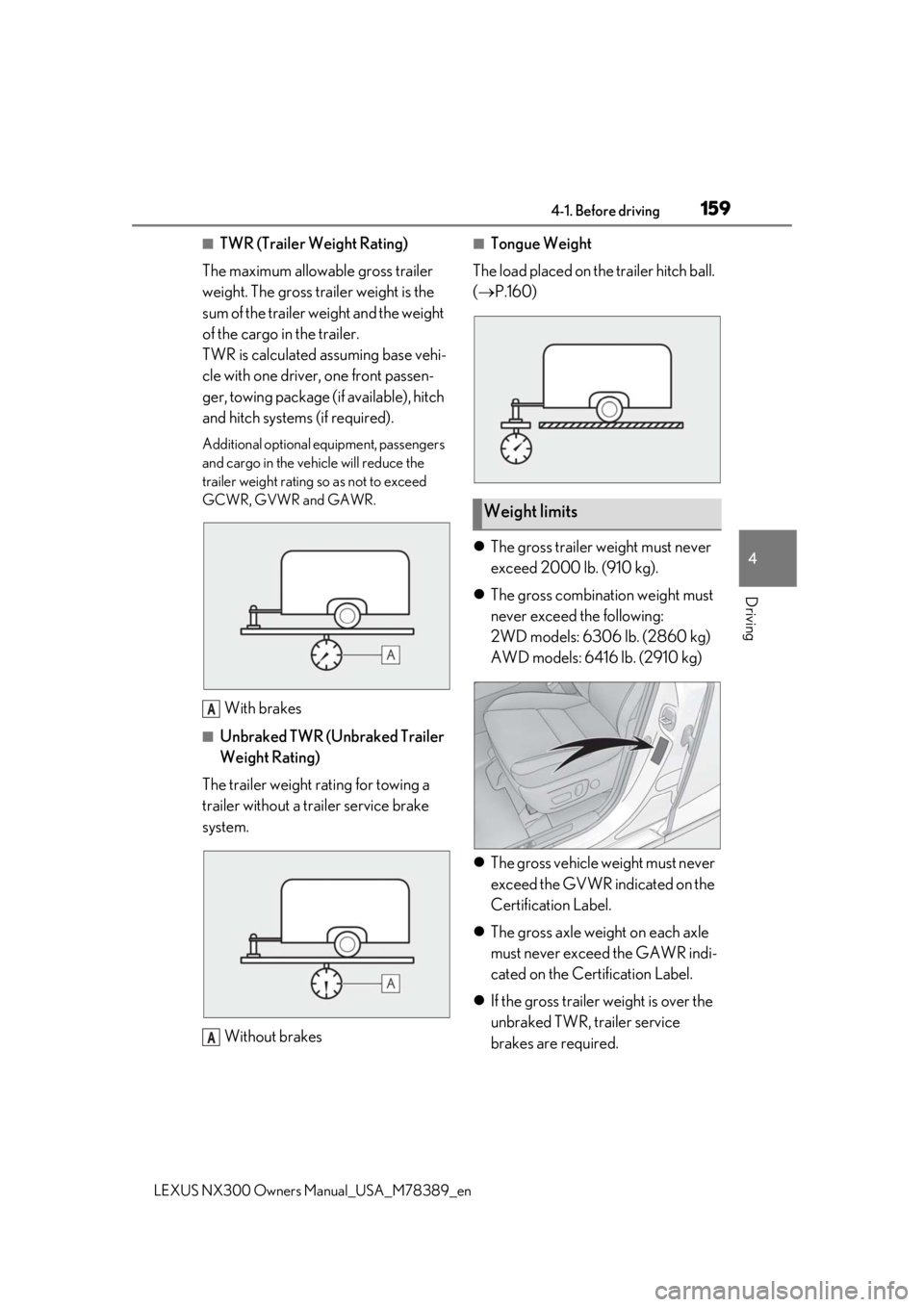
■TWR (Trailer Weight Rating)
The maximum allowable gross trailer
weight. The gross trailer weight is the
sum of the trailer weight and the weight
of the cargo in the trailer.
TWR is calculated assuming base vehi-
cle with one driver, one front passen-
ger, towing package (if available), hitch
and hitch systems (if required).
Additional optional equipment, passengers
and cargo in the vehicle will reduce the
trailer weight rating so as not to exceed
GCWR, GVWR and GAWR.
With brakes
■Unbraked TWR (Unbraked Trailer
Weight Rating)
The trailer weight rating for towing a
trailer without a trailer service brake
system.
Without brakes
■Tongue Weight
The load placed on the trailer hitch ball.
( P.160)
The gross trailer weight must never
exceed 2000 lb. (910 kg).
The gross combination weight must
never exceed the following:
2WD models: 6306 lb. (2860 kg)
AWD models: 6416 lb. (2910 kg)
The gross vehicle weight must never
exceed the GVWR indicated on the
Certification Label.
The gross axle weight on each axle
must never exceed the GAWR indi-
cated on the Certification Label.
If the gross trailer weight is over the
unbraked TWR, trailer service
brakes are required.
A
A
Weight limits
Page 160 of 468
1604-1. Before driving
LEXUS NX300 Owners Manual_USA_M78389_en
Confirm that the gross trailer weight,
gross combination weight, gross vehi-
cle weight, gross axle weight and
tongue weight are all within the limits.
■GCWR*
2WD models: 6306 lb. (2860 kg)
AWD models: 6416 lb. (2910 kg)
■TWR*
2000 lb. (910 kg)
■Unbraked TWR*
1000 lb. (450 kg)
*: These models meet the tow-vehicle trail-
ering requirement of SAE International
per SAE J2807.
A recommended tongue weight
varies in accordance with the types
of trailers or towing as described
below.
To ensure the recommended values
shown below, the trailer must be
loaded by referring to the following
instructions.
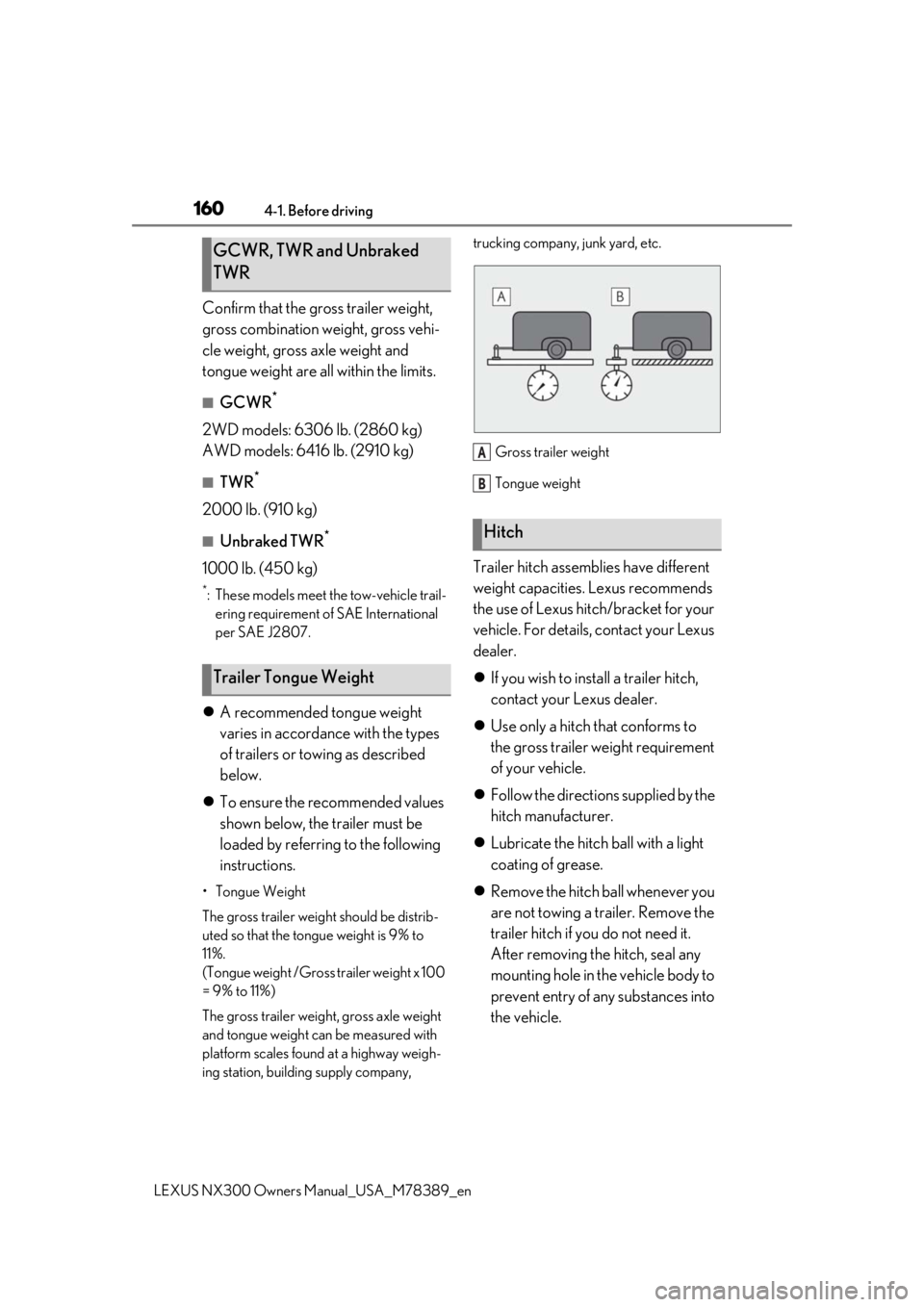
• Tongue Weight
The gross trailer weight should be distrib-
uted so that the tongue weight is 9% to
11%.
(Tongue weight /Gross trailer weight x 100
= 9% to 11%)
The gross trailer weight , gross axle weight
and tongue weight can be measured with
platform scales found at a highway weigh-
ing station, building supply company, trucking company, junk yard, etc.
Gross trailer weight
Tongue weight
Trailer hitch assemblies have different
weight capacities. Lexus recommends
the use of Lexus hitch/bracket for your
vehicle. For details, contact your Lexus
dealer.
If you wish to install a trailer hitch,
contact your Lexus dealer.
Use only a hitch that conforms to
the gross trailer weight requirement
of your vehicle.
Follow the directions supplied by the
hitch manufacturer.
Lubricate the hitch ball with a light
coating of grease.
Remove the hitch ball whenever you
are not towing a trailer. Remove the
trailer hitch if you do not need it.
After removing the hitch, seal any
mounting hole in the vehicle body to
prevent entry of any substances into
the vehicle.
GCWR, TWR and Unbraked
TWR
Trailer Tongue Weight
Hitch
A
B
Page 161 of 468
1614-1. Before driving
LEXUS NX300 Owners Manual_USA_M78389_en
4
Driving
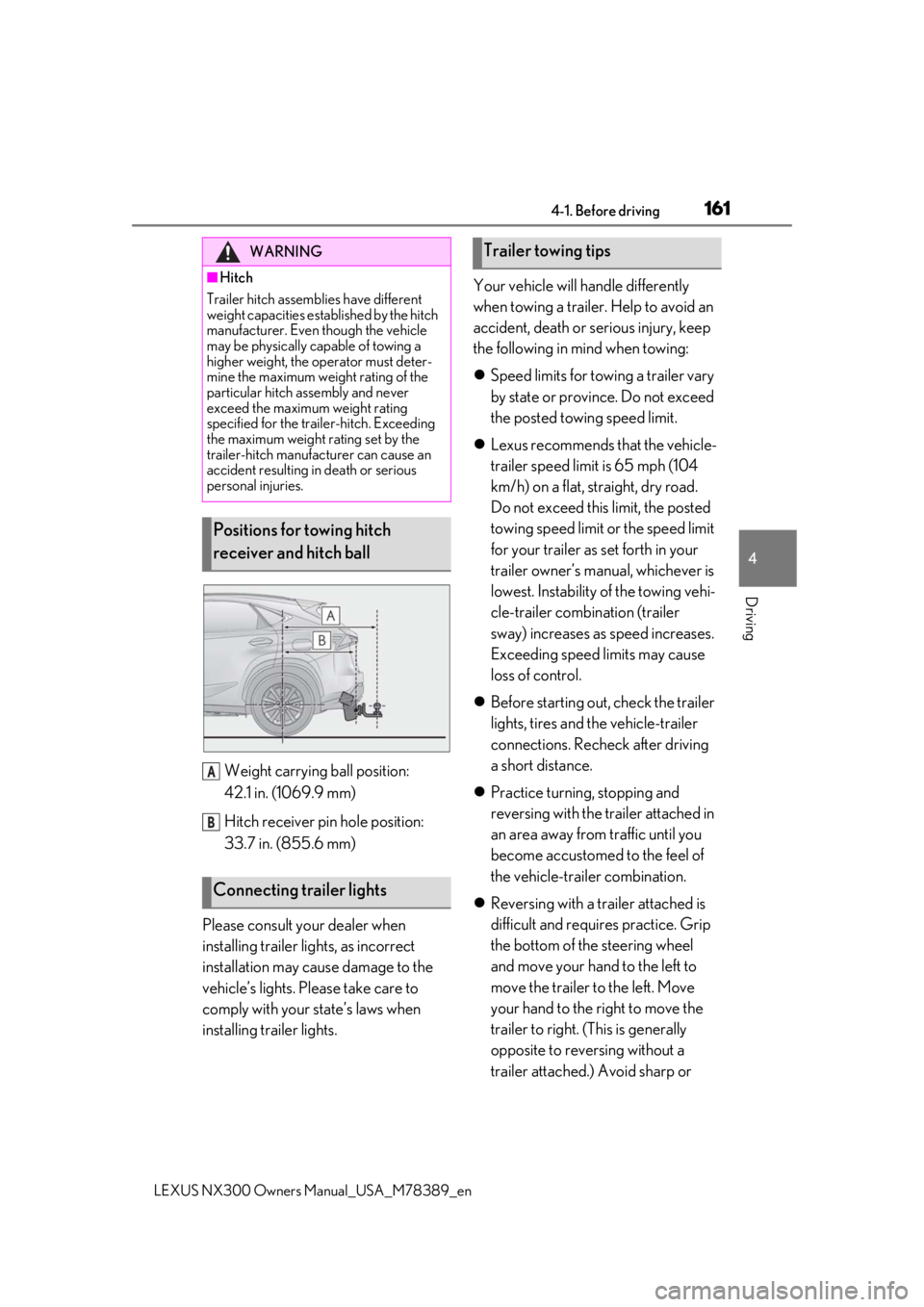
Weight carrying ball position:
42.1 in. (1069.9 mm)
Hitch receiver pin hole position:
33.7 in. (855.6 mm)
Please consult your dealer when
installing trailer lights, as incorrect
installation may cause damage to the
vehicle’s lights. Please take care to
comply with your state’s laws when
installing trailer lights. Your vehicle will handle differently
when towing a trailer. Help to avoid an
accident, death or serious injury, keep
the following in mind when towing:
Speed limits for towing a trailer vary
by state or province. Do not exceed
the posted towing speed limit.
Lexus recommends that the vehicle-
trailer speed limit is 65 mph (104
km/h) on a flat, straight, dry road.
Do not exceed this limit, the posted
towing speed limit or the speed limit
for your trailer as set forth in your
trailer owner’s manual, whichever is
lowest. Instability of the towing vehi-
cle-trailer combination (trailer
sway) increases as speed increases.
Exceeding speed limits may cause
loss of control.
Before starting out, check the trailer
lights, tires and the vehicle-trailer
connections. Recheck after driving
a short distance.
Practice turning, stopping and
reversing with the trailer attached in
an area away from traffic until you
become accustomed to the feel of
the vehicle-trailer combination.
Reversing with a trailer attached is
difficult and requires practice. Grip
the bottom of the steering wheel
and move your hand to the left to
move the trailer to the left. Move
your hand to the right to move the
trailer to right. (This is generally
opposite to reversing without a
trailer attached.) Avoid sharp or
WARNING
■Hitch
Trailer hitch assemb lies have different
weight capacities established by the hitch
manufacturer. Even though the vehicle
may be physically capable of towing a
higher weight, the operator must deter-
mine the maximum weight rating of the
particular hitch assembly and never
exceed the maximum weight rating
specified for the trailer-hitch. Exceeding
the maximum weight rating set by the
trailer-hitch manufacturer can cause an
accident resulting in death or serious
personal injuries.
Positions for towing hitch
receiver and hitch ball
Connecting trailer lights
A
B
Trailer towing tips
Page 343 of 468
3436-3. Do-it-yourself maintenance
LEXUS NX300 Owners Manual_USA_M78389_en
6
Maintenance and care
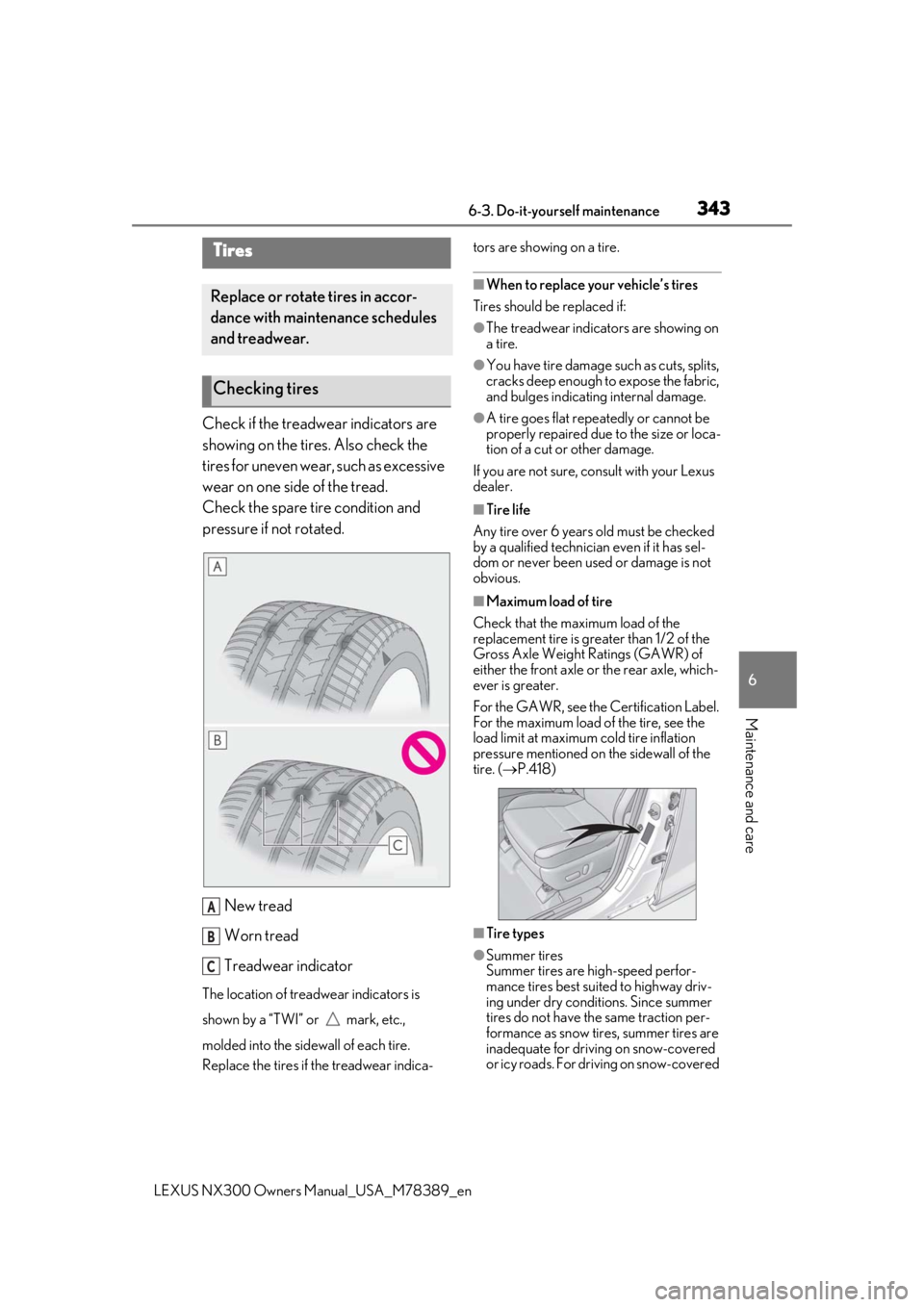
Check if the treadwear indicators are
showing on the tires. Also check the
tires for uneven wear, such as excessive
wear on one side of the tread.
Check the spare tire condition and
pressure if not rotated.
New tread
Worn tread
Treadwear indicator
The location of treadwear indicators is
shown by a “TWI” or mark, etc.,
molded into the sidewall of each tire.
Replace the tires if the treadwear indica- tors are showing on a tire.
■When to replace your vehicle’s tires
Tires should be replaced if:
●The treadwear indicators are showing on
a tire.
●You have tire damage such as cuts, splits,
cracks deep enough to expose the fabric,
and bulges indicating internal damage.
●A tire goes flat repe atedly or cannot be
properly repaired due to the size or loca-
tion of a cut or other damage.
If you are not sure, consult with your Lexus
dealer.
■Tire life
Any tire over 6 years old must be checked
by a qualified technician even if it has sel-
dom or never been used or damage is not
obvious.
■Maximum load of tire
Check that the maximum load of the
replacement tire is greater than 1/2 of the
Gross Axle Weight Ratings (GAWR) of
either the front axle or the rear axle, which-
ever is greater.
For the GAWR, see the Certification Label.
For the maximum load of the tire, see the
load limit at maximum cold tire inflation
pressure mentioned on the sidewall of the
tire. ( P.418)
■Tire types
●Summer tires
Summer tires are high-speed perfor-
mance tires best suited to highway driv-
ing under dry conditions. Since summer
tires do not have the same traction per-
formance as snow tires, summer tires are
inadequate for driving on snow-covered
or icy roads. For driving on snow-covered
Tires
Replace or rotate tires in accor-
dance with maintenance schedules
and treadwear.
Checking tires
A
B
C
Page 352 of 468
3526-3. Do-it-yourself maintenance
LEXUS NX300 Owners Manual_USA_M78389_en
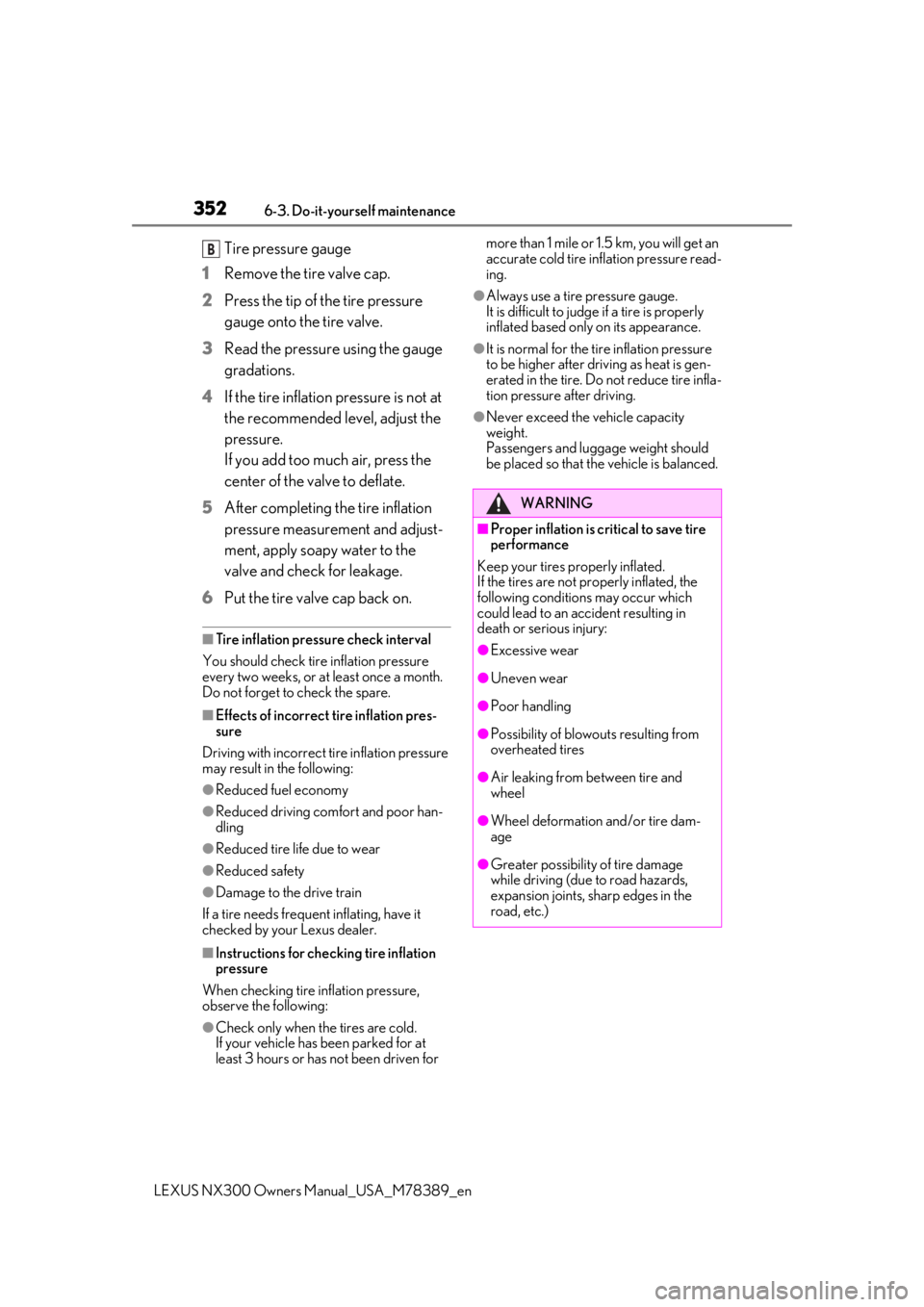
Tire pressure gauge
1
Remove the tire valve cap.
2
Press the tip of the tire pressure
gauge onto the tire valve.
3
Read the pressure using the gauge
gradations.
4
If the tire inflation pressure is not at
the recommended level, adjust the
pressure.
If you add too much air, press the
center of the valve to deflate.
5
After completing the tire inflation
pressure measurem ent and adjust-
ment, apply soapy water to the
valve and check for leakage.
6
Put the tire valve cap back on.
■Tire inflation pressure check interval
You should check tire inflation pressure
every two weeks, or at least once a month.
Do not forget to check the spare.
■Effects of incorrect tire inflation pres-
sure
Driving with incorrect ti re inflation pressure
may result in the following:
●Reduced fuel economy
●Reduced driving comfort and poor han-
dling
●Reduced tire life due to wear
●Reduced safety
●Damage to the drive train
If a tire needs frequent inflating, have it
checked by your Lexus dealer.
■Instructions for checking tire inflation
pressure
When checking tire inflation pressure,
observe the following:
●Check only when the tires are cold.
If your vehicle has been parked for at
least 3 hours or has not been driven for more than 1 mile or 1.5 km, you will get an
accurate cold tire inflation pressure read-
ing.
●Always use a tire pressure gauge.
It is difficult to judge if a tire is properly
inflated based only on its appearance.
●It is normal for the ti
re inflation pressure
to be higher after driving as heat is gen-
erated in the tire. Do not reduce tire infla-
tion pressure after driving.
●Never exceed the vehicle capacity
weight.
Passengers and luggage weight should
be placed so that the vehicle is balanced.
B
WARNING
■Proper inflation is critical to save tire
performance
Keep your tires properly inflated.
If the tires are not properly inflated, the
following conditions may occur which
could lead to an accident resulting in
death or serious injury:
●Excessive wear
●Uneven wear
●Poor handling
●Possibility of blowouts resulting from
overheated tires
●Air leaking from between tire and
wheel
●Wheel deformation and/or tire dam-
age
●Greater possibility of tire damage
while driving (due to road hazards,
expansion joints, sharp edges in the
road, etc.)
Page 354 of 468
3546-3. Do-it-yourself maintenance
LEXUS NX300 Owners Manual_USA_M78389_en
Use only Lexus wheel nuts and
wrenches designed for use with
your aluminum wheels.
When rotating, repairing or chang-
ing your tires, check that the wheel
nuts are still tight after driving 1000
miles (1600 km).
Be careful not to damage the alumi-
num wheels when using tire chains.
Use only Lexus genuine balance
weights or equivalent and a plastic
or rubber hammer when balancing your wheels.
WARNING
●Never use an inner tube in a leaking
wheel which is designed for a tubeless
tire. Doing so may result in an acci-
dent, causing death or serious injury.
■Use of defective wheels prohibited
Do not use cracked or deformed wheels.
Doing so could cause the tire to leak air
during driving, possibly causing an acci-
dent.
NOTICE
■Replacing tire pressure warning
valves and transmitters
●Because tire repair or replacement
may affect the tire pressure warning
valves and transmitters, make sure to
have tires serviced by your Lexus
dealer or other qualified service shop.
In addition, make sure to purchase
your tire pressure warning valves and
transmitters at your Lexus dealer.
●Ensure that only genuine Lexus wheels
are used on your vehicle.
Tire pressure warning valves and trans-
mitters may not work properly with
non-genuine wheels.
Aluminum wheel precautions
Page 408 of 468

4088-1. Specifications
LEXUS NX300 Owners Manual_USA_M78389_en
8-1.Specifications
*1:Unladen vehicle
*2: Vehicles with towing package
■Vehicle identification number
The vehicle identification number
(VIN) is the legal identifier for your
vehicle. This is the primary identifica-
tion number for your Lexus. It is used in
registering the ownership of your vehi-
cle.
This number is stamped on the top left
of the instrument panel. This number is also on the Certification
Label.
Maintenance data (fuel, oil level, etc.)
Dimensions and weight
Overall length182.7 in. (4640 mm)
Overall width72.6 in. (1845 mm)
Overall height*164.8 in. (1645 mm)
Wheelbase104.7 in. (2660 mm)
Front and rear tread
Vehicles with
225/65R17 and
225/60R18 tires
62.2 in. (1580 mm)
Vehicles with
235/55R18 tires61.8 in. (1570 mm)
Vehicle capacity weight
(Occupants + luggage)895 lb. (405 kg)
Trailer Weight Rating*2
(Trailer weight + cargo weight)2000 lb. (910 kg)
Vehicle identification
Page 422 of 468
4228-1. Specifications
LEXUS NX300 Owners Manual_USA_M78389_en
nation, can cause heat buildup and
possible tire failure.
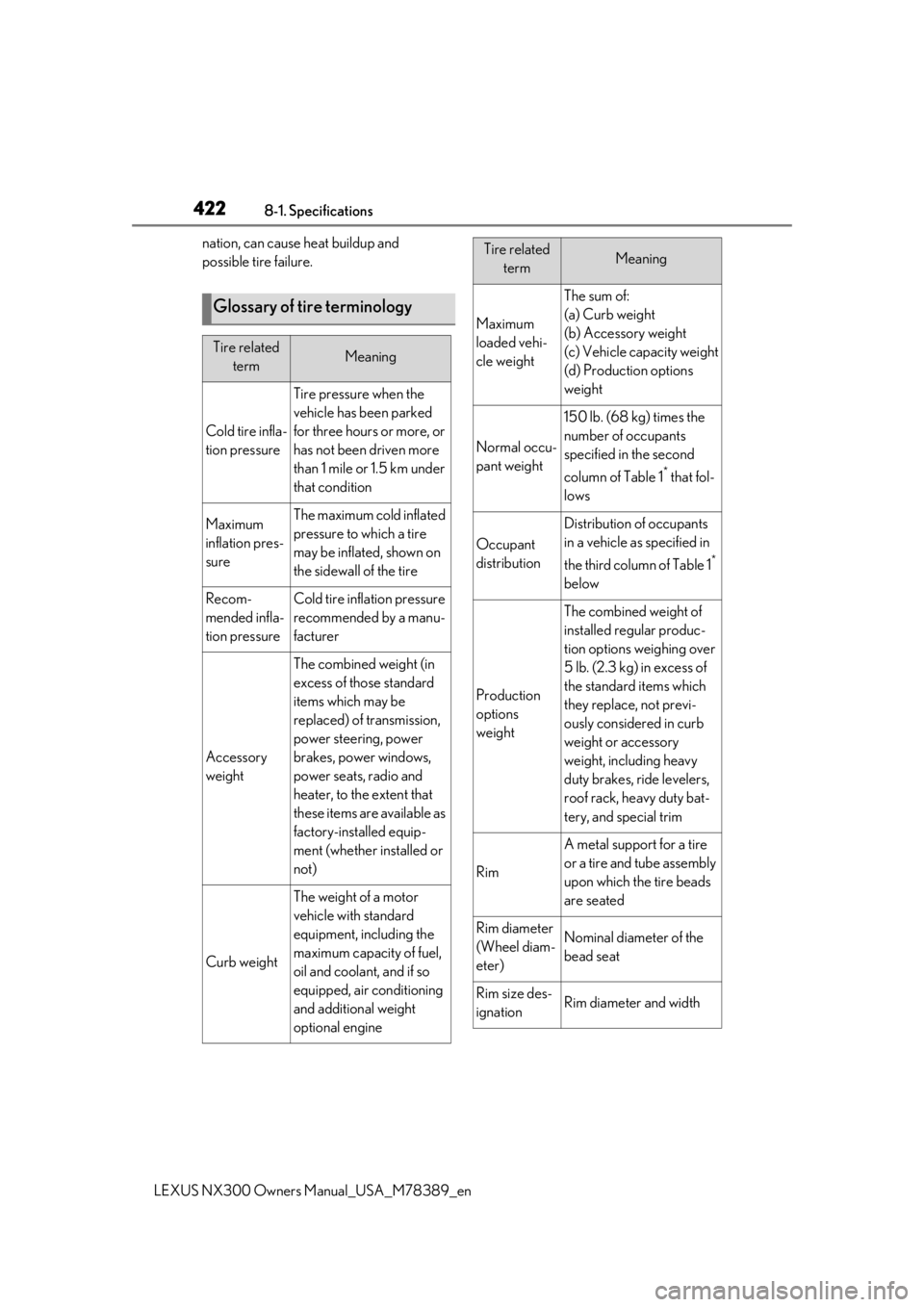
Glossary of tire terminology
Tire related
termMeaning
Cold tire infla-
tion pressure
Tire pressure when the
vehicle has been parked
for three hours or more, or
has not been driven more
than 1 mile or 1.5 km under
that condition
Maximum
inflation pres-
sureThe maximum cold inflated
pressure to which a tire
may be inflated, shown on
the sidewall of the tire
Recom-
mended infla-
tion pressureCold tire inflation pressure
recommended by a manu-
facturer
Accessory
weight
The combined weight (in
excess of thos e standard
items which may be
replaced) of transmission,
power steering, power
brakes, power windows,
power seats, radio and
heater, to the extent that
these items are available as
factory-installed equip-
ment (whether installed or
not)
Curb weight
The weight of a motor
vehicle with standard
equipment, including the
maximum capacity of fuel,
oil and coolant, and if so
equipped, air conditioning
and additional weight
optional engine
Maximum
loaded vehi-
cle weight
The sum of:
(a) Curb weight
(b) Accessory weight
(c) Vehicle capacity weight
(d) Production options
weight
Normal occu-
pant weight
150 lb. (68 kg) times the
number of occupants
specified in the second
column of Table 1
* that fol-
lows
Occupant
distribution
Distribution of occupants
in a vehicle as specified in
the third column of Table 1
*
below
Production
options
weight
The combined weight of
installed regu lar produc-
tion options weighing over
5 lb. (2.3 kg) in excess of
the standard items which
they replace, not previ-
ously considered in curb
weight or accessory
weight, including heavy
duty brakes, ride levelers,
roof rack, heavy duty bat-
tery, and special trim
Rim
A metal support for a tire
or a tire and tube assembly
upon which the tire beads
are seated
Rim diameter
(Wheel diam-
eter)Nominal diameter of the
bead seat
Rim size des-
ignationRim diameter and width
Tire related termMeaning
Page 423 of 468
4238-1. Specifications
LEXUS NX300 Owners Manual_USA_M78389_en
8
Vehicle specifications
Rim type des-
ignationThe industry manufac-
turer’s designation for a
rim by style or code
Rim widthNominal distance between
rim flanges
Vehicle
capacity
weight
(Total load
capacity)The rated cargo and lug-
gage load plus 150 lb. (68
kg) times the vehicle’s des-
ignated seating capacity
Vehicle maxi-
mum load on
the tire
The load on an individual
tire that is determined by
distributing to each axle its
share of the maximum
loaded vehicle weight, and
dividing by two
Vehicle nor-
mal load on
the tire
The load on an individual
tire that is determined by
distributing to each axle its
share of curb weight,
accessory weight, and nor-
mal occupant weight (dis-
tributed in accordance
with Table 1
* below), and
dividing by two
Weather side
The surface area of the rim
not covered by the inflated
tire
Bead
The part of the tire that is
made of steel wires,
wrapped or reinforced by
ply cords and that is
shaped to fit the rim
Bead separa-
tionA breakdown of the bond
between components in
the bead
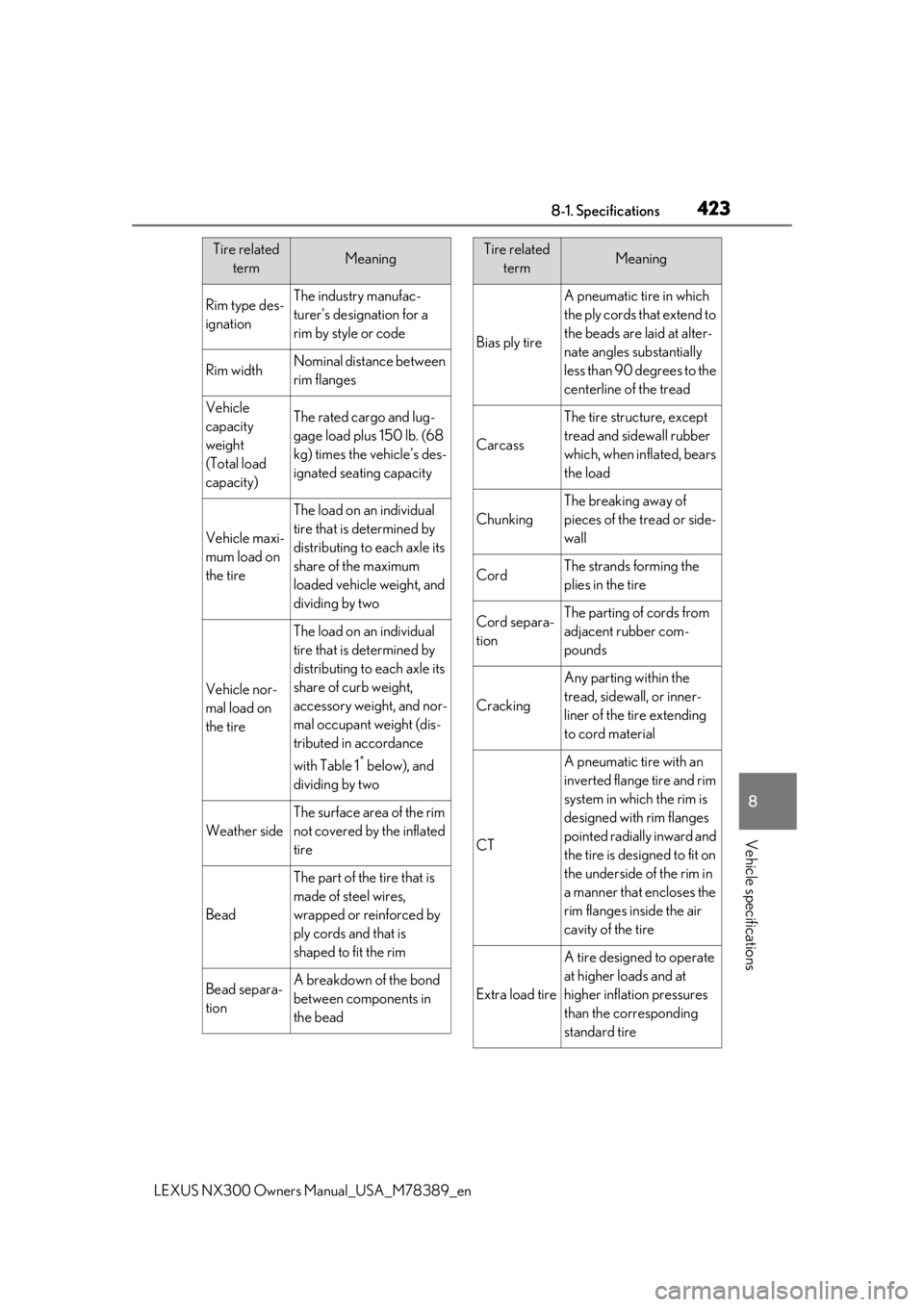
Tire related termMeaning
Bias ply tire
A pneumatic tire in which
the ply cords that extend to
the beads are laid at alter-
nate angles substantially
less than 90 degrees to the
centerline of the tread
Carcass
The tire structure, except
tread and sidewall rubber
which, when inflated, bears
the load
Chunking
The breaking away of
pieces of the tread or side-
wall
CordThe strands forming the
plies in the tire
Cord separa-
tionThe parting of cords from
adjacent rubber com-
pounds
Cracking
Any parting within the
tread, sidewall, or inner-
liner of the tire extending
to cord material
CT
A pneumatic tire with an
inverted flange tire and rim
system in which the rim is
designed with rim flanges
pointed radially inward and
the tire is designed to fit on
the underside of the rim in
a manner that encloses the
rim flanges inside the air
cavity of the tire
Extra load tire
A tire designed to operate
at higher loads and at
higher inflation pressures
than the corresponding
standard tire
Tire related termMeaning
Page 424 of 468
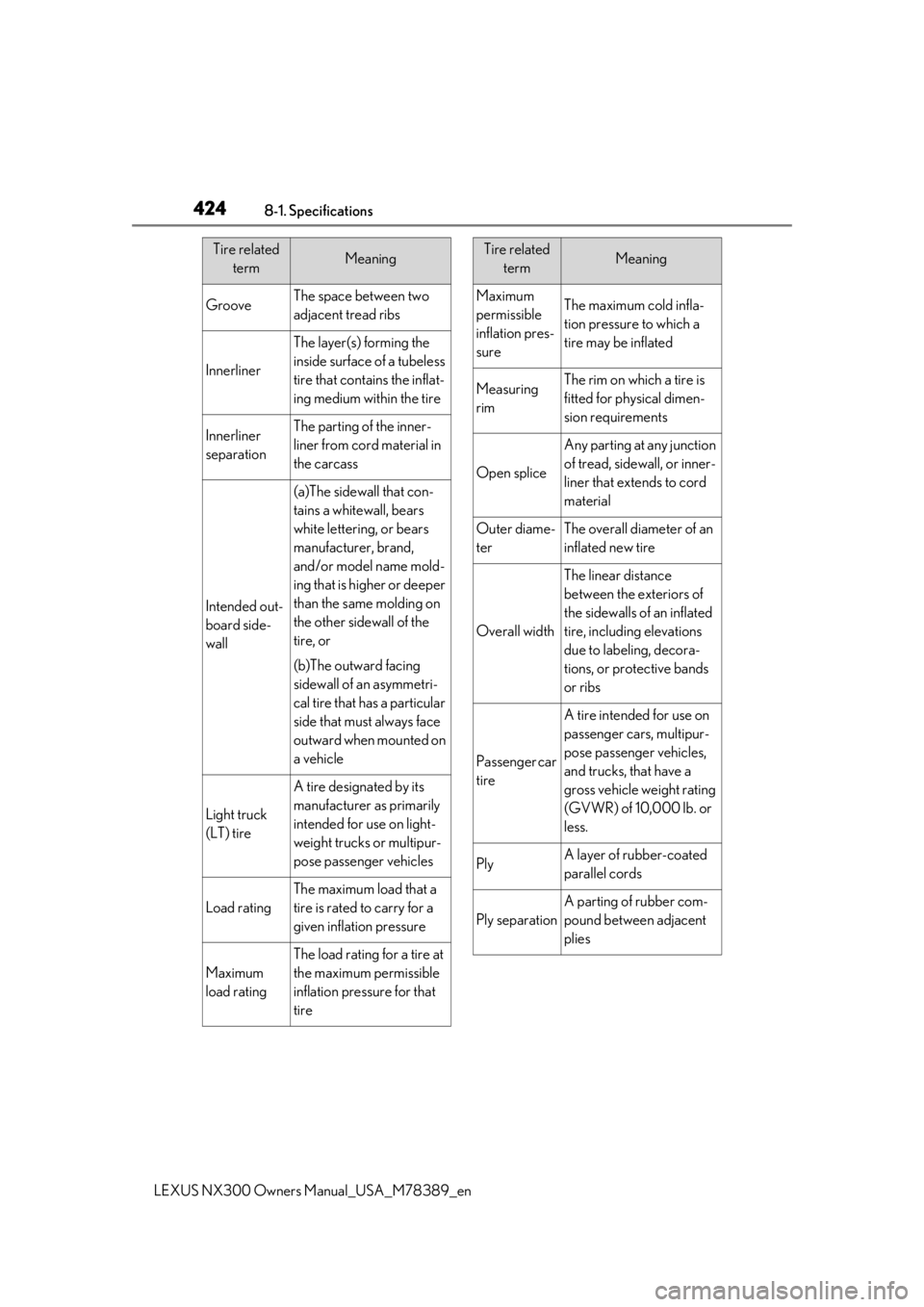
4248-1. Specifications
LEXUS NX300 Owners Manual_USA_M78389_en
GrooveThe space between two
adjacent tread ribs
Innerliner
The layer(s) forming the
inside surface of a tubeless
tire that contains the inflat-
ing medium within the tire
Innerliner
separationThe parting of the inner-
liner from cord material in
the carcass
Intended out-
board side-
wall
(a)The sidewall that con-
tains a whitewall, bears
white lettering, or bears
manufacturer, brand,
and/or model name mold-
ing that is higher or deeper
than the same molding on
the other sidewall of the
tire, or
(b)The outward facing
sidewall of an asymmetri-
cal tire that has a particular
side that must always face
outward when mounted on
a vehicle
Light truck
(LT) tire
A tire designated by its
manufacturer as primarily
intended for use on light-
weight trucks or multipur-
pose passenger vehicles
Load rating
The maximum load that a
tire is rated to carry for a
given inflation pressure
Maximum
load rating
The load rating for a tire at
the maximum permissible
inflation pressure for that
tire
Tire related
termMeaning
Maximum
permissible
inflation pres-
sureThe maximum cold infla-
tion pressure to which a
tire may be inflated
Measuring
rimThe rim on which a tire is
fitted for physical dimen-
sion requirements
Open splice
Any parting at any junction
of tread, sidewall, or inner-
liner that extends to cord
material
Outer diame-
terThe overall diameter of an
inflated new tire
Overall width
The linear distance
between the exteriors of
the sidewalls of an inflated
tire, including elevations
due to labeling, decora-
tions, or protective bands
or ribs
Passenger car
tire
A tire intended for use on
passenger cars, multipur-
pose passenger vehicles,
and trucks, that have a
gross vehicle weight rating
(GVWR) of 10,000 lb. or
less.
PlyA layer of rubber-coated
parallel cords
Ply separation
A parting of rubber com-
pound between adjacent
plies
Tire related termMeaning