lights LEXUS NX300 2020 Owner's Manual
[x] Cancel search | Manufacturer: LEXUS, Model Year: 2020, Model line: NX300, Model: LEXUS NX300 2020Pages: 468, PDF Size: 10.24 MB
Page 134 of 468

1343-4. Adjusting the steering wheel and mirrors
LEXUS NX300 Owners Manual_USA_M78389_en
To sound the horn, press on or close to
the mark. The height of the rear view mirror can
be adjusted to suit your driving pos-
ture.
Adjust the height of the rear view mir-
ror by moving it up and down.
Responding to the level of brightness
of the headlights of vehicles behind, the
reflected light is automatically
reduced.
Type A
Changing automatic anti-glare func-
tion mode on/off
WARNING
■Caution while driving
Do not adjust the steering wheel while
driving.
Doing so may cause the driver to mis-
handle the vehicle and cause an acci-
dent, resulting in death or serious injury.
■After adjusting the steering wheel
(manual type)
Make sure that the steering wheel is
securely locked.
Otherwise, the steering wheel may move
suddenly, possibly causing an accident,
resulting in death or serious injury.
Sounding the horn
Inside rear view mirror
The rear view mirror’s position can
be adjusted to enable sufficient
confirmation of the rear view.
Adjusting the heig ht of rear view
mirror
WARNING
■Caution while driving
Do not adjust the position of the mirror
while driving.
Doing so may lead to mishandling of the
vehicle and cause an accident, resulting
in death or serious injury.
Anti-glare function
Page 145 of 468
145
LEXUS NX300 Owners Manual_USA_M78389_en
4
4
Driving
Driving
4-1. Before driving
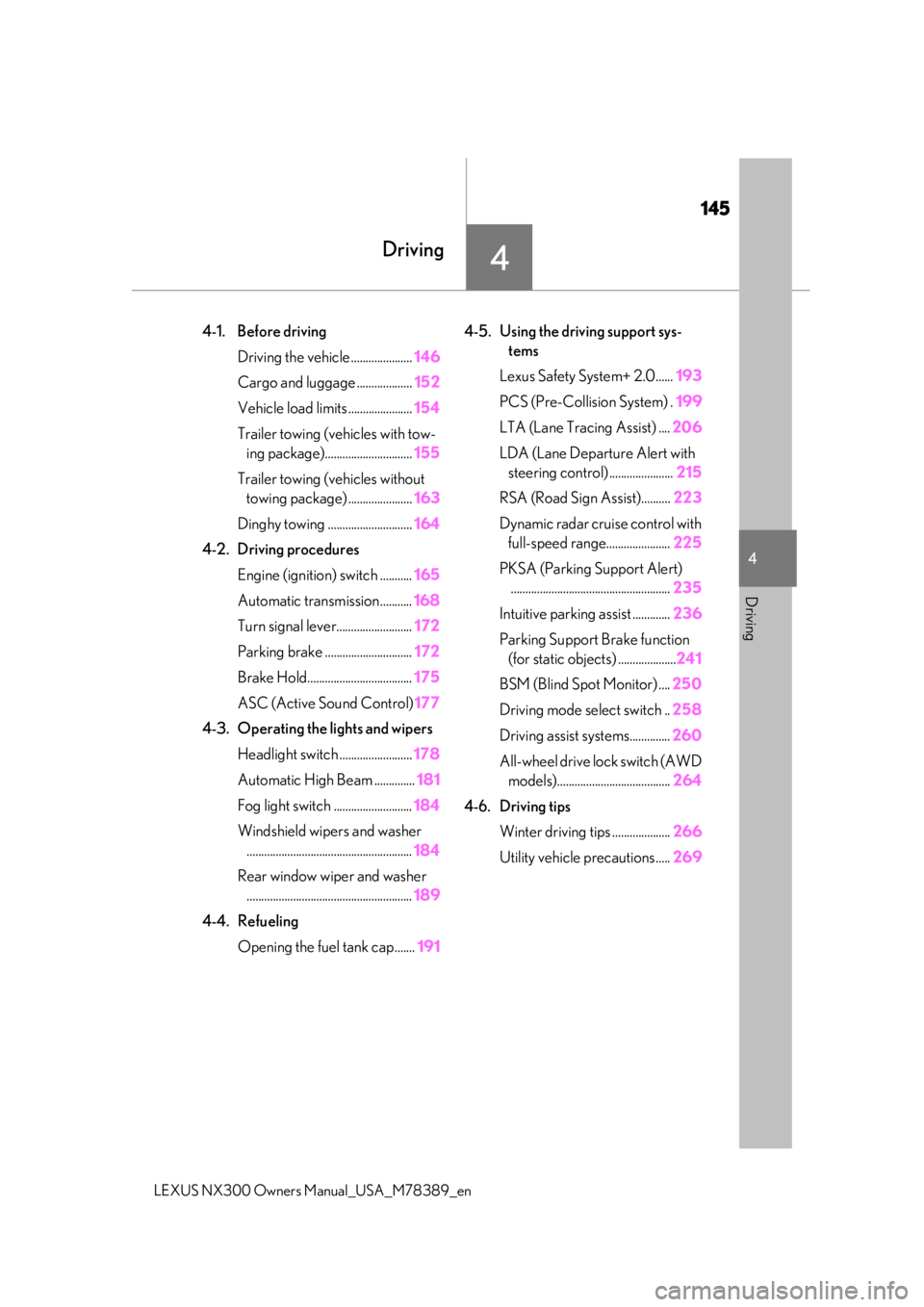
Driving the vehicle ..................... 146
Cargo and luggage ................... 152
Vehicle load limits ...................... 154
Trailer towing (vehicles with tow- ing package).............................. 155
Trailer towing (vehicles without towing package) ...................... 163
Dinghy towing ............................. 164
4-2. Driving procedures Engine (ignition) switch ........... 165
Automatic transmission........... 168
Turn signal lever.......................... 172
Parking brake .............................. 172
Brake Hold.................................... 175
ASC (Active Sound Control) 177
4-3. Operating the lights and wipers Headlight switch ......................... 178
Automatic High Beam .............. 181
Fog light switch ........................... 184
Windshield wipers and washer ......................................................... 184
Rear window wiper and washer ......................................................... 189
4-4. Refueling Opening the fuel tank cap....... 1914-5. Using the driving support sys-
tems
Lexus Safety System+ 2.0...... 193
PCS (Pre-Collision System) . 199
LTA (Lane Tracing Assist) .... 206
LDA (Lane Departure Alert with steering control) ...................... 215
RSA (Road Sign Assist).......... 223
Dynamic radar cruise control with full-speed range...................... 225
PKSA (Parking Support Alert) ....................................................... 235
Intuitive parking assist ............. 236
Parking Support Brake function (for static objects) .................... 241
BSM (Blind Spot Monitor) .... 250
Driving mode select switch .. 258
Driving assist systems.............. 260
All-wheel drive lock switch (AWD models)....................................... 264
4-6. Driving tips Winter driving tips .................... 266
Utility vehicle precautions..... 269
Page 156 of 468
1564-1. Before driving
LEXUS NX300 Owners Manual_USA_M78389_en
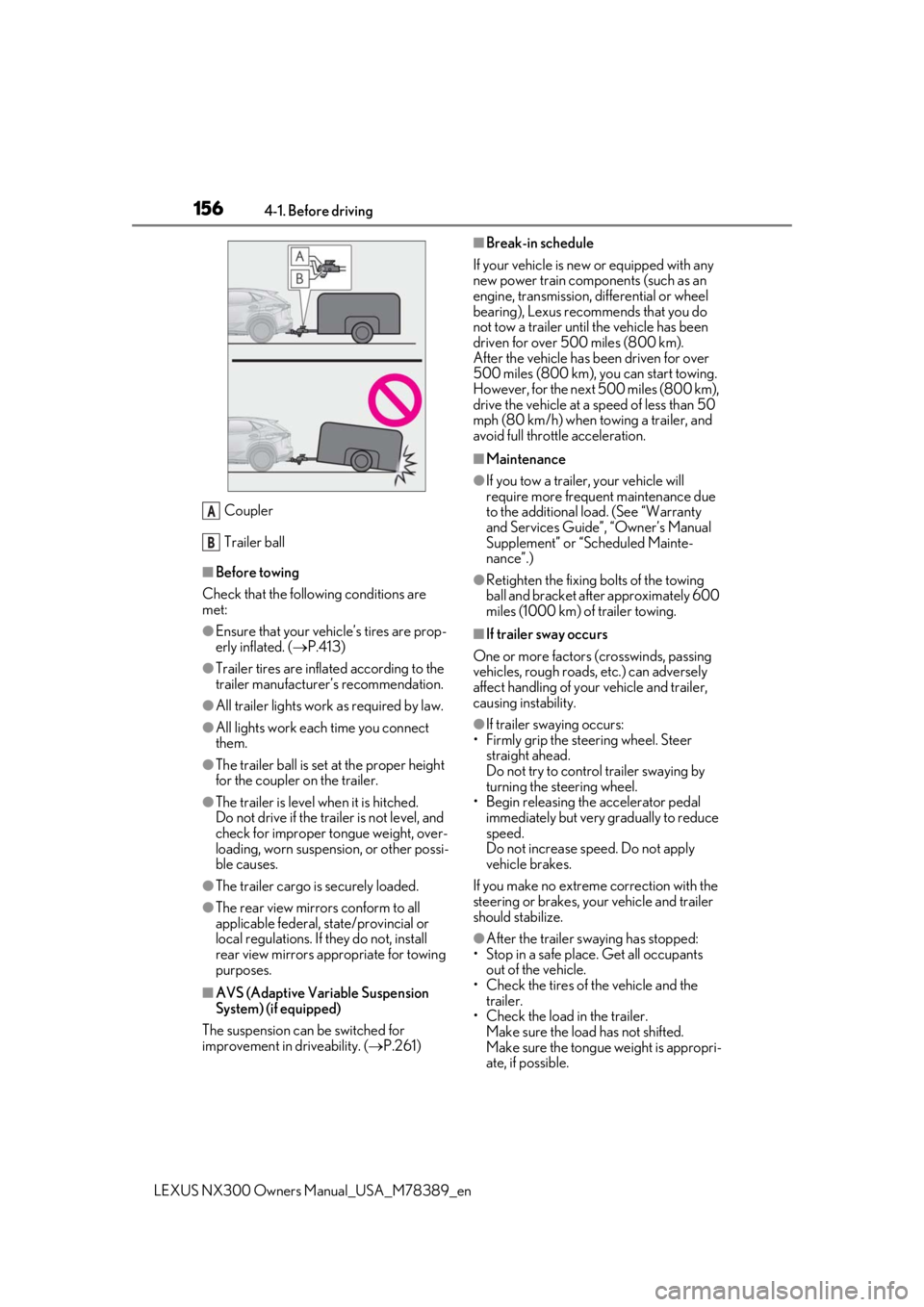
Coupler
Trailer ball
■Before towing
Check that the following conditions are
met:
●Ensure that your vehicle’s tires are prop-
erly inflated. ( P.413)
●Trailer tires are inflated according to the
trailer manufacturer’s recommendation.
●All trailer lights work as required by law.
●All lights work each time you connect
them.
●The trailer ball is set at the proper height
for the coupler on the trailer.
●The trailer is level when it is hitched.
Do not drive if the trailer is not level, and
check for improper tongue weight, over-
loading, worn suspension, or other possi-
ble causes.
●The trailer cargo is securely loaded.
●The rear view mirrors conform to all
applicable federal, state/provincial or
local regulations. If they do not, install
rear view mirrors appropriate for towing
purposes.
■AVS (Adaptive Variable Suspension
System) (if equipped)
The suspension can be switched for
improvement in driveability. ( P.261)
■Break-in schedule
If your vehicle is new or equipped with any
new power train components (such as an
engine, transmission, differential or wheel
bearing), Lexus recommends that you do
not tow a trailer until the vehicle has been
driven for over 500 miles (800 km).
After the vehicle has been driven for over
500 miles (800 km), you can start towing.
However, for the next 500 miles (800 km),
drive the vehicle at a speed of less than 50
mph (80 km/h) when towing a trailer, and
avoid full throttle acceleration.
■Maintenance
●If you tow a trailer, your vehicle will
require more frequent maintenance due
to the additional load. (See “Warranty
and Services Guide”, “Owner’s Manual
Supplement” or “Scheduled Mainte-
nance”.)
●Retighten the fixing bolts of the towing
ball and bracket after approximately 600
miles (1000 km) of trailer towing.
■If trailer sway occurs
One or more factors (crosswinds, passing
vehicles, rough roads, etc.) can adversely
affect handling of your vehicle and trailer,
causing instability.
●If trailer swaying occurs:
• Firmly grip the steering wheel. Steer
straight ahead.
Do not try to control trailer swaying by
turning the steering wheel.
• Begin releasing th e accelerator pedal
immediately but very gradually to reduce
speed.
Do not increase speed. Do not apply
vehicle brakes.
If you make no extreme correction with the
steering or brakes, your vehicle and trailer
should stabilize.
●After the trailer swaying has stopped:
• Stop in a safe place. Get all occupants out of the vehicle.
• Check the tires of the vehicle and the trailer.
• Check the load in the trailer.
Make sure the load has not shifted.
Make sure the tongue weight is appropri-
ate, if possible.
A
B
Page 158 of 468
1584-1. Before driving
LEXUS NX300 Owners Manual_USA_M78389_en
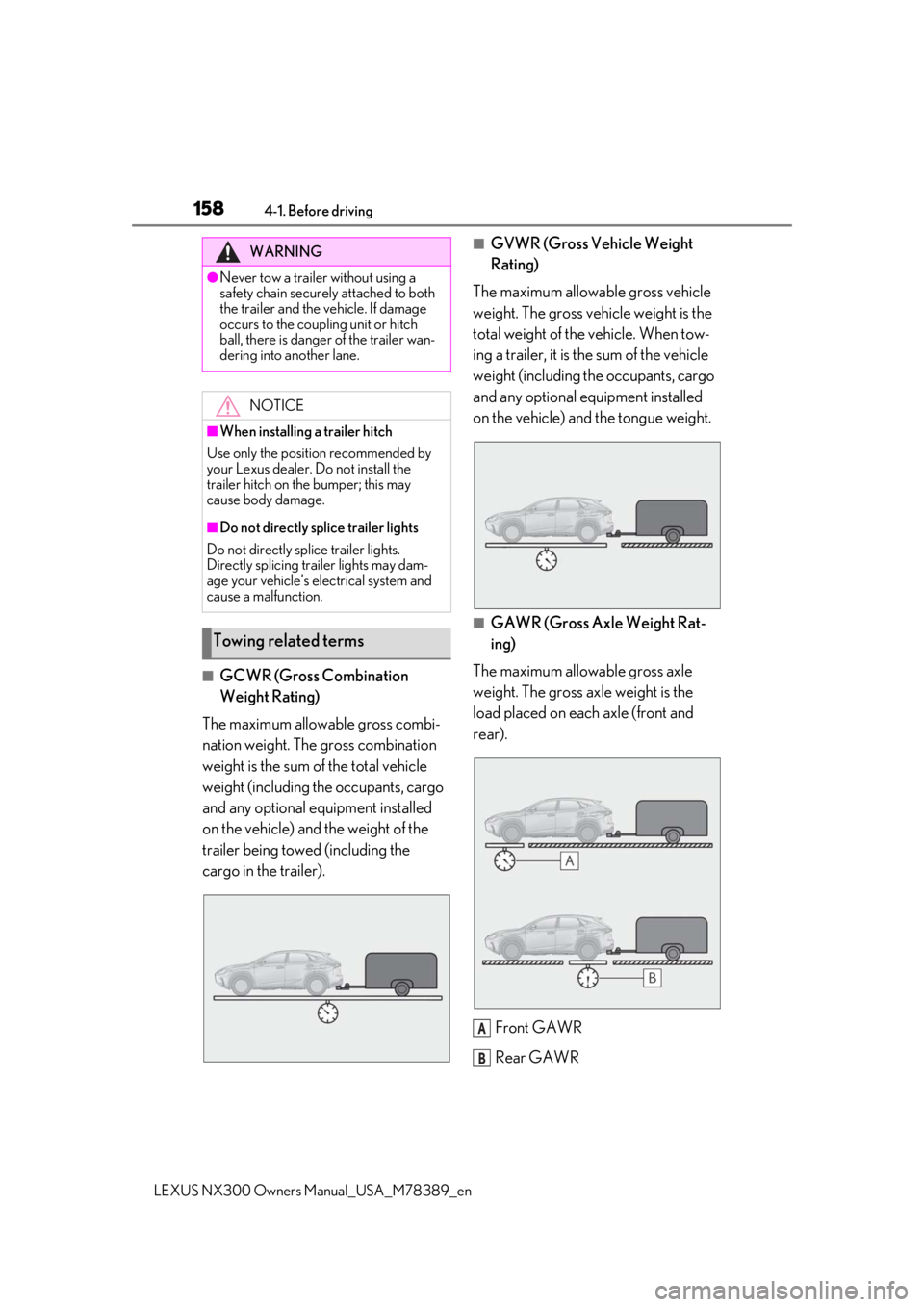
■GCWR (Gross Combination
Weight Rating)
The maximum allowable gross combi-
nation weight. The gross combination
weight is the sum of the total vehicle
weight (including the occupants, cargo
and any optional equipment installed
on the vehicle) and the weight of the
trailer being towed (including the
cargo in the trailer).
■GVWR (Gross Vehicle Weight
Rating)
The maximum allowable gross vehicle
weight. The gross vehicle weight is the
total weight of the vehicle. When tow-
ing a trailer, it is the sum of the vehicle
weight (including the occupants, cargo
and any optional equipment installed
on the vehicle) and the tongue weight.
■GAWR (Gross Axle Weight Rat-
ing)
The maximum allowable gross axle
weight. The gross axle weight is the
load placed on each axle (front and
rear).
Front GAWR
Rear GAWR
WARNING
●Never tow a trailer without using a
safety chain securely attached to both
the trailer and the vehicle. If damage
occurs to the coupling unit or hitch
ball, there is danger of the trailer wan-
dering into another lane. NOTICE
■When installing a trailer hitch
Use only the position recommended by
your Lexus dealer. Do not install the
trailer hitch on the bumper; this may
cause body damage.
■Do not directly splice trailer lights
Do not directly splice trailer lights.
Directly splicing trailer lights may dam-
age your vehicle’s electrical system and
cause a malfunction.
Towing related terms
A
B
Page 161 of 468
1614-1. Before driving
LEXUS NX300 Owners Manual_USA_M78389_en
4
Driving
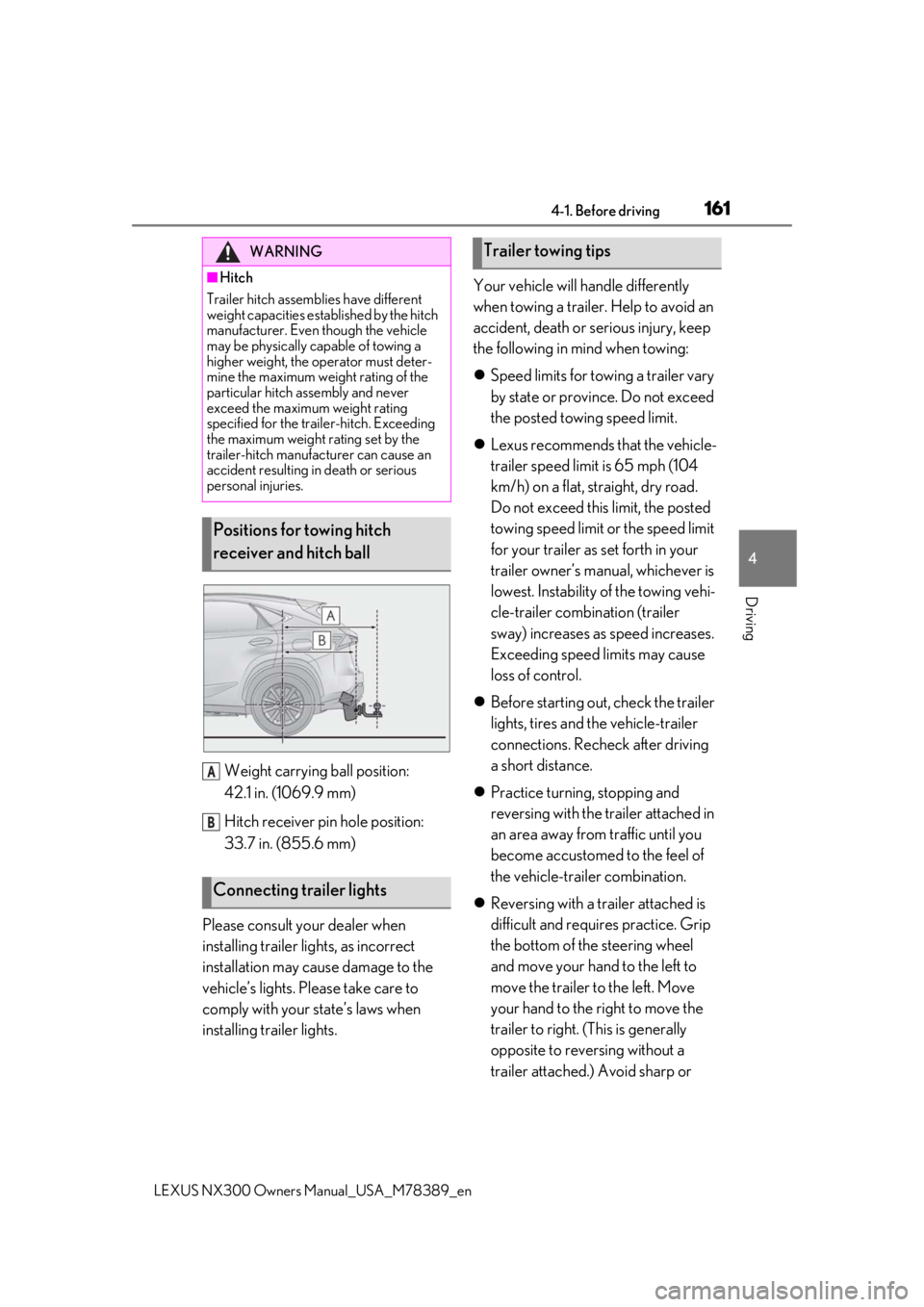
Weight carrying ball position:
42.1 in. (1069.9 mm)
Hitch receiver pin hole position:
33.7 in. (855.6 mm)
Please consult your dealer when
installing trailer lights, as incorrect
installation may cause damage to the
vehicle’s lights. Please take care to
comply with your state’s laws when
installing trailer lights. Your vehicle will handle differently
when towing a trailer. Help to avoid an
accident, death or serious injury, keep
the following in mind when towing:
Speed limits for towing a trailer vary
by state or province. Do not exceed
the posted towing speed limit.
Lexus recommends that the vehicle-
trailer speed limit is 65 mph (104
km/h) on a flat, straight, dry road.
Do not exceed this limit, the posted
towing speed limit or the speed limit
for your trailer as set forth in your
trailer owner’s manual, whichever is
lowest. Instability of the towing vehi-
cle-trailer combination (trailer
sway) increases as speed increases.
Exceeding speed limits may cause
loss of control.
Before starting out, check the trailer
lights, tires and the vehicle-trailer
connections. Recheck after driving
a short distance.
Practice turning, stopping and
reversing with the trailer attached in
an area away from traffic until you
become accustomed to the feel of
the vehicle-trailer combination.
Reversing with a trailer attached is
difficult and requires practice. Grip
the bottom of the steering wheel
and move your hand to the left to
move the trailer to the left. Move
your hand to the right to move the
trailer to right. (This is generally
opposite to reversing without a
trailer attached.) Avoid sharp or
WARNING
■Hitch
Trailer hitch assemb lies have different
weight capacities established by the hitch
manufacturer. Even though the vehicle
may be physically capable of towing a
higher weight, the operator must deter-
mine the maximum weight rating of the
particular hitch assembly and never
exceed the maximum weight rating
specified for the trailer-hitch. Exceeding
the maximum weight rating set by the
trailer-hitch manufacturer can cause an
accident resulting in death or serious
personal injuries.
Positions for towing hitch
receiver and hitch ball
Connecting trailer lights
A
B
Trailer towing tips
Page 172 of 468

1724-2. Driving procedures
LEXUS NX300 Owners Manual_USA_M78389_en
1Right turn
2 Lane change to the right (move the
lever partway and release it)
The right hand signals will flash 3
times.
3 Lane change to the left (move the
lever partway and release it)
The left hand signals will flash 3
times.
4 Left turn
■Turn signals can be operated when
The engine switch is in IGNITION ON
mode.
■If the indicator flashes faster than usual
Check that a light bulb in the front or rear
turn signal lights has not burned out.
■Customization
P.427
■Turns automatic mode on
While the vehicle is stopped, pull and
hold the parking brake switch until the
automatic mode lamp turns on.
Parking brake indicator (U.S.A.)
Parking brake indicator (Canada)
Parking brake lamp
Automatic mode lamp
Turn signal lever
Operating instructions
Parking brake
The parking brake can be set or
released automatically or manually.
In automatic mode, the parking
brake can be set or released auto-
matically according to shift lever
operation. Also, even in automatic
mode, the parking brake can be set
or released manually.
Operating instructions
A
B
C
D
Page 178 of 468
1784-3. Operating the lights and wipers
LEXUS NX300 Owners Manual_USA_M78389_en
4-3.Operating the lights and wipers
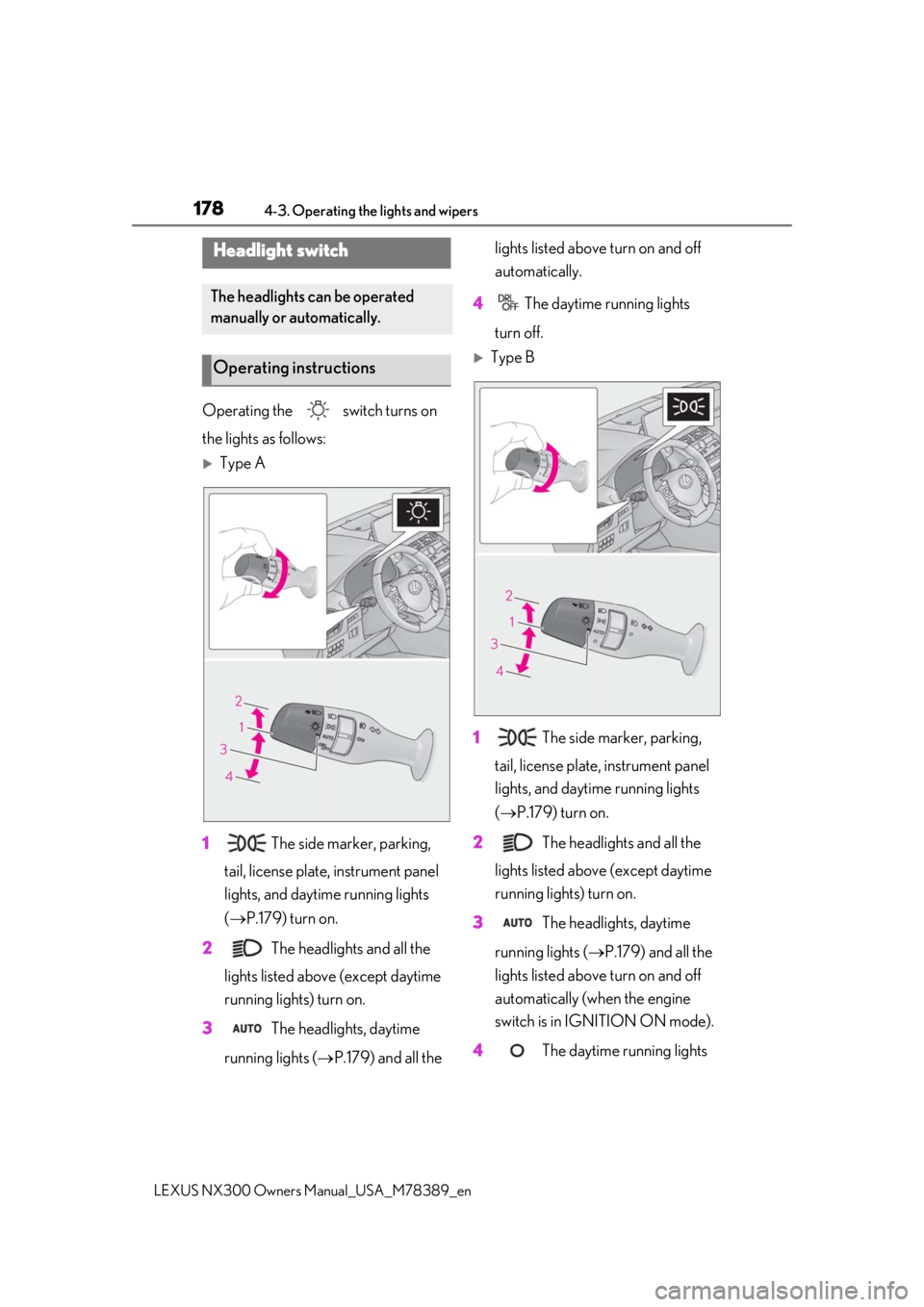
Operating the switch turns on
the lights as follows:
Type A
1 The side marker, parking,
tail, license plate, instrument panel
lights, and daytime running lights
( P.179) turn on.
2 The headlights and all the
lights listed above (except daytime
running lights) turn on.
3 The headlights, daytime
running lights ( P.179) and all the lights listed above turn on and off
automatically.
4 The daytime running lights
turn off.
Type B
1 The side marker, parking,
tail, license plate, instrument panel
lights, and daytime running lights
( P.179) turn on.
2 The headlights and all the
lights listed above (except daytime
running lights) turn on.
3 The headlights, daytime
running lights ( P.179) and all the
lights listed above turn on and off
automatically (when the engine
switch is in IGNITION ON mode).
4 The daytime running lights
Headlight switch
The headlights can be operated
manually or automatically.
Operating instructions
Page 179 of 468

1794-3. Operating the lights and wipers
LEXUS NX300 Owners Manual_USA_M78389_en
4
Driving
turn on. (P.179)
■AUTO mode can be used when
The engine switch is in IGNITION ON
mode.
■Daytime running light system
●The daytime running lights illuminate
using the same lights as the parking lights
and illuminate brighter than the parking
lights.
●To make your vehicle more visible to
other drivers during daytime driving, the
daytime running lights turn on automati-
cally when all of the following conditions
are met. (The daytime running lights are
not designed for use at night.)
• The engine is running
• The parking brake is released
• The headlight switch is in the
(type B), or
* position
*: When the surroundings are bright
The daytime running lights remain on after
they illuminate, even if the parking brake is
set again.
●For the U.S.A.: Dayt ime running lights
can be turned off by operating the switch.
●Compared to turning on the headlights,
the daytime running light system offers
greater durability and consumes less
electricity, so it can help improve fuel
●If a turn signal light is in use, the daytime
running light, on the same side, is turned
off. For emergency flashers, both are
turned off.
■Headlight control sensor
The sensor may not function properly if an
object is placed on th e sensor, or anything
that blocks the sensor is affixed to the wind-
shield.
Doing so interferes with the sensor detect-
ing the level of ambient light and may cause
the automatic headlight system to malfunc-
tion.
■Automatic light off system
●When the headlights come on: The head-
lights and tail lights turn off 30 seconds
after a door is opened and closed if the
engine switch is turned to ACCESSORY
mode or turned off. (The lights turn off
immediately if on the key is
pressed after all the doors are locked.)
●When only the tail lights come on: The tail
lights turn off automatically if the engine
switch is turned to ACCESSORY mode
or turned off and the driver’s door is
opened.
To turn the lights on again, turn the engine
switch to IGNITION ON mode, or turn the
light switch off once and then back to or .
■Light reminder buzzer
A buzzer sounds when the engine switch is
turned off or turned to ACCESSORY
mode and the driver’s door is opened while
the lights are turned on.
■Automatic headlight leveling system (if
equipped)
The level of the headlights is automatically
adjusted according to the number of pas-
sengers and the loadin g condition of the
vehicle to ensure that the headlights do not
interfere with other road users.
■Battery-saving function
In order to prevent the battery of the vehicle
from discharging, if the headlights and/or
tail lights are on when the engine switch is
turned off the battery saving function will
operate and automatically turn off all the
lights after approximately 20 minutes.
When the engine switch is turned to IGNI-
TION ON mode, the battery-saving func-
Page 180 of 468
1804-3. Operating the lights and wipers
LEXUS NX300 Owners Manual_USA_M78389_en
tion will be disabled.
When any of the following are performed,
the battery-saving function is canceled
once and then reactivated. All the lights will
turn off automatically 20 minutes after the
battery-saving function has been reacti-
vated:
●When the headlight switch is operated
●When a door is opened or closed
■Customization
Settings (e.g. light sens or sensitivity) can be
changed. (Customizable features: P.427)
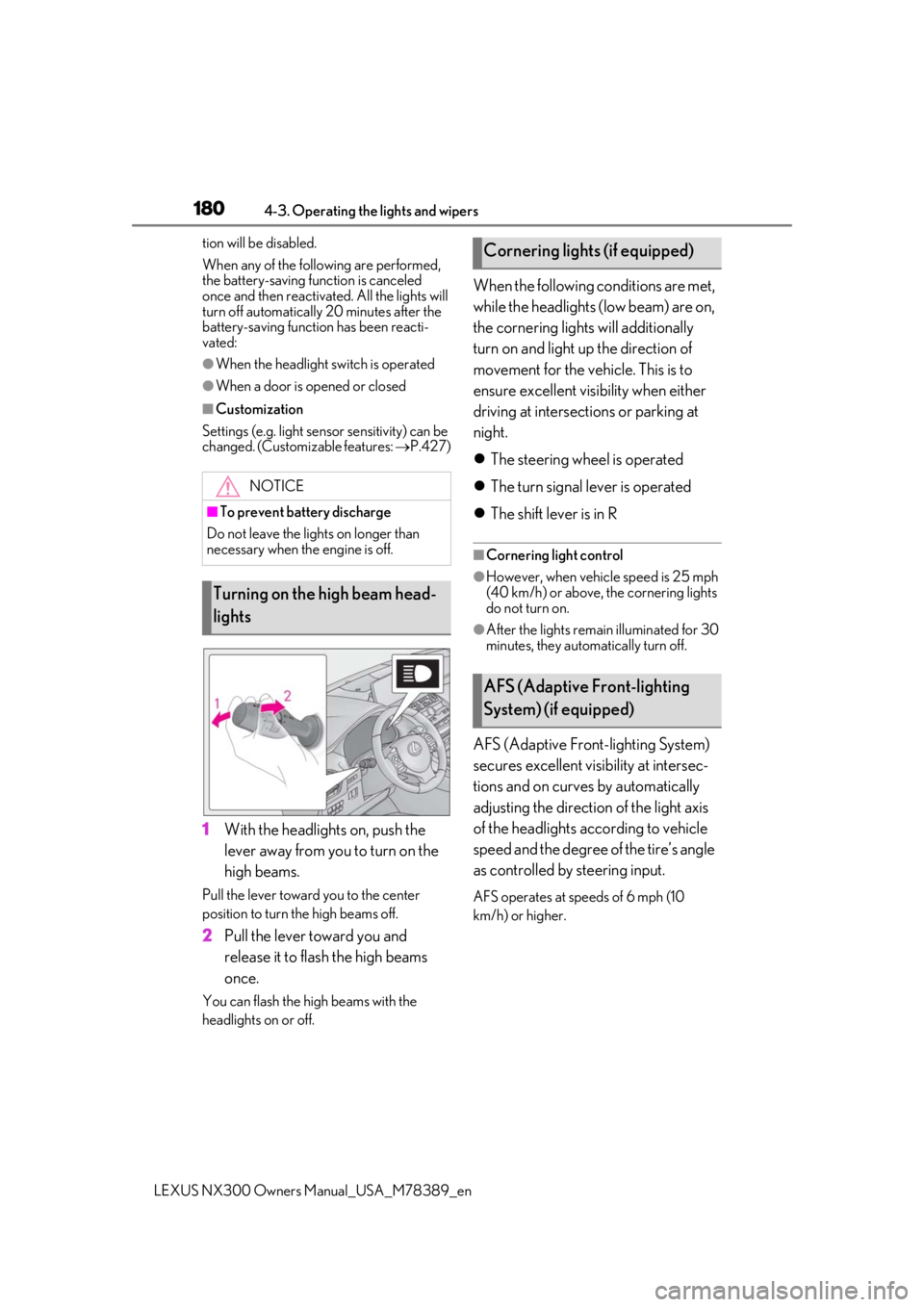
1With the headlights on, push the
lever away from you to turn on the
high beams.
Pull the lever toward you to the center
position to turn the high beams off.
2Pull the lever toward you and
release it to flash the high beams
once.
You can flash the high beams with the
headlights on or off.
When the following conditions are met,
while the headlights (low beam) are on,
the cornering lights will additionally
turn on and light up the direction of
movement for the vehicle. This is to
ensure excellent visibility when either
driving at intersections or parking at
night.
The steering wheel is operated
The turn signal lever is operated
The shift lever is in R
■Cornering light control
●However, when vehicle speed is 25 mph
(40 km/h) or above, the cornering lights
do not turn on.
●After the lights remain illuminated for 30
minutes, they automatically turn off.
AFS (Adaptive Front-lighting System)
secures excellent visibility at intersec-
tions and on curves by automatically
adjusting the direction of the light axis
of the headlights according to vehicle
speed and the degree of the tire’s angle
as controlled by steering input.
AFS operates at speeds of 6 mph (10
km/h) or higher.
NOTICE
■To prevent battery discharge
Do not leave the lights on longer than
necessary when the engine is off.
Turning on the high beam head-
lights
Cornering lights (if equipped)
AFS (Adaptive Front-lighting
System) (if equipped)
Page 181 of 468
1814-3. Operating the lights and wipers
LEXUS NX300 Owners Manual_USA_M78389_en
4
Driving
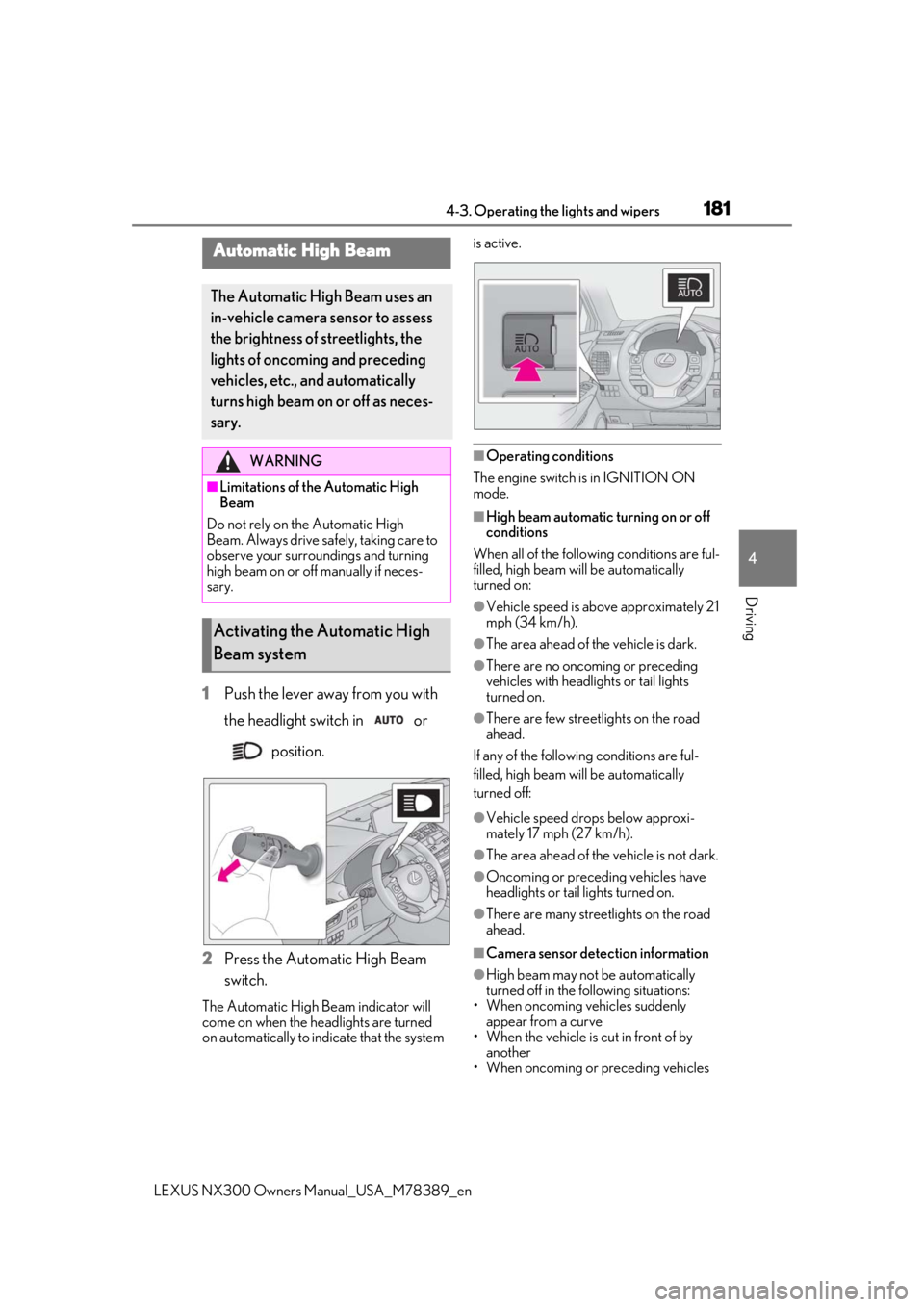
1Push the lever away from you with
the headlight switch in or
position.
2
Press the Automatic High Beam
switch.
The Automatic High Beam indicator will
come on when the headlights are turned
on automatically to indicate that the system is active.
■Operating conditions
The engine switch is in IGNITION ON
mode.
■High beam automatic turning on or off
conditions
When all of the following conditions are ful-
filled, high beam will be automatically
turned on:
●Vehicle speed is above approximately 21
mph (34 km/h).
●The area ahead of the vehicle is dark.
●There are no oncoming or preceding
vehicles with headlights or tail lights
turned on.
●There are few streetlights on the road
ahead.
If any of the following conditions are ful-
filled, high beam will be automatically
turned off:
●Vehicle speed drops below approxi-
mately 17 mph (27 km/h).
●The area ahead of the vehicle is not dark.
●Oncoming or preceding vehicles have
headlights or tail lights turned on.
●There are many streetlights on the road
ahead.
■Camera sensor detection information
●High beam may not be automatically
turned off in the following situations:
• When oncoming vehicles suddenly
appear from a curve
• When the vehicle is cut in front of by another
• When oncoming or preceding vehicles
Automatic High Beam
The Automatic High Beam uses an
in-vehicle camera sensor to assess
the brightness of streetlights, the
lights of oncoming and preceding
vehicles, etc., and automatically
turns high beam on or off as neces-
sary.
WARNING
■Limitations of the Automatic High
Beam
Do not rely on the Automatic High
Beam. Always drive sa fely, taking care to
observe your surroundings and turning
high beam on or off manually if neces-
sary.
Activating the Automatic High
Beam system