wheel LEXUS NX300h 2015 Owners Manual
[x] Cancel search | Manufacturer: LEXUS, Model Year: 2015, Model line: NX300h, Model: LEXUS NX300h 2015Pages: 681, PDF Size: 9.14 MB
Page 605 of 681
6058-2. Steps to take in an emergency
8
When trouble arises
NX300h_U_OM78007U WA R N I N G ■
When attempting to free a stuck vehicle
If you choose to push the vehicle back and forth to free it, make sure the surrounding
area is clear to avoid striking other vehicl es, objects or people. The vehicle may also
lunge forward or lunge back suddenly as it becomes free. Use extreme caution. ■
When shifting the shift lever
Be careful not to shift the shift lever with the accelerator pedal depressed.
This may lead to unexpected rapid accelerati on of the vehicle that may cause an acci-
dent resulting in death or serious injury.
NOTICE ■
To avoid damage to the hybrid transmission and other components ●
Avoid spinning the front wheels and depressing the accelerator pedal more than nec-
essary. ●
If the vehicle remains stuck even after th ese procedures are performed, the vehicle
may require towing to be freed.
Page 608 of 681
608 9-1. Specifications
NX300h_U_OM78007UMaintenance data (fuel, oil level, etc.)
* 1
: Unladen vehicle
* 2
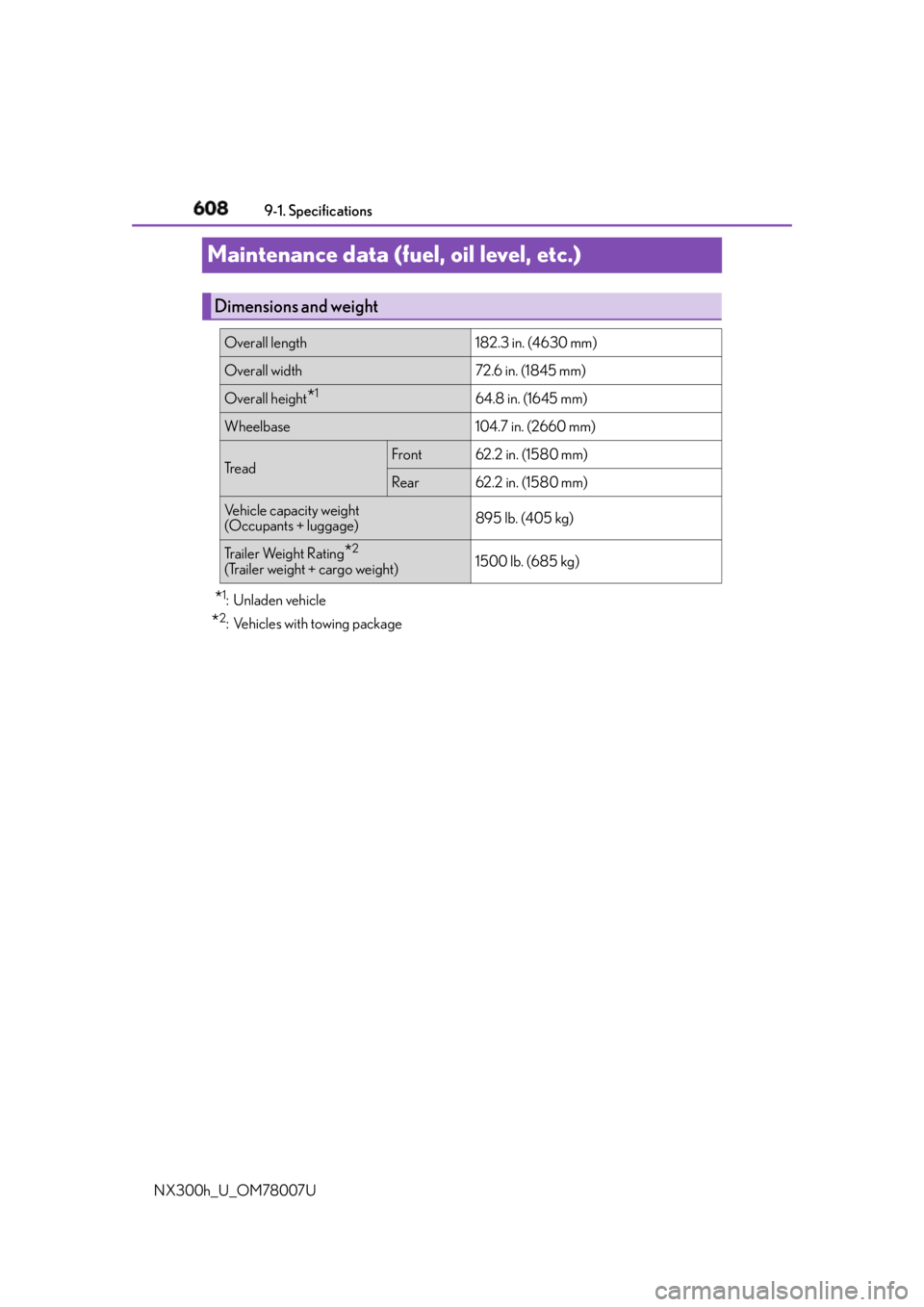
: Vehicles with towing packageDimensions and weight Overall length 182.3 in. (4630 mm)
Overall width 72.6 in. (1845 mm)
Overall height
* 1
64.8 in. (1645 mm)
Wheelbase 104.7 in. (2660 mm)
Tr e a d Front 62.2 in. (1580 mm)
Rear 62.2 in. (1580 mm)
Vehicle capacity weight
(Occupants + luggage) 895 lb. (405 kg)
Trailer Weight Rating
* 2
(Trailer weight + cargo weight) 1500 lb. (685 kg)
Page 615 of 681
6159-1. Specifications
9
Vehicle specifications
NX300h_U_OM78007U
Ty p e A
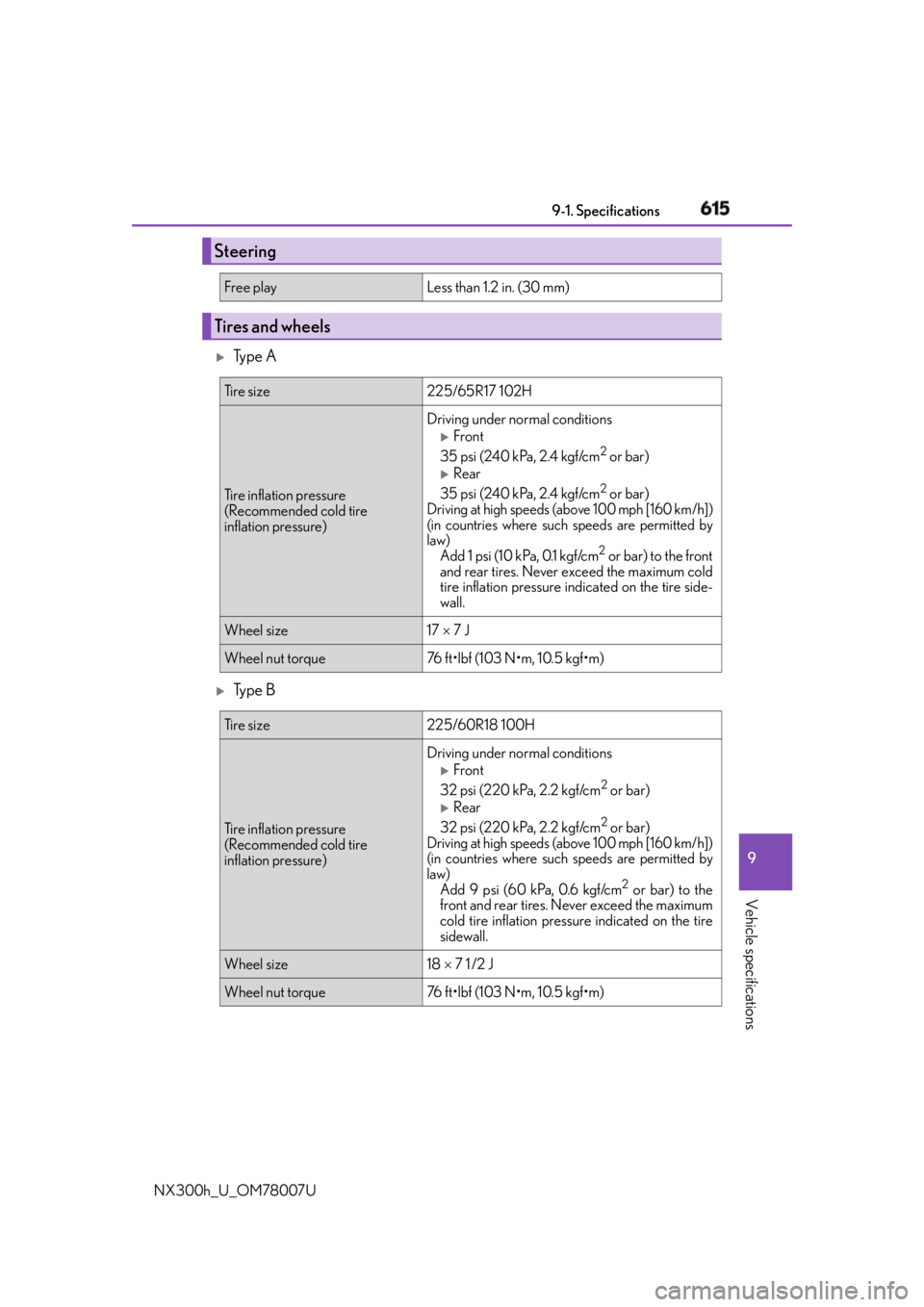
Ty p e BSteering Free play Less than 1.2 in. (30 mm)
Tires and wheels Ti r e s i z e 225/65R17 102H
Tire inflation pressure
(Recommended cold tire
inflation pressure) Driving under normal conditions
Front
35 psi (240 kPa, 2.4 kgf/cm 2
or bar)
Rear
35 psi (240 kPa, 2.4 kgf/cm 2
or bar)
Driving at high speeds (above 100 mph [160 km/h])
(in countries where such speeds are permitted by
law)
Add 1 psi (10 kPa, 0.1 kgf/cm 2
or bar) to the front
and rear tires. Never exceed the maximum cold
tire inflation pressure in dicated on the tire side-
wall.
Wheel size 17 7 J
Wheel nut torque 76 ft•lbf (103 N•m, 10.5 kgf•m)
Ti r e s i z e 225/60R18 100H
Tire inflation pressure
(Recommended cold tire
inflation pressure) Driving under normal conditions
Front
32 psi (220 kPa, 2.2 kgf/cm 2
or bar)
Rear
32 psi (220 kPa, 2.2 kgf/cm 2
or bar)
Driving at high speeds (above 100 mph [160 km/h])
(in countries where such speeds are permitted by
law)
Add 9 psi (60 kPa, 0.6 kgf/cm 2
or bar) to the
front and rear tires. Never exceed the maximum
cold tire inflation pressure indicated on the tire
sidewall.
Wheel size 18 7 1 /2 J
Wheel nut torque 76 ft•lbf (103 N•m, 10.5 kgf•m)
Page 616 of 681
616 9-1. Specifications
NX300h_U_OM78007U
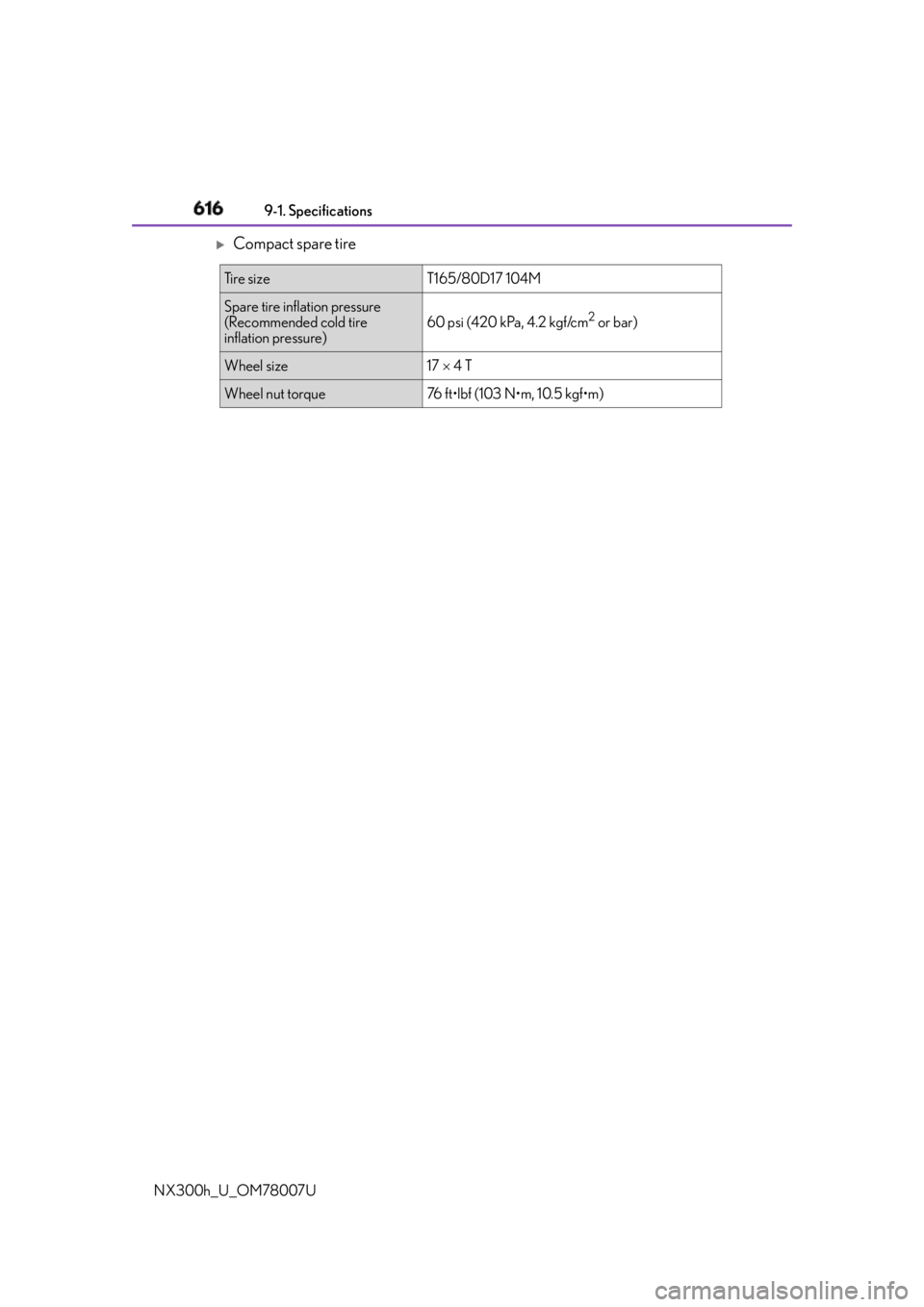
Compact spare tire Ti r e s i z e T165/80D17 104M
Spare tire inflation pressure
(Recommended cold tire
inflation pressure) 60 psi (420 kPa, 4.2 kgf/cm 2
or bar)
Wheel size 17 4 T
Wheel nut torque 76 f t •
lbf (103 N •
m, 10.5 kgf •
m)
Page 624 of 681
624 9-1. Specifications
NX300h_U_OM78007U ■
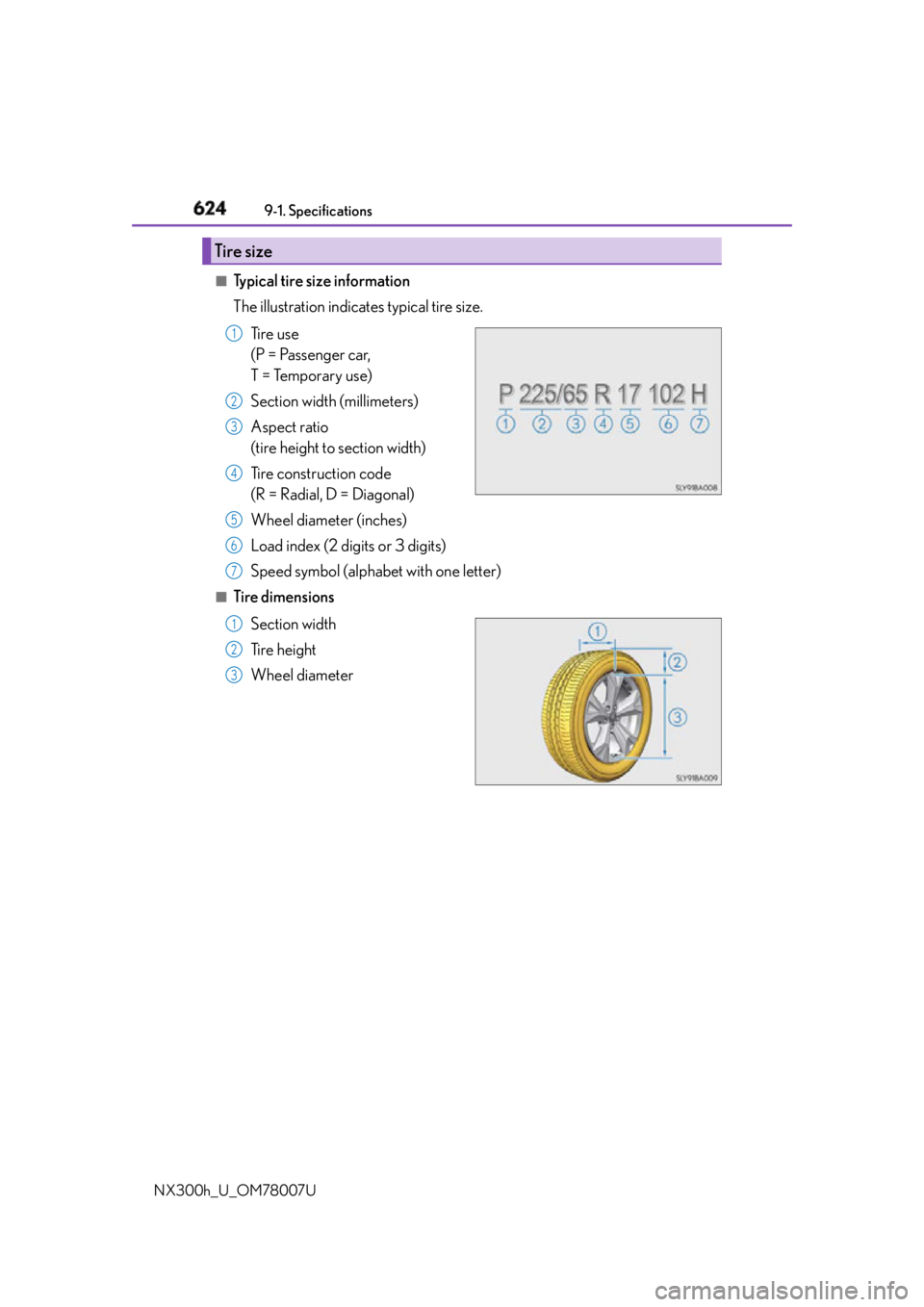
Typical tire size information
The illustration indicates typical tire size.
Ti r e u s e
(P = Passenger car,
T = Temporary use)
Section width (millimeters)
Aspect ratio
(tire height to section width)
Tire construction code
(R = Radial, D = Diagonal)
Wheel diameter (inches)
Load index (2 digits or 3 digits)
Speed symbol (alphabet with one letter)■
Tire dimensions
Section width
Tire height
Wheel diameterTire size 1
2
3
4
5
6
7
1
2
3
Page 626 of 681

626 9-1. Specifications
NX300h_U_OM78007U ■
Tr e a d w e a r
The treadwear grade is a comparative rati ng based on the wear rate of the tire
when tested under controlled conditions on a specified government test
course. For example, a tire graded 150 would wear one and a half (1 - 1 /2) times as well on
the government course as a tire graded 100.
The relative performance of tires depends upon the actual conditions of their use,
however, and may depart significantly from the norm due to variations in driving
habits, service practices and differences in road characteristics and climate.■
Tr a c t i o n A A , A , B , C
The traction grades, from highest to lowest, are AA, A, B and C, and they rep-
resent the tire’s ability to stop on we t pavement as measured under controlled
conditions on specified government te st surfaces of asphalt and concrete.A tire marked C may have poor traction performance.
Warning: The traction grade assigned to th is tire is based on braking (straight
ahead) traction tests and does not include cornering (turning) traction.■
Temperature A, B, C
The temperature grades are A (the highes t), B, and C, representing the tire’s
resistance to the generation of heat and its ability to dissipate heat when
tested under controlled conditions on a specified indoor laboratory test
wheel. Sustained high temperature can cause the material of the tire to degenerate and
reduce tire life, and excessive temperature can lead to sudden tire failure.
Grade C corresponds to a level of perfor mance which all passenger car tires must
meet under the Federal Motor Vehicle Safety Standard No. 109.
Grades B and A represent higher levels of performance on the laboratory test
wheel than the minimum required by law.
Warning: The temperature grades for this tire are established for a tire that is prop-
erly inflated and not overloaded.
Excessive speed, underinflation, or excessiv e loading, either separately or in com-
bination, can cause heat buildup and possible tire failure.
Page 628 of 681
628 9-1. Specifications
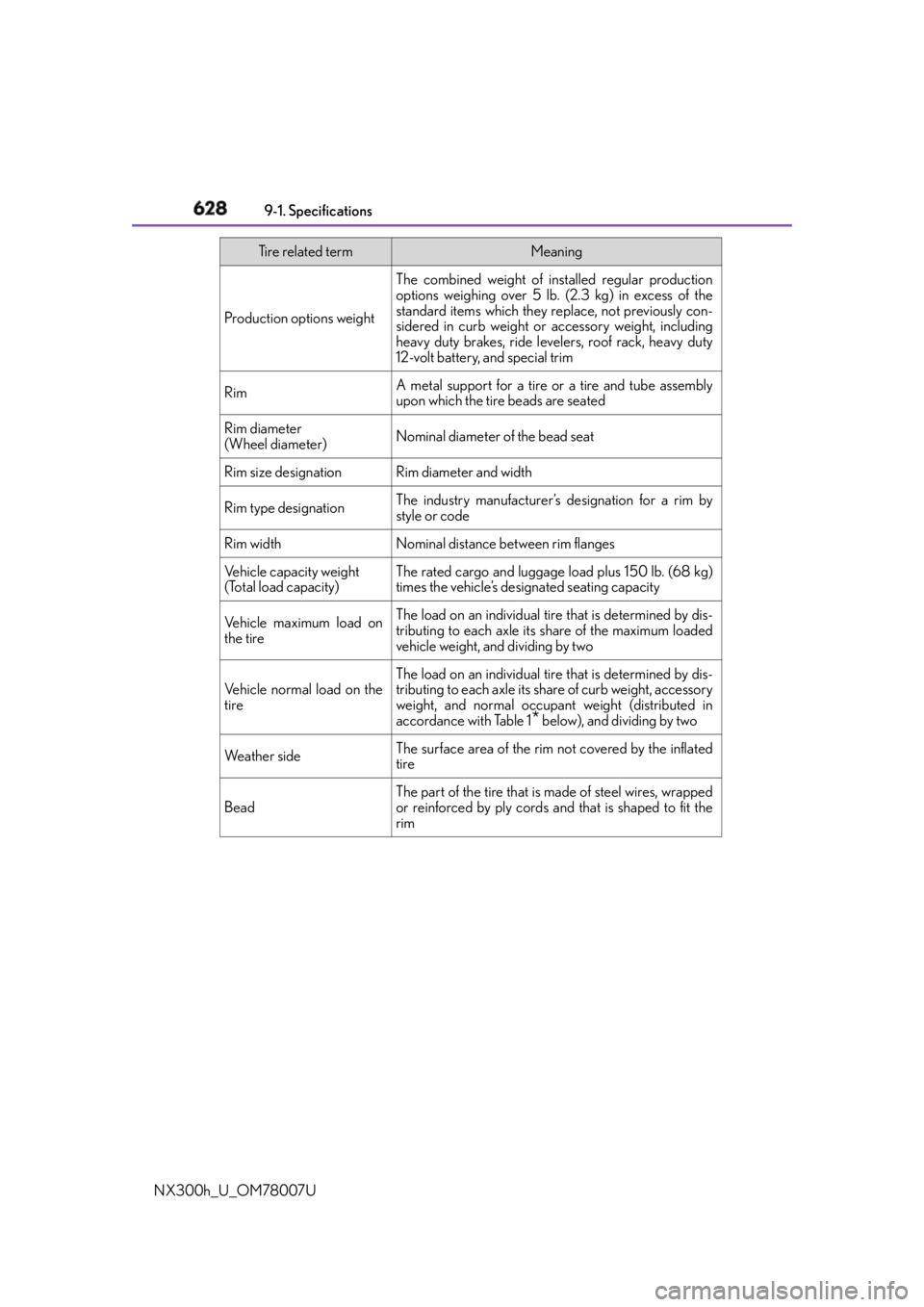
NX300h_U_OM78007U Production options weight The combined weight of installed regular production
options weighing over 5 lb. (2.3 kg) in excess of the
standard items which they replace, not previously con-
sidered in curb weight or accessory weight, including
heavy duty brakes, ride levelers, roof rack, heavy duty
12-volt battery, and special trim
Rim A metal support for a tire or a tire and tube assembly
upon which the tire beads are seated
Rim diameter
(Wheel diameter) Nominal diameter of the bead seat
Rim size designation Rim diameter and width
Rim type designation The industry manufacturer’s designation for a rim by
style or code
Rim width Nominal distance between rim flanges
Vehicle capacity weight
(Total load capacity) The rated cargo and luggage load plus 150 lb. (68 kg)
times the vehicle’s designated seating capacity
Vehicle maximum load on
the tire The load on an individual tire that is determined by dis-
tributing to each axle its share of the maximum loaded
vehicle weight, and dividing by two
Vehicle normal load on the
tire The load on an individual tire that is determined by dis-
tributing to each axle its sh are of curb weight, accessory
weight, and normal occupant weight (distributed in
accordance with Table 1
* below), and dividing by two
We a t h e r s i d e The surface area of the rim not covered by the inflated
tire
Bead The part of the tire that is made of steel wires, wrapped
or reinforced by ply cords and that is shaped to fit the
rimTire related term Meaning
Page 631 of 681
6319-1. Specifications
9
Vehicle specifications
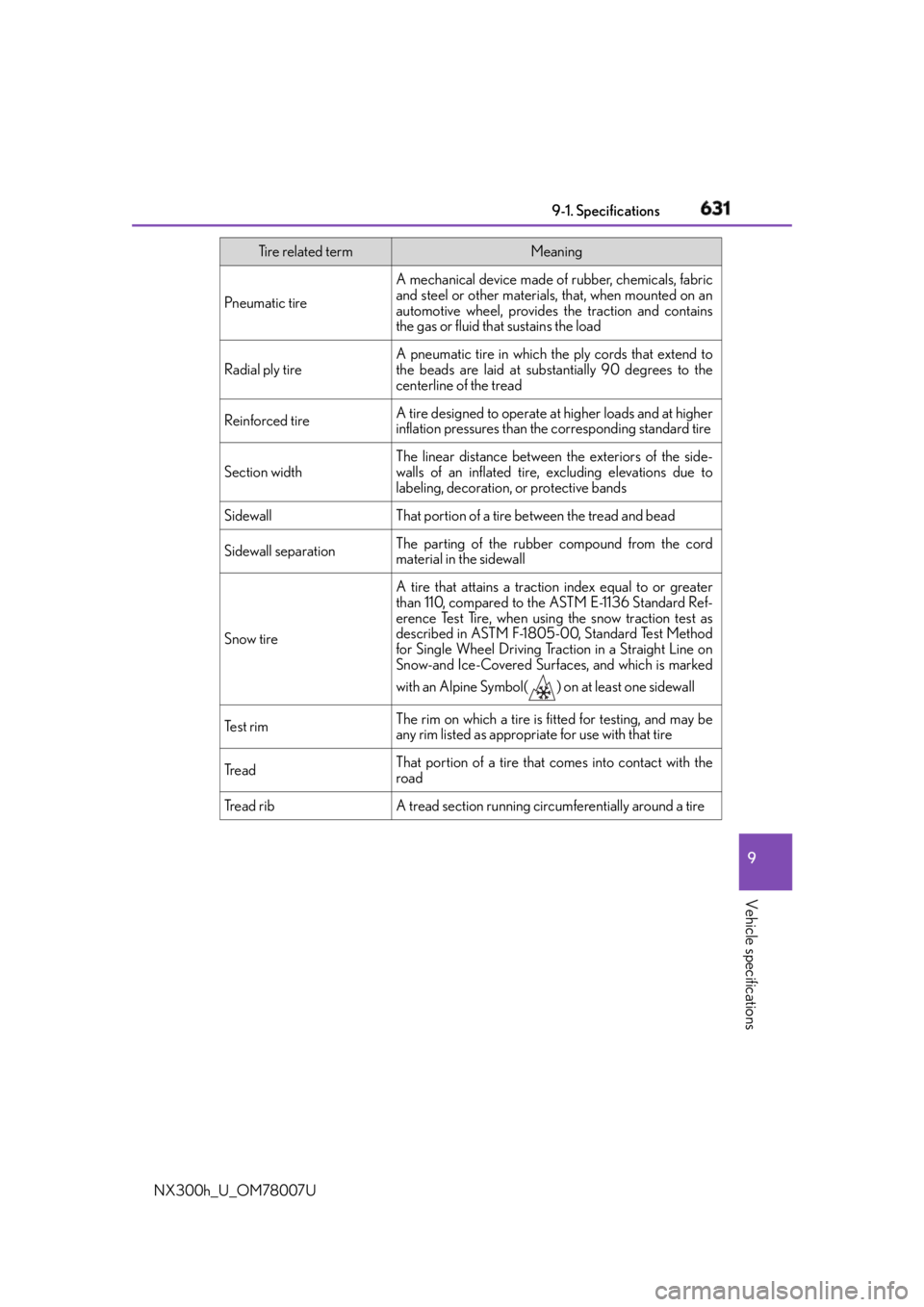
NX300h_U_OM78007U Pneumatic tire A mechanical device made of rubber, chemicals, fabric
and steel or other materials, that, when mounted on an
automotive wheel, provides the traction and contains
the gas or fluid that sustains the load
Radial ply tire A pneumatic tire in which the ply cords that extend to
the beads are laid at substantially 90 degrees to the
centerline of the tread
Reinforced tire A tire designed to operate at higher loads and at higher
inflation pressures than the corresponding standard tire
Section width The linear distance between the exteriors of the side-
walls of an inflated tire, excluding elevations due to
labeling, decoration, or protective bands
Sidewall That portion of a tire between the tread and bead
Sidewall separation The parting of the rubber compound from the cord
material in the sidewall
Snow tire A tire that attains a traction index equal to or greater
than 110, compared to the ASTM E-1136 Standard Ref-
erence Test Tire, when using the snow traction test as
described in ASTM F-1805-00, Standard Test Method
for Single Wheel Driving Tract ion in a Straight Line on
Snow-and Ice-Covered Surfaces, and which is marked
with an Alpine Symbol( ) on at least one sidewall
Te s t r i m The rim on which a tire is fitted for testing, and may be
any rim listed as appropriate for use with that tire
Tr e a d That portion of a tire that comes into contact with the
road
Tr e a d r i b A tread section running circumferentially around a tireTire related term Meaning
Page 632 of 681
632 9-1. Specifications
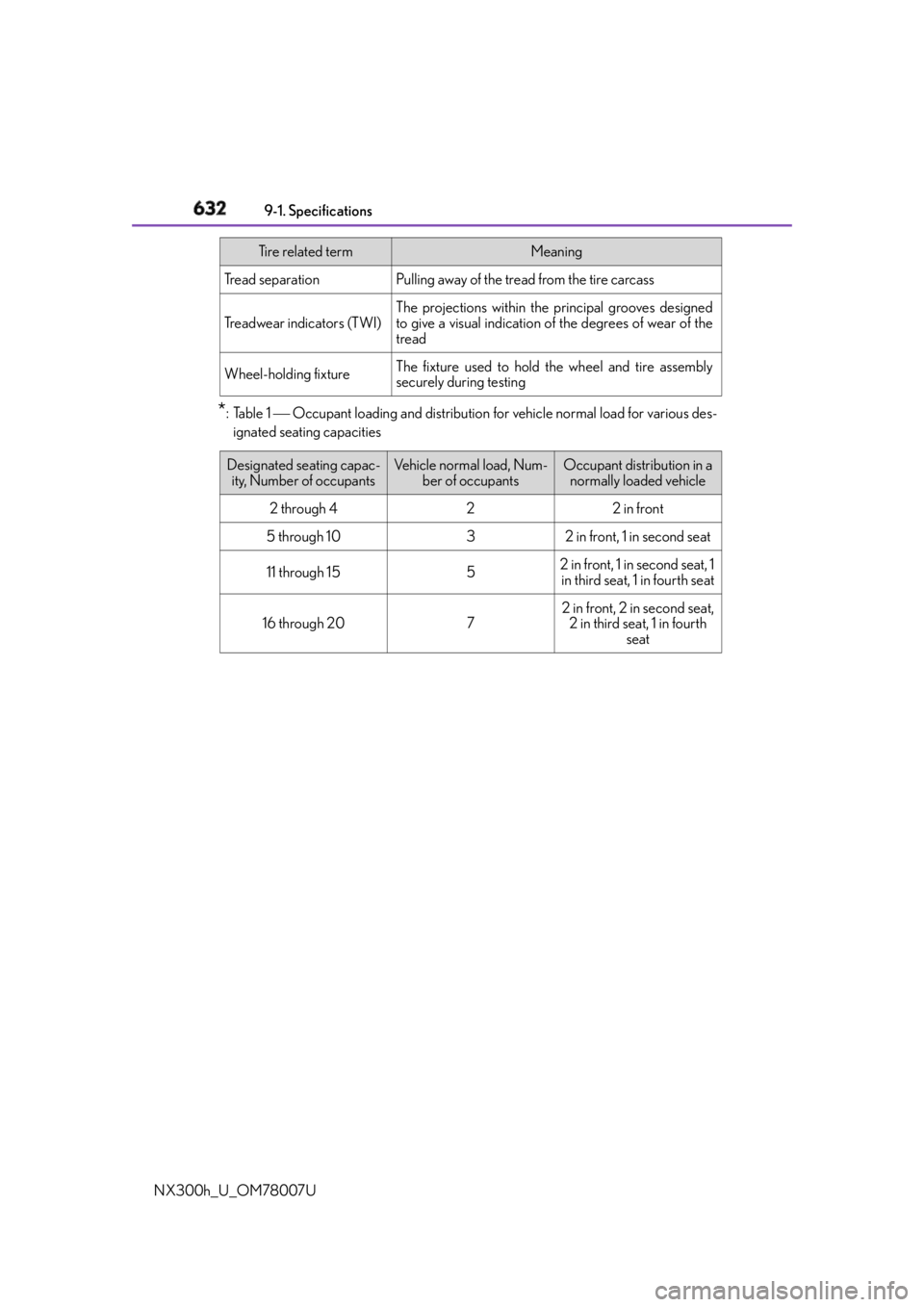
NX300h_U_OM78007U * :Table 1 Occupant loading and distribution fo r vehicle normal load for various des-
ignated seating capacitiesTread separation Pulling away of the tread from the tire carcass
Treadwear indicators (TWI) The projections within the principal grooves designed
to give a visual indication of the degrees of wear of the
tread
Wheel-holding fixture The fixture used to hold the wheel and tire assembly
securely during testingTire related term Meaning
Designated seating capac-
ity, Number of occupants Vehicle normal load, Num-
ber of occupants Occupant distribution in a
normally loaded vehicle
2 through 4 2 2 in front
5 through 10 3 2 in front, 1 in second seat
11 through 15 5 2 in front, 1 in second seat, 1
in third seat, 1 in fourth seat
16 through 20 7 2 in front, 2 in second seat,
2 in third seat, 1 in fourth
seat
Page 660 of 681
659What to do if... (Troubleshooting)
NX300h_U_OM78007U ●
Did you press the power switch while firmly depressing the brake pedal?
( P. 2 0 1 )●
Is the shift position in P? ( P. 2 0 3 )●
Is the electronic key anywhere detectable inside the vehicle? ( P. 1 4 0 )●
Is the steering wheel unlocked? ( P. 2 0 3 )●
Is the electronic key battery weak or depleted?
In this case, the hybrid system can be started in a temporary way. ( P. 5 9 3 )●
Is the 12-volt battery discharged? ( P. 5 9 5 )●
Is the power switch in ON mode?
If you cannot release the shift lever by depressing the brake pedal with the
power switch in ON mode ( P. 5 9 1 )●
It is locked automatically to prevent theft of the vehicle. ( P. 2 0 4 )
●
Is the window lock switch pressed?
The power window except for the one at the driver’s seat cannot be operated
if the window lock switch is pressed. ( P. 1 6 6 )
●
The auto power off function will be operated if the vehicle is left in
ACCESSORY or ON mode (the hybrid system is not operating) for a period
of time. ( P. 2 0 3 )If you think something is wrong The hybrid system does not start
The shift lever cannot be shifted from P even if you depress the brake
pedal
The steering wheel cannot be turned after the hybrid system is stopped
The windows do not open or close by operating the power window
switches
The power switch is turned off automatically