tire size LEXUS NX300H 2016 User Guide
[x] Cancel search | Manufacturer: LEXUS, Model Year: 2016, Model line: NX300H, Model: LEXUS NX300H 2016Pages: 680, PDF Size: 10.23 MB
Page 525 of 680
5257-3. Do-it-yourself maintenance
7
Maintenance and care
NX300h_OM_USA_OM78082U
Tire inflation pressure
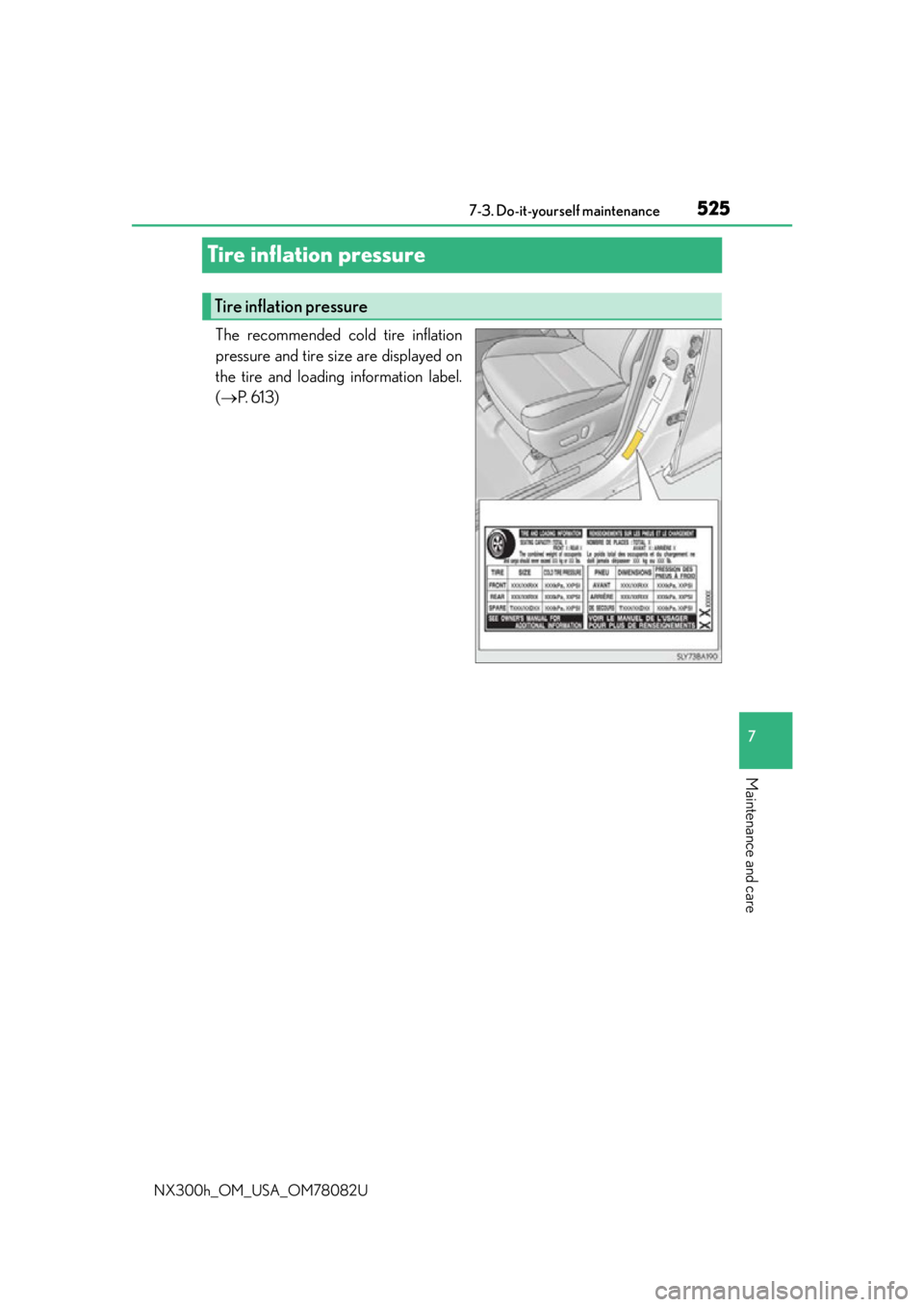
The recommended cold tire inflation
pressure and tire size are displayed on
the tire and loading information label.
(P. 6 1 3 )
Tire inflation pressure
Page 528 of 680
5287-3. Do-it-yourself maintenance
NX300h_OM_USA_OM78082U
Wheels
When replacing wheels, care should be taken to ensure that they are equivalent
to those removed in load capacity , diameter, rim width and inset
*.
Replacement wheels are available at your Lexus dealer.
*: Conventionally referred to as “offset”.
Lexus does not recommend using the following:
●Wheels of different sizes or types
●Used wheels
●Bent wheels that have been straightened
●Use only Lexus wheel nuts and wrenches designed for use with your alumi-
num wheels.
●When rotating, repairing or changing your tires, check that the wheel nuts are
still tight after driving 1000 miles (1600 km).
●Be careful not to damage the aluminum wheels when using tire chains.
●Use only Lexus genuine balance weights or equivalent and a plastic or rubber
hammer when balancing your wheels.
■When replacing wheels
The wheels of your vehicle are equipped with tire pressure warning valves and transmit-
ters that allow the tire pressure warning system to provide advance warning in the event
of a loss in tire inflation pressure. Whenever wheels are replaced, tire pressure warning
valves and transmitters must be installed. ( P. 5 1 7 , 5 2 9 )
If a wheel is bent, cracked or heavily corroded, it should be replaced. Other-
wise, the tire may separate from the wheel or cause a loss of handling control.
Wheel selection
Aluminum wheel precautions
Page 529 of 680

5297-3. Do-it-yourself maintenance
7
Maintenance and care
NX300h_OM_USA_OM78082U
WA R N I N G
■When replacing wheels
●Do not use wheels that are a different size from those recommended in the Owner’s
Manual, as this may result in a loss of handling control.
●Never use an inner tube in a leaking wheel which is designed for a tubeless tire. Doing
so may result in an accident, causing death or serious injury.
■Use of defective wheels prohibited
Do not use cracked or deformed wheels.
Doing so could cause the tire to leak air during driving, possibly causing an accident.
NOTICE
■Replacing tire pressure warning valves and transmitters
●Because tire repair or replacement may affect the tire pressure warning valves and
transmitters, make sure to have tires serviced by your Lexus dealer or other qualified
service shop. In addition, make sure to pu rchase your tire pressure warning valves
and transmitters at your Lexus dealer.
●Ensure that only genuine Lexus wheels are used on your vehicle.
Tire pressure warning valves and transmitte rs may not work properly with non-genu-
ine wheels.
Page 569 of 680

5698-2. Steps to take in an emergency
8
When trouble arises
NX300h_OM_USA_OM78082U
■When the tire pressure warning light comes on
Inspect the appearance of the tire to check that the tire is not punctured.
If the tire is punctured: P. 5 7 5
If the tire is not punctured:
Carry out the following procedure after the tire temperature has lowered sufficiently.
●Check the tire inflation pressure and adjust to the appropriate level.
●If the warning light does not go out even after several minutes, check that the tire infla-
tion pressure is at the specified level and carry out initialization. ( P. 5 1 8 )
The warning light may come on again if the above operations are conducted without first
allowing the tire temperature to lower sufficiently.
■The tire pressure warning light may come on due to natural causes
The tire pressure warning light may come on due to natural causes such as natural air
leaks and tire inflation pressure changes caused by temperature. In this case, adjusting
the tire inflation pressure will turn off the warning light (after a few minutes).
■When a tire is replaced with a spare tire
Vehicles with a compact spare tire: The comp act spare tire is not equipped with a tire
pressure warning valve and transmitter. If a tire goes flat, the tire pressure warning light
will not turn off even though the flat tire ha s been replaced with the spare tire. Replace
the spare tire with the repaired tire and adjust the tire inflation pressure. The tire pressure
warning light will go off after a few minutes.
Vehicles with a full-size spare tire: The spare tire is also equipped with a tire pressure
warning valve and transmitter. The tire pressure warning light will turn on if the tire infla-
tion pressure of the spare tire is low. If a tire goes flat, the tire pressure warning light will
not turn off even though the flat tire has been replaced with the spare tire. Replace the
spare tire with the repaired tire and adjust the tire inflation pressure. The tire pressure
warning light will go off after a few minutes.
■Conditions that the tire pressure warning system may not function properly
P. 5 2 1
■If the tire pressure warning light frequently comes on after blinking for 1 minute
If the tire pressure warning light frequently comes on after blinking for 1 minute when the
power switch is turned to ON mode, ha ve it checked by your Lexus dealer.
■Warning buzzer
In some cases, the buzzer may not be heard due to being in a noisy location or audio
sound.
Page 571 of 680

5718-2. Steps to take in an emergency
8
When trouble arises
NX300h_OM_USA_OM78082U
WA R N I N G
■Maintenance of the tires
Each tire, including the spare (if provided), should be checked monthly when cold and
inflated to the inflation pressure recomm ended by the vehicle manufacturer on the
vehicle placard or tire inflation pressure la bel (tire and load information label). (If your
vehicle has tires of a different size than the size indicated on the vehicle placard or tire
inflation pressure label [tire and load in formation label], you should determine the
proper tire inflation pressure for those tires.)
As an added safety feature, your vehicle has been equipped with a tire pressure moni-
toring system (TPMS-tire pressure warning system) that illuminates a low tire pressure
telltale (tire pressure warning light) when on e or more of your tires is significantly
under-inflated. Accordingly, when the low ti re pressure telltale (tire pressure warning
light) illuminates, you should stop and check your tires as soon as possible, and inflate
them to the proper pressure. Driving on a significantly under-inflated tire causes the
tire to overheat and can lead to tire failure. Under-inflation also reduces fuel efficiency
and tire tread life, and ma y affect the vehicle’s handling and stopping ability.
Please note that the TPMS (tire pressure wa rning system) is not a substitute for proper
tire maintenance, and it is the driver’s resp onsibility to maintain correct tire pressure,
even if under-inflation has no t reached the level to trigger illumination of the TPMS low
tire pressure telltale (tire pressure warning light).
Your vehicle has also been equipped with a TPMS (tire pressure warning system) mal-
function indicator to indicate when the system is not operating properly. The TPMS
(tire pressure warning system) malfunction indi cator is combined with the low tire pres-
sure telltale (tire pressure warning light). When the system detects a malfunction, the
telltale will flash for approximately one minu te and then remain continuously illumi-
nated. This sequence will cont inue upon subsequent vehicle start-ups as long as the
malfunction exists. When the malfunction indicator is illuminated, the system may not
be able to detect or signal low tire pressure as intended.
TPMS (tire pressure warning system) malfun ctions may occur for a variety of reasons,
including the installation of replacement or alternate tires or wheels on the vehicle that
prevent the TPMS (tire pressure warning system) from functioning properly. Always
check the TPMS (tire pressure warning syst em) malfunction telltale after replacing one
or more tires or wheels on your vehicle to ensure that the replacement or alternate
tires and wheels allow the TPMS (tire pressure warning system) to continue to function
properly.
NOTICE
■To ensure the tire pressure warning system operates properly
Do not install tires with different specificatio ns or makers, as the tire pressure warning
system may not operate properly.
Page 613 of 680
6139-1. Specifications
9
Vehicle specifications
NX300h_OM_USA_OM78082U
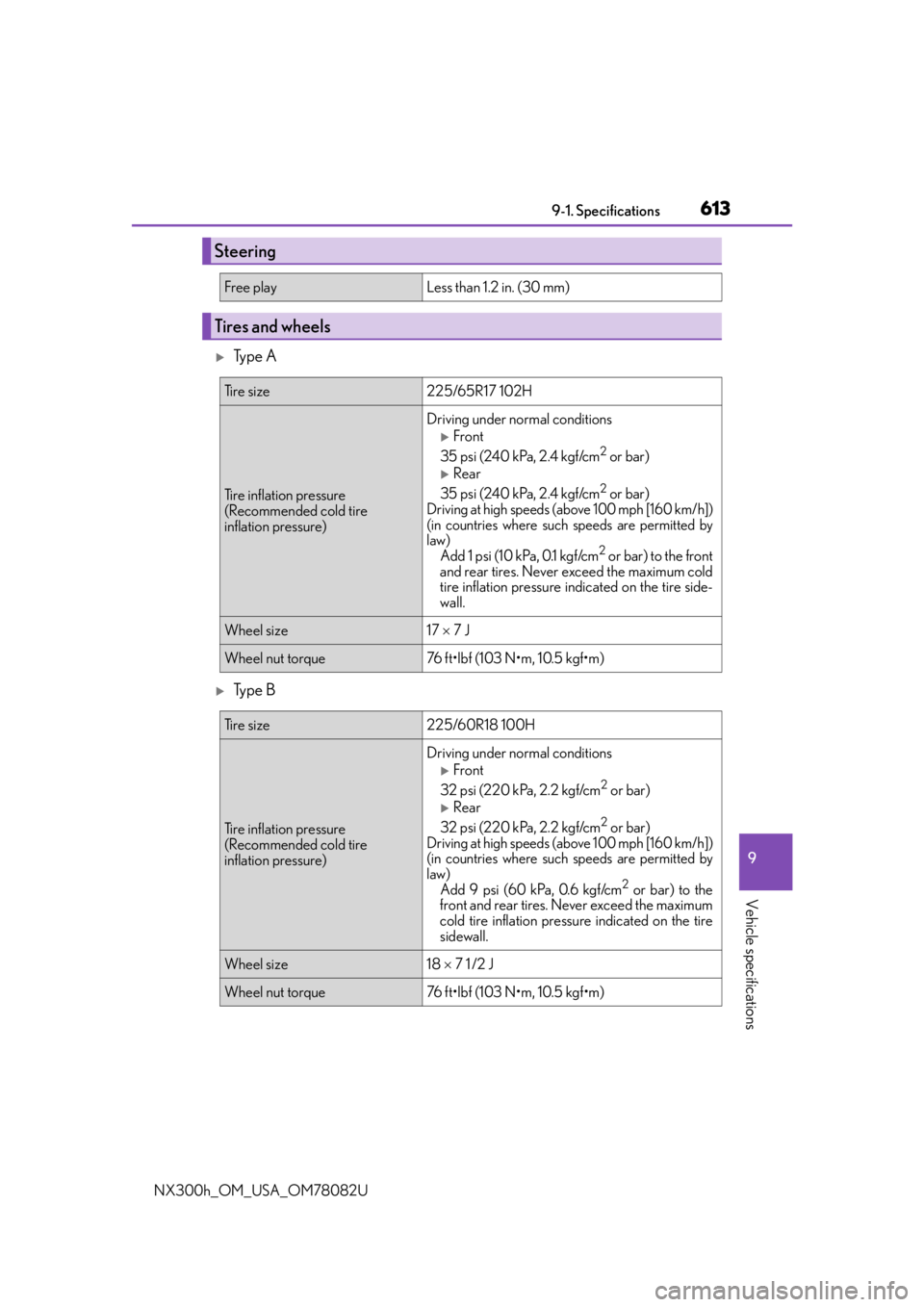
Ty p e A
Ty p e B
Steering
Free playLess than 1.2 in. (30 mm)
Tires and wheels
Ti r e s i z e225/65R17 102H
Tire inflation pressure
(Recommended cold tire
inflation pressure)
Driving under normal conditions
Front
35 psi (240 kPa, 2.4 kgf/cm2 or bar)
Rear
35 psi (240 kPa, 2.4 kgf/cm2 or bar)Driving at high speeds (above 100 mph [160 km/h])
(in countries where such speeds are permitted by
law)
Add 1 psi (10 kPa, 0.1 kgf/cm2 or bar) to the front
and rear tires. Never exceed the maximum cold
tire inflation pressure in dicated on the tire side-
wall.
Wheel size17 7 J
Wheel nut torque76 ft•lbf (103 N•m, 10.5 kgf•m)
Ti r e s i z e225/60R18 100H
Tire inflation pressure
(Recommended cold tire
inflation pressure)
Driving under normal conditions
Front
32 psi (220 kPa, 2.2 kgf/cm2 or bar)
Rear
32 psi (220 kPa, 2.2 kgf/cm2 or bar)
Driving at high speeds (above 100 mph [160 km/h])
(in countries where such speeds are permitted by
law)
Add 9 psi (60 kPa, 0.6 kgf/cm2 or bar) to the
front and rear tires. Never exceed the maximum
cold tire inflation pressure indicated on the tire
sidewall.
Wheel size18 7 1 /2 J
Wheel nut torque76 ft•lbf (103 N•m, 10.5 kgf•m)
Page 614 of 680
6149-1. Specifications
NX300h_OM_USA_OM78082U
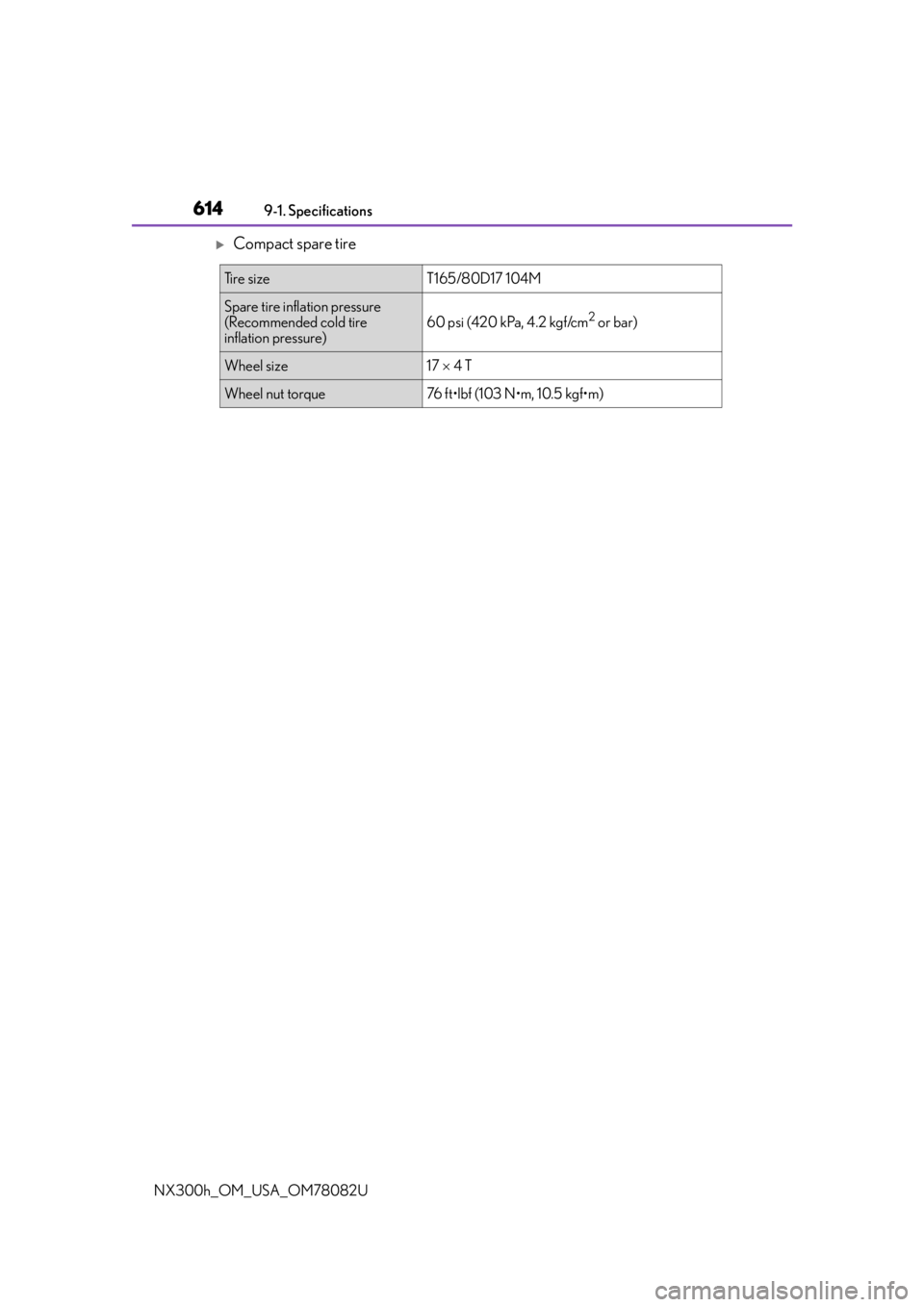
Compact spare tire
Ti r e s i z eT165/80D17 104M
Spare tire inflation pressure
(Recommended cold tire
inflation pressure)
60 psi (420 kPa, 4.2 kgf/cm2 or bar)
Wheel size17 4 T
Wheel nut torque76 f t•lbf (103 N•m, 10.5 kgf•m)
Page 619 of 680
6199-1. Specifications
9
Vehicle specifications
NX300h_OM_USA_OM78082U
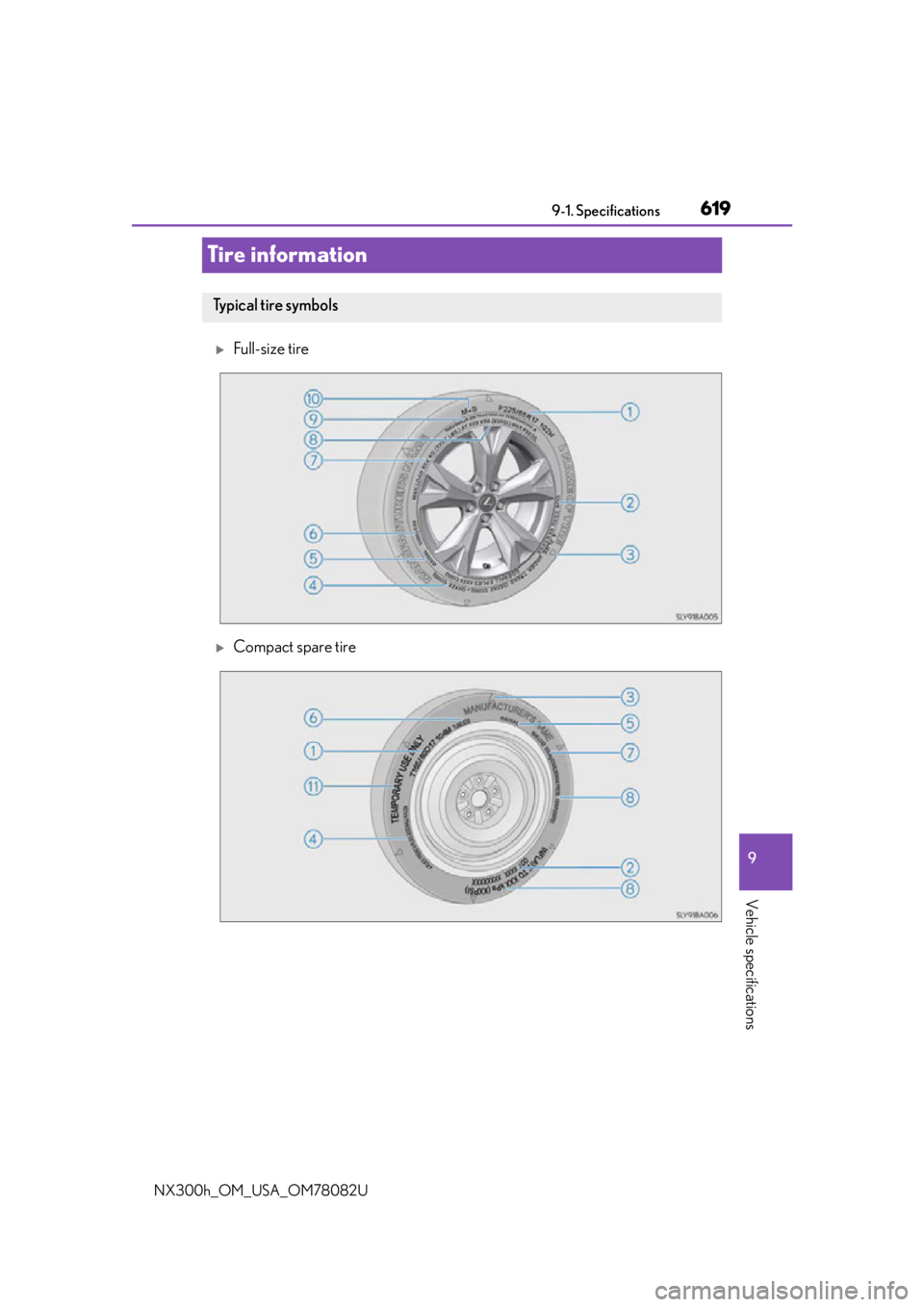
Tire information
Full-size tire
Compact spare tire
Ty p i c a l t i r e s y m b o l s
Page 622 of 680
6229-1. Specifications
NX300h_OM_USA_OM78082U
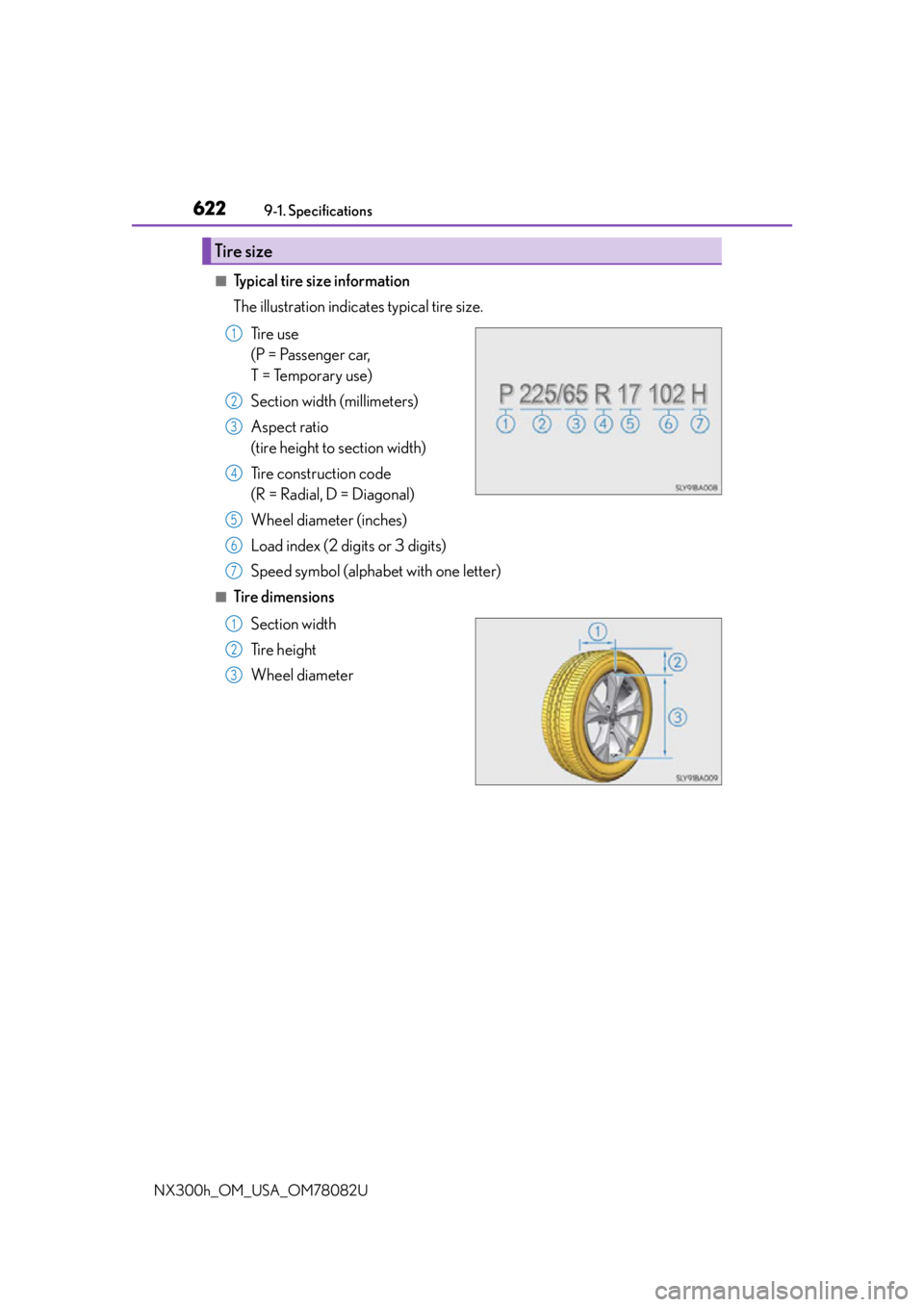
■Typical tire size information
The illustration indicates typical tire size. Ti r e u s e
(P = Passenger car,
T = Temporary use)
Section width (millimeters)
Aspect ratio
(tire height to section width)
Tire construction code
(R = Radial, D = Diagonal)
Wheel diameter (inches)
Load index (2 digits or 3 digits)
Speed symbol (alphabet with one letter)
■Tire dimensionsSection width
Tire height
Wheel diameter
Tire size
1
2
3
4
5
6
7
1
2
3
Page 626 of 680
6269-1. Specifications
NX300h_OM_USA_OM78082U
Production options weight
The combined weight of installed regular production
options weighing over 5 lb. (2.3 kg) in excess of the
standard items which they replace, not previously con-
sidered in curb weight or accessory weight, including
heavy duty brakes, ride levelers, roof rack, heavy duty
12-volt battery, and special trim
RimA metal support for a tire or a tire and tube assembly
upon which the tire beads are seated
Rim diameter
(Wheel diameter)Nominal diameter of the bead seat
Rim size designationRim diameter and width
Rim type designationThe industry manufacturer’s designation for a rim by
style or code
Rim widthNominal distance between rim flanges
Vehicle capacity weight
(Total load capacity)The rated cargo and luggage load plus 150 lb. (68 kg)
times the vehicle’s designated seating capacity
Vehicle maximum load on
the tireThe load on an individual tire that is determined by dis-
tributing to each axle its share of the maximum loaded
vehicle weight, and dividing by two
Vehicle normal load on the
tire
The load on an individual tire that is determined by dis-
tributing to each axle its sh are of curb weight, accessory
weight, and normal occupant weight (distributed in
accordance with Table 1
* below), and dividing by two
We a t h e r s i d eThe surface area of the rim not covered by the inflated
tire
BeadThe part of the tire that is made of steel wires, wrapped
or reinforced by ply cords and that is shaped to fit the
rim
Tire related termMeaning