windshield LEXUS NX300H 2016 Owners Manual
[x] Cancel search | Manufacturer: LEXUS, Model Year: 2016, Model line: NX300H, Model: LEXUS NX300H 2016Pages: 680, PDF Size: 10.23 MB
Page 3 of 680

3
1
9 8
7
6 4 3
2
10
5
NX300h_OM_USA_OM78082U
3-4. Adjusting the steering wheel and mirrors
Steering wheel ............................. 160
Inside rear view mirror................ 161
Outside rear view mirrors........163
3-5. Opening, closing the windows and moon roof
Power windows .............................166
Moon roof .......................................169
4-1. Before driving Driving the vehicle .......................174
Cargo and luggage.................... 182
Vehicle load limits ....................... 186
Trailer towing (vehicles with towing package) .......................187
Trailer towing (vehicles without towing package) ...... 199
Dinghy towing .............................200
4-2. Driving procedures Power (ignition) switch ............. 201
EV drive mode ............................ 206
Hybrid transmission ..................208
Turn signal lever ............................ 212
Parking brake ................................213
Brake Hold .....................................216
ASC (Active Sound Control) ....................................... 218 4-3. Operating the lights
and wipers
Headlight switch ..........................219
Automatic High Beam............. 223
Fog light switch ............................227
Windshield wipers and washer ......................................... 228
Rear window wiper and washer ......................................... 234
4-4. Refueling Opening the fuel tank cap ..... 236
4-5. Using the driving support systems
Dynamic radar cruise control ......................................... 240
Dynamic radar cruise control with full-speed
range ............................................ 253
Cruise control .............................. 267
LDA (Lane Departure Alert with steering co ntrol) .............270
Intuitive parking assist ...............279
Lexus parking assist monitor.........................................287
Driving mode select switch ........................................... 303
Driving assist systems ..............305
PCS (Pre-Collision System) ........................................ 310
BSM (Blind Spot Monitor).......316
4-6. Driving tips Hybrid vehicle driving tips ................................................. 324
Winter driving tips ..................... 326
Utility vehicle precautions...... 330
4Driving
Page 17 of 680

17Pictorial index
NX300h_OM_USA_OM78082U
Windshield wipers . . . . . . . . . . . . . . . . . . . . . . . . . . . . . . . . . . . . . . . . . . . . . . . . . . . P. 228
Precautions against winter season . . . . . . . . . . . . . . . . . . . . . . . . . . . . . . . . . . . . . .P. 326
To prevent freezing (windshield wiper de-icer) . . . . . . . . . . . . . . . . . . . . . . . . . .P. 436
Precautions against car wash . . . . . . . . . . . . . . . . . . . . . . . . . . . . . . . . . . . . . . . . . . P. 486
Fuel filler door . . . . . . . . . . . . . . . . . . . . . . . . . . . . . . . . . . . . . . . . . . . . . . . . . . . . . . . P . 236
Refueling method . . . . . . . . . . . . . . . . . . . . . . . . . . . . . . . . . . . . . . . . . . . . . . . . . . . . . . .P. 236
Fuel type/fuel tank capacity . . . . . . . . . . . . . . . . . . . . . . . . . . . . . . . . . . . . . . . . . . . . P. 608
Tires . . . . . . . . . . . . . . . . . . . . . . . . . . . . . . . . . . . . . . . . . . . . . . . . . . . . . . . . . . . . . . . . . . . P. 516
Tire size/inflation pressure . . . . . . . . . . . . . . . . . . . . . . . . . . . . . . . . . . . . . . . . . . . . . . P. 613
Winter tires/tire chain. . . . . . . . . . . . . . . . . . . . . . . . . . . . . . . . . . . . . . . . . . . . . . . . . . . P. 327
Checking/rotation/tire pressure warning system . . . . . . . . . . . . . . . . . . . . . . . . P. 516
Coping with flat tires . . . . . . . . . . . . . . . . . . . . . . . . . . . . . . . . . . . . . . . . . . . . . . . . . . . . P. 575
Hood . . . . . . . . . . . . . . . . . . . . . . . . . . . . . . . . . . . . . . . . . . . . . . . . . . . . . . . . . . . . . . . . . P. 500
Opening. . . . . . . . . . . . . . . . . . . . . . . . . . . . . . . . . . . . . . . . . . . . . . . . . . . . . . . . . . . . . . . P. 500
Engine compartment cover . . . . . . . . . . . . . . . . . . . . . . . . . . . . . . . . . . . . . . . . . . . . P. 503
Engine oil . . . . . . . . . . . . . . . . . . . . . . . . . . . . . . . . . . . . . . . . . . . . . . . . . . . . . . . . . . . . . . P. 609
Coping with overheat . . . . . . . . . . . . . . . . . . . . . . . . . . . . . . . . . . . . . . . . . . . . . . . . . . .P. 599
Warning messages . . . . . . . . . . . . . . . . . . . . . . . . . . . . . . . . . . . . . . . . . . . . . . . . . . . . . P. 57 2
Headlights . . . . . . . . . . . . . . . . . . . . . . . . . . . . . . . . . . . . . . . . . . . . . . . . . . . . . . . . . . . .P. 219
Parking lights/daytime running lights . . . . . . . . . . . . . . . . . . . . . . . . . . . . . . . .P. 219
Fog lights . . . . . . . . . . . . . . . . . . . . . . . . . . . . . . . . . . . . . . . . . . . . . . . . . . . . . . . . . . . . . P. 227
Turn signal lights . . . . . . . . . . . . . . . . . . . . . . . . . . . . . . . . . . . . . . . . . . . . . . . . . . . . . .P . 212
Tail lights . . . . . . . . . . . . . . . . . . . . . . . . . . . . . . . . . . . . . . . . . . . . . . . . . . . . . . . . . . . . . .P. 219
License plate lights . . . . . . . . . . . . . . . . . . . . . . . . . . . . . . . . . . . . . . . . . . . . . . . . . . .P. 21 9
Back-up light
Shifting the shift lever to R . . . . . . . . . . . . . . . . . . . . . . . . . . . . . . . . . . . . . . . . . . . . . P. 208
Side marker lights . . . . . . . . . . . . . . . . . . . . . . . . . . . . . . . . . . . . . . . . . . . . . . . . . . . .P. 219
4
5
6
7
Light bulbs of the exte rior lights for driving
(Replacing method: P. 538, Watts: P. 615)
*: If equipped
8
9
10
11
12
13
14
15
Page 19 of 680

19Pictorial index
NX300h_OM_USA_OM78082U
Multi-information display . . . . . . . . . . . . . . . . . . . . . . . . . . . . . . . . . . . . . . . . . . . P. 102
Display . . . . . . . . . . . . . . . . . . . . . . . . . . . . . . . . . . . . . . . . . . . . . . . . . . . . . . . . . . . . . . . . . P. 102
Energy monitor . . . . . . . . . . . . . . . . . . . . . . . . . . . . . . . . . . . . . . . . . . . . . . . . . . . . . . . . . . . P. 111
When the warning messages are displayed . . . . . . . . . . . . . . . . . . . . . . . . . . . . . P. 572
Turn signal lever. . . . . . . . . . . . . . . . . . . . . . . . . . . . . . . . . . . . . . . . . . . . . . . . . . . . . . .P . 212
Headlight switch . . . . . . . . . . . . . . . . . . . . . . . . . . . . . . . . . . . . . . . . . . . . . . . . . . . . . . . . . P. 219
Headlights/parking lights/tai l lights/license plate lights/
daytime running lights . . . . . . . . . . . . . . . . . . . . . . . . . . . . . . . . . . . . . . . . . . . . . . . . . . P. 2 19
Fog lights . . . . . . . . . . . . . . . . . . . . . . . . . . . . . . . . . . . . . . . . . . . . . . . . . . . . . . . . . . . . . . . P. 227
Windshield wiper and washer switch. . . . . . . . . . . . . . . . . . . . . . . . . . P. 228, 234
Usage . . . . . . . . . . . . . . . . . . . . . . . . . . . . . . . . . . . . . . . . . . . . . . . . . . . . . . . . . . . . P. 228, 234
Adding washer fluid . . . . . . . . . . . . . . . . . . . . . . . . . . . . . . . . . . . . . . . . . . . . . . . . . . . . . P . 511
Warning messages . . . . . . . . . . . . . . . . . . . . . . . . . . . . . . . . . . . . . . . . . . . . . . . . . . . . . P. 57 2
Emergency flasher switch . . . . . . . . . . . . . . . . . . . . . . . . . . . . . . . . . . . . . . . . . . . P. 556
Hood lock release lever . . . . . . . . . . . . . . . . . . . . . . . . . . . . . . . . . . . . . . . . . . . . . P. 500
Tilt and telescopic steering control switch . . . . . . . . . . . . . . . . . . . . . . . . . . .P. 160
Adjustment . . . . . . . . . . . . . . . . . . . . . . . . . . . . . . . . . . . . . . . . . . . . . . . . . . . . . . . . . . . . . P. 160
Driving position memory
*1 . . . . . . . . . . . . . . . . . . . . . . . . . . . . . . . . . . . . . . . . . . . . . P. 154
Air conditioning system . . . . . . . . . . . . . . . . . . . . . . . . . . . . . . . . . . . . . . . . . . . . . P. 430
Usage . . . . . . . . . . . . . . . . . . . . . . . . . . . . . . . . . . . . . . . . . . . . . . . . . . . . . . . . . . . . . . . . . P. 430
Rear window defogger . . . . . . . . . . . . . . . . . . . . . . . . . . . . . . . . . . . . . . . . . . . . . . . . .P. 435
Audio system*2
Audio system . . . . . . . . . . . . . . . . . . . . . . . . . . . . . . . . . . . . . . . . . . . . . . . . . . . . . . . . . . .P. 336
Hands-free system . . . . . . . . . . . . . . . . . . . . . . . . . . . . . . . . . . . . . . . . . . . . . . . . . . . . . .P. 392
*1: If equipped
*2: For vehicles with a navigation system, refer to
“NAVIGATION SYSTEM OWNER’S MANUAL”.
4
5
6
7
8
9
10
11
Page 46 of 680
461-1. For safe use
NX300h_OM_USA_OM78082U
WA R N I N G
■SRS airbag precautions
●Do not hang coat hangers or other hard objects on the coat hooks. All of these items
could become projectiles and may cause death or serious injury, should the SRS cur-
tain shield ai rbags deploy.
●If a vinyl cover is put on the area where the SRS knee airbag will deploy, be sure to
remove it.
●Do not use seat accessories which cover the parts where the SRS side airbags and
SRS seat cushion airbag inflate as they may interfere with inflation of the SRS airbags.
Such accessories may prevent the side ai rbags and SRS seat cushion airbag from
activating correctly, disable the system or cause the side airbags and SRS seat cush-
ion airbag to inflate accidentally, re sulting in death or serious injury.
●Do not strike or apply significant levels of force to the area of the SRS airbag compo-
nents.
Doing so can cause the SRS airbags to malfunction.
●Do not touch any of the component parts immediately after the SRS airbags have
deployed (inflated) as they may be hot.
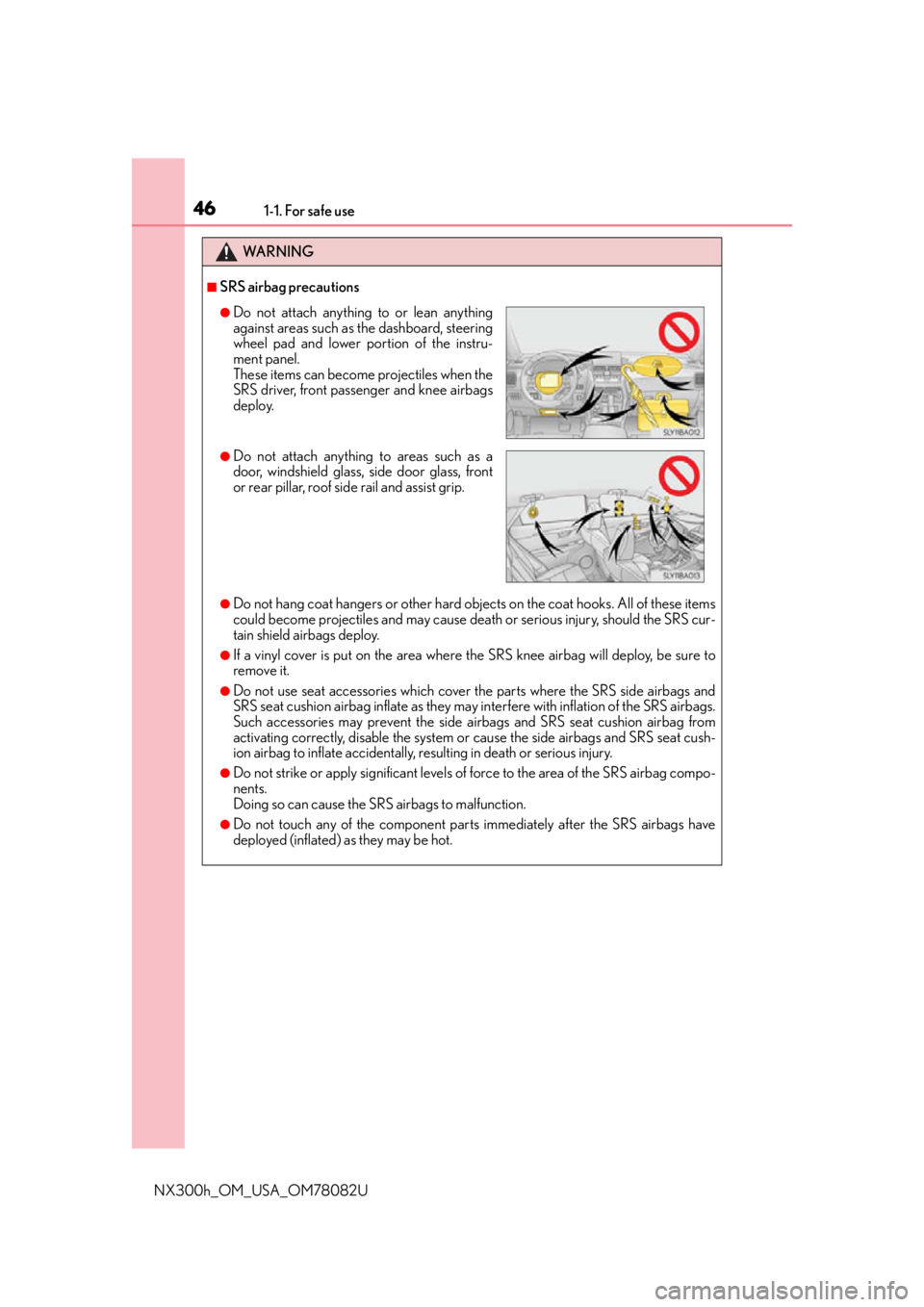
●Do not attach anything to or lean anything
against areas such as the dashboard, steering
wheel pad and lower portion of the instru-
ment panel.
These items can become projectiles when the
SRS driver, front passenger and knee airbags
deploy.
●Do not attach anything to areas such as a
door, windshield glass, side door glass, front
or rear pillar, roof side rail and assist grip.
Page 48 of 680

481-1. For safe use
NX300h_OM_USA_OM78082U
■If the SRS airbags deploy (inflate)
●Slight abrasions, burns, bruising, etc., may be sustained from SRS airbags, due to the
extremely high speed deployment (inflation) by hot gases.
●A loud noise and white powder will be emitted.
●Parts of the airbag module (steering wheel hub, airbag cover and inflator) as well as the
front seats, parts of th e front and rear pillars, and roof side rails, may be hot for several
minutes. The airbag itself may also be hot.
●The windshield may crack.
●For Safety Connect subscribers, if the SRS airbags deploy or in the event of a severe
rear-end collision, the system is designed to send an emergency call to the response
center, notifying them of the vehicle’s location (without needing to push the “SOS” but-
ton) and an agent will attempt to speak wi th the occupants to ascertain the level of
emergency and assistance required. If the oc cupants are unable to communicate, the
agent automatically treats the call as an em ergency and helps to dispatch the necessary
emergency services. ( P. 477)
■SRS airbag deployment conditions (SRS front airbags)
●The SRS front airbags will deploy in the event of an impact that exceeds the set threshold
level (the level of force corresponding to an approximately 12-18 mph [20-30 km/h]
frontal collision with a fixed wall that does not move or deform).
However, this threshold velocity will be considerably higher in the following situations:
• If the vehicle strikes an object, such as a parked vehicle or sign pole, which can move
or deform on impact
• If the vehicle is involved in an underride collision, such as a collision in which the
front of the vehicle “underrides”, or goes under, the bed of a truck
●Depending on the type of collision, it is possib le that only the seat belt pretensioners will
activate.
●The SRS front airbags for the front passenger will not activate if there is no passenger
sitting in the front passenger seat. However, the SRS front airbags for the front passen-
ger may deploy if luggage is put in the seat, even if the se at is unoccupied. (P. 5 3 )
●The SRS seat cushion airbag on the front passenger seat will not operate if the occu-
pant is not wearing a seat belt.
■SRS airbag deployment conditions (S RS side and curtain shield airbags)
●The SRS side and curtain shield airbags wi ll deploy in the event of an impact that
exceeds the set threshol d level (the level of force corresponding to the impact force
produced by an approximately 3300 lb. [1500 kg] vehicle colliding with the vehicle
cabin from a direction perpendicular to the vehicle orientation at an approximate
speed of 12 -18 mph [20 -30 km/h]).
●The SRS curtain shield airbags will deploy in the event of vehicle rollover.
●The SRS side and curtain shield airbags may al so deploy in the event of a severe frontal
collision.
Page 61 of 680

611-1. For safe use
1
For safety and security
NX300h_OM_USA_OM78082U
WA R N I N G
■When a child is riding
Observe the following precautions.
Failure to do so may result in death or serious injury.
●For effective protection in automobile accidents and sudden stops, a child must be
properly restrained, using a seat belt or child restraint system depending on the age
and size of the child.
●Lexus strongly urges the use of a proper child restraint system that conforms to the
size of the child, installed on the rear seat . According to accident statistics, the child is
safer when properly restrained in th e rear seat than in the front seat.
●Holding a child in your or someone else’s ar ms is not a substitute for a child restraint
system. In an accident, the child can be crushed against the windshield or between
the holder and the interior of the vehicle.
●Place one child to a child restraint system and then secure the child with the harness
of the child restraint system.
■Handling the child restraint system
If the child restraint system is not properly fixed in place, the child or other passengers
may be seriously injured or even killed in th e event of sudden braking, sudden swerv-
ing, or an accident.
●If the vehicle were to receive a strong impact from an accident, etc., it is possible that
the child restraint system has damage that is not readily visible. In such cases, do not
reuse the restraint system.
●Make sure you have complied with all installa tion instructions provided with the child
restraint system manufacturer and that the system is properly secured.
●Keep the child restraint system properly secured on the seat even if it is not in use. Do
not store the child restraint system unsecured in the passenger compartment.
●If it is necessary to detach the child rest raint system, remove it from the vehicle or
store it securely in the luggage compartment.
Page 106 of 680
1062. Instrument cluster
NX300h_OM_USA_OM78082U
Head-up display
The head-up display can be used to proj ect vehicle speed and other information
onto the windshield.
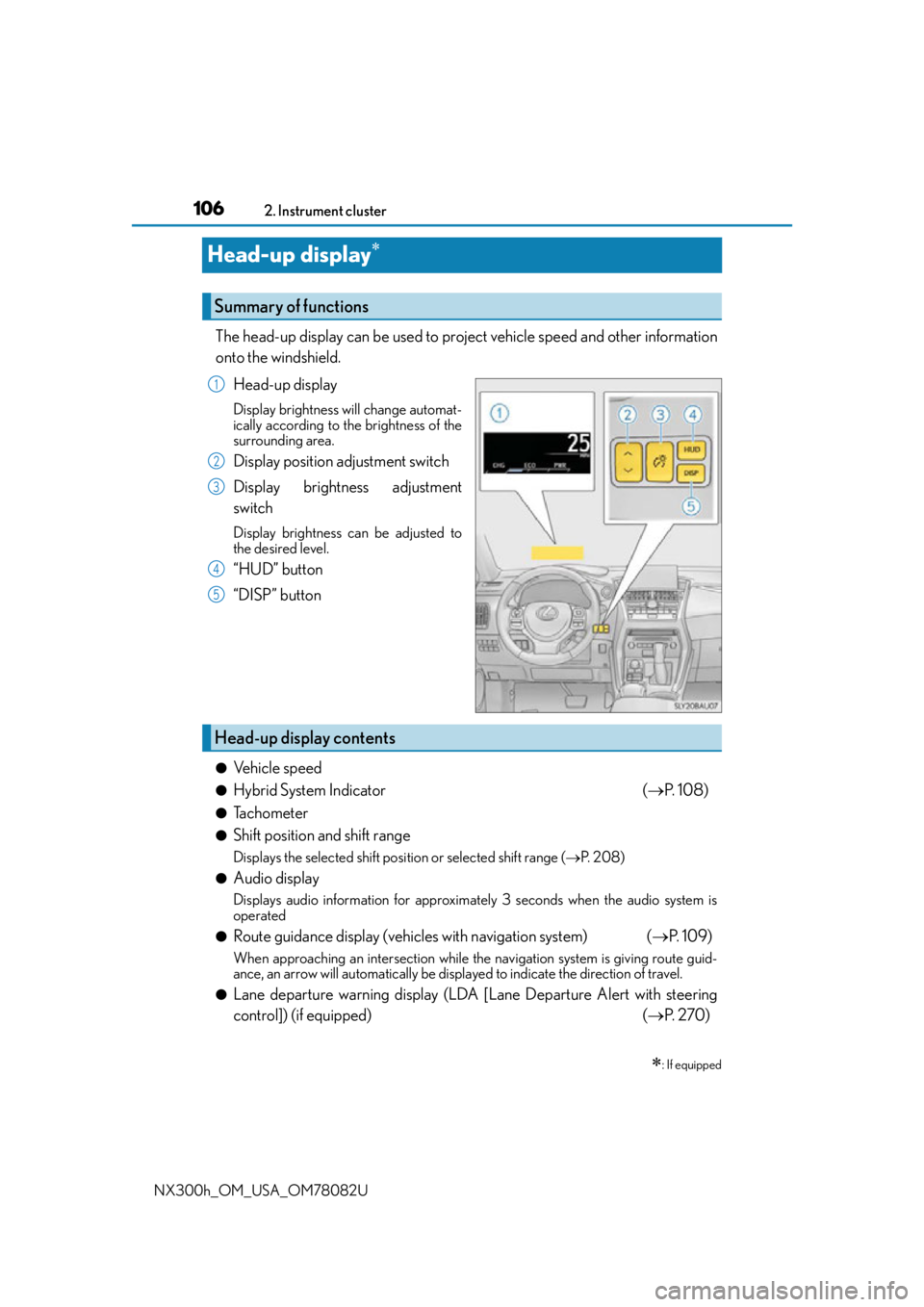
Head-up display
Display brightness will change automat-
ically according to the brightness of the
surrounding area.
Display position adjustment switch
Display brightness adjustment
switch
Display brightness can be adjusted to
the desired level.
“HUD” button
“DISP” button
●Vehicle speed
●Hybrid System Indicator ( P. 1 0 8 )
●Tachometer
●Shift position and shift range
Displays the selected shift posi tion or selected shift range (P. 2 0 8 )
●Audio display
Displays audio information for approximately 3 seconds when the audio system is
operated
●Route guidance display (vehicles with navigation system) ( P. 1 0 9 )
When approaching an intersec tion while the navigation system is giving route guid-
ance, an arrow will automatically be displayed to indicate the direction of travel.
●Lane departure warning display (LDA [Lane Departure Alert with steering
control]) (if equipped) ( P. 2 7 0 )
: If equipped
Summary of functions
1
2
3
4
5
Head-up display contents
Page 173 of 680

173
4Driving
NX300h_OM_USA_OM78082U
4-1. Before drivingDriving the vehicle ....................... 174
Cargo and luggage .................... 182
Vehicle load limits ....................... 186
Trailer towing (vehicles with towing package) ....................... 187
Trailer towing (vehicles without towing package) ...... 199
Dinghy towing............................. 200
4-2. Driving procedures Power (ignition) switch.............. 201
EV drive mode ........................... 206
Hybrid transmission ................. 208
Turn signal lever ........................... 212
Parking brake ................................ 213
Brake Hold ..................................... 216
ASC (Active Sound Control) ......... 218
4-3. Operating the lights and wipers
Headlight switch .......................... 219
Automatic High Beam .............223
Fog light switch............................ 227
Windshield wipers and washer..........................................228
Rear window wiper and washer..........................................234 4-4. Refueling
Opening the fuel tank cap ..... 236
4-5. Using the driving support systems
Dynamic radar cruise control ......................................... 240
Dynamic radar cruise control with full-speed
range ............................................ 253
Cruise control ..............................267
LDA (Lane Departure Alert with steering control) ............ 270
Intuitive parking assist .............. 279
Lexus parking assist monitor ........................................ 287
Driving mode select switch ...........................................303
Driving assist systems...............305
PCS (Pre-Collision System)........... 310
BSM (Blind Spot Monitor) ...... 316
4-6. Driving tips Hybrid vehicle driving tips ................................................. 324
Winter driving tips ..................... 326
Utility vehicle precautions ......330
Page 206 of 680
2064-2. Driving procedures
NX300h_OM_USA_OM78082U
EV drive mode
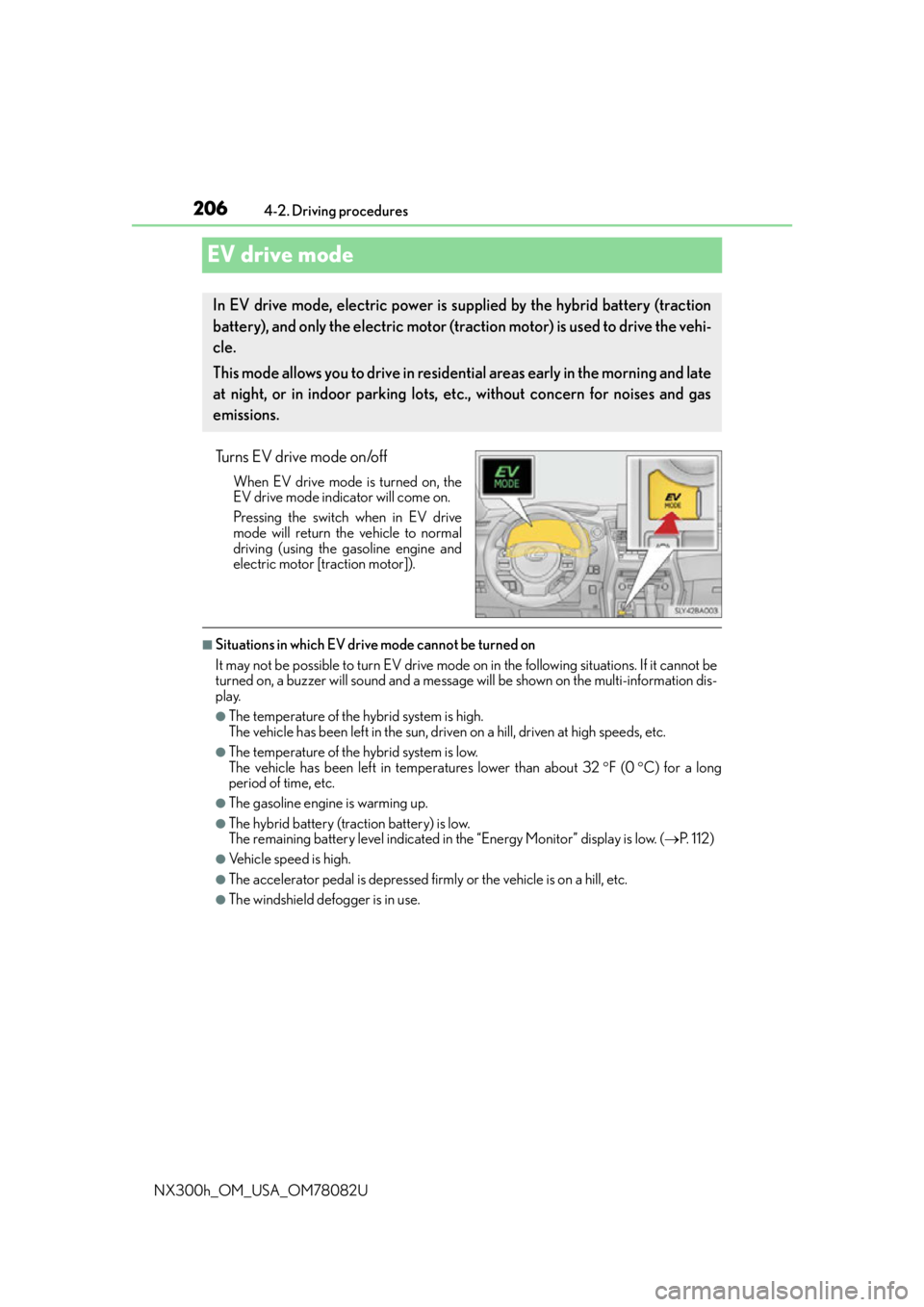
Turns EV drive mode on/off
When EV drive mode is turned on, the
EV drive mode indicator will come on.
Pressing the switch when in EV drive
mode will return the vehicle to normal
driving (using the gasoline engine and
electric motor [traction motor]).
■Situations in which EV drive mode cannot be turned on
It may not be possible to turn EV drive mode on in the following situations. If it cannot be
turned on, a buzzer will sound and a message will be shown on the multi-information dis-
play.
●The temperature of the hybrid system is high.
The vehicle has been left in the sun, driven on a hill, driven at high speeds, etc.
●The temperature of the hybrid system is low.
The vehicle has been left in temperatures lower than about 32 F (0 C) for a long
period of time, etc.
●The gasoline engine is warming up.
●The hybrid battery (traction battery) is low.
The remaining battery level indicated in the “Energy Monitor” display is low. ( P. 112)
●Vehicle speed is high.
●The accelerator pedal is depressed firm ly or the vehicle is on a hill, etc.
●The windshield defogger is in use.
In EV drive mode, electric power is su pplied by the hybrid battery (traction
battery), and only the electric motor (tra ction motor) is used to drive the vehi-
cle.
This mode allows you to drive in residential areas early in the morning and late
at night, or in indoor parking lots, etc., without concern for noises and gas
emissions.
Page 221 of 680
2214-3. Operating the lights and wipers
4
Driving
NX300h_OM_USA_OM78082U
■Daytime running light system
●To make your vehicle more visible to other drivers during daytime driving, the daytime
running lights turn on automatically (at an in creased intensity) whenever the hybrid sys-
tem is started and the parking brake is releas ed with the headlight switch off or in the
“AUTO” position. (Illuminate brighter than the front parking lights.) Daytime running
lights are not designed for use at night.
Type A only: Daytime running lights can be turned off by operating the switch.
●If a turn signal light is in use, the daytime running light, on the same side, is turned off.
For emergency flashers, both are turned off.
●Compared to turning on the headlights, the daytime running light system offers greater
durability and consumes less electricity, so it can help improve fuel economy.
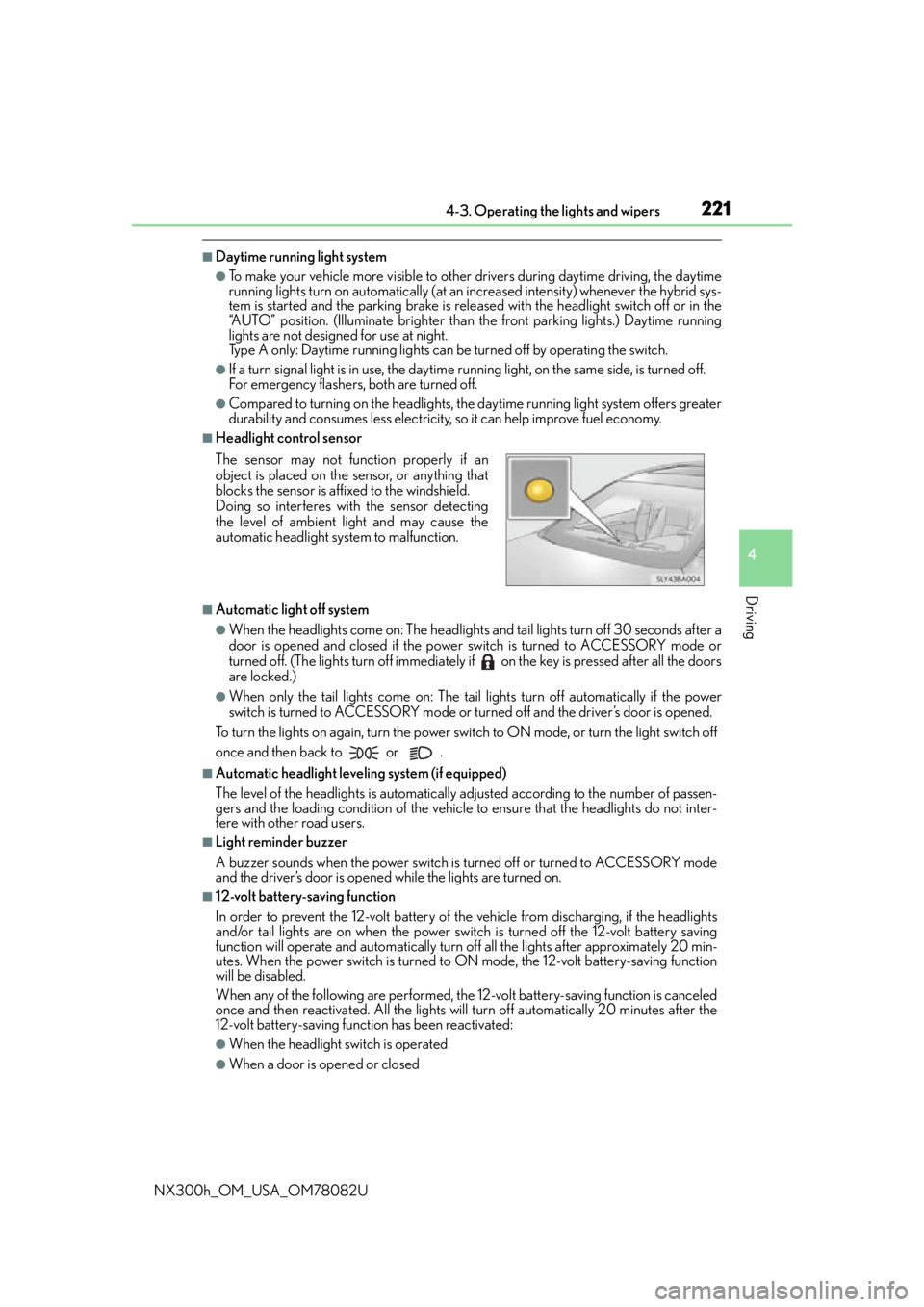
■Headlight control sensor
■Automatic light off system
●When the headlights come on: The headlights and tail lights turn off 30 seconds after a
door is opened and closed if the power switch is turned to ACCESSORY mode or
turned off. (The lights turn off immediately if on the key is pressed after all the doors
are locked.)
●When only the tail lights come on: The tail lights turn off automatically if the power
switch is turned to ACCESSORY mode or turned off and the driver’s door is opened.
To turn the lights on again, turn the power switch to ON mode, or turn the light switch off
once and then back to or .
■Automatic headlight leveling system (if equipped)
The level of the headlights is automatically ad justed according to the number of passen-
gers and the loading condition of the vehicle to ensure that the headlights do not inter-
fere with other road users.
■Light reminder buzzer
A buzzer sounds when the power switch is turned off or turned to ACCESSORY mode
and the driver’s door is opened while the lights are turned on.
■12-volt battery-saving function
In order to prevent the 12-volt battery of the vehicle from discharging, if the headlights
and/or tail lights are on when the power switch is turned off the 12-volt battery saving
function will operate and automatically turn off all the lights after approximately 20 min-
utes. When the power switch is turned to ON mode, the 12-volt battery-saving function
will be disabled.
When any of the following are performed, the 12-volt battery-saving function is canceled
once and then reactivated. All the lights w ill turn off automatically 20 minutes after the
12-volt battery-saving function has been reactivated:
●When the headlight switch is operated
●When a door is opened or closed
The sensor may not function properly if an
object is placed on the sensor, or anything that
blocks the sensor is affixed to the windshield.
Doing so interferes with the sensor detecting
the level of ambient light and may cause the
automatic headlight system to malfunction.