brakes LEXUS NX300h 2018 Owner's Manual
[x] Cancel search | Manufacturer: LEXUS, Model Year: 2018, Model line: NX300h, Model: LEXUS NX300h 2018Pages: 460, PDF Size: 13.57 MB
Page 261 of 460
2614-6. Driving tips
LEXUS NX300h Owners Manu-
al_USA_OM78212U 4
Driving WARNING●
Always check your brakes for effec-
tiveness immediately after driving in
sand, mud, water or snow.●
After driving through tall grass, mud,
rock, sand, water, etc., check that there
is no grass, bush, paper, rags, stone,
sand, etc. adhering or trapped to the
underbody. Clear off any such matter
from the underbody. If the vehicle is
used with these materials trapped or
adhering to the underbody, a break-
down or fire could occur.●
When driving off-road or in rugged
terrain, do not drive at excessive
speeds, jump, make sh arp turns, strike
objects, etc. This may cause loss of
control or vehicle rollover causing
death or serious injury. You are also
risking expensive damage to your
vehicle’s suspension and chassis.
NOTICE■
To prevent water damage
Take all necessary sa fety measures to
ensure that water da mage to the hybrid
battery (traction battery), hybrid system
or other components does not occur. ●
Water entering the engine compart-
ment may cause severe damage to the
hybrid system. Water entering the inte-
rior may cause the hybrid battery
stowed under the rear seats to short
circuit.
●
Water entering the hybrid transmis-
sion and rear electr ic motor (traction
motor) will cause deterioration in
transmission quality. The malfunction
indicator may come on, and the vehi-
cle may not be drivable.
●
Water can wash the grease from wheel
bearings, causing rusting and prema-
ture failure, and may also enter the
hybrid transmission case, reducing the
gear oil’s lubricating qualities. ■
When you drive through water
If driving through water, such as when
crossing shallow streams, first check the
depth of the water and the bottom of the
riverbed for firmness. Drive slowly and
avoid deep water. ■
Inspection after off-road driving ●
Sand and mud that has accumulated
around brake discs may affect braking
efficiency and may damage brake sys-
tem components. ●
Always perform a maintenance
inspection after each day of off-road
driving that has taken you through
rough terrain, sand, mud, or water. For
scheduled maintena nce information,
refer to the “Warranty and Services
Guide/Owner’s Manual Supplement/
Scheduled Maintenance”.
Page 321 of 460
3216-2. Maintenance
LEXUS NX300h Owners Manu-
al_USA_OM78212U 6
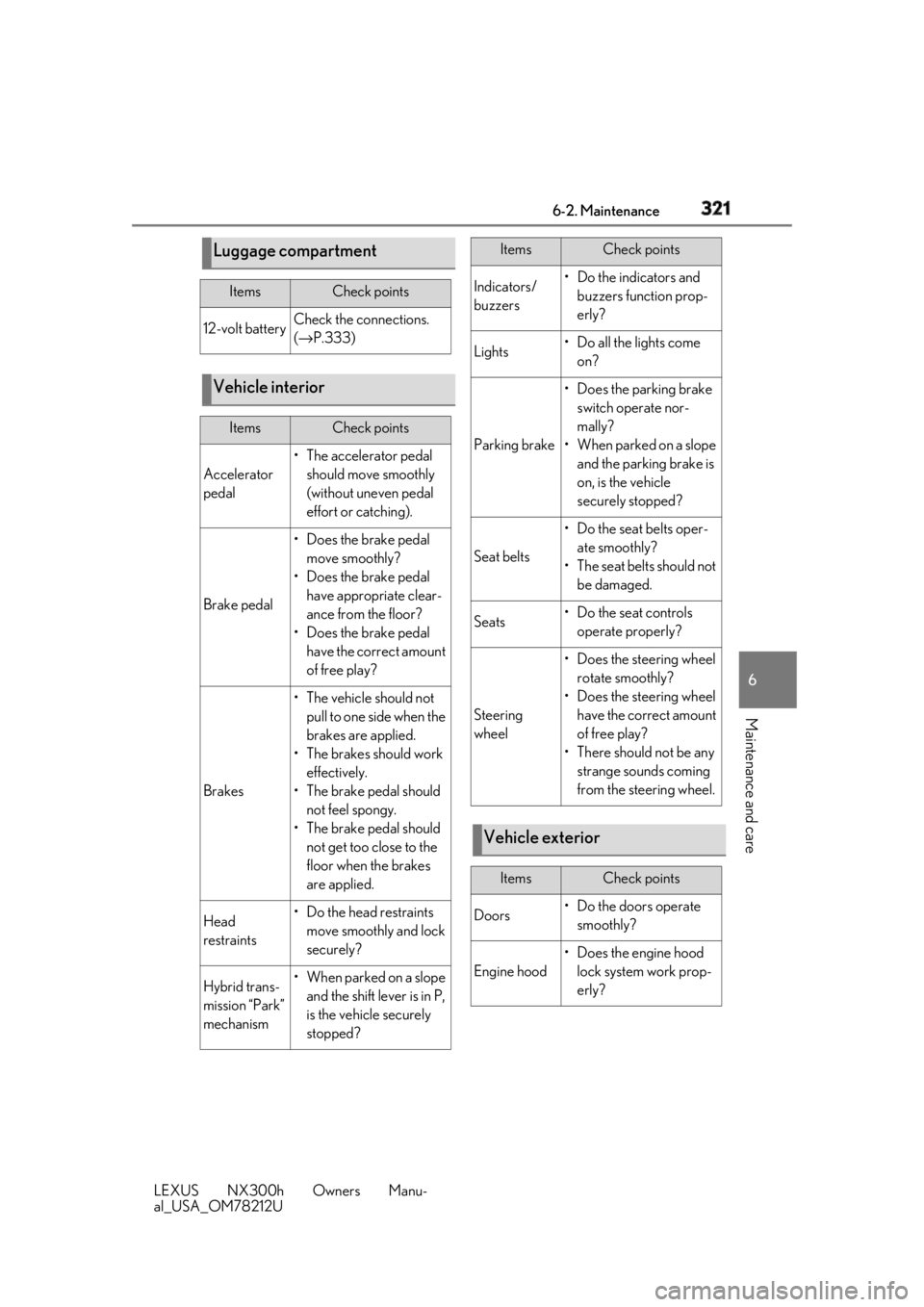
Maintenance and care Luggage compartment Items Check points
12-volt battery Check the connections.
( → P.333)
Vehicle interior Items Check points
Accelerator
pedal • The accelerator pedal
should move smoothly
(without uneven pedal
effort or catching).
Brake pedal • Does the brake pedal
move smoothly?
• Does the brake pedal
have appropriate clear-
ance from the floor?
• Does the brake pedal
have the correct amount
of free play?
Brakes •The vehicle should not
pull to one side when the
brakes are applied.
• The brakes should work
effectively.
• The brake pedal should
not feel spongy.
• The brake pedal should
not get too close to the
floor when the brakes
are applied.
Head
restraints • Do the head restraints
move smoothly and lock
securely?
Hybrid trans-
mission “Park”
mechanism • When parked on a slope
and the shift lever is in P,
is the vehicle securely
stopped? Indicators/
buzzers • Do the indicators and
buzzers function prop-
erly?
Lights • Do all the lights come
on?
Parking brake • Does the parking brake
switch operate nor-
mally?
• When parked on a slope
and the parking brake is
on, is the vehicle
securely stopped?
Seat belts • Do the seat belts oper-
ate smoothly?
• The seat belts should not
be damaged.
Seats • Do the seat controls
operate properly?
Steering
wheel • Does the steering wheel
rotate smoothly?
• Does the steering wheel
have the correct amount
of free play?
• There should not be any
strange sounds coming
from the steering wheel.
Vehicle exterior Items Check points
Doors • Do the doors operate
smoothly?
Engine hood • Does the engine hood
lock system work prop-
erly?Items Check points
Page 362 of 460
362 7-2. Steps to take in an emergency
LEXUS NX300h Owners Manu-
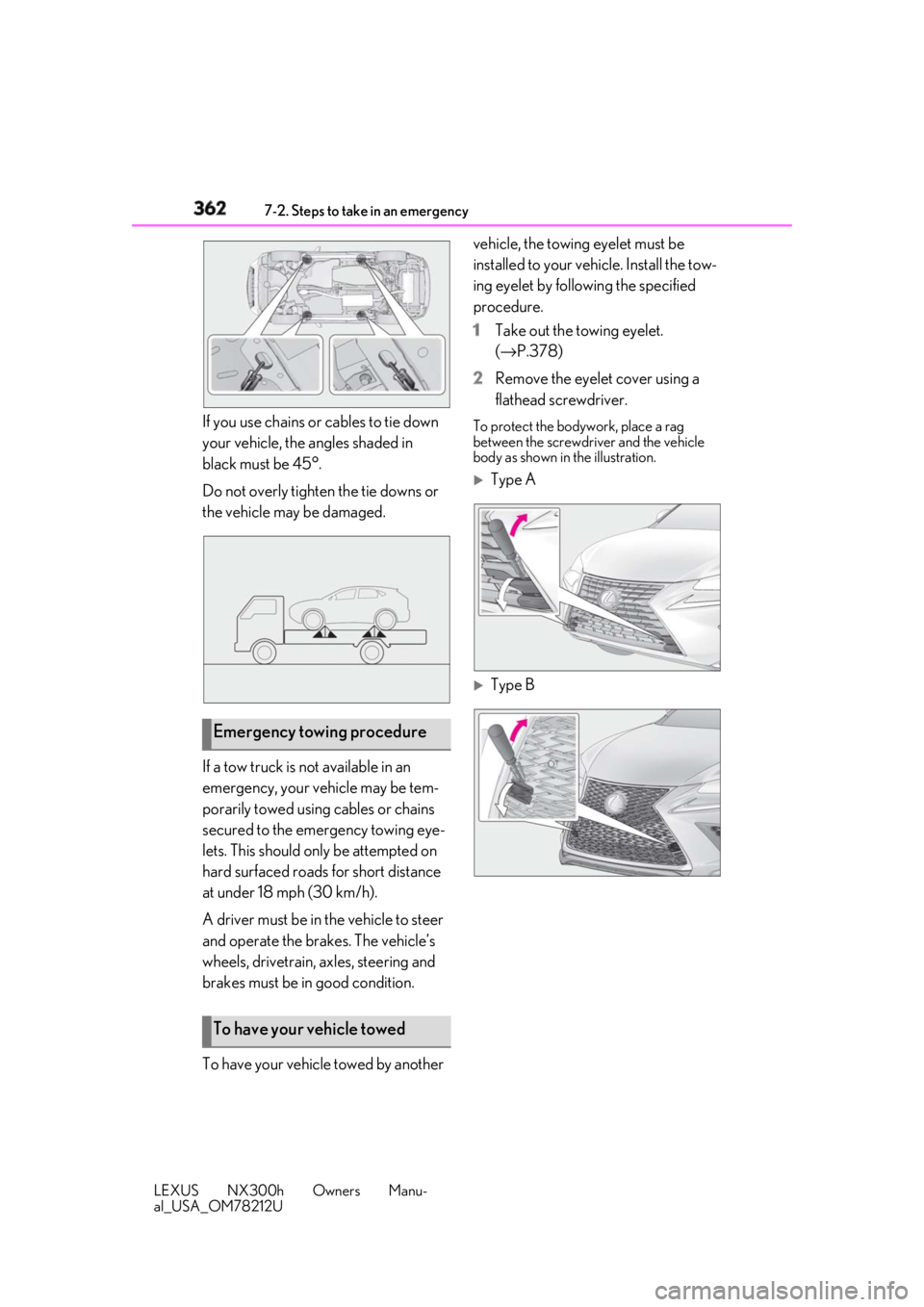
al_USA_OM78212U If you use chains or cables to tie down
your vehicle, the angles shaded in
black must be 45°.
Do not overly tighten the tie downs or
the vehicle may be damaged.
If a tow truck is not available in an
emergency, your vehicle may be tem-
porarily towed using cables or chains
secured to the emergency towing eye-
lets. This should only be attempted on
hard surfaced roads for short distance
at under 18 mph (30 km/h).
A driver must be in the vehicle to steer
and operate the brakes. The vehicle’s
wheels, drivetrain, ax les, steering and
brakes must be in good condition.
To have your vehicle towed by another vehicle, the towing eyelet must be
installed to your vehicle. Install the tow-
ing eyelet by following the specified
procedure.
1 Take out the towing eyelet.
( → P.378)
2 Remove the eyelet cover using a
flathead screwdriver. To protect the bodywork, place a rag
between the screwdriver and the vehicle
body as shown in the illustration.
Type A
Type B
Emergency towing procedure
To have your vehicle towed
Page 363 of 460
3637-2. Steps to take in an emergency
LEXUS NX300h Owners Manu-
al_USA_OM78212U 7
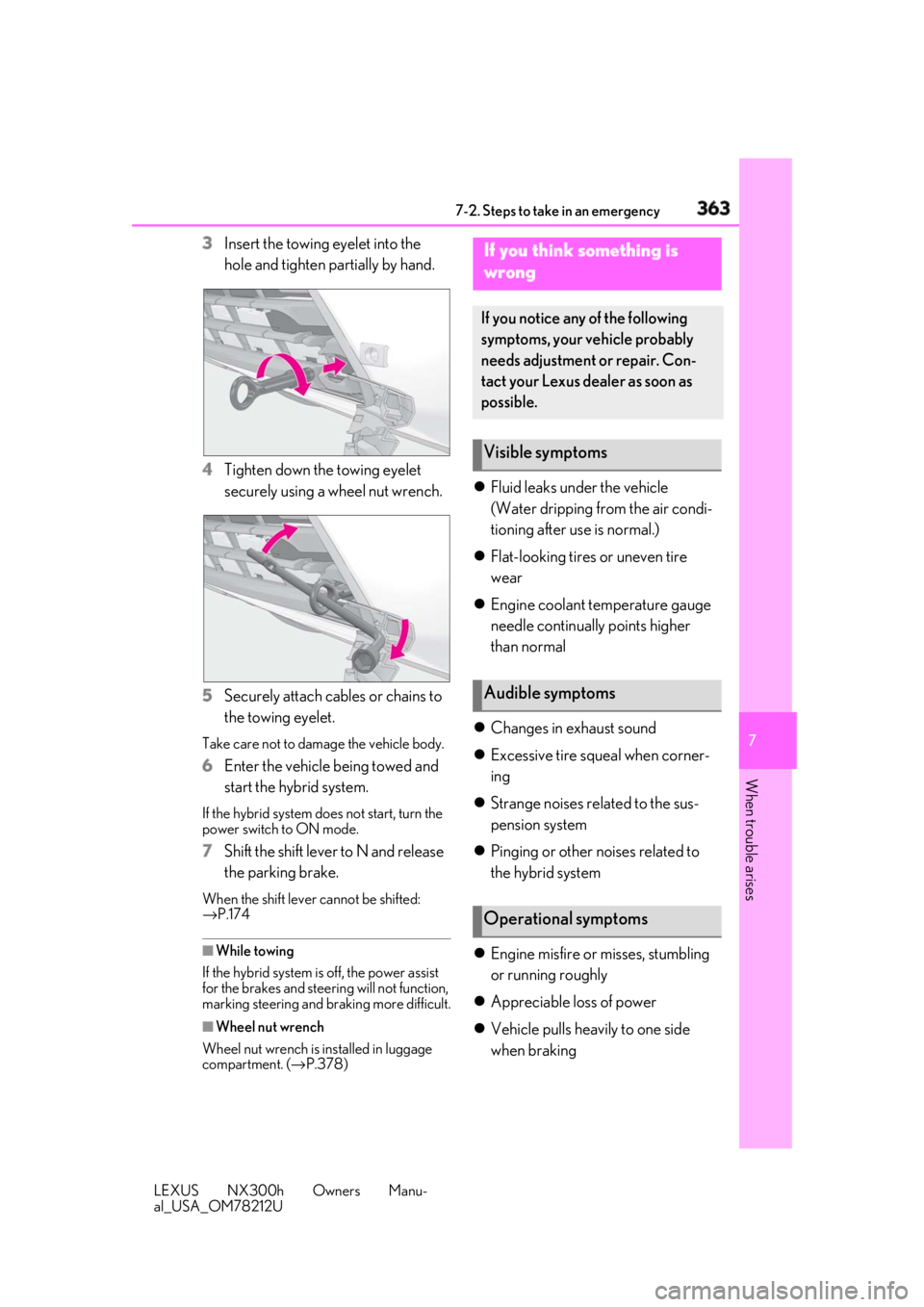
When trouble arises 3 Insert the towing eyelet into the
hole and tighten partially by hand.
4 Tighten down the towing eyelet
securely using a wheel nut wrench.
5 Securely attach cables or chains to
the towing eyelet.Take care not to damage the vehicle body.
6 Enter the vehicle being towed and
start the hybrid system.If the hybrid system does not start, turn the
power switch to ON mode.
7 Shift the shift lever to N and release
the parking brake.When the shift lever cannot be shifted:
→ P.174
■
While towing
If the hybrid system is off, the power assist
for the brakes and steering will not function,
marking steering and braking more difficult.
■
Wheel nut wrench
Wheel nut wrench is installed in luggage
compartment. ( → P.378) Fluid leaks under the vehicle
(Water dripping from the air condi-
tioning after use is normal.)
Flat-looking tires or uneven tire
wear
Engine coolant temperature gauge
needle continually points higher
than normal
Changes in exhaust sound
Excessive tire squeal when corner-
ing
Strange noises related to the sus-
pension system
Pinging or other noises related to
the hybrid system
Engine misfire or misses, stumbling
or running roughly
Appreciable loss of power
Vehicle pulls heavily to one side
when brakingIf you think something is
wrong If you notice any of the following
symptoms, your vehicle probably
needs adjustment or repair. Con-
tact your Lexus dealer as soon as
possible.
Visible symptoms
Audible symptoms
Operational symptoms
Page 373 of 460
3737-2. Steps to take in an emergency
LEXUS NX300h Owners Manu-
al_USA_OM78212U 7
When trouble arises WARNING●
Avoid abrupt maneuvering and brak-
ing. If the vehicle tires deteriorate, you
could lose control of the steering
wheel or the brakes.■
If a blowout or sudden air leakage
should occur
The tire pressure warning system may
not activate immediately. ■
Maintenance of the tires
Each tire, including the spare (if pro-
vided), should be checked monthly when
cold and inflated to the inflation pressure
recommended by the vehicle manufac-
turer on the vehicle placard or tire infla-
tion pressure label (tire and load
information label). (I f your vehicle has
tires of a different size than the size indi-
cated on the vehicle placard or tire infla-
tion pressure label [tire and load
information label], yo u should determine
the proper tire infl ation pressure for
those tires.)
As an added safety feature, your vehicle
has been equipped with a tire pressure
monitoring system (TPMS-tire pressure
warning system) that illuminates a low
tire pressure telltale (tire pressure warn-
ing light) when one or more of your tires
is significantly under-inflated. Accord-
ingly, when the low tire pressure telltale
(tire pressure warnin g light) illuminates,
you should stop and check your tires as
soon as possible, and inflate them to the
proper pressure. Driving on a signifi-
cantly under-inflated tire causes the tire
to overheat and can lead to tire failure.
Under-inflation also reduces fuel effi-
ciency and tire tread life, and may affect
the vehicle’s handling and stopping abil-
ity. Please note that the TPMS (tire pressure
warning system) is not a substitute for
proper tire maintenance, and it is the
driver’s responsibility to maintain correct
tire pressure, even if under-inflation has
not reached the level to trigger illumina-
tion of the TPMS low tire pressure telltale
(tire pressure warning light).
Your vehicle has also been equipped with
a TPMS (tire pressure warning system)
malfunction indicator to indicate when
the system is not operating properly. The
TPMS (tire pressure warning system)
malfunction indicator is combined with
the low tire pressure telltale (tire pres-
sure warning light) . When the system
detects a malfunction, the telltale will
flash for approximately one minute and
then remain continuously illuminated.
This sequence will continue upon subse-
quent vehicle start-ups as long as the
malfunction exists. When the malfunction
indicator is illuminated, the system may
not be able to detect or signal low tire
pressure as intended.
TPMS (tire pressure warning system)
malfunctions may occur for a variety of
reasons, including the installation of
replacement or alternate tires or wheels
on the vehicle that prevent the TPMS
(tire pressure warning system) from func-
tioning properly. Always check the
TPMS (tire pressure warning system)
malfunction telltale after replacing one
or more tires or wheels on your vehicle to
ensure that the replacement or alternate
tires and wheels allow the TPMS (tire
pressure warning system) to continue to
function properly.
NOTICE
■
To ensure the tire pressure warning
system operates properly
Do not install tires with different specifi-
cations or makers, as the tire pressure
warning system may not operate prop-
erly.
Page 381 of 460
3817-2. Steps to take in an emergency
LEXUS NX300h Owners Manu-
al_USA_OM78212U 7
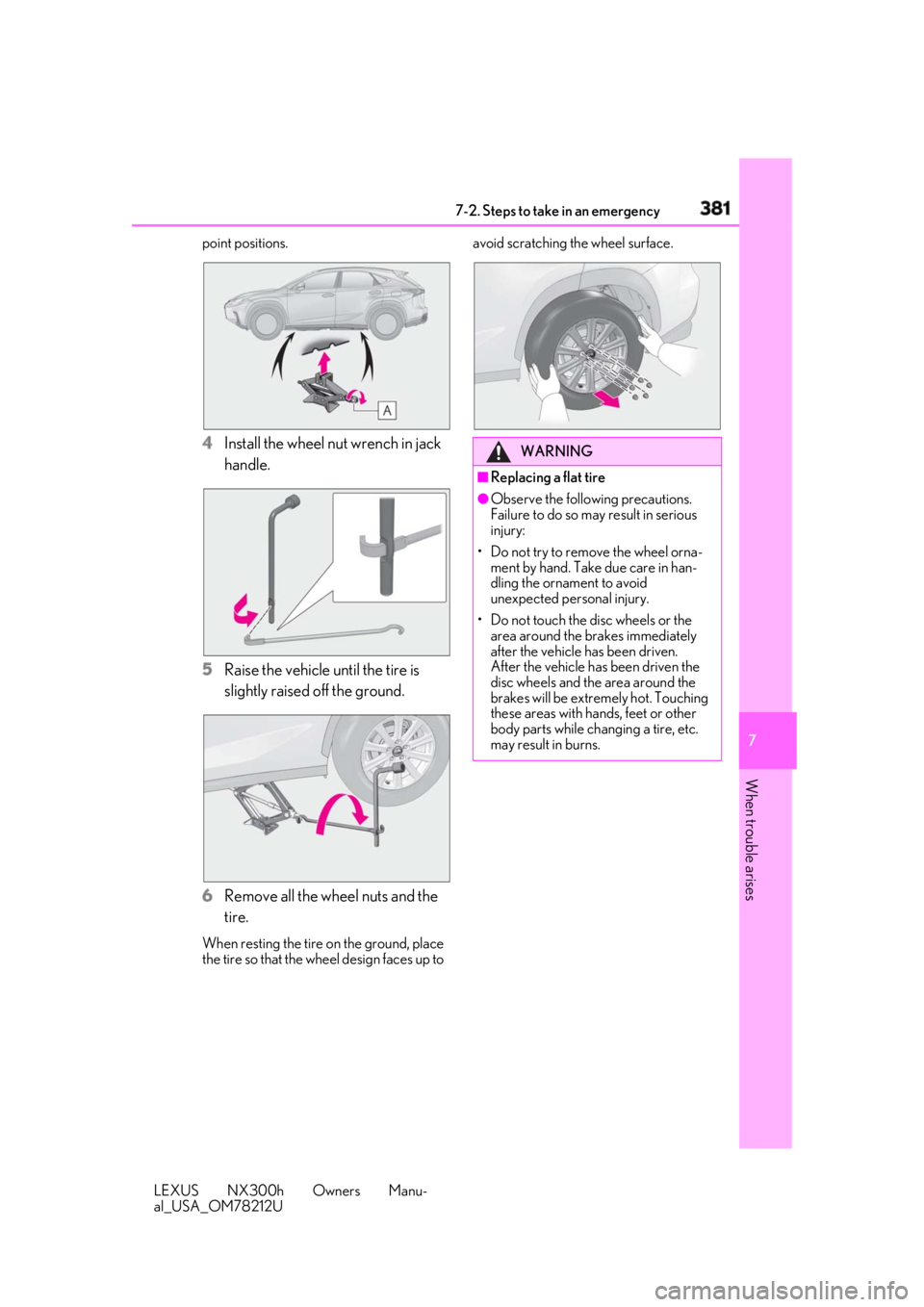
When trouble arises point positions.
4 Install the wheel nut wrench in jack
handle.
5 Raise the vehicle until the tire is
slightly raised off the ground.
6 Remove all the wheel nuts and the
tire.When resting the tire on the ground, place
the tire so that the wh eel design faces up to avoid scratching the wheel surface.
WARNING■
Replacing a flat tire ●
Observe the following precautions.
Failure to do so may result in serious
injury:
• Do not try to remove the wheel orna-
ment by hand. Take due care in han-
dling the ornament to avoid
unexpected personal injury.
• Do not touch the disc wheels or the
area around the brakes immediately
after the vehicle has been driven.
After the vehicle has been driven the
disc wheels and the area around the
brakes will be extremely hot. Touching
these areas with hands, feet or other
body parts while changing a tire, etc.
may result in burns.
Page 405 of 460
4058-1. Specifications
LEXUS NX300h Owners Manu-
al_USA_OM78212U 8
Vehicle specifications *
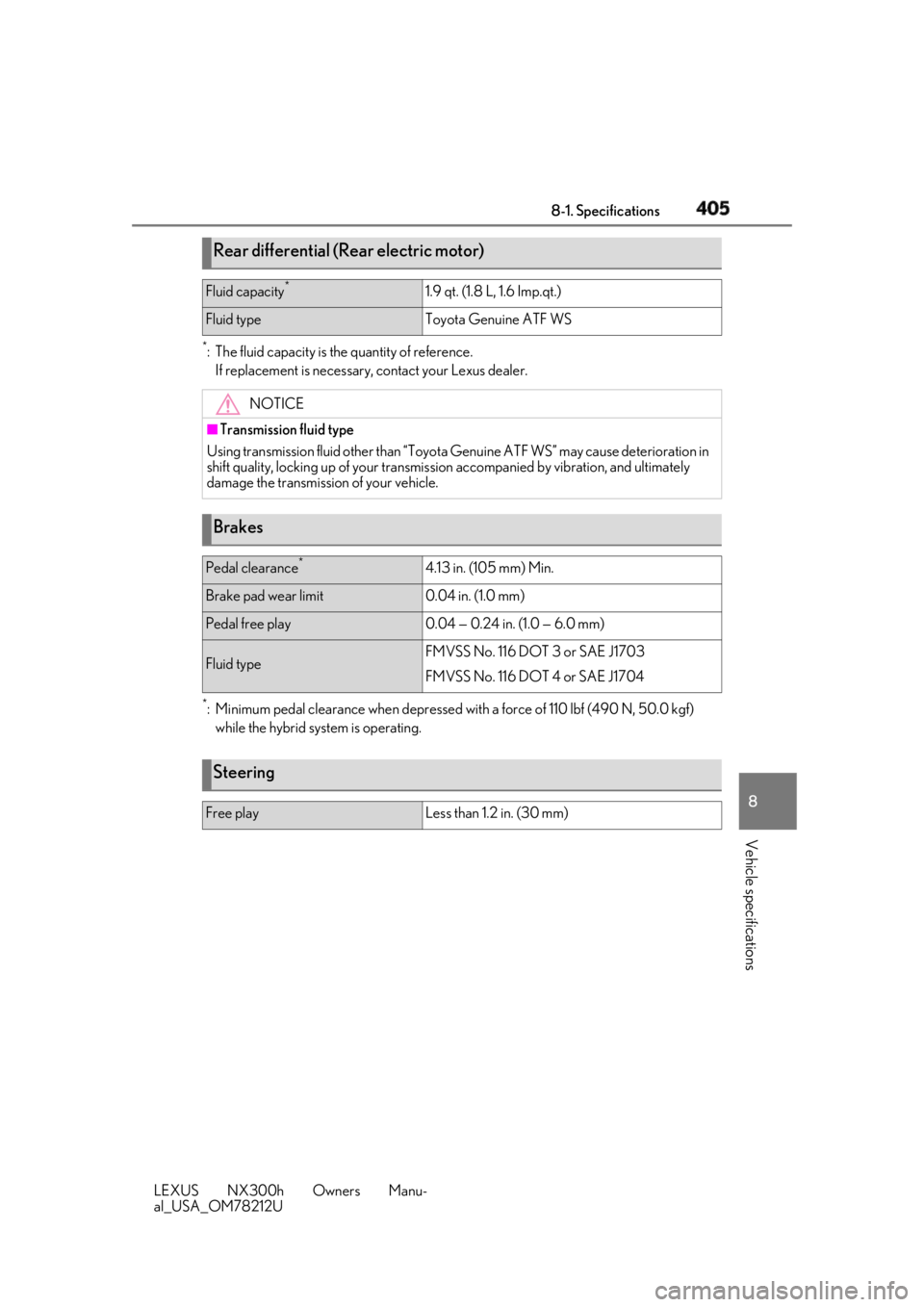
: The fluid capacity is the quantity of reference.
If replacement is necessary, contact your Lexus dealer.
*
: Minimum pedal clearance when depressed with a force of 110 lbf (490 N, 50.0 kgf)
while the hybrid system is operating.Rear differential (Rear electric motor) Fluid capacity *
1.9 qt. (1.8 L, 1.6 Imp.qt.)
Fluid type Toyota Genuine ATF WS
NOTICE■
Transmission fluid type
Using transmission fluid other than “Toyota Genuine ATF WS” may ca use deterioration in
shift quality, locking up of your transmission accompanied by vibration, and ultimately
damage the transmission of your vehicle.
Brakes Pedal clearance *
4.13 in. (105 mm) Min.
Brake pad wear limit 0.04 in. (1.0 mm)
Pedal free play 0.04 — 0.24 in. (1.0 — 6.0 mm)
Fluid type FMVSS No. 116 DOT 3 or SAE J1703
FMVSS No. 116 DOT 4 or SAE J1704
Steering Free play Less than 1.2 in. (30 mm)
Page 414 of 460
414 8-1. Specifications
LEXUS NX300h Owners Manu-
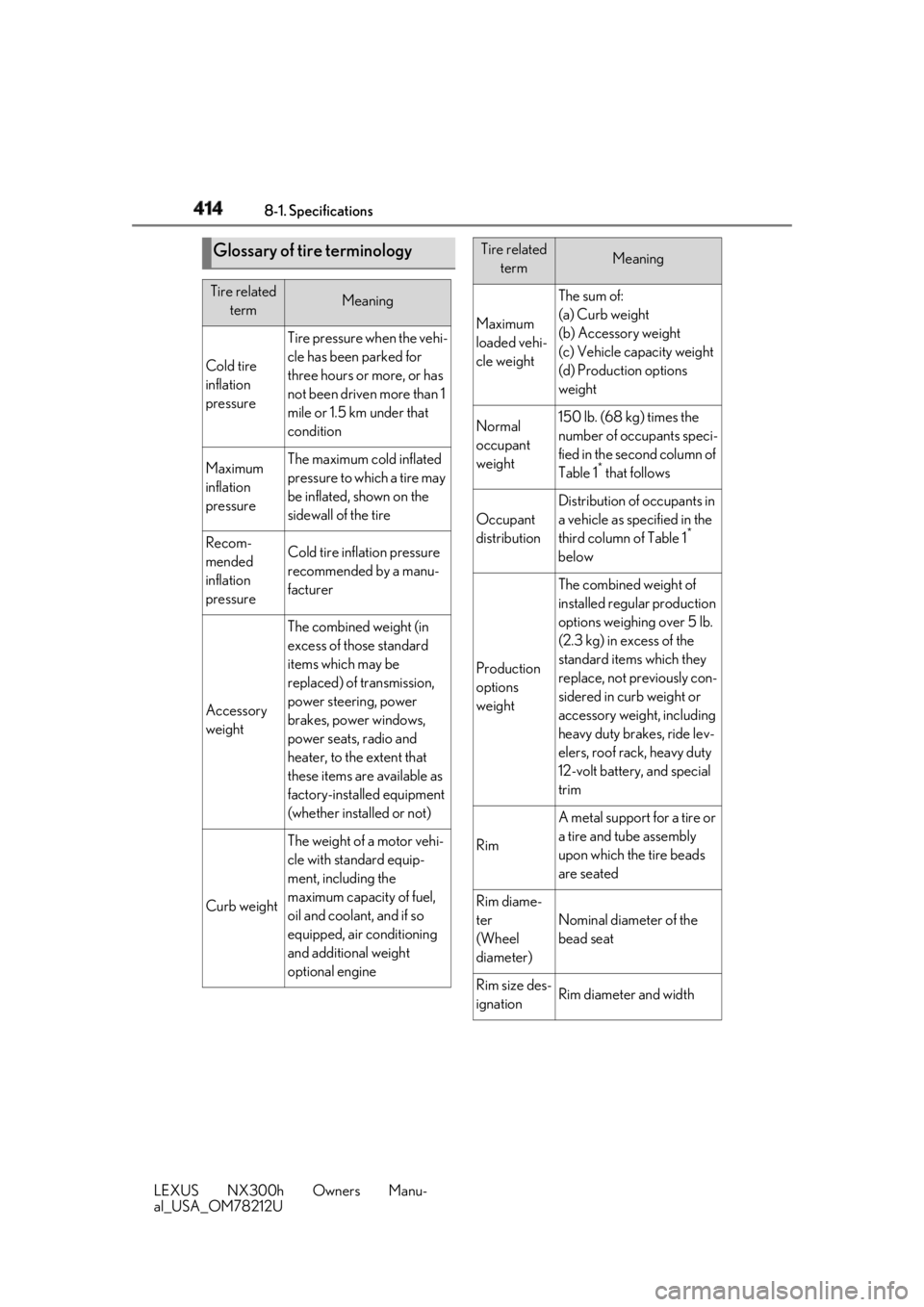
al_USA_OM78212U Glossary of tire terminology Tire related
term Meaning
Cold tire
inflation
pressure Tire pressure when the vehi-
cle has been parked for
three hours or more, or has
not been driven more than 1
mile or 1.5 km under that
condition
Maximum
inflation
pressure The maximum cold inflated
pressure to which a tire may
be inflated, shown on the
sidewall of the tire
Recom-
mended
inflation
pressure Cold tire inflation pressure
recommended by a manu-
facturer
Accessory
weight The combined weight (in
excess of those standard
items which may be
replaced) of transmission,
power steering, power
brakes, power windows,
power seats, radio and
heater, to the extent that
these items are available as
factory-installed equipment
(whether installed or not)
Curb weight The weight of a motor vehi-
cle with standard equip-
ment, including the
maximum capacity of fuel,
oil and coolant, and if so
equipped, air conditioning
and additional weight
optional engine Maximum
loaded vehi-
cle weight The sum of:
(a) Curb weight
(b) Accessory weight
(c) Vehicle capacity weight
(d) Production options
weight
Normal
occupant
weight 150 lb. (68 kg) times the
number of occupants speci-
fied in the second column of
Table 1 *
that follows
Occupant
distribution Distribution of occupants in
a vehicle as specified in the
third column of Table 1 *
below
Production
options
weight The combined weight of
installed regular production
options weighing over 5 lb.
(2.3 kg) in excess of the
standard items which they
replace, not previously con-
sidered in curb weight or
accessory weight, including
heavy duty brakes, ride lev-
elers, roof rack, heavy duty
12-volt battery, and special
trim
Rim A metal support for a tire or
a tire and tube assembly
upon which the tire beads
are seated
Rim diame-
ter
(Wheel
diameter) Nominal diameter of the
bead seat
Rim size des-
ignation Rim diameter and widthTire related
term Meaning