brake LEXUS NX300h 2020 Workshop Manual
[x] Cancel search | Manufacturer: LEXUS, Model Year: 2020, Model line: NX300h, Model: LEXUS NX300h 2020Pages: 484, PDF Size: 15.45 MB
Page 245 of 484

2454-5. Using the driving support systems
LEXUS NX300h Owners Manual_USA_M78530_en
4
Driving
lane
●Vehicles with small rear ends (trailers
with no load on board, etc.)
●Motorcycles travelin g in the same lane
●When water or snow thrown up by the
surrounding vehicles hinders the detect-
ing of the sensor
●When your vehicle is pointing upwards
(caused by a heavy load in the luggage
compartment, etc.)
●Preceding vehicle has an extremely high
ground clearance
■Conditions under which the vehicle-to-
vehicle distance control mode may not
function correctly
In the case of the following conditions,
operate the brake pedal (or accelerator
pedal, depending on the situation) as nec-
essary.
As the sensor may not be able to correctly
detect vehicles ahead, the system may not
operate properly.
●When the road curves or when the lanes are narrow
●When steering wheel operation or your
position in the lane is unstable
●When the vehicle ahead of you deceler-
ates suddenly
●When driving on a road surrounded by a
structure, such as in a tunnel or on a
bridge
●While the vehicle speed is decreasing to
the set speed after the vehicle acceler-
ates by depressing the accelerator pedal
Page 249 of 484

2494-5. Using the driving support systems
LEXUS NX300h Owners Manual_USA_M78530_en
4
Driving
Lexus dealer.
■Sensor detectio n information
●The sensor’s detection areas are limited
to the areas around the vehicle’s bumper.
●Certain vehicle conditions and the sur-
rounding environment may affect the
ability of a sensor to correctly detect an
obstacle. Particular instances where this
may occur are listed below.
• There is dirt, snow or ice on the sensor. (Wiping the sensors will resolve this
problem.)
• The sensor is frozen. (Thawing the area will resolve this problem.)
In especially cold weather, if a sensor is
frozen the screen may show an abnormal
display, or obstacles may not be
detected.
• The sensor is covered in any way.
• The vehicle is leaning considerably to one side.
• On an extremely bumpy road, on an incline, on gravel, or on grass.
• The vicinity of the vehicle is noisy due to vehicle horns, motorcycle engines, air
brakes of large vehicles, or other loud
noises producing ultrasonic waves.
• There is another vehicle equipped with parking assist sensors in the vicinity.
• The sensor is coated with a sheet of spray or heavy rain.
• The vehicle is equipped with a fender
pole or wireless antenna.
• Towing eyelets are installed.
• The bumper or sensor receives a strong impact.
• A backlit license plate, license plate holder, etc., are installed.
• The vehicle is approaching a tall or curved curb.
• In harsh sunlight or intense cold weather.
• The area directly under the bumpers is
not detected.
• If obstacles draw too close to the sensor.
• A non-genuine Lexus suspension (low- ered suspension etc.) is installed.
• People may not be detected if they are wearing certain types of clothing.
In addition to the examples above, there are
instances in which, because of their shape,
signs and other objects may be judged by a
sensor to be closer than they are.
●The shape of the obstacle may prevent a
sensor from detecting it. Pay particular
attention to the following obstacles:
• Wires, fences, ropes, etc.
• Cotton, snow and other materials that absorb sound waves
• Sharply-angled objects
• Low obstacles
• Tall obstacles with upper sections pro- jecting outwards in the direction of your
vehicle
●The following situations may occur
during use.
• Depending on the shape of the obstacle
and other factors, the detection distance
may shorten, or detection may be impos-
sible.
• Obstacles may not be detected if they are too close to the sensor.
• There will be a short delay between
obstacle detection and display. Even at
slow speeds, there is a possibility that the
obstacle will come within the sensor’s
detection areas befo re the display is
shown and the buzzer sounds.
• Thin posts or object s lower than the sen-
sor may not be detected when
approached, even if they have been
detected once.
• It might be difficult to hear beeps due to the volume of audio system or air flow
noise of the air conditioning system.
■Customization
Some functions can be customized.
(Customizable features: P.441)
WARNING
■When using the intuitive parking
assist
Observe the following precautions.
Failure to do so may result in the vehicle
being unable to be driven safely and pos-
sibly cause an accident.
●Do not use the sensor at speeds in
excess of 6 mph (10 km/h).
Page 250 of 484
2504-5. Using the driving support systems
LEXUS NX300h Owners Manual_USA_M78530_en
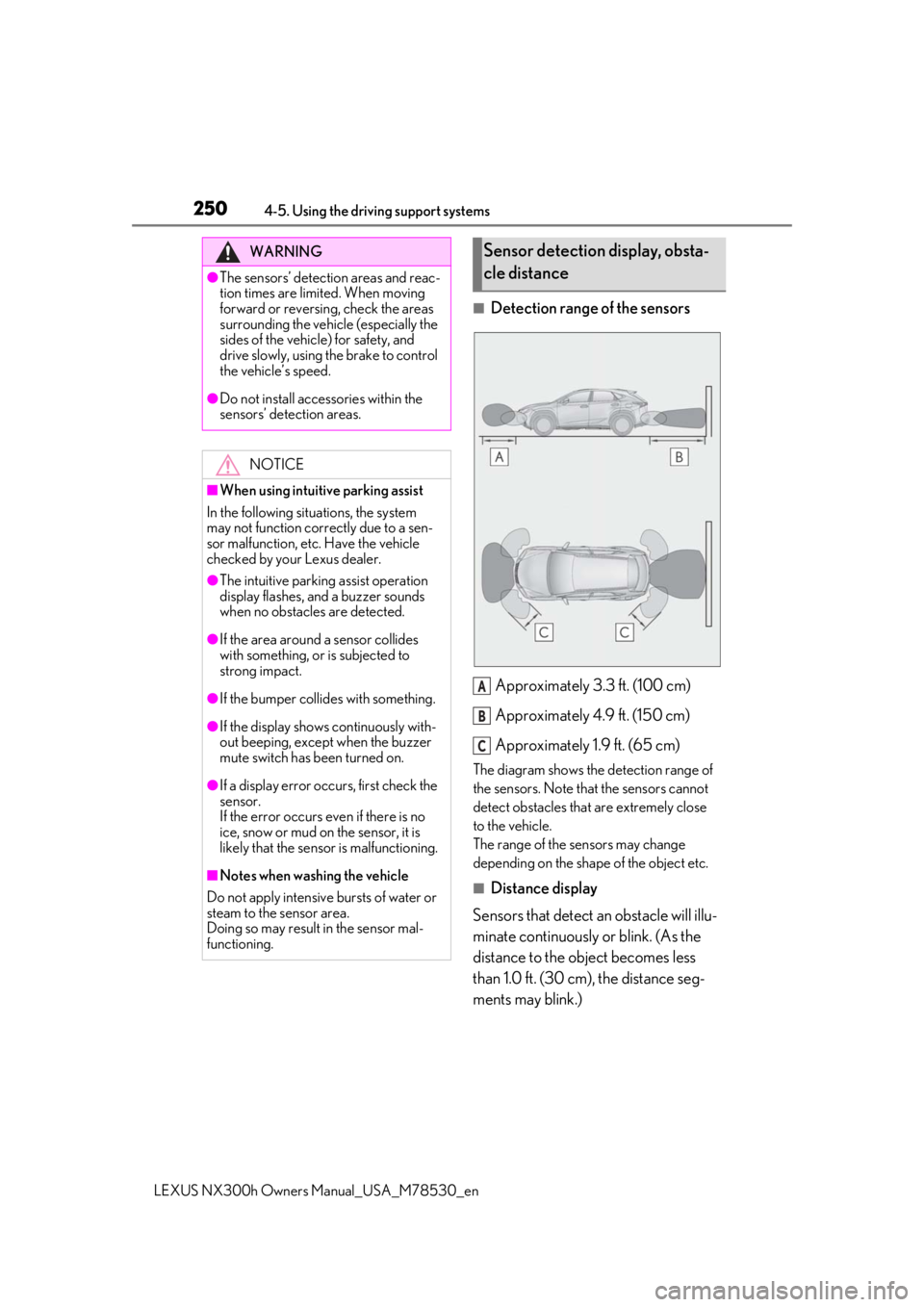
■Detection range of the sensorsApproximately 3.3 ft. (100 cm)
Approximately 4.9 ft. (150 cm)
Approximately 1.9 ft. (65 cm)
The diagram shows the detection range of
the sensors. Note that the sensors cannot
detect obstacles that are extremely close
to the vehicle.
The range of the sensors may change
depending on the shape of the object etc.
■Distance display
Sensors that detect an obstacle will illu-
minate continuously or blink. (As the
distance to the object becomes less
than 1.0 ft. (30 cm), the distance seg-
ments may blink.)
WARNING
●The sensors’ detection areas and reac-
tion times are limited. When moving
forward or reversing, check the areas
surrounding the vehicle (especially the
sides of the vehicle) for safety, and
drive slowly, using the brake to control
the vehicle’s speed.
●Do not install accessories within the
sensors’ detection areas.
NOTICE
■When using intuitive parking assist
In the following situations, the system
may not function correctly due to a sen-
sor malfunction, etc. Have the vehicle
checked by your Lexus dealer.
●The intuitive parking assist operation
display flashes, and a buzzer sounds
when no obstacles are detected.
●If the area around a sensor collides
with something, or is subjected to
strong impact.
●If the bumper collides with something.
●If the display shows continuously with-
out beeping, except when the buzzer
mute switch has been turned on.
●If a display error occurs, first check the
sensor.
If the error occurs even if there is no
ice, snow or mud on the sensor, it is
likely that the sensor is malfunctioning.
■Notes when washing the vehicle
Do not apply intensive bursts of water or
steam to the sensor area.
Doing so may result in the sensor mal-
functioning.
Sensor detection display, obsta-
cle distance
A
B
C
Page 252 of 484
2524-5. Using the driving support systems
LEXUS NX300h Owners Manual_USA_M78530_en
*:If equipped
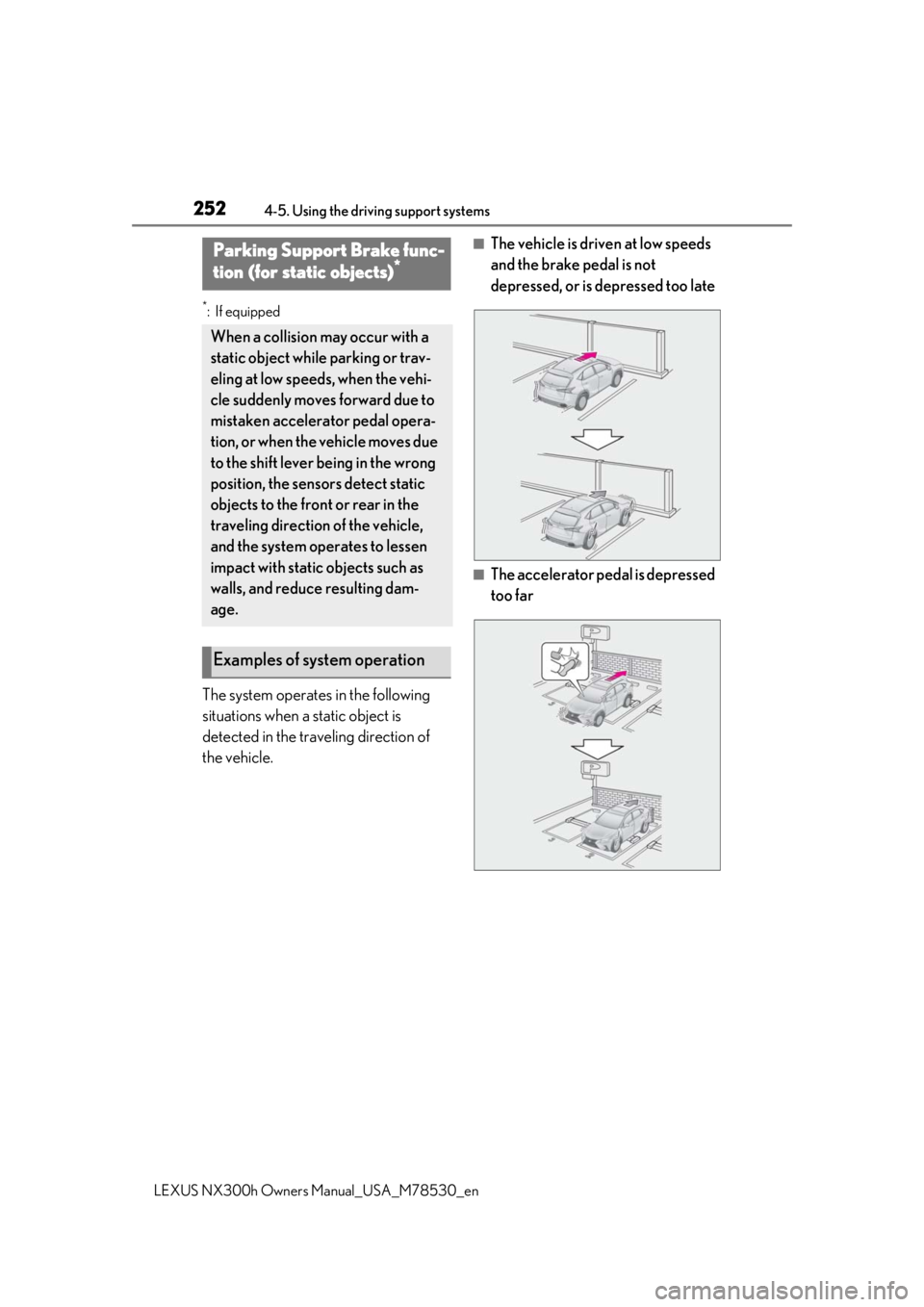
The system operates in the following
situations when a static object is
detected in the traveling direction of
the vehicle.
■The vehicle is driven at low speeds
and the brake pedal is not
depressed, or is depressed too late
■The accelerator pedal is depressed
too far
Parking Support Brake func-
tion (for static objects)*
When a collision may occur with a
static object while parking or trav-
eling at low speeds, when the vehi-
cle suddenly moves forward due to
mistaken accelerator pedal opera-
tion, or when the vehicle moves due
to the shift lever being in the wrong
position, the sensors detect static
objects to the front or rear in the
traveling direction of the vehicle,
and the system operates to lessen
impact with static objects such as
walls, and reduce resulting dam-
age.
Examples of system operation
Page 253 of 484

2534-5. Using the driving support systems
LEXUS NX300h Owners Manual_USA_M78530_en
4
Driving
■When the shift lever is mistakenly
in D and the vehicle moves forward
■Sensor positions and types Front corner sensors
Front center sensors
Rear corner sensors
Rear center sensors
This system can be enabled/disabled
on the multi-information display.
WARNING
■For safe use
Do not rely solely upon the system. Rely-
ing solely upon the sy stem may lead to an
unexpected accident.
●Driving safely is the sole responsibility
of the driver. Pay careful attention to
the surrounding conditions in order to
ensure safe driving. The Parking Sup-
port Brake function (f or static objects)
can provide support to lessen the
severity of collisions. However, it may
not operate depending on the situa-
tion.
●The Parking Support Brake function
(for static objects) is not a system
designed to completely stop the vehi-
cle. Furthermore, even if the Parking
Support Brake function (for static
objects) is able to stop the vehicle,
brake control is canceled after
approximately 2 seco nds, so depress
the brake pedal immediately.
Sensor positions and types
NOTICE
■Preventing sensor malfunctions
●If the area around a sensor is subjected
to an impact, equipment may not oper-
ate properly due to a sensor malfunc-
tion. Have the vehicle inspected by
your Lexus dealer.
●When using a high-pressure washer to
wash the vehicle, do not spray water
directly on the sensors. The sensors
may not function properly if subjected
to an impact from strong water pres-
sure.
●When using steam to wash the vehicle,
do not direct steam too close to the
sensors. The sensor s may not function
properly if subjected to steam.
Changing settings of the Park-
ing Support Brake function (for
static objects)
A
B
C
D
Page 254 of 484
2544-5. Using the driving support systems
LEXUS NX300h Owners Manual_USA_M78530_en
1Press “ ” or “ ” of the meter
control switches and select .
2 Press “ ” or “ ” of the meter
control switches and select .
3 Press on the meter control
switches to enable/disable the sys-
tem.
The PKSB OFF indicator comes on
when the Parking Support Brake
function is OFF (not operating).
When the Parking Support Brake func- tion is switched OFF, system operation
does not resume until the function is
switched back ON through the set-
tings screen on the multi-information
display. (System operation does not
resume by operating the power
switch.)
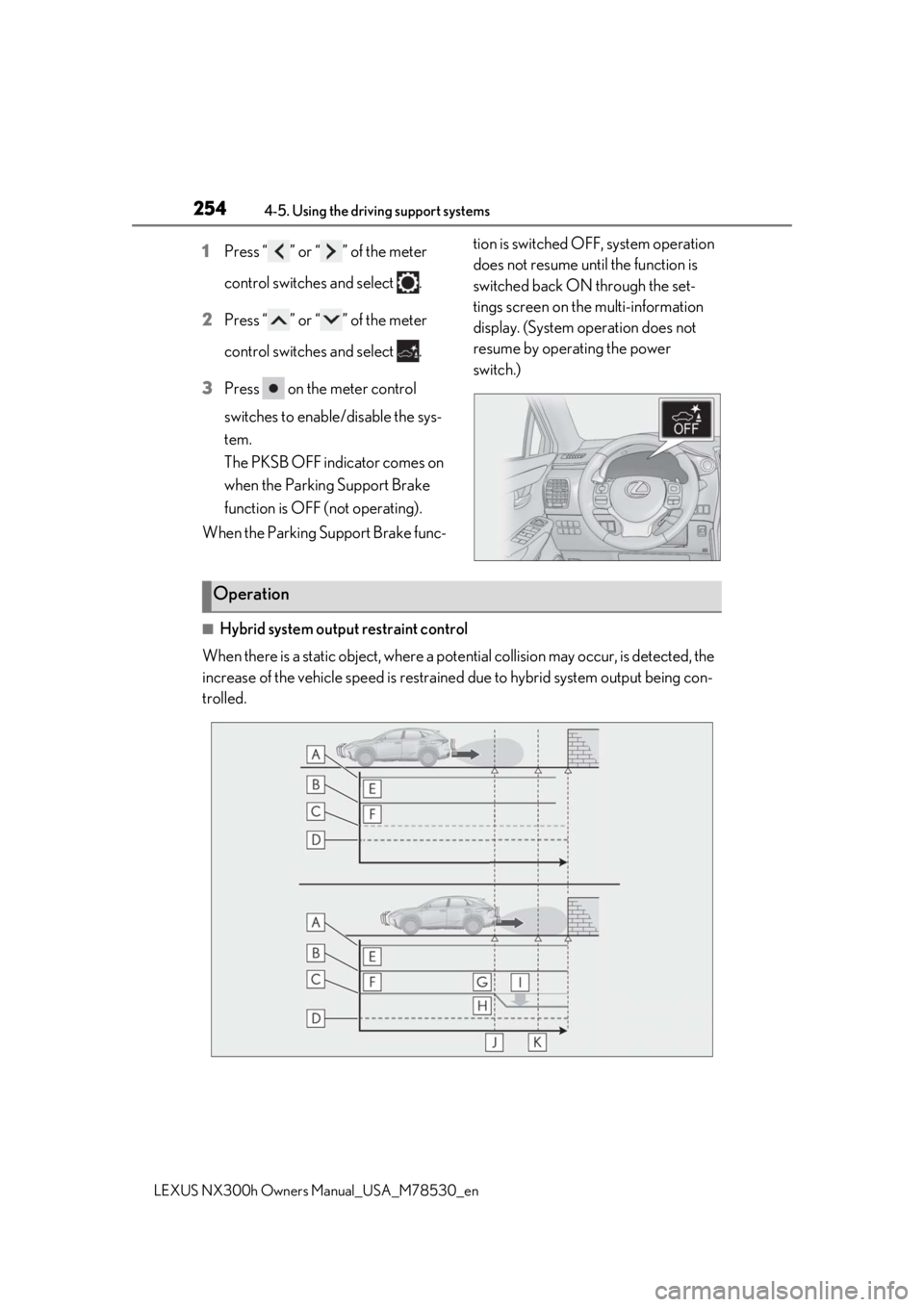
■Hybrid system output restraint control
When there is a static object, where a pote ntial collision may occur, is detected, the
increase of the vehicle speed is restrained due to hybrid system output being con-
trolled.
Operation
Page 255 of 484
2554-5. Using the driving support systems
LEXUS NX300h Owners Manual_USA_M78530_en
4
Driving
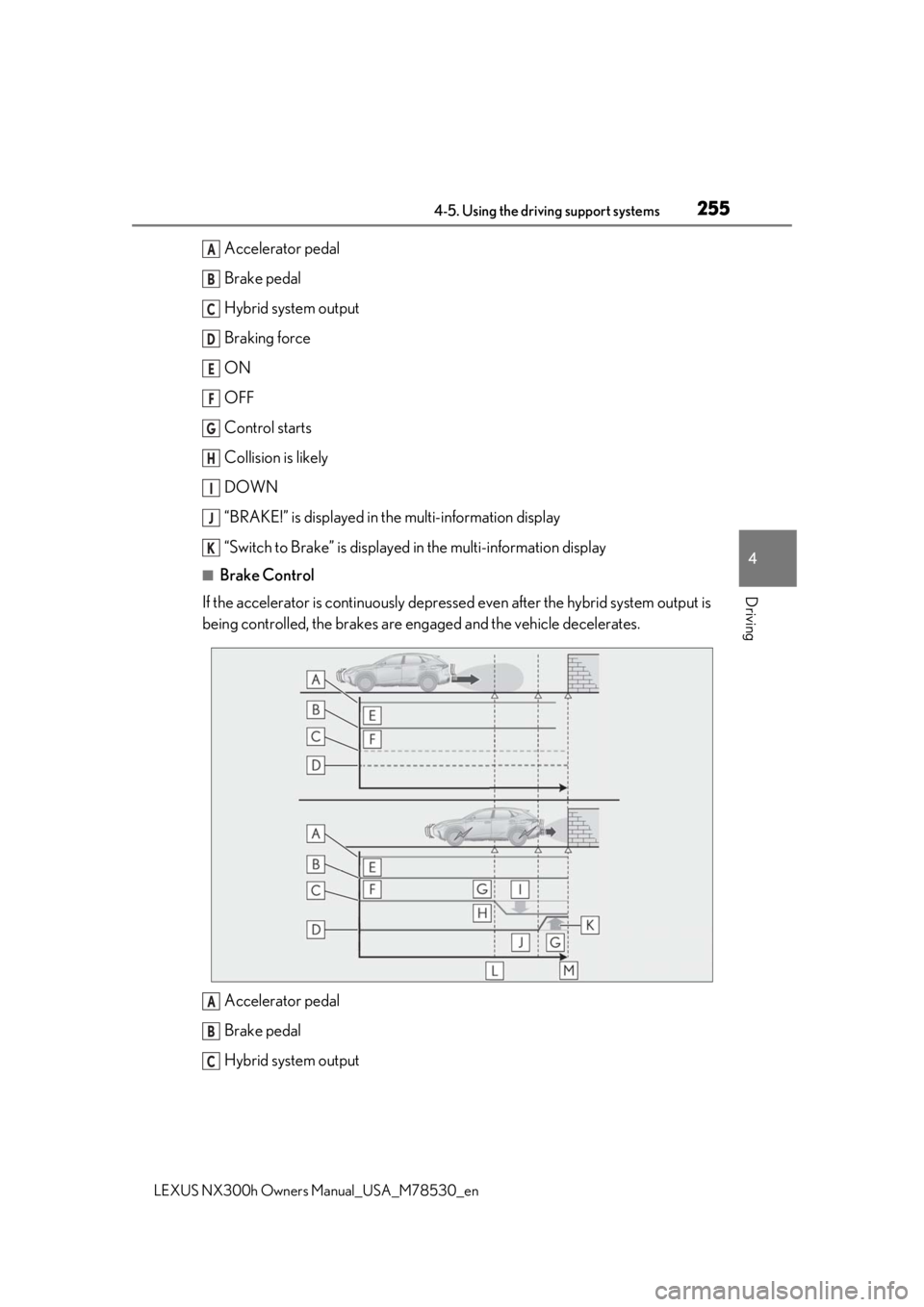
Accelerator pedal
Brake pedal
Hybrid system output
Braking force
ON
OFF
Control starts
Collision is likely
DOWN
“BRAKE!” is displayed in the multi-information display
“Switch to Brake” is displayed in the multi-information display
■Brake Control
If the accelerator is continuously depressed even after the hybrid system output is
being controlled, the brakes are engaged and the vehicle decelerates.
Accelerator pedal
Brake pedal
Hybrid system output
A
B
C
D
E
F
G
H
I
J
K
A
B
C
Page 256 of 484

2564-5. Using the driving support systems
LEXUS NX300h Owners Manual_USA_M78530_en
Braking force
ON
OFF
Control starts
Collision is likely
DOWN
Collision possibility is very high
UP
“BRAKE!” is displayed in the multi-information display
“Switch to Brake” is displayed in the multi-information display
■Operation starting conditions
When the PKSB OFF indicator is not illumi-
nated or flashing ( P.253, 390) and all of
the following conditions are met, the system
operates.
●Hybrid system output restriction control
• The Parking Support Brake function (for static objects) is on.
• The vehicle speed is 10 mph (15 km/h) or less.
• There is a static ob ject in the traveling
direction of the vehicle (6 to 13 ft. [2 to 4
m] ahead).
• The system determined that a stronger- than-normal brake operation was neces-
sary to avoid a collision.
●Brake control
• Hybrid system output restriction control is being performed.
• The system determined that an emer-
gency brake operation was necessary to
avoid a collision.
■Operation ending conditions
In any of the following situations, the system
stops operating.
●Hybrid system output restriction control
• The Parking Support Brake function (for static objects) ha s been turned off
(stopped).
• The collision became avoidable with nor- mal brake operation. • The static object is no longer in the travel-
ing direction of the vehicle (6 to 13 ft. [2
to 4 m] ahead).
●Brake control
• The Parking Support Brake function (for static objects) has been turned off
(stopped).
• Approximately 2 seconds elapsed after the vehicle was stopped by brake control.
• The brake pedal was depressed after the
vehicle was stopped by brake control.
• The static object is no longer in the travel- ing direction of the vehicle (6 to 13 ft. [2
to 4 m] ahead).
■Sensor detection range
The detection range of the Parking Support
Brake function (for static objects) differs
from the detection range of the clearance
sonar ( P.250).
Therefore, even if the clearance sonar
detects a static object and provides a warn-
ing, the Parking Support Brake function (for
static objects) may not start operating.
■Static objects not detected by the sen-
sors
The following static objects may not be
detected by the sensors.
●Objects such as people, cloth and snow,
that are difficult for sonic waves to reflect
off of. (In particular, people may also not
be detected depending on the type of
D
E
F
G
H
I
J
K
L
M
Page 257 of 484

2574-5. Using the driving support systems
LEXUS NX300h Owners Manual_USA_M78530_en
4
Driving
clothing they are wearing.)
●Objects not perpendicular with the
ground, objects not at a right angle to the
traveling direction of the vehicle, uneven
objects or waving objects
●Low objects
●Thin objects such as wires, fences, ropes
and signposts
●Objects that are extremely close to the
bumper
■Situations in which the Parking Support
Brake function (for static objects) may
not operate
When driving with the shift lever in N
■Situations when the system may operate
even though there is no possibility of a
collision
In the following situations, the system may
operate even though there is no possibility
of a collision.
●Environmental influence
• The vehicle is driven on a narrow road
• The vehicle is driven on a gravel road or in an area with tall grass
• The vehicle is driven toward a banner or flag, a low-hanging branch or a boom
barrier (such as those used at railroad
crossings, toll gates and parking lots).
• There is a static obje ct on the shoulder of
the road (when the vehicle is driven in a
narrow tunnel, on a narrow bridge or on a narrow road)
• The vehicle is be ing parallel parked
• There is a rut or hole in the surface of the
road
• When the vehicle is driven on a metal cover (grating), such as those used for
drainage ditches
• The vehicle is driven on a steep slope
• The sensor is covered by water on a flooded road
●Influence from the weather
• Ice, snow, dirt, etc., has adhered to the sensor (if removed, the system returns to
normal)
• Heavy rain or water strikes the vehicle
• In severe weather such as fog, snow or a sand storm
●Influence from other sonic waves
• An ultrasonic wave source is nearby, such
as the horn or clearance sonar of another
vehicle, a vehicle detector, a motorcycle
engine or the air brake of a large vehicle
• Electronic components (such as a backlit license plate (especially fluorescent
types), fog lights, a fe nder pole or a wire-
less antenna) are installed near the sen-
sors
●Changes in the vehicle
• The vehicle is tilted a large amount
• The height of the vehicle has drastically changed due to the carried load (the
nose tilts up or down)
• The direction of the sensor has deviated
due to a collision or other impact
■Situations in which the system may not
operate normally
In the following situations, the system may
not operate normally.
●Environmental influence
• There is a static object that cannot be detected between the vehicle and
another static object that can be
detected
• A static object such as another vehicle, a motorcycle, a bicycle or a pedestrian cuts
in front of the vehicle or jumps out from
the side.
●Influence from the weather
• The area around the sensor is extremely hot or cold
Page 258 of 484

2584-5. Using the driving support systems
LEXUS NX300h Owners Manual_USA_M78530_en• The wind is strong
• Ice, snow, dirt, etc., has adhered to the
sensor (if removed, the system returns to
normal)
• Heavy rain or water strikes the vehicle
• In severe weather such as fog, snow or a
sand storm
●Influence from other sonic waves
• An ultrasonic wave source is nearby, such as the horn or clearance sonar of another
vehicle, a vehicle detector, a motorcycle
engine or the air brake of a large vehicle
• Electronic components (such as a backlit
license plate (especially fluorescent
types), fog lights, a fender pole or a wire-
less antenna) are inst alled near the sen-
sors
●Changes in the vehicle
• The vehicle is tilted a large amount
• The height of the vehicle has drastically changed due to the carried load (the
nose tilts up or down)
• The direction of the sensor has deviated due to a collision or other impact
■When “Parking Support Brake Unavail-
able” is displayed on the multi-informa-
tion display and the PKSB OFF indicator
flashes
●Ice, snow, dirt, etc., may have adhered to
the sensor. If this occurs, remove the ice,
snow, dirt, etc., from the sensor to return
the system to normal.
Also, a warning message may be dis- played at low temperatures due to ice
forming on the sensor, and the sensor
may not detect static objects. Once the
ice melts, the system will return to normal.
●If this message is shown even after
removing dirt from the sensor, or shown
when the sensor was not dirty to begin
with, have the vehicle inspected by your
Lexus dealer.
●System initialization may not have been
performed after remova
l and installation
of the 12-volt battery. Perform system ini-
tialization.
■When removing and installing the 12-
volt battery
The system needs to be initialized.
The system can be init ialized by driving the
vehicle straight ahead for 5 seconds or
more at a speed of approximately 22 mph
(35 km/h) or higher.
■When “Parking Support Brake Mal-
function Visit Your Dealer” is displayed
on the multi-information display, the
PKSB OFF indicator flashes and the
buzzer sounds
The system may not be operating properly.
Have the vehicle inspected by your Lexus
dealer.
WARNING
■In order for the system to operate
properly
Make sure to observe the following pre-
cautions regarding the sensors
( P.250). Failure to observe these pre-
cautions may cause the sensors not to
operate properly, and may result in an
unexpected accident.
●Do not perform work such as modifi-
cation, disassembly or painting
●Only perform replacements using
genuine parts
●Do not subject the area around the
sensors to any impacts