ECU LEXUS RC300 2017 User Guide
[x] Cancel search | Manufacturer: LEXUS, Model Year: 2017, Model line: RC300, Model: LEXUS RC300 2017Pages: 724, PDF Size: 15.76 MB
Page 39 of 724

391-1. For safe use
1
For safety and security
WARNING
■Using a seat belt extender
●Do not wear the seat belt extender if you can fasten the seat belt without the extender.
●Do not use the seat belt extender when installing a child restraint system because the
belt will not securely hold the child restra int system, increasing the risk of death or
serious injury in the event of an accident.
●The personalized extender may not be safe on another vehicle, when used by another
person, or at a different seating position other than the one originally intended.
NOTICE
■When using a seat belt extender
When releasing the seat belt, press on the buckle release button on the extender, not
on the seat belt.
This helps prevent damage to the vehicle interior and the extender itself.
Page 41 of 724
411-1. For safe use
1
For safety and security
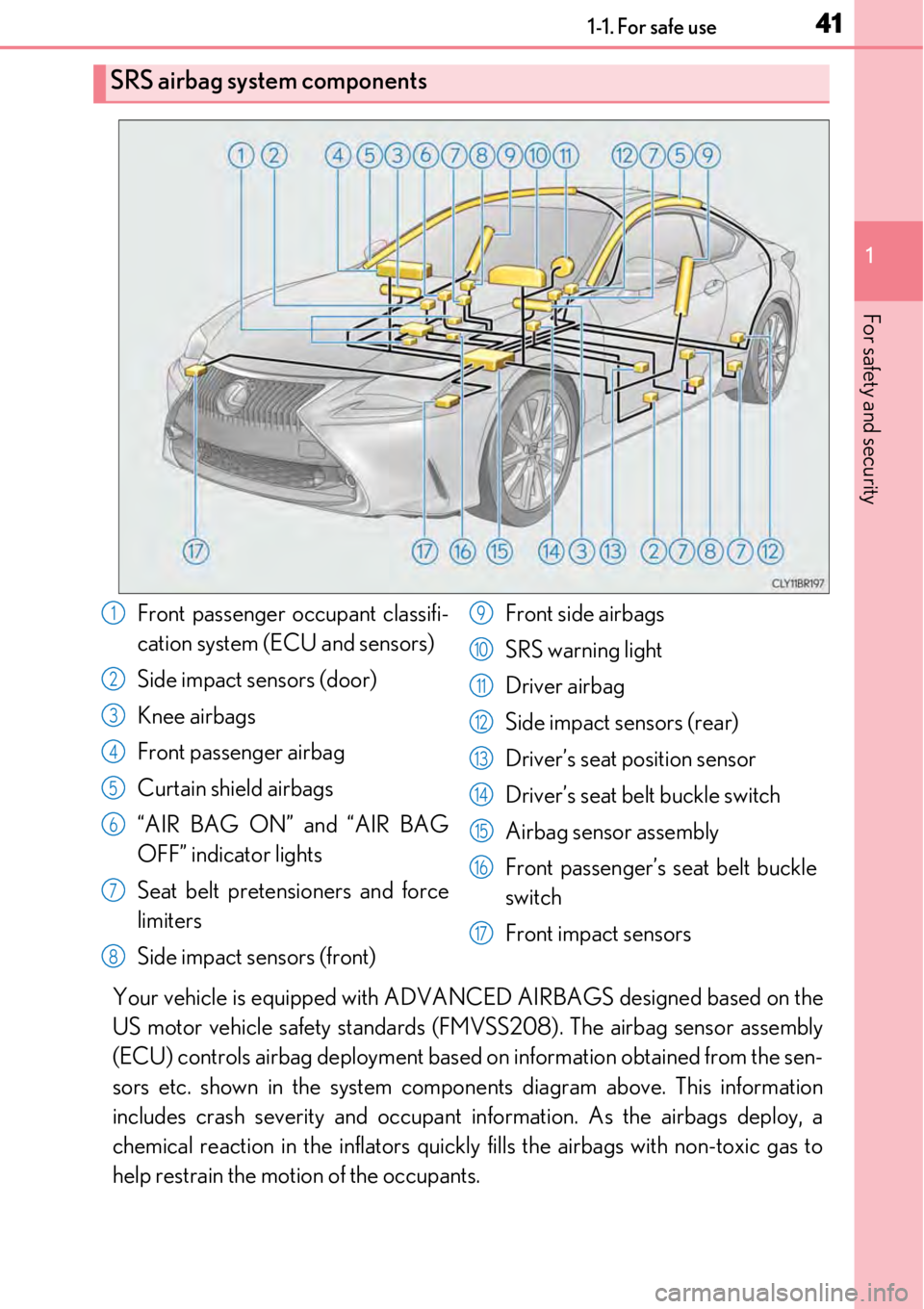
Your vehicle is equipped with ADVANCED AIRBAGS designed based on the
US motor vehicle safety standards (F MVSS208). The airbag sensor assembly
(ECU) controls airbag deployment based on information obtained from the sen-
sors etc. shown in the system compon ents diagram above. This information
includes crash severity and occupant information. As the airbags deploy, a
chemical reaction in the inflators quickly fills the airbags with non-toxic gas to
help restrain the motion of the occupants.
SRS airbag system components
Front passenger occupant classifi-
cation system (ECU and sensors)
Side impact sensors (door)
Knee airbags
Front passenger airbag
Curtain shield airbags
“AIR BAG ON” and “AIR BAG
OFF” indicator lights
Seat belt pretensioners and force
limiters
Side impact sensors (front) Front side airbags
SRS warning light
Driver airbag
Side impact sensors (rear)
Driver’s seat position sensor
Driver’s seat belt buckle switch
Airbag sensor assembly
Front passenger’s seat belt buckle
switch
Front impact sensors1
2
3
4
5
6
7
8
9
10
11
12
13
14
15
16
17
Page 43 of 724
431-1. For safe use
1
For safety and security
WARNING
■SRS airbag precautions
●The SRS front passenger airbag also deploys with considerable force, and can cause
death or serious injury especially if the front passenger is very close to the airbag. The
front passenger seat should be as far from the airbag as possible with the seatback
adjusted, so the front passenger sits upright.
●Improperly seated and/or restrained infant s and children can be killed or seriously
injured by a deploying airbag. An infant or child who is too small to use a seat belt
should be properly secured using a chil d restraint system. Lexus strongly recom-
mends that all infants and children be placed in the rear seats of the vehicle and prop-
erly restrained. The rear se ats are safer for infants and children than the front
passenger seat. ( →P. 58)
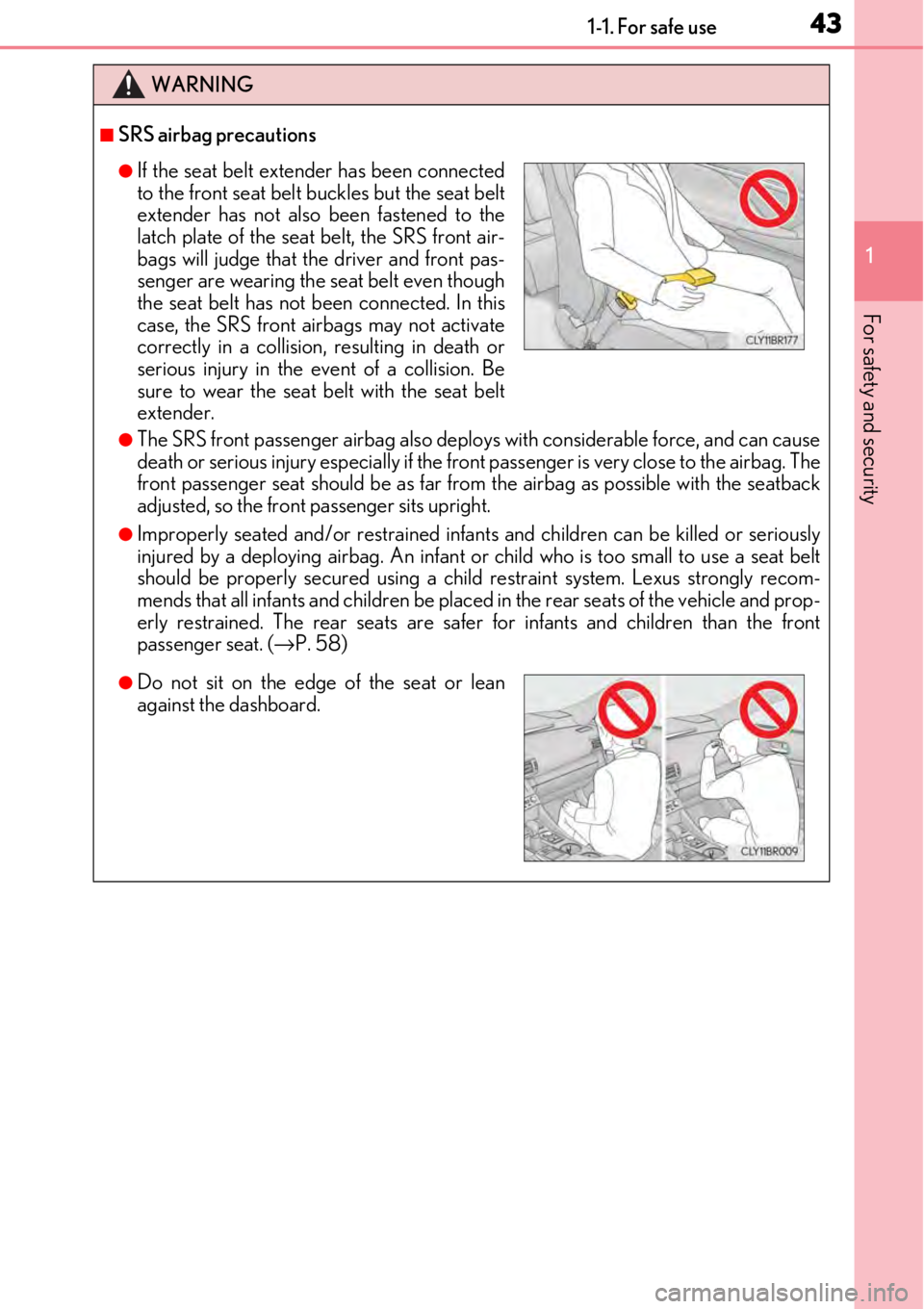
●If the seat belt extender has been connected
to the front seat belt buckles but the seat belt
extender has not also been fastened to the
latch plate of the seat belt, the SRS front air-
bags will judge that the driver and front pas-
senger are wearing the seat belt even though
the seat belt has not been connected. In this
case, the SRS front airbags may not activate
correctly in a collision, resulting in death or
serious injury in the event of a collision. Be
sure to wear the seat belt with the seat belt
extender.
●Do not sit on the edge of the seat or lean
against the dashboard.
Page 45 of 724

451-1. For safe use
1
For safety and security
WARNING
■SRS airbag precautions
●Do not hang coat hangers or hard objects on the coat hooks. All of these items could
become projectiles and may cause death or serious injury, should the SRS curtain
shield airbags deploy.
●If a vinyl cover is put on the area where the SRS knee airbag will deploy, be sure to
remove it.
●Do not use seat accessories which cover the parts where the SRS side airbags inflate
as they may interfere with inflation of th e airbags. Such accessories may prevent the
side airbags from activating correctly, disable the system or cause the side airbags to
inflate accidentally, resulting in death or serious injury.
●Do not strike or apply signif icant levels of force to the area of the SRS airbag compo-
nents.
Doing so can cause the SRS airbags to malfunction.
●Do not touch any of the component part s immediately after the SRS airbags have
deployed (inflated) as they may be hot.
●If breathing becomes difficult after the SR S airbags have deployed, open a door or
window to allow fresh air in, or leave the vehicl e if it is safe to do so. Wash off any resi-
due as soon as possible to prevent skin irritation.
●If the areas where the SRS airbags are stored, such as the steering wheel pad and
front and rear pillar garnishes, are damaged or cracked, have them replaced by your
Lexus dealer.
●Do not place anything, such as a cushion, on the front passenger's seat. Doing so will
disperse the passenger's weight, which prevents the sensor from detecting the pas-
senger's weight properly. As a result, th e SRS front airbags for the front passenger
may not deploy in the event of a collision.
Page 47 of 724
471-1. For safe use
1
For safety and security
■SRS airbag deployment conditions (SRS front airbags)
●The SRS front airbags will deploy in the event of an impact that exceeds the set thresh-
old level (the level of force corresponding to an approximately 12 - 18 mph [20 - 30
km/h] frontal collision with a fixed wa ll that does not move or deform).
However, this threshold velocity will be cons iderably higher in the following situations:
• If the vehicle strikes an object, such as a parked vehicle or sign pole, which can move
or deform on impact
• If the vehicle is involved in an underride collision, such as a collision in which the
front of the vehicle “underrides”, or goes under, the bed of a truck
●Depending on the type of collision, it is possi ble that only the seat belt pretensioners will
activate.
●The SRS front airbags for the front passenger will not activa te if there is no passenger
sitting in the front passenger seat. However, the SRS front airbags for the front passen-
ger may deploy if luggage is put in the seat, even if the seat is unoccupied. (→P. 51)
■SRS airbag deployment conditions (S RS side and curtain shield airbags)
●The SRS side and curtain shield airbags w ill deploy in the event of an impact that
exceeds the set threshold level (the level of force corresponding to the impact force
produced by an approximately 3300 lb. [15 00 kg] vehicle colliding with the vehicle
cabin from a direction perpendicular to the vehicle orientation at an approximate
speed of 12 - 18 mph [20 - 30 km/h]).
●The SRS curtain shield airbags will depl oy in the event of vehicle rollover.
●The SRS side and curtain shield airbags will de ploy in the event of a severe frontal colli-
sion.
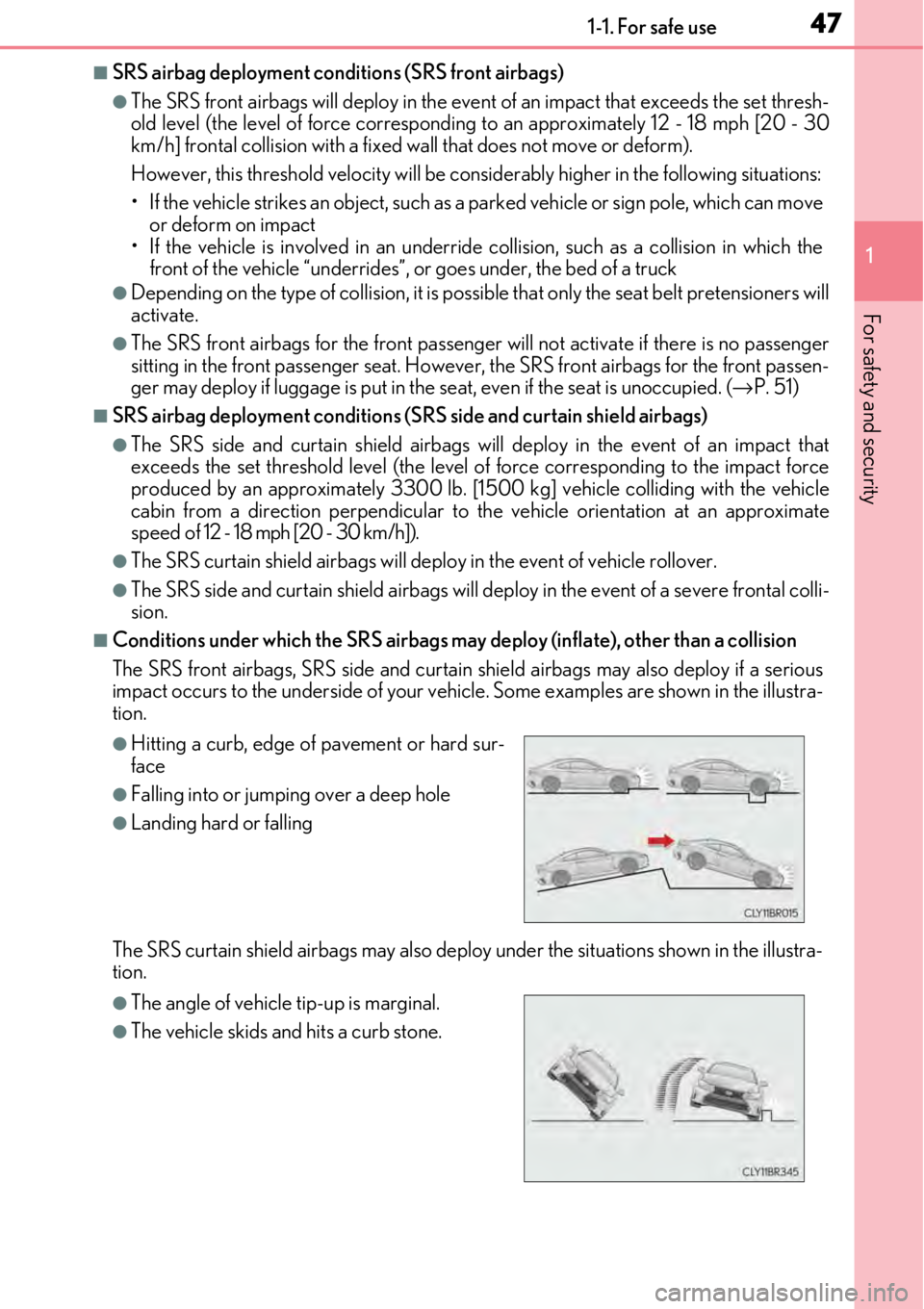
■Conditions under which the SRS airbags may deploy (inflate), other than a collision
The SRS front airbags, SRS side and curtain sh ield airbags may also deploy if a serious
impact occurs to the undersid e of your vehicle. Some exampl es are shown in the illustra-
tion.
The SRS curtain shield airbags may also deploy under the situations shown in the illustra-
tion.
●Hitting a curb, edge of pavement or hard sur-
face
●Falling into or jumping over a deep hole
●Landing hard or falling
●The angle of vehicle tip-up is marginal.
●The vehicle skids and hits a curb stone.
Page 49 of 724
491-1. For safe use
1
For safety and security
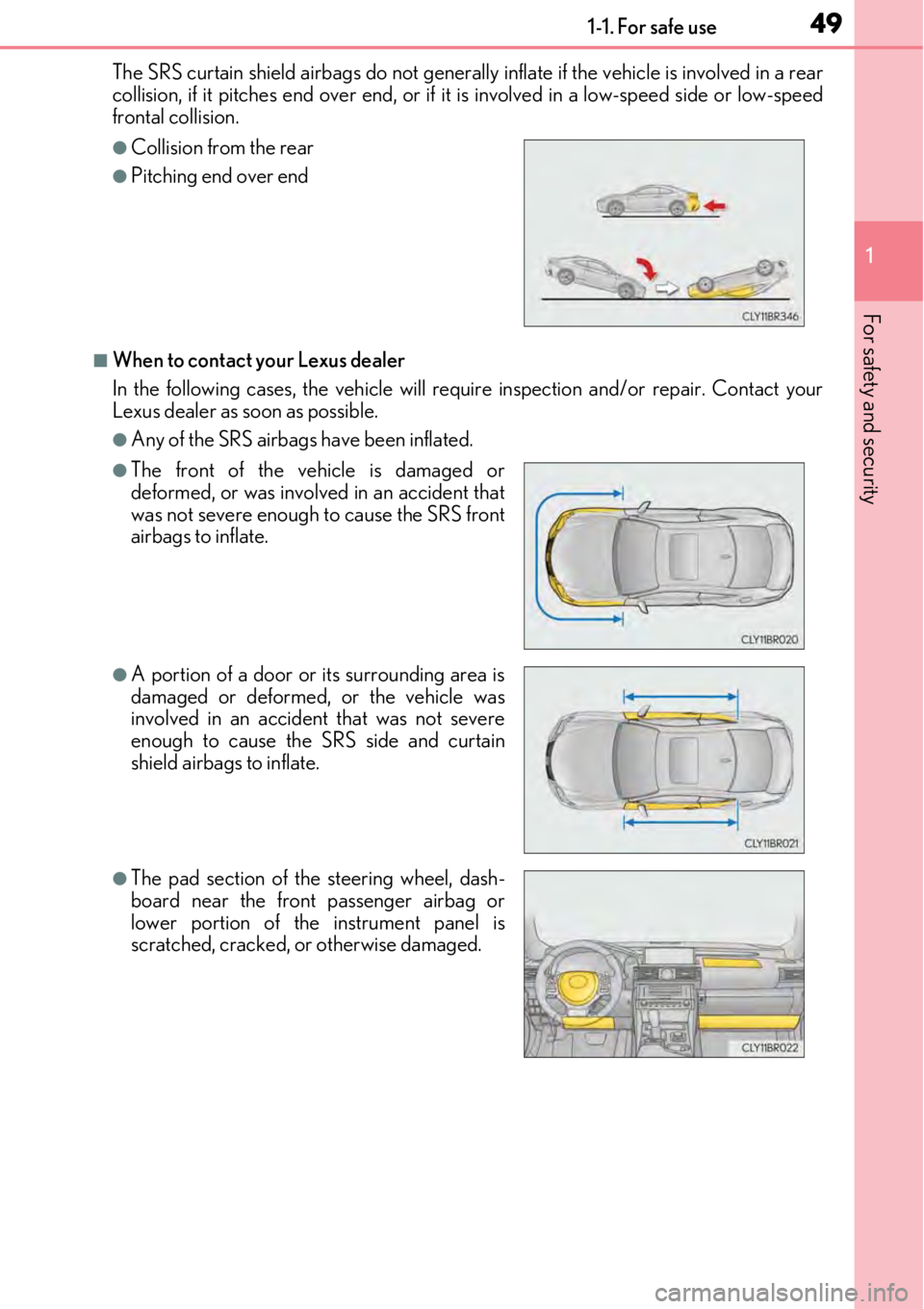
The SRS curtain shield airbags do not generally inflate if the vehicle is involved in a rear
collision, if it pitches end over end, or if it is involved in a low-speed side or low-speed
frontal collision.
■When to contact your Lexus dealer
In the following cases, the ve hicle will require inspection and/or repair. Contact your
Lexus dealer as soon as possible.
●Any of the SRS airbags have been inflated.
●Collision from the rear
●Pitching end over end
●The front of the vehicle is damaged or
deformed, or was involved in an accident that
was not severe enough to cause the SRS front
airbags to inflate.
●A portion of a door or its surrounding area is
damaged or deformed, or the vehicle was
involved in an acciden t that was not severe
enough to cause the SRS side and curtain
shield airbags to inflate.
●The pad section of the steering wheel, dash-
board near the front passenger airbag or
lower portion of the instrument panel is
scratched, cracked, or otherwise damaged.
Page 51 of 724

511-1. For safe use
1
For safety and security
Front passenger occupant classification system
Your vehicle is equipped with a front passenger occupant classification sys-
tem. This system detects the conditions of the front passenger seat and acti-
vates or deactivates the devices for the front passenger.
Seat belt reminder light
SRS warning light
“AIR BAG OFF” indicator light
“AIR BAG ON” indicator light1
2
3
4
Page 53 of 724

531-1. For safe use
1
For safety and security
■Child restraint system with infant*5
■Unoccupied
Indicator/
warning light
“AIR BAG ON” and “AIR BAG OFF”
indicator lights“AIR BAG OFF”*6
SRS warning lightOff
Seat belt reminder lightOff*2 or
flashing
*3
Devices
Front passenger airbagDeactivated
Side airbag
on the front passenger seat
ActivatedCurtain shield airbag
in the front passenger side
Front passenger knee airbagDeactivated
Front passenger’s seat belt pretensionerActivated
Indicator/
warning light
“AIR BAG ON” and “AIR BAG OFF” indicator lights“AIR BAG OFF”
SRS warning light
Off
Seat belt reminder light
Devices
Front passenger airbagDeactivated
Side airbag
on the front passenger seat
ActivatedCurtain shield airbag
in the front passenger side
Front passenger knee airbagDeactivated
Front passenger’s seat belt pretensionerActivated
Page 55 of 724

551-1. For safe use
1
For safety and security
WARNING
■Front passenger occupant classification system precautions
Observe the following precautions regarding the front passenger occupant classifica-
tion system.
Failure to do so may cause death or serious injury.
●Wear the seat belt properly.
●Make sure the front passenger’s seat belt plate has not been left inserted into the
buckle before someone sits in the front passenger seat.
●Make sure the “AIR BAG OFF” indicator li ght is not illuminated when using the seat
belt extender for the front passenger seat. If the “AIR BAG OFF” indicator light is illu-
minated, disconnect the extender tongue from the seat belt buckle, and reconnect
the seat belt. Reconnect the seat belt extender after making sure the “AIR BAG ON”
indicator light is illuminated. If you use the seat belt extender while the “AIR BAG
OFF” indicator light is illuminated, the SRS airbags for the front passenger may not
activate, which could cause death or seri ous injury in the event of a collision.
●Do not apply a heavy load to the front passenger seat or equipment (e.g. seatback
pocket).
●Do not put weight on the front passenger seat by putting your hands or feet on the
front passenger seat seatback from the rear passenger seat.
●Do not let a rear passenger lift the front passe nger seat with their feet or press on the
seatback with their legs.
●Do not put objects under the front passenger seat.
Page 57 of 724

571-1. For safe use
1
For safety and security
●It is recommended that children sit in the rear seats to avoid accidental con-
tact with the shift lever, wiper switch, etc.
●Use the window lock switch to avoid children operating the power window
accidentally.
●Do not let small children operate equipment which may catch or pinch body
parts, such as the power window, hood, trunk, seats etc.
Safety information for children
Observe the following precautions wh en children are in the vehicle.
Use a child restraint system appropriate for the child, until the child becomes
large enough to properly wear the vehicle’s seat belt.
WARNING
Never leave children unattended in the vehicl e, and never allow children to have or use
the key.
Children may be able to start the vehicle or sh ift the vehicle into neutral. There is also a
danger that children may injure themselves by playing with the windows, the moon roof
or other features of the vehi cle. In addition, heat build-up or extremely cold tempera-
tures inside the vehicle can be fatal to children.