cooling LEXUS RC300 2020 User Guide
[x] Cancel search | Manufacturer: LEXUS, Model Year: 2020, Model line: RC300, Model: LEXUS RC300 2020Pages: 390, PDF Size: 8.65 MB
Page 254 of 390
2546-3. Do-it-yourself maintenance
Check the radiator, condenser and
intercooler radiator and clear away
any foreign objects.
If any of the above parts are extremely
dirty or you are not sure of their condi-
tion, have your vehicle inspected by
your Lexus dealer.
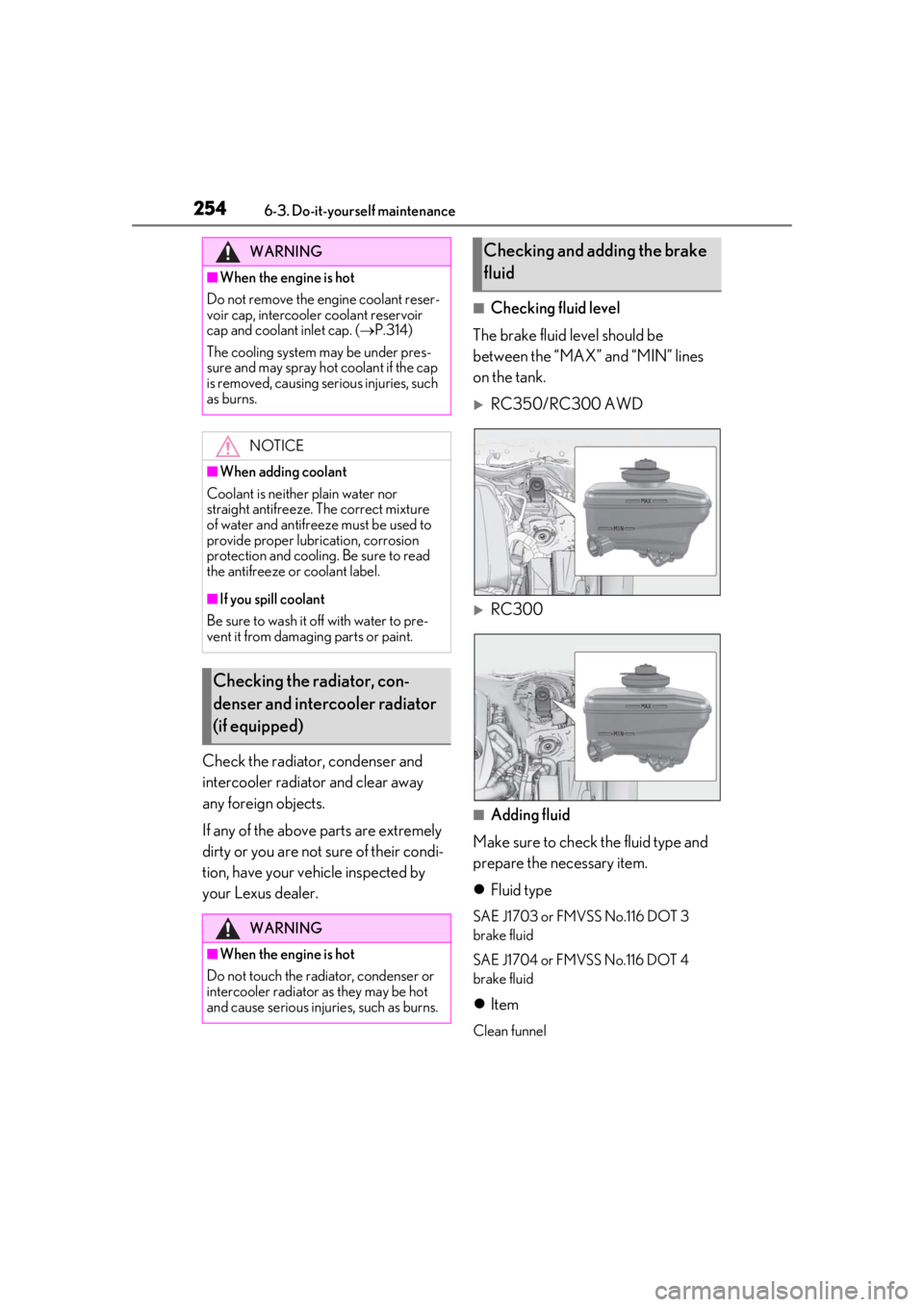
■Checking fluid level
The brake fluid level should be
between the “MAX” and “MIN” lines
on the tank.
RC350/RC300 AWD
RC300
■Adding fluid
Make sure to check the fluid type and
prepare the necessary item.
Fluid type
SAE J1703 or FMVSS No.116 DOT 3
brake fluid
SAE J1704 or FMVSS No.116 DOT 4
brake fluid
Item
Clean funnel
WARNING
■When the engine is hot
Do not remove the engine coolant reser-
voir cap, intercooler coolant reservoir
cap and coolant inlet cap. ( P.314)
The cooling system may be under pres-
sure and may spray hot coolant if the cap
is removed, causing serious injuries, such
as burns.
NOTICE
■When adding coolant
Coolant is neither plain water nor
straight antifreeze. The correct mixture
of water and antifreeze must be used to
provide proper lubrication, corrosion
protection and cooling. Be sure to read
the antifreeze or coolant label.
■If you spill coolant
Be sure to wash it off with water to pre-
vent it from damagi ng parts or paint.
Checking the radiator, con-
denser and intercooler radiator
(if equipped)
WARNING
■When the engine is hot
Do not touch the radiator, condenser or
intercooler radiator as they may be hot
and cause serious injuries, such as burns.
Checking and adding the brake
fluid
Page 313 of 390
3117-2. Steps to take in an emergency
7
When trouble arises
1Stop the vehicle in a safe place and
turn off the air conditioning system,
and then stop the engine.
2
If you see steam:
Carefully lift the hood after the
steam subsides.
If you do not see steam:
Carefully lift the hood.
3
After the engine has cooled down
sufficiently, inspect the hoses and
radiator core (radiator) for any
leaks.
WARNING
●When working with the battery, always
wear safety glasses and take care not
to allow any battery fluids (acid) to
come into contact with skin, clothing
or the vehicle body.
●Do not lean over the battery.
●In the event that battery fluid comes
into contact with the skin or eyes,
immediately wash the affected area
with water and seek medical attention.
Place a wet sponge or cloth over the
affected area until medical attention
can be received.
●Always wash your hands after handling
the battery support, terminals, and
other battery-related parts.
●Do not allow children near the battery.
NOTICE
■When handling jumper cables
When connecting the jumper cables,
ensure that they do not become entan-
gled in the cooling fans or engine drive
belt.
If your vehicle overheats
The following may indicate that
your vehicle is overheating.
The engine coolant temperature
gauge ( P.64) is in the red zone
or a loss of engine power is expe-
rienced. (For example, the vehicle
speed does not increase.)
“Engine Coolant Temp High Stop
in a Safe Place See Owner’s
Manual” is shown on the
multi-information display.
Steam comes out from under the
hood.
Correction procedures
Page 314 of 390
3127-2. Steps to take in an emergency
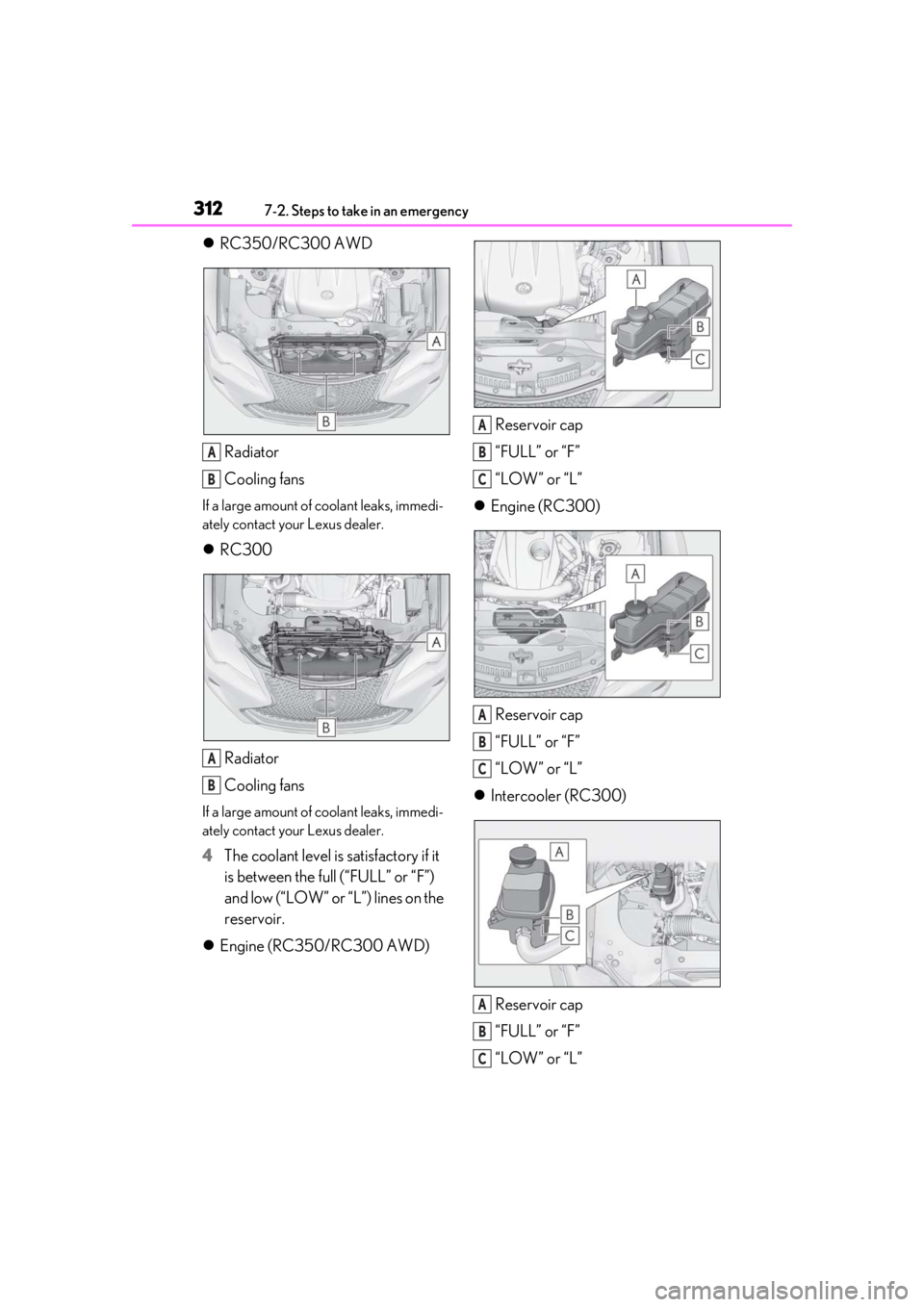
RC350/RC300 AWD
Radiator
Cooling fans
If a large amount of coolant leaks, immedi-
ately contact your Lexus dealer.
RC300
Radiator
Cooling fans
If a large amount of coolant leaks, immedi-
ately contact your Lexus dealer.
4 The coolant level is satisfactory if it
is between the full (“FULL” or “F”)
and low (“LOW” or “L”) lines on the
reservoir.
Engine (RC350/RC300 AWD) Reservoir cap
“FULL” or “F”
“LOW” or “L”
Engine (RC300)
Reservoir cap
“FULL” or “F”
“LOW” or “L”
Intercooler (RC300)
Reservoir cap
“FULL” or “F”
“LOW” or “L”
A
B
A
B
A
B
C
A
B
C
A
B
C
Page 315 of 390
3137-2. Steps to take in an emergency
7
When trouble arises
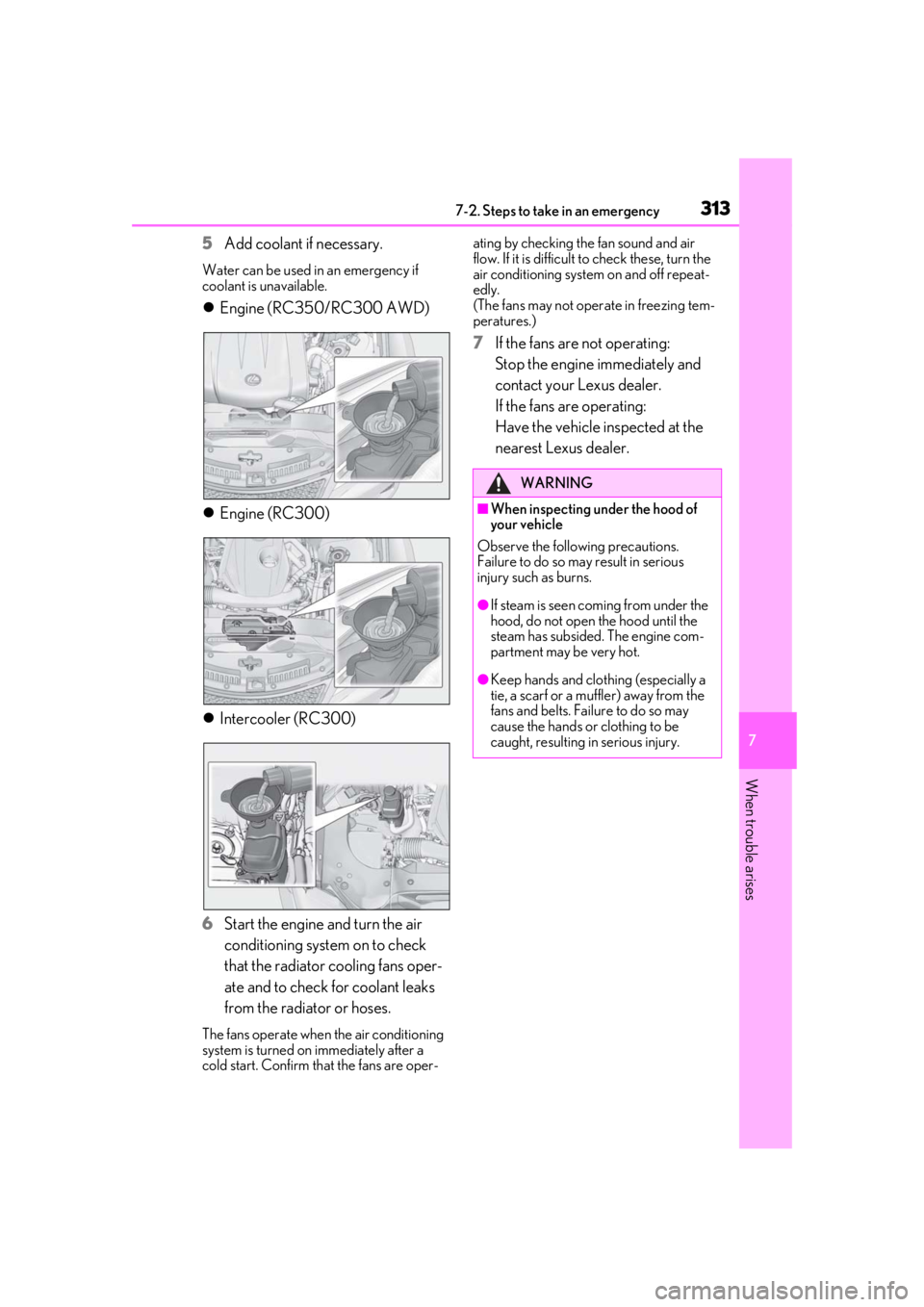
5Add coolant if necessary.
Water can be used in an emergency if
coolant is unavailable.
Engine (RC350/RC300 AWD)
Engine (RC300)
Intercooler (RC300)
6
Start the engine and turn the air
conditioning system on to check
that the radiator cooling fans oper-
ate and to check for coolant leaks
from the radiator or hoses.
The fans operate when the air conditioning
system is turned on immediately after a
cold start. Confirm that the fans are oper- ating by checking the fan sound and air
flow. If it is difficult to check these, turn the
air conditioning system on and off repeat-
edly.
(The fans may not oper
ate in freezing tem-
peratures.)
7If the fans are not operating:
Stop the engine immediately and
contact your Lexus dealer.
If the fans are operating:
Have the vehicle inspected at the
nearest Lexus dealer.
WARNING
■When inspecting under the hood of
your vehicle
Observe the following precautions.
Failure to do so may result in serious
injury such as burns.
●If steam is seen coming from under the
hood, do not open the hood until the
steam has subsided. The engine com-
partment may be very hot.
●Keep hands and clothing (especially a
tie, a scarf or a muffler) away from the
fans and belts. Failure to do so may
cause the hands or clothing to be
caught, resulting in serious injury.
Page 316 of 390
3147-2. Steps to take in an emergency
WARNING
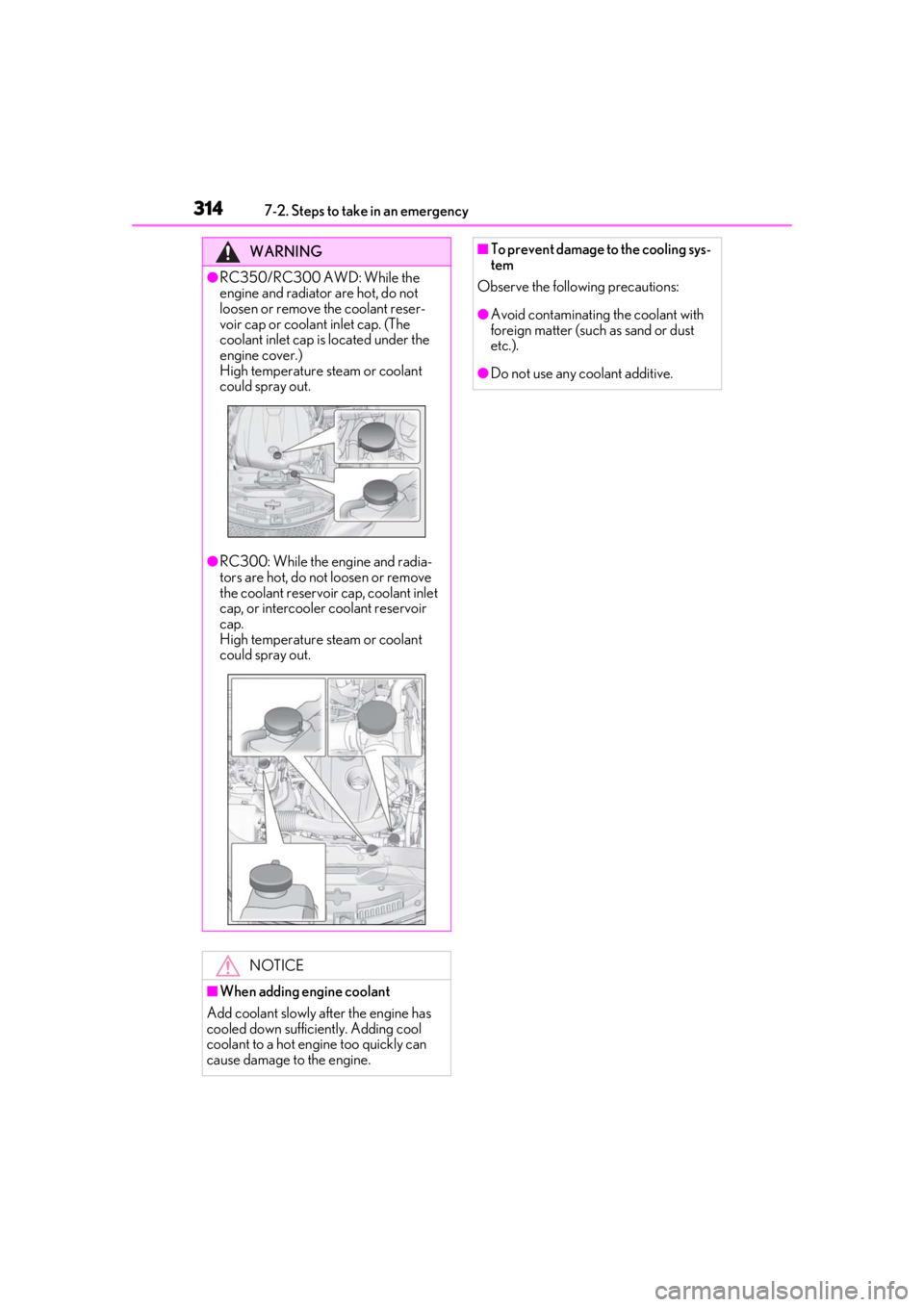
●RC350/RC300 AWD: While the
engine and radiator are hot, do not
loosen or remove the coolant reser-
voir cap or coolant inlet cap. (The
coolant inlet cap is located under the
engine cover.)
High temperature steam or coolant
could spray out.
●RC300: While the engine and radia-
tors are hot, do not loosen or remove
the coolant reservoir cap, coolant inlet
cap, or intercooler coolant reservoir
cap.
High temperature steam or coolant
could spray out.
NOTICE
■When adding engine coolant
Add coolant slowly after the engine has
cooled down sufficiently. Adding cool
coolant to a hot engine too quickly can
cause damage to the engine.
■To prevent damage to the cooling sys-
tem
Observe the following precautions:
●Avoid contaminating the coolant with
foreign matter (such as sand or dust
etc.).
●Do not use any coolant additive.
Page 323 of 390
3218-1. Specifications
8
Vehicle specifications
Outside temperature
Oil viscosity (0W-20 is explained here
as an example):
• The 0W in 0W-20 indicates the characteristic of the oil which allows
cold startability. Oils with a lower
value before the W allow for easier
starting of the engine in cold
weather.
• The 20 in 0W-20 indicates the vis- cosity characteristic of the oil when
the oil is at high temperature. An oil
with a higher viscosity (one with a
higher value) may be better suited if
the vehicle is operated at high
speeds, or under extreme load con- ditions.
How to read oil container label:
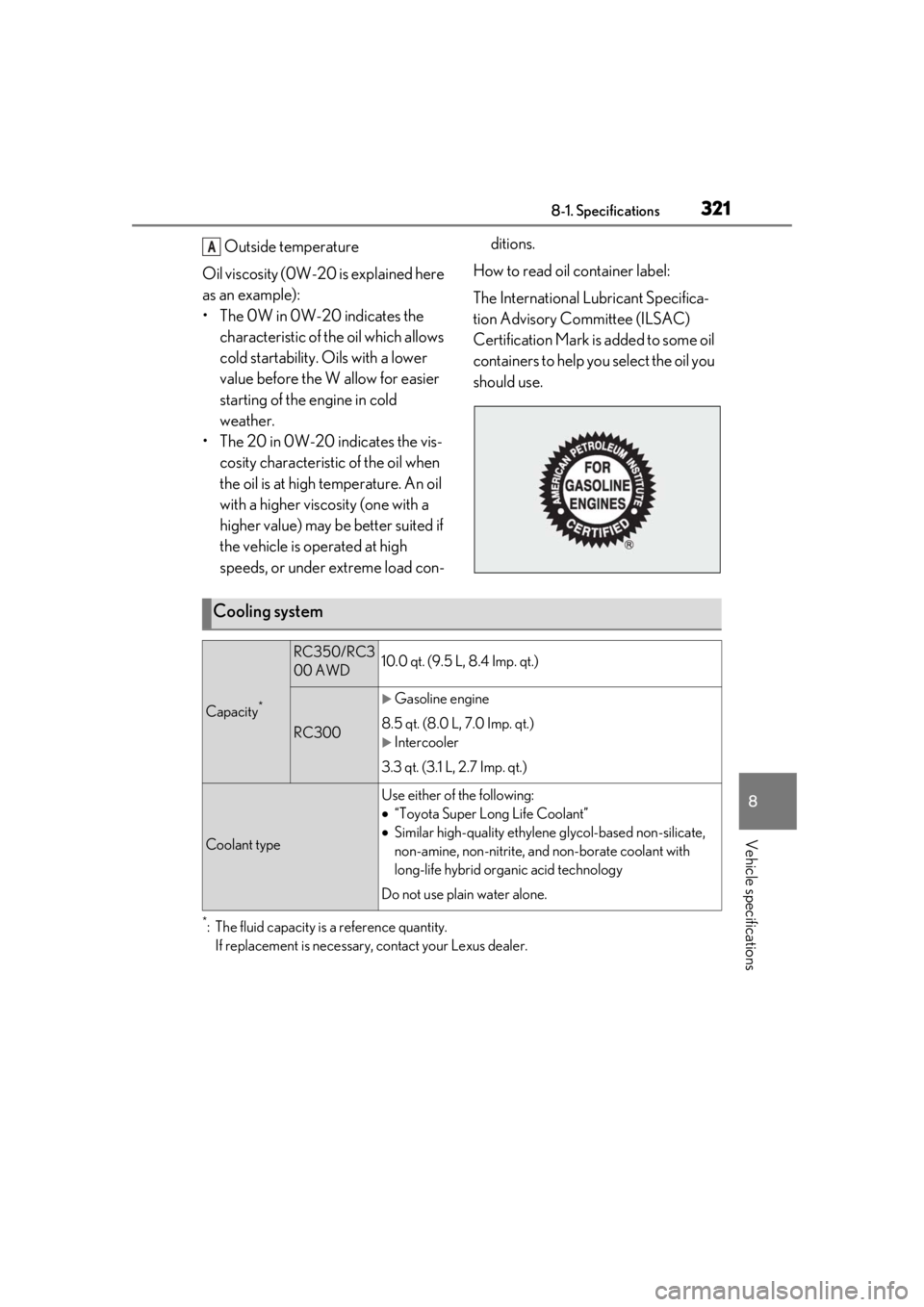
The International Lubricant Specifica-
tion Advisory Committee (ILSAC)
Certification Mark is added to some oil
containers to help you select the oil you
should use.
*: The fluid capacity is a reference quantity. If replacement is necessary, contact your Lexus dealer.
A
Cooling system
Capacity*
RC350/RC3
00 AWD10.0 qt. (9.5 L, 8.4 Imp. qt.)
RC300
Gasoline engine
8.5 qt. (8.0 L, 7.0 Imp. qt.)
Intercooler
3.3 qt. (3.1 L, 2.7 Imp. qt.)
Coolant type
Use either of the following:
“Toyota Super Long Life Coolant”
Similar high-quality ethylene glycol-based non-silicate,
non-amine, non-nitrite, and non-borate coolant with
long-life hybrid orga nic acid technology
Do not use plain water alone.
Page 378 of 390

376Alphabetical Index
Exterior ........................................................... 234
Interior ............................................................. 237
Seat belts........................................................ 237
Cargo capacity...............................................123
Cargo hooks ................................................... 221
Center Display ............................................. 204
Chains ................................................................199
Child restraint system Child seats definition................................... 40
Child seats installation........................ 44, 47
Front passenger occupant classification system ............................................................. 36
Installing a CRS to the front passenger seat ....................................................................42
Installing CRS with LATCH anchors . 48
Installing CRS with top tether strap.....50
Riding with children ..................................... 40
Types of child restraint system installation method ............................................................. 41
Using an anchor bracket .......................... 49
Child safety Airbag precautions.......................................32
Battery precautions ....................... 256, 310
Child restraint system.......................... 40, 41
Heated steering wheel or seat heater precautions.................................................. 214
How your child should wear the seat belt ............................................................................ 25
Installing child restraints ............................ 40
Moon roof precautions ..............................114
Power window lock switch........................ 111
Removed electronic key battery precau- tions ...............................................................268
Seat belt extender precautions ............. 25
Seat belt precautions .................................. 40
Trunk precautions ........................................ 89
Cleaning Aluminum wheels ...................................... 234
Exterior ........................................................... 234
Interior ............................................................. 237
Radar sensor..................................................152
Seat belts........................................................ 237 Clock ........................................................ 64, 222
Clock settings ............................................... 222
Coat hooks..................................................... 222
Compass ......................................................... 229
Condenser ..................................................... 254
Console box .................................................. 220
Consumption screen ..................................... 77
Cooling system............................................. 252
Engine overheating...................................... 311
Cornering lights ............................................ 138 Replacing light bulbs ................................ 272
Cruise control Dynamic radar cruise control............... 170
Cup holders ................................................... 220
Current fuel consumption ............................ 71
Curtain shield airbags .................................. 28
Customizable features ................................341
D
Daytime running light system ................... 137
Daytime running lights Replacing light bulbs ................................ 272
Defogger Outside rear view mirrors........................ 211
Rear window ................................................... 211
Windshield ....................................................... 211
Differential Front differential oil............. ....................... 323
Rear differential oil......... ..................... ....... 323
Dimension ....................................................... 318
Dinghy towing................................................. 124
Display Center Display ............................................204
Drive information ............................................ 71
LDA (Lane Departure Alert with steering control) ......................................................... 165
Multi-information display .......................... 69
Warning messages...................................293
Distance until next engine oil change .... 68
Do-it-yourself maintenance ......................241
Door courtesy lights ..................................... 217