tire LEXUS RC300H 2017 Service Manual
[x] Cancel search | Manufacturer: LEXUS, Model Year: 2017, Model line: RC300H, Model: LEXUS RC300H 2017Pages: 640, PDF Size: 35.53 MB
Page 497 of 640
4977-3. Do-it-yourself maintenance
7
Maintenance and care
RC300h_EE(OM24740E)
WARNING
■When inspecting or replacing tires
Observe the following precautions to prevent accidents. Failure to do so may cause damage to parts of the drivetrain as well as dangerous han-
dling characteristics, which may lead to an acc ident resulting in death or serious injury.
●Do not mix tires of different makes, models or tread patterns. Also, do not mix tires of remarkably different treadwear.
●Do not use tire sizes other th an those recommended by Lexus.
●Do not mix differently constructed tires (radial, bias-belted or bias-ply tires).
●Do not mix summer, all season and snow tires.
●Do not use tires that have been used on another vehicle. Do not use tires if you do not know how they were used previously.
●Do not tow anything if a tire that has been repaired using the emergency tire puncture
repair kit is installed. The load on the tire may cause unexpected damage to the tire.
■When initializing the tire pressure warning system
Do not operate the tire pressure warning re set switch without first adjusting the tire
inflation pressure to the specified level. Ot herwise, the tire pressure warning light may not come on even if the tire inflation pressu re is low, or it may come on when the tire inflation pressure is actually normal.
■Caution regarding interference with electronic devices
●Users of any electrical medical device other than implantable cardiac pacemakers,
cardiac resynchronization therapy-pacemakers or implantable cardioverter defibrillators should consult the manufacturer of the device for information about itsoperation under the influence of radio waves.
Radio waves could have unexpected effects on the operation of such medical devices.
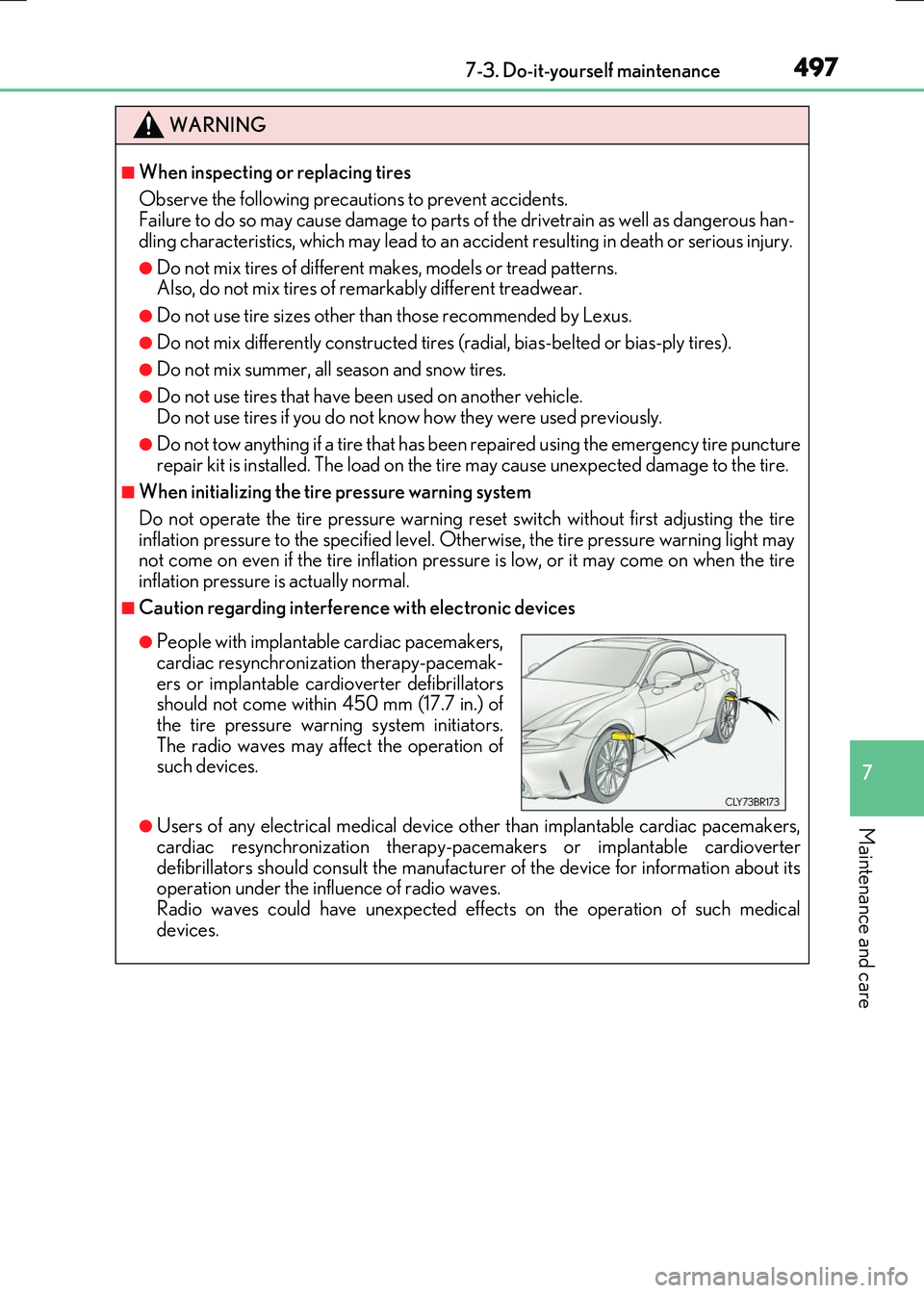
●People with implantable cardiac pacemakers,
cardiac resynchronization therapy-pacemak- ers or implantable cardioverter defibrillatorsshould not come within 450 mm (17.7 in.) of
the tire pressure warning system initiators. The radio waves may affect the operation ofsuch devices.
Page 498 of 640
4987-3. Do-it-yourself maintenance
RC300h_EE(OM24740E)
NOTICE
■Repairing or replacing tires, wheels, tire pressure warning valves, transmitters and tire valve caps
●When removing or fitting the wheels, tires or the tire pressure warning valves and
transmitters, contact any authorized Lexus de aler or repairer, or another duly quali- fied and equipped professional as the tire pressure warning valves and transmitters may be damaged if not handled correctly.
●Make sure to install the tire valve caps. If the tire valve caps are not installed, water could enter the tire pressure warning valv es and the tire pressure warning valves could be bound.
●When replacing tire valve caps, do not use tire valve caps other than those specified.The cap may become stuck.
■To avoid damage to the tire pressure warning valves and transmitters
When a tire is repaired with liquid sealants, the tire pressure warning valve and trans- mitter may not operate properly. If a liquid sealant is used, contact any authorizedLexus dealer or repairer, or another duly qu alified and equipped professional or other
qualified service shop as soon as possible. After use of liquid sealant, make sure to replace the tire pressure warning valve and transmitter when repairing or replacing the tire. ( P. 486)
■Driving on rough roads
Take particular care when driving on roads with loose surfaces or potholes. These conditions may cause losses in tire inflation pressure, reducing the cushioning
ability of the tires. In addition, driving on rough roads may cause damage to the tires themselves, as well as the vehicle’s wheels and body.
■Low profile tires
Low profile tires may cause greater damage than usual to the tire wheel when sustain- ing impact from the road surface. Therefore, pay attention to the following:
●Be sure to use proper tire inflation pressu re. If tires are under-inflated, they may be
damaged more severely.
●Avoid potholes, uneven pavement, curbs an d other road hazards. Failure to do so may lead to severe tire and wheel damage.
■If tire inflation pressure of ea ch tire becomes low while driving
Do not continue driving, or your tires and/or wheels may be ruined.
Page 499 of 640
4997-3. Do-it-yourself maintenance
7
Maintenance and care
RC300h_EE(OM24740E)
●Stop the vehicle on a hard, flat surface.
●Set the parking brake.
●Shift the shift lever to P.
●Stop the hybrid system.
Replacing the tire
When raising your vehicle with a jack, position the jack correctly.
Improper placement may damage your vehicle or cause injury.
Before jacking up the vehicle
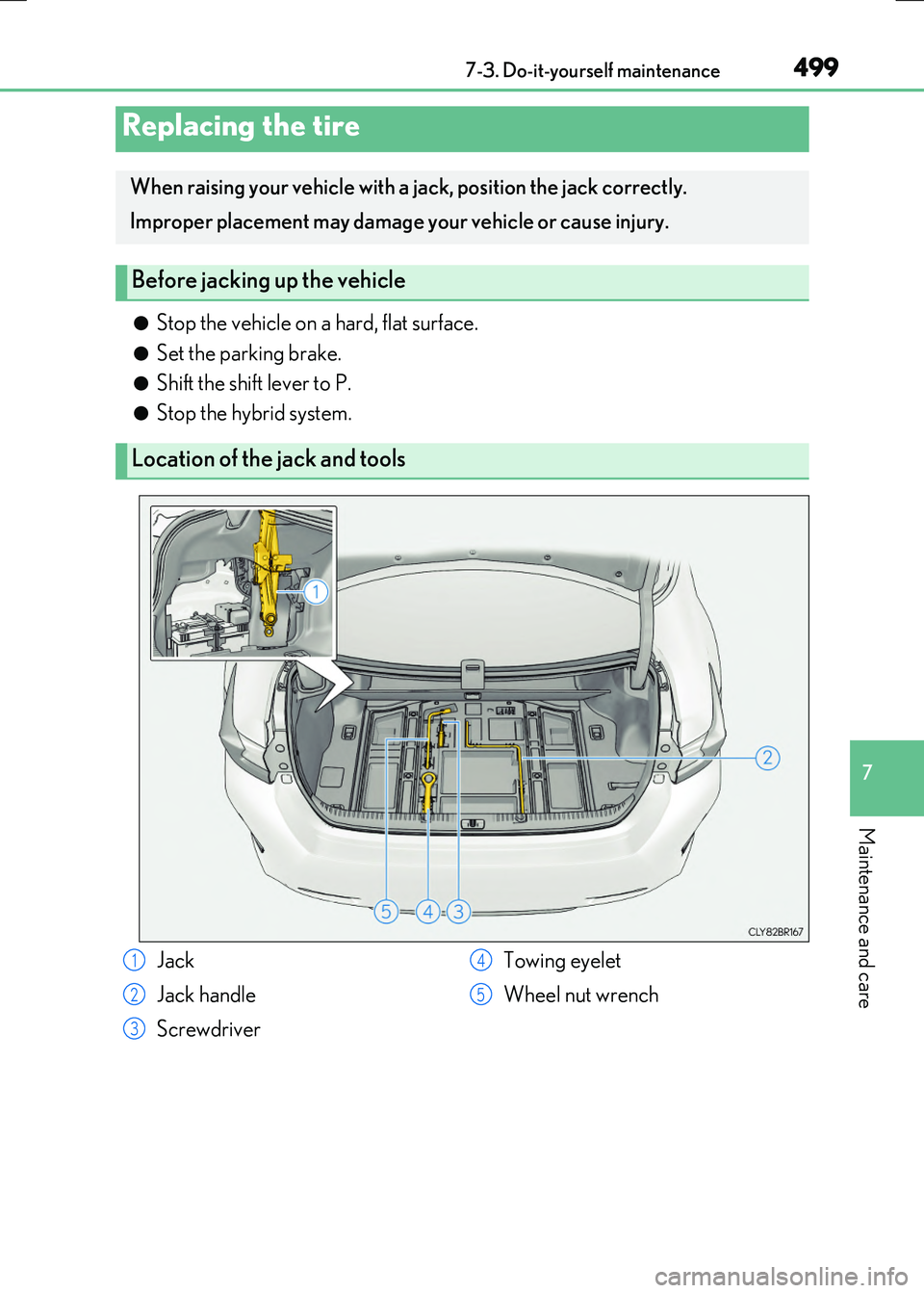
Location of the jack and tools
Jack
Jack handle
Screwdriver
Towing eyelet
Wheel nut wrench
1
2
3
4
5
Page 500 of 640
5007-3. Do-it-yourself maintenance
RC300h_EE(OM24740E)
Jack
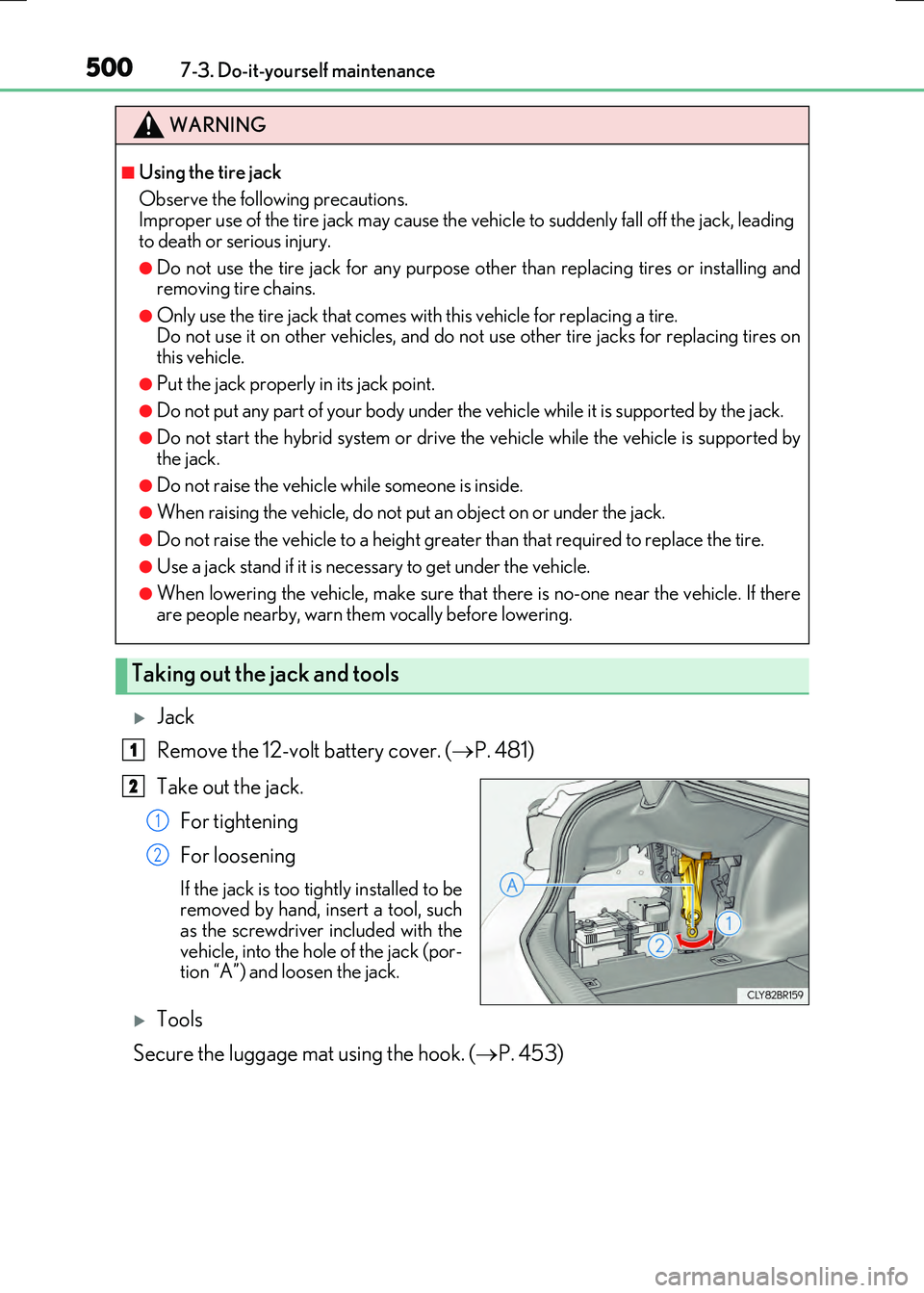
Remove the 12-volt battery cover. ( P. 481)
Take out the jack.
For tightening
For loosening
If the jack is too tightly installed to be removed by hand, insert a tool, suchas the screwdriver included with the
vehicle, into the hole of the jack (por- tion “A”) and loosen the jack.
Tools
Secure the luggage mat using the hook. ( P. 453)
WARNING
■Using the tire jack
Observe the following precautions. Improper use of the tire jack may cause the vehicle to suddenly fall off the jack, leading
to death or serious injury.
●Do not use the tire jack for any purpose ot her than replacing tires or installing and removing tire chains.
●Only use the tire jack that comes with this vehicle for replacing a tire. Do not use it on other vehicles, and do no t use other tire jacks for replacing tires on this vehicle.
●Put the jack properly in its jack point.
●Do not put any part of your body under the vehicle while it is supported by the jack.
●Do not start the hybrid system or drive the vehicle while the vehicle is supported by
the jack.
●Do not raise the vehicle while someone is inside.
●When raising the vehicle, do not put an object on or under the jack.
●Do not raise the vehicle to a height greater than that required to replace the tire.
●Use a jack stand if it is necessary to get under the vehicle.
●When lowering the vehicle, make sure that there is no-one near the vehicle. If there
are people nearby, warn them vocally before lowering.
Taking out the jack and tools
1
2
1
2
Page 501 of 640
5017-3. Do-it-yourself maintenance
7
Maintenance and care
RC300h_EE(OM24740E)
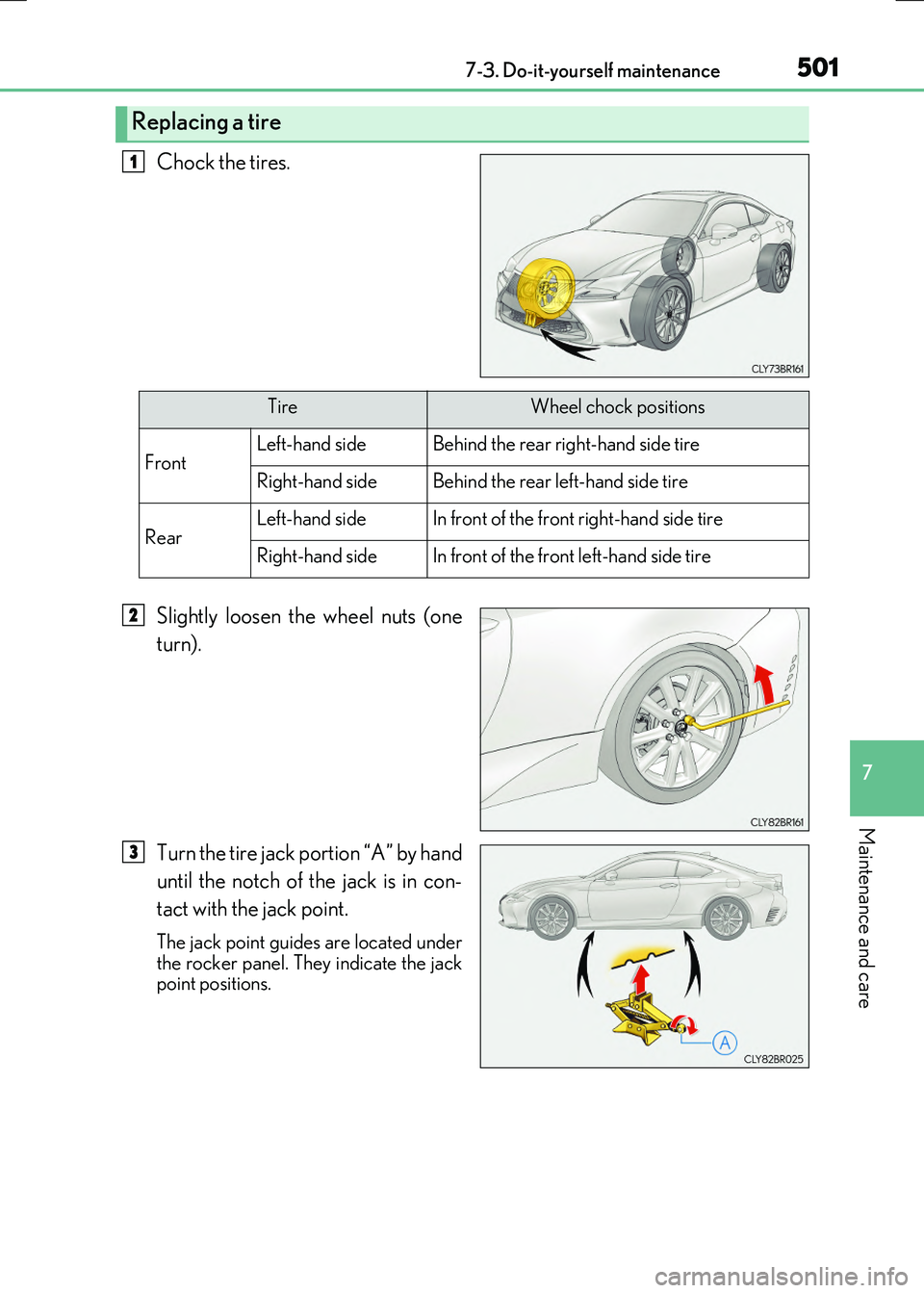
Chock the tires.
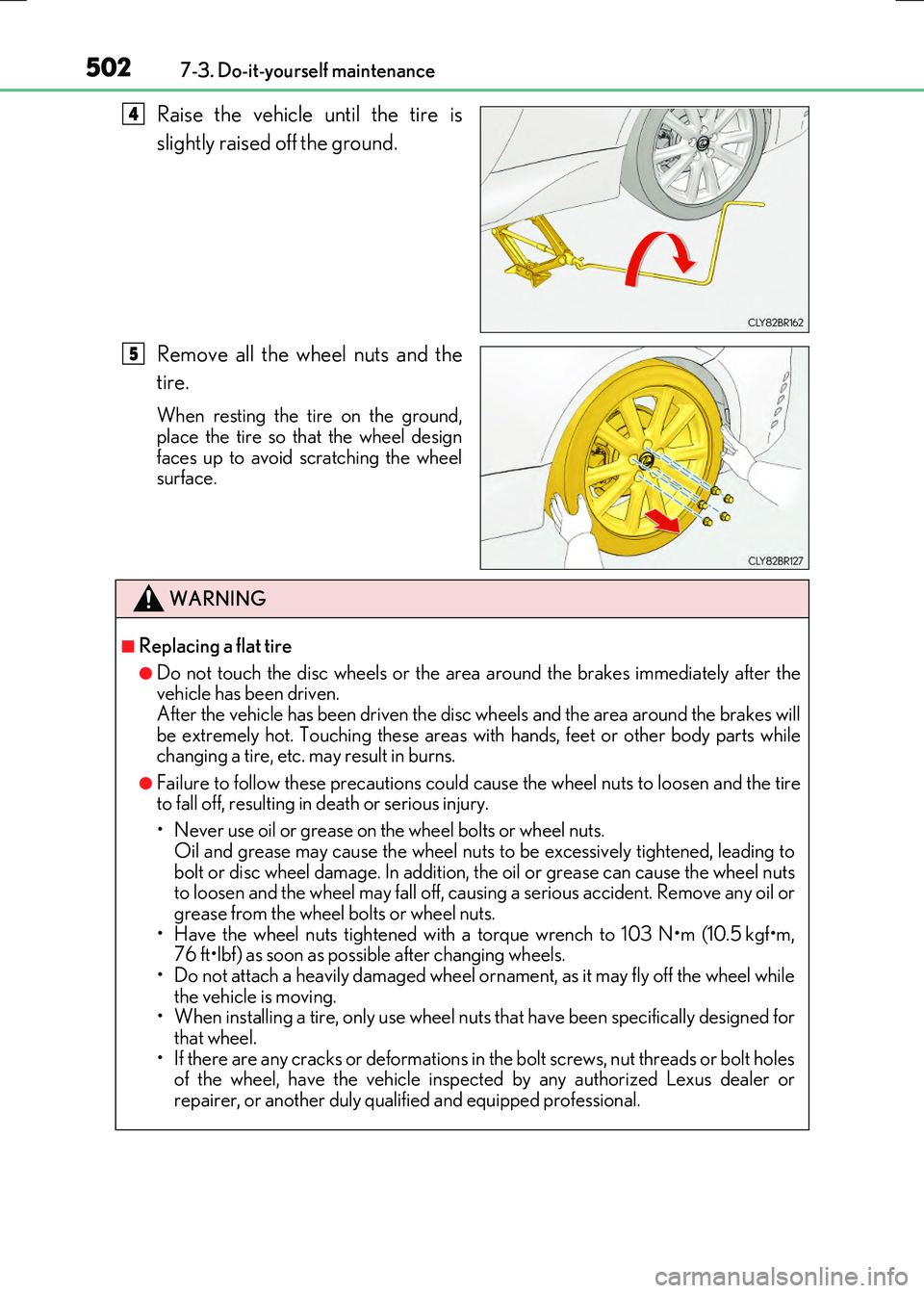
Slightly loosen the wheel nuts (one
turn).
Turn the tire jack portion “A” by hand
until the notch of the jack is in con-
tact with the jack point.
The jack point guides are located under
the rocker panel. They indicate the jack point positions.
Replacing a tire
1
TireWheel chock positions
FrontLeft-hand sideBehind the rear right-hand side tire
Right-hand sideBehind the rear left-hand side tire
RearLeft-hand sideIn front of the front right-hand side tire
Right-hand sideIn front of the front left-hand side tire
2
3
Page 502 of 640
5027-3. Do-it-yourself maintenance
RC300h_EE(OM24740E)
Raise the vehicle until the tire is
slightly raised off the ground.
Remove all the wheel nuts and the
tire.
When resting the tire on the ground,
place the tire so that the wheel design faces up to avoid scratching the wheelsurface.
4
5
WARNING
■Replacing a flat tire
●Do not touch the disc wheels or the area around the brakes immediately after thevehicle has been driven.
After the vehicle has been driven the disc wheels and the area around the brakes will be extremely hot. Touching these areas wi th hands, feet or other body parts while changing a tire, etc. may result in burns.
●Failure to follow these precautions could cause the wheel nuts to loosen and the tireto fall off, resulting in death or serious injury.
• Never use oil or grease on the wheel bolts or wheel nuts.
Oil and grease may cause the wheel nuts to be excessively tightened, leading to bolt or disc wheel damage. In addition, the oil or grease can cause the wheel nuts to loosen and the wheel may fall off, causing a serious accident. Remove any oil or
grease from the wheel bolts or wheel nuts. • Have the wheel nuts tightened with a torque wrench to 103 N•m (10.5 kgf•m,76 ft•lbf) as soon as possible after changing wheels.
• Do not attach a heavily damaged wheel or nament, as it may fly off the wheel while the vehicle is moving.• When installing a tire, only use wheel nuts that have been specifically designed for
that wheel. • If there are any cracks or deformations in the bolt screws, nut threads or bolt holesof the wheel, have the vehicle inspected by any authorized Lexus dealer or
repairer, or another duly qualif ied and equipped professional.
Page 503 of 640
5037-3. Do-it-yourself maintenance
7
Maintenance and care
RC300h_EE(OM24740E)
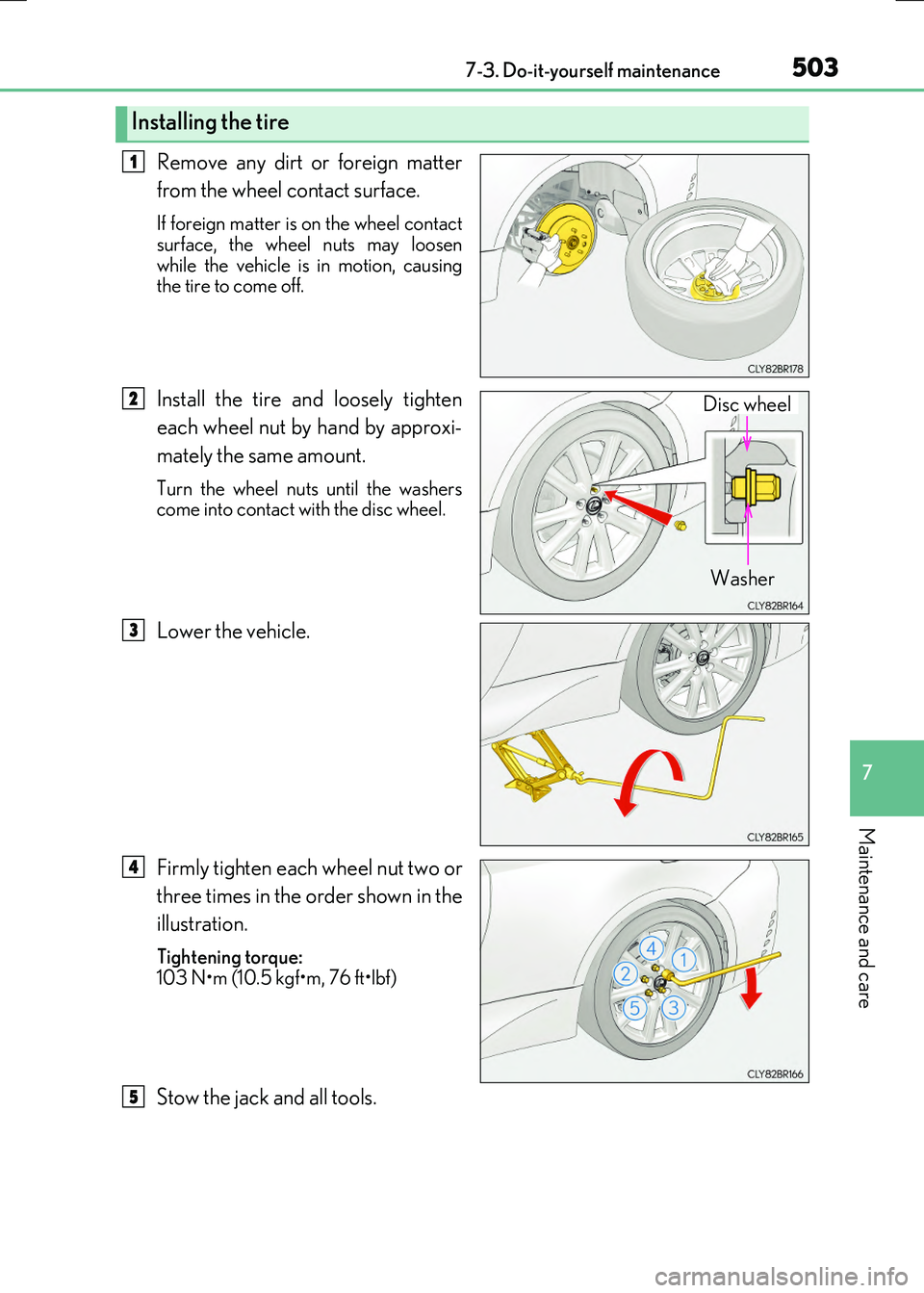
Remove any dirt or foreign matter
from the wheel contact surface.
If foreign matter is on the wheel contact
surface, the wheel nuts may loosen while the vehicle is in motion, causingthe tire to come off.
Install the tire and loosely tighten
each wheel nut by hand by approxi-
mately the same amount.
Turn the wheel nuts until the washers come into contact with the disc wheel.
Lower the vehicle.
Firmly tighten each wheel nut two or
three times in the order shown in the
illustration.
Tightening torque: 103 N•m (10.5 kgf•m, 76 ft•lbf)
Stow the jack and all tools.
Installing the tire
1
Disc wheel
Washer
2
3
4
5
Page 505 of 640
5057-3. Do-it-yourself maintenance
7
Maintenance and care
RC300h_EE(OM24740E)
■Effects of incorrect tire inflation pressure
Driving with incorrect tire inflation pressure may result in the following:
●Reduced fuel economy
●Reduced driving comfort and poor handling
●Reduced tire life due to wear
●Reduced safety
●Damage to the drivetrain
If a tire needs frequent inflating, have it checked by any authorized Lexus dealer or repairer, or another duly qua lified and equipped professional.
■Instructions for checking tire inflation pressure
When checking tire inflation pressure, observe the following:
●Check only when the tires are cold. If your vehicle has been parked for at least 3 hours or has not been driven for more than
1.5 km or 1 mile, you will get an accurate cold tire inflation pressure reading.
●Always use a tire pressure gauge. It is difficult to judge if a tire is prop erly inflated based only on its appearance.
●It is normal for the tire inflation pressure to be higher after driving as heat is generated in the tire. Do not reduce tire inflation pressure after driving.
●Passengers and luggage weight should be placed so that the vehicle is balanced.
Tire inflation pressure
Make sure to maintain proper tire infl ation pressure. Tire inflation pressure
should be checked at least once per month. However, Lexus recommends
that tire inflation pressure be checked once every two weeks. ( P. 604)
Page 506 of 640
5067-3. Do-it-yourself maintenance
RC300h_EE(OM24740E)
WARNING
■Proper inflation is critical to save tire performance
Keep your tires properly inflated. If the tires are not properly inflated, the following conditions may occur which could
lead to an accident resulting in death or serious injury:
●Excessive wear
●Uneven wear
●Poor handling
●Possibility of blowouts resulting from overheated tires
●Air leaking from between tire and wheel
●Wheel deformation and/or tire damage
●Greater possibility of tire damage while driving (due to road hazards, expansion joints, sharp edges in the road, etc.)
NOTICE
■When inspecting and adjusting tire inflation pressure
Be sure to put the tire valve caps back on. If a valve cap is not installed, dirt or moisture may get into the valve and cause an airleak, resulting in decrease d tire inflation pressure.
Page 507 of 640
5077-3. Do-it-yourself maintenance
7
Maintenance and care
RC300h_EE(OM24740E)
When replacing wheels, care should be taken to ensure that they are equivalent
to those removed in load capacity, diameter, rim width and inset*.
Replacement wheels are available at any authorized Lexus dealer or repairer, or
another duly qualified and equipped professional.
*: Conventionally referred to as “offset”.
Lexus does not recommend using the following:
●Wheels of different sizes or types
●Used wheels
●Bent wheels that have been straightened
●Use only Lexus wheel nuts and wrenches designed for use with your alumi-
num wheels.
●When rotating, repairing or changing your tires, check that the wheel nuts are
still tight after driving 1600 km (1000 miles).
●Be careful not to damage the aluminum wheels when using tire chains.
●Use only Lexus genuine balance weights or equivalent and a plastic or rubber
hammer when balancing your wheels.
■When replacing wheels
The wheels of your vehicle are equipped with tire pressure warning valves and transmit- ters that allow the tire pressure warning sy stem to provide advance warning in the event
of a loss in tire inflation pressure. Whenever wheels are replaced, tire pressure warning valves and transmitters must be installed. (P. 486)
Wheels
If a wheel is bent, cracked or heavily corroded, it should be replaced. Other-
wise, the tire may separate from the wheel or cause a loss of handling control.
Wheel selection
Aluminum wheel precautions