air LEXUS RCF 2018 Owners Manual
[x] Cancel search | Manufacturer: LEXUS, Model Year: 2018, Model line: RCF, Model: LEXUS RCF 2018Pages: 636, PDF Size: 6.88 MB
Page 510 of 636
510 7-2. Steps to take in an emergency
RC350_RC300 AWD_RC3 00_RC F_U(OM24748U)Inflate the tire until the recom-
mended pressure is reached.
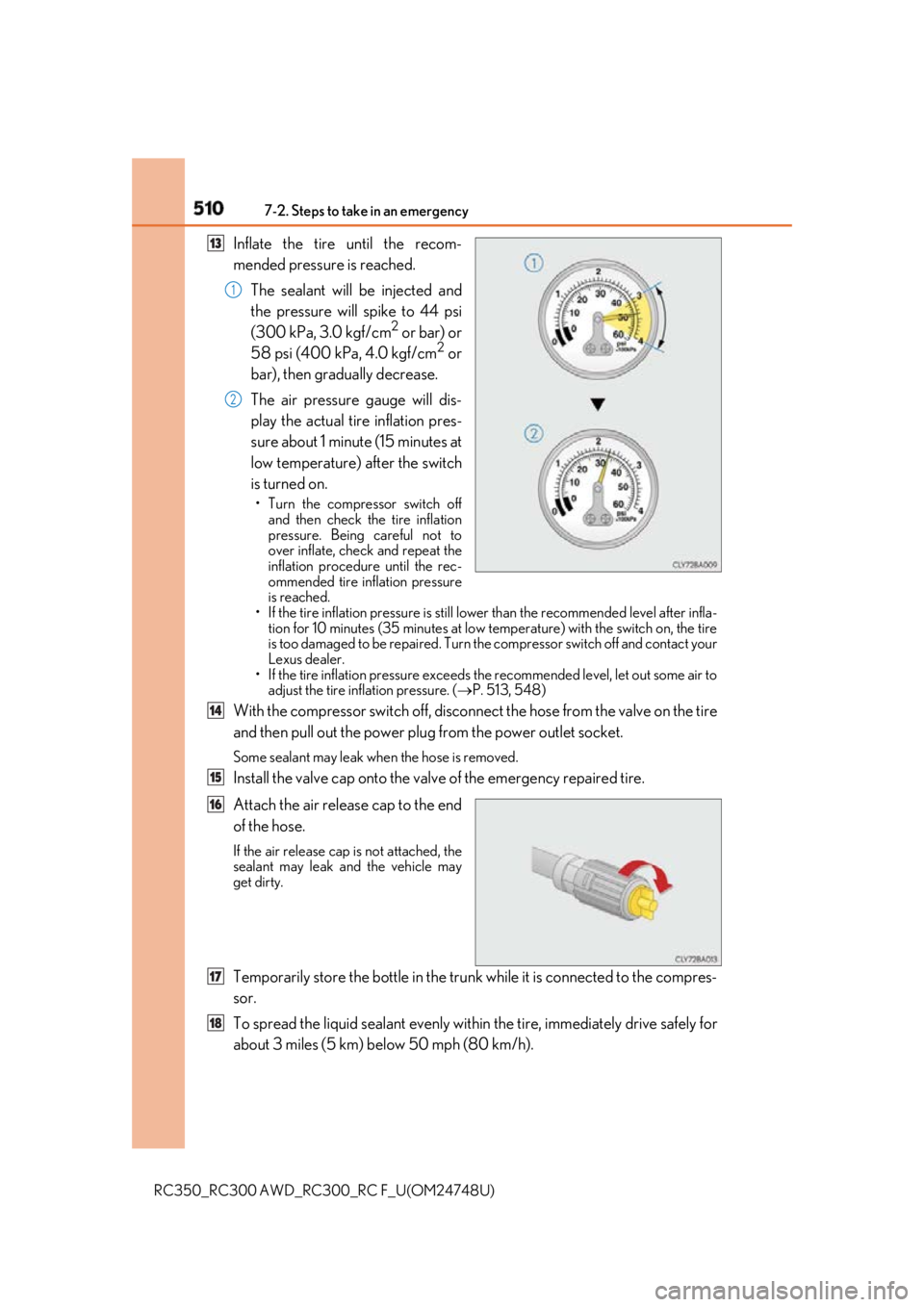
The sealant will be injected and
the pressure will spike to 44 psi
(300 kPa, 3.0 kgf/cm 2
or bar) or
58 psi (400 kPa, 4.0 kgf/cm 2
or
bar), then gradually decrease.
The air pressure gauge will dis-
play the actual tire inflation pres-
sure about 1 minute (15 minutes at
low temperature) after the switch
is turned on. • Turn the compressor switch off
and then check the tire inflation
pressure. Being careful not to
over inflate, check and repeat the
inflation procedure until the rec-
ommended tire inflation pressure
is reached.
• If the tire inflation pressure is still lo wer than the recommen ded level after infla-
tion for 10 minutes (35 minutes at low temperature) with the switch on, the tire
is too damaged to be repaired. Turn th e compressor switch off and contact your
Lexus dealer.
• If the tire inflation pressure exceeds th e recommended level, let out some air to
adjust the tire inflation pressure. ( P. 513, 548)
With the compressor switch off, disconnect the hose from the valve on the tire
and then pull out the power plug from the power outlet socket.Some sealant may leak when the hose is removed.
Install the valve cap onto the valv e of the emergency repaired tire.
Attach the air release cap to the end
of the hose. If the air release cap is not attached, the
sealant may leak and the vehicle may
get dirty.
Temporarily store the bottle in the trunk while it is connected to the compres-
sor.
To spread the liquid sealant evenly within the tire, immediately drive safely for
about 3 miles (5 km) below 50 mph (80 km/h). 13
1
2
14
15
16
17
18
Page 511 of 636
5117-2. Steps to take in an emergency
RC350_RC300 AWD_RC3 00_RC F_U(OM24748U) 7
When trouble arises After driving, stop your vehicle in a
safe place on a hard, flat surface and
reconnect the compressor.
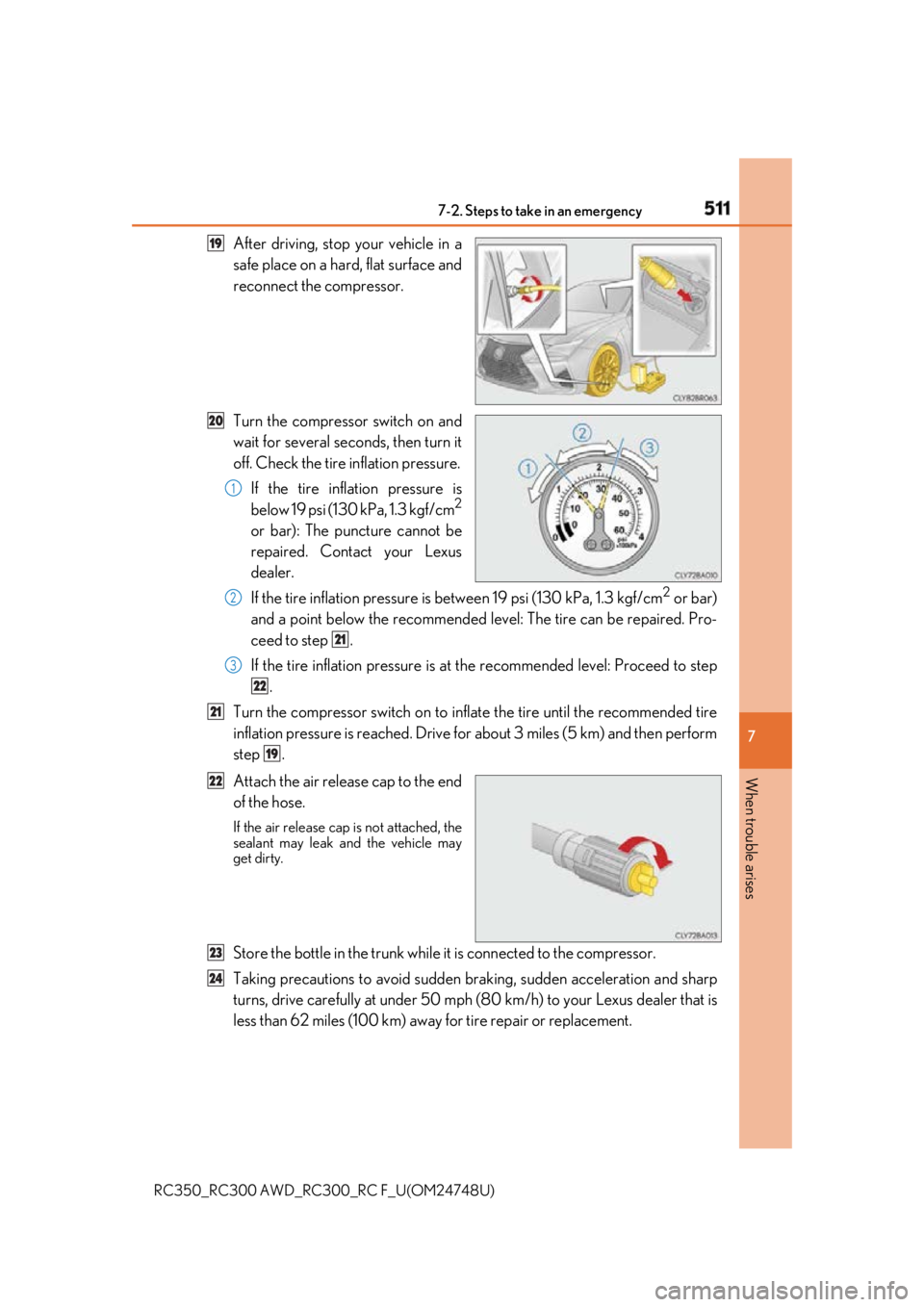
Turn the compressor switch on and
wait for several seconds, then turn it
off. Check the tire inflation pressure.
If the tire inflation pressure is
below 19 psi (130 kPa, 1.3 kgf/cm 2
or bar): The puncture cannot be
repaired. Contact your Lexus
dealer.
If the tire inflation pressure is between 19 psi (130 kPa, 1.3 kgf/cm 2
or bar)
and a point below the recommended leve l: The tire can be repaired. Pro-
ceed to step .
If the tire inflation pressure is at the recommended level: Proceed to step
.
Turn the compressor switch on to inflate the tire until the recommended tire
inflation pressure is reached. Drive for about 3 miles (5 km) and then perform
step .
Attach the air release cap to the end
of the hose. If the air release cap is not attached, the
sealant may leak and the vehicle may
get dirty.
Store the bottle in the trunk while it is connected to the compressor.
Taking precautions to avoid sudden br aking, sudden acceleration and sharp
turns, drive carefully at under 50 mph (80 km/h) to your Lexus dealer that is
less than 62 miles (100 km) away for tire repair or replacement.19
20
1
2
21
3
1322
21
19
22
23
24
Page 512 of 636
512 7-2. Steps to take in an emergency
RC350_RC300 AWD_RC3 00_RC F_U(OM24748U)■
Emergency tire puncture repair kit ●
The sealant has a limited lifespan. The expiry date is marked on the bottle. The sealant
should be replaced before the expiry date. Contact your Lexus dealer for replacement.●
The sealant stored in the emergency tire puncture repair kit can be used only once to
temporarily repair a single tire. If the seal ant has been used and needs to be purchased,
contact your Lexus dealer. The compressor is reusable.●
The sealant can be used when the outside temperature is from -40 F (-40 C) to
140 F (60 C).●
The kit is exclusively designed for size and type of tires originally in stalled on your vehi-
cle. Do not use it for tires that a different size than the original ones, or for any other
purposes. ●
If the sealant gets on yo ur clothes, it may stain.●
If the sealant adheres to a wheel or the surface of the vehicle body, the stain may not be
removable if it is not cleaned at once. Immediately wipe away the sealant with a wet
cloth. ●
During operation of the kit, a loud operation noise is produc ed. This does not indicate a
malfunction. ●
Do not use the emergency tire puncture repair kit to check or to adjust the tire pres-
sure.
Page 513 of 636
5137-2. Steps to take in an emergency
RC350_RC300 AWD_RC3 00_RC F_U(OM24748U) 7
When trouble arises ■
If the tire is inflated to mo re than the recommended level
Disconnect the hose from the valve.
Disconnect the hose from the valve, remove the air releas e cap from the hose and then
reconnect the hose.
Turn the compressor switch on and wait for se veral seconds, then turn it off. Check that
the air pressure indicator sh ows the recommended level. ( P. 548)
If the air pressure is lower than the reco mmended level, turn th e compressor switch on
again and repeat the inflation procedure un til the recommended pr essure is reached.■
After a tire is repaired with the emergency tire puncture repair kit ●
The tire pressure warning valve an d transmitter should be replaced.●
Even if the tire inflation pres sure is at the recommended leve l, the tire pressure warning
light may come on/flash. ■
Note for checking the emergency tire puncture repair kit
Check the sealant expi ry date occasionally.
The expiry date is shown on the bottle. Do not use sealant whose expiry date has already
passed. Otherwise, repairs co nducted using the emergency ti re puncture repair kit may
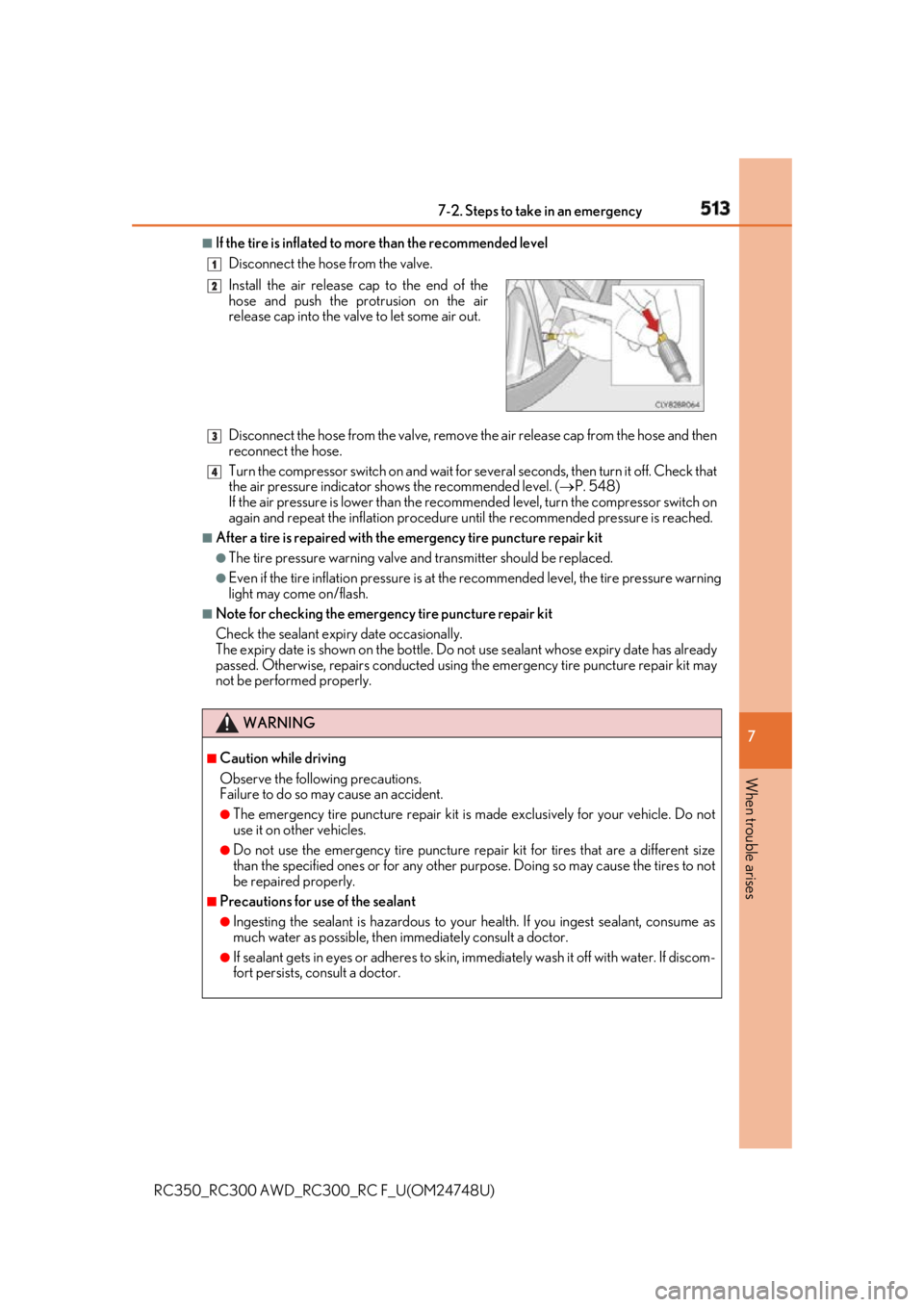
not be performed properly. Install the air release cap to the end of the
hose and push the protrusion on the air
release cap into the valve to let some air out.
WARNING ■
Caution while driving
Observe the following precautions.
Failure to do so may cause an accident. ●
The emergency tire puncture repair kit is made exclusively for your vehicle. Do not
use it on other vehicles. ●
Do not use the emergency tire puncture repa ir kit for tires that are a different size
than the specified ones or for any other pu rpose. Doing so may cause the tires to not
be repaired properly. ■
Precautions for use of the sealant ●
Ingesting the sealant is hazardous to your health. If you ingest sealant, consume as
much water as possible, then immediately consult a doctor. ●
If sealant gets in eyes or adheres to skin, immediately wash it off with water. If discom-
fort persists, consult a doctor. 1
2
3
4
Page 514 of 636
514 7-2. Steps to take in an emergency
RC350_RC300 AWD_RC3 00_RC F_U(OM24748U)WARNING ■
When fixing the flat tire
Observe the following precautions.
Failure to do so may result in death or serious injury.●
Stop your vehicle in a safe and flat area. ●
Do not touch the wheels or the area around the brakes immediately after the vehicle
has been driven.
After the vehicle has been driven, the wheels and the area around the brakes may be
extremely hot. Touching these areas with hands, feet or other body parts may result in
burns. ●
Connect the valve and hose securely with the tire installed on the vehicle.
• If the hose is not properly connected to the valve, air leakage may occur or sealant
may be sprayed out.
• If the hose comes off the valve while inflating the tire, there is a risk that the hose
will move abruptly due to air pressure.
• After inflation of the tire has completed, the sealant may splatter when the hose is
disconnected or some air is let out of the tire. ●
Follow the operation procedure to repair the tire. If the procedure is not followed, the
sealant may spray out. ●
Keep back from the tire while it is being re paired, as there is a chance of it bursting
while the repair operation is being performed. If you notice any cracks or deforma-
tion of the tire, turn off the compressor sw itch and stop the repa ir operation immedi-
ately. ●
The kit may overheat if operated for a long period of time. Do not operate the com-
pressor continuously for more than 35 minutes. ●
Parts of the kit become hot during operation. Be careful handling the kit during and
after operation. Do not touch the metal part around the connecting area between the
bottle and compressor. It will be extremely hot. ●
Do not attach the vehicle speed warning sticker to an area other than the one indi-
cated. If the sticker is attached to an area where an SRS airbag is located, such as the
pad of the steering wheel, it may preven t the SRS airbag from operating properly.■
Driving to spread th e liquid sealant evenly●
Drive the vehicle carefully at a low speed. Be especially careful when turning and cor-
nering. ●
If the vehicle does not drive straight or you feel a pull through the steering wheel, stop
the vehicle and check the following:
• Tire condition. The tire may have separated from the wheel.
• Tire inflation pressure. If tire inflation pressure is 19 psi (130 kPa, 1.3 kgf/cm 2
or
bar) or below, this may in dicate severe tire damage.
Page 515 of 636
5157-2. Steps to take in an emergency
RC350_RC300 AWD_RC3 00_RC F_U(OM24748U) 7
When trouble arises NOTICE ■
When performing an emergency repair ●
Perform the emergency repair without removi ng the nail or screw that has punctured
the tread of the tire. If the object that has punctured the tire is removed, repair by the
emergency tire puncture repair kit may not be possible. ●
The kit is not waterproof. Make sure that th e kit is not exposed to water, such as when
it is being used in the rain. ●
Do not put the kit directly onto dusty ground such as sand at the side of the road. If the
kit vacuums up dust etc., a malfunction may occur. ●
Make sure to stand the kit with the bottle ve rtical. The kit cannot work properly if it is
laid on its side. ■
Handling the emergency tire puncture repair kit ●
The compressor power source should be 12 V DC suitable for vehicle use. Do not
connect the compressor to any other source. ●
If gasoline splatters on the kit, the kit may deteriorate. Take care not to allow gasoline
to contact it. ●
Store the emergency tire punctu re repair kit in the trunk.
The kit may be thrown around during sudden braking and so forth, damaging the kit. ●
Store the kit in its assigned place out of reach of children.●
Do not disassemble or modify the kit. Do not subject parts such as the air pressure
indicator to impacts. This may cause a malfunction. ■
To avoid damage to the tire pressu re warning valves and transmitters
When a tire is repaired with liquid sealants, the tire pressure warning valve and trans-
mitter may not operate properly. If a liquid sealant is used, contact your Lexus dealer as
soon as possible. After use of liquid sealan t, make sure to repl ace the tire pressure
warning valve and transmitter when repairing or replacing the tire. ( P. 413)
Page 517 of 636
5177-2. Steps to take in an emergency
RC350_RC300 AWD_RC3 00_RC F_U(OM24748U) 7
When trouble arises One of the following may be the cause of the problem: ●
One or both of the battery terminals may be disconnected. ●
The battery may be discharged. ( P. 522)●
There may be a malfunction in the steering lock system.Contact your Lexus dealer if the problem cannot be repaired, or if repair procedures
are unknown.
When the engine does not start, the follo wing steps can be used as an interim
measure to start the engine if the engine switch is functioning normally:
Set the parking brake.
Shift the shift lever to P.
Turn the engine switch to ACCESSORY mode.
Press and hold the engine switch for about 15 seconds while depressing the
brake pedal firmly.
Even if the engine can be started using the above steps, the system may be mal-
functioning. Have the vehicle in spected by your Lexus dealer.The starter motor does not turn ove r, the interior lights and headlights
do not turn on, or the horn does not sound.
Emergency start function 1
2
3
4
Page 522 of 636
522 7-2. Steps to take in an emergency
RC350_RC300 AWD_RC3 00_RC F_U(OM24748U)If you have a set of jumper (or booster) cables and a second vehicle with a 12-volt
battery, you can jump start your vehicle by following the steps below.
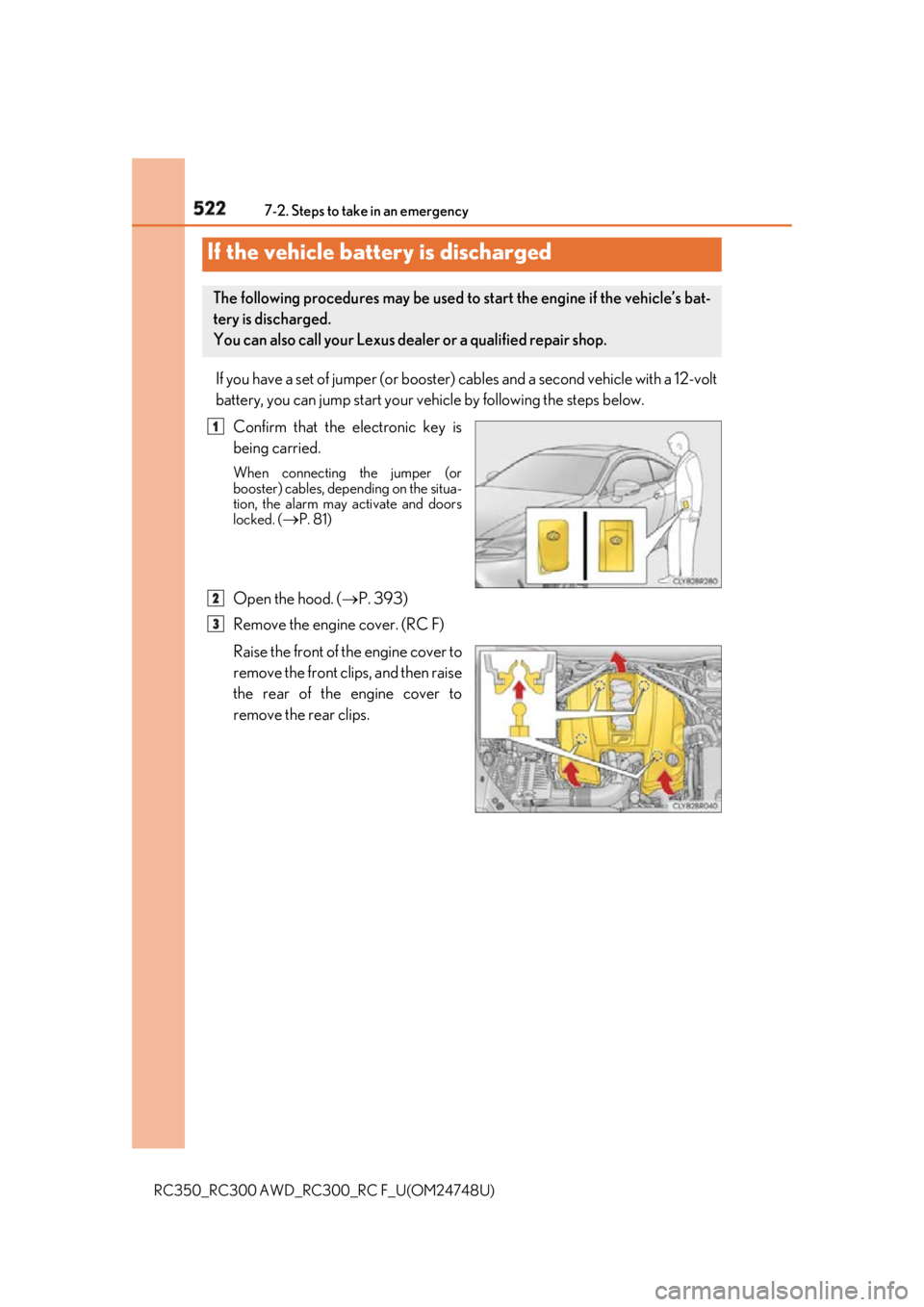
Confirm that the electronic key is
being carried. When connecting the jumper (or
booster) cables, depe nding on the situa-
tion, the alarm may activate and doors
locked. (
P. 81)
Open the hood. ( P. 393)
Remove the engine cover. (RC F)
Raise the front of the engine cover to
remove the front clips, and then raise
the rear of the engine cover to
remove the rear clips.If the vehicle battery is discharged The following procedures may be used to start the engine if the vehicle’s bat-
tery is discharged.
You can also call your Lexus deal er or a qualified repair shop.1
2
3
Page 526 of 636
526 7-2. Steps to take in an emergency
RC350_RC300 AWD_RC3 00_RC F_U(OM24748U)●
The engine coolant temperature gauge ( P. 91, 96) is in the red zone or a
loss of engine power is experienced. (For example, the vehicle speed does not
increase.) ●
“Engine Coolant Temp High Stop in a Safe Place See Owner's Manual” is
shown on the multi-information display. ●
Steam comes out from under the hood.
Stop the vehicle in a safe place and tu rn off the air conditioning system, and
then stop the engine.
If you see steam:
Carefully lift the hood after the steam subsides.
If you do not see steam:
Carefully lift the hood.If your vehicle overheats The following may indicate that your vehicle is overheating.
Correction procedures 1
2
Page 529 of 636
5297-2. Steps to take in an emergency
RC350_RC300 AWD_RC3 00_RC F_U(OM24748U) 7
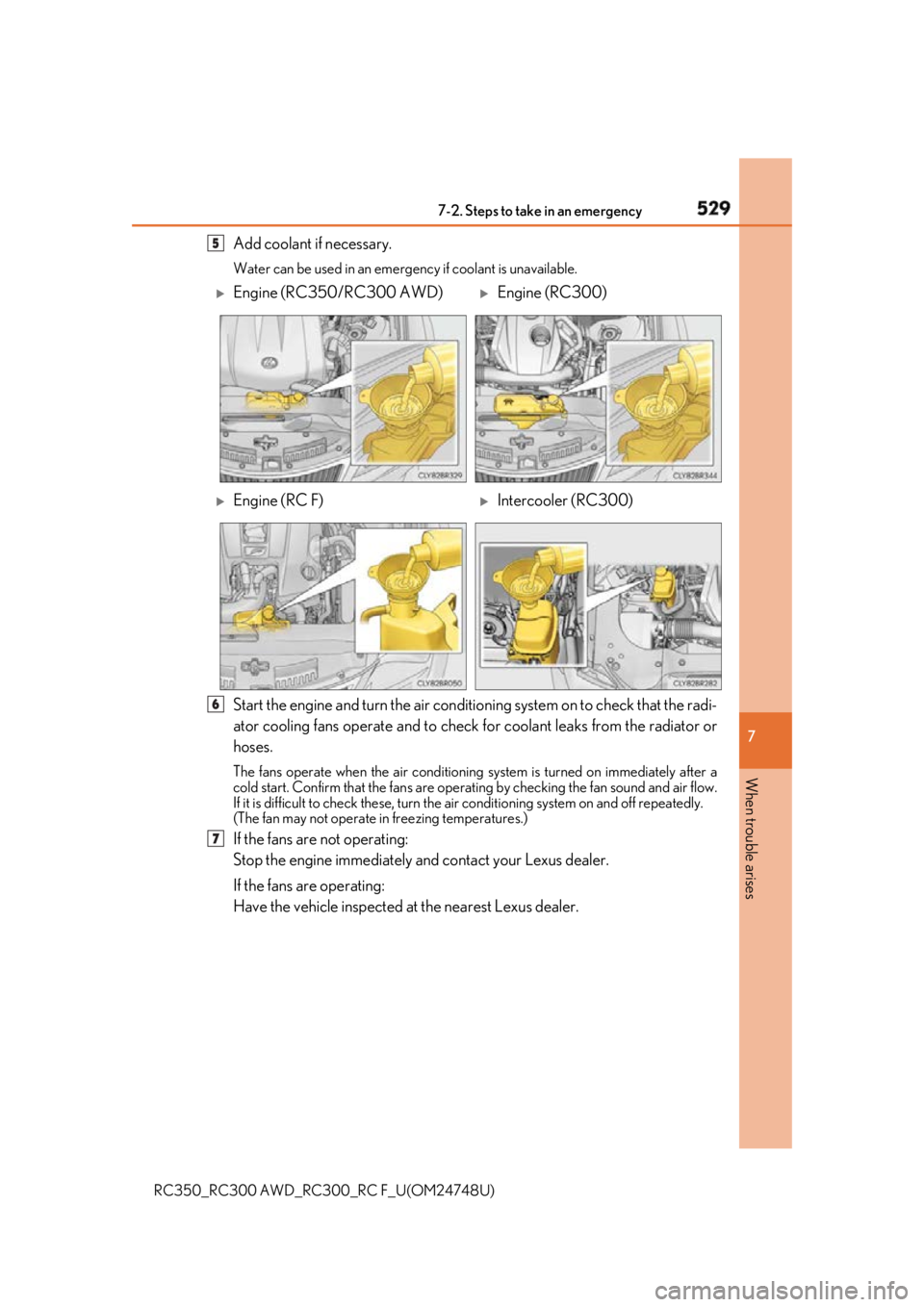
When trouble arises Add coolant if necessary. Water can be used in an emerge ncy if coolant is unavailable.
Start the engine and turn the air conditio ning system on to check that the radi-
ator cooling fans operate and to check for coolant leaks from the radiator or
hoses. The fans operate when the air conditioning system is turned on immediately after a
cold start. Confirm that the fans are operating by checking the fan sound and air flow.
If it is difficult to check these, turn the air conditioning system on and off repeatedly.
(The fan may not operate in freezing temperatures.)
If the fans are not operating:
Stop the engine immediately an d contact your Lexus dealer.
If the fans are operating:
Have the vehicle inspected at the nearest Lexus dealer. 5
Engine (RC350/RC300 AWD)
Engine (RC300)
Engine (RC F)
Intercooler (RC300)
6
7