tires LEXUS RCF 2019 Service Manual
[x] Cancel search | Manufacturer: LEXUS, Model Year: 2019, Model line: RCF, Model: LEXUS RCF 2019Pages: 636, PDF Size: 12.48 MB
Page 513 of 636
5137-2. Steps to take in an emergency
RC F_U 7
When trouble arises ■
If the tire is inflated to mo re than the recommended level
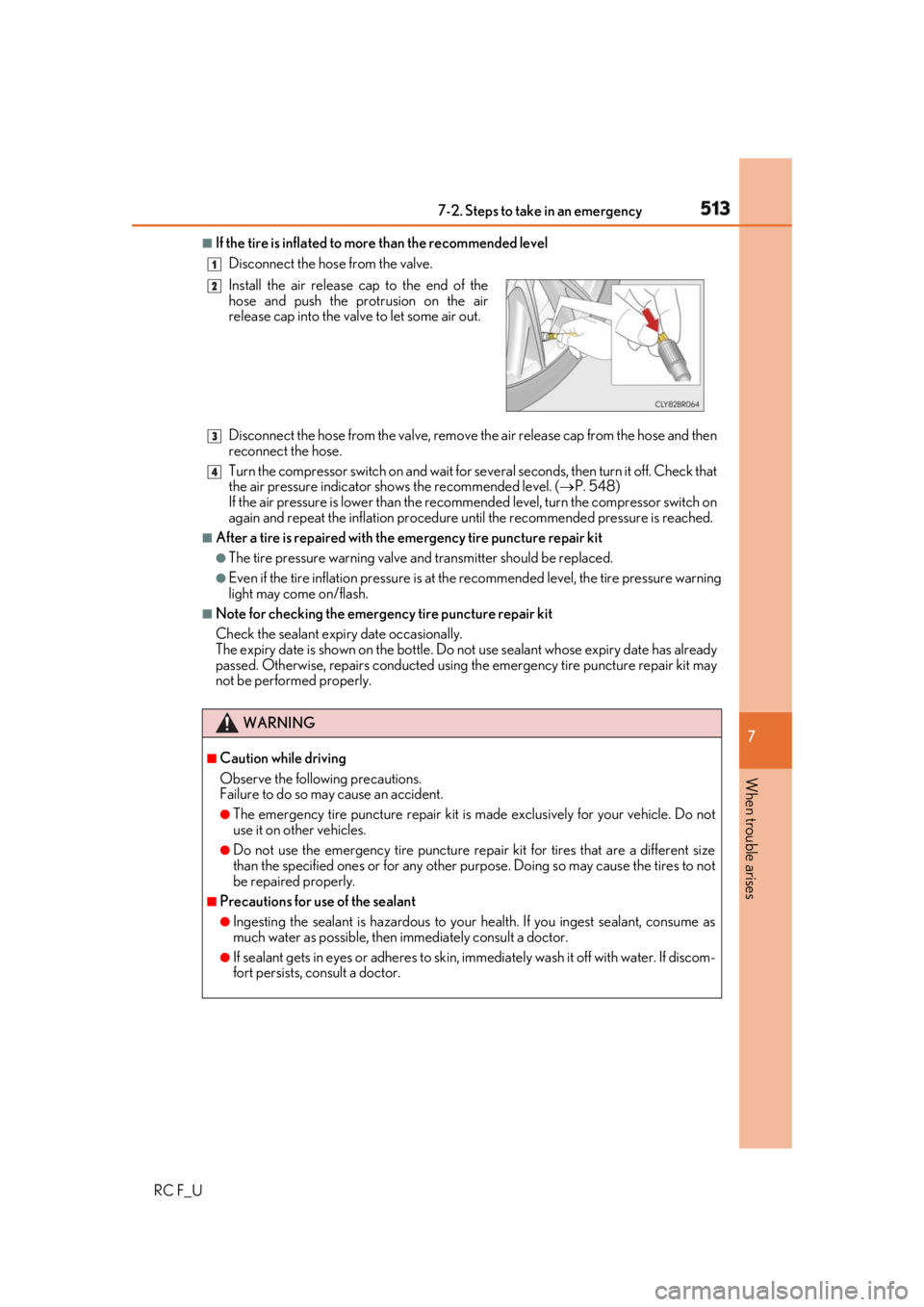
Disconnect the hose from the valve.
Disconnect the hose from the valve, remove the air releas e cap from the hose and then
reconnect the hose.
Turn the compressor switch on and wait for se veral seconds, then turn it off. Check that
the air pressure indicator sh ows the recommended level. ( P. 548)
If the air pressure is lower than the reco mmended level, turn th e compressor switch on
again and repeat the inflation procedure un til the recommended pr essure is reached.■
After a tire is repaired with the emergency tire puncture repair kit ●
The tire pressure warning valve an d transmitter should be replaced.●
Even if the tire inflation pres sure is at the recommended leve l, the tire pressure warning
light may come on/flash. ■
Note for checking the emergency tire puncture repair kit
Check the sealant expi ry date occasionally.
The expiry date is shown on the bottle. Do not use sealant whose expiry date has already
passed. Otherwise, repairs co nducted using the emergency ti re puncture repair kit may
not be performed properly. Install the air release cap to the end of the
hose and push the protrusion on the air
release cap into the valve to let some air out.
WARNING ■
Caution while driving
Observe the following precautions.
Failure to do so may cause an accident. ●
The emergency tire puncture repair kit is made exclusively for your vehicle. Do not
use it on other vehicles. ●
Do not use the emergency tire puncture repa ir kit for tires that are a different size
than the specified ones or for any other pu rpose. Doing so may cause the tires to not
be repaired properly. ■
Precautions for use of the sealant ●
Ingesting the sealant is hazardous to your health. If you ingest sealant, consume as
much water as possible, then immediately consult a doctor. ●
If sealant gets in eyes or adheres to skin, immediately wash it off with water. If discom-
fort persists, consult a doctor. 1
2
3
4
Page 532 of 636
532 7-2. Steps to take in an emergency
RC F_U Stop the engine. Set the parking br ake and shift the shift lever to P.
Remove the mud, snow or sand from around the rear wheels.
Place wood, stones or some other materi al under the rear wheels to help pro-
vide traction.
Restart the engine.
Shift the shift lever to D or R and rele ase the parking brake. Then, while exer-
cising caution, depress the accelerator pedal. ■
When it is difficult to free the vehicle
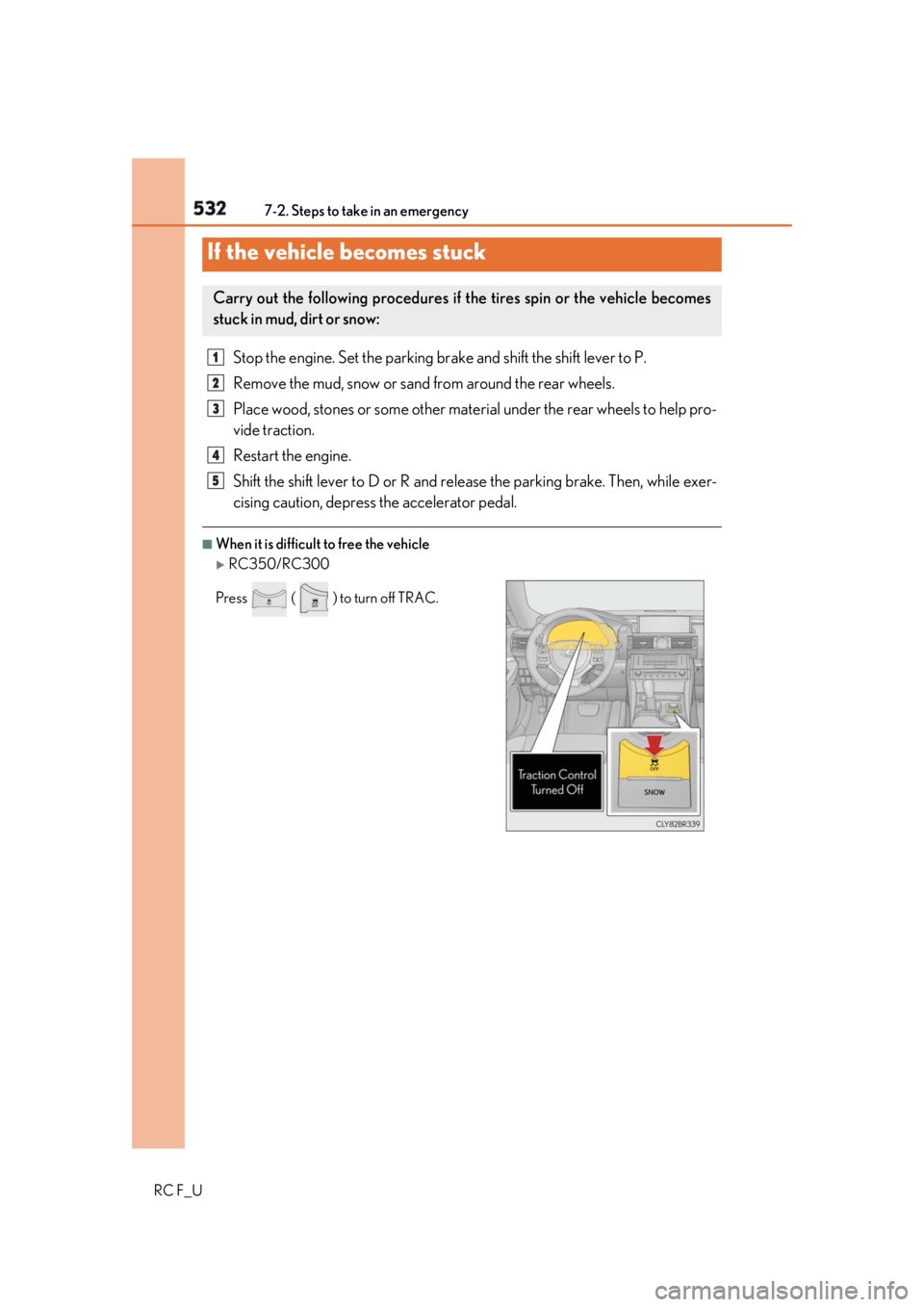
RC350/RC300
If the vehicle becomes stuck Carry out the following procedures if the tires spin or the vehicle becomes
stuck in mud, dirt or snow:
Press ( ) to turn off TRAC. 1
2
3
4
5
Page 536 of 636
536
RC F_U 8-1. Specifications
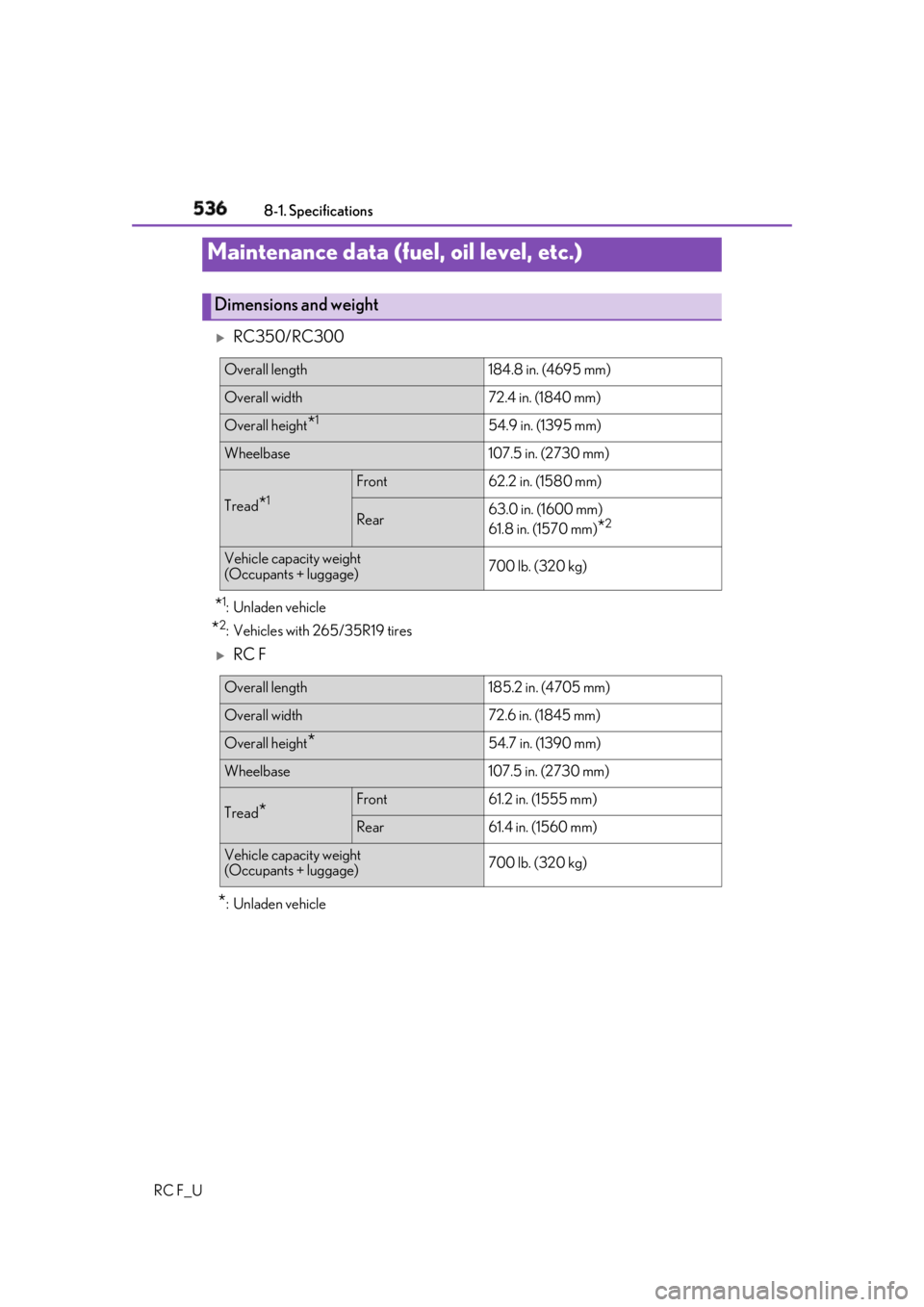
RC350/RC300
* 1
:Unladen vehicle
* 2
: Vehicles with 265/35R19 tires
RC F
* :Unladen vehicleMaintenance data (fuel, oil level, etc.) Dimensions and weight Overall length 184.8 in. (4695 mm)
Overall width 72.4 in. (1840 mm)
Overall height
* 1
54.9 in. (1395 mm)
Wheelbase 107.5 in. (2730 mm)
Tread
* 1
Front 62.2 in. (1580 mm)
Rear 63.0 in. (1600 mm)
61.8 in. (1570 mm)
* 2
Vehicle capacity weight
(Occupants + luggage) 700 lb. (320 kg)
Overall length 185.2 in. (4705 mm)
Overall width 72.6 in. (1845 mm)
Overall height
* 54.7 in. (1390 mm)
Wheelbase 107.5 in. (2730 mm)
Tread
* Front 61.2 in. (1555 mm)
Rear 61.4 in. (1560 mm)
Vehicle capacity weight
(Occupants + luggage) 700 lb. (320 kg)
Page 548 of 636
548 8-1. Specifications
RC F_U
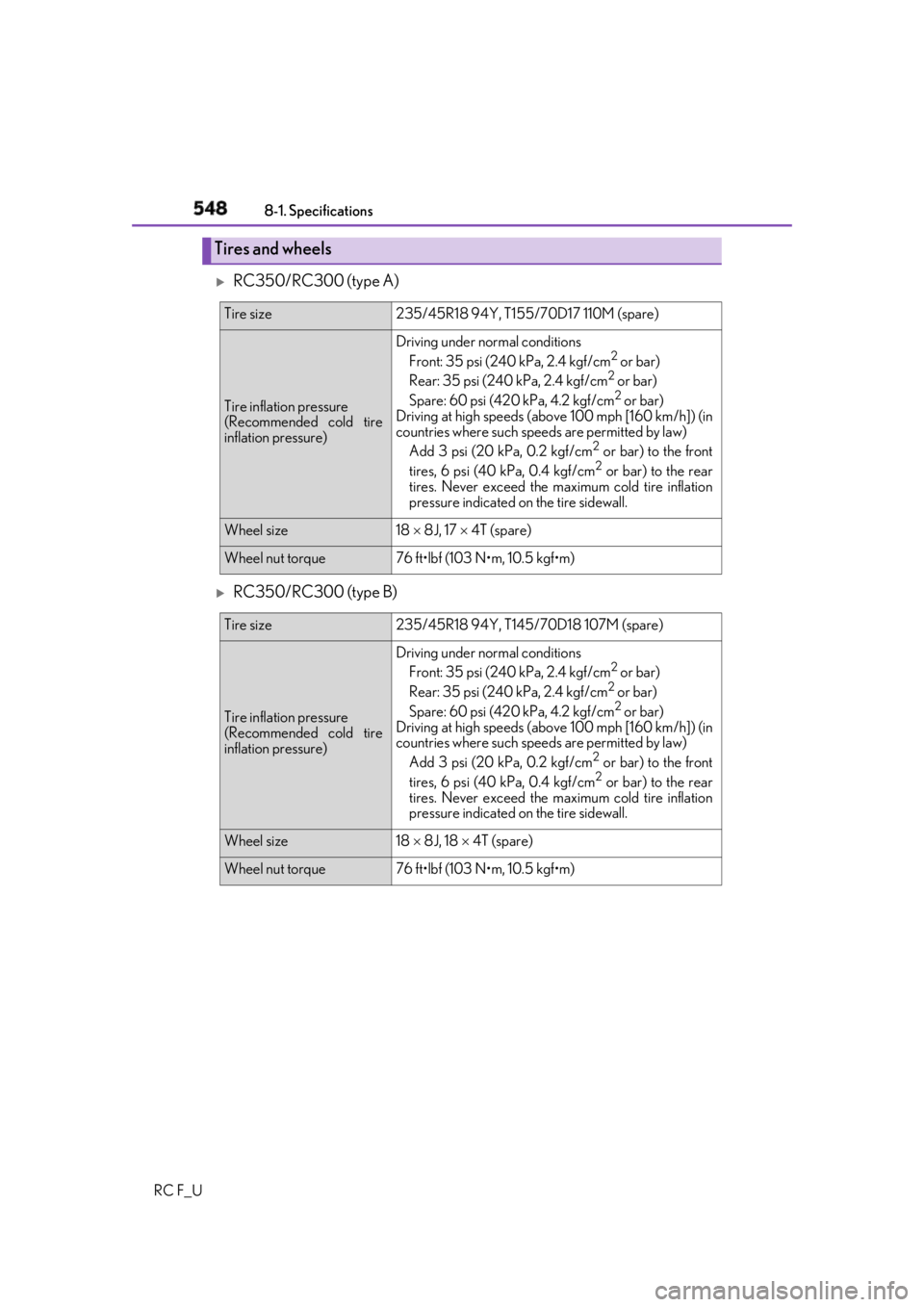
RC350/RC300 (type A)
RC350/RC300 (type B)Tires and wheels Tire size 235/45R18 94Y, T155/70D17 110M (spare)
Tire inflation pressure
(Recommended cold tire
inflation pressure) Driving under normal conditions
Front: 35 psi (240 kPa, 2.4 kgf/cm 2
or bar)
Rear: 35 psi (240 kPa, 2.4 kgf/cm 2
or bar)
Spare: 60 psi (420 kPa, 4.2 kgf/cm 2
or bar)
Driving at high speeds (above 100 mph [160 km/h]) (in
countries where such speeds are permitted by law)
Add 3 psi (20 kPa, 0.2 kgf/cm 2
or bar) to the front
tires, 6 psi (40 kPa, 0.4 kgf/cm 2
or bar) to the rear
tires. Never exceed the maximum cold tire inflation
pressure indicated on the tire sidewall.
Wheel size 18 8J, 17 4T (spare)
Wheel nut torque 76 ft •
lbf (103 N •
m, 10.5 kgf •
m)
Tire size 235/45R18 94Y, T145/70D18 107M (spare)
Tire inflation pressure
(Recommended cold tire
inflation pressure) Driving under normal conditions
Front: 35 psi (240 kPa, 2.4 kgf/cm 2
or bar)
Rear: 35 psi (240 kPa, 2.4 kgf/cm 2
or bar)
Spare: 60 psi (420 kPa, 4.2 kgf/cm 2
or bar)
Driving at high speeds (above 100 mph [160 km/h]) (in
countries where such speeds are permitted by law)
Add 3 psi (20 kPa, 0.2 kgf/cm 2
or bar) to the front
tires, 6 psi (40 kPa, 0.4 kgf/cm 2
or bar) to the rear
tires. Never exceed the maximum cold tire inflation
pressure indicated on the tire sidewall.
Wheel size 18 8J, 18 4T (spare)
Wheel nut torque 76 ft •
lbf (103 N •
m, 10.5 kgf •
m)
Page 549 of 636
5498-1. Specifications
8
Vehicle specifications
RC F_U
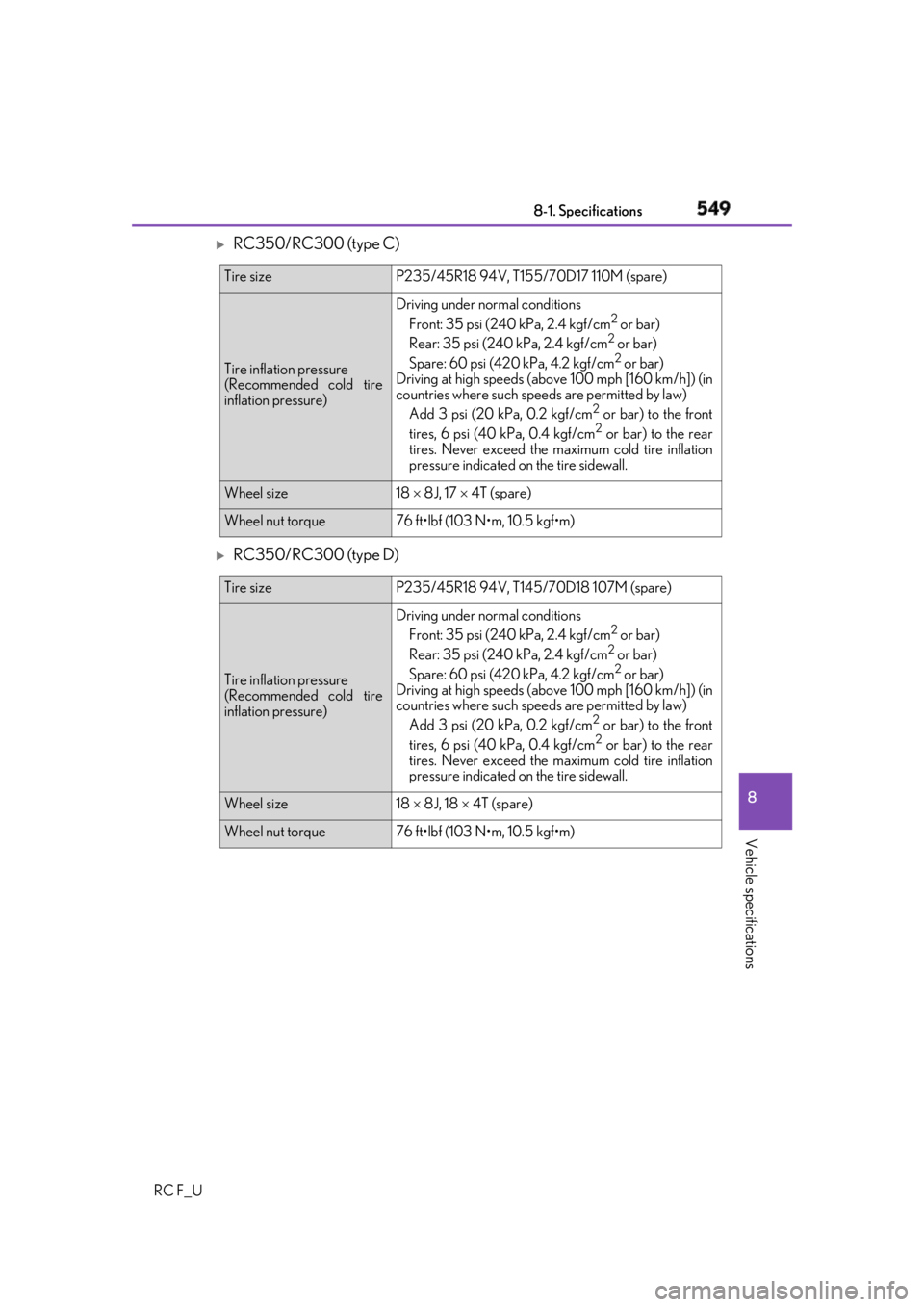
RC350/RC300 (type C)
RC350/RC300 (type D) Tire size P235/45R18 94V, T155/70D17 110M (spare)
Tire inflation pressure
(Recommended cold tire
inflation pressure) Driving under normal conditions
Front: 35 psi (240 kPa, 2.4 kgf/cm 2
or bar)
Rear: 35 psi (240 kPa, 2.4 kgf/cm 2
or bar)
Spare: 60 psi (420 kPa, 4.2 kgf/cm 2
or bar)
Driving at high speeds (above 100 mph [160 km/h]) (in
countries where such speeds are permitted by law)
Add 3 psi (20 kPa, 0.2 kgf/cm 2
or bar) to the front
tires, 6 psi (40 kPa, 0.4 kgf/cm 2
or bar) to the rear
tires. Never exceed the maximum cold tire inflation
pressure indicated on the tire sidewall.
Wheel size 18 8J, 17 4T (spare)
Wheel nut torque 76 ft •
lbf (103 N •
m, 10.5 kgf •
m)
Tire size P235/45R18 94V, T145/70D18 107M (spare)
Tire inflation pressure
(Recommended cold tire
inflation pressure) Driving under normal conditions
Front: 35 psi (240 kPa, 2.4 kgf/cm 2
or bar)
Rear: 35 psi (240 kPa, 2.4 kgf/cm 2
or bar)
Spare: 60 psi (420 kPa, 4.2 kgf/cm 2
or bar)
Driving at high speeds (above 100 mph [160 km/h]) (in
countries where such speeds are permitted by law)
Add 3 psi (20 kPa, 0.2 kgf/cm 2
or bar) to the front
tires, 6 psi (40 kPa, 0.4 kgf/cm 2
or bar) to the rear
tires. Never exceed the maximum cold tire inflation
pressure indicated on the tire sidewall.
Wheel size 18 8J, 18 4T (spare)
Wheel nut torque 76 ft •
lbf (103 N •
m, 10.5 kgf •
m)
Page 550 of 636
550 8-1. Specifications
RC F_U
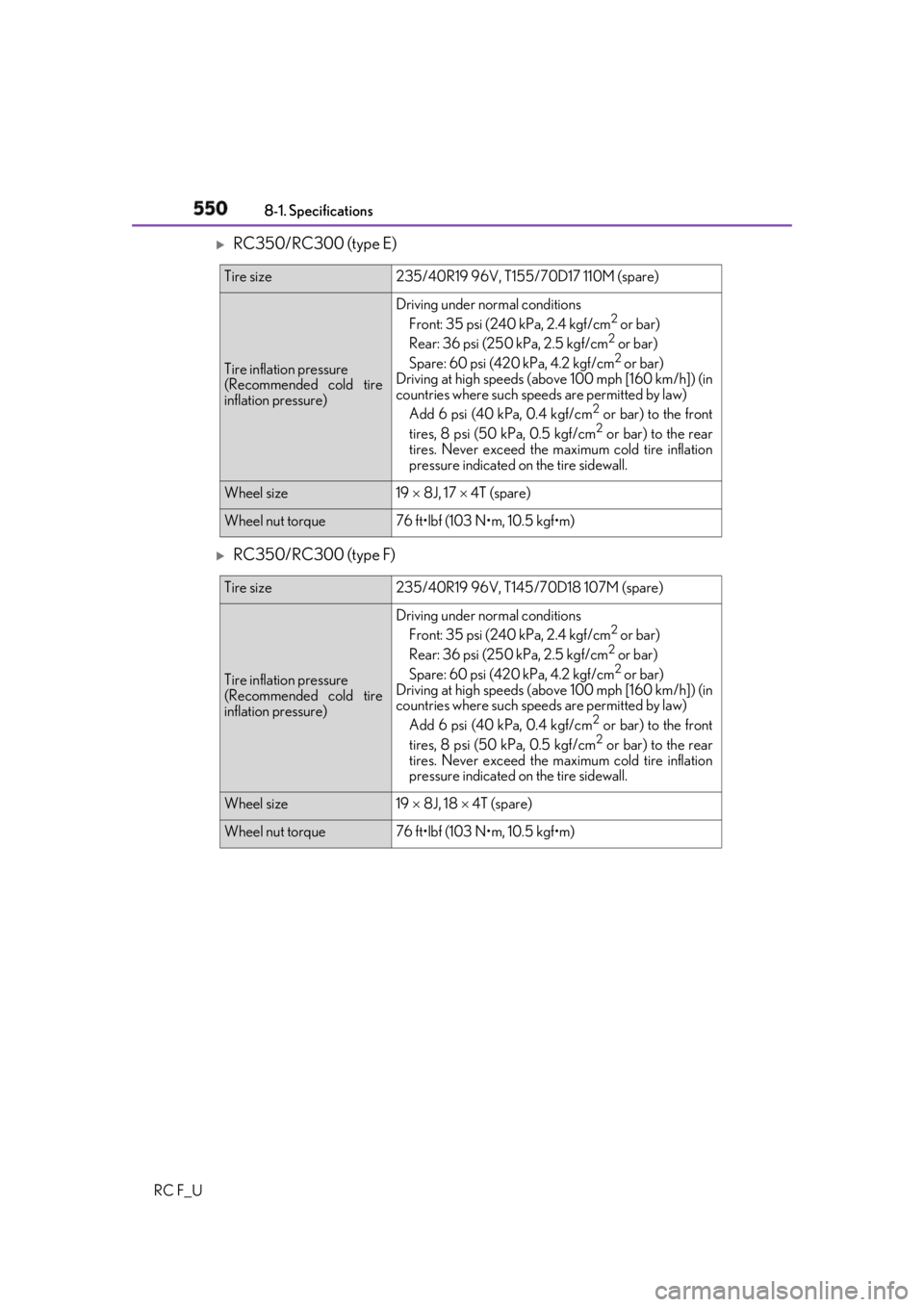
RC350/RC300 (type E)
RC350/RC300 (type F) Tire size 235/40R19 96V, T155/70D17 110M (spare)
Tire inflation pressure
(Recommended cold tire
inflation pressure) Driving under normal conditions
Front: 35 psi (240 kPa, 2.4 kgf/cm 2
or bar)
Rear: 36 psi (250 kPa, 2.5 kgf/cm 2
or bar)
Spare: 60 psi (420 kPa, 4.2 kgf/cm 2
or bar)
Driving at high speeds (above 100 mph [160 km/h]) (in
countries where such speeds are permitted by law)
Add 6 psi (40 kPa, 0.4 kgf/cm 2
or bar) to the front
tires, 8 psi (50 kPa, 0.5 kgf/cm 2
or bar) to the rear
tires. Never exceed the maximum cold tire inflation
pressure indicated on the tire sidewall.
Wheel size 19 8J, 17 4T (spare)
Wheel nut torque 76 ft •
lbf (103 N •
m, 10.5 kgf •
m)
Tire size 235/40R19 96V, T145/70D18 107M (spare)
Tire inflation pressure
(Recommended cold tire
inflation pressure) Driving under normal conditions
Front: 35 psi (240 kPa, 2.4 kgf/cm 2
or bar)
Rear: 36 psi (250 kPa, 2.5 kgf/cm 2
or bar)
Spare: 60 psi (420 kPa, 4.2 kgf/cm 2
or bar)
Driving at high speeds (above 100 mph [160 km/h]) (in
countries where such speeds are permitted by law)
Add 6 psi (40 kPa, 0.4 kgf/cm 2
or bar) to the front
tires, 8 psi (50 kPa, 0.5 kgf/cm 2
or bar) to the rear
tires. Never exceed the maximum cold tire inflation
pressure indicated on the tire sidewall.
Wheel size 19 8J, 18 4T (spare)
Wheel nut torque 76 ft •
lbf (103 N •
m, 10.5 kgf •
m)
Page 551 of 636
5518-1. Specifications
8
Vehicle specifications
RC F_U
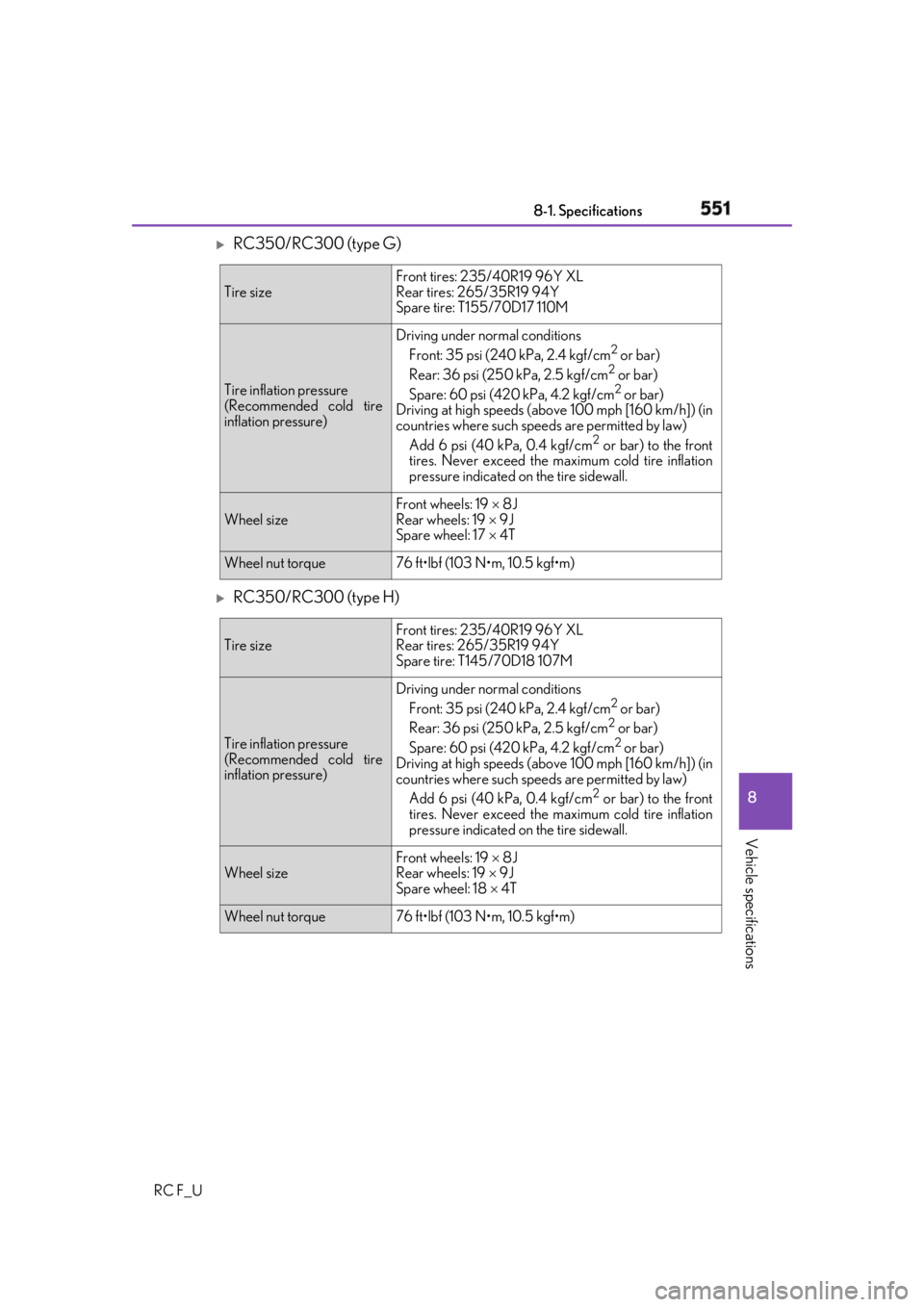
RC350/RC300 (type G)
RC350/RC300 (type H) Tire size Front tires: 235/40R19 96Y XL
Rear tires: 265/35R19 94Y
Spare tire: T155/70D17 110M
Tire inflation pressure
(Recommended cold tire
inflation pressure) Driving under normal conditions
Front: 35 psi (240 kPa, 2.4 kgf/cm 2
or bar)
Rear: 36 psi (250 kPa, 2.5 kgf/cm 2
or bar)
Spare: 60 psi (420 kPa, 4.2 kgf/cm 2
or bar)
Driving at high speeds (above 100 mph [160 km/h]) (in
countries where such speeds are permitted by law)
Add 6 psi (40 kPa, 0.4 kgf/cm 2
or bar) to the front
tires. Never exceed the maximum cold tire inflation
pressure indicated on the tire sidewall.
Wheel size Front wheels: 19 8J
Rear wheels: 19 9J
Spare wheel: 17 4T
Wheel nut torque 76 ft •
lbf (103 N •
m, 10.5 kgf •
m)
Tire size Front tires: 235/40R19 96Y XL
Rear tires: 265/35R19 94Y
Spare tire: T145/70D18 107M
Tire inflation pressure
(Recommended cold tire
inflation pressure) Driving under normal conditions
Front: 35 psi (240 kPa, 2.4 kgf/cm 2
or bar)
Rear: 36 psi (250 kPa, 2.5 kgf/cm 2
or bar)
Spare: 60 psi (420 kPa, 4.2 kgf/cm 2
or bar)
Driving at high speeds (above 100 mph [160 km/h]) (in
countries where such speeds are permitted by law)
Add 6 psi (40 kPa, 0.4 kgf/cm 2
or bar) to the front
tires. Never exceed the maximum cold tire inflation
pressure indicated on the tire sidewall.
Wheel size Front wheels: 19 8J
Rear wheels: 19 9J
Spare wheel: 18 4T
Wheel nut torque 76 ft •
lbf (103 N •
m, 10.5 kgf •
m)
Page 552 of 636
552 8-1. Specifications
RC F_U
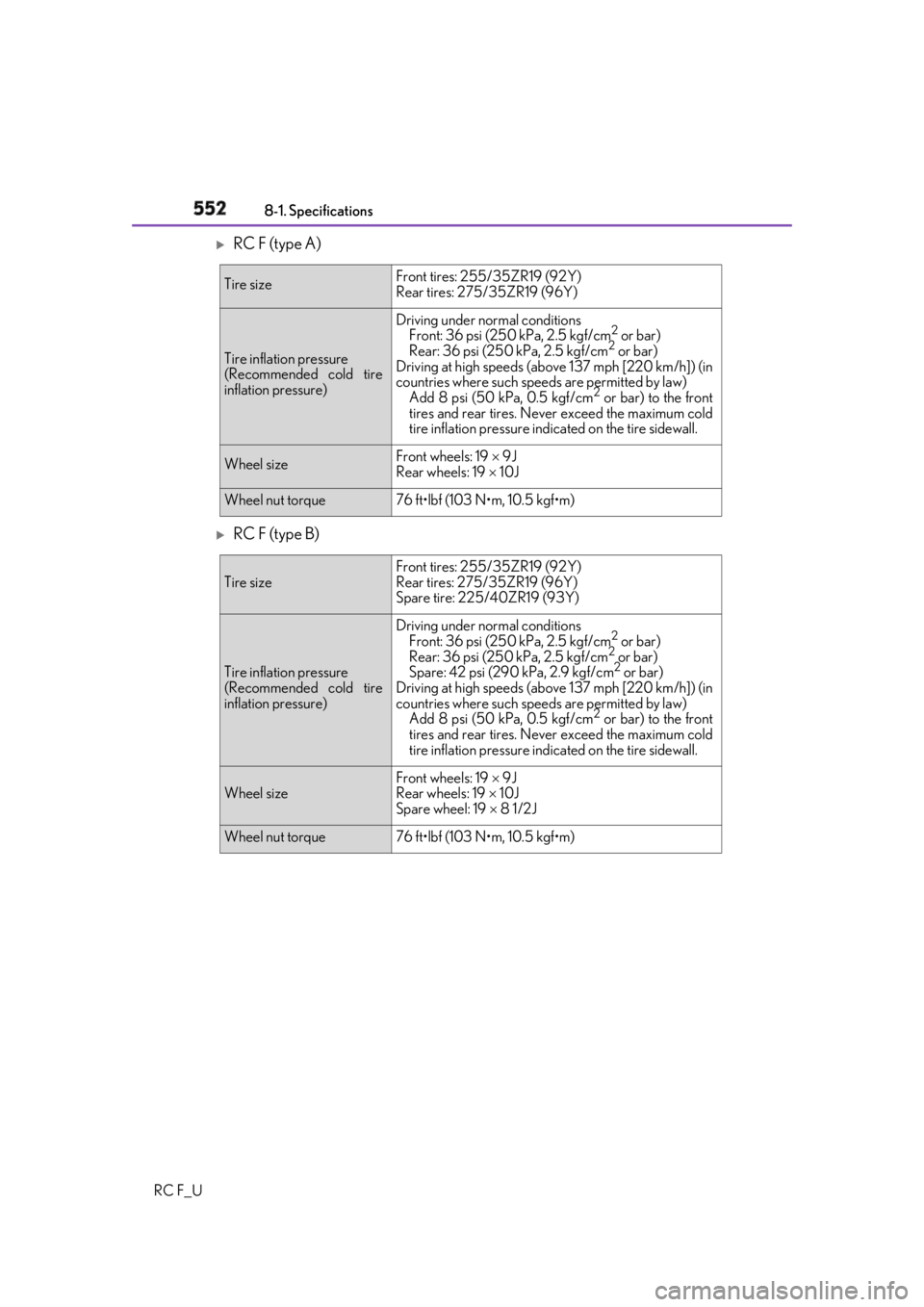
RC F (type A)
RC F (type B) Tire size Front tires: 255/35ZR19 (92Y)
Rear tires: 275/35ZR19 (96Y)
Tire inflation pressure
(Recommended cold tire
inflation pressure) Driving under normal conditions
Front: 36 psi (250 kPa, 2.5 kgf/cm 2
or bar)
Rear: 36 psi (250 kPa, 2.5 kgf/cm 2
or bar)
Driving at high speeds (above 137 mph [220 km/h]) (in
countries where such speeds are permitted by law)
Add 8 psi (50 kPa, 0.5 kgf/cm 2
or bar) to the front
tires and rear tires. Never exceed the maximum cold
tire inflation pressure indi cated on the tire sidewall.
Wheel size Front wheels: 19 9J
Rear wheels: 19 10J
Wheel nut torque 76 ft •
lbf (103 N •
m, 10.5 kgf •
m)
Tire size Front tires: 255/35ZR19 (92Y)
Rear tires: 275/35ZR19 (96Y)
Spare tire: 225/40ZR19 (93Y)
Tire inflation pressure
(Recommended cold tire
inflation pressure) Driving under normal conditions
Front: 36 psi (250 kPa, 2.5 kgf/cm 2
or bar)
Rear: 36 psi (250 kPa, 2.5 kgf/cm 2
or bar)
Spare: 42 psi (290 kPa, 2.9 kgf/cm 2
or bar)
Driving at high speeds (above 137 mph [220 km/h]) (in
countries where such speeds are permitted by law)
Add 8 psi (50 kPa, 0.5 kgf/cm 2
or bar) to the front
tires and rear tires. Never exceed the maximum cold
tire inflation pressure indi cated on the tire sidewall.
Wheel size Front wheels: 19 9J
Rear wheels: 19 10J
Spare wheel: 19 8 1/2J
Wheel nut torque 76 ft •
lbf (103 N •
m, 10.5 kgf •
m)
Page 558 of 636

558 8-1. Specifications
RC F_U Tire size ( P. 560)
DOT and Tire Identification Number (TIN) ( P. 559)
Location of trea dwear indicators ( P. 412)
Tire ply composition and materials Plies are layers of rubber-c oated parallel cords. Cords are the strands which form the
plies in a tire.
Radial tires or bias-ply tires A radial tire has “RADIAL” on the sidewall. A tire not marked “RADIAL” is a bias-ply
tire.
TUBELESS or TUBE TYPE A tubeless tire does not have a tube and air is directly put into the tire. A tube type tire
has a tube inside the tire and the tube maintains the air pressure.
Load limit at maximum cold tire inflation pressure ( P. 564)
Maximum cold tire inflation pressure ( P. 564)This means the pressure to which a tire may be inflated.
Uniform tire quality grading For details, see “Uniform Tire Quality Grading” that follows.
Summer tires or all season tires ( P. 416)An all season tire has “M+S” on the side wall. A tire not marked “M+S” is a summer
tire.
“TEMPORARY USE ONLY” A compact spare tire is identified by the phrase “TEMPORARY USE ONLY” molded
on its sidewall. This tire is design ed for temporary emergency use only.1
2
3
4
5
6
7
8
9
10
11
Page 562 of 636

562 8-1. Specifications
RC F_U This information has been prepared in acco rdance with regulations issued by the
National Highway Traffic Safety Administra tion of the U.S. Department of Trans-
portation.
It provides the purchasers and/or prospe ctive purchasers of Lexus vehicles with
information on uniform tire quality grading.Your Lexus dealer will help answer any ques tions you may have as you read this infor-
mation.■
DOT quality grades
All passenger vehicle tires must conform to Federal Safety Requirements in
addition to these grades. Quality grad es can be found where applicable on
the tire sidewall between tread shoulder and maximum section width. For example: Treadwear 200 Traction AA Temperature A■
Treadwear
The treadwear grade is a comparative rati ng based on the wear rate of the tire
when tested under controlled conditio ns on a specified government test
course. For example, a tire graded 150 would wear one and a half (1 - 1/2) times as well on
the government course as a tire graded 100.
The relative performance of tires depends upon the actua l conditions of their use.
Performance may differ significantly from the norm due to variations in driving
habits, service practices and difference s in road characteristics and climate.■
Traction AA, A, B, C
The traction grades, from highest to lo west, are AA, A, B and C, and they rep-
resent the tire’s ability to stop on wet pavement as measured under controlled
conditions on specified government test surfaces of asphalt and concrete. A tire marked C may have poor traction performance.
Warning: The traction grade assigned to this tire is based on braking (straight
ahead) traction tests and does not include cornering (turning) traction.Uniform Tire Quality Grading