brake light LEXUS RCF 2021 Owners Manual
[x] Cancel search | Manufacturer: LEXUS, Model Year: 2021, Model line: RCF, Model: LEXUS RCF 2021Pages: 408, PDF Size: 8.25 MB
Page 3 of 408

3TABLE OF CONTENTS
1
2
3
4
5
6
7
8
9
Automatic transmission..............132
Turn signal lever............................. 136
Parking brake ................................. 137
ASC (Active Sound Control) .. 137
4-3. Operating the lights and wipers Headlight switch ............................ 138
AHB (Automatic High Beam) ............................................................ 140
Windshield wipers and washer ............................................................ 143
4-4. Refueling Opening the fuel tank cap......... 150
4-5. Using the driving support systems Lexus Safety System + ................ 153
PCS (Pre-Collision System)..... 157
LDA (Lane Departure Alert with steering control) ......................... 164
Dynamic radar cruise control ... 171
BSM (Blind Spot Monitor) ........ 179
Intuitive parking assist ................. 187
Driving mode select switch....... 192
Launch control ............................... 194
Active rear wing ............................ 195
TVD (Torque Vect oring Differen-
tial) .................................................... 198
Driving assist systems .................. 199
4-6. Driving tips Winter driving tips ....................... 204
5-1. Remote Touch/Display Remote Touch ............................... 208
Center Display ............................... 2105-2. Using the air conditioning system
Automatic air conditioning system............................................................ 213
Heated steering wheel/seat heat- ers/seat ventilators..................... 221
5-3. Using the interior lights Interior lights list ............................ 223
5-4. Using the storage features List of storage features ............... 225
Trunk features ................................ 227
5-5. Using the other interior features Other interior features .............. 228
Garage door opener ................... 231
Compass ......................................... 236
6-1. Maintenance and care Cleaning and protecting the vehi-cle exterior................................... 240
Cleaning and protecting the vehi- cle interior .................................... 245
6-2. Matte paint care guide (if equipped)
Basic knowledge about matte clear coat ................................................. 248
Washing your vehicle ................ 252
Frequently Asked Questions .......................................................... 254
6-3. Maintenance Maintenance re quirements .....257
General maintenance................ 258
Emission inspection and mainte- nance (I/M) programs .............. 261
6-4. Do-
it-yourself maintenance
Do-it-yourself service precautions ........................................................... 262
5Interior features
6Maintenance and care
Page 15 of 408

15Pictorial index
Parking brake........................................................................................................... P.137
Applying/releasing ............................................................................................................P.137
Precautions for winter season .. ...................................................................................P.205
Warning buzzer/message............................................................................................. P.310
Headlight switch .....................................................................................................P.138
Turn signal lever ...................................................................................................... P.136
Headlights/parking lights/tail lights/license plate lig hts/daytime running lights
................................................................................................................................................... P.138
Windshield wiper and washer switch ................................................................ P.143
Usage.......................................................................................................................... ............ P.143
Adding washer fluid ......................................................................................................... P.2 72
Warning messages ........................................................................................................... P.31 0
Headlight cleaners
*1......................................................................................................... P.143
Emergency flasher switch ...................................................................................P.294
Trunk opener switch................................................................................................. P.96
Hood lock release lever ....................................................................................... P.264
Tilt and telescopic steering control switch
*1.................................................. P.108
Adjustment ..................................................................................................................... ...... P.108
Driving position memory
*1............................................................................................. P.105
Tilt and telescopic steeri ng lock release lever
*1........................................... P.108
Air conditioning system ........................................................................................P.213
Usage.......................................................................................................................... .............P.213
Rear window defogger..................................................................................................... P.217
Audio system
*2
Trunk opener main switch ..................................................................................... P.98
*1: If equipped
*2: Refer to “NAVIGATION AND MULTIMEDIA SYSTEM OWNER’S MANUAL”.
E
F
G
H
I
J
K
L
M
N
O
Page 62 of 408
622-1. Instrument cluster
2-1.Instrument cluster
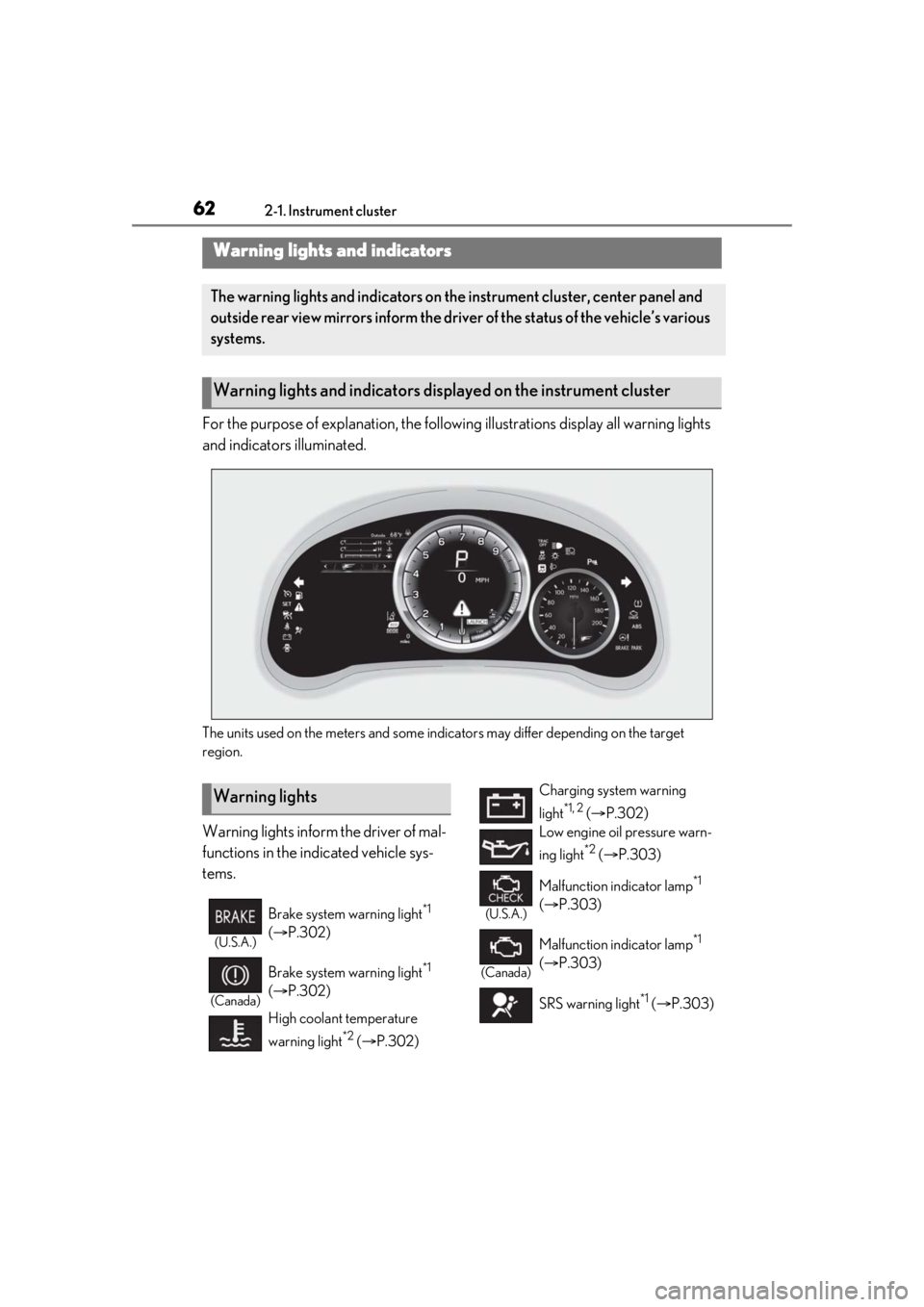
For the purpose of explanation, the following illustrations display all warning lights
and indicators illuminated.
The units used on the meters and some indicators may differ depending on the target
region.
Warning lights inform the driver of mal-
functions in the indicated vehicle sys-
tems.
Warning lights and indicators
The warning lights and indicators on th e instrument cluster, center panel and
outside rear view mirrors inform the driver of the status of the vehicle’s various
systems.
Warning lights and indicators displayed on the instrument cluster
Warning lights
(U.S.A.)
Brake system warning light*1
( P.302)
(Canada)
Brake system warning light*1
( P.302)
High coolant temperature
warning light
*2 ( P.302)
Charging syst em warning
light
*1, 2 ( P.302)
Low engine oil pressure warn-
ing light
*2 ( P.303)
(U.S.A.)
Malfunction indicator lamp*1
( P.303)
(Canada)
Malfunction indicator lamp*1
( P.303)
SRS warning light
*1 ( P.303)
Page 63 of 408
632-1. Instrument cluster
2
Vehicle status information and indicators
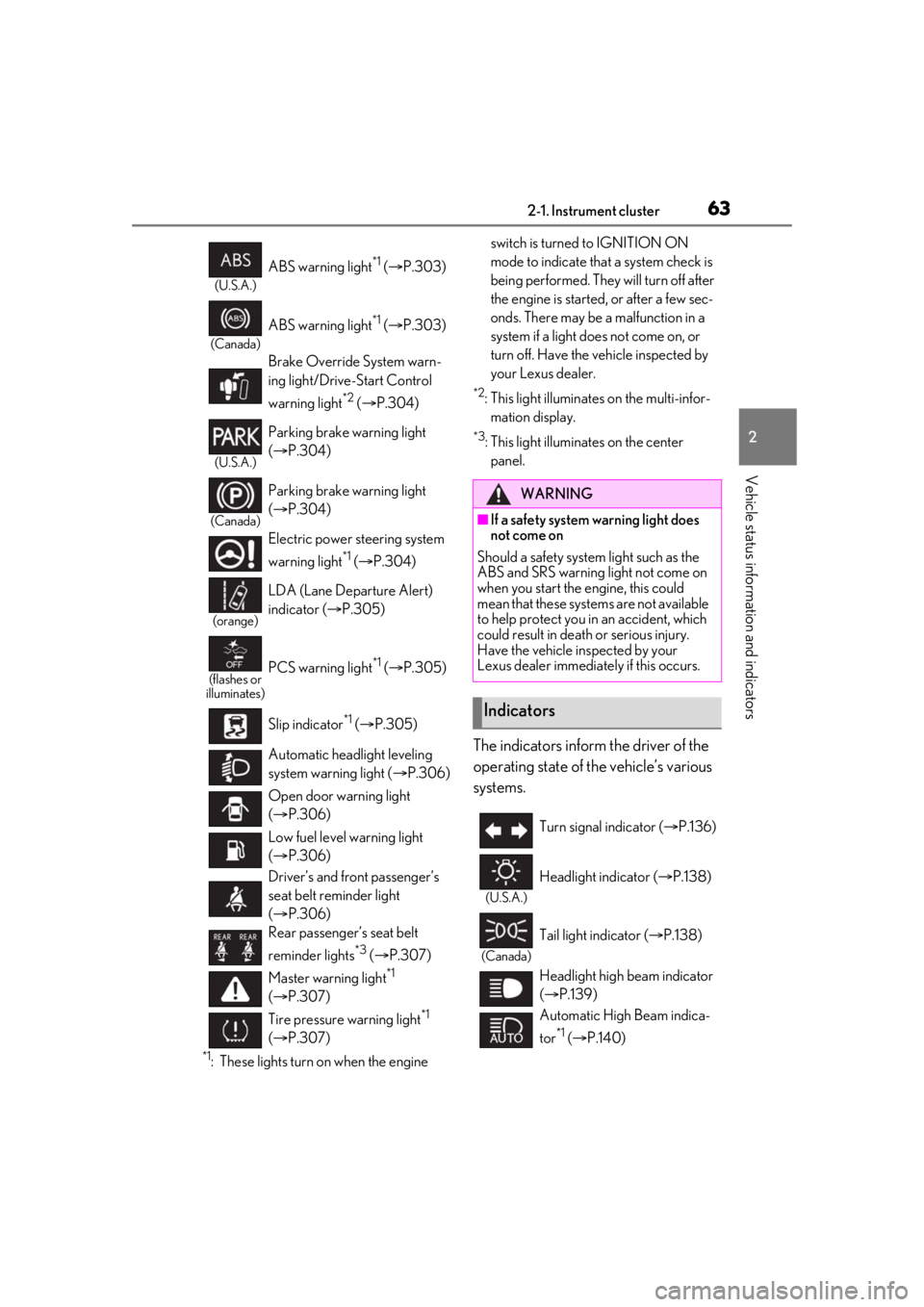
*1: These lights turn on when the engine switch is turned to IGNITION ON
mode to indicate that a system check is
being performed. They will turn off after
the engine is started, or after a few sec-
onds. There may be a malfunction in a
system if a light does not come on, or
turn off. Have the vehicle inspected by
your Lexus dealer.
*2: This light illuminates on the multi-infor-
mation display.
*3: This light illuminates on the center panel.
The indicators inform the driver of the
operating state of the vehicle’s various
systems.
(U.S.A.)
ABS warning light*1 ( P.303)
(Canada)
ABS warning light*1 ( P.303)
Brake Override System warn-
ing light/Drive-Start Control
warning light
*2 ( P.304)
(U.S.A.)
Parking brake warning light
( P.304)
(Canada)
Parking brake warning light
( P.304)
Electric power st eering system
warning light
*1 ( P.304)
(orange)
LDA (Lane Departure Alert)
indicator ( P.305)
(flashes or
illuminates)PCS warning light*1 ( P.305)
Slip indicator
*1 ( P.305)
Automatic headlight leveling
system warning light ( P.306)
Open door warning light
( P.306)
Low fuel level warning light
( P.306)
Driver’s and front passenger’s
seat belt reminder light
( P.306)
Rear passenger’s seat belt
reminder lights
*3 ( P.307)
Master warning light
*1
( P.307)
Tire pressure warning light
*1
( P.307)
WARNING
■If a safety system warning light does
not come on
Should a safety system light such as the
ABS and SRS warning light not come on
when you start the engine, this could
mean that these systems are not available
to help protect you in an accident, which
could result in death or serious injury.
Have the vehicle inspected by your
Lexus dealer immediately if this occurs.
Indicators
Turn signal indicator ( P.136)
(U.S.A.)
Headlight indicator ( P.138)
(Canada)
Tail light indicator ( P.138)
Headlight high beam indicator
( P.139)
Automatic High Beam indica-
tor
*1 ( P.140)
Page 117 of 408
117
4
4
Driving
Driving
.4-1. Before drivingDriving the vehicle ...................... 118
Cargo and luggage ................... 124
Vehicle load limits ...................... 126
Trailer towing ............................... 127
Dinghy towing ............................. 127
4-2. Driving procedures Engine (ignition) switch ........... 128
Automatic transmission........... 132
Turn signal lever.......................... 136
Parking brake .............................. 137
ASC (Active Sound Control) ......................................................... 137
4-3. Operating the lights and wipers Headlight switch ......................... 138
AHB (Automatic High Beam) ......................................................... 140
Windshield wipers and washer ......................................................... 143
4-4. Refueling Opening the fuel tank cap...... 150
4-5. Using the driving support sys- tems
Lexus Safety System + ............. 153
PCS (Pre-Collision System) ......................................................... 157
LDA (Lane Departure Alert with steering control) ...................... 164
Dynamic radar cruise control .......................................................... 171
BSM (Blind Spot Monitor) ..... 179Intuitive parking assist ..............
187
Driving mode select switch ... 192
Launch control ............................ 194
Active rear wing ......................... 195
TVD (Torque Vectoring Differen- tial)................................................. 198
Driving assist systems............... 199
4-6. Driving tips Winter driving tips .................... 204
Page 119 of 408
1194-1. Before driving
4
Driving
■Restraining sudden start (Drive-Start
Control)
●When the following unusual operation is
performed, the engine output may be
restrained.
• When the shift lever is shifted from R to D, D to R, N to R, P to D, or P to R (D
includes M) with the accelerator pedal
depressed, a warning message appears
on the multi-information display. If a
warning message is shown on the
multi-information disp lay, read the mes-
sage and follow the instruction.
• When the accelerator pedal is depressed
too much while the vehicle is in reverse.
●While Drive-Start Control is being acti-
vated, your vehicle may have trouble
escaping from the mud or fresh snow. In
such case, deactivate TRAC ( P.200)
to cancel Drive-Start Control so that the
vehicle may become able to escape from
the mud or fresh snow.
■Breaking in your new Lexus
To extend the life of the vehicle, observing
the following precautions is recommended:
●For the first 186 miles (300 km):
Avoid sudden stops.
●For the first 621 miles (1000 km):
• Do not drive at extremely high speeds.
• Avoid sudden acceleration.
• Do not drive continuously in low gears.
• Do not drive at a constant speed for
extended periods.
■Drum-in-disc type parking brake system
Your vehicle has a drum-in-disc type park-
ing brake system. This type of brake system
needs bedding-down of the brake shoes
periodically or whenev er the parking brake
shoes and/or drum are replaced. Have your
Lexus dealer perform the bedding down
operation.
■Operating your vehicle in a foreign
country
Comply with the relevant vehicle registra-
tion laws and confirm the availability of the
correct fuel. ( P.343)
■Brake pads and discs
The brake pads and discs are designed for use under high load conditions. Therefore,
brake noise may be generated depending
on the vehicle speed, braking force and
vehicle environment (temperature, humid-
ity, etc.).
WARNING
Observe the following precautions.
Failure to do so may result in death or
serious injury.
■When starting the vehicle
Always keep your foot on the brake
pedal while stopped with the engine run-
ning. This prevents the vehicle from
creeping.
■When driving the vehicle
●Do not drive if you are unfamiliar with
the location of the brake and accelera-
tor pedals to avoid depressing the
wrong pedal.
• Accidentally depressing the accelera- tor pedal instead of the brake pedal
will result in sudden acceleration that
may lead to an accident.
• When backing up, you may twist your body around, leading to a difficulty in
operating the pedals. Make sure to
operate the pedals properly.
• Make sure to keep a correct driving posture even when moving the vehicle
only slightly. This allows you to depress
the brake and accelerator pedals
properly.
• Depress the brake pedal using your right foot. Depressing the brake pedal
using your left foot may delay
response in an emer gency, resulting in
an accident.
●Do not drive the vehicle over or stop
the vehicle near flammable materials.
The exhaust system and exhaust gases
can be extremely hot. These hot parts
may cause a fire if there is any flamma-
ble material nearby.
Page 120 of 408
1204-1. Before driving
WARNING
●During normal driving, do not turn off
the engine. Turning the engine off
while driving will not cause loss of
steering or braking control, but the
power assist to these systems will be
lost. This will make it more difficult to
steer and brake, so you should pull
over and stop the vehicle as soon as it
is safe to do so.
However, in the event of an emer-
gency, such as if it becomes impossible
to stop the vehicle in the normal way:
P.294
●Use engine braking (downshift) to
maintain a safe speed when driving
down a steep hill.
Using the brakes continuously may
cause the brakes to overheat and lose
effectiveness. (
P.132)
●Do not adjust the positions of the
steering wheel, the seat, or the inside
or outside rear view mirrors while driv-
ing.
Doing so may result in a loss of vehicle
control.
●Always check that all passengers’
arms, heads or other parts of their
body are not outside the vehicle.
●Do not drive in excess of the speed
limit. Even if the legal speed limit per-
mits it, do not drive over 85 mph (140
km/h) unless your vehicle has
high-speed capability tires. Driving
over 85 mph (140 km/h) may result in
tire failure, loss of control and possible
injury. Be sure to consult a tire dealer
to determine whether the tires on your
vehicle are high-speed capability tires
or not before driving at such speeds.
■When driving on slippery road sur-
faces
●Sudden braking, acceleration and
steering may cause tire slippage and
reduce your ability to control the vehi-
cle.
●Sudden acceleration, engine braking
due to shifting, or changes in engine
speed could cause the vehicle to skid.
●After driving through a puddle, lightly
depress the brake pedal to make sure
that the brakes are functioning prop-
erly. Wet brake pads may prevent the
brakes from functioning properly. If the
brakes on only one side are wet and
not functioning properly, steering con-
trol may be affected.
■When shifting the shift lever
●Do not let the vehicle roll backward
while the shift lever is in a driving posi-
tion, or roll forward while the shift lever
is in R.
Doing so may cause the engine to stall
or lead to poor brake and steering
performance, resulting in an accident
or damage to the vehicle.
●Do not shift the shift lever to P while
the vehicle is moving.
Doing so can damage the transmission
and may result in a loss of vehicle con-
trol.
●Do not shift the shift lever to a driving
position while the vehicle is moving
backward.
Doing so can damage the transmission
and may result in a loss of vehicle con-
trol.
●Do not shift the shift lever to R while
the vehicle is moving forward.
Doing so can damage the transmission
and may result in a loss of vehicle con-
trol.
●Moving the shift lever to N while the
vehicle is moving will disengage the
engine from the transmission. Engine
braking is not available when N is
selected.
Page 121 of 408
1214-1. Before driving
4
Driving
WARNING
●Be careful not to shift the shift lever
with the accelerator pedal depressed.
Shifting the shift lever to a gear other
than P or N may lead to unexpected
rapid acceleration of the vehicle that
may cause an accident and result in
death or serious injury.
■If a brake pad wear warning message
is displayed
Have the brake pads visually checked
and replaced by your Lexus dealer as
soon as possible.
Rotor damage may result if the pads are
not replaced when needed.
Moderate levels of the brake pad and
disc wear allow enha nced braking power.
As a result, the discs may wear more
quickly than conventional brake discs.
Therefore, when replacing the brake
pads, Lexus recommends that you also
have the thickness of the discs measured.
It is dangerous to drive the vehicle when
the wear limits of the brake pads and/or
those of the brake discs are exceeded.
■When the vehicle is stopped
●Do not race the engine.
If the vehicle is in any gear other than P
or N, the vehicle may accelerate sud-
denly and unexpectedly, causing an
accident.
●In order to prevent accidents due to
the vehicle rolling away, always keep
depressing the brake pedal while the
engine is running, and apply the park-
ing brake as necessary.
●If the vehicle is stopped on an incline,
in order to prevent accidents caused
by the vehicle rolling forward or back-
ward, always depress the brake pedal
and securely apply the parking brake
as needed.
●Avoid revving or racing the engine.
Running the engine at high speed
while the vehicle is stopped may cause
the exhaust system to overheat, which
could result in a fire if combustible
material is nearby.
■When the vehicle is parked
●Do not leave glasses, cigarette lighters,
spray cans, or soft drink cans in the
vehicle when it is in the sun.
Doing so may result in the following:
• Gas may leak from a cigarette lighter or spray can, and may lead to a fire.
• The temperature inside the vehicle may cause the plastic lenses and plas-
tic material of glasses to deform or
crack.
• Soft drink cans may fracture, causing the contents to spray over the interior
of the vehicle, and may also cause a
short circuit in the vehicle’s electrical
components.
●Do not leave cigarette lighters in the
vehicle. If a cigare tte lighter is in a
place such as the glove box or on the
floor, it may be lit accidentally when
luggage is loaded or the seat is
adjusted, causing a fire.
●Do not attach adhesive discs to the
windshield or windows. Do not place
containers such as air fresheners on
the instrument panel or dashboard.
Adhesive discs or containers may act
as lenses, causing a fire in the vehicle.
●Do not leave a door or window open if
the curved glass is coated with a met-
allized film such as a silver-colored
one. Reflected sunlight may cause the
glass to act as a lens, causing a fire.
Page 129 of 408
1294-2. Driving procedures
4
Driving
firmly, the engine switch mode may not
change or the engine may not start.
●If attempting to restart the engine imme-
diately after turning the engine switch off,
the engine may not start in some cases.
After turning the engine switch off, please
wait a few seconds before restarting the
engine.
■Customization
If the smart access sy stem with push-button
start has been deactivated in a customized
setting, refer to P.332.
1 Stop the vehicle.
2 Set the parking brake ( P.137),
and shift the shift lever to P.
3 Press the engine switch.
4 Release the brake pedal and check
that the display on the meters is off.
■Automatic engine shut off feature
●The vehicle is equipped with a feature
that automatically shuts off the engine
when the shift lever is in P with the engine
running for an extended period.
●The engine will automatically shut off
after approximately 1 hour if it has been
left running while the shift lever is in P.
●The timer for the automatic engine shut
off feature will reset if the brake pedal is
depressed or if the shift lever is in a posi-
tion other than P.
●After the vehicle is parked, if the door is
locked with the door lock switch ( P.94)
from the inside or the mechanical key
( P.332) from the outside, the auto-
matic engine shut off feature will be dis-
abled. The timer for the automatic engine
shut off feature will be re-enabled if the
driver’s door is opened.
■Locking the door from outside with the
engine running
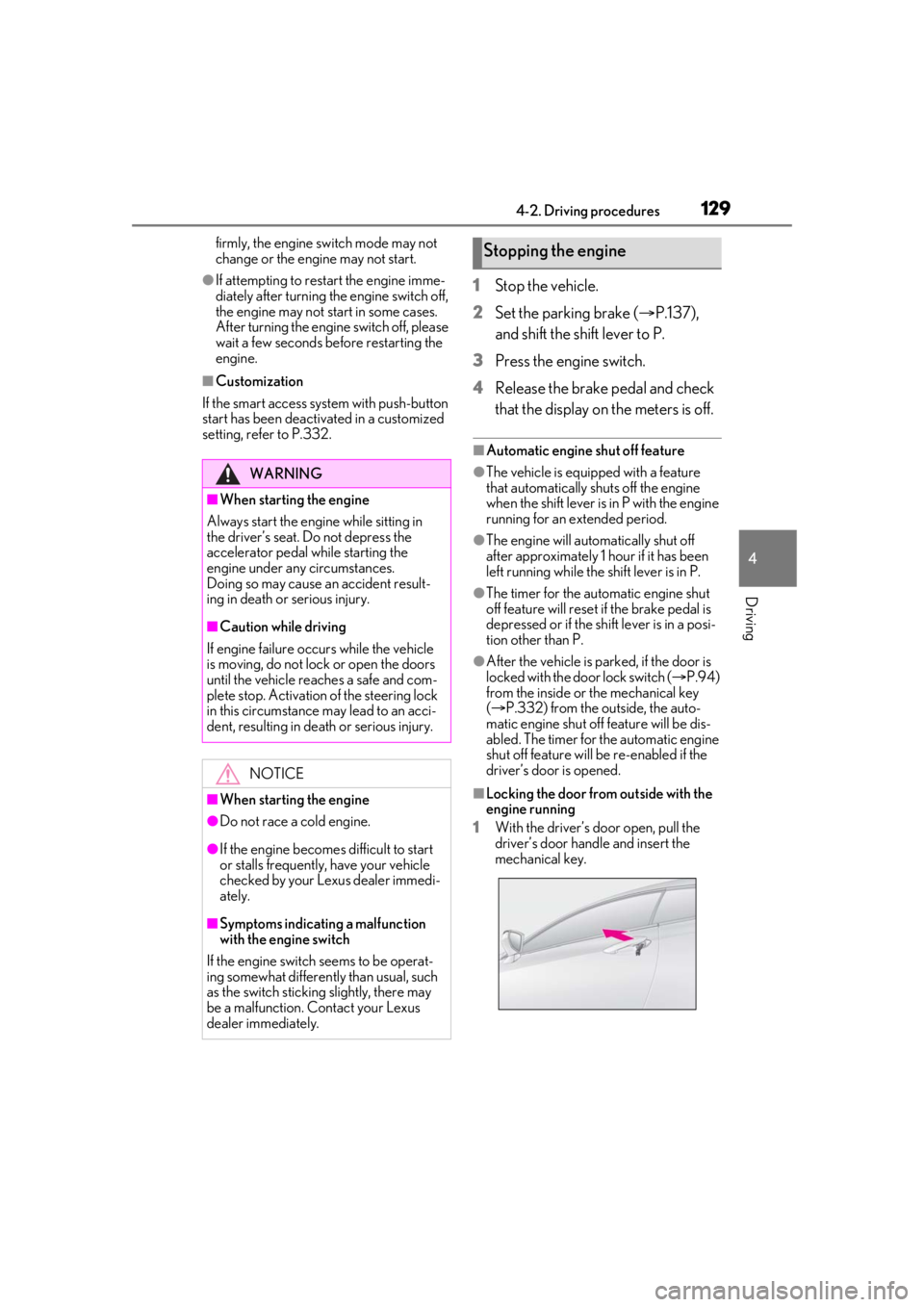
1 With the driver’s door open, pull the
driver’s door hand le and insert the
mechanical key.
WARNING
■When starting the engine
Always start the engine while sitting in
the driver’s seat. Do not depress the
accelerator pedal while starting the
engine under any circumstances.
Doing so may cause an accident result-
ing in death or serious injury.
■Caution while driving
If engine failure occurs while the vehicle
is moving, do not lock or open the doors
until the vehicle reaches a safe and com-
plete stop. Activation of the steering lock
in this circumstance may lead to an acci-
dent, resulting in death or serious injury.
NOTICE
■When starting the engine
●Do not race a cold engine.
●If the engine becomes difficult to start
or stalls frequently, have your vehicle
checked by your Lexus dealer immedi-
ately.
■Symptoms indicating a malfunction
with the engine switch
If the engine switch seems to be operat-
ing somewhat differently than usual, such
as the switch sticking slightly, there may
be a malfunction. Contact your Lexus
dealer immediately.
Stopping the engine
Page 130 of 408
1304-2. Driving procedures
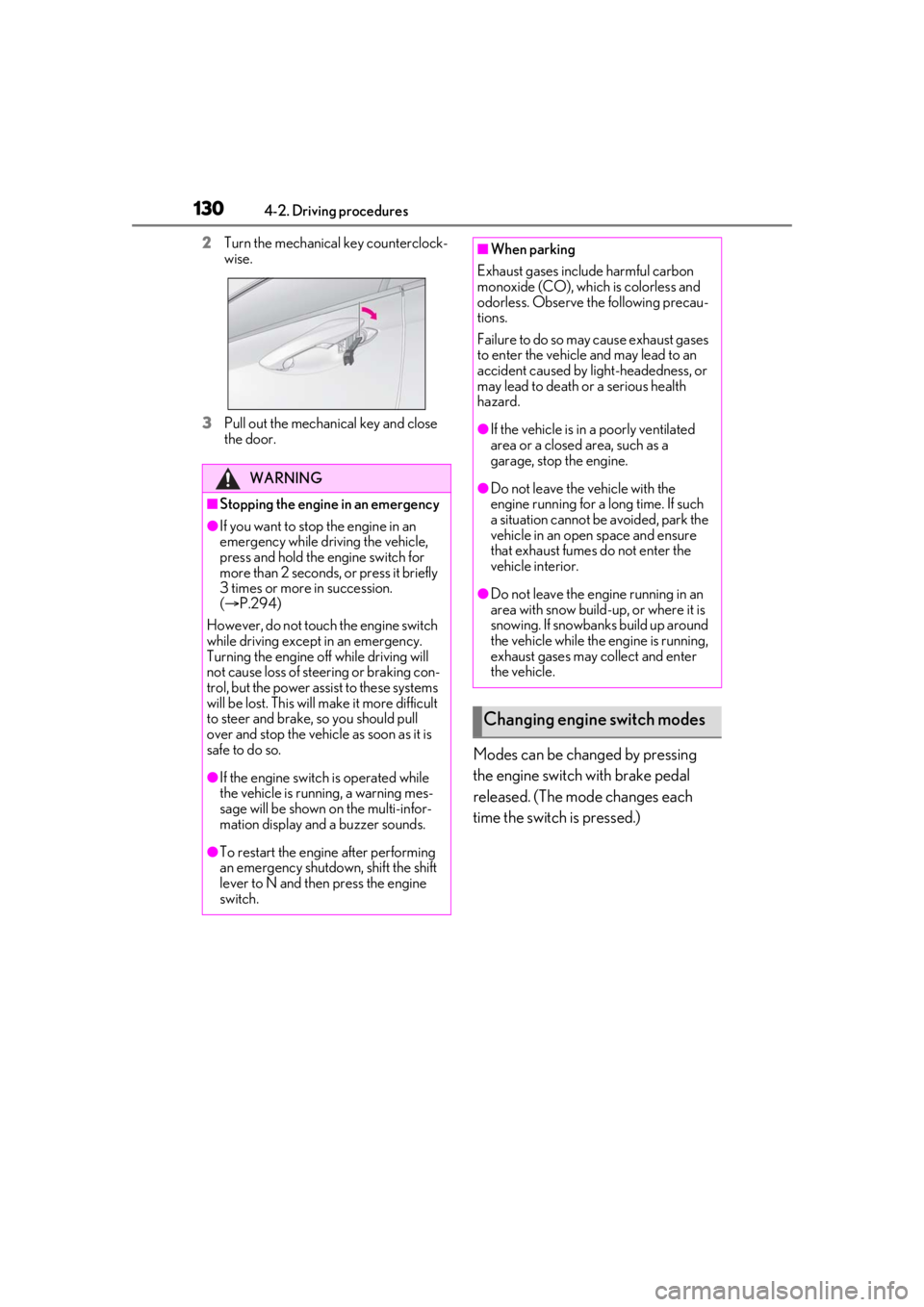
2Turn the mechanical key counterclock-
wise.
3 Pull out the mechanical key and close
the door.
Modes can be changed by pressing
the engine switch with brake pedal
released. (The mode changes each
time the switch is pressed.)
WARNING
■Stopping the engine in an emergency
●If you want to stop the engine in an
emergency while driving the vehicle,
press and hold the engine switch for
more than 2 seconds, or press it briefly
3 times or more in succession.
( P.294)
However, do not touch the engine switch
while driving except in an emergency.
Turning the engine of f while driving will
not cause loss of steering or braking con-
trol, but the power assist to these systems
will be lost. This will make it more difficult
to steer and brake, so you should pull
over and stop the vehicle as soon as it is
safe to do so.
●If the engine switch is operated while
the vehicle is running, a warning mes-
sage will be shown on the multi-infor-
mation display and a buzzer sounds.
●To restart the engine after performing
an emergency shutdown, shift the shift
lever to N and then press the engine
switch.
■When parking
Exhaust gases include harmful carbon
monoxide (CO), which is colorless and
odorless. Observe the following precau-
tions.
Failure to do so may cause exhaust gases
to enter the vehicle and may lead to an
accident caused by light-headedness, or
may lead to death or a serious health
hazard.
●If the vehicle is in a poorly ventilated
area or a closed area, such as a
garage, stop the engine.
●Do not leave the vehicle with the
engine running for a long time. If such
a situation cannot be avoided, park the
vehicle in an open space and ensure
that exhaust fumes do not enter the
vehicle interior.
●Do not leave the engine running in an
area with snow build-up, or where it is
snowing. If snowbanks build up around
the vehicle while the engine is running,
exhaust gases may collect and enter
the vehicle.
Changing engine switch modes